All Adults Here Summary, Characters and Themes
All Adults Here by Emma Straub is a warm, sharply observed family novel about aging, parenting, secrets, and the slow work of understanding one another. Set in the small town of Clapham, the story follows Astrid Strick, a widowed mother and grandmother whose life shifts after she witnesses a sudden death.
That shock pushes her to examine her past choices, her hidden relationship with Birdie, and the wounds she may have left in her children. Around her, three generations of the Strick family face love, shame, identity, betrayal, and repair. The novel is about adults still learning how to grow up.
Summary
Astrid Strick is sixty-eight, widowed, and living in the family house in Clapham, New York, when she witnesses the sudden death of Barbara Baker, a woman she has known for decades but never liked. Barbara is hit by a speeding school bus in the middle of town, and the shock of seeing death arrive so quickly unsettles Astrid.
She is not simply frightened by mortality; she is awakened by it. At the hair salon afterward, her longtime partner, Birdie, comforts her, and Astrid begins to feel that hiding important parts of herself has become unbearable.
Astrid has been in a secret romantic relationship with Birdie for years. Before Barbara’s death, she had accepted secrecy as a kind of convenience.
Afterward, she no longer wants to waste time. She decides that her adult children should know the truth.
This decision becomes part of a larger reckoning with motherhood, memory, and regret.
At the same time, Astrid’s thirteen-year-old granddaughter Cecelia is sent from New York City to live with her. Cecelia has been pulled out of school after a painful conflict involving her best friend, Katherine, and an older man who pretended to be younger.
Cecelia had told adults what was happening because she feared Katherine was in danger, but Katherine turned against her and accused her of betrayal. Cecelia arrives in Clapham feeling abandoned by her parents, Nicky and Juliette, who think the distance will protect her.
She is hurt that they did not keep her close when she needed them.
Nicky, Astrid’s youngest son, has his own troubled history. As a teenager, he left home and built an unusual adult life as a former actor and online crystal seller.
He loves Cecelia deeply, but her crisis exposes his fear that he has failed her. His memories return to a frightening moment from his own youth, when he was invited to a director’s apartment and realized too late that the situation was unsafe.
He had called Astrid for help, but she had not understood the danger. That old failure quietly shapes his panic about Cecelia.
Astrid’s daughter, Porter, runs a goat dairy farm and is pregnant by choice through a sperm donor. She has not yet told her family, partly because she wants to define motherhood on her own terms.
Porter wants to be warmer and more open than Astrid was. Yet she is also caught in old patterns.
She reconnects with Jeremy, her high school boyfriend, now a married veterinarian with children. Their affair resumes, and Porter convinces herself that what they have is love, even though Jeremy never truly promises to leave his wife.
Porter also reunites with Rachel, an old school friend who is pregnant and recently separated from her husband after his infidelity. Rachel’s pain makes Porter’s affair with Jeremy harder to defend.
When Rachel learns about Jeremy, she sees Porter as similar to the woman who damaged her own marriage. Their friendship fractures before Porter begins to recognize the selfishness and fantasy in her relationship with Jeremy.
Astrid’s oldest son, Elliot, runs a construction business and feels trapped by adulthood. He has a wife, Wendy, and twin sons who exhaust them both.
Elliot is under pressure from a business deal involving a building he bought in the center of town. A large salon chain wants to rent it, which would bring Elliot major financial success but could harm Birdie’s independent salon across the street.
Wendy, a lawyer, helps him with the contract but also sees the moral cost. Their marriage is strained by work, parenting, and Elliot’s resentment toward Astrid.
When Astrid finally tells her family about Birdie, reactions vary. Porter is happy for her.
Cecelia barely cares in the best possible way. Elliot, however, feels deceived and angry.
His anger is not only about Birdie. It is rooted in years of feeling judged by Astrid.
Astrid remembers an incident from Elliot’s adolescence, when Barbara Baker told her she had seen Elliot kissing a boy. Astrid responded with shame and told Elliot not to behave that way in public.
Now that Astrid is openly loving a woman, she feels the weight of her hypocrisy and worries about how deeply she may have hurt him.
Cecelia begins school in Clapham and becomes friends with Robin, who is still publicly known by her birth name and presenting as a boy. Robin is transgender and has only been able to live openly as herself at summer camp, where she was accepted.
In Clapham, she is not yet ready to tell everyone. Cecelia slowly earns Robin’s trust, and Robin tells her the truth about her identity.
Cecelia promises to protect the secret until Robin is ready.
At school, Cecelia faces bullying from Sidney, a popular girl who calls her names and spreads rumors about why she left New York. When Sidney threatens to expose Robin’s identity, Cecelia punches her.
The incident brings adults into the situation and creates unexpected connections: Sidney is Jeremy’s daughter, and Rachel, Cecelia’s teacher, is Porter’s friend. Cecelia’s punishment is to help at Birdie’s salon, where she and Robin find safety, humor, and friendship.
The town prepares for the Harvest Parade, and the students help build a float. Cecelia encourages Robin to take part as herself.
On the day of the parade, Robin wears a dress and rides proudly on the float. Instead of the rejection Cecelia fears, Robin is celebrated by her classmates, and her parents cheer for her.
It becomes one of the novel’s clearest moments of public courage and acceptance.
The parade also brings several family conflicts into the open. Porter sees Jeremy’s wife, Kristen, who is visibly pregnant.
Kristen makes it clear that Jeremy was never going to choose Porter. Porter is humiliated and heartbroken, but Astrid finds her and comforts her with unusual tenderness.
This moment gives Porter something she has long wanted from her mother: direct affection and reassurance.
Elliot, meanwhile, confronts his own anger. He first believes he is upset about Astrid’s reaction to the kiss when he was young, but he later admits the deeper wound came from overhearing Astrid say he would not make a good lawyer.
That comment stayed with him for years. Astrid apologizes and tells him she and his father were proud of him.
Their conversation does not erase the past, but it opens a path toward repair.
Nicky and Juliette also return to Clapham for Cecelia. Cecelia overhears them expressing regret and anger over what happened to her in New York, and she finally feels wanted again.
Her parents’ return helps her understand that being sent away was not a rejection, even if it felt like one.
Near the end, the story briefly turns to Barbara Baker before her death. Barbara had lived in an unhappy marriage, had never had the children she once wanted, and had recently left her husband in search of a freer life.
Her death is tragic partly because she had just begun to choose herself. For Astrid, Barbara becomes a reminder that waiting too long can be its own danger.
In the months after the parade, life moves forward. Porter gives birth to a daughter, Eleanor Hope, called Hopie, and finds support from her siblings.
Astrid and Birdie plan their honeymoon on an Alaskan cruise after Astrid asks Birdie to marry her. Astrid, who once kept distance from her children and guarded her feelings, now calls them often and tries to live with more openness.
All Adults Here ends with the Stricks not fixed, but closer: still flawed, still learning, and more willing to tell the truth.
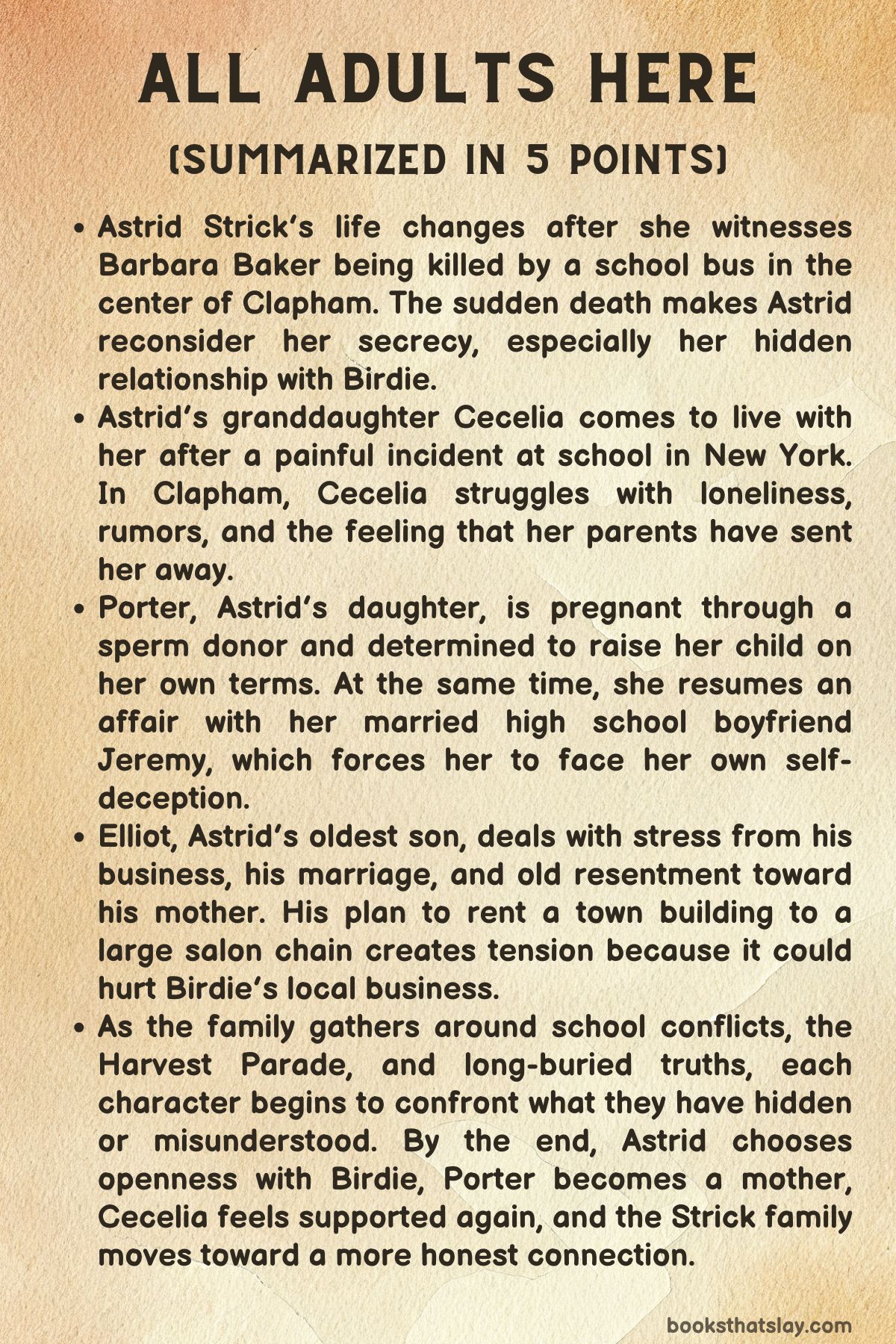
Characters
Astrid Strick
Astrid Strick is the emotional center of All Adults Here, a woman in late middle age who is forced to confront both death and the unfinished business of her own life. At sixty-eight, she has already lived through marriage, widowhood, motherhood, and the long habits of small-town life, but Barbara Baker’s sudden death makes her aware that she has not been as honest or present as she wants to be.
Astrid’s relationship with Birdie reveals her desire for love, companionship, and freedom, but it also exposes how much of herself she has hidden from her family. Her decision to tell her children about Birdie is not simply a romantic announcement; it is an act of self-correction.
She wants to stop living as if secrecy is harmless.
Astrid is also a mother looking back at her failures. She loves her children, but her love has often been filtered through restraint, judgment, or emotional distance.
Her memory of how she reacted when Elliot was seen kissing a boy becomes one of her deepest regrets. She recognizes that even small moments of shame can leave lasting marks on children.
Her difficulty with affection, especially toward Porter, shows how limited she has been in expressing care. Yet Astrid is not presented as cruel.
She is flawed, self-protective, and shaped by her generation’s ideas about respectability, but she is also capable of growth. By the end, she becomes more openly loving, more willing to apologize, and more aware that adulthood does not mean having everything figured out.
Cecelia Strick
Cecelia is thirteen, but her experiences force her into adult moral territory before she is ready. Sent to live with Astrid after a painful school incident in New York, she arrives in Clapham feeling rejected by her parents and betrayed by her former best friend.
Her situation is complicated because she did the right thing for the right reason, yet she was punished socially for it. By telling adults about Katherine’s relationship with an older man, Cecelia tried to protect someone she loved, but the aftermath taught her that truth can carry a heavy cost.
In Clapham, Cecelia begins to rebuild herself. She is sensitive, observant, and socially aware, able to recognize group behavior and power dynamics among other students.
Her friendship with Robin becomes one of the most important relationships in the story because it gives Cecelia a chance to use her courage more directly. When Robin trusts her with the truth about her identity, Cecelia understands the seriousness of that trust.
Her decision to defend Robin, even violently, shows both her loyalty and her still-developing judgment. Cecelia’s growth lies in learning that avoiding conflict does not always keep people safe.
She begins the story wounded by rejection, but she gradually becomes someone who can protect others, accept support, and believe that her parents still love her.
Porter Strick
Porter is Astrid’s daughter, independent and practical on the surface, but emotionally hungry beneath that independence. Her goat dairy farm reflects her desire to build a life through effort, control, and self-sufficiency.
Choosing to become a single mother through a sperm donor is an extension of that same belief: Porter wants to rely on herself rather than wait for a partner to give her the life she wants. She also wants to be a different kind of mother from Astrid, someone warmer, more physically affectionate, and more emotionally available.
Yet Porter’s confidence is weakened by her affair with Jeremy. Her relationship with him reveals a part of her still attached to old longing, old validation, and the fantasy of being chosen.
Even while she prepares for motherhood on her own terms, she becomes involved with a married man who cannot give her honesty or commitment. This contradiction makes Porter one of the more complex characters in All Adults Here.
She is strong but not always wise, self-reliant but still vulnerable to emotional dependence. Her pregnancy makes her more open to support, especially from Rachel, Astrid, and her brothers.
By ending things with Jeremy and accepting help, Porter moves toward a healthier version of independence: not isolation, but self-respect supported by real connection.
Elliot Strick
Elliot is Astrid’s oldest son, a man burdened by resentment, responsibility, and the pressure to prove himself. He owns a construction business and has a family, but he does not seem fully at peace with either his work or his home life.
His marriage to Wendy is strained by exhaustion, parenting, and his sense that everyone expects something from him. The business deal involving the town building gives him a chance at financial success, yet it also forces him to consider whether profit is worth damaging the character of Clapham and hurting Birdie’s salon.
Much of Elliot’s anger toward Astrid comes from old wounds he has never fully named. At first, he reacts badly to learning about Birdie because he feels deceived.
Later, it becomes clear that his resentment also comes from feeling underestimated. Hearing Astrid say that he would not make a good lawyer shaped his sense of failure and pushed him into a defensive adulthood.
Elliot wants approval, but he often expresses that need through irritation and distance. His conversations with Astrid near the end allow him to finally admit what hurt him.
He is not magically transformed, but he becomes more honest about his pain. Elliot’s character shows how adult children can carry childhood remarks for decades, even when parents barely remember saying them.
Nicky Strick
Nicky, Astrid’s youngest son and Cecelia’s father, is gentle, unconventional, and deeply affected by his own past. He has lived a less traditional life than his siblings, moving from teenage acting to selling crystals online, and he often seems detached from ordinary expectations of adulthood.
Yet his love for Cecelia is sincere and intense. Her absence from his New York apartment leaves him unmoored, and he begins to question who he is when he is not actively parenting her.
Nicky’s memories reveal that his fear for Cecelia is rooted in his own experience of danger as a young person. When he once found himself in a frightening situation with a director, Astrid failed to understand what he needed from her.
This memory helps explain why Cecelia’s situation shakes him so deeply. He knows how easily young people can be placed in unsafe circumstances and how badly adults can fail them.
Sending Cecelia to Astrid may seem like rejection to her, but for Nicky it is an attempt to protect her when he feels powerless. Nicky’s character is defined by tenderness, avoidance, and belated understanding.
He wants to be a peaceful person, but he must learn that peace cannot come from looking away from harm.
Birdie
Birdie is Astrid’s partner and the owner of a local hair salon, and she represents warmth, steadiness, and chosen intimacy. Unlike Astrid, Birdie seems more comfortable with openness, though she respects Astrid’s pace in revealing their relationship.
Her salon functions as a safe, practical, welcoming space where people can be cared for without ceremony. For Cecelia and Robin, helping at the salon becomes a form of gentle discipline, but also a way to enter a community where they feel useful and accepted.
Birdie is not simply a romantic figure in Astrid’s life. She also offers clear judgment.
When Elliot worries about the Beauty Bar deal, Birdie surprises him by telling him not to base his choices entirely on fear of what others think. This advice shows her maturity.
Even though the deal could harm her own business, she does not reduce the issue to personal grievance. Birdie’s love for Astrid is grounded in patience, but she is not passive.
She has her own dignity, work, and opinions. Her presence helps Astrid become braver, and by the end, she stands as a symbol of the life Astrid is finally ready to claim in public.
Wendy
Wendy, Elliot’s wife, is one of the clearest portraits of exhausted competence in the story. She is a lawyer, a mother of twins, and a woman who has adapted to life in Clapham largely because Elliot’s family and history are there.
Yet she often feels like an outsider in a town that belongs more naturally to her husband. Her frustration comes from the unequal division of emotional and domestic labor in her marriage.
She handles much of the parenting, absorbs stress, and still finds the clarity to look at Elliot’s business choices with professional intelligence.
Wendy’s character is important because she sees things Elliot refuses to see. She understands that the Beauty Bar deal is not just a contract; it has consequences for Birdie, Astrid, and the town’s identity.
At the same time, she is not naïve about money or business. Her legal help shows that she wants Elliot to succeed, but not blindly.
Wendy asking Porter to be guardian of the twins also reveals her quiet trust in the Strick family, despite its flaws. She is practical, tired, loving, and underappreciated.
Through Wendy, the novel shows how adult life can make capable people feel invisible when their labor is treated as automatic.
Robin
Robin is one of the most tenderly developed younger characters. Publicly known by her birth name for much of the story, she is a transgender girl who has experienced the freedom of being herself at summer camp but does not yet feel safe doing so in Clapham.
Her sadness after camp comes from having to leave behind a place where she was recognized and accepted. At home and school, she must manage the painful difference between who she is privately and how others see her.
Robin’s friendship with Cecelia is built on trust. She does not reveal her identity casually; she does so because Cecelia has shown kindness, curiosity, and respect.
Robin’s careful explanation of when she is Robin and when she must still present differently shows the emotional labor required of a child managing other people’s reactions. Her public appearance at the Harvest Parade in a dress is a major act of courage.
The acceptance she receives from classmates and her parents does not erase the risks she faces, but it gives her a moment of joy and recognition. Robin’s character highlights the importance of safe spaces, chosen friends, and adults who allow children to become themselves without shame.
Rachel
Rachel is Porter’s old friend and Cecelia’s teacher, and she enters the story at a vulnerable point in her life. Pregnant and recently separated from her husband after discovering his infidelity, Rachel is wounded, lonely, and unsure what kind of future she wants.
Her reunion with Porter offers the possibility of renewed friendship, especially because both women are pregnant and facing motherhood under emotionally complicated circumstances.
Rachel’s response to Porter’s affair with Jeremy is sharp because it comes from personal pain. She sees Porter not as an abstract friend making a mistake, but as someone participating in the same kind of betrayal that hurt her.
This conflict gives Rachel moral force in the story. She is not perfect, and she is still considering whether to reconcile with her own husband, but she understands the damage caused by secrecy and selfish desire.
As a teacher, Rachel also provides calm adult support for Cecelia after the fight at school. Her character connects the adult and adolescent storylines, showing how personal hurt can coexist with professional care and emotional generosity.
Jeremy Fogelman
Jeremy is Porter’s former boyfriend and current lover, a man who thrives on emotional ambiguity. As a veterinarian, husband, and father, he appears settled, but his affair with Porter reveals his willingness to take comfort and excitement without making real choices.
He tells Porter enough to keep her attached, including that he loves her and is unhappy in his marriage, but he avoids committing to any meaningful change. His words allow Porter to imagine a future while his actions keep him safely inside his existing life.
Jeremy’s character is not defined by dramatic villainy but by weakness and selfishness. He wants to be desired by Porter without facing the consequences of choosing her.
The revelation that his wife is pregnant makes his behavior even more damaging, because it shows how much he has hidden and how little control Porter has over the truth of the situation. His connection to Sidney also complicates the younger characters’ conflict, linking adult betrayal with adolescent cruelty.
Jeremy represents a kind of immaturity that can survive well into adulthood: the desire to be loved without being accountable.
Barbara Baker
Barbara Baker dies early, but her presence remains powerful throughout the story. To Astrid, Barbara first represents judgment, gossip, and old shame.
The memory of Barbara reporting Elliot’s kiss becomes tied to Astrid’s regret and fear. Barbara’s death forces Astrid to revisit that moment and recognize how much her own response, not Barbara’s call alone, harmed her son.
In that sense, Barbara becomes a mirror for Astrid’s conscience.
Later, Barbara becomes more than the unpleasant acquaintance Astrid remembered. The glimpse into her life shows a woman trapped in a marriage that did not satisfy her and grieving the life she never had, including children.
Her decision to leave her husband shortly before her death changes the meaning of her character. She was not only a source of discomfort in Astrid’s life; she was also a woman trying, late in life, to claim freedom.
Her sudden death gives the novel one of its central warnings: self-honesty postponed for too long may never have enough time. Barbara’s life and death push Astrid toward action.
Sidney Fogelman
Sidney is a popular girl at Cecelia’s new school and functions as a source of social threat. She understands the power of ridicule and uses it quickly, calling Cecelia names and spreading rumors that isolate her.
Sidney’s cruelty is recognizable because it is casual, performative, and designed to strengthen her own position in the group. She does not need to understand Cecelia to hurt her; she only needs an audience.
Her threat to expose Robin’s identity shows the danger of adolescent social power when it is used without empathy. Sidney is also Jeremy’s daughter, which connects her behavior to a family system marked by secrecy and dishonesty.
However, Sidney is still a child, not a fully formed antagonist. Her role is to show how quickly private pain can become public danger in school environments.
She brings Cecelia’s protective instincts to the surface and helps push Robin’s storyline toward its public turning point.
Juliette
Juliette, Cecelia’s mother and Nicky’s wife, is less central than Astrid or Porter, but she plays an important role in Cecelia’s emotional world. As a dancer and city parent, she belongs to the life Cecelia is forced to leave behind.
Her decision, along with Nicky’s, to send Cecelia to Clapham hurts Cecelia deeply, even though it is meant as protection. Juliette represents the painful limits of parental decision-making: parents can act out of love and still make a child feel abandoned.
When Juliette returns with Nicky, her presence helps restore Cecelia’s sense of being wanted. The reunion matters because Cecelia needs not only safety but reassurance.
Juliette’s love is not questioned, but the story shows that love must be made visible, especially to a child in crisis. Through Juliette, the novel suggests that even caring parents can misjudge what support should look like.
Kristen
Kristen, Jeremy’s wife, appears most forcefully near the end, but her role changes the reader’s understanding of Porter’s affair. Until Kristen is seen clearly, she exists mostly as an obstacle in Porter’s fantasy.
Porter imagines Jeremy’s marriage as emotionally empty and assumes that his connection to her is deeper and more authentic. Kristen’s pregnancy disrupts that fantasy.
She is not an absent or irrelevant wife; she is a real person with her own place in Jeremy’s life.
Her confrontation with Porter is cutting because it exposes Porter’s self-deception. Kristen understands more than Porter thought she did, and her words make clear that Jeremy was never truly available.
Kristen’s character gives moral weight to the affair by reminding the reader that betrayal harms people outside the romantic pair. She also forces Porter to face the difference between being desired and being chosen.
Bob Baker
Bob Baker, Barbara’s husband, is left behind after Barbara’s death, but the story complicates the idea of him as a grieving widower. Barbara had already left him before she died, and Bob’s loneliness is therefore not new.
His life with cats, photographs, and the remains of marriage suggests habit more than deep companionship. He is a man who had grown used to emotional absence even before actual loss arrived.
Bob matters because he helps reveal Barbara’s hidden dissatisfaction. Astrid’s visit to him makes her uncomfortable, partly because his situation exposes the strangeness of marriage from the outside: two people can spend years together and still remain unknown to each other.
Bob is not presented as monstrous, but his marriage to Barbara appears stagnant and insufficient. Through him, the story reflects on the quiet sadness of relationships that continue because no one has yet left.
Aidan and Zachary
Aidan and Zachary, Elliot and Wendy’s twins, represent the chaos and pressure of young family life. They are not deeply developed as individual characters, but their presence shapes the adults around them.
Their behavior exhausts Wendy and frustrates Elliot, exposing the unequal strain in the household. For Elliot, the twins become part of his feeling that adulthood has trapped him.
For Wendy, they are beloved but demanding children whose needs never pause.
Their scenes with Cecelia also show her ability to handle responsibility. When Zachary is injured, Cecelia responds with practical care, even while still being a child herself.
The twins therefore serve two purposes: they reveal the strain in Elliot and Wendy’s marriage, and they give Cecelia a chance to show maturity in a domestic setting. They are reminders that family life is often built from small emergencies, messes, and acts of care that rarely look heroic but matter deeply.
Themes
Parenting, Regret, and the Long Memory of Children
Parenthood in All Adults Here is shown as a role filled with love, mistakes, blind spots, and delayed consequences. Astrid loves her children, but she often failed to give them the emotional responses they needed at the right time.
Her reaction to Elliot’s kiss and her inability to help Nicky when he was unsafe in New York both reveal how parents can mishandle moments they do not fully understand. These failures do not come from lack of love; they come from fear, discomfort, social conditioning, and emotional limitation.
The novel is especially interested in how children remember what parents forget. A passing comment, a poor reaction, or a moment of silence can become part of a child’s identity for decades.
Elliot carries Astrid’s judgment about his career, while Nicky carries the memory of being left emotionally alone. Cecelia’s story adds another layer, showing how even protective parents can make a child feel rejected.
The novel does not suggest that perfect parenting is possible. Instead, it argues for accountability, apology, and repair.
Astrid’s growth comes from accepting that good intentions do not erase harm. Her later openness with her children shows that parenthood continues long after children become adults.
Truth, Secrecy, and the Cost of Silence
The characters are repeatedly shaped by what they say, what they hide, and what they are afraid others will know. Astrid hides her relationship with Birdie, Robin hides her gender identity in public, Porter hides her affair with Jeremy, and Cecelia is punished for telling the truth about Katherine’s dangerous relationship.
These secrets are not all morally equal. Robin’s privacy protects her safety, while Porter’s secrecy protects a selfish relationship.
Astrid’s secrecy begins as caution but becomes a barrier between herself and her children. Cecelia’s truth-telling, by contrast, costs her friendship and social standing, yet it is rooted in care.
The novel treats truth as necessary but not simple. Telling the truth can free people, but it can also expose them to judgment, anger, or pain.
Barbara Baker is remembered by Astrid as someone who told the truth, though not always kindly. After Barbara’s death, Astrid begins to understand that honesty without compassion can wound, but silence can also do damage.
The movement of the story is toward more truthful living: Astrid comes out to her family, Robin appears publicly as herself, Porter ends her affair, and Elliot finally names the real source of his hurt.
Identity, Acceptance, and Becoming Visible
Several characters struggle with the gap between who they are privately and who they allow others to see. Astrid’s late-life relationship with Birdie shows that identity does not stop changing, or stop needing recognition, after youth.
Her decision to stop hiding is an assertion that older people still deserve desire, romance, and public happiness. Robin’s story carries the theme most directly.
At camp, she experiences the relief of being known as herself; at home, she must return to a role that does not fit. Her friendship with Cecelia gives her a safe place to speak honestly before she is ready for public visibility.
The Harvest Parade becomes important because it allows Robin to be seen by the town not as a rumor or target, but as herself. Cecelia’s role in this process also matters.
She learns that acceptance is active. It requires listening, using the right name in the right context, protecting trust, and standing beside someone when others might reject them.
The theme also applies to Porter, Elliot, and Nicky, who each struggle with versions of self-definition. The novel presents identity as something people grow into through courage, recognition, and the presence of others who make honesty safer.
Adulthood as Ongoing Growth
Adulthood is not treated as a finished state. The adults in the novel are parents, spouses, professionals, and grandparents, but they are still confused, defensive, lonely, impulsive, and capable of change.
Astrid is still learning how to love openly and apologize. Porter is about to become a mother but still makes reckless emotional choices.
Elliot owns a business and has children, yet remains shaped by old insecurity. Nicky is a father trying to protect his daughter while still carrying fear from his own youth.
Wendy appears highly competent, but she is exhausted by the daily reality of marriage and motherhood. This theme challenges the idea that age brings certainty.
Instead, the story shows that people often keep repeating old patterns until some event forces reflection. Barbara’s death acts as that force for Astrid, while pregnancy does the same for Porter, and Cecelia’s crisis does it for Nicky.
Growth comes through uncomfortable recognition rather than dramatic reinvention. The adults do not become perfect, but they become more honest about their limits.
The title’s idea is quietly ironic: everyone may be an adult, but everyone is still becoming one.