All I Asking for Is My Body Summary, Characters and Themes
All I Asking for Is My Body by Milton Murayama is a coming-of-age novel about Kiyoshi Oyama, a Japanese American boy growing up in Hawaii before and during World War II. Through Kiyoshi’s family, the book examines plantation life, poverty, duty, race, labor, and the heavy expectations placed on children by immigrant parents.
The story is sharp, plainspoken, and often bitterly funny, told through Kiyoshi’s clear-eyed voice as he watches his older brother Tosh fight against family debt and cultural obligation. All I Asking for Is My Body is also a story about freedom: what it costs, who gets to ask for it, and who is expected to pay.
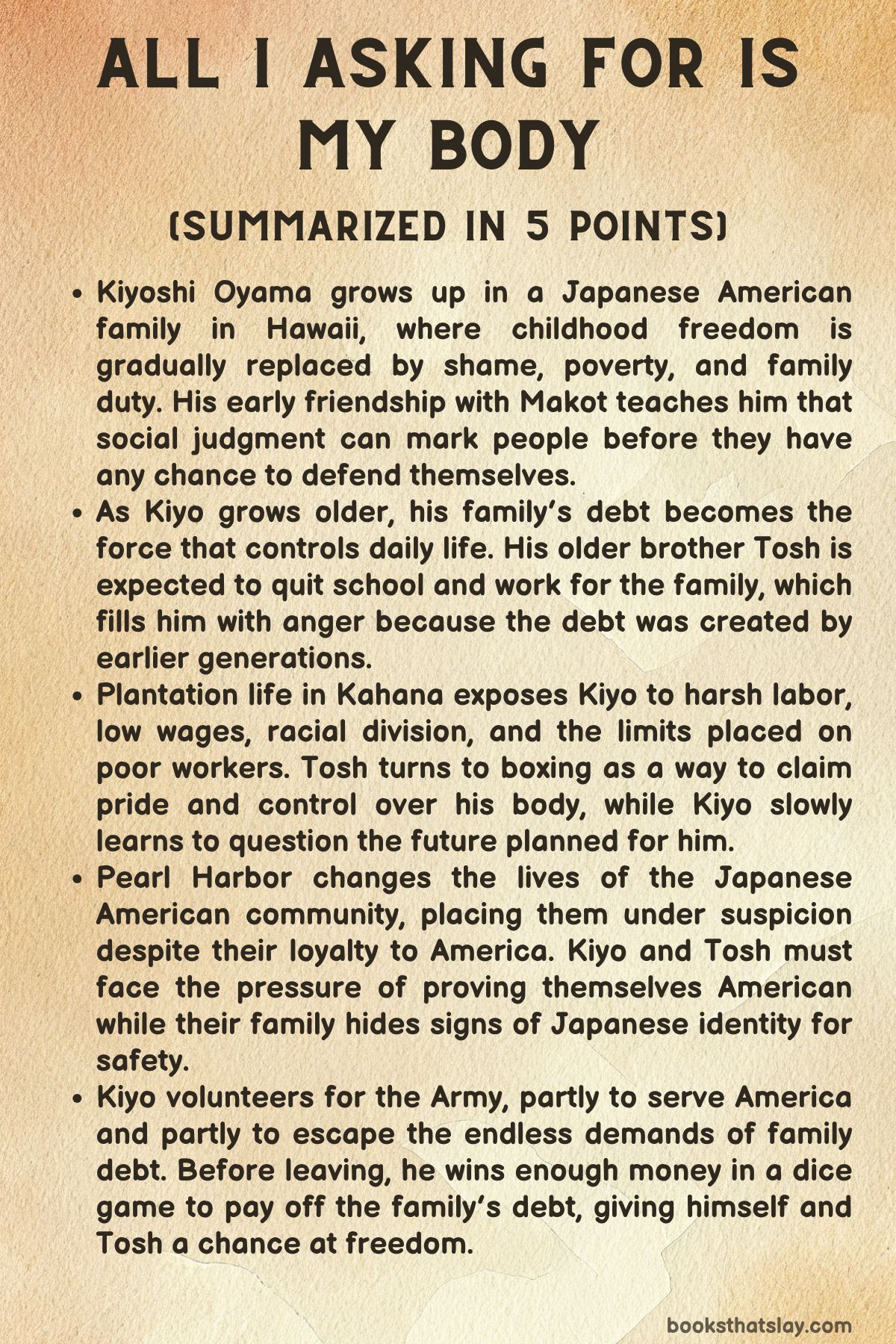
Summary
Kiyoshi Oyama, known as Kiyo, grows up in Hawaii in a Japanese American family shaped by poverty, duty, and silence. As a boy, he spends his days swimming, surfing, and spearfishing with his friends.
His childhood seems open and physical, full of ocean air, games, and risk. Yet even in these early years, he begins to sense the rules that govern adult life, especially the rules his parents refuse to explain.
One summer, Kiyo and his friends are drawn into the company of Makot, an older boy who forms a small gang of younger boys. Makot leads them on adventures and schemes, including attempts to raise money for a rifle by selling coconuts and mangoes.
Kiyo enjoys the freedom of belonging to this group, but his parents strongly object to Makot. They do not give Kiyo a clear reason.
His mother worries that people will think the family is too poor to feed him if he eats at Makot’s house, but that explanation does not satisfy him. His father is harsher and more direct, forbidding him to go there and threatening punishment.
Kiyo does not understand why Makot’s family is considered shameful. His parents only say that Makot’s home and parents are “bad.” Because the adults will not speak plainly, Kiyo goes to Makot’s house to say goodbye and explain why he can no longer visit.
There he sees men outside the house and catches a glimpse of the painful truth surrounding Makot’s mother. Makot understands what Kiyo has been told without needing to hear all of it.
Their friendship ends quietly, leaving Kiyo with one of his first lessons in shame, class, and the cruelty of adult judgment.
A few years later, Kiyo’s family faces a deeper crisis when his mother becomes ill. His father’s work as a fisherman brings in little money, and his mother supports the household by sewing kimonos.
While she is hospitalized, Kiyo takes on adult duties at home, cooking and caring for his younger sisters. At the hospital, his mother tells him about the family’s debt and the sacrifices she made after leaving Japan to marry his father.
She had spent years helping pay off debt that was not truly hers, all while enduring mistreatment from her husband’s family.
The only person who had shown her real kindness was Obaban, a relative who had herself been cast out for defying family custom. Kiyo decides to bring Obaban to his mother’s bedside, despite his mother’s concern about the cost.
During the visit, the idea of bachi, or punishment for wrongdoing, becomes important. Kiyo’s mother believes she may be suffering as a substitute for someone else’s sins.
Obaban explains that perhaps another substitute could free her. Soon after, Obaban dies, while Kiyo’s mother survives.
Kiyo feels relief and guilt at once. To him and his mother, Obaban has taken on the burden and saved her.
As Kiyo grows older, the family moves back inland to Kahana, where plantation life shapes every part of existence. The move is hard for him.
The family’s home is near outhouses and a pigpen, and the smell of poverty is constant. Their debt has grown to $6,000, an enormous amount compared with plantation wages.
The burden falls especially on Tosh, Kiyo’s older brother. As the first son, Tosh is expected to quit school and work in the cane fields to help pay what the family owes.
Tosh is intelligent, capable, and angry. He knows he is being asked to give up his own future for mistakes made by older generations.
Tosh becomes the voice of resistance in the family. He questions filial duty, Japanese tradition, and the idea that children must surrender their bodies and lives to repay parents.
His mother calls him ungrateful, while his father often avoids direct argument or answers with anger. Kiyo, younger and more cautious, watches Tosh fight battles that he himself is not yet ready to fight.
On the plantation, Kiyo also learns about labor and race. When Filipino workers strike, Japanese workers replace them for higher temporary wages.
Kiyo’s teacher, Mr. Snook, criticizes the strikebreakers and tells him that workers should unite rather than compete against one another. Tosh understands this, but the older generation is more concerned with survival and keeping their place.
When the strike ends, wages fall again, and it becomes clear that the plantation owners benefit most from the divisions among workers.
Tosh and Kiyo also begin to question their relationship to Japan and America. They ask their father to give up their Japanese citizenship, insisting that they are American and will fight for America if war comes.
This creates tension at home, especially as news arrives about Japanese military actions in China. Tosh openly criticizes Japan, while his father refuses to believe reports of Japanese brutality.
Their arguments become physical, showing the split between immigrant loyalty and the American identity of the second generation.
Boxing becomes Tosh’s outlet. He trains hard, wins fights, and earns respect.
Kiyo also takes up boxing, though at first he relies more on natural talent than discipline. The ring offers both brothers a different kind of measure: not family duty, not plantation rank, but the body’s skill and courage.
Tosh has a chance to leave the plantation and become a professional boxer in Honolulu, but he turns it down because of the family debt. Even his anger cannot free him yet.
At the same time, Kiyo begins to struggle with desire, shame, and the limits of plantation life. He becomes fascinated by girls and frustrated by the expectation that sons should avoid marriage so they can keep giving money to the family.
His thoughts about women are often immature and selfish, revealing his youth and the distortions caused by repression. Still, his larger fear is clear: marriage, debt, and plantation work could trap him forever.
Tosh seeks advice from Mr. Takemoto, a respected elder in the Japanese community. He asks how long a son must work to repay his parents.
Mr. Takemoto surprises him by admitting that, in America, ten years may be enough. This moment matters because it gives Tosh moral permission to imagine an end to obligation.
He is not rejecting his family entirely; he is asking whether gratitude must mean lifelong servitude.
Then Pearl Harbor changes everything. The Japanese attack throws the Hawaiian Japanese community into fear and suspicion.
Tosh quickly understands the danger. He tells his family to hide or destroy anything that might make them look disloyal to America.
Japanese books, flags, and language itself become risky. The family and community prepare for possible invasion while also fearing retaliation from neighbors and arrest by authorities.
Kiyo struggles to understand how a culture that praises honesty and sincerity could be connected to a surprise attack. Mr. Takemoto tries to separate the actions of a nation from the values of ordinary people, but neither man finds full comfort in that explanation.
The war forces Kiyo to confront identity in a harsher way than before. He is Japanese by ancestry, American by birth and loyalty, and suspect in the eyes of many because of his face.
Kiyo’s father is questioned by the FBI after withdrawing money from the bank for the Japanese community club. The family fears arrest, but he explains that he was protecting club funds and had distributed the money properly.
He also proves that Tosh and Kiyo had renounced Japanese citizenship. The agent leaves without arresting him.
Tosh still criticizes his father, saying he cared more about community money than his own family’s debt. Yet the war has changed the scale of their worries.
The old bitterness over money fades beside the larger danger facing Japanese Americans.
Under martial law, Japanese residents live with severe restrictions. Tosh marries Fujie with help from Reverend Sherman, who secures permission for the wedding despite limits on Japanese gatherings.
After Tosh moves out, Kiyo discovers that his brother’s anger had protected him. Without Tosh in the house, Kiyo becomes the son expected to obey and provide.
He tries to challenge his father about the debt but cannot bring himself to break fully away.
The family’s burdens grow. Kiyo learns that his mother is pregnant again, as is his unmarried sister Miwa, and Tosh’s wife Fujie.
Tosh is furious at his father for having more children despite poverty. Miwa marries the baby’s father in a sad, small wedding.
Kiyo works as a truck driver’s helper and gives most of his pay to his parents. He considers marriage but knows that debt and plantation life would swallow him.
For Kiyo, freedom means escape from other people’s demands, even when those demands come wrapped in family love. In 1943, the Army recruits Japanese American volunteers to fight in Europe.
Kiyo’s mother does not want him to go because she depends on his wages. He volunteers anyway.
He tells her that if he dies, the insurance money will pay the debt; if he lives, he will return to work; if he is disabled, the family will have to accept it. This is not a noble speech so much as a hard bargain.
Kiyo is claiming his own body at last.
Before leaving, Kiyo receives money from the community. Among the soldiers, gambling begins, especially dice games.
Kiyo studies the game carefully and practices controlling his throws. He realizes he can improve his chances and begins winning.
His goal becomes clear: win enough to erase the family debt. After a tense run of luck, skill, and risk, he wins more than $6,000.
Kiyo sends the money to Tosh with instructions to pay off the debt. He admits that he manufactured some of his luck, but he also believes the family’s fortune may finally have changed.
His message closes with a request to take care of the body. That phrase carries the force of the whole novel.
Kiyo has spent his life watching bodies used by parents, plantations, nations, and debts. By the end of All I Asking for Is My Body, he has not escaped every burden, but he has made one decisive act toward freedom.
Characters
Kiyoshi Oyama
Kiyoshi Oyama, called Kiyo, is the narrator and central consciousness of the novel. He begins as a young boy trying to make sense of adult rules that are never explained to him clearly.
His early friendship with Makot shows his innocence, but also his instinct for fairness: when his parents forbid him from visiting Makot’s house, Kiyo still feels that Makot deserves an explanation. As he grows older, Kiyo becomes more observant, more practical, and more aware of the systems controlling his life.
He watches his family’s debt consume Tosh, sees plantation labor reduce people to exhausted bodies, and slowly understands that obedience can become a kind of prison. Unlike Tosh, Kiyo does not rebel loudly at first.
He often stays quiet, avoids direct confrontation, and lets his brother carry the burden of open resistance. Yet his silence should not be mistaken for agreement.
Kiyo is constantly measuring the world around him, learning from shame, poverty, racial tension, sexuality, work, war, and family obligation. His decision to volunteer for the Army is both patriotic and personal.
He wants to prove his loyalty as a Japanese American, but he also wants control over his own body and future. By the end of All I Asking for Is My Body, Kiyo’s gambling victory becomes more than a lucky escape from debt.
It is his way of breaking a chain that has held his family for generations. He does not become purely free, but he acts with purpose, intelligence, and risk, showing that he has moved from passive witness to active agent.
Toshio Oyama
Toshio Oyama, or Tosh, is Kiyo’s older brother and the most openly rebellious figure in the family. As the first son, he carries the heaviest expectations.
His parents expect him to quit school, work in the cane fields, and surrender his earnings to repay debts created by his father and grandfather. Tosh sees the unfairness of this arrangement clearly.
He does not reject family because he lacks love; he rejects the idea that love should require the destruction of his own life. His anger is sharp, repeated, and often painful, especially in his clashes with his mother and father.
Yet Tosh’s resentment comes from moral clarity. He knows that tradition can be used to justify exploitation, and he refuses to pretend that filial duty is noble when it leaves him trapped.
Boxing gives Tosh a physical language for his anger. In the ring, effort has a visible result, unlike plantation labor, where work disappears into debt.
His skill as a boxer suggests the life he might have had if he were free to choose for himself. His refusal to turn professional, however, reveals the complexity of his character.
Though he rages against obligation, he still sacrifices himself for the family. Tosh is also politically alert.
He rejects Japanese nationalism, insists on American loyalty, and understands quickly after Pearl Harbor that his family must protect itself from suspicion. He is harsh, sometimes cruel, but he is rarely blind.
He gives voice to the central demand of the novel: that a person’s body should not belong endlessly to parents, employers, governments, or inherited debt.
Mr. Oyama
Mr. Oyama is Kiyo and Tosh’s father, a man shaped by old-world values, poverty, and a strong sense of communal responsibility. He is not presented as a simple villain, although his choices cause great pain to his children.
He believes in obedience, hierarchy, endurance, and knowing one’s place. These beliefs make him unable or unwilling to see the emotional cost of the family debt on Tosh and Kiyo.
When challenged, he often responds with anger, threats, or silence instead of explanation. His authority depends less on persuasion than on the expectation that children must obey their father.
Yet he is also a man under pressure. His work as a fisherman fails to support the family, and the plantation world offers few paths to dignity.
His withdrawal of money from the bank after Pearl Harbor shows another side of him: he is deeply responsible toward the Japanese community in Kahana. He protects the club’s funds, donates to the Red Cross, and distributes money carefully among members.
This act proves that his honesty and sense of duty are real. The tragedy is that he seems more capable of serving the community than understanding his own sons.
His loyalty to tradition blinds him to the new American reality in which Tosh and Kiyo live. He expects sacrifice because he himself has accepted sacrifice as normal.
His failure is not that he lacks values, but that he cannot adapt those values to his children’s hunger for freedom.
Mrs. Oyama
Mrs. Oyama is one of the most complicated figures in the family because she is both victim and enforcer. Her life has been marked by sacrifice from the moment she left Japan to marry into the Oyama family.
She works hard, sews kimonos, raises many children, and helps carry a debt that was not originally hers. Her belief in bachi reflects the emotional and spiritual weight she carries.
She sees suffering not merely as bad luck, but as punishment transferred through family lines. This belief gives shape to her pain, but it also keeps her tied to endurance rather than rebellion.
As a mother, she can be loving and dependent, but also demanding and manipulative. She expects Tosh and later Kiyo to support the family, and she treats their desire for independence as ingratitude.
Her love is real, but it often expresses itself through obligation. When she discourages marriage for her sons, she is protecting the family’s financial survival, yet she is also denying them adult lives of their own.
Her relationship with Obaban reveals her capacity for tenderness and loyalty, while her reaction to her new baby shows how maternal feeling can be selective and possessive. Mrs. Oyama has suffered under patriarchal and family systems, but she also helps pass those systems on to her sons.
That contradiction makes her deeply human. She is not cruel by nature; she has learned to survive by accepting sacrifice and asking others to do the same.
Makot
Makot appears early in the novel, but his presence leaves a lasting impression because he introduces Kiyo to the hidden moral codes of adult society. To Kiyo, Makot is exciting, older, confident, and adventurous.
He leads the younger boys into schemes, gives them a sense of belonging, and represents a form of freedom outside parental control. But the adults see him through the shame attached to his family, especially his mother.
Kiyo’s parents refuse to explain the situation directly, which makes Makot’s world seem mysterious and forbidden. When Kiyo finally visits Makot to say he can no longer play with him, the scene exposes the cruelty of social judgment.
Makot already understands what Kiyo has only begun to discover: that children can inherit the shame adults place on their families. His reaction is not rage but wounded acceptance.
He knows the friendship is over because the community’s judgment has spoken through Kiyo’s parents. Makot’s brief role is important because he shows how class, sexuality, reputation, and family background shape a child’s life before that child has any power to answer back.
He is one of the first people through whom Kiyo learns that society often punishes people not for what they have done, but for where they come from.
Obaban
Obaban represents kindness, defiance, and sacrificial love. She is described as the black sheep of the family because she once broke social custom by eloping during a mourning period.
That act caused her rejection, but it also marks her as someone who chose personal feeling over rigid tradition. Her move to Hawaii suggests courage and a willingness to begin again after disgrace.
For Kiyo’s mother, Obaban is not merely a relative; she is the one person who treated her with compassion when married life placed her under the burden of debt and mistreatment. Obaban’s role becomes almost spiritual when Kiyo brings her to his mother’s hospital bedside.
The discussion of bachi and substitution gives her death a powerful meaning in Kiyo’s mind. Whether or not Obaban literally saves Kiyo’s mother, the emotional truth is that her love offers release.
She becomes associated with the possibility that suffering can be transferred, interrupted, or answered by another person’s generosity. Unlike the forms of duty that crush Tosh and Kiyo, Obaban’s sacrifice feels voluntary and loving.
She does not demand repayment. Her goodness stands apart from the harsh economy of debt that rules the Oyama family.
In that sense, she becomes a quiet moral contrast to the rest of the world around Kiyo.
Mr. Takemoto
Mr. Takemoto is a respected elder in the Japanese community and serves as a moral guide, especially for Tosh and Kiyo. He understands tradition, but he is not imprisoned by it.
This makes him different from Kiyo’s parents, who often treat custom as fixed and unquestionable. When Tosh asks how long a son must work to repay a debt of gratitude, Mr. Takemoto gives him an answer rooted in compromise.
He recognizes that America has changed the terms of family life. Children born there do not see duty in exactly the same way as their immigrant parents.
His response does not dismiss filial obligation, but it places a limit on it. This is crucial because it gives Tosh the validation he cannot get at home.
Mr. Takemoto also helps Kiyo think through the moral shock of Pearl Harbor. He tries to distinguish between the actions of Japan as a nation and the values held by ordinary Japanese people.
Even though his explanation does not fully satisfy Kiyo, his willingness to think honestly matters. Mr. Takemoto represents wisdom that can bend without breaking.
He honors the old world but understands that the young must live in a new one.
Reverend Sherman
Reverend Sherman is a minor but important character because he represents moral courage from outside the Japanese American community. After Pearl Harbor, when Japanese residents are under suspicion and restriction, he uses his position to protect people who might otherwise be vulnerable.
His support helps prevent arrests and allows Tosh and Fujie’s wedding to take place despite rules limiting Japanese gatherings. Kiyo respects him because his help is practical, not merely sympathetic.
Reverend Sherman’s role also shows the importance of allies during periods of racial fear. He cannot remove the prejudice Japanese Americans face, but he can use his credibility to reduce harm.
In a world where institutions often treat Japanese ancestry as suspicious, Sherman insists on seeing individuals. His actions contrast with the suspicion of the FBI and the broader climate of wartime surveillance.
He is not central to the family conflict over debt, but he becomes central to the question of belonging. Through him, the novel shows that loyalty, decency, and American identity are not determined by ancestry.
They are revealed through action.
Fujie Nakama
Fujie Nakama is Tosh’s wife and a figure connected to his attempt to build a life beyond his parents’ control. Her relationship with Tosh marks one of his clearest acts of independence.
His parents, especially his mother, discourage marriage because they fear it will weaken his financial contribution to the family. By marrying Fujie, Tosh asserts that he has the right to a private future.
Fujie’s work at the hospital also places her in a position where she learns important family news, including the pregnancies that anger Tosh. She is not developed as deeply as Tosh or Kiyo, but her presence changes the structure of the family.
Once Tosh marries and leaves home, Kiyo feels the burden of filial duty more directly. Fujie therefore becomes part of the shift that moves responsibility from the older brother to the younger one.
Her pregnancy also complicates Tosh’s anger toward his parents. He is starting his own family at the same time that his mother is having another child, forcing him to confront the difference between chosen responsibility and inherited obligation.
Fujie represents adulthood, separation, and the possibility of a life not entirely ruled by the Oyama debt.
Miwa Oyama
Miwa Oyama, Kiyo’s sister, reveals the different expectations placed on daughters within the family. Tosh resents the money spent on his sisters’ education because he believes they will eventually marry into other families and no longer contribute to the Oyama household.
His view is harsh, but it reflects the economic logic that governs the family. Miwa’s pregnancy outside marriage becomes another crisis layered onto an already strained household.
Her rushed marriage to Hachiro Shiotsugu is sad rather than celebratory, showing how sexuality, shame, and economic pressure shape young lives in the community. Miwa does not receive the same narrative attention as Kiyo and Tosh, but her situation exposes the vulnerability of daughters.
While sons are treated as financial assets whose labor must repay debt, daughters are treated in terms of marriage, reputation, and family honor. Her story also mirrors the larger pattern of young people being forced into adult consequences before they have real freedom.
Miwa’s character adds to the novel’s portrait of a family where every child is caught in a different version of obligation.
Mr. Snook
Mr. Snook, Kiyo’s teacher, introduces a wider social and political perspective into Kiyo’s life. He criticizes Japanese workers who replace striking Filipino laborers and tries to make Kiyo understand the importance of worker solidarity.
His lesson is significant because it challenges the survival logic Kiyo hears at home. The Oyama family’s immediate need for money makes strikebreaking seem practical, but Mr. Snook pushes Kiyo to see the long-term cost: when workers are divided by race or ethnicity, the plantation wins.
Mr. Snook also encourages Kiyo to think about freedom, a word that becomes central to Kiyo’s self-understanding. He is not just teaching school subjects; he is teaching Kiyo how to question the structure of plantation life.
His influence remains with Kiyo when Kiyo later imagines escape from debt, marriage pressure, and plantation work. In All I Asking for Is My Body, Mr. Snook functions as one of the few adults who encourages Kiyo to think beyond obedience and survival.
Minoru Tanaka
Minoru Tanaka represents the model of the dutiful first son, the very model Tosh rejects. He has worked for years to support his family before marrying, and Kiyo’s parents praise him as an example of proper filial behavior.
To them, Minoru proves that Tosh’s resistance is selfish. To Tosh, however, Minoru represents surrender.
He sees Minoru as someone who allowed family obligation to consume his youth. Their conflict becomes personal when Tosh provokes him and later threatens revenge after Minoru hits him.
Minoru’s importance lies less in his individual personality than in what he symbolizes. He is the socially approved version of sonship: obedient, patient, self-denying, and useful.
Tosh’s contempt for him shows how deeply Tosh fears becoming the same kind of man. Minoru also reveals how communities enforce values through comparison.
Parents do not need to argue directly when they can point to someone like Minoru and say, in effect, this is what a good son looks like. His character sharpens the conflict between gratitude and self-ownership.
Sachiko Nosawa
Sachiko Nosawa appears in Kiyo’s imagination as a possible escape into romance and physical desire. Kiyo is drawn to her beauty and briefly considers marriage, but his fantasy says more about his hunger than about Sachiko herself.
He imagines love as enclosure, possession, and endless physical satisfaction, which reveals his immaturity and frustration. At the same time, his rejection of the idea of marrying her shows that he is becoming more realistic.
He understands that marriage would not free him. It would likely bind him more tightly to plantation life, debt, and responsibility.
Sachiko therefore represents both temptation and warning. She is connected to Kiyo’s desire for intimacy, but also to his fear of being trapped.
His thoughts about her expose the pressure placed on young men who are expected to delay adulthood for the sake of family finances, while still living with intense emotional and physical longing. Through Sachiko, the novel shows how poverty distorts even private desire.
Themes
The Body as Property, Labor, and Freedom
The title idea of the body is central because every major conflict turns on who controls a person’s physical life. Tosh and Kiyo are not simply asked to help their family; they are expected to give their working years, strength, and choices to a debt they did not create.
Plantation labor makes this problem harsher. Bodies are measured by how much cane they can cut, how many hours they can work, and how much money they can bring home.
Boxing offers Tosh and Kiyo a different use of the body, one connected to skill, pride, and personal ambition, but even that possibility is limited by family obligation. War adds another claim: the nation asks Japanese American men to prove loyalty by risking their lives.
Kiyo’s enlistment is therefore both submission and resistance. He gives his body to the Army, but he does so partly to escape the endless family claim on it.
In All I Asking for Is My Body, freedom is not abstract. It means having the right to decide where one’s body works, fights, loves, suffers, and rests.
Family Debt and the Burden of Gratitude
Debt in the novel is financial, emotional, and moral at the same time. The Oyama family’s $6,000 debt is a real economic burden, but it also becomes a tool through which duty is enforced.
Tosh is expected to repay not only money, but also the fact of being born, raised, and fed. Gratitude becomes dangerous when it has no limit.
The parents believe sacrifice is natural because they themselves have lived under older systems of family duty. Tosh sees the cruelty in this logic.
He does not deny that children owe something to parents, but he refuses the idea that repayment should consume a whole life. Mr. Takemoto’s answer to Tosh matters because it places a boundary around obligation.
A son may help, but he should not be erased. Kiyo’s final act of sending gambling winnings to repay the debt is powerful because it ends the financial chain without accepting its moral terms.
He pays the debt, but he does not surrender to the belief that his body was born for repayment.
Japanese American Identity and Wartime Suspicion
Kiyo and Tosh live between Japanese inheritance and American belonging long before Pearl Harbor, but the war makes that conflict urgent and dangerous. Their desire to give up Japanese citizenship shows that they already understand loyalty as a choice that may be tested.
Tosh’s arguments with his father over Japan’s actions reveal a generational divide: the immigrant father remains emotionally tied to Japan, while the American-born sons judge Japan from the standpoint of American identity and democratic ideals. After Pearl Harbor, ancestry itself becomes a source of suspicion.
Language, books, flags, bank accounts, meetings, and ordinary movements are suddenly treated as possible signs of disloyalty. The family must perform loyalty under pressure, even though Kiyo and Tosh have already chosen America.
The novel shows the emotional unfairness of this condition. Japanese Americans are asked to prove what others are allowed to assume.
Reverend Sherman’s support and the father’s questioning by the FBI reveal two sides of wartime America: suspicion backed by state power, and individual decency that recognizes loyalty beyond race.
Plantation Life, Class, and Divided Workers
Plantation life is shown as a system that keeps workers poor, dependent, and divided. The Oyama family’s move to Kahana places them in a world where housing, wages, status, and opportunity are controlled by the plantation economy.
Their home’s location near outhouses and a pigpen captures the indignity of poverty in physical terms. The labor strike exposes how the plantation benefits when ethnic groups are turned against one another.
Filipino workers strike for better conditions, but Japanese workers replace them for temporary higher wages. In the short term, this seems like an opportunity for families desperate for money.
In the long term, it weakens all workers. Mr. Snook’s criticism helps Kiyo see that racial division serves the owners, not the laborers.
The plantation also narrows imagination. Marriage, education, work, and family planning are all shaped by low wages and debt.
Kiyo’s desire to leave is not only personal restlessness; it is a rejection of a system designed to make poverty feel permanent and obedience feel practical.