As Long as the Lemon Trees Grow Summary, Characters and Themes
As Long as the Lemon Trees Grow by Zoulfa Katouh is a young adult novel set during the Syrian Revolution. It follows eighteen-year-old Salama Kassab, a pharmacy student forced into emergency medical work after war tears apart her city, her family, and her sense of reality.
The book is about survival, guilt, love, faith, trauma, and the painful choice between staying to serve one’s country and leaving to live. Through Salama’s story, the novel shows the cost of violence on ordinary people while also honoring hope, memory, and the stubborn will to keep going.
Summary
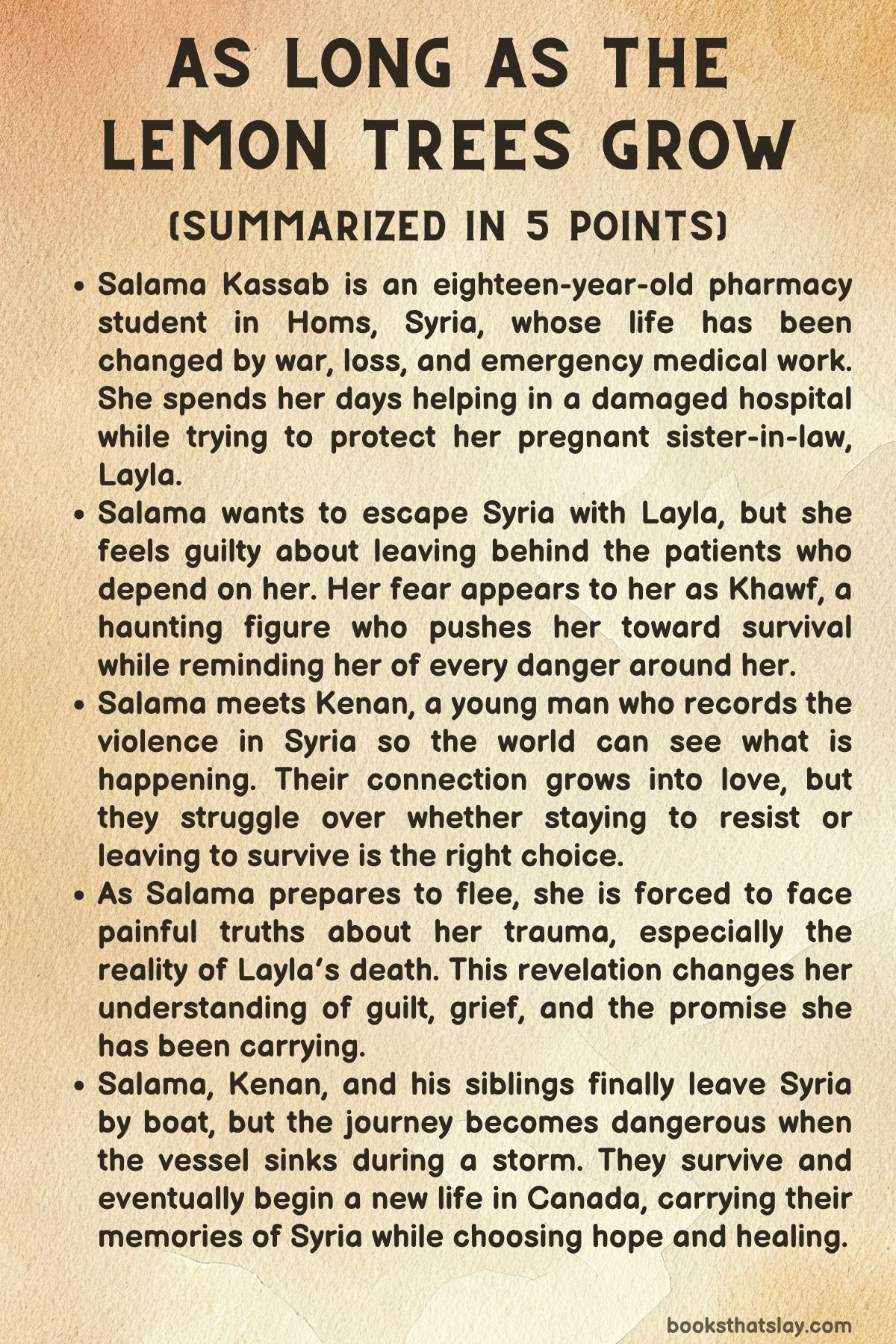
Salama Kassab is eighteen years old and living in Homs, Syria, during the Syrian Revolution. Her city has been broken by bombs, gunfire, hunger, and fear.
Once, she was a pharmacy student with dreams of traveling, studying plants, and helping people through medicine. Now, after only one year of training, she works in a hospital because so many doctors have been killed, arrested, or forced away.
She has learned to stitch wounds, treat injuries, assist surgeries, and comfort the dying, even though she never imagined herself doing such work.
Her family has been shattered. Her mother died after a bombing destroyed their home.
Her father and brother, Hamza, left to fight and were later taken from her life by the war. Salama lives with Layla, her sister-in-law and closest friend, who is pregnant with Hamza’s child.
Before leaving, Hamza made Salama promise to protect Layla. That promise becomes the center of Salama’s life.
Layla begs her to find a way out of Syria before the baby is born. The roads are dangerous, snipers are everywhere, and walking to safety is impossible for a heavily pregnant woman.
Salama knows that leaving may be the only way to keep Layla and the baby alive, but she also knows the hospital needs her.
Salama is haunted by a figure named Khawf, whose name means fear in Arabic. He appears to her as a man in a dark suit and constantly pressures her to leave Syria.
He gives voice to her worst thoughts, reminding her of death, assault, torture, imprisonment, and the promise she made to Hamza. Khawf forces her to relive the day her mother died and the day her family was broken.
Salama believes he began as a result of her head injury and trauma, but he feels real to her. He is cruel, relentless, and sometimes protective.
His only goal seems to be survival.
At the hospital, Salama works under Dr. Ziad, a former endocrinologist who has become a leader in emergency care. He treats Salama with compassion and worries that she is destroying herself through exhaustion.
Every day brings more wounded people: children, protesters, soldiers, civilians, and families torn apart by violence. Salama sees death so often that she feels both numb and overwhelmed.
One day, she approaches a smuggler named Am, who arranges boat passage for people escaping Syria. He demands more money than Salama has, but when she tells him Layla is pregnant, he allows her to skip the waiting list if she can find payment.
During one difficult day, a young man named Kenan arrives at the hospital, begging for help for his little sister, Lama. She has been injured by shrapnel and is close to death.
Salama goes to Kenan’s house and operates on Lama, removing fragments and saving her life. Kenan also cares for his younger brother, Yusuf, who no longer speaks because of trauma.
Salama and Kenan are drawn to each other. They discover that, before the bombing that killed Salama’s mother, their families had arranged for them to meet as possible marriage partners.
This knowledge fills Salama with a painful sense of what life might have been without war.
Kenan films the suffering around him and posts videos online, hoping the world will see what is happening in Syria. He believes staying is a form of resistance.
Salama understands his purpose, but she fears that his commitment will get him killed or arrested. She wants him and his siblings to leave with her and Layla, but Kenan feels responsible for showing the truth.
Their bond grows through conversations about family, movies, art, faith, memory, and the lives they once wanted. Salama falls in love with him, even as she tells herself she cannot afford love when she is planning to leave.
Desperate to secure passage, Salama commits an act that deeply scars her conscience. When Am arrives at the hospital with his injured daughter, Samar, Salama realizes she has power over him.
Samar needs urgent treatment, and Salama uses that moment to force Am to lower the price and promise a place on the boat. She saves Samar, but the act horrifies her.
She sees herself as cruel and unworthy, even though Khawf insists she did what was necessary to survive. Her guilt grows so heavy that she struggles to eat and begins punishing herself.
As the date of escape approaches, Salama imagines a future in Germany with Layla and the baby. She also tries to persuade Kenan to send Lama and Yusuf away.
Eventually, Kenan agrees to leave with his siblings, though the choice pains him. Salama’s hope grows stronger, but the war continues to close in.
A sarin chemical attack sends choking victims into the hospital, and Salama witnesses another form of mass suffering. This attack hardens her anger.
Before leaving Syria, she wants to attend a protest so she can stand with her people and feel that she has not abandoned them.
At the protest, Salama sees Syrians singing, chanting, and demanding freedom despite the danger. She feels connected to something larger than herself.
Then soldiers open fire, and Kenan pulls her through the chaos. They hide in the ruins of Salama’s old home, the place where her mother died.
There, they argue about his videos and the danger he creates for himself and his family. Salama finally admits she loves him.
Kenan admits he loves her too. He also notices that she seems to look at someone who is not there, and Salama tells him about Khawf.
Instead of rejecting her, he responds with tenderness and understanding. He asks her to marry him, offering his mother’s ring, and she accepts.
Their wedding is small and takes place at the hospital, with Dr. Ziad officiating and patients celebrating around them. Salama is happy for the first time in a long while.
Kenan and his siblings prepare to move in with Salama and Layla for their final days before leaving. But when they arrive at the house, Kenan cannot see Layla.
Salama insists Layla is there, but Kenan gently tells her no one is in the room. Salama is forced to remember the truth: Layla died months earlier, killed by a sniper while pregnant.
Salama’s mind created Layla as a way to survive the unbearable loss. The promise to protect Layla had continued inside her, even after Layla was gone.
This revelation breaks Salama, but it also frees her from one part of her guilt. The imagined Layla tells her that her death was not Salama’s fault and that it is time to move forward.
Salama mourns her friend and the baby who never lived. Kenan stays with her and helps her face the truth.
Salama realizes that leaving Syria is no longer only about keeping a promise to Hamza. It is about choosing life, healing, and the possibility of a future.
In the final days before departure, Salama tells Kenan about what she did to Samar. He does not excuse the pain of it, but he does not condemn her as a monster.
He reminds her that Samar lived and that Salama is still someone capable of love and care. Their marriage gives Salama a new family with Kenan, Lama, and Yusuf.
Still, danger grows. Soldiers attack the hospital, searching for rebels and punishing anyone who helps them.
Salama is almost sexually assaulted by a soldier, but she fights back and survives. Soon after, the hospital is bombed.
Salama and Dr. Ziad manage to save some babies from the incubators, but not all. The loss devastates them.
Salama says goodbye to Dr. Ziad, who plans to rebuild again. She leaves with Kenan, Lama, and Yusuf to meet Am at a mosque.
Their journey to the coast is tense and humiliating as soldiers at checkpoints threaten them and take bribes. At last, they reach the sea, where a small crowded boat waits.
Salama questions whether it is safe, but Am swears it has worked before. With no better choice, Salama and her new family board.
On the boat, refugees sing for Syria and say goodbye to the homeland they love. Salama watches the coast disappear, carrying grief, guilt, hope, and fear with her.
During the crossing, Khawf appears one last time. He tells her fear exists everywhere, in every person and every country.
Salama understands that fear can protect people, but it can also trap them. Khawf tells her Layla’s death was not her fault, and Salama finally accepts it.
Then he leaves.
A storm strikes, and the boat begins to fail. Salama must decide whether to stay aboard or jump into the sea.
She chooses to trust herself rather than fear. She, Kenan, Lama, and Yusuf enter the water and struggle to survive as the boat sinks.
They pray, keep moving, and cling to one another. After hours in the water, a light appears.
Months later, Salama and Kenan live in Toronto. They survived, reached Germany, and later found safety in Canada, where they can study.
Lama and Yusuf live safely in Germany with their uncle and attend school. Salama resumes pharmacy studies, and Kenan studies animation.
Together, they work on stories. In their apartment, they keep Syria alive through art, memory, and a lemon tree.
The lemons become a sign of survival, return, and hope: proof that even after terrible loss, life can still grow.
Characters
Salama Kassab
Salama Kassab is the emotional center of As Long as the Lemon Trees Grow, and her character is shaped by the impossible demands of war. At eighteen, she should be studying pharmacy, imagining travel, friendships, marriage, and a future built around medicine and writing.
Instead, she becomes an emergency medical worker in a collapsing hospital, forced to perform tasks far beyond her training because the revolution has taken away the people who would normally protect and guide her. Her strength does not come from fearlessness; it comes from continuing to act while terrified.
She treats the wounded, comforts dying children, negotiates with smugglers, and tries to hold together the remains of her family even as her own mind is breaking under grief.
Salama’s deepest conflict is between duty and survival. She feels responsible for Layla, for Layla’s unborn child, for the patients in the hospital, for Hamza’s promise, and for Syria itself.
This crushing responsibility makes her both brave and self-punishing. Her decision to use Samar’s injury to bargain with Am shows how war can push a fundamentally compassionate person into morally painful choices.
She is not written as flawless; she is loving, frightened, guilty, angry, and sometimes desperate enough to do wrong. That complexity makes her believable.
Her hallucinations of Layla and Khawf reveal the force of her trauma, but they also show how her mind tries to protect her from truths too painful to face. By the end, Salama’s growth lies in her ability to choose life without treating that choice as betrayal.
She learns that survival is not selfish, that love can exist in disaster, and that leaving Syria does not mean abandoning it.
Kenan
Kenan is one of the book’s clearest symbols of resistance through witness. While Salama fights to save bodies inside the hospital, Kenan fights to make the outside world see what is happening.
His camera is not a hobby or a shield from pain; it is his way of refusing silence. He records bombings, injuries, protests, and hospital scenes because he believes truth has power.
This makes him courageous, but it also makes him stubborn. He is willing to risk himself for Syria, and for much of the story he struggles to understand that his death would also wound the siblings who depend on him.
Kenan’s tenderness balances his defiance. He is responsible for Lama and Yusuf after the loss of their parents, and his care for them shows his maturity.
He is gentle with Salama, not because he sees her as fragile, but because he recognizes the pain she carries. His reaction to her hallucinations is especially important.
He does not shame her, dismiss her, or turn her suffering into something frightening. Instead, he listens and imagines healing with her.
His love is not a rescue fantasy; it is a partnership built in the middle of danger. Through Kenan, the novel explores the courage of staying and the courage of leaving.
His eventual decision to escape is not a rejection of his cause. It is an acceptance that survival can also serve the future.
Layla
Layla is Salama’s sister-in-law, best friend, emotional anchor, and one of the most devastating figures in the story. For much of the book, she appears as the pregnant woman Salama must protect, the living reminder of Hamza, and the person who gives Salama permission to seek joy.
Layla is warm, teasing, practical, loving, and hopeful. She encourages Salama to think about Kenan, to imagine happiness, and to believe that leaving Syria is not a moral failure.
Her presence gives the early part of the story a domestic tenderness that contrasts sharply with the violence outside.
The later revelation that Layla has been dead for months transforms her role. She becomes evidence of Salama’s trauma and of the mind’s power to create shelter when reality is unbearable.
Salama’s hallucinated Layla is not meaningless; she represents memory, love, guilt, and unfinished grief. Through her, Salama keeps speaking to the person she could not save.
Layla’s death also deepens the tragedy of Salama’s promise to Hamza. Salama has been living under the weight of a duty that can no longer be fulfilled, because the person she promised to protect is already gone.
Layla’s final goodbye allows Salama to face the truth without being destroyed by it. In that sense, Layla remains a source of love even after death.
Khawf
Khawf is one of the most powerful figures in the book because he gives physical form to fear. He is not simply a villain or a hallucination meant to scare Salama.
He is the voice of trauma, survival instinct, guilt, and dread. He appears after Salama’s life is shattered by bombing, loss, and injury, and he remains with her as a constant reminder of every possible danger.
He tells her that she may die, that Layla may die, that soldiers may torture or assault her, and that staying in Syria will destroy her. His cruelty is often unbearable, but his purpose is tied to survival.
He wants Salama to live, even if his methods leave her more wounded.
Khawf’s complexity lies in the fact that he is sometimes right. Salama is in real danger.
The hospital is attacked. Soldiers do threaten her.
The escape route is deadly. His warnings are not imaginary in a simple sense; they are rooted in the violence around her.
Yet Khawf also shows how fear can become a prison. He pushes Salama toward life, but he also tries to control her choices, her love, and her sense of hope.
His final conversation with her at sea gives his role emotional clarity. Fear exists everywhere, and it can either guide or paralyze.
Salama’s farewell to Khawf marks her movement toward self-trust. She does not stop being afraid, but she stops letting fear be the only force shaping her life.
Dr. Ziad
Dr. Ziad represents steadiness, moral responsibility, and exhausted compassion. He is not originally trained for the kind of emergency work he performs, yet war forces him into a role far beyond his old medical specialty.
Like Salama, he adapts because people need him. His hospital becomes a fragile place of mercy amid destruction, and he carries the burden of leadership with quiet discipline.
He directs surgeries, treats mass casualties, comforts staff, and tries to preserve human dignity when the world outside seems determined to erase it.
His relationship with Salama is one of the gentlest in the book. He sees her not only as a worker but as a young woman who is being consumed by duty.
When he tells her that her life matters too, he challenges the idea that sacrifice must have no limit. He understands why she works beyond exhaustion, but he also recognizes the danger of allowing guilt to become a form of self-destruction.
His decision to officiate Salama and Kenan’s marriage shows how he becomes a fatherly presence to her. Even when the hospital is bombed, he keeps trying to save lives, including the babies in the incubators.
His choice to remain behind and rebuild makes him a figure of endurance, though not a romanticized one. He is tired, wounded, and grieving, but still committed.
Hamza
Hamza’s physical absence shapes much of the book. As Salama’s brother and Layla’s husband, he represents the family life that war has stolen.
Before his arrest and suffering, he belongs to a world of weddings, love, study, and ordinary ambition. His marriage to Layla is remembered with warmth and joy, making the later destruction of their future even more painful.
His request that Salama protect Layla becomes one of the central emotional burdens Salama carries, and it influences nearly every major decision she makes.
Hamza is also important because he shows the hidden violence of imprisonment. The book does not need to keep him present in scenes for his suffering to matter.
The news that he is alive in prison does not bring simple relief; it brings horror, because Salama and Layla understand what being held by the regime may mean. Through Hamza, the story shows that survival under torture can be its own kind of agony for those who endure it and for those who love them.
He becomes a symbol of the people taken from their families but not fully mourned because their fate remains uncertain. His absence leaves Salama trapped between hope and dread.
Salama’s Mother
Salama’s mother is central to the emotional memory of the story. Her death in the bombing marks the moment when Salama’s old life collapses.
Before that loss, she is connected to home, food, marriage customs, family warmth, and the ordinary concerns of a mother preparing her daughter for a possible future. The scene involving the planned meeting with Kenan’s family gains much of its emotional weight because Salama’s mother was still trying to preserve normal life even as danger closed in.
Her wish to arrange a suitable match for Salama belongs to a world where families could still plan.
After her death, Salama’s mother becomes a source of grief and guilt. Salama remembers reaching for her as she was dying, unable to save her.
This helplessness becomes part of Salama’s larger trauma: again and again, she is forced to face people she cannot save. Her mother’s memory also reminds readers that Salama is not only a caregiver but a daughter who needed care herself.
The loss strips Salama of one of her strongest emotional protections. Her later longing for reunion with her dead loved ones at sea shows how deeply this grief remains inside her.
Salama’s Father
Salama’s father, often referred to through the loving term Baba, stands for family protection, patriotic duty, and the painful cost of resistance. Like Hamza, he leaves to fight, and his departure places Salama in the role of protector before she is ready.
His absence changes the structure of the family. Salama is no longer simply a daughter or sister; she becomes someone expected to hold the remaining household together.
This pressure contributes to her sense that every loss is somehow her responsibility.
The news of his death confirms what Salama has feared, but it is still a heavy blow. His fate also shows how war separates families long before death is confirmed.
Salama has already been living with grief, uncertainty, and fear, and the official knowledge of his death gives shape to a loss that has been haunting her for months. Baba’s character is not developed through many direct actions, but through the emotional space he leaves behind.
He represents the fathers, brothers, and sons whose choices are shaped by political violence, and whose families must live with the consequences of their courage.
Lama
Lama is Kenan’s younger sister and one of the book’s clearest reminders that children bear the physical costs of war. When Salama first meets her, Lama is severely injured, malnourished, and close to death.
Her body carries the evidence of violence she did nothing to invite. Salama’s decision to treat her creates the first real connection between Salama and Kenan, so Lama’s survival also becomes part of the love story.
She is not just a patient; she becomes a member of the family Salama slowly gains.
Lama’s innocence gives tenderness to scenes that might otherwise be overwhelmed by fear. She is young enough to ask direct questions, to be confused by grief, and to respond to kindness with openness.
Her excitement about Salama and her presence at the hospital wedding show how children continue to seek joy even in unsafe conditions. At the same time, her vulnerability shapes Kenan’s choices.
His decision to leave Syria becomes possible because he understands that Lama needs safety more than he needs to remain a witness inside the country. Through Lama, the story argues that protecting the future means protecting children from becoming permanent victims of adult violence.
Yusuf
Yusuf is Kenan’s younger brother, and his silence is one of the book’s strongest portrayals of trauma. He does not need long speeches to be memorable.
His muteness shows how deeply fear and loss can affect a child. Unlike Salama, whose trauma creates visible hallucinations, Yusuf’s trauma turns inward and removes his voice.
This contrast is important because the book shows that suffering does not appear the same in every person. Some people keep moving, some become angry, some see what others cannot, and some fall silent.
Yusuf’s presence also helps reveal Kenan’s character. Kenan’s care for him is patient and protective, showing that Kenan’s courage is not only public and political but also private and familial.
Yusuf’s quiet understanding when Layla’s truth is revealed suggests that he recognizes pain in others because he carries his own. His future in Germany, where he and Lama attend school and live safely with their uncle, gives the ending a sense of partial healing.
The book does not pretend that trauma disappears once people reach safety, but Yusuf’s survival suggests that silence may one day give way to recovery.
Am
Am is morally troubling because he profits from people’s desperation, yet he is not presented as a simple monster. He arranges escape routes for refugees, but he does so for money and uses suffering as a business opportunity.
His first interactions with Salama show the ugly economy created by war: safety has a price, and the people most in need of it are often least able to pay. His refusal to show mercy to Layla’s pregnancy makes him appear cold and opportunistic.
However, Am’s role becomes more complicated when his daughter Samar is injured. In that moment, he becomes a terrified father, and Salama becomes the one holding power over him.
Their conflict reveals how quickly war can reverse moral positions. Am exploits refugees, but Salama exploits his fear for his child.
Neither person is innocent in that exchange, and both know it. His later anger toward Salama is understandable, even though his own actions remain questionable.
By the time he transports Salama and the others to the coast, he is still a man making money from escape, but he is also part of the system that allows them a chance to live. His character shows how war creates moral compromise in almost every direction.
Samar
Samar is a minor character in terms of page presence, but she has a major effect on Salama’s conscience. As Am’s daughter, she enters the story injured and vulnerable, needing the same mercy that every patient deserves.
Salama does save her, but only after using her condition to bargain for escape. This makes Samar a symbol of Salama’s most painful moral failure.
The fact that Samar survives does not erase the wrongness of the act, and Salama knows this.
Samar’s scar becomes an outward mark of an inward wound that Salama also carries. For Am, it is a reminder of what Salama did.
For Salama, Samar represents the moment when survival pushed her across a line she never wanted to cross. This is why Samar’s role matters so much.
She forces the reader to see Salama not only as a victim or healer, but as a person capable of harm under extreme pressure. In a lesser book, Salama might remain morally untouched by everything around her.
Here, Samar’s presence makes the emotional and ethical cost of survival much harder to ignore.
Dr. Ziad’s Patients and the Refugees
The patients and refugees in As Long as the Lemon Trees Grow function almost like a collective character. They include wounded children, injured fighters, grieving families, orphaned babies, protesters, and people crowded onto the escape boat.
They give the book its moral scale. Salama’s story is personal, but these people show that her suffering is not isolated.
Every patient who enters the hospital carries another broken family, another interrupted future, and another example of what war does to ordinary life.
The refugees on the boat are especially important because they show that leaving is not a simple escape from pain. They sing for Syria even as they flee it.
They love the place they are leaving, and that love makes departure feel like another wound. Their presence prevents the ending from becoming only Salama and Kenan’s private survival story.
They represent a wider displaced community, people forced to trust smugglers, unstable boats, and uncertain borders because staying has become impossible. Through them, the book honors both the desire to live and the grief of leaving home behind.
Themes
Survival and Moral Compromise
Survival in As Long as the Lemon Trees Grow is never presented as clean or easy. Salama wants to live, but every step toward safety seems to demand something from her conscience.
Her work at the hospital is heroic, yet it also drains her until she barely has enough strength to care for herself. Her promise to protect Layla gives her purpose, but it also traps her in guilt.
The clearest example of moral compromise comes when she uses Samar’s injury to force Am to secure passage. Salama saves the girl, but she also turns a child’s suffering into leverage.
That moment matters because it refuses to make survival look innocent. War creates conditions where good people may do things they later hate themselves for doing.
The book does not excuse Salama’s action, but it places it inside a world where normal moral choices have been damaged by fear, hunger, violence, and urgency. Her later guilt shows that her conscience is still alive.
The theme becomes most powerful because survival is shown as both necessary and costly. Salama must learn that one terrible act does not erase her humanity, but neither can she pretend it did not matter.
Trauma, Fear, and the Mind’s Defenses
Salama’s hallucinations reveal how trauma can reshape reality when grief becomes too much to bear. Khawf appears as a living form of fear, while Layla appears as a comforting presence Salama cannot let go of.
These figures are not random inventions of the mind. They serve emotional purposes.
Khawf tries to keep Salama alive by forcing her to imagine the worst possible outcomes. Layla helps Salama continue after a loss she cannot accept.
Together, they show two sides of psychological survival: fear protects, and denial shelters. Yet both can become dangerous when they prevent a person from seeing clearly.
Salama’s mind creates these figures because the world around her is already unreal in its cruelty. Children die in hospital beds, homes vanish in bombings, families are separated by prison and death, and safety becomes something bought through smugglers.
In such a world, the boundary between reality and inner terror becomes fragile. Salama’s healing begins when she can face what happened to Layla and say goodbye to Khawf.
The story does not suggest that trauma vanishes, but it does show that naming pain is the first step toward living with it differently.
Love as Shelter and Responsibility
Love in the novel is not an escape from war; it is one of the reasons characters keep going. Salama’s love for Layla drives her to search for a way out of Syria.
Kenan’s love for Lama and Yusuf makes him a caretaker long before he is ready. Dr. Ziad’s fatherly care for Salama helps her remember that her life has value beyond her usefulness.
These bonds create small shelters inside a violent world. They give characters reasons to eat, work, pray, plan, and survive.
Salama and Kenan’s romance is especially meaningful because it grows in a place where the future feels almost impossible. Their love is not naive.
They know either of them could die, be arrested, or be separated. That knowledge makes their decision to marry more urgent and more serious.
Marriage becomes a promise to claim life even when death surrounds them. Love also brings responsibility.
Kenan must learn that loving his siblings means choosing their safety over his need to remain in Syria. Salama must learn that loving the dead does not require dying with them.
The book treats love as fragile but active, something proven through care, honesty, sacrifice, and the courage to imagine tomorrow.
Home, Exile, and Hope
Home is both a place of belonging and a place of unbearable loss. Syria is where Salama’s memories live: her mother, Layla, Hamza, Baba, her studies, her dreams, her old neighborhood, and the life she might have had with Kenan under peaceful circumstances.
Yet it is also where bombs fall, hospitals are attacked, snipers kill civilians, and soldiers threaten the vulnerable. This tension makes leaving deeply painful.
Salama and the other refugees do not escape because they have stopped loving home. They escape because love alone cannot make a place safe.
The boat scenes capture this conflict with great force. The refugees sing for Syria as they leave it, proving that exile is not a clean break but a wound carried across borders.
Hope, however, survives in symbols of growth. The lemon tree at the end matters because it brings Syria into Salama’s new life without trapping her in the past.
In Toronto, she studies pharmacy, Kenan studies animation, and they build a life shaped by memory rather than ruled by destruction. The ending does not erase grief, but it allows hope to become practical: education, art, safety, family, and the patient act of growing something alive.