All Good People Here Summary, Characters and Themes
All Good People Here by Ashley Flowers is a crime thriller about buried secrets, small-town judgment, and the long damage caused by silence. Set in Wakarusa, Indiana, the novel follows Margot Davies, a journalist who returns home to care for her uncle and becomes drawn back into the unsolved murder of her childhood friend, January Jacobs.
When another young girl disappears, Margot begins to question the story the town has accepted for 25 years. The book moves between past and present, exposing family lies, failed investigations, and the dangerous ways people protect reputations over truth.
Summary
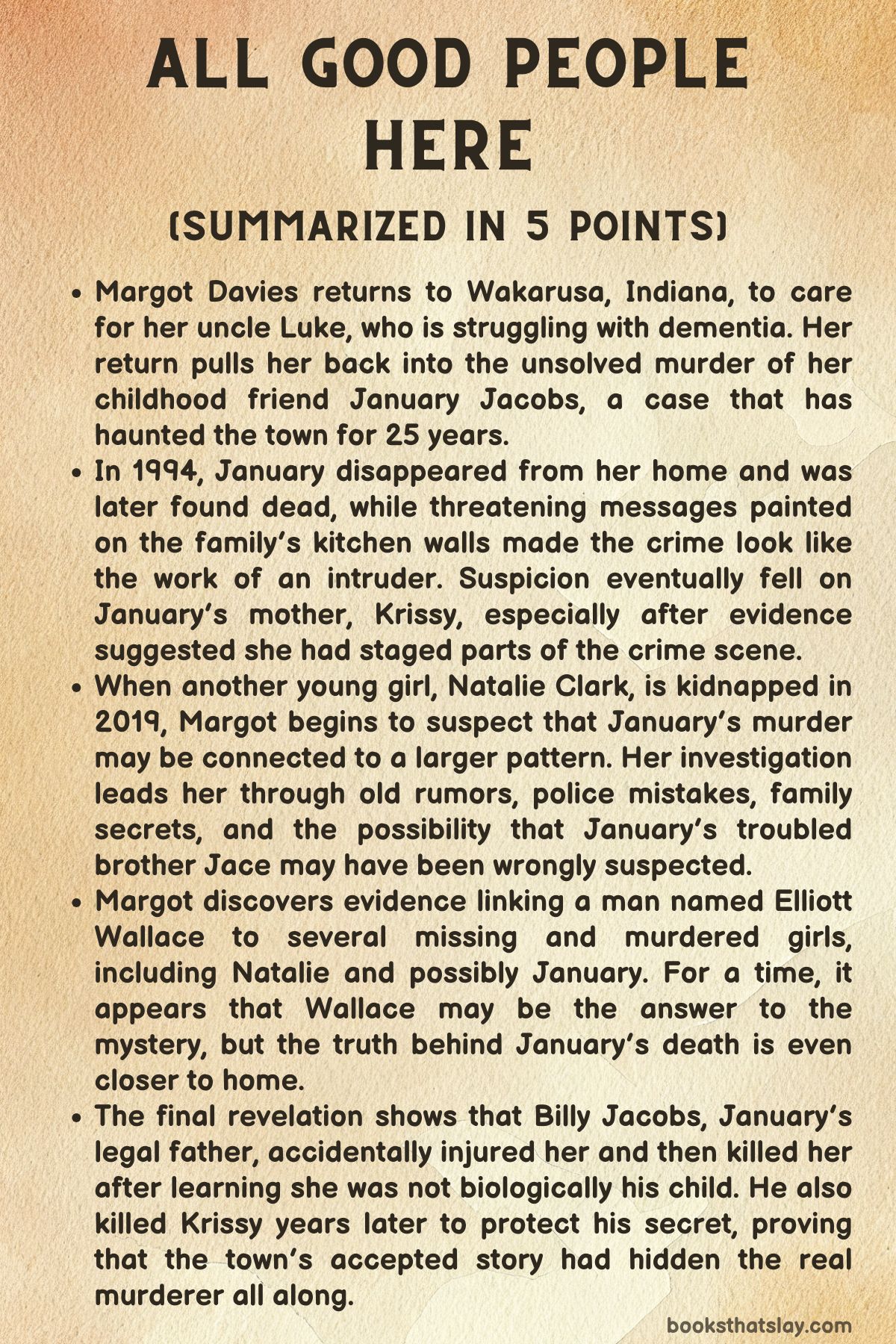
In 1994, Wakarusa, Indiana, is the kind of town where everyone knows everyone else’s business, and gossip can shape a life as much as truth can. Krissy Jacobs understands this better than most.
She is married to Billy Jacobs, part of a wealthy farming family, and she tries hard to appear like the perfect wife and mother. She dresses her twins, January and Jace, properly, attends church, and keeps up the image expected of her.
Her life is not the one she once wanted, but it is safer and more comfortable than the poverty she escaped.
One morning, Krissy wakes early and finds horrifying messages spray-painted on the kitchen walls. The words suggest that someone has taken January.
Krissy and Billy search the house, but January is missing. Police arrive, and the investigation begins.
A broken basement window appears to support the idea of an intruder, but the detectives quickly notice things that make them suspicious of Krissy. January’s room, with its dance trophies, costumes, and photographs, becomes part of the case, especially because some people believe the six-year-old was being made to look too grown up during dance performances.
In 2019, Margot Davies returns to Wakarusa to care for her uncle Luke, who is living with dementia. Luke was her safe place during childhood, and she loves him deeply, but his illness is worsening.
While Margot is adjusting to life back home, five-year-old Natalie Clark is kidnapped from a local playground. The case immediately reminds the town of January Jacobs, Margot’s childhood friend, whose murder was never officially solved.
Margot, a reporter whose career is already in trouble, becomes determined to investigate a possible link between the two cases.
Margot remembers growing up across the street from January and being haunted by the idea that the killer might have chosen January instead of her. Her editor warns her not to force a connection where one may not exist, but Margot cannot let go of the similarities.
She starts asking questions around town. Many people still talk about the Jacobs family as if they know the truth, but their opinions are built on rumors.
Some believe Krissy killed January because she was jealous of her daughter’s beauty, talent, and closeness with Billy. Others suspect Jace, who was known as troubled and angry.
As Margot investigates, someone writes a new warning on Billy Jacobs’s barn, suggesting that the danger is not over. Margot also receives notes telling her it is not safe and ordering her to leave.
Police treat these incidents as pranks, but Margot is not convinced. She interviews Billy, who insists that Krissy did not kill January, though he becomes defensive when Margot asks about his wife’s later death, which was ruled a suicide.
Margot also speaks with retired detective Max Townsend, who says he believed Krissy was guilty all along. He points to spray paint on Krissy’s robe, her fingerprints on the can, and fibers from January’s nightgown found in Krissy’s car trunk.
The past reveals that Krissy had indeed staged part of the crime scene, but not because she killed January. On the night January died, Krissy found her daughter dead at the bottom of the basement stairs and saw Jace nearby.
Because Jace had long resented January, Krissy believed he had killed her. In panic and fear, she moved January’s body, wrote the threatening messages, and tried to make the crime look like the work of an intruder.
She sacrificed her own reputation to protect the son she thought was guilty.
Margot learns more about Jace and tracks him to Chicago, where he lives under another name. Jace tells her he did not kill January.
He says he found his sister already injured and touched her bloody nose, which explains why her blood was found on his pajamas. He also reveals that January once spoke about a man she called “Elephant Wallace,” a figure who seemed to attend her recitals and spend time near her.
Margot connects this to Elliott Wallace, a man she had previously investigated in another missing girl case, Polly Limon.
Margot’s search points toward Wallace as a predator. She learns that he may be connected to several missing or murdered girls.
With the help of Jodie Palmer, Krissy’s former lover, Margot breaks into Wallace’s storage unit. Inside, they find boxes containing trophies from many girls, including Natalie, Polly, and January.
The discovery proves that Wallace stalked children and was involved in multiple crimes. Margot reports the evidence, Wallace is arrested, and it seems that January’s killer has finally been found.
But the truth is not that simple. During her investigation, Margot also discovers that Luke, her beloved uncle, had a hidden connection to the Jacobs family.
As a teenager, Luke went by Dave, and he had been close to both Billy and Krissy. Krissy had secretly been involved with Luke around the time she became pregnant, and Luke was the biological father of January and Jace.
Krissy kept this secret for years, allowing Billy to believe the twins were his. Luke knew more than he had admitted, and his dementia causes him to say confusing things that make Margot fear he may have been involved in January’s death.
Jodie believes Luke killed Krissy after learning the truth about the twins, but Margot slowly realizes this does not fit. Luke had known about the children for years.
His secrecy came from shame, guilt, and a desire not to hurt his wife Rebecca or Margot. Margot comes to believe that Luke was not the killer.
Instead, another possibility emerges when she visits Billy after Wallace’s arrest.
At Billy’s house, Margot notices a photograph of January holding a scrap of her baby blanket. Jace had said January was holding the same kind of fabric when he found her dead.
Margot realizes that the detail does not make sense unless someone placed it in January’s hand after hurting her. Billy reacts strangely when Luke’s name comes up, and Margot understands that Billy knew the truth about Luke being the twins’ father.
Billy then confesses.
Years earlier, Luke had told Billy that the twins looked like him and hinted at the truth. Billy returned home furious, intending to hurt Krissy.
Hearing someone in the basement, he opened the door violently, expecting Krissy to fall. Instead, January tumbled down the stairs.
She survived the fall and cried out that he had hurt her. In anger and panic, Billy killed her to silence her.
He later placed the blanket scrap in her hand and let Krissy, Jace, and the rest of the town suffer under suspicion.
Billy also killed Krissy years later after she began uncovering the truth and tried to tell Jace about his real father. Her death was staged as suicide, allowing Billy to hide behind the town’s assumptions once again.
When Margot realizes the truth, Billy tries to stop her and drags her toward the basement, intending to silence her too. Margot fights back, determined not to become another woman erased by a violent man and a town too eager to believe the easiest story.
All Good People Here ends by revealing that Wakarusa’s accepted truth was wrong from the start. January was not killed by her mother, her brother, or the serial predator whose crimes overlapped with hers.
She was killed by the man who claimed to love her, because he could not bear the truth about his family. The novel shows how secrets, shame, and public judgment can protect the guilty while destroying the innocent.
Characters
Margot Davies
Margot Davies is the central investigator figure, but her role is more emotionally complicated than that of a typical crime reporter. She returns to Wakarusa not because she wants to revisit her past, but because she feels responsible for her uncle Luke, whose dementia has begun to reshape both their lives.
Her investigation into January Jacobs’s murder grows out of professional instinct, childhood trauma, and personal guilt. January was not just a case to her; she was the girl across the street, the friend whose death made Margot imagine that she herself might have been chosen instead.
This survivor’s guilt explains why she cannot accept easy answers. Even when she loses her job, faces financial stress, and feels unsafe in town, she keeps searching because the case has defined her fear for most of her life.
Margot’s strength lies in her refusal to be satisfied with the version of truth that Wakarusa has repeated for years. At the same time, she is flawed by obsession.
She sometimes places herself in danger and neglects her own stability because solving January’s murder feels like the only way to make sense of her life. Her relationship with Luke adds emotional weight to her character.
She loves him deeply, but when evidence seems to point toward him, she is forced to confront the painful possibility that love does not always equal knowledge. By the end, Margot becomes a woman who understands that truth is rarely clean.
In All Good People Here, her journey is not only about solving a crime but about learning how easily fear, family loyalty, and public opinion can hide what really happened.
Krissy Jacobs
Krissy Jacobs is one of the most tragic figures in the story because almost every judgment made about her is shaped by misunderstanding. To Wakarusa, she becomes the suspicious mother: cold, jealous, unstable, and guilty-looking.
In reality, Krissy is a woman trapped by class expectations, motherhood, marriage, secrecy, and grief. Before marrying Billy, she dreams of leaving town and becoming a dancer.
Her pregnancy ends that dream, and her marriage becomes both an escape from poverty and a prison of appearances. She wants comfort and status, but she pays for them by surrendering her freedom and hiding the truth about the twins’ father.
Her relationship with January is complicated by envy and projection. January’s dance talent reminds Krissy of the life she lost, but that does not mean she hates her daughter.
The town reduces her emotions to motive, which shows how little room women are given to be conflicted without being condemned. Krissy’s greatest mistake is assuming Jace killed January and staging the crime scene to protect him.
That decision destroys the investigation and allows the real killer to remain free. Yet her action comes from panic and maternal fear, not malice.
Her later relationship with Jodie reveals the version of Krissy that could have existed in another life: tender, honest, loved, and finally seen. Her death is especially cruel because it comes just as she begins trying to repair the damage caused by her secrets.
Krissy is not innocent in every choice she makes, but she is innocent of the crime that defines her public memory.
January Jacobs
January Jacobs is the murdered child at the center of the novel, but she is more than a symbol of lost innocence. Through other characters’ memories, she appears as talented, gentle, loved, and unusually visible for a child her age.
Her dance performances make her famous in Wakarusa, but that visibility also becomes part of the way adults interpret her death. Some people judge Krissy for the costumes and makeup January wears, while others turn January into a perfect victim whose image helps them create stories about the family.
January’s kindness is seen in the memory of her comforting Margot with a scrap of fabric, a small gesture that stays with Margot for decades. That detail becomes important later because it reveals how carefully January’s final scene was manipulated.
January’s role in the story also exposes the failures of the adults around her. Her mother misunderstands what happened, her brother is blamed by implication, her legal father kills her, her biological father hides his connection, and the town turns her death into gossip.
She is loved by many people, but not protected by them. Her character represents how a child can become an object of adult pride, jealousy, fear, and denial.
The tragedy of January is not only that she dies, but that even after death, her truth is buried beneath the needs of others.
Billy Jacobs
Billy Jacobs is the novel’s hidden villain, and his danger comes from how successfully he performs decency. For years, he stands in the role of grieving father and wronged husband while allowing suspicion to fall on Krissy and Jace.
His calmness, social standing, and family wealth help protect him from scrutiny. Billy understands the power of appearances in Wakarusa and uses that power to survive.
His crime begins in wounded pride. When he learns that January and Jace may not be his biological children, he does not respond with grief alone; he responds with entitlement and rage.
He sees Krissy’s deception as an injury to his ownership of the family. His first impulse is to punish Krissy, and when January becomes the victim instead, his horror quickly turns into self-preservation.
The fact that he kills January after she survives the fall makes his character especially chilling. The initial injury may be accidental, but the murder is a choice.
Billy’s later murder of Krissy proves that he is not simply a man who made one terrible mistake in panic. He is willing to destroy anyone who threatens the story that keeps him safe.
His affection for January may have been real at some point, but it collapses when biology and pride challenge his identity as father. Billy represents respectable violence: the kind hidden behind churchgoing, family reputation, and community sympathy.
Jace Jacobs
Jace Jacobs is shaped by rejection from almost the beginning of his life. As January becomes the beloved, talented child, Jace becomes the difficult one.
He is angry, isolated, and often disturbing in his behavior, which makes it easy for others to imagine him as capable of murder. His childhood resentment toward January is real, but the novel makes an important distinction between resentment and guilt.
Jace is not a harmless child in every memory, yet he is also not the monster others create. The blood on his pajamas, his strange comments, and his troubled history all make him look suspicious, but these details are eventually explained through trauma and misunderstanding.
His life after January’s death is marked by abandonment. Krissy emotionally withdraws from him because she believes he killed his sister, and Jace grows up feeling that he lost both January and his mother.
His later efforts to make amends show a man trying to understand his own damage. When he tells Margot what he saw, he becomes one of the few characters willing to speak plainly about the past.
His annual visits to January’s grave show guilt, but not murderous guilt. It is the guilt of a brother who envied his sister, failed to love her well, and then had to live under the shadow of her death.
Jace’s character shows how suspicion can become a second sentence, punishing someone for years even without proof.
Luke Davies
Luke Davies is one of the most emotionally layered characters because he exists in two states at once: the loving uncle Margot trusts and the secretive man connected to the Jacobs family’s buried past. His dementia makes him vulnerable, unpredictable, and frightening at different moments.
For Margot, caring for Luke means watching the person who raised and understood her disappear in pieces. Yet his illness also causes fragments of truth to surface, making him appear suspicious.
Luke’s past as Dave reveals that he was more involved with Krissy, Billy, January, and Jace than he ever admitted. He is the biological father of the twins, a truth he hides out of shame, fear, and concern for the people around him.
His secrecy is morally significant because it helps create the conditions in which lies flourish, but he is not the murderer Margot fears he may be. Luke is a man who failed to speak when truth mattered, yet he is not portrayed as evil.
His grief over Rebecca, his confusion, and his love for Margot humanize him. He also reflects the pain of memory loss in a story built around hidden memory.
While Margot searches for the past, Luke is losing access to his own. His character asks whether a person can still be held accountable for old choices when illness has changed their mind, speech, and sense of reality.
Jodie Palmer
Jodie Palmer is crucial because she preserves a version of Krissy that almost no one else knows. To the town, Krissy is a suspicious mother and possible killer, but to Jodie, she is a woman who loved, suffered, and wanted to make things right.
Jodie’s relationship with Krissy is secret because of social pressure, family obligations, and fear of exposure. Her silence is painful because it delays the truth, but it is also understandable within the world of Wakarusa, where reputation can destroy lives.
Jodie’s decision to follow Margot, warn her, and eventually reveal her connection to Krissy shows both fear and courage. She is not reckless at first; she tests whether Margot can be trusted.
Once she decides to speak, she becomes an active force in the investigation. Her belief that Krissy did not kill January helps Margot challenge the dominant story.
Jodie is also a witness to Krissy’s final attempts at honesty, including her decision to tell Luke the truth about the twins. Through Jodie, the novel shows how private love can exist outside public recognition, and how the people who know the truth may remain silent because truth carries personal cost.
Jodie’s loyalty to Krissy is one of the few loving bonds in the story that is not based on control.
Elliott Wallace
Elliott Wallace functions as both a real predator and a false final answer. He is dangerous, manipulative, and connected to several missing and murdered girls.
The evidence in his storage unit reveals that he stalked children and kept trophies, making him guilty of terrible crimes. His presence in the story expands the threat beyond Wakarusa and shows that Margot’s instincts are not entirely wrong when she connects January to other cases.
However, Wallace’s role is also a narrative trap. Because he fits the profile of the kind of man everyone fears, it becomes tempting to assign January’s murder to him too.
His existence shows how one truth can hide another. He may be guilty of many crimes, but not the central crime Margot is trying to solve.
This makes him important to the book’s moral structure. Evil is not always found only in the obvious predator.
Sometimes it also lives inside the respected home, behind the familiar face, within the person no one thinks to suspect. Wallace’s character complicates the investigation because he provides real evidence and real horror, yet his guilt does not absolve Billy.
In All Good People Here, he represents the danger of stopping at the first answer that seems to fit.
Detective Max Townsend
Detective Max Townsend represents investigative certainty hardened into error. From early on, he believes Krissy is guilty, and once that belief forms, he interprets the evidence through it.
The spray paint, the fibers, Krissy’s behavior, and the family’s awkward public interview all become proof in his mind. He is not portrayed as foolish; he notices important details and understands that January’s death looks personal.
His failure is narrower and more dangerous: he becomes so committed to one theory that he cannot see the ways the evidence might mean something else. Townsend’s certainty damages the case because it helps freeze public opinion around Krissy.
Even decades later, he speaks as if the case was solved, though no arrest was made and serious questions remain. His character shows how authority can turn suspicion into accepted history.
When an investigator decides too soon who the villain is, every later fact can be bent to support that decision. Townsend also reflects the limits of justice when a crime scene has been altered.
Krissy’s staging makes the truth harder to find, but Townsend’s tunnel vision makes it easier for Billy to escape accountability.
Detective Rhonda Lacks
Detective Rhonda Lacks has a smaller role than Townsend, but she represents the continuing official presence of law enforcement across both timelines. In the earlier investigation, she is part of the team that enters the Jacobs family’s private tragedy and begins sorting grief from evidence.
In the later Natalie Clark case, she appears as the public voice of the police, giving careful statements and resisting Margot’s attempt to connect Natalie to January. Her guardedness makes Margot suspect that she is hiding something, though the situation is more complex than simple deception.
Lacks operates within an institution concerned with procedure, public messaging, and avoiding unproven claims. Her character helps show the gap between what reporters seek and what police are willing to say.
She is not as strongly characterized by obsession as Townsend, but she belongs to the same system that failed to bring January’s killer to justice. Through her, the novel shows how official caution can appear evasive, especially to someone like Margot, who has personal reasons to distrust closed answers.
Pete Finch
Pete Finch gives Margot a connection to the present-day police force, but he is also important as a figure of ordinary kindness. He remembers Margot from childhood and treats her with more respect than many others do.
When Luke’s dementia causes public incidents, Pete responds with compassion rather than judgment, drawing on his own experience with a family member who had dementia. This makes him one of the few people in Wakarusa who sees Margot’s personal burden as clearly as her investigation.
As a police officer, Pete provides information that complicates Townsend’s theory, especially regarding Jace and the blood found on his pajamas. He is cautious, but not dismissive.
His concern for Margot’s safety is genuine, though she sometimes reads it as doubt or interference because she is under so much pressure. Pete’s role balances the novel’s suspicion of institutions by showing that individuals within them can still act with care.
He is not the person who solves the case, but he helps Margot remain connected to facts, community memory, and practical support.
Linda
Linda serves as one of Wakarusa’s key voices of local memory. As a bartender and familiar town presence, she hears what people say when they are relaxed, emotional, or eager to repeat old stories.
Her conversations with Margot reveal how the town remembers the Jacobs family: with sympathy, suspicion, admiration, and judgment all mixed together. Linda does not necessarily create the rumors, but she helps show how they circulate.
She claims to repeat what others think, especially about Krissy, while distancing herself from full responsibility for those views. This makes her believable as a small-town observer.
Linda is helpful to Margot, directing people toward her and later giving her a lead to Jace through Eli. At the same time, her character reflects the danger of community storytelling.
In a town like Wakarusa, memory is collective, but not always accurate. Linda’s value lies in access: she can open doors for Margot.
Her limitation is that the information she carries has passed through years of bias.
Adrienne
Adrienne, Margot’s editor, represents the professional pressure surrounding Margot’s investigation. She is not emotionally tied to January’s case in the same way Margot is, so she sees Margot’s obsession as a liability.
Her decision to fire Margot is harsh, but it also reflects a real concern: Margot has previously pursued connections that did not lead where she hoped, and her judgment appears compromised. Adrienne’s role is important because she reminds readers that Margot’s pursuit of truth has consequences outside the mystery itself.
Margot needs money, credibility, and employment, and each risk she takes threatens those things. Later, when Margot produces the Wallace exposé, Adrienne becomes part of Margot’s professional recovery.
Their relationship is not especially warm, but it is based on standards, results, and negotiation. Adrienne helps show the tension between journalism as a calling and journalism as a job.
Margot wants justice and meaning; Adrienne also needs evidence, deadlines, and a story the paper can stand behind.
Dave Davies
Dave Davies is the younger version of Luke and is essential to understanding the origin of the Jacobs family’s secrets. As a teenager, Dave is close to Krissy and Billy, but his relationship with Krissy leads to the hidden parentage of January and Jace.
His later conversation with Billy exposes the truth that sets off the final chain of violence. Dave’s pain over Rebecca’s miscarriage makes him emotionally raw, and his remark to Billy comes from grief, resentment, and perhaps a desire to make Billy understand what he has failed to value.
He does not intend to cause January’s death, but his disclosure becomes the spark that ignites Billy’s rage. Dave is not responsible for Billy’s violence, yet his silence before and after the truth matters.
As Luke, he carries this past quietly, and dementia later breaks holes in that silence. Dave’s character shows how one hidden truth can damage multiple families across decades.
Natalie Clark
Natalie Clark is the present-day victim whose kidnapping reopens the emotional wound of January’s murder. Her disappearance forces Wakarusa to confront the possibility that the past has returned.
For Margot, Natalie is both a child in danger and a reminder of the friend she lost. The discovery of Natalie’s body makes the case more urgent and strengthens Margot’s belief that January’s murder may connect to a wider pattern.
Natalie’s role also exposes the horror of Wallace’s crimes. Through the items found in his storage unit, she becomes part of a larger history of stalking and violence against girls.
Like January, Natalie is vulnerable not only because of the man who targets her, but because adults struggle to recognize the full danger in time. Her character is not developed through her own voice, but her death has enormous force in the story.
She represents the cost of unsolved violence: when past crimes are mishandled, future victims may remain at risk.
Polly Limon
Polly Limon is another missing girl whose case shaped Margot’s career and reputation. Margot previously suspected a connection between Polly and January, but the police never confirmed it, and the failed lead damaged Margot’s credibility.
Polly’s case is important because it explains why Adrienne doubts Margot and why Margot herself fears being seen as obsessive. Later, Polly’s connection to Wallace proves that Margot’s instincts had more basis than others believed.
Polly therefore becomes a symbol of dismissed patterns. Her case shows how crimes against girls can be treated as separate tragedies even when there may be shared signs.
In the structure of the mystery, Polly helps bridge January and Natalie, allowing Margot to see Wallace as a serious suspect. Although Polly is not the answer to January’s murder, her case is part of the wider truth about Wallace’s predation.
Annabelle Wallace
Annabelle Wallace provides an outside view of Elliott Wallace that is personal but limited. As his sister, she knows his charm, instability, and pattern of taking from others, but she resists the idea that he could be a killer.
Her reaction is believable because family members often preserve a boundary between admitting someone is flawed and accepting that they are capable of extreme harm. Annabelle’s information about Wallace’s storage unit becomes vital to Margot’s investigation, even though Annabelle does not intend to incriminate him.
Her character shows how proximity to a dangerous person does not always create understanding. She has been hurt by Wallace, but she still protects an idea of him.
In doing so, she reflects one of the novel’s recurring concerns: people often defend the version of someone they can bear to believe in.
Billy’s Parents and the Jacobs Family Reputation
Billy’s family reputation operates almost like a character of its own. The Jacobs name carries money, status, and influence in Wakarusa, shaping how people view Billy, Krissy, and the twins.
Billy’s wealth gives Krissy security when she marries him, but it also traps her inside a life where appearances matter more than honesty. The family’s standing makes Billy look respectable and makes Krissy seem like the outsider who gained access to privilege.
This imbalance affects how suspicion forms after January’s death. The town is more willing to believe Krissy is unstable or jealous than to imagine Billy as violent.
The Jacobs reputation becomes a shield, not because it proves innocence, but because it directs attention elsewhere. This social protection is one reason Billy survives for so long without being exposed.
Themes
The Violence Hidden Behind Respectability
Respectability protects several dangerous truths in All Good People Here. Wakarusa values church attendance, family image, gender roles, wealth, and polite behavior, and those values shape who is trusted and who is doubted.
Billy benefits most from this system. He appears to be a grieving father from a good family, a man whose pain seems public and understandable.
Because he fits the town’s idea of decency, he is not examined with the same suspicion placed on Krissy or Jace. Krissy, by contrast, becomes suspicious because she does not perform grief in the expected way, because she once had ambitions beyond motherhood, and because people imagine her as jealous of her daughter.
The theme is powerful because the story does not present evil as something that always looks strange or openly threatening. Wallace is an obvious predator once the evidence appears, but Billy is more socially protected.
His violence grows out of pride, entitlement, and the belief that betrayal gives him the right to punish. The town’s devotion to appearances allows him to hide in plain sight.
The novel suggests that communities can become unsafe when they confuse reputation with morality. A person can say the right things, belong to the right family, and still be capable of terrible harm.
Gossip, Judgment, and the Making of False Truth
Wakarusa’s gossip does not merely surround the crime; it helps create the false history that follows it. After January’s death, people search for explanations that fit their assumptions, and Krissy becomes the easiest target.
Her behavior during interviews, her complicated relationship with motherhood, her past, and her perceived jealousy are turned into evidence by people who do not actually know what happened. The town’s stories harden over time until they feel like fact.
This is one of the most damaging forces in the novel because it affects not only public opinion but also the investigation itself. Detectives, neighbors, reporters, and family members all operate under the pressure of what seems believable.
Krissy’s guilt becomes believable because she is already viewed as flawed. Jace’s guilt becomes believable because he is strange, angry, and troubled.
Billy’s guilt remains unbelievable because he looks like the victim. Gossip also gives people the pleasure of involvement without the burden of truth.
They can claim to care about January while repeating cruel ideas about her mother and brother. The novel shows that judgment often feels like knowledge, especially in a close community.
Once a story becomes familiar, people may defend it simply because it has been repeated for years.
Motherhood, Guilt, and Misread Love
Krissy’s motherhood is filled with contradictions, and the novel refuses to make her either saintly or monstrous. She loves her children, but she also feels trapped by the life their birth forced upon her.
She is proud of January, but January’s talent reminds her of her own lost dreams. She wants to protect Jace, but her mistaken belief that he killed his sister causes her to emotionally abandon him for years.
This theme is especially strong because Krissy’s worst choices come from a distorted form of love. When she stages the crime scene, she believes she is saving her son from being known forever as a murderer.
Her action is disastrous, but it is not heartless. The tragedy is that her love is shaped by panic, fear, and incomplete understanding.
Jace also lives under the weight of misread love. He thinks his mother stopped loving him because January died, while Krissy believes she has sacrificed everything for him.
Their letters reveal the terrible distance between intention and experience. The novel portrays motherhood as emotionally messy, especially under social pressure.
Krissy is condemned because she does not match the town’s ideal of the grieving mother, but the truth is far more painful: she is a mother whose love leads her into a lie that ruins the people she meant to protect.
Secrets, Silence, and the Cost of Delayed Truth
Nearly every major tragedy in the story is worsened by silence. Krissy hides the truth about the twins’ father.
Luke hides his connection to Krissy and the children. Billy hides January’s murder and later Krissy’s murder.
Jodie hides her relationship with Krissy. Even Margot withholds details at times because she is unsure whom to trust.
These secrets differ in motive: some are born from shame, some from fear, some from love, and some from self-preservation. Yet the result is similar.
Silence creates space for false stories to grow. If Krissy had told the truth earlier, Billy’s rage might still have been dangerous, but the structure of lies around the family would have been different.
If Luke had been honest about his past, Margot might not have had to suspect him so painfully. If Jodie had spoken sooner, Krissy’s innocence may have been clearer.
The novel does not pretend that truth is simple or safe. Telling the truth can destroy marriages, reputations, families, and identities.
Still, hidden truth proves even more destructive. It isolates the innocent, protects the guilty, and passes damage from one generation to another.
By the end, the central mystery is solved only because Margot refuses to let old silences remain untouched.