A War of Wyverns Summary, Characters and Themes
A War of Wyverns by SF Williamson is a wartime fantasy set in a shattered London where dragons control the skies and language has become a weapon. Vivien Featherswallow, a gifted translator, works in the shadows for the Human-Dragon Coalition while the government tries to impose a single “approved” dragon tongue to tighten its grip.
When Vivien is exposed, she’s dragged from the city into a dangerous mission in the Hebrides—where a rare wyvern species may hold the key to changing the war. Survival, propaganda, betrayal, and hard choices follow as Vivien learns what power costs—and who gets to decide the story that people remember. It’s the 2nd book in the “A Language of Dragons” series.
Summary
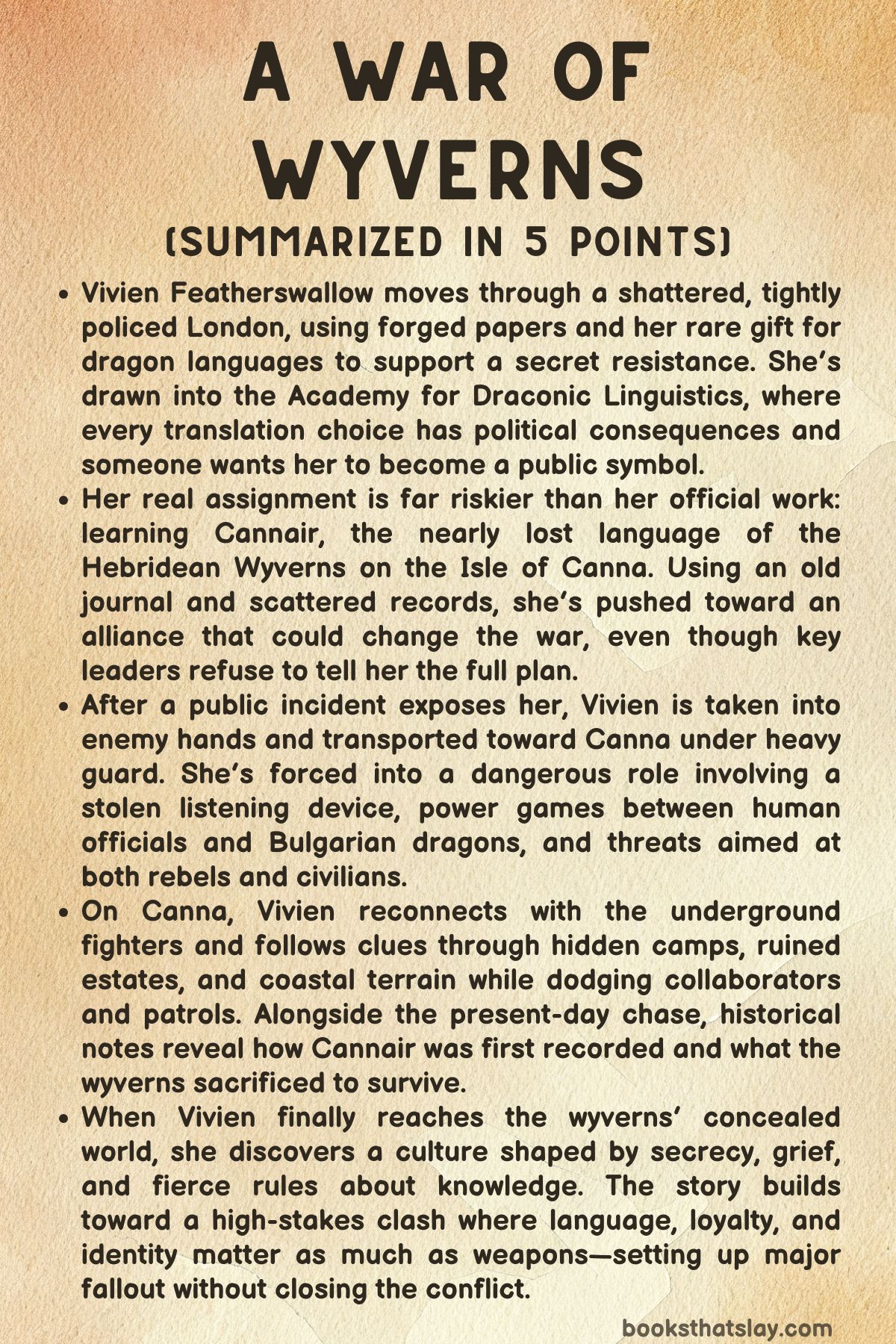
Vivien Featherswallow moves through a battered London at dawn, keeping her head down as armed Guardians patrol and Bulgarian Bolgorith dragons circle above the ruined streets. The city is tense with fear and rumor: rebel attacks are growing, dragon raids have left whole blocks in rubble, and the government’s alliance with Bulgaria is tightening into something closer to occupation.
Vivien carries two things that matter more than food or money: a fake class pass to get her through checkpoints, and a swallow necklace that keeps her anchored to the memory of Atlas, the boy she believes died because of the same struggle she is still fighting.
Vivien’s work is secret, controlled, and risky. She reports to Rita Hollingsworth, Chancellor of the Academy for Draconic Linguistics, who has built a public reputation around scholarship while quietly feeding information to the Human-Dragon Coalition.
Hollingsworth keeps Vivien inside Claridge House, where a Western Drake named Clementius guards the property in hiding. When Vivien enters Hollingsworth’s office, she finds a sketch of herself labeled as a draconic translator.
Hollingsworth explains that rebels need symbols, and Vivien’s face—carefully managed—could become one.
Vivien is furious that her role is being shaped into propaganda without her consent, but she has little room to refuse. Hollingsworth presses her back to work: translating dragon statements and studying the languages the government is trying to erase.
The most urgent task is Cannair, the language of the Hebridean Wyverns, a rare two-legged dragon species believed to survive on the Isle of Canna. Hollingsworth insists the wyverns matter to the war, but refuses to say why, only repeating that Vivien must learn Cannair well enough to secure an alliance.
Vivien studies from the journal of Patrick Clawtail, a linguist executed in the nineteenth century after recording wyvern speech and customs. His notes suggest a culture with strict rules, specialized tools, and a way of communicating that outsiders barely understand.
While Vivien works, the government tightens its grip on speech. The Babel Decree pushes banned languages out of public life, and rumors spread that the Bulgarian dragon tongue, Slavidraneishá, will be forced on the nation as the official draconic language.
Vivien sees what this really is: control disguised as unity. She also sees Hollingsworth’s compromises up close.
In one translation, Hollingsworth edits Vivien’s wording to soften condemnation of Bulgarian brutality, claiming the Academy must maintain its cover because it is watched by the Prime Minister’s office. To Vivien, it feels like lying for safety—and she is tired of being told to accept it.
Restless and angry, Vivien slips into a First Class party after curfew using Hollingsworth’s cover story that she is a niece. There she meets people who treat the war like a dinner conversation, including Hyacinth, Edward, and George Beecham.
The talk turns to the Babel Decree, and then to a new title created for Bulgaria’s leader: Dragon Chief of State for General Goranov. A statue is already planned.
Outside the party, Edward privately admits he has been printing Vivien’s illegal pamphlets defending banned dragon languages, and he gives her a bundle to distribute.
On the way home, Vivien witnesses a Bolgorith burn a Guardian alive—an unmistakable show of dominance. The balance of power is no longer disguised.
She returns to her hidden home in an abandoned sugar factory, where she lives with Chumana, a pink Bolgorith who once attacked Downing Street and now secretly supports the rebels. Chumana confirms the political shift: Britain is being reshaped through Bulgarian power, and Slavidraneishá is part of the leash.
Chumana calls Vivien “the Swallow,” a rebel name that has spread beyond the pamphlets. She also warns that the Hebridean Wyverns are proud, dangerous, and hard to locate.
The next day, Vivien’s pamphlets appear across London. People snatch them up faster than Guardians can tear them down.
When Vivien tries to help a frightened dragonling being prodded by Guardians, the situation turns violent. A parent drake attacks, fire erupts, and panic spreads.
In the confusion, Vivien’s satchel splits and the pamphlets spill into view. She is arrested as a rebel.
To protect Hollingsworth, she destroys her class pass and lets the authorities believe she acted alone.
Vivien is taken to Croydon Airfield, where new fire-breathing planes are guarded by dragons. General Goranov is there and recognizes her from Bletchley Park, a place tied to trauma and Atlas’s supposed death.
Goranov threatens her, but Prime Minister Wyvernmire arrives and interrupts, claiming Vivien as a “passenger” for her personal plane. Wyvernmire says Vivien will be useful on Canna.
During the flight, Wyvernmire interrogates her about rebel leadership and boasts that she intends to end the war near Eigg, where Coalition forces are based. A radio broadcast features Serena’s voice praising “the Swallow,” proving to Vivien that her identity has become public whether she wanted it or not.
On the crossing toward Canna, Vivien meets Daria, a young Bulgarian Bolgorith who speaks politely and warns her to cooperate for now—then escape once they reach the island. When Vivien arrives at a hidden beach camp beneath cliffs, she sees taxidermied wyvern heads in Wyvernmire’s tent, trophies displayed like threats.
She meets Ralph Wyvernmire, the Prime Minister’s nephew and the man responsible for Atlas’s death, and Andronikos Svetoslav, a Bulgarian prince. Wyvernmire unveils a working loquisonus machine smuggled from Bulgaria and orders Vivien to use it to spy on dragon echolocation traffic.
If Vivien refuses, Wyvernmire threatens to torch Eigg.
Ralph corners Vivien privately and offers help, but his help has conditions. He wants Vivien to listen for anything Goranov says about him.
Ralph reveals he has formed a rare human-dragon partnership with Goranov and believes the Bolgoriths will eventually seize control from Wyvernmire. Vivien begins using the machine and hears dense, layered signals—then a clear message directed at her: a voice greets her as “human girl.” Before she can find the source, the camp erupts into chaos.
Dragons attack from the sky. Fire rains down, tents burn, and Chumana appears overhead.
Vivien runs with the loquisonus, trying to reach high ground so Chumana can take her, but the assault fractures the camp in smoke and panic. Ralph pursues her toward the cliffs.
A low whistle sounds nearby.
Vivien is trapped as fire and blood fall around her. Then she sees Marquis among the rocks, waving frantically.
Through the smoke, a rider appears on horseback—Atlas. Vivien is certain he died, yet he speaks to her as if he never left, calling her “Featherswallow,” pulling her onto the horse, and driving them away from gunfire.
Atlas brings her to a hidden settlement behind a flint wall: a rough village where children live in huts and forest shelters. Serena and Gideon are there, wearing rebel armbands.
They explain they were sent to Canna to find the Hebridean Wyverns but have been surviving under constant pressure from soldiers and Bulgarian dragons. Vivien learns the children tie themselves into trees at night to avoid a predator called a Lyndwyrm.
Later, Atlas explains how he survived: Chumana carried him away and used fireblod—blood altered into a healing substance—to save him. Hollingsworth and Chumana kept this from Vivien to keep her focused.
Vivien feels used, lashes out at Chumana when she returns, and says cruel things about Chumana’s past in Bulgaria. Chumana’s rage explodes; huts are damaged, and she flies away.
Jasper, the child leader, expels the rebels.
Forced onward, the group crosses to Sanday at low tide and meets Ruth, leader of a separate clan living in tunnels. Ruth confirms the wyverns exist but are rare and nest on the Skye side.
She also reveals a vital detail: the wyverns are tunnellers, not open-air roamers. The rebels search Canna House, an old research estate, and find detailed dragon records, including watercolours of Hebridean Wyverns and the objects they collect.
But Goranov arrives with Ralph. Vivien is caught, and Ralph demands the loquisonus.
The rebels escape in a scramble through gunfire and chaos, aided by a camouflaged juvenile Western Drake that attacks the pursuing Guardians. Serena is shot but heals herself with fireblod.
A dracovol delivers Patrick Clawtail’s journal and a coded note from Dr Seymour, sent using Gideon’s scent. The directions lead them toward a church landmark and then across to the Skye side near the Stepstones, an alternative nesting area.
With the journal, the loquisonus, and emergency poison pouches from Ruth, the rebels finally have a path forward.
They locate the Hebridean Wyverns’ underground tunnels and enter a hidden world where wyverns spend their days reading human books, making art, and only leaving to hunt. Vivien feels useless among rebels who have practical combat skills.
Atlas becomes distant, refusing her attempts at closeness, and her insecurity grows into anger. Then a wyvern named Cindra secretly approaches Vivien and reveals she can speak English.
Cindra believes Abelio, the wyvern leader, is destroying their culture by keeping them sealed underground, making them obsessed with humans and forgetful of older crafts. She asks Vivien to translate Cannair into English so the Academy will recognize it and preserve it if the wyverns are wiped out.
In exchange, Cindra promises the wyverns will fight. Vivien wants to know what makes them decisive in war, but Cindra refuses to say unless Vivien agrees.
Vivien studies Cannair using Cindra’s written records and learns how hard translation becomes when a language carries concepts English cannot hold. During a flying lesson in a vast cavern, the wyverns demonstrate flawless coordination.
Their echolocation sounds different from other dragons, like layered whispering tones. Marquis earns trust by saving a wyvernling mid-flight.
He is invited to a sacred egg-choosing ceremony where wyverns carefully select eggs from a central fire. Aodahn, a solitary wyvern, chooses an egg and explains that the choice is a commitment.
Later, he tells Vivien that translation can preserve information but not necessarily meaning, and suggests that Clawtail may have stopped translating because a language survives by being spoken, not only stored.
Tensions spike when the loquisonus breaks. Abelio accuses the humans of vandalism, and Vivien suspects he sabotaged it.
Atlas admits what the machine truly does: it detects echolocation, including the wyverns’ sacred mind-language, Smuainswel. The wyverns see this as violation.
Abelio orders the humans out, but Cindra delays the expulsion.
That night, poisonous green gas floods the tunnels. The humans flee with wyverns toward an exit near a hidden waterfall.
Wyvernlings die, many wyverns vanish, and Aodahn’s chosen egg is ruined, killing the unborn wyvernling inside. The grief is collective and loud.
Cindra blames the humans for bringing danger and threatens Vivien as the rebels stumble back into the forest to find Chumana.
The war outside has worsened. They discover evidence of slaughtered dragons and a world collapsing faster than any plan can keep up.
They spy on Ralph and Goranov and witness Ralph cutting his own arms so Goranov can drink his blood as a sustaining resource. They find Clawtail’s grave and a strange claim that wyvern echolocation can heal humans, but they cannot verify it.
Masked youths capture Vivien and her friends; the captors are Freddie’s feral group from Canna, allied with Jasper after Guardians destroyed Jasper’s camp. The captors demand Speerspitzes—dragon-killing guns—hidden near dunes, forcing the rebels into an uneasy bargain.
Soon the rebels spot Speerspitzes being positioned and see Atlas moving inside Wyvernmire’s camp, stealing papers. One newspaper reveals Hollingsworth has been exposed as a rebel and London has fallen.
A report describes the wyverns’ unrecorded tongue and hints their communication includes instinctive mannerisms. The rebels hear screams from a guarded tent and suspect a dragon prisoner.
They plan a rescue: Vivien will distract Ralph while Atlas removes a detonator meant to kill the captive.
Vivien approaches Ralph and lies that she will help with the loquisonus. Ralph leads her into the tent.
Under harsh lights and chains, Vivien sees the prisoner: Chumana, bound and tortured, wings stretched wide.
A massive battle erupts on the beach as Speerspitzes are deployed and riders act as bait to draw dragons into range. Hollingsworth volunteers to lure the Bolgorith regal Krasimir, claiming she can trick him by pretending to accept Bulgarian recruitment.
The fighting lasts for hours. Queen Ignacia arrives, a towering Western Drake, bringing reinforcements and raising hope—until Krasimir kills her by tearing off her head and displaying it in the sky.
Ignacia’s forces panic and scatter.
Chumana is freed and joins the fight. Vivien watches the battle turn desperate.
Speerspitz shots fail to stop Krasimir. Chumana makes a suicidal attack that wounds him badly, but she is targeted.
Goranov dives toward Vivien and breathes fire. Hollingsworth grabs Vivien and commands Chumana to take her.
Viv climbs onto Chumana’s back, and they flee over the sea as Goranov staggers through the sky, weakened by lack of blood.
Ralph fires a Speerspitz sphere at Chumana mid-flight. The blast sends them crashing into a sheltered bay.
Chumana is struck by a poisoned bullet and tells Vivien it is too late. As she fades, she tells Vivien to stop defining herself by titles.
Chumana dies, leaving Vivien shattered.
Ruth finds Vivien and guides her through abandoned tunnels. Atlas is alive, frantic, and relieved—until Vivien tells him Chumana is dead and Ralph shot her.
Atlas then reveals a secret plan the adults kept from Vivien: months earlier, Goranov offered retreat if ten humans a year were sent to Bulgaria as blood perfumers for Regal Vasil, and the first demanded is Vivien, labeled “brasstongue.” Hollingsworth, Dr Seymour, and Atlas knew. Atlas admits he lied to stop it from happening.
Vivien refuses to be handed over while any chance of victory remains.
The survivors regroup in caves packed with injured and frightened people. Hollingsworth announces sabotage of planes, then publicly frames Vivien as a martyr who will “sacrifice” herself to secure Bulgarian retreat.
The crowd surges with anger and desperation. Ruth, furious over dead children, confronts Wyvernmire and later stabs her, leaving her dying.
A last stand forms: Speerspitzes arranged defensively, rifles aimed at Bolgorith eyes, and strict orders to keep Goranov away from Vivien. Vivien contributes a crucial detail: Bolgoriths have poor eyesight but share vision through telepathy, so blinding them disrupts their advantage.
The defenders push out into chaos. A shield formation of Bolgoriths protects Krasimir, and defeat seems unavoidable—until the Hebridean Wyverns arrive.
They release a kill call through echolocation that collapses bonded Bolgorith family groups. Dragons fall into the sea.
Krasimir staggers onto shore, wounded but still lethal.
Atlas and Vivien load a Speerspitz together. Krasimir asks who Vivien is.
She answers that she is just Viv, and she fires, killing him.
Then another Bulgarian battalion arrives—unbonded and unaffected by the kill call. Vivien screams that she will go to Bulgaria if they spare Britannia.
Before the bargain can take shape, foreign dragons and troops surge in from across Europe. Daria calls it foreign aid.
The Bulgarians retreat, and the immediate battle ends, though the threat is not gone. Hollingsworth rewrites the story again to protect the wyverns, crediting foreign aid and heroics while warning privately that the Bulgarian Council of Regals may retaliate.
The survivors board a ship back to London. Vivien throws the loquisonus into the sea, letting go of the version of herself tied to surveillance, coercion, and being used.
But the war refuses to end neatly. Goranov—still alive—attacks the ship and snatches Marquis, carrying him out over the water.
Three days later, Vivien and Atlas return to a London filled with foreign troops, shaken alliances, and fear. As they move through the city searching for safety and family, a radio announcement reports new Bolgorith sightings.
Sirens rise again, warning that whatever pause they have won is temporary.
Characters
Vivien “Viv” Featherswallow
In A War of Wyverns by SF Williamson, Vivien is the story’s emotional and moral core: a young linguist forced into becoming a symbol. She begins as someone who survives by staying small—hiding her face, using forged papers, living in a derelict factory—yet she is carrying something enormous: Atlas’s unfinished work and the belief that language can be resistance.
Viv’s talent is not simply “translation” as a skill; it’s an instinct to notice nuance, power, and the way words can be sharpened into weapons or softened into propaganda. That is why she clashes with Hollingsworth’s edits and secrecy: Viv wants truth and agency, while the adults around her keep treating her as a tool to be deployed.
Across the war, her identity repeatedly gets renamed by others—“Draconic Translator,” “the Swallow,” “brasstongue,” potential “sacrifice”—and her deepest arc is the slow, painful choice to stop living as a title and start living as herself. Her final insistence that she is “just Viv” is not a throwaway line; it is the hard-won rejection of being owned by rebellion, government, romance, or prophecy.
She is also written with sharp flaws that matter: she lashes out when frightened, wounds people with knowledge she shouldn’t use as a blade, and sometimes confuses loyalty with control. Those weaknesses don’t cancel her bravery—they make it costly and real.
Atlas
Atlas functions as both love interest and thematic pressure point: he is the living proof that war turns people into myths, and myths into leverage. His “death” creates the motivational vacuum Viv tries to fill; his return detonates that entire structure, because it forces her to confront not only grief but manipulation.
Atlas is capable, daring, and deeply committed to the cause, yet his devotion comes with a habit of deciding what others “need” to know, especially Viv, and that creates a quiet betrayal under the romance. His distance in the wyvern tunnels—his refusal of affection, his focus on being useful—reads like trauma expressed as utility, a person trying to control fear by controlling outcomes.
At the same time, Atlas is not simply cold; he is tender in bursts, intensely protective, and sincere in the private admissions that he is afraid of losing Viv and afraid of the plans that might require sacrificing her. His moral conflict sharpens when the “Plan B” is revealed: he has participated in a lie meant to keep Viv from being taken as a blood resource, and that lie is both love and paternalism at once.
In the climactic battle, Atlas becomes the partner who shares action rather than direction—loading a Speerspitz with Viv, fighting beside her—and that shift matters, because it signals a relationship evolving away from guardianship and toward equality.
Rita Hollingsworth
Rita Hollingsworth is one of the most complex antagonistic allies in A War of Wyverns by SF Williamson because she embodies the central question of wartime ethics: what are you allowed to do “for the cause”? Publicly, she is the brilliant founder of the Academy for Draconic Linguistics, the person who knows languages can decide alliances and outcomes.
Privately, she is also a strategist who treats narratives as ammunition, openly planning to turn Viv into a recognizable face for Coalition papers and later weaponizing Viv again by framing her as a martyr to calm panic and force compliance. Hollingsworth’s defining trait is control—control of information, wording, movement, and perception—and that control is justified through real danger: the Academy is watched, London is occupied, and one wrong sentence could burn everything down.
Yet the story repeatedly shows that her “necessary” secrecy harms her own side, fraying trust and turning people into expendable pieces. What makes her compelling is that she is not a cartoon villain; she does meaningful work, takes risks, and even steps into bait tactics when others hesitate.
But her version of courage is managerial rather than intimate: she will run toward the battle, and she will also rewrite the meaning of that battle afterward. By the end, she has helped save people while also becoming someone Ruth wants dead, which is exactly the kind of moral fallout the book insists cannot be neatly cleaned away.
Chumana
Chumana is the beating heart of the book’s argument that “monsters” are often manufactured by power, and that redemption is not soft. A pink Bolgorith who once attacked Downing Street, she begins as an improbable ally—someone who should be terrifying, and is, but who chooses to protect Viv and feed the rebellion with air support and brutal honesty.
Chumana’s relationship with Viv is intimate in a way no human relationship fully matches: she provides shelter, truth, mobility, and—through fireblod—literal survival. Yet that intimacy is volatile because it includes history; when Viv throws Chumana’s past in Bulgaria at her, it is not just cruelty, it is weaponizing a person’s shame to regain a sense of dominance in a moment of fear.
Chumana’s violent reaction and later departure underline a key theme: you cannot demand loyalty while denying someone their personhood. Her death is one of the story’s most emotionally coherent sacrifices because it is not “noble” in a clean way; it is the consequence of sustained brutality, poison, betrayal, and war’s tendency to devour even those trying to change.
Her final counsel to Viv—stop defining yourself by titles—lands with force precisely because Chumana herself has been defined as “terrorist,” “dragon,” “asset,” and finally “martyr.” She dies freeing Viv from the same trap.
Prime Minister Wyvernmire
Wyvernmire represents state power wearing the mask of order while practicing coercion and cultural erasure. Her alliance with Bulgarian Bolgoriths and her enforcement of language policy—rumors of Slavidraneishá becoming the national dragon language and the suppression of British dragon tongues—make her less a conventional wartime leader and more an architect of domination through identity control.
Her most chilling quality is how calmly she treats people as cargo: she “claims” Viv as a passenger, threatens to torch Eigg, and deploys surveillance tools like the loquisonus as if morality is an inconvenience. Even her injuries later do not soften her; they merely strip away the posture, revealing fear underneath authority.
Her death at Ruth’s hands is framed less as triumph and more as reckoning: Wyvernmire is confronted not just for politics but for children’s bodies, which forces the narrative to acknowledge that “leadership” is measured in the lives it spends. She is also a warning about collaboration: she believes she can steer Bulgarian power for Britannia’s benefit, and the story repeatedly shows that the dragon alliance is not partnership but dependency.
General Goranov
Goranov is the face of Bolgorith dominance and the book’s study of power sustained by appetite. He is frightening not only because he can kill with flame but because he understands symbolism and fear: he carries the aura of a conqueror whose presence rewrites the rules of the world, as seen when a Bolgorith kills a Guardian casually in the street and when Goranov is elevated with titles and statues.
The most disturbing detail about Goranov is the economy of blood around him—Ralph cutting himself so Goranov can drink—because it turns collaboration into literal nourishment. That dynamic suggests that conquest is not only territorial; it is bodily and intimate, forcing humans to participate in their own subjugation.
Goranov’s strategic weakness—needing blood, flying erratically when deprived—also keeps him from becoming invincible; the story gives him vulnerabilities that are grotesquely biological rather than conveniently moral. He survives, remains a looming threat, and ends the book still capable of snatching Marquis from a ship, which reinforces his function: he is not a boss to be defeated once, but a system of violence that returns.
Ralph Wyvernmire
Ralph is one of the novel’s sharpest portraits of collaboration as self-justification. As Wyvernmire’s nephew and Atlas’s killer, he carries personal guilt and political rot at once, and he tries to launder both through the language of “help.” He offers Viv escape while demanding surveillance, frames his alliance with Goranov as rare and clever, and insists he is the one who sees the coming betrayal—yet he is also actively feeding that betrayal by making himself useful to a dragon hierarchy.
Ralph’s obsession with what Goranov “really thinks” about him reads like paranoia mixed with craving: he wants power, but he also wants recognition from the very force that will never see him as equal. His violence is opportunistic and intimate; shooting Chumana, forcing Viv into the torture tent, trying to control the loquisonus—these are the actions of someone who believes information is dominance and pain is leverage.
He is not driven by ideology so much as by the need to stay on top of the shifting pile, and that makes him especially dangerous, because he can pivot his story to fit any side that keeps him alive.
Serena
Serena is the rebellion’s voice and its nerve. The radio broadcast praising “the Swallow” shows how she understands morale as a battlefield, but the story also grounds her in grit: she is physically present on Canna, shares hunger and fear with the others, and keeps moving even when injured.
Her choice to drink fireblod rather than seek treatment reveals a ruthless pragmatism that mirrors the war’s pressure—survival first, consequences later—and it also subtly connects her to the dragon-human entanglement the book keeps interrogating. Serena’s relationship with Viv is important because it complicates leadership: she inspires Viv, but she also benefits from the symbol of “the Swallow,” meaning she is not entirely separate from the machinery that turns people into banners.
Still, she consistently reads as someone who believes in people more than plans, which is why she remains a stabilizing force when Hollingsworth’s manipulations and Atlas’s secrecy fracture trust.
Marquis
Marquis is the story’s embodiment of loyalty expressed through action rather than rhetoric. He appears first as a signal in smoke—frantic, directing Viv—and later as a uniformed rebel with a swallow armband, which shows he has chosen the cause in a visible, risky way.
His defining scenes emphasize physical courage: he jumps down into a dangerous cavern to free a trapped wyvernling with his bare hands, and he earns Cindra’s respect not through clever talk but through willingness to be hurt for someone else’s life. That matters because the novel is full of language and translation, and Marquis is the counterpoint: he communicates through decisive, compassionate movement.
His abduction by Goranov at the end is not random spectacle; it is the narrative punishing hope right after victory, and it positions Marquis as the cost still unpaid. Being taken out to sea by a living symbol of domination sets him up as a possible future bargaining chip, martyr, or survivor—whatever comes next, his capture ensures the war remains unfinished in human terms.
Gideon
Gideon’s role in the group is built around competence, logistics, and loyalty that doesn’t need applause. He appears in the rebel unit as someone who can get messages delivered through dragon scent, which highlights the quiet infrastructure behind visible heroism.
Gideon’s insistence on escorting Hollingsworth and Sophie when bait tactics begin shows a protective instinct that is disciplined rather than romanticized; he understands that bravery without structure becomes slaughter. He also functions as a stabilizer when conflict inside the group threatens to derail them, often standing closer to practicality than passion.
In a story where many characters manipulate or withhold, Gideon reads as one of the more reliably straightforward presences, which makes him a kind of moral anchor in a plot thick with double meanings.
Edward
Edward, Hollingsworth’s brother, is a reminder that rebellion is often made of small illegal acts repeated until they become a movement. He prints Viv’s pamphlets, distributes banned ideas, and does it from within elite spaces that pretend they are untouched by war.
His importance isn’t in battlefield scenes but in the way he extends Viv’s influence beyond her body: once the pamphlets scatter across London and people read them despite Guardians trying to collect them, Edward’s work becomes the proof that control of language is never absolute. He also complicates class politics, because he uses the privileges of First Class parties and family networks to undermine the regime, implying that resistance can grow even in the rooms that benefit from silence.
Hyacinth
Hyacinth operates as social atmosphere given a face: she is part of the First Class world that chats about decrees, statues, and language policy as if they are interesting headlines rather than lived violence. Her presence helps the book show how authoritarian changes become normalized through gossip and fashionably detached conversation.
Even without direct cruelty, Hyacinth represents the comfort that makes oppression easier, because people like her can treat the Babel Decree as abstract debate while others are beaten in the street. As a character, she is less about plot influence and more about illustrating the moral sleepwalking of privilege.
Daria
Daria is one of the novel’s most interesting “in-between” figures: a young Bulgarian Bolgorith who speaks politely, calls Viv “brasstongue,” and still chooses to warn her in secret. She shows that even inside an occupying force, individuals can resist the script assigned to them.
Daria’s caution—cooperate now, escape later—signals an understanding of survival politics that parallels Viv’s early instinct to hide and endure. When she later returns with foreign dragons and calls it aid, she becomes a hinge between national conflict and wider European involvement, suggesting that not all Bulgarians are identical to the regals and generals leading the violence.
Daria’s decency does not erase the harm of her side, but it complicates the idea that identity determines morality, which is central to a story obsessed with language, labels, and who gets to name whom.
Queen Ignacia
Queen Ignacia functions like a burst of mythic hope—and then a brutal lesson in how hope can be weaponized against you. Her arrival as a massive Western Drake allied with the Coalition feels like the moment Britannia can finally unify, a living symbol that might counterbalance the Bulgarian regals.
Her decapitation by Krasimir is deliberately horrifying because it is not just the death of a powerful dragon; it is the public execution of morale. The parade of her head through the sky is domination as theatre, engineered to break allied cohesion, and it works—Ignacia’s dragons panic and flee.
Ignacia’s role is therefore short but heavy: she is the narrative proving that symbolic victories are fragile, and that war devours icons as easily as it devours civilians.
Krasimir
Krasimir is the apex predator of the battlefield, a regal Bolgorith whose presence turns combat into catastrophe. Unlike Goranov’s sustained menace and political entanglements, Krasimir is written as sheer destructive momentum: he arrives, he kills, he shatters alliances, and he refuses to be straightforwardly countered even by Speerspitz fire.
His function is to force the rebels into innovation and desperation—bait tactics, coordinated firing, exploiting sensory weaknesses—and to make the wyverns’ intervention feel genuinely necessary rather than convenient. The fact that he is only finally stopped when Viv rejects her title and acts as herself turns his death into a thematic victory, not merely a tactical one.
Yet the appearance of a second, unbonded battalion immediately after also shows that Krasimir was never the whole problem; he was an embodiment of the worst of it.
Patrick Clawtail
Patrick Clawtail is a “character” mostly through documents, but his presence shapes the plot as strongly as any living person. As the executed scholar who recorded Cannair and wyvern life, he becomes the story’s ancestor of linguistic resistance, and his journal functions as both map and moral inheritance.
Clawtail’s writings show the tension between preserving a language as data and preserving it as living breath; he can record and name, but he cannot stop eviction, violence, or the silencing of the very people he studies. That limitation echoes forward into Viv’s struggle with translation: she can carry meaning across tongues, but she cannot guarantee the world will honor what it learns.
Clawtail also represents the danger of knowledge in authoritarian systems—his execution is the warning that recording truth can be treated as treason.
Abelio
Abelio, leader of the Hebridean Wyverns, is the guardian of secrecy and the embodiment of survival through concealment. His authority is rooted in fear that outsiders bring death, and the narrative repeatedly validates that fear with the gas attack and the catastrophic losses that follow.
Abelio’s hostility toward the humans, and his suspicion that they vandalized the loquisonus, reflect a leader who sees technology and translation not as neutral tools but as pathways for invasion. His most revealing moment is the anger around Smuainswel, the wyverns’ sacred mind-language: Abelio’s outrage suggests that the deepest betrayal is not physical intrusion but epistemic intrusion—being listened to, decoded, and exposed.
He is not written as cruel for cruelty’s sake; he is written as someone whose responsibility is to keep his people alive, even if that requires shutting doors on the very alliance that could end the war.
Cindra
Cindra is the wyvern who turns the wyvern society from mysterious ally into ethically complicated culture. By speaking English secretly, she reveals that the wyverns are not simply hidden; they are divided, with internal arguments about what concealment has done to them.
Cindra’s critique—that underground life has made wyverns obsess over humans and lose older crafts—frames cultural change as a wound, not a neutral evolution. Her desire for Viv to translate Cannair into English is both preservation and risk: she wants recognition and survival through record, but she also wants to bargain that record for military intervention.
What makes Cindra compelling is that she is not purely altruistic; she is political, strategic, and willing to pressure Viv by withholding the truth about the wyverns’ special advantage. After the gas attack, her fury and threat toward Viv expose the cost of alliance-making: when catastrophe strikes, blame returns to the outsider first, and Cindra’s earlier idealism hardens into protective rage.
Aodahn
Aodahn provides one of the book’s clearest philosophical counterweights to Viv’s faith in translation. Living alone and choosing an egg by committing to it, he expresses identity through responsibility rather than status, which parallels Viv’s later rejection of titles.
His conversation about translation—how it can preserve information but not necessarily meaning—says aloud what the novel keeps demonstrating: languages are not codes to be cracked, they are worlds to be lived in. Aodahn’s loss of the chosen egg in the gas disaster makes him a vessel for collective grief, and the shared wail of the wyverns after the death underscores that what is endangered is not just individuals but continuity itself.
He is a quiet character, but his role is to make the story’s linguistic theme spiritual rather than academic.
Jasper
Jasper is the fierce, exhausted authority figure of the displaced children’s camp, shaped by a world where mercy can get everyone killed. His first instinct is to drive Viv out because she is a beacon for Wyvernmire’s violence, and that instinct is not villainous—it is survival math.
Jasper’s leadership is harsh, sometimes unfair, but it is also grounded in care: he has created systems like sleeping tied into trees to avoid a Lyndwyrm, which shows a practical imagination born of terror. When Viv’s conflict with Chumana destroys huts and destabilizes the camp, Jasper expels the rebels, demonstrating that his loyalty is to the children, not to larger causes.
His later alliance with feral groups after his camp is destroyed by Guardians illustrates how oppression pushes communities into morally messy coalitions; Jasper becomes less a person choosing sides and more a person being cornered into whatever keeps people breathing.
Philippa
Philippa is a small but vital representation of what the war is actually about: children trying to remain children in a landscape that doesn’t allow it. Her excitement in welcoming Viv into “Camp Jasper” injects warmth into a narrative heavy with policy and blood, and it also heightens the horror when later beaches are littered with bodies, including children.
Philippa’s role is not strategic, but emotional and thematic: she shows the cost of adult decisions, and she makes every “necessary” manipulation—Hollingsworth’s propaganda, Wyvernmire’s decrees, the regals’ bargains—feel personally, painfully real.
Ruth
Ruth is the novel’s embodiment of ferocious self-determination. Banished after killing a boy in self-defence, she leads a girls’ clan with discipline, tactics, and a ruthlessness that comes from being punished for surviving.
Her camp’s defence—bait animals, poison pouches, practiced coordination—shows leadership that treats the world as hostile by default, because for Ruth it always has been. She is also the character most willing to say what polite resistance avoids: when children die, she wants names and blood, not speeches.
Her stabbing of Wyvernmire is not framed as clean justice; it is the eruption of grief and rage into action, and it forces the story to confront what war does to moral boundaries. In the final defence, Ruth is also practical—setting circles of guns, ordering shots at Bolgorith eyes, keeping Goranov away from Viv—showing that her violence is not theatrical but functional.
She is, in many ways, the human mirror of the wyverns: protective, uncompromising, shaped by exile.
Freddie
Freddie represents what happens when children’s communities are shattered and survival becomes feral politics. His group’s ambush and their focus on Speerspitzes show how quickly ideals collapse into resource hunger when the world offers no safety.
Freddie is not built as a mastermind; he is a symptom of the war’s cruelty—young people learning that power comes from weapons and leverage, not trust. His alliance shifts, his demands are transactional, and that instability highlights how rebellion is not a single coherent body but a patchwork of frightened groups, each one capable of harming others while still being harmed by the same enemy.
Dr Seymour
Dr Seymour is a quieter architect figure, someone working at the seams between scholarship and survival. The delivery of Clawtail’s journal and the encoded directions using dragon call types show Seymour as a person who understands that knowledge must be operational to matter—information turned into routes, signals, and actionable plans.
Seymour’s presence also reinforces the theme that language study in this world is not academic prestige; it is logistics, rescue, and sometimes the thin line between extinction and alliance. By existing mostly through messages and materials, Seymour becomes part of the story’s broader idea that networks—of people, dragons, documents, codes—are what keep resistance alive.
Andronikos Svetoslav
Andronikos, the Bulgarian prince, functions primarily as a symbol of Bulgaria’s political entanglement with dragon power. His presence in Wyvernmire’s tent alongside taxidermied wyvern heads and the loquisonus machine frames the occupation as not only military but aristocratic and extractive: dragons and humans are both being collected, studied, displayed, and leveraged.
Even without many direct actions, Andronikos contributes to the atmosphere of an elite coalition that treats Britannia as a chessboard and treats rare species—like the wyverns—as trophies or instruments.
Clementius
Clementius, the British Western Drake guarding Claridge House, is an early signal that alliances and loyalties among dragons are not monolithic. His secret guardianship suggests that even within structures controlled by Wyvernmire’s government, there are dragons who protect rebel-linked figures and enable resistance indirectly.
Clementius’s function is to widen the moral landscape: “British dragon” does not automatically mean “state dragon,” and safety in the book often comes from the quiet choices of individuals who cannot openly declare sides.
Ursa
Ursa appears more as a destination than an active figure in the provided summary, but that narrative role still matters. Ursa represents continuity and home—the human relationship anchor that survives outside missions, propaganda, and battlefield alliances.
When Viv and Atlas return to London aiming to reunite with Ursa, the desire signals that the war has not erased ordinary bonds, only endangered them. Ursa’s implied importance is that she is someone Viv wants to be a person with, not a symbol for, which ties directly to Viv’s final rejection of titles and roles.
Themes
Language as Power, Identity, and Resistance
London’s occupation is enforced as much through policy as through fire. The Babel Decree and the push to make Slavidraneishá the national dragon language turn speech into a tool of rule, where controlling which tongues are permitted becomes a way to control who is seen as legitimate.
Vivien’s work is therefore never “academic.” Her talent for languages makes her valuable to every side, because translation decides what the public believes, what allies trust, and what information survives. Even small edits matter: when Hollingsworth changes Vivien’s translation to soften condemnation of Bulgarian dragons, it shows how language can be shaped to maintain cover, manage alliances, and avoid immediate retaliation.
The pamphlets Vivien writes and distributes reveal the other side of the same idea: words can mobilize people, give shape to anger, and keep suppressed cultures present in everyday life even under patrols and curfews. The emotional charge around banned British dragon tongues also clarifies that language is tied to belonging; when a government attacks a tongue, it attacks the people who live inside it.
Cannair raises the stakes further. Concepts in Cannair resist English equivalents, which forces Vivien to confront the limits of translation: she can carry information across languages, but she cannot guarantee that the receiving culture will understand what a word feels like inside the world that created it.
That gap becomes political, because misunderstanding is one of the easiest ways for outsiders to dismiss a community. In A War of Wyverns, surviving a culture is shown as inseparable from keeping its speech alive, and resisting conquest becomes inseparable from refusing to let one official language erase all others.
Betrayal, Secrecy, and the Ethics of “Necessary” Lies
Almost every relationship in the story is strained by withheld information, and the pressure comes from a single recurring justification: necessity. Hollingsworth demands obedience while denying context, arguing that security and cover require compartmentalization.
Atlas and others hide the truth of his survival, claiming that Vivien’s grief will keep her focused and compliant. Later, the secret Plan B—sending ten humans per year to Bulgaria as blood perfumers, with Vivien demanded first—exposes how far that logic goes.
It is not merely a tactical detail; it is a policy that treats human lives as resources in a diplomatic exchange. The revelation retroactively reinterprets earlier choices: moments that looked like protection now read as management, and affection becomes entangled with control.
This dynamic also complicates “good side vs bad side” thinking. Wyvernmire’s threats are overt, but allied deception is quieter and therefore more corrosive, because it arrives wrapped in care and shared cause.
Vivien’s anger is not only personal; it is moral, because the people claiming to fight oppression still make plans that resemble the oppressor’s logic when it suits them. The book also shows why secrecy persists: exposure leads to raids, camps are destroyed, and entire communities die.
The result is a tense ethical landscape where honesty can be lethal, but deception can quietly rebuild the same cruelty the rebellion claims to oppose. Vivien’s arc moves from accepting secrecy as the cost of war to challenging it as a slippery habit.
Trust becomes something that must be rebuilt through accountability, not through emotional appeals. In A War of Wyverns, betrayal is not presented as a single twist; it is a continuing structure that war encourages, because the fastest path to victory often looks like the fastest path to justifying harm.
Coexistence, Exploitation, and the Economics of Blood
The book places human–dragon relations inside systems of extraction. The Bolgoriths’ dominance is not only military; it is built on agreements, titles, and resource flows that reduce bodies to utility.
Ralph’s “pairing” with Goranov is framed as a rare alliance, yet it is soaked in asymmetry: Ralph cuts his own arms so Goranov can drink, turning intimacy into supply. The Plan B makes the underlying economy unmistakable: humans as blood perfumers offered annually to keep Britannia from being destroyed.
This is not presented as a symbolic sacrifice but as an organized arrangement with quotas, expectations, and enforcement. Even Vivien’s linguistic value is treated as a commodity; she is moved, guarded, threatened, and traded because her skills can unlock strategic advantage with the wyverns or expose echolocation traffic.
The loquisonus machine becomes a physical emblem of extraction: a device meant to harvest sound and meaning from dragons without consent, including the Smuainswel that the wyverns treat as sacred mind-language. When Abelio breaks the machine and expels the humans, it reads as a boundary being enforced against a long history of humans treating dragon knowledge as theirs to take.
The theme also extends to the Academy and the state. The government’s control over institutions determines what research exists and for whom, while dragons are deployed as weapons, guardians, and prisoners.
Chumana’s role deepens the complexity because she embodies both violence and care: once an attacker, later a covert ally, and finally a tortured captive. Her death after being shot by Ralph while shielding Vivien exposes the moral bankruptcy of a world where bodies are constantly assigned “use.” The narrative keeps returning to the question of what coexistence would require if it were not based on bargains of pain.
It suggests that peace built on extraction is merely a pause in violence, because it preserves the belief that some lives are currency and some are buyers.
Cultural Preservation Versus Change in Exile and Hiding
The Hebridean Wyverns present a living case study in what happens to a culture forced into concealment. Their tunnels keep them safe, but safety changes them.
Cindra argues that remaining underground has made the wyverns obsess over humans and lose older crafts that required open air and flight, suggesting that survival strategies can quietly rewrite identity. The wyverns’ art-making and reading of human books show adaptation, but also risk: when a community is cut off from its own environment and traditions, the dominant outside culture fills the vacuum.
Cindra’s request that Vivien translate Cannair into English so the Academy will recognize it carries both hope and desperation. Recognition can protect a language by making it “official,” but it can also invite intrusion, classification, and ownership by outsiders.
The tension becomes sharper when Aodahn argues that translation can preserve information but not meaning, and that a language survives through being spoken, not stored. This debate is not abstract; it shapes war strategy, because the humans want an alliance and a “special advantage,” while the wyverns want autonomy and continuity.
Abelio’s fury over the loquisonus machine connects preservation with consent. A language is not only vocabulary; it includes sacred modes of communication like Smuainswel that carry spiritual and communal weight.
When outsiders attempt to capture it as data, the culture becomes an object. The poison gas attack then demonstrates how contact with the wider war can destroy what hiding was meant to protect, and how quickly a small population can lose irreplaceable life.
By the time the wyverns arrive in battle and use a kill call, their participation reads as a decision made under pressure rather than a simple heroic entrance. A War of Wyverns treats cultural preservation as active work that must balance openness with boundaries.
It argues that survival without cultural integrity is a quieter kind of defeat, but that integrity without practical protection can become impossible when violence reaches the doorstep.
Coming-of-Age Through Agency and Self-Definition
Vivien’s growth is measured less by skill mastery than by her changing relationship to choice. At first, she is directed by others—Hollingsworth’s rules, the Academy’s cover, Wyvernmire’s threats, Ralph’s demands, and even the rebellion’s need for a symbol.
Her early rebellion is reactive: stealing a car, attending a party after curfew, distributing pamphlets, acting on anger when she sees a dragonling abused. Those actions show courage but also expose her to capture, which then reinforces how constrained she is by forces larger than herself.
As the story progresses, she begins to see the patterns that trap her: secrecy justified as protection, identity shaped by propaganda, and her own worth reduced to what she can produce. Her conflict with Atlas after reaching the wyvern tunnels highlights a personal crisis: she feels “useless” because others are in demand, and she tries to reclaim closeness as proof she still matters.
When that fails, she swings between resentment and desperation, revealing how agency can be confused with attention or approval. The turning point is not a single victory but a sequence of refusals.
She refuses to accept being traded to Bulgaria while other options remain. She shares tactical insight about Bolgorith eyesight and telepathic vision, contributing as a thinker rather than a mascot.
She takes responsibility for choosing action even when it costs her emotionally, including returning to battle after Chumana’s death. Finally, when Krasimir asks who she is and she answers “just Viv,” it is an act of identity reclamation.
She stops defining herself by job titles, rebel nicknames, or other people’s stories about her. Throwing the loquisonus machine into the sea extends that choice: she rejects the version of herself tied to surveillance, coercion, and strategic utility.
The ending—Marquis taken, sirens rising—shows that self-definition does not end the war, but it changes how she enters the next phase. In the book, coming-of-age is portrayed as learning to choose values in a world that constantly offers roles instead of freedom.