Anne of a Different Island Summary, Characters and Themes
Anne of a Different Island by Virginia Kantra is a contemporary novel about a young English teacher, Anne, who returns to Mackinac Island after her father’s sudden death and finds that grief rearranges everything—family roles, old friendships, work, and the future she assumed she’d have.
Anne measures her life against the promise of being fully known and chosen, the way she once felt while reading about “Anne, with an e.” On the island, she faces her practical, guarded mother, the carpenter who was beside her father at the end, and the question she’s avoided for years: what does she actually want, if she stops building her plans around other people?
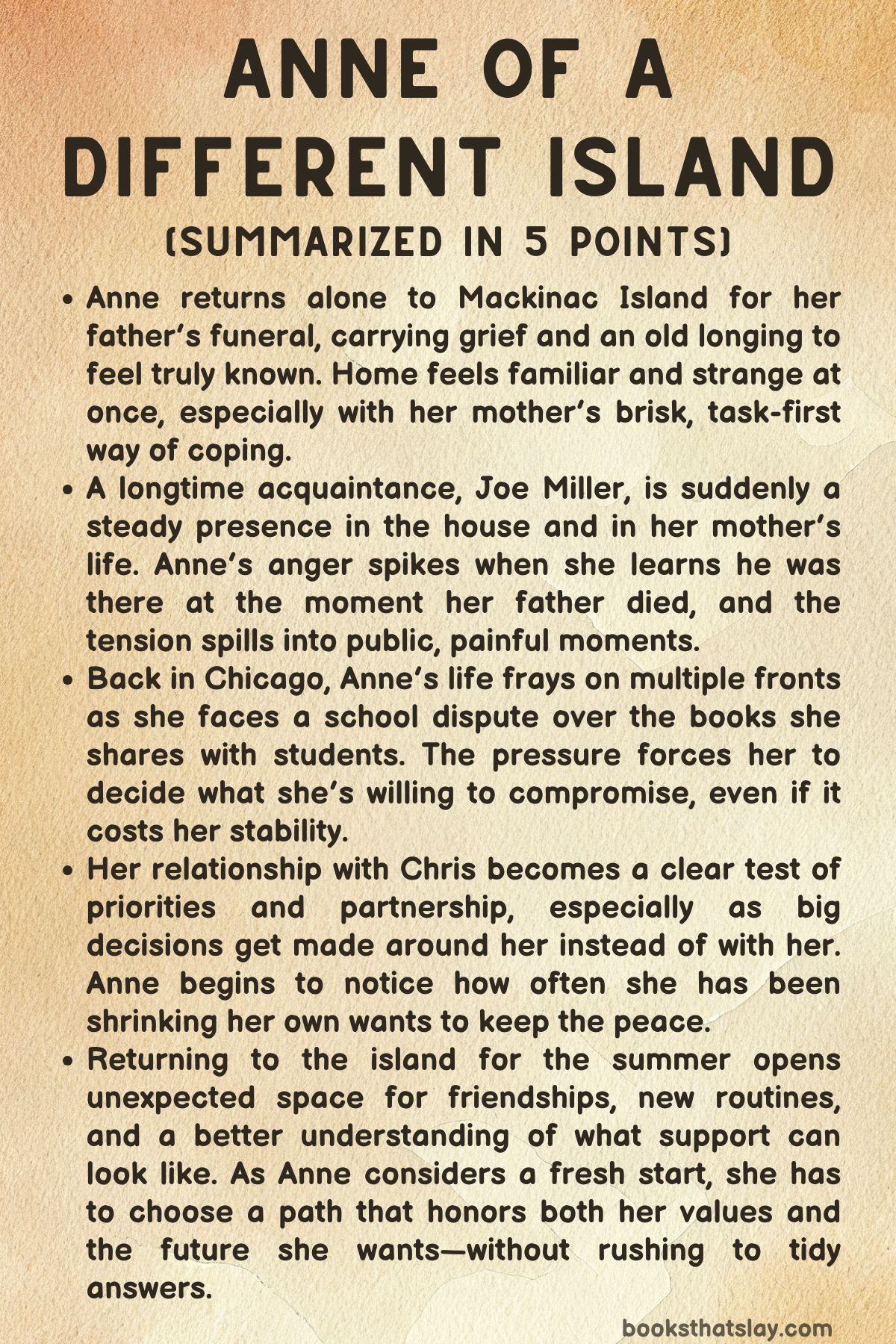
Summary
Anne lands in an airport coffee shop on her way to Mackinac Island for her father’s funeral and introduces herself with a small, private hope: “Anne, with an e.” It’s a line that has mattered to her since childhood, when her father gave her a beloved book during an illness and made her feel seen. The barista writes her name wrong anyway, and the moment sets the tone for how raw and lonely she feels.
She is traveling alone because her boyfriend, Chris, a pediatric oncologist in Chicago, cancels at the last minute when one of his patients is readmitted. Anne tells him she understands, but inside she registers the familiar feeling that she will never come first.
The ferry ride to the island is gray and cold, with tourists absent and locals moving through early spring routines. Anne recognizes people from her childhood—teachers, school staff, neighbors—and realizes how quickly the island can make her feel both anchored and out of place.
She thinks about her parents in contrasting terms: her mother, Maddie, who values order and usefulness, and her father, Rob, who listened to Anne and encouraged her imagination. With Rob gone, Anne dreads being alone with Maddie’s brisk competence and the quiet rules of their relationship.
When Anne arrives, the village is subdued, shops shuttered for the season. A friendly cream-colored dog trots up to her, and its owner calls it back.
The man is Joe Miller, her father’s former apprentice and one of Anne’s long-running irritants from growing up—now older, bearded, and solid in a way that makes him hard to dismiss. Joe helps with her bag without asking and offers a blunt condolence: he’s sorry her dad died.
Anne doesn’t like Joe, but she recognizes the honesty in the sentence, the way it refuses to decorate what happened.
At her mother’s house, Anne notices both neglect and evidence that someone has been trying to keep things from falling apart—repairs made, a step mended, gutters fixed. Maddie greets Anne with a practical instruction about the door and the heat.
Anne hugs her anyway, needing comfort, but Maddie quickly redirects into tasks: food neighbors have dropped off, things to store, arrangements to handle. When Joe arrives and walks in as if the place is partly his, Maddie embraces him warmly.
Anne watches her mother praise Joe and say she doesn’t know what she would do without him, and jealousy flares in a place Anne doesn’t want to admit exists.
Anne overhears tension between Maddie and Joe about something that happened: Maddie calls it an accident, Joe insists he is still responsible. Anne doesn’t know what they mean, but she hears unfinished history in their voices.
The next days are scheduled around ritual—visitation, funeral—and Anne tries to prepare herself by staying busy.
Before the wake, Anne makes an impulsive decision and dyes her hair a vivid red in her mother’s bathroom, leaving a mess. Maddie scolds her for being careless and rushes her along.
At the visitation, the church hall fills with neighbors who offer condolences and familiar phrases. Anne sees photographs of her father and the box holding his cremated remains.
She tries to answer people politely, but grief makes her responses awkward and sharp. When someone offers a religious comfort she can’t accept in the moment, she blurts a reply that sounds wrong even to her and hides in the bathroom, texting Chris like he might steady her through a screen.
Back in the hall, Anne notices Joe near Maddie, making her smile. It needles Anne, because it looks like Joe fits into the family space she fears she’s losing.
Her best friend from childhood, Daanis, arrives and hugs her, and Anne immediately senses the distance time has created. Daanis is pregnant again and has a toddler at home, her life full of responsibilities that Anne once thought they would both escape together.
Daanis offers support but can’t stay long.
A deputy chief mentions they came quickly “as soon as Joe called,” and Anne realizes Joe was with her father when he died. The information hits like a second loss, not because Anne wants her father to have been alone, but because it means Joe was there in a moment Anne can never reach.
Joe explains that he and Rob were repairing rotten fascia on a roof when Rob had a cardiac event and fell. Anne’s shock turns into rage, and she accuses Joe of causing it, saying her father wouldn’t have died if Joe had been the one on the roof.
The accusation erupts in public, and Anne immediately feels exposed. Maddie demands Anne apologize and insists it wasn’t Joe’s fault.
Joe absorbs the attack without fighting back, which only makes Anne feel worse.
At the funeral, Maddie warns Anne not to embarrass her father. The service moves forward with hymns, speeches, and a procession to the cemetery led by bagpipes.
Anne is furious when tourists film the mourners as if it’s entertainment. At the graveside, as her father is lowered into the ground, Anne finally breaks and sobs.
Joe puts a heavy arm around her shoulders, and for a moment his scent reminds her of her father’s workshop. Anne pulls away, ashamed of needing comfort from the man she blamed.
Chris calls that night, and Anne tries to tell him what she feels, but his responses are careful and clinical. He is kind in a distant way, offering practical help and calm words, but not showing up.
Anne considers staying on the island longer to repair things with her mother. Chris tells her to do what she thinks is best and then reminds her that time is a luxury; he chooses patients over personal life, as if it’s a moral truth that should settle the argument.
In the morning, Anne notices her father’s belongings already removed from their usual places. When she suggests going through things together, Maddie pushes her to pack and leave, shutting down the idea of staying.
Back in Chicago, Anne returns to her job teaching English at Ravenscrest. In class, she struggles to keep students engaged while teaching The Great Gatsby and ends up assigning a creative project—students will create Instagram profiles for characters.
The approach works in the moment, but after class Anne learns the principal wants to see her. In his office, she discovers a parent complaint about a book from her classroom “readers’ corner.” The issue isn’t a trendy graphic novel; it’s The Perks of Being a Wallflower, and the parents cite LGBTQ content along with other mature themes.
The principal demands Anne provide a list of all her unofficial classroom books, apologize to the parents, and stick closely to approved curriculum. Anne argues that students need stories that reflect real life, but he makes it clear her job depends on compliance.
That evening, Anne vents to Chris. He listens, but he treats it like minor drama and says parents have rights.
He also hints that Anne’s grief is fueling her reactions. Then he drops another decision: he wants them to live together, and he expects Anne to move with him because he has accepted a fellowship in Atlanta.
Anne is thrilled for a split second and then realizes he made a life plan without her input. She doesn’t fully fight him yet, but a new anger forms: Chris keeps choosing, and Anne keeps adapting.
A few days later, Anne catches Covid. Chris refuses to see her because of his patients and instructs her to quarantine and report symptoms.
He orders groceries and checks on her numbers, but Anne spends the worst days alone, feverish and frightened. She doesn’t tell her mother because she doesn’t want Maddie’s judgment or distance.
Daanis video-calls, concerned, and Anne tries to sound fine. An elderly neighbor, Mr. Banerjee, brings her a tiffin lunchbox, a quiet act of care that lands more gently than Chris’s medical supervision.
When Anne recovers and calls to return to work, she learns the school has hired a substitute for the rest of the year. She is told to come collect her belongings; her classroom books have been boxed up.
The message is clear: apologize and fall in line, or be replaced. Anne refuses to apologize and feels pushed out of the job she cared about.
She gets a tattoo to honor her father: a chisel with his initials and the date he died. When she shows Chris, he scolds her for going out while recovering.
Anne asks him to meet her and talk in person. He says he’s traveling to Atlanta the next day to arrange housing “for us,” again without her.
Something finally snaps into clarity: Chris is building a future that expects Anne to follow. Anne tells him she isn’t moving, and she decides to go back to the island for the summer to think, work, and try to write.
The story also shows Joe’s perspective and his years with Rob. Joe is a carpenter with pride in his work and a life that hasn’t turned out as he expected.
Rob valued him, pushed him to keep dreaming, and spoke of Anne with admiration. Joe’s attachment to the family has roots in those years, as does the guilt he carries about the day Rob died.
When Anne returns to Mackinac for the summer, she starts working at Maddie’s candy shop. She meets coworkers, including cheerful Zoe, and learns she must cover her tattoo while handling food.
Hailey, Joe’s younger sister, joins the staff too. Anne and Joe circle each other with tension that sometimes softens into reluctant warmth.
Anne learns Joe fixed her bike tires. She tries to apologize for what she said at the wake, but the moment slips away.
Anne grows close to Hailey while they wash dishes and talk. Hailey resents Joe’s protectiveness and admits she’s distracted and forgetful.
Anne recognizes the feeling and encourages her to prove she can handle her own life. Anne starts lending Hailey books, and Hailey becomes invested in the old story Anne once clung to as a child.
Wanting to retrieve a volume she loaned out years ago, Anne visits Daanis. Over dinner preparations, Anne admits she and Chris are “taking a break,” and she reveals the school conflict.
Daanis challenges her to stop waiting for other people to make the right choice and instead decide what she wants. The conversation is tense but ends in a renewed honesty between them.
Anne tries to be productive—cooking, writing, building structure—but grief keeps scattering her focus. She decides to claim her father’s shed as a workspace.
Inside, she finds many tools and projects missing, signs her mother has been clearing. The mess she makes while reorganizing triggers Maddie’s frustration, but then Maddie surprises Anne by helping move a desk into the shed.
Anne learns Joe took her father’s workbench. Maddie urges Anne to get along with Joe and admits Joe has been good to her in the months since Rob died.
Anne and Joe take a trip that includes stopping for cherries at a farm stand. Anne chats easily with the vendor, and Joe watches, amused and drawn to her.
They share small, charged moments—Anne feeding Joe a bite, music playing in the truck, the shared cup for cherry pits. Joe feels attracted to Anne and irritated when she mentions buying fruit for Chris, because it signals she still belongs to someone else in her mind even when she’s standing beside Joe.
They travel toward Chicago for Chris’s event. Anne changes clothes in the truck, anxious and determined to arrive looking right.
At the hotel, she’s overwhelmed by the luxury and the hidden rules. Her name isn’t on the seating chart; she’s not truly included.
Chris finds her and smooths things over with a hug and champagne, but his parents are cool, and Anne ends up seated far from him. She watches Chris placed at the center of the room with his family and colleagues while she sits near a service entrance with relatives who barely know her.
A crude cousin flirts and presses too close; Anne threatens him with a fork, furious that she’s trapped in a corner both socially and literally.
Chris apologizes for the seating, but then tells her the next day’s lunch is “immediate family only,” and he can’t even commit to wanting her there. A coworker named Lauren introduces herself and calls herself Chris’s “work wife,” casually signaling closeness and shared status.
Chris confirms he’s staying at the hotel and offers Anne the apartment code as if that’s enough. Anne realizes, with painful certainty, that Chris won’t choose her.
She confronts him, crying, and says there is no room for her in his life. Chris blames her too, pointing out she ended things when he announced Atlanta, as if that erases how he kept making decisions alone.
Anne texts Joe to pick her up. He finds her outside the hotel, shaken and humiliated, and brings her to the apartment he’s using for work.
He makes tea, listens, and doesn’t ask her to be smaller. Anne admits she built her pandemic years around Chris and feels like she lost time.
Joe shares that his own marriage ended and that he misses the life he thought he’d have. They sleep on the same sofa bed with restraint and tenderness.
In the days that follow, Anne spends time alone in the city—walking, visiting a library, eating pastries—testing what it feels like to exist without Chris’s orbit. When she rejoins Joe and his friends for pizza, the group teases them about being together, and Anne blurts out her breakup story.
Later, alone again, Anne asks Joe to kiss her. He says it’s a bad idea but kisses her gently, then pulls away, trying to protect them both.
Back on the island, Anne returns to the candy shop and helps plan a tea party with Hailey and Zoe. The chemistry between Anne and Joe is obvious to everyone but them.
Anne insists they’re just friends, partly because she’s afraid of wanting Joe too much and partly because she’s still learning how to choose anything for herself.
Beverly Powell, someone who has known Anne for years, invites her in for advice. Anne explains the school has boxed up her library and is pushing censorship.
Beverly tells Anne not to return if it means betraying her beliefs, even though Anne worries about abandoning students. Beverly reminds her there is a teacher shortage and that Michigan and Illinois have reciprocity options.
Zoe adds that the island school needs a substitute teacher for the academic year. The job isn’t permanent, but it could give Anne space to breathe and decide her next steps.
Anne begins clearing out her childhood bedroom, donating and discarding items that no longer fit her. The act is both grief work and self-definition.
Maddie comes home, and Anne tells her she feels like she’s been stuck for months but is finally letting go. Anne admits she quit Ravenscrest by email and is thinking about getting licensed in Michigan and applying for the substitute job.
Instead of disapproval, Maddie confesses it has been good to have Anne around since Rob died, and she admits she encouraged Anne to leave because Maddie herself never did.
Maddie then brings Anne to Rob’s workshop, now cleaned and organized. Joe helped with the tools, and the space has been prepared so Anne can use it as her own—writing, working, building a life that isn’t borrowed from someone else’s plans.
Anne is overwhelmed, and mother and daughter share a rare moment of closeness as they move Anne’s old desk into the shed.
When Daanis goes into labor suddenly, Anne stays calm and capable, helping with Rose and coordinating calls while Joe assists with practical tasks. The emergency sharpens Anne’s sense that she can be relied on, that she isn’t just the person who falls apart.
But soon after, Anne and Joe clash. They agree to meet, and at the Mustang Lounge Anne sees Joe’s ex-wife Brittany flirting with him.
Anne announces she’s applying for the substitute job and plans to stay. Joe responds warily, asking what happens after the year and pointing out Chris still texts her.
Anne blurts that she loves Joe. Joe refuses to accept it, accusing her of using him as a backup plan, and says something cruel that links Anne’s pain to her father, implying she uses people the way she thinks she was used.
Anne breaks down publicly, defends her father’s love, insists she truly loves Joe, and storms out when he doesn’t follow.
Anne interviews with Principal Olson and gets the substitute position. She drives to Chicago alone to pack up her apartment and collect what remains of her classroom books.
She runs into Sarah, her former mentor, and learns Sarah actually defended her and could have saved her job, which gives Anne closure: she isn’t leaving because she failed, she’s leaving because she won’t surrender her values.
That night in Chicago, Chris shows up and tries to pull Anne back into his future. He talks about Atlanta and says he misses her.
Then he proposes with his mother’s ring. Anne refuses.
She explains that she loved the idea of him and the stability he represented, but that she’s choosing her own life now—teaching, writing, and space to become herself. She tells him goodbye and means it.
On the ferry back to Mackinac, Anne feels relief and fear at once, especially about Joe. When she arrives at the dock, Joe is waiting with his dog and a dray to help with her boxes.
He asks to speak in person. In the workshop, he apologizes and then shows her what he built: a new writing desk made from her father’s workbench, carved with Anne’s name.
The gesture isn’t flashy; it’s specific, attentive, and rooted in what Anne needs. Anne realizes Joe listened when she talked about creating a place to write and start again.
They kiss. Anne tells Joe she’s staying for at least nine months and may pursue a permanent role if Beverly retires.
Joe admits he loves her and wants a life with her, not a temporary arrangement. Anne accepts the possibility of that commitment without losing herself inside it.
The story moves forward to June 2025: Anne is now teaching full-time, giving a graduation speech, surrounded by her island community—friends, students, her mother, and Joe—showing that her life has shifted from waiting to be chosen to choosing, step by step, where she belongs and what she will build.
Characters
Anne
Anne is the emotional center of Anne of a Different Island, and nearly every relationship in the story refracts through her grief, her longing to be chosen, and her stubborn insistence that stories and people deserve more nuance than the world often allows. Her identity is built from two competing inheritances: her father’s encouragement of imagination and her mother’s devotion to order and usefulness, and she spends much of the book testing which inheritance will define her adult life.
The “Anne, with an e” moment at the airport shows how desperately she wants recognition that feels intimate rather than generic, and how easily she is wounded when that recognition doesn’t come. After her father’s death, her anger becomes a form of protection—especially anger directed at Joe—because rage is easier to carry in public than the rawness of being helpless, abandoned, and afraid of loving someone who might not stay.
As a teacher, Anne’s values become visible in her choices: she believes difficult books make room for difficult lives, and her refusal to apologize to the Quinns is not just professional pride but a moral line that proves she is willing to lose security rather than betray what she thinks students need. Across the novel, Anne’s growth is not a tidy transformation into calm acceptance; it is a slow learning to distinguish between attachment that shrinks her, as with Chris’s constant “later,” “not now,” and “my priorities,” and attachment that makes room for her, as she eventually experiences with her mother, her friends, and Joe.
By the end, she earns a new version of home, not by returning to childhood, but by renegotiating it—claiming space for her writing, choosing work that aligns with her beliefs, and allowing love that does not require her to disappear.
Joe Miller
Joe begins the story as an old irritant from Anne’s childhood and becomes the person who most consistently tells the truth without ornament, which is both his flaw and his strange kind of tenderness. His bluntness works like a tool: it can repair, but it can also bruise, and he often reaches for responsibility the way other people reach for comfort.
His relationship to Anne’s father defines him early—apprentice, coworker, the one who stayed—and that loyalty becomes complicated when Rob dies while working with him, leaving Joe to carry guilt that he can’t “logic” away. Joe’s sense of duty is almost reflexive: he shows up, fixes things, loads bags into carts, mends steps and gutters, and keeps moving because stopping would mean feeling the full weight of what he couldn’t prevent.
Yet underneath the competence is a man who is lonely, disappointed by the gap between the life he expected and the one he has, and frightened of being wanted only as a second choice. That fear explains why he resists Anne’s declaration of love and lashes out with a comparison designed to hurt; he is trying to protect himself by rewriting her feelings as temporary, grief-driven, or convenient.
Joe’s arc is partly romantic, but it is also moral: he learns that caretaking is not the same as controlling, and that love requires letting Anne decide her own future rather than assuming he knows it. The desk he builds from Rob’s workbench becomes his most honest language—an apology made out of attention—because it proves he listened to what she needed and chose to honor it.
Maddie
Maddie is the novel’s most misread character inside the story and, arguably, its most quietly vulnerable one, because her love is expressed through control, practicality, and constant movement. She prizes usefulness and order not because she lacks emotion, but because emotion threatens to overwhelm her, and tasks give her a structure she can survive inside.
Her first interactions with Anne after the death—closing doors, putting food away, managing neighbor casseroles—show how she translates grief into logistics, as if keeping the household running can keep her from falling apart. Maddie’s closeness to Joe becomes a flashpoint for Anne’s jealousy, but it also reveals Maddie’s isolation: with Rob gone, Joe is the person who knows the daily realities of what needs fixing, and he is physically present in a way Anne’s adult life has not allowed her to be.
Maddie’s habit of throwing away Rob’s belongings reads as cold to Anne, yet it can also be understood as self-preservation—an attempt to reduce the constant triggers of loss—and as a statement of agency in a house that suddenly feels haunted by absence. Importantly, Maddie is not static; she eventually admits she pushed Anne to leave because Maddie never did, which reframes her harshness as a complicated kind of maternal ambition mixed with regret.
Her decision to help create the workshop space for Anne is Maddie learning a new vocabulary of care: not just “be useful,” but “take up space,” and that shift is one of the book’s deepest reconciliations.
Chris Harris
Chris represents the kind of adulthood Anne thought she was building: respectable, purposeful, and structured around sacrifice, but his version of sacrifice leaves very little room for mutuality. He is not a cartoon villain; he is consistent, and that is precisely the problem, because his consistency is built on the assumption that his work will always outrank Anne’s needs, and that she should quietly accept being scheduled around his priorities.
His cancellations, his clinical sympathy during grief, his refusal to see her when she is sick, and his habit of offering logistical solutions—apartment codes, advice to rest, access rather than presence—all convey the same message: he can be responsible without being emotionally available. The Atlanta fellowship reveals how he makes life-defining decisions unilaterally, treating Anne as an accessory to his plan rather than a partner with her own trajectory.
The hotel dinner crystallizes his values under pressure: he understands optics, hierarchy, and family approval, and he relegates Anne to the margins rather than challenging the arrangement. Even his proposal, coming after distance and after her life has already begun to shift, feels like an attempt to secure a version of the future that suits him more than it honors her.
Chris’s role in the novel is to force Anne to confront a painful truth: being loved by someone who is “good” on paper is not the same as being chosen in practice.
Rob
Rob is the story’s absent presence, the gravitational force that shapes Anne’s past and the silence that exposes every crack in the surviving relationships. He is defined less by grand gestures and more by the consistent way he made space for Anne’s inner life—listening, encouraging her plans, affirming that he was never disappointed in her.
That unconditional regard becomes Anne’s anchor and her measuring stick: it’s why she flinches at conditional love, why she reacts so fiercely when Joe suggests she uses people, and why she struggles to accept comfort from the person she blames for Rob’s death. Rob is also a bridge between Anne and Joe, because he saw goodness in Joe and urged him toward dreams, which implies that Rob valued not just accomplishment but becoming.
His death is not simply a plot event; it triggers a crisis of belonging for Anne, because losing the parent who understood her imagination makes her fear she will be left with a world that only rewards practicality. The objects he leaves behind—the workshop, the tools, the absence at the table—become emotional terrain that Anne and Maddie must renegotiate.
In the end, Rob’s legacy is not only grief; it becomes a foundation for Anne’s future, symbolized by the workbench turned into her writing desk, transforming what he built with his hands into a space for what she will build with words.
Daanis
Daanis embodies the life Anne once imagined as a shared trajectory and then experienced as a divergence, making her both a beloved friend and a living reminder that people choose different forms of fulfillment. She is not framed as someone who “settled” so much as someone who accepted a life rooted in community, family, and continuity, even if it looks smaller from the outside.
Anne’s bitterness around Daanis’s wedding and later her pregnancies exposes Anne’s fear of being left behind and her tendency to interpret others’ choices as rejections of their shared dreams. Yet Daanis continues to show up with honest care—hugging Anne at the visitation, checking on her when she has Covid, challenging her to focus on what she wants rather than what she expects others to do.
Their reconciliation matters because it requires Anne to release the idea that friendship must mirror identity in order to remain real. Daanis’s labor scene becomes a turning point because it places Anne in a role of competent support, proving she can be steady when someone else needs her, and it also forces contact between Anne and Joe in a situation where the priority is life, not pride.
Through Daanis, the novel argues that staying is not automatically failure, and leaving is not automatically growth; the meaning comes from whether the choice is owned.
Hailey
Hailey functions as a mirror and a catalyst for Anne, representing a younger version of the same struggle: wanting independence while still being treated as someone who needs managing. She enters as Joe’s little sister under his protective shadow, and her resentment toward that protectiveness reveals the tension between care and control that the novel explores repeatedly.
Hailey’s distractibility and her suspicion that she has ADHD bring a contemporary, compassionate thread into the story, and her willingness to name what she’s experiencing contrasts with Anne’s earlier habit of translating pain into anger or silence. The bond between Hailey and Anne grows through books, which is significant because it ties Anne’s identity as a teacher and reader to a tangible act of mentorship outside the classroom, especially after her school experience turns punitive.
Hailey’s engagement with Anne of Green Gables is also thematically loaded: she is literally reading the story that shaped Anne’s sense of being seen, suggesting that recognition can be passed forward rather than hoarded as nostalgia. Hailey’s presence helps move Anne from self-absorption into generativity—proof that Anne can be someone who steadies another person, not just someone who is destabilized.
Zoe
Zoe brings lightness without being shallow, and she serves as one of the story’s quiet assurances that Anne’s world can expand beyond grief and conflict. In Anne of a Different Island, Zoe’s cheerfulness at the candy shop is not just tonal relief; it models a version of community that is easy, present, and not earned through suffering.
She notices the chemistry between Anne and Joe and teases Anne in a way that gently pushes Anne to acknowledge what she’s feeling rather than hiding behind denial. Zoe also provides practical belonging by involving Anne in plans like the tea party, giving her a role that is not defined by being someone’s daughter, someone’s girlfriend, or someone’s employee under scrutiny.
Her mention of the island school’s staffing needs becomes a meaningful pivot because it turns Anne’s crisis into a possibility, showing how casual connections can open doors. Zoe represents the new life Anne is building—one that includes friendship, work, and daily rituals that don’t revolve around proving herself to anyone.
Beverly Powell
Beverly is a community elder figure who offers Anne something rare in the story: counsel that is neither sentimental nor punitive. She recognizes Anne’s patterns—how Anne uses fudge deliveries as a shorthand for needing forgiveness or advice—and she meets that pattern with clarity rather than judgment.
Beverly’s guidance reframes Anne’s teaching crisis in empowering terms: refusing censorship is not “throwing everything away,” it is choosing integrity, and there are practical pathways forward because the world needs teachers. She becomes the voice that separates permanence from possibility, emphasizing that a choice can be a breathing space rather than a lifelong sentence.
Beverly’s presence also expands the idea of family; she is part of the island network that holds people up when biological family is strained. By directing Anne toward licensure reciprocity and by validating her instincts, Beverly helps Anne translate raw conviction into a workable plan, which is exactly what Anne has struggled to do since her father’s death.
Sarah
Sarah is both friend and institution, embodying the complicated reality that allies within systems are still constrained by the systems they work inside. She initially appears as a supportive department head who understands Anne as a teacher and as a person, telling her to take the time she needs and offering a sense of safety at work.
Yet she also delivers hard news—about substitutes, about the consequences of not apologizing—and those moments can feel like betrayal to Anne even when Sarah is trying to protect her. The later revelation that Sarah defended Anne and saved her job reframes Sarah’s earlier caution as strategy, suggesting she has been fighting behind the scenes in ways Anne couldn’t see while she was sick and grieving.
Sarah’s role highlights one of the book’s central tensions: integrity can be costly, and sometimes the people who support you do so imperfectly, balancing risk, politics, and care. Her confrontation with Anne at Ravenscrest becomes a form of closure, allowing Anne to leave not as someone purely cast out, but as someone choosing her own path with fuller knowledge of what happened.
Principal Jim Curtis
Curtis represents institutional authority shaped by fear of conflict and by deference to parental power, and his presence turns Anne’s teaching philosophy into a real-world test. He frames education as compliance—approved curriculum, lists of unofficial books, apologies as damage control—reducing literature to a liability rather than a tool for empathy.
His emphasis on the book’s LGBTQ content alongside sex, alcohol, and violence exposes how “inappropriate” becomes a catchall label that can hide prejudice and discomfort under the language of protecting children. Curtis’s implied threat to Anne’s job is significant because it weaponizes stability against conviction, forcing Anne to decide what she is willing to lose for what she believes.
He also symbolizes the kind of adult world Anne is rejecting: one where order matters more than truth, and where difficult conversations are avoided by removing the stories that might provoke them.
Colin Quinn
Colin exists mostly through the controversy around the book he borrows, but his significance is emotional rather than plot-heavy: he is the student Anne is trying to protect in principle, whether or not the narrative shows his interior life directly. He becomes the focal point of a power struggle between a teacher’s judgment and parents’ control, and the fact that the complaint targets LGBTQ content suggests the stakes could include a student’s right to see themselves reflected safely in literature.
Anne’s refusal to apologize is partly about her own autonomy, but it is also about refusing to treat a student’s reading as shameful or dangerous. Colin thus represents the unseen young people whose needs are often discussed without being centered, and he anchors the ethical seriousness beneath Anne’s professional crisis.
Mr. Banerjee
Mr. Banerjee appears briefly, but he carries symbolic weight as a figure of quiet mutual care, showing Anne what community can look like outside romance and family tension. His act of bringing a tiffin lunchbox during Anne’s illness is a simple, culturally specific gesture that communicates nourishment, respect, and memory—repaying kindness with kindness rather than with grand declarations.
He contrasts sharply with Chris’s distant caretaking because Mr. Banerjee’s support is embodied and immediate, offered without making Anne feel like a problem to manage. His presence reinforces one of the novel’s gentler claims: being cared for can be ordinary, local, and unshowy, and sometimes it arrives from people who owe you nothing.
Mrs. Mosley
Mrs. Mosley represents the island’s social memory and its sharp-edged expectations, the kind of person who turns private grief into public performance standards without necessarily meaning cruelty. Her pointed question about Anne’s “fiancé” exposes how quickly communities assign roles and how those roles can shame someone who doesn’t fit the expected narrative of partnership and propriety.
She also reminds Anne that returning home means returning to a place where people remember the child you were and feel entitled to interpret the adult you are. Mrs. Mosley’s presence intensifies Anne’s sense of being watched and judged, which helps explain why Anne’s anger and humiliation at the wake cut so deeply—because the island is not anonymous, and every misstep becomes part of communal lore.
Principal Olson
Principal Olson is one of the story’s steadier adult figures on the island, representing a kind of leadership grounded in need and practicality rather than politics. His role matters less for personal drama and more for what he offers Anne: a chance to reenter teaching on terms that don’t require her to betray her values.
By hiring her as a substitute, he becomes a doorway into reinvention, aligning with the island’s broader theme that home can be a place of forward motion, not just regression. His presence also completes a loop from Anne’s childhood memories to her adult choice to build a life there, suggesting that the community she once fled can also be the community where she becomes fully herself.
Deputy Chief Petrovski
Deputy Chief Petrovski appears at a critical moment, and his brief role underscores how quickly death turns into procedure while the bereaved are still trying to understand what happened. His comment about arriving quickly “as soon as Joe called” inadvertently reveals the truth Anne didn’t know—that Joe was present when Rob died—and sets off the confrontation that becomes one of Anne’s most humiliating public moments.
Petrovski functions as a reminder that in small communities, information travels through official and unofficial channels at once, and that grief often includes the shock of learning new details too late, in rooms full of witnesses.
Brittany Wilson
Brittany operates as a pressure point in Joe’s storyline, not because she is developed as a full antagonist, but because she embodies Joe’s past and the insecurity that past triggers for Anne. Her flirtation while serving at the Mustang Lounge catalyzes Anne’s fear that Joe’s affection is unstable or that she is replaceable, especially after Chris made her feel peripheral and unwanted.
For Joe, Brittany represents an earlier life that didn’t hold—marriage, expectations, disappointment—and her presence tempts him toward familiar patterns even if he claims nothing is happening. Brittany’s narrative function is to expose what Joe and Anne still don’t trust: that love can be chosen deliberately rather than stumbled into or used as a consolation prize.
The conflict she sparks forces the couple to confront the ugliest version of their fears—Anne’s fear of being second, Joe’s fear of being backup—and makes their eventual reconciliation feel earned rather than merely romantic.
Lauren
Lauren is the embodiment of the world Chris actually belongs to, the professional ecosystem where closeness is coded as teamwork and intimacy is justified by shared ambition. Her “work wife” label is both casual and cutting because it names an emotional partnership Chris has normalized without recognizing how it diminishes Anne.
Lauren’s confident, career-forward chatter implicitly positions Anne as an outsider to the residency story, the hospital hierarchy, and the future Chris is pursuing, and her presence at the main table underscores the social reality Anne feels in her bones: Chris’s life has a center, and Anne is not in it. Lauren is not necessarily malicious; she is simply aligned with Chris in values and proximity, which makes her a powerful contrast to Anne and clarifies why Anne cannot win in a relationship structured around Chris’s world.
Kelsey
Kelsey appears as a generous, grounded figure in Chicago, providing the literal shelter Anne needs when she leaves the hotel and the emotional shelter of a space where she is not being evaluated. Her apartment becomes a liminal home where Anne can fall apart safely and then begin rebuilding, and Kelsey’s friendliness shows Anne what uncomplicated welcome feels like after a night of exclusion and humiliation.
Kelsey’s friend group also offers Anne a social mirror that is less harsh than her own inner critic; their teasing may be crude, but it is also a form of communal processing that pulls Anne out of isolation. Kelsey thus functions as an enabling environment for Anne’s transition, a place where the story pauses long enough for Anne to recognize she can survive on her own.
Rose
Rose, Daanis’s toddler, is a small but important symbol of continuity and responsibility, anchoring adult choices in daily care rather than grand plans. Rose’s presence forces Anne into the practical, tender tasks of love—staying behind, comforting a child, folding clothes—especially during the labor emergency.
When Anne promises to stay with Rose, it demonstrates a version of adulthood Anne has resisted: showing up, staying steady, and being needed in ways that cannot be performed or postponed. Rose represents the future that keeps arriving regardless of grief, and she helps frame Anne’s growth as movement toward commitment rather than away from obligation.
Namid
Namid’s birth marks a turning point that reorders priorities and exposes character under pressure. Namid’s arrival brings urgency that temporarily dissolves romantic tension and pride, compelling Anne and Joe to cooperate and revealing Anne’s competence in crisis.
The newborn also symbolizes new beginnings within a story shaped by death, loss, and endings, reinforcing the idea that Anne’s life is not only about what she has lost but also about what she can still build. By the time of the epilogue, Namid becomes part of Anne’s chosen family landscape, evidence that the relationships she recommits to are living, growing, and rooted in the island.
Mary Brooks
Mary Brooks appears briefly at the farm stand, but she functions as a spark of warmth and possibility, a stranger who witnesses chemistry and normalizes pleasure. Her easy conversation with Anne and her offering of goat cheese and jam creates a small pocket of abundance—food, humor, goats, simple generosity—that contrasts with the tightness of grief and conflict elsewhere.
The scene matters because it frames Anne and Joe’s attraction in an everyday context rather than a dramatic one, suggesting that intimacy can arise naturally inside ordinary life. Mary’s presence also highlights Anne’s social gifts—her ability to connect quickly, charm genuinely, and make strangers feel like neighbors—which is part of what makes the island both her past and her future.
Ned
Ned’s role is largely functional—packing up Anne’s boxed books—but that function carries emotional weight because it symbolizes the institutional stripping of Anne’s teaching identity. The image of her classroom library being packed and removed turns a political conflict into a personal violation, making the cost of censorship tangible.
Ned is not portrayed as a villain; he is a worker executing decisions made above him, which reinforces one of the story’s bleak truths: harm is often delivered impersonally, by people simply doing their jobs. His presence underscores Anne’s sense of being pushed out and replaced, intensifying the clarity of her eventual choice to leave that environment entirely.
Mr. Garcia
Mr. Garcia, the hotel manager, appears in a moment designed to amplify Anne’s vulnerability, and his professionalism becomes another form of gatekeeping. His escorting Anne toward the event after she cannot check her bag because she is “not a guest” underscores how status and belonging can be policed through small rituals—names on lists, seating charts, access to space.
He is not cruel, but his role emphasizes the humiliation Anne feels: she has arrived believing she matters, only to discover she is administratively invisible. This interaction deepens the emotional impact of the dinner scene by showing that Anne’s exclusion is not only interpersonal; it is structural, built into the event’s design.
Zack
Zack remains mostly offstage, but his absence during Daanis’s late pregnancy adds texture to the theme that partnership is measured by presence, not titles. Daanis’s wish that Zack were home parallels Anne’s wish that Chris would show up, creating a quiet echo across two relationships with different shapes.
Zack’s absence is not framed as abandonment in the same way Chris’s is, but it reinforces the story’s ongoing question: when life becomes messy and urgent, who appears in the doorway? By making Zack a felt absence rather than a developed character, the narrative keeps the focus on how women support one another when men are elsewhere, whether by necessity or by choice.
Themes
Grief, blame, and the difficult work of forgiveness
Anne’s return to Mackinac Island after her father’s death exposes how grief can look less like quiet sadness and more like anger, accusation, and the desperate need to pin the unthinkable to a single cause. When she learns Joe was present at the moment her father died, she latches onto him as the most visible target for pain that has no clean place to go.
The outburst at the visitation is not only about what happened on the roof; it is Anne’s panic at the idea that death can arrive without permission, without fairness, and without a story that makes sense. Her humiliation afterward deepens the spiral because she feels judged in the very space where she most wants to be held.
Even her body seems to betray her at the gravesite: she wants comfort, but recoils when Joe offers it, as though accepting support from him would erase her father or pardon the event too soon. The book keeps returning to how grief complicates perception—how it narrows options until “fault” feels like the only language that can match the intensity of loss.
Forgiveness, then, is not presented as a moral choice Anne makes once; it becomes a slow rebuilding of reality where Joe is allowed to be a full person again rather than a symbol of the day everything collapsed. Anne’s eventual movement toward him does not cancel the harm of her earlier accusation, and it also does not excuse the pain that created it.
Instead, the story shows forgiveness as something earned through time, accountability, and actions that match what words cannot repair—especially when apologies are awkward, incomplete, and still necessary.
The hunger to be chosen and the cost of being “second”
Across Anne’s relationships, a repeating ache appears: she wants to matter first to someone, without bargaining for it, without having to be endlessly understanding. Chris’s absences are often morally defensible—his patients are sick children—and that is precisely what makes the abandonment sharper.
Anne cannot argue with the importance of his work, yet she also cannot ignore how often she is expected to shrink her needs so he can remain uninterrupted. She performs “it’s okay” because she thinks love requires it, then resents herself for being so easily postponed.
That pattern reappears in Chicago at the graduation dinner, where social choreography places Anne literally and emotionally at the margins. The seating chart becomes a blunt diagram of her role in Chris’s world: present, tolerated, and easy to set aside when his parents, colleagues, and career are in the room.
Even Lauren’s “work wife” talk functions as a warning that intimacy has already been claimed elsewhere. Anne’s breaking point arrives when Chris offers logistics instead of presence—door codes, apartments, vague sympathy—because it confirms she is convenient, not central.
What makes this theme resonate is that Anne’s desire to be chosen is not shallow romance; it is tied to the earlier loss of her father, the one person who made space for her imagination without demanding she earn it. After that anchor is gone, every relationship becomes a test: will anyone choose her without conditions?
The story doesn’t suggest she needs constant priority over others, but it insists that adulthood cannot be an endless exercise in accepting less than mutual commitment. Anne’s refusal of Chris’s proposal later underscores this shift: she rejects a symbolic upgrade that arrives too late and under the shadow of someone else’s expectations.
Being chosen finally becomes inseparable from choosing herself.
Home as a place that changes, and the choice to rebuild belonging
Mackinac Island is not presented as a simple comfort zone; it greets Anne with empty streets, shuttered shops, and the eerie feeling of returning to a place that holds your past but cannot return it intact. The island becomes a pressure chamber where old versions of Anne collide with the person she has become in Chicago.
Seeing former teachers, feeling the bleak spring weather, and moving through her mother’s house all emphasize that “home” is not a fixed location—it is a relationship with memory, grief, and the people who remain. Anne’s tension with Maddie shows how home can also be a site of conflict, especially when the surviving parent manages loss by clearing away evidence of the dead.
Maddie throwing out Rob’s belongings feels, to Anne, like a second death. Yet the later scenes in the workshop shift what home can mean: not a museum to her father, and not a battlefield with her mother, but a space redesigned for the living.
The shed becoming a writing workspace is an act of rebuilding belonging through function, not nostalgia. It says: you can stay without being trapped; you can remember without freezing time.
The substitute teaching opportunity reinforces this theme by offering Anne a way to return that is forward-facing. She is not coming back as the girl who never left; she is arriving as an adult who can contribute, earn, and choose her place.
Even her donation of childhood possessions carries the same message—keeping only what fits the life she is making. Home, in Anne of a Different Island, is ultimately less about where Anne started and more about where she decides to put her next season of work, love, and attention.
Growing up without surrendering yourself
A recurring pressure in Anne’s life is the demand to “grow up,” often framed as accepting limits quietly. Joe tells her years earlier that “everybody settles,” presenting adulthood as resignation.
Maddie uses similar language when she pushes Anne to leave after the funeral and refuses help sorting through Rob’s things, implying maturity means self-containment and emotional economy. The school administration also offers its version of adulthood: compliance, apology, and avoidance of conflict.
Anne’s arc challenges that definition. She does mature, but not by shrinking.
She learns to take responsibility for her outbursts and for the ways grief makes her harsh, yet she also refuses to trade her values for stability. She breaks from Chris not because he is evil, but because their relationship requires her to accept a permanent imbalance.
She leaves her job not because teaching stops mattering, but because she cannot teach honestly under a system that punishes honesty. Her growth shows up in concrete decisions: driving to Chicago alone, packing her life, facing Sarah, rejecting a proposal that would have once felt like rescue, and applying for work that gives her space to rebuild.
Maturity here looks like learning the difference between endurance and self-erasure. The book also acknowledges that growth is messy.
Anne can be impulsive, jealous, and sharp-tongued. Joe can be generous and also defensive.
What changes is that Anne stops confusing intensity with destiny. She begins to ask what she actually wants—time to write, a place where her work matters, relationships where she is treated as an equal—and then takes steps that align with those wants.
Growing up becomes less about accepting “settling” and more about insisting that a life can be built with intention, even after loss rearranges everything.
Recognition, naming, and the ache of being seen accurately
The small moment at the airport coffee shop—Anne offering “Anne, with an e” and receiving “ENN”—sets up a theme that keeps echoing in larger stakes. Anne is constantly searching for signs that others understand her the way her father did when he gave her Anne of Green Gables during childhood sickness.
That gift becomes a model of recognition: not just being loved, but being seen in a specific, personal way. After Rob dies, Anne’s world fills with misrecognitions.
Chris treats her like someone who will adapt around him. The school treats her like a liability.
Tourists filming the funeral procession treat grief as scenery. Even Maddie’s practicality can make Anne feel like her emotions are being mistranslated into chores.
Anne’s anger often comes from this gap between who she is inside and how she is handled by others. The tattoo of the chisel is one attempt to claim authorship over meaning—marking her body with a symbol of her father and her own inheritance of craft, work, and making.
The writing desk built from the old workbench is another, more relational form of recognition: Joe demonstrates that he listened to what Anne needed and honored it with time and skill. The carving of her name on the desk is not just romantic; it answers the earlier sting of “ENN” by offering a form of naming that is careful and correct.
By the end, Anne’s community on the island—friends, coworkers, students, and family—reflects back a version of her that feels accurate: teacher, writer, daughter, partner, person with agency. The theme suggests that recognition is not a compliment; it is the experience of being handled with care, spoken to as if your inner life is real, and included as someone whose presence genuinely matters.