Chosen Family Summary, Characters and Themes
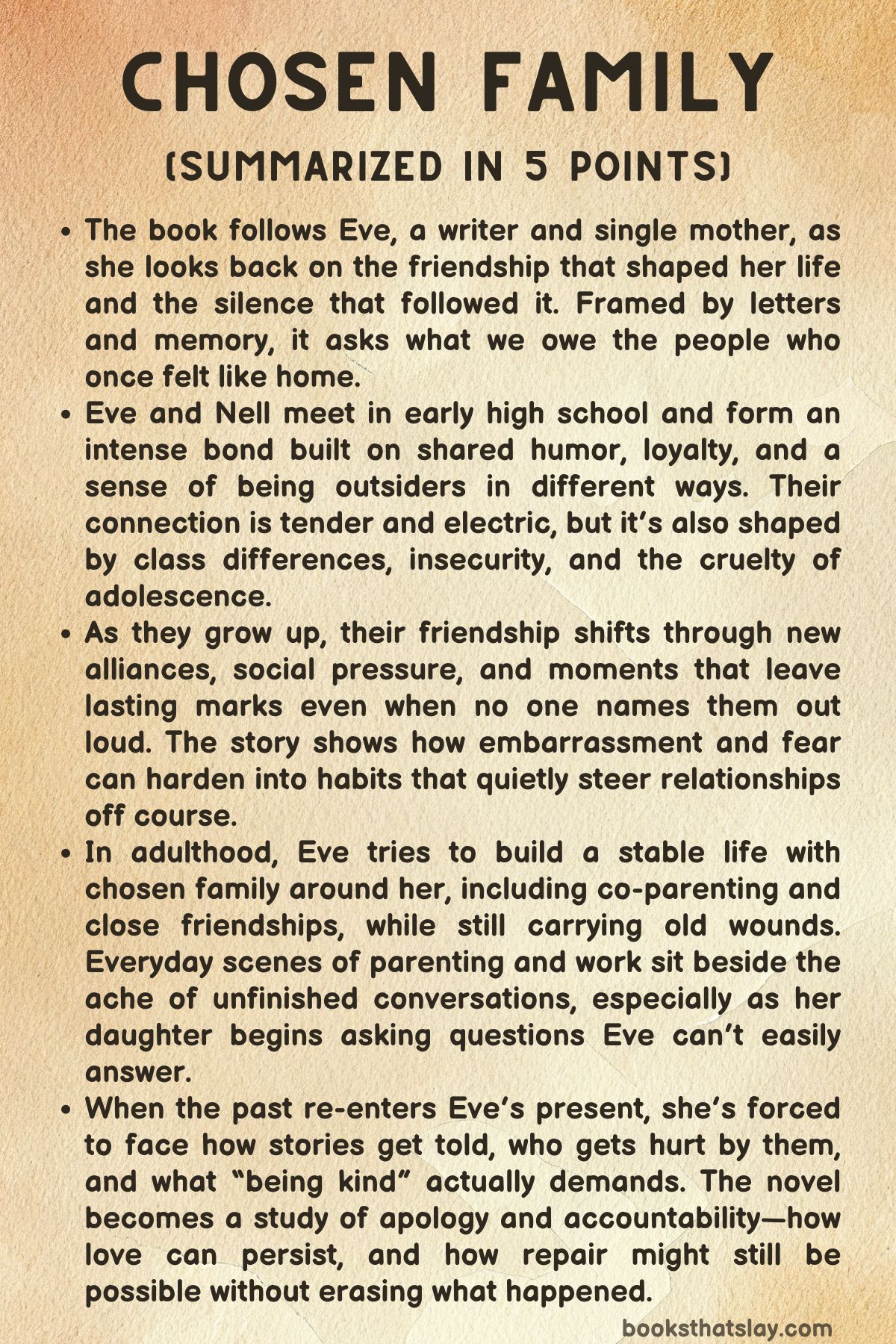
Chosen Family by Madeleine Gray is a contemporary novel about friendship that turns into a lifelong attachment, and the ways love can hide inside ordinary routines until it becomes impossible to ignore. It follows Eve, a writer and single mother, as she tries to explain an absence that has shaped her entire adult life: Nell, her first real friend, her co-parent, and the person she keeps circling back to in memory and on the page.
Moving between adolescence, early adulthood, and motherhood, the book looks closely at shame, desire, class, loyalty, and what people do when they don’t know how to ask to be chosen.
Summary
In 2023, Eve writes a letter to Nell that she never sends. She can’t believe how long it has been since they spoke, and she doesn’t even know where Nell lives or whether she’s safe.
The act of writing pulls Eve back to where it began: school, where she first saw Nell inside a world that looked polished and expensive compared with Eve’s own life. Eve remembers visiting Nell’s pristine house and feeling judged by Nell’s mother, Ondine, whose politeness lands like a test Eve is failing.
Nell, for her part, mocks the glossy taste and money around her, while Eve secretly admires it. Even as kids, they want things from each other—ease, attention, freedom, belonging—without knowing how to name it.
Eve’s most vivid memory is teaching Nell to ride a bike, borrowing bikes because Nell’s parents never did the small, practical work of showing her. Nell’s joy on the bike becomes a bright marker in Eve’s mind, proof that once they made each other feel possible.
Eve admits in the letter that something happened between them later that took things away from both of them. She tells Nell she misses the tiny observations of daily life they used to share.
She also tells her about Lake—their daughter—who asks questions about Nell that Eve cannot answer. Eve ends with apology after apology, confessing that everything she’s written has been, in some form, addressed to Nell.
In 2024, Eve is thirty, living in a cramped one-bedroom apartment with seven-year-old Lake. She freelances as a copyeditor and constantly counts money: rent, groceries, school costs, small emergencies.
Lake sleeps in Eve’s bedroom behind a bookshelf that pretends to be a wall, and Lake is starting to notice that other kids have real rooms. Eve tries to keep life steady with routines and jokes, using language to turn stress into something her daughter can laugh at.
When she tosses out mismatched socks and calls them “neoliberal socks,” Lake giggles and accepts the nonsense logic, and Eve feels the brief relief of being able to make the world feel lighter. Underneath, Eve is scared of the day Lake stops worshipping her, or demands the truth about why Nell disappeared.
Even Lake’s name—once a private joke between two parents—now feels like a reminder of how the family Eve expected is no longer intact.
The story reaches back to 2006, when Nell is twelve and starting high school. She’s sharp, watchful, and already tired of the social rules everyone else seems to accept.
At home, her parents provide money, books, and a well-run household, but very little interest in her inner life. Ondine performs warmth when other people are watching, then retreats.
Nell’s younger sister, Chelsea, fits more easily into popularity and prettiness, while Nell feels like someone waiting for childhood to be over so she can finally start living.
Two weeks into term, Eve Bowman arrives as the new girl—new uniform, very short hair, an eagerness that reads as confidence. In English, she answers questions quickly, and it makes her visible in a way that attracts attention.
She tries to find a social foothold at lunch, briefly sitting with a lower-status group while scanning for something better. In swimming, Eve’s body shame rises.
She tries to hide signs of puberty, and that fear becomes ammunition. Georgia Smith, trying to impress the popular Alex Robbins, humiliates Eve by calling attention to her pubic hair and labeling her a lesbian.
Eve reacts fast, using crude humor as a shield, flipping the embarrassment back onto Georgia. It works, but it also marks Eve as someone people can target.
In the aftermath, Nell approaches her, impressed. That moment becomes the start of an alliance: two outsiders recognizing something useful, and something familiar, in each other.
By 2007, the friendship is intense and sealed with private jokes. They spend lunch in an unused band room, making their own territory.
But the school’s cruelty finds them again. Georgia and Alex edit a Wikipedia page so Eve’s name becomes a slur in public form, something searchable and sticky.
Eve panics—not only about gossip, but about what the label might mean, and how it might follow her forever. Nell tries to help, holding her and talking strategy, but Eve fixates on denial.
She decides she has to “prove” she isn’t gay by kissing a boy at the Grove, a beachside spot where older teens drink and hook up.
That night, Nell helps Eve get ready. Eve’s mother, Emerald, is distracted and misses the danger in the plan.
At the Grove, Nell uses an older student, Alannah, to get them in. Eve approaches a boy named Toby.
What follows is frightening and coercive: Toby is rough, groping, pushing past Eve’s hesitation. Eve tries to stop him from going further by offering something else, and ends up giving him a hand job while crying silently.
Nell is nearby, watching but not intervening. After Toby is done, he walks off as if Eve is nothing.
Eve and Nell leave together, trading flat jokes, both refusing to speak the truth of what just happened.
In 2024, the weight of those early experiences sits inside Eve’s adult life. Some nights, after Lake’s strict bedtime routine, Eve drinks alone in the kitchen to shut her mind off.
She remembers when Lake was a toddler and both mothers would sit beside the bed for hours, patting her to sleep, sometimes sharing wine and exhaustion like a secret handshake. Now, Eve feels the grind of doing everything alone and the ache of having no one to share the daily labor with.
She keeps circling a thought: Nell is gone because of what Eve did.
Back in 2008, Nell and Eve are in year nine. A new girl, Naomi Mandel, joins them—witty, self-assured, connected to a music-industry family.
The trio forms quickly, but the balance shifts. Naomi and Nell trade big opinions and intellectual language that make Eve feel slow and left out.
During a lunch debate about families, Eve jokes about friends co-parenting a baby with donor sperm. Naomi twists the conversation into a jab about Eve’s absent father, and Eve apologizes just to keep her place.
At Nell’s empty house during a sleepover, Naomi proposes stealing Ondine’s luxury items and selling them online. They open an eBay account called “BitchCloset” and list expensive scarves, a coat, and a diamond ring.
Eve senses there are plans and jokes happening without her, and she waits for Nell to pull her back in. Nell doesn’t.
Soon, the exclusions become daily: Naomi takes Eve’s seat beside Nell, leaving Eve behind them. In class discussions, Naomi needles Eve with remarks that land as insults.
Eve’s jealousy grows into a constant hum.
At Naomi’s house, the tension turns openly sexual. In the pool, Naomi suggests “kiss chicken” as a game.
She nearly kisses Nell, then orders Nell to kiss Eve. Eve leans in, wanting it, and Nell sees it.
Nell recoils and laughs, choosing Naomi’s safety over Eve’s hope. Later, while Naomi and Nell whisper in bed, Eve lies nearby and masturbates while thinking about Nell, then feels sick with guilt.
Soon after, Nell ends the friendship by freezing Eve out. When Eve finally begs for an explanation, Nell says Naomi and she think Eve is “fake,” accusing her of trying to impress popular girls and laughing along.
Nell tells her to work on herself and hangs up. Eve is left stunned, desperate, and alone.
By 2010, Eve is isolated at school, surviving by going quiet. She reads, writes, and pins her future to escape.
When she enters a writing competition and receives a call saying she’s won, she lets herself hope—until she learns it was a prank, and Nell was part of it. The betrayal hardens into a rule inside Eve: don’t need anyone.
Get out.
In 2012 at university, Eve tries to find queer community and a new self. She meets Marcus and Tae, two gay students who are funny, candid, and unafraid to talk about cruelty and desire.
They bring her into their routines—beers, gossip, politics, plans for a night at a queer bar—and offer her a tiny spare bedroom in their share house. Eve feels, for the first time in years, that friendship can be simple and mutual.
That same year, Nell is living in a grimy share apartment with Naomi and another housemate, stuck in mess, weed, and low-level misery. She paints obsessively and half-avoids her degree.
After seeing Eve at a party and not being shut out, Nell becomes fixated on reconnecting. She drafts and deletes messages for days, then texts Eve.
They meet at a ten-pin bowling place that triggers old memories. They hug.
The familiarity unsettles Eve and hits Nell like electricity. As they bowl badly and joke, the tension loosens, and Eve blurts that she’s glad Nell exists.
The comment lands hard, because it sounds like forgiveness and hunger at once.
Nell starts spending most of her time at Eve’s house with Eve, Marcus, and Tae. The home is warm in a way Nell hasn’t had: people show up for each other, feed each other, notice moods.
Nell uses fewer drugs and becomes absorbed in Eve instead. She wants Eve romantically but refuses to speak it.
Eve, meanwhile, talks openly about hookups, letting Nell laugh along while suffering quietly. One night, high and watching TV, Eve tells Nell to stay over and insists she share Eve’s bed.
Nell lies awake, terrified of being seen as predatory. Eve falls asleep and rolls into her, wrapping around her.
Nell strokes Eve’s arm for a long time, believing she’s asleep—while Eve is awake and chooses not to stop it, keeping Nell suspended in wanting.
Years pass. The household grows up: new jobs, shifting ambitions, Nell’s art gaining attention, Eve working in literary spaces while scraping by.
Emerald, Eve’s mother, reappears at a fancy lunch and drunkenly needles the group, exposing Nell’s lack of experience and pressuring her to define her sexuality. Later, when Eve touches a cut in Nell’s mouth and Nell reacts with involuntary pleasure, Eve recoils with disgust, and Nell is left humiliated.
When Emerald dies suddenly of a heart attack, Nell drives Eve to the hospital and supports her through the shock. Eve is furious at how people rewrite Emerald as perfect.
She reads a poem at the funeral. Emerald’s death also leaves Eve an apartment, and Eve’s life shifts financially.
Grief and money collide, and Eve spirals, bringing women home, neglecting herself, letting chaos fill the space where her mother used to be. In the aftermath, Eve and Nell create a new structure: they decide to have a child together as co-parents and best friends, insisting to others that romance won’t complicate it because they’ll always communicate.
They have Lake, and for a while the arrangement works. The intimacy of parenting gives Eve and Nell a shared purpose, even as Nell continues to love Eve in a way she won’t name.
Then Eve meets Bridget, confident and adult-seeming, and the attraction is immediate. Eve hides the reality of her living situation—one bedroom shared by the co-parents and child—because she fears Bridget will leave.
When the truth comes out, Bridget is startled and jealous, but says she wants the relationship anyway.
Eve, Nell, and Bridget try to manage careful introductions, but Eve brings Bridget to the apartment at the wrong time. Eve and Bridget have sex in Eve and Nell’s bed and fall asleep.
Nell and Lake come home early, and Lake bursts into the bedroom, forcing a messy first meeting. Nell holds herself together for Lake, makes tea, and keeps the atmosphere civil, but inside she’s burning.
Lake, blunt and observant, quickly decides Bridget is “more than friends” because “adults don’t work in the bedroom.” After Bridget leaves, Eve thinks it went fine. Nell is shaken and full of hatred she can’t safely show.
Over the next months, Bridget becomes a regular presence. She bonds with Lake through play and outings.
She also helps Eve professionally, steering her toward better-paying copyediting work and nudging her to submit writing. Nell resents Bridget’s growing role, even while benefiting from the increased stability.
During a taco night, Lake hands over a drawing titled “My Three Mums.” Eve and Bridget are centered, holding hands, with Lake between them, while Nell is off to the side, reaching for Lake’s hand. Nell forces enthusiasm, but the picture confirms what she has been fearing: she is becoming optional.
The breaking point comes when Bridget arrives early one morning and leaves printed pages and a note: she has submitted Eve’s story to a prestigious journal. The note calls Eve “my love” and is signed with a lipstick kiss.
Nell reads the story and sees it labeled autofiction. In it, there’s a clinging, unwanted “ghost” in the home—an image Nell recognizes as a cruel version of herself.
She feels exposed, mocked, and finally certain that her presence is doing harm. Nell writes a goodbye note saying she will go, telling Eve to tell Lake she can look to the sky, and then she disappears.
Two years later, Eve is raising Lake alone, haunted by the silence. She finds an old note from Emerald that says, in a postscript, to be kind to Nell because Nell loves her.
The line cracks something open in Eve: a recognition of how much she ignored and took for granted. Then Eve runs into Chelsea, Nell’s sister, who confirms Nell is alive and has been in contact with family.
Chelsea is blunt: Nell loved Eve for years, and Eve benefited from it without paying the cost. Still, Chelsea gives Eve Nell’s address in New Zealand and urges her to write, if not for herself then for Lake.
Soon after, Lake brings home a letter addressed to Eve in Nell’s handwriting. After Lake is asleep, Eve reads it.
Nell explains why she left: she thought she was helping, admits how long fear and anger lived inside her, and says that reading Eve’s story made her feel disgusting and convinced her she had to remove herself. She also says that after talking with Chelsea, she wants Eve’s honest account.
Nell includes her phone number and asks Eve to call.
Eve finishes the letter with shaking hands and realizes two truths at once: Nell still loves her, and Eve loves Nell too—not as a convenient constant, not as a background parent, but as the person she has been writing toward for years. Eve picks up the phone and dials.
Characters
Eve Bowman
Eve is the novel’s emotional lens: a person who narrates her life as though confession can stand in for repair, and who keeps trying to turn pain into something coherent by arranging it into stories, routines, and “explanations” that sound clever enough to hold chaos at bay. As a child and teenager, she is driven by an aching desire to be liked and understood, but that desire expresses itself in performance—being “good,” impressing teachers, reading the room, polishing the self into whatever shape seems safest.
That same instinct becomes her gift and her flaw: it helps her survive humiliations, but it also makes her evasive with the people who know her best, especially Nell. Eve’s early shame—about sexuality, about the body, about social status—doesn’t just injure her; it teaches her to manage fear by controlling the narrative, which is why the incident at the Grove becomes a silent landmark that reorganizes her inner life while remaining largely unspoken.
As an adult, her single motherhood sharpens her: she is funny, tender, inventive, and scrappy, able to transform scarcity into play for Lake, yet the same stamina also enables denial, particularly the belief that love can be kept “platonic” if she names it that way. Eve’s most consequential pattern is her talent for intimacy without accountability: she draws people close, accepts devotion, and then insists the arrangement is harmless because it isn’t officially romantic.
Her writing embodies both her sincerity and her cruelty; it is a lifelong “letter” to Nell, but also a mechanism of distance, because describing someone is easier than meeting them honestly. When she finally reaches for the phone, it lands as the first genuinely risky act of her adulthood: choosing contact over story, and choosing responsibility over the protective comfort of ambiguity.
Nell Argall
Nell is introduced as sharp-edged and solitary, someone who refuses the social rituals of school not because she is above them in any triumphant way, but because she distrusts the terms on which belonging is offered. Her early home life shapes this: wealth exists without warmth, books replace attention, and her mother’s public performance of care leaves Nell starved for private recognition.
That hunger becomes the engine of her bond with Eve—Nell is magnetized by Eve’s aliveness and desperate intelligence, and she also envies Eve’s messy, human kind of family even while mocking its tastes through borrowed disdain. Nell’s fierce loyalty is real, but it is paired with a capacity for coldness that emerges when she feels exposed; her withdrawal in 2008 isn’t only teenage cruelty, it is a defensive amputation, a way to sever the part of herself that had begun to want too much.
As the story moves into adulthood, Nell’s devotion intensifies into a kind of self-erasure: she rearranges her habits, her drug use, her living situation, and her daily rhythms around Eve, accepting crumbs of closeness as if they are proof of an unspoken promise. What makes Nell tragic is not merely that she loves Eve, but that she builds a whole ethics of caretaking around that love, mistaking endurance for virtue and silence for safety.
Yet she is not a passive victim; she can be complicit, cruel, and proud, and she can choose disappearance as a form of control when she feels she has been made into a grotesque caricature. Her leaving is both wound and agency: an attempt to stop being the “ghost” in someone else’s house, and also an act that creates a new ghost for Eve and Lake.
Nell’s eventual letter shows a person who has finally named the long fear beneath her anger—the fear of being unwanted in a way that cannot be argued with—and who is tentatively stepping back toward truth, not because it is painless, but because it is the only way to live with what she has done and what she still wants.
Lake
Lake functions as far more than a “child character”; she is the book’s moral pressure system, the person who turns adult evasions into concrete problems that can no longer hide behind language. Her questions are simple in a way that exposes everyone else’s complexity, and her blunt observations—about bedrooms, about who belongs where, about what adults do—slice through the stories the adults tell themselves.
Lake’s love is immediate and organizing: she adores Eve, depends on routine, and learns the emotional weather of the home with the accuracy children develop when they sense instability. The “My Three Mums” drawing is devastating precisely because it is not an accusation; it is a child’s attempt to map attachment, and it becomes the moment when the adult triangle can no longer pretend it is balanced.
Lake’s greatest significance is that she embodies consequence without malice: she absorbs guilt she does not deserve, interprets Nell’s disappearance as her fault, and becomes the reason Eve can no longer treat Nell as a private longing or a literary subject. In the novel’s logic, Lake is what makes “chosen family” non-theoretical—she is the person for whom choices must be lived, explained, and repaired, not merely justified.
Ondine Argall
Ondine represents a particular kind of damage that can hide inside refinement: the parent who looks attentive in public and is emotionally absent in private, using taste, money, and presentation as substitutes for intimacy. Her immaculate home becomes a stage where Eve feels small and ignorant, and that early encounter establishes a hierarchy that reverberates through the girls’ friendship: Nell learns to perform superiority as armor, and Eve learns to crave the approval that always seems just out of reach.
Ondine’s influence is indirect but potent; she teaches Nell that care is something you demonstrate, not something you feel, and that lesson contributes to Nell’s later inability to ask plainly for what she needs. Even the theft plotline—turning Ondine’s luxury items into an adolescent “venture”—reads like a twisted dialogue with Ondine’s values, as if the girls are trying to convert her symbols of control into their own currency.
Ondine’s cruelty is rarely overt, which is what makes it last: it is the steady erosion of being seen, the kind of parenting that leaves a child technically provided for and internally abandoned.
Chelsea Argall
Chelsea is positioned as Nell’s foil in the family mythology: popular, pretty, and easier to love in the way families often reward. Yet as an adult presence, she becomes unexpectedly essential because she refuses the sentimental story Eve prefers to tell about the past.
Chelsea’s bluntness is not gratuitous; it is corrective, forcing Eve to confront that Nell’s love wasn’t a vague mutual entanglement but a sustained asymmetry that Eve benefited from. At the same time, Chelsea’s loyalty to Nell is complicated—she is angry, but she stays in contact, and she ultimately gives Eve the address not as an act of forgiveness but as a choice for Lake and for reality.
Chelsea’s role is to puncture denial while still enabling repair, embodying the messy ethics of family ties: she can condemn Eve and still hand her the one thing that might change the story.
Emerald
Emerald is both a comic and painful figure, a mother whose chaos and craving for attention embarrass Eve while also revealing how little Eve has ever been allowed to feel safely parented. She is loud, inappropriate, often distracted, and frequently unable to perceive what Eve needs, which helps explain why Eve becomes a self-parent so early—managing appearances, managing feelings, managing outcomes.
Emerald’s death does not tidy her into sainthood; instead it intensifies Eve’s rage at how people rewrite the dead, and that rage is also grief for a relationship that never stabilized into what Eve wanted. The apartment Emerald leaves behind is a material turning point, but the more intimate legacy is in the note Eve later finds, especially the postscript urging kindness to Nell.
That line reframes Emerald as someone who, despite her failures, saw the truth of Nell’s devotion more clearly than Eve did, and it lands like a final maternal act: not comfort, but instruction. Emerald’s presence complicates the idea of “family” by showing how love can exist alongside neglect, and how inheritance can be both rescue and haunting.
Naomi Mandel
Naomi arrives as charisma with teeth: witty, socially fluent, and hungry to define the group’s intellectual style in ways that flatter her. She bonds with Nell through shared big opinions and a performative sophistication, and she quickly positions Eve as the expendable member by making Eve feel naïve, earnest, and slightly ridiculous.
Naomi’s power comes from her ability to turn social life into a game with rules she controls, including the subtle cruelty of replacing Eve’s seat, framing Eve as “fake,” and making Eve apologize to keep access to the friendship. The theft scheme and the “BitchCloset” store show Naomi’s comfort with transgression as status, but her most damaging trait is her talent for manufacturing narratives about other people and then acting as if those narratives are facts.
Even the “kiss chicken” moment functions as a kind of experiment in dominance: Naomi detects Eve’s desire, then uses it to embarrass her while bonding with Nell through shared amusement. Naomi is important because she demonstrates how easily adolescent cruelty can be dressed up as wit, and how social intelligence can become a weapon that leaves lasting distortions in the people it targets.
Georgia Smith
Georgia is the early face of public humiliation, a teenager who understands that cruelty is a currency and spends it to buy proximity to power, particularly through Alex. Her attack on Eve in the swimming context is designed to be both sexual and social, weaponizing the body and labeling to create a stain that can be passed around.
Yet Georgia’s presence also clarifies Eve’s survival instincts: Eve’s sharp, crude comeback is the first time we see how Eve can flip shame into performance and take control of an audience. Georgia functions less as a psychologically deep figure than as a mechanism of social punishment, but her impact is long; she helps teach Eve that identity can be assigned from outside, that the crowd enjoys certainty, and that defending yourself publicly might still leave you privately terrified.
Alex Robbins
Alex represents the gravitational pull of “the popular,” the kind of person whose approval structures the behavior of everyone around them even when they are not directly speaking. The dynamic with Georgia shows how cruelty can be outsourced: Alex doesn’t need to invent the attack so long as others do it in her orbit to maintain the hierarchy.
As Eve and Nell age, Alex’s crowd becomes the source of escalating pranks and reputational violence, culminating in the writing-competition phone call, which turns Eve’s hope into humiliation. Alex matters because she symbolizes the system rather than the individual—an ecosystem where attention is extracted through spectacle, and where someone like Nell can drift into complicity simply by choosing proximity over conscience.
Toby
Toby is less a full character than an embodied event: the boy at the Grove who becomes the vehicle for Eve’s attempt to “prove” something to the world and to herself. The encounter is marked by coercion and fear, and Toby’s casual disregard afterward—returning to friends, ignoring Eve—underscores how little her inner life matters to him, even though the moment will define her for years.
Toby’s function is to show how adolescent sexual scripts can become instruments of harm, especially when a girl believes she must perform heterosexuality to escape a label. He is a catalyst for Eve’s shame and silence, and the fact that it remains largely undiscussed between Eve and Nell reveals how trauma can lodge itself between friends, becoming a shared absence that quietly corrodes trust.
Alannah
Alannah appears as a gatekeeper to older teen spaces, someone Nell can leverage to gain entry to the Grove. She illustrates Nell’s early skill at navigating power through proximity—knowing who to ask, how to be interesting enough, how to turn social access into proof of sophistication.
Alannah’s role is small but telling: she is part of the machinery that makes the Grove feel like a rite of passage, and her presence highlights how older teens can enable situations without witnessing, or caring about, the consequences for younger kids.
Marcus
Marcus is part of Eve’s university reinvention, offering a friendship that is warm, teasing, and comparatively honest about sexuality and shame. He helps build the first environment where Eve can be around queerness without it being used as an accusation, and that shift is crucial: it gives Eve language and community at the moment she is trying to rebuild herself from the wreckage of school.
Marcus’s steadiness within the share-house dynamic also provides a contrast to the more volatile emotional economy between Eve and Nell; he can observe, question, and care without turning love into leverage. In later years, his career progress marks time passing and adulthood arriving, while the central relationship remains stuck in its unresolved patterns.
Tae
Tae functions as both nurturer and truth-teller, someone whose confidence makes space for others while also refusing the group’s self-deceptions. He is part of the home Eve creates that feels safer than Nell’s earlier share house, and he becomes a quiet witness to Nell’s longing and Eve’s ambiguity, noticing what the two women refuse to name.
Tae’s blunt outburst at lunch about Nell’s lack of sexual experience is a mistake, but it’s an honest one, and the scene shows how even friends can accidentally expose the private vulnerabilities someone is desperately protecting. Tae’s later shift into fashion PR emphasizes his adaptability, yet his deeper role stays consistent: he is a stabilizing presence who models chosen family as daily care rather than dramatic declarations.
Pat
Pat is sketched as part of Nell’s grim early-adulthood environment, a housemate in the messy share apartment where drugs and stagnation replace direction. Pat’s importance is atmospheric: they represent the life Nell is technically escaping through university yet emotionally trapped inside, the version of “freedom” that is really a slow erosion of structure.
By contrasting Pat’s world with Eve’s warmer household, the story makes Nell’s attachment to Eve feel not only romantic but also existential—Eve’s home becomes the alternative to the drift Pat embodies.
Hana
Hana, Tae’s mother, appears at a moment when Eve is unraveling after Emerald’s death, and her care is quietly profound because it is offered without demanding performance in return. While Eve cycles through numbing behaviors, Hana brings food and comfort even while dealing with chemo, creating a sharp moral contrast: someone with every reason to focus inward still chooses to mother outward.
Hana’s presence underscores that family can be made through acts of sustained tenderness, and it also throws Eve’s relationship to caregiving into relief—Eve can be devoted to Lake, but she struggles to receive care without turning it into guilt or debt.
Bridget
Bridget enters as adult possibility: confident, organized, materially stable, and emotionally forward in a way that feels like relief to Eve after years of murky, half-spoken intimacy. She offers Eve not just romance but infrastructure—better work, professional encouragement, an image of adulthood that looks clean and manageable.
Yet Bridget is also a destabilizer because she forces the hidden truth of Eve and Nell’s arrangement into the open, where it can no longer be protected by euphemisms like “best friends” or “temporary.” Bridget’s jealousy is understandable, but her sharpest impact comes from intention: arriving early, leaving the Palladium note, signing it “my love,” and pushing Eve’s writing outward without considering—or perhaps while precisely considering—how that exposure will land on Nell. Whether Bridget means harm or simply means to claim her place, the effect is surgical: she makes the triangle explicit and makes Nell feel replaced.
Bridget’s character therefore sits in moral complexity; she is not merely an interloper, because she does care for Lake and supports Eve, but she also participates in a kind of territoriality that turns private vulnerability into collateral damage. In the end, Bridget embodies the question the book keeps asking: when you build a family by choice, what do you owe the people whose love made that family possible, especially when new love arrives and wants space?
Themes
Class, Taste, and the Quiet Violence of Belonging
From the earliest memories, social class isn’t presented as a simple background detail; it shapes the air Eve and Nell breathe around each other. Eve’s first encounter with Nell’s childhood home is a lesson in how wealth can communicate judgment without raising its voice.
Ondine’s poise and certainty turn Eve’s normal not-knowing into a kind of embarrassment, and that embarrassment sticks, teaching Eve to measure herself through other people’s standards. At the same time, Nell’s relationship to wealth is complicated: she benefits from it, resents it, and performs disdain for it in ways that can sound brave but also keep her emotionally protected.
When Nell mocks Eve’s parents’ expensive taste and Eve secretly admires it, it reveals a split in how they read status. Eve sees polish as safety and competence; Nell sees it as fraudulence and control.
Their friendship forms partly because each girl believes the other possesses an easier version of life: Nell envies Eve’s capacity to be liked by adults and succeed within rules; Eve envies Nell’s confidence to reject those rules and still seem interesting.
As they grow, class continues to operate as a set of permissions and exclusions. Nell’s parents supply resources instead of attention, which means Nell has access to culture—records, books, a home that signals success—while still suffering neglect that money can’t fix.
Eve’s home, by contrast, carries instability and emotional unpredictability, and her hunger for approval becomes a survival method. The class divide isn’t only about material comfort; it’s about how each family teaches their child to feel entitled to space.
Nell can be solitary and contemptuous because she has a cushion; Eve learns to scan rooms, to adjust, to win back footing through performance. Even later, adulthood repeats these pressures in new forms: the one-bedroom arrangement, the financial strain, Bridget’s ability to open doors to better-paid work, and the sharp contrast between “orderly adult life” and precarious life.
In Chosen Family, class works like an invisible hand on the back of the neck—guiding who feels confident, who apologizes first, who gets to leave when things become uncomfortable, and who is left holding the practical consequences.
Shame, Sexuality, and the Cruelty of Labels
Adolescence in this story is not treated as a nostalgic phase; it’s a training ground where shame is taught publicly and absorbed privately. Eve’s humiliation during swimming isn’t just about bodies; it’s about how quickly a room can decide what you are, and how that decision can stick to your name.
The “lesbian” accusation functions less as a statement about desire and more as a tool of control. It marks Eve as disposable, makes her available for ridicule, and forces her into a panicked relationship with her own identity.
What follows—Eve’s urgent need to “prove” something by kissing a boy—shows how social pressure can push a person toward a performance that becomes physically unsafe. The encounter with Toby lands with the logic of coercion rather than choice: Eve tries to manage danger with the only tool she believes she has, which is compliance.
The aftermath is telling: the emotional reality is left unspoken, flattened into joking words, because naming it would make it real and would also risk being interpreted as further evidence of whatever label others want to attach to her.
The story keeps returning to the gap between what a person feels and what they can admit. Eve’s desire for Nell appears gradually, then crashes in with intensity and guilt—masturbation on a mattress while hearing whispers nearby becomes a scene about secrecy, longing, and self-disgust, all at once.
Nell’s desire is shaped differently: she fears being seen as predatory, especially in a world that already frames queer attraction as something suspicious. That fear makes her passive in ways that protect her socially but damage her emotionally.
When Eve keeps Nell “suspended in desire,” it underlines how shame can be used as leverage. Eve doesn’t need to say “I’m using you” for the dynamic to become exploitative; she only needs to benefit from Nell’s longing while refusing to clarify what it means.
In adulthood, the label pressure doesn’t vanish; it changes form. The planned introduction of Bridget as a “friend,” the careful staging of what Lake is allowed to understand, and the anxiety around being seen in a one-bedroom arrangement all show how sexuality remains subject to other people’s interpretations.
Lake’s blunt insight—her simple rule about what adults do in bedrooms—cuts through the adults’ evasions and exposes how much energy they spend managing appearances. Chosen Family treats shame as something socially manufactured but personally lived, and it shows how the fear of being misnamed can lead to choices that harm the very intimacy a person is trying to protect.
Power, Need, and Emotional Exploitation Inside Intimacy
The central relationships in Chosen Family run on uneven exchanges of power, and that unevenness isn’t always obvious to the people inside it. As children, Eve and Nell attach to each other in a way that feels like mutual rescue: Nell offers solidarity when Eve is targeted, and Eve offers Nell a kind of practical care—teaching her to ride a bike, giving her attention that her parents don’t.
But even in those early moments, the friendship contains a quiet competition of injuries and advantages. Each girl becomes both witness and mirror, and the mirror is not always kind.
When Naomi arrives, the social economy changes, and it becomes clear how fragile Eve’s position is. Nell’s failure to “fix” the seating change in class reads small on the surface, yet it signals a deeper truth: Nell chooses comfort over loyalty when choosing feels risky.
Eve’s silence—waiting for rescue—shows how dependency can form inside friendship when one person is trained to earn belonging rather than assume it.
The cruelty escalates into something more deliberate: the prank call about the writing competition, with Nell complicit, is not just teenage meanness. It’s an attack on Eve’s sense of a future.
It teaches Eve that what she loves—writing, recognition, the idea of being seen accurately—can be turned into a weapon. Later, when adulthood brings the share-house warmth with Marcus and Tae, the power dynamic shifts again, but it doesn’t become equal; it becomes harder to name.
Nell is emotionally dependent on Eve, and the group can see it. Eve, meanwhile, enjoys Nell’s devotion as a kind of steady supply: comfort, caretaking, admiration, and a home base she can return to after hookups.
The bed scene is a sharp example of consent operating in foggy territory. Nell strokes Eve’s arm believing Eve is asleep; Eve is awake and chooses not to interrupt, choosing desire over clarity.
That decision becomes a pattern: Eve benefits from Nell’s love while refusing to give it a stable shape, and Nell accepts uncertainty because certainty might mean rejection.
The co-parenting arrangement intensifies this dynamic by binding logistics to emotion. When Lake arrives, the household becomes both family and trap.
Nell’s labor—emotional, practical, and relational—supports Eve’s life, yet Nell receives no secure claim to Eve’s affection. Bridget’s arrival doesn’t create the imbalance; it exposes it.
Eve can pursue romantic fulfillment while expecting Nell to adapt, and Nell is expected to swallow jealousy because the arrangement is framed as rational and modern. The moment Nell reads Eve’s story and recognizes herself as a “ghost” captures the final cruelty: Eve’s art takes Nell’s most vulnerable position and turns it into material without consent.
That’s not merely insensitive; it is a form of extraction. Nell’s disappearance is therefore not only heartbreak; it is a boundary set by someone who has been asked, again and again, to endure being necessary but not fully chosen.
Grief, Inheritance, and the Way Parents Shape Love After Death
Parental presence in Chosen Family is often indirect, arriving through absence, performance, and aftershocks rather than sustained care. Ondine performs maternal concern in public yet shows little interest in Nell’s interior life, offering money and books instead of attention.
This teaches Nell a particular lesson: love is something presented, not necessarily felt, and need is something to hide. Emerald, Eve’s mother, is different but equally destabilizing—loud, unreliable, sometimes embarrassing, sometimes missing what matters.
Eve’s memory of the thirteenth birthday party, where she ends up crying in a bathroom until Nell coaxes her out, captures how Eve’s childhood includes emotional exposure without protection. That exposure becomes part of her adult personality: her sensitivity to humiliation, her quick defensive humor, her fear of being seen as “wrong,” and her habit of pushing forward without processing what hurt her.
When Emerald dies suddenly, grief arrives without ceremony. Eve’s numbness shifts into anger at how people sanitize the dead, rewriting Emerald into a perfect mother.
That anger is not only about Emerald; it’s about Eve’s lifetime of managing contradictions. The funeral poem instead of a eulogy suggests Eve’s deeper instinct: when direct speech feels impossible, she reaches for art.
The inheritance complicates everything further. Emerald leaves Eve material stability—the apartment—while leaving behind emotional mess.
Money enters as both rescue and distortion: it gives Eve options, but it also fuels her spiral, her careless choices, and her ability to avoid accountability for longer. Meanwhile, it highlights a contrast with Nell, whose parents offer money without closeness, shaping Nell into someone who can survive materially while starving emotionally.
Hana’s care during Eve’s breakdown is a crucial counter-image: a parent figure who provides food, steadiness, and presence even while facing illness. This suggests that chosen family support can sometimes supply what biological parents failed to provide, but it also shows how care tends to flow toward the person who is loudest in crisis.
Nell’s devotion becomes invisible because it is consistent rather than dramatic. The late note from Emerald—“Be kind to Nell – that one loves you”—is striking because it arrives as a postscript from beyond the relationship’s breaking point.
It functions like a moral document, evidence that someone saw the truth Eve avoided. It forces Eve to recognize that Nell’s love was legible to outsiders even when Eve treated it as background comfort.
Grief also links to the present-day loneliness of parenting. Eve drinks to knock herself out not only because she is tired, but because the household is missing the person who used to share the weight.
The story suggests that unresolved grief can harden into patterns: avoidance, self-medication, brittle humor, and the habit of postponing difficult conversations until they become disasters. In the end, inheritance is shown to be more than property; it is the transfer of emotional scripts.
Eve inherits instability and learns control through narration. Nell inherits neglect and learns devotion through self-erasure.
The phone call at the close hints at a different inheritance being chosen—one where love is not guessed at or performed, but spoken plainly, with consequences accepted.