Hollow by Celina Myers Summary, Characters and Themes
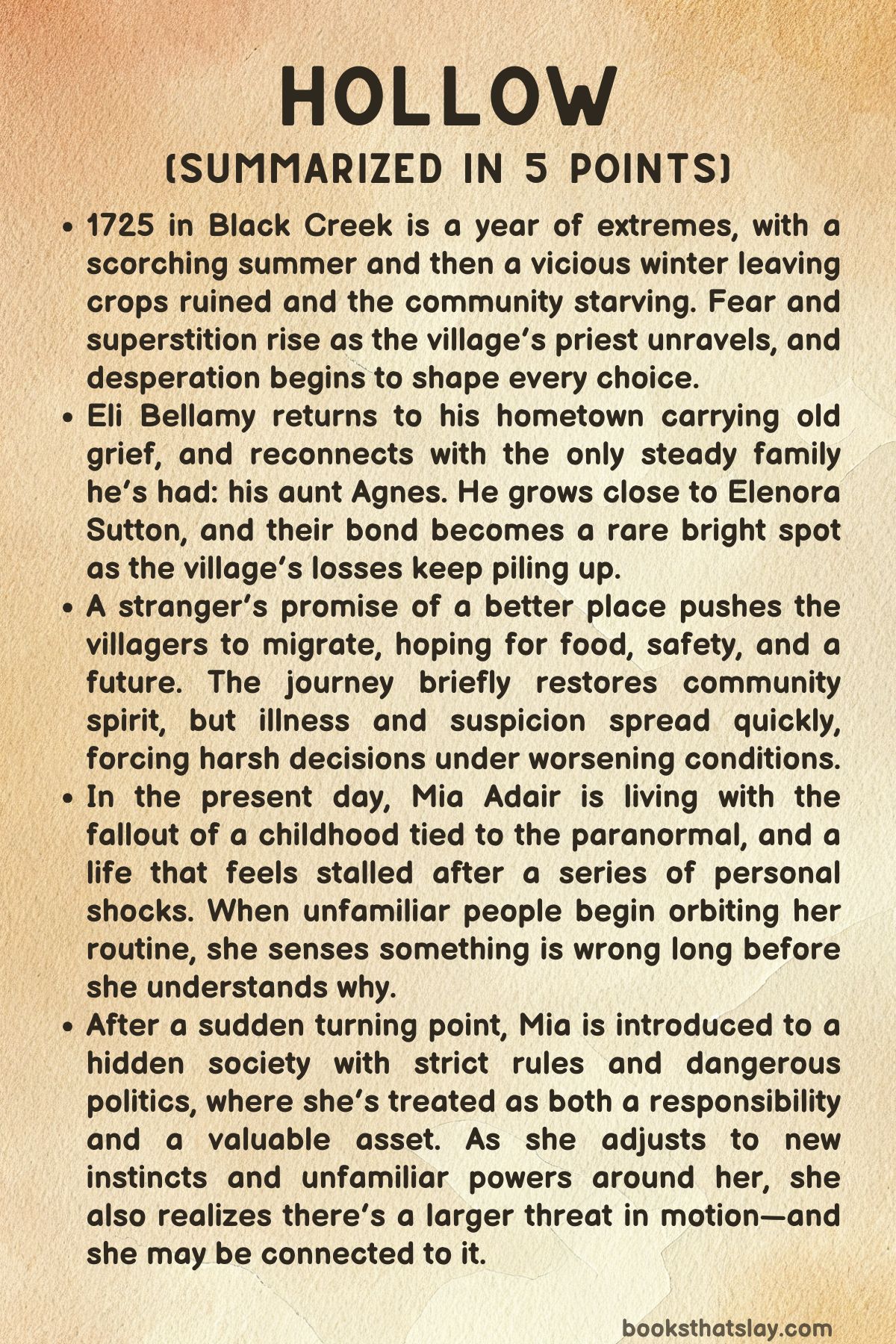
Hollow by Celina Myers is a dual-timeline supernatural thriller that starts like a folktale and lands in a neon-lit modern nightmare. In 1725, a starving village follows the promise of salvation and instead meets sickness, violence, and a strange “Family” that survives the centuries.
In the present, Mia Adair—once famous as a child who could see spirits—dies in a car crash and wakes to learn she’s been remade as a vampire. As she’s pulled into two ancient vampire Families with strict rules, hidden powers, and older grudges, Mia realizes her new life is tied to a secret succession—and to a killer working from inside the system.
Summary
In 1725, Black Creek suffers through a year that feels unnatural. A punishing summer dries the creek and destroys crops, and the village priest grows feverish, raving about curses and the End of Days.
People swing from fear to mockery, and the priest dies on September twentieth. The weather shifts soon after, but it’s too late for the harvest.
Food runs low. Mothers struggle to feed infants.
Nights fill with hunger and quiet panic.
Eli Bellamy returns to Black Creek as the village deteriorates. His childhood was shaped by loss: his mother died giving birth, and his father, Matthieu, withdrew into grief.
Eli was mostly raised by his aunt Agnes—Aunt Aggie—who ran a cheese shop and gave him a steady kind of love.
Years earlier, the wealthy Sutton family arrived with two daughters. Elenora, sixteen at the time, experiences people as colors, and she quickly grows attached to Black Creek’s small routines.
She becomes close with a neighbor, Alice, and the two girls create a ritual: they ring bells to each other every morning and night, a private signal that the other is there. Eli notices Elenora from a distance, and Elenora notices him too, though neither makes the first move.
Aunt Aggie finally forces the issue by calling Elenora out publicly and nudging Eli into conversation. The two walk to fetch water together, and that awkward beginning becomes a real bond.
Two summers later they marry in an outdoor celebration that briefly makes the village feel alive again.
Joy doesn’t last. Eli’s father, Matthieu, softens toward him after the wedding, then abruptly dies after complaining of shoulder pain.
Not long after, Jeanne Sutton—Elenora’s younger sister—is trampled by a spooked horse. She survives the immediate injury but falls into a silent, unresponsive state.
Elenora’s parents leave to find a doctor in a distant village, but Jeanne dies three days later, and the parents never return. Elenora waits and watches the road for weeks until hope turns into a hollow ache.
With her family gone, she clings to Eli as the only solid thing left.
As drought and scarcity deepen, Elenora becomes pregnant and miscarries. The grief hits hard and lingers, while Aunt Aggie keeps their household from collapsing.
Then, in November, a stranger named Gregor arrives. He sees the hardship and helps repair a fallen wall, seeming generous and practical.
He tells Eli about a large town to the east with plentiful food and underground springs. He insists it’s about thirteen days away and urges the villagers to go before winter finishes them.
At a village meeting, some doubt him, but hunger and cold make the decision for them. Gregor leaves the next morning, leaving behind a map.
After one more meeting, Black Creek chooses to follow it.
They pack wagons with whatever they can spare: grain, water, salted meat, blankets, and small valuables. The line of wagons stretches east.
For a moment, people act like themselves again. Children laugh.
Neighbors call to each other. At night, Elenora and Alice continue their bell ritual, a thin thread of normal in the dark.
On the third day, Tomas Jones becomes violently ill with fever and chills, his skin changing color in a way that terrifies everyone who sees it. Eli rides with Tomas’s wife Ann and their baby to help.
Tomas worsens quickly and dies overnight with blood at his mouth. By morning, others are sick too.
The healer admits he has never seen anything like it and can only suggest warmth, water, and herbs. Fear divides the camp.
The sick are separated from the healthy, and people begin watching each other like strangers.
Eli studies the map and finds Gregor’s body half-buried in snow, marked by the same bloody signs. Eli understands the stranger brought the sickness with him.
Elder Caron orders everyone to stay where they are for three days, then meet on the fourth to assess. Snow falls heavily.
During confinement, people die inside their wagons. Bodies are dragged out and left in the cold.
On the third evening, Elenora rings her bell for Alice and gets no answer.
On the fourth morning, the camp is silent in a way that feels wrong. Eli finds the healer dead.
He finds Aunt Aggie dead beneath a collapsed quilt-roof shelter. He finds Alice, Pierre, and their infant dead in their wagon.
As he searches, dread turns into certainty: everyone is gone except Elenora. When Elenora sees Alice’s body, she screams that Alice’s “color” is gone, as if something essential has been erased.
Eli stops her from touching the corpses, feeds the remaining animals, transfers supplies into a larger wagon, and drives away with Elenora and the horses, moving east because there is nowhere else to go.
That night, Elenora tries to cling to the idea that the promised town will save them. Before dawn, Eli develops the same fever.
He weakens quickly, and Elenora breaks under the fear of losing the last person she has. Barefoot and desperate, she walks toward a cliff with the intention of ending it.
An elderly woman stops her—not out of kindness, but annoyance, warning about where the body would land. The woman claims Eli has the plague and says it can’t touch her.
She forces Elenora down a hidden path to a stone cottage in a gorge, where her son Alexander sits sharpening a knife.
The old woman gives Elenora a dark drink that tastes metallic and a second cup for Eli, promising it will cure them. Elenora and Alexander return to the wagon and make Eli swallow the deep red liquid.
Alexander assures Elenora that Eli will feel new in three days. Then, without warning, Alexander stabs Eli in the chest.
As Elenora tries to flee, Alexander catches her and kills her too, telling her, “Welcome to the Family.” The implication lands like a curse: something predatory has been building a lineage for a long time.
In the modern day, Mia Adair wakes with her bedroom window open, drawn to the night sky the way she always has been. As a child, Mia could see spirits.
Her mother, Elizabeth Adair—a famous psychiatrist who focuses on parapsychology—turned Mia into “Case 37” in a widely known book. After Mia’s father Ben died in a car accident when she was seven, Elizabeth became emotionally distant, leaving Mia to care for her younger sister Sasha.
Elizabeth obsessed over contacting Ben through Mia’s ability, but Ben never appeared.
Mia’s gift faded as she grew up, though her notoriety never fully vanished. She works at a chain bookstore and feels trapped in a life that never became what it could have been.
She still carries guilt from childhood, especially “The Accident,” when she set an old fox trap beneath her window to stop “bad people” and forgot her neighbor, Mr. Charles the gardener. He stepped into it, suffered catastrophic injuries, and soon died.
His spirit later visited Mia, forgave her, asked her to keep it secret, and then disappeared.
Mia once had a refuge: Slow Burn, a coffee-and-book shop run by Mr. Horvath, who became a surrogate father figure. Slow Burn closed after Mia found Mr. Horvath dead in the shop at 4:54 a.m., prompted by seeing his spirit in her hallway.
The building was boarded up, leaving Mia with another loss she couldn’t explain to anyone.
At the bookstore, Mia notices a new pattern: strange regulars arrive, browse in coordinated silence, and leave without buying. One frequent visitor, a quiet blue-haired woman named Cordelia, usually buys a book and avoids conversation.
One day Cordelia asks Mia if she’d be okay if everything ended today, a question that leaves Mia rattled. Later, Cordelia arrives with a glamorous blonde woman in a black sports car—Kris—who buys a journal and says she needs to write her days down or she forgets.
Kris calls Cordelia “kind of family.” Mia impulsively runs outside to return Kris’s change and admits she likes when Cordelia comes in. The women drive away, and Mia’s unease deepens.
Driving home in heavy rain, Mia notices the black sports car following her. More cars trail behind it, an unusually long line for that quiet road.
Near her driveway, a rabbit darts across the road and Mia’s golden retriever, Cooper, chases it. Mia brakes and swerves to avoid hitting him.
Cooper makes it across safely, but Mia’s car skids off the shoulder on the slick road and crashes into a maple tree.
Mia drifts in and out of awareness. She smells gasoline, feels hot blood on her face, and assumes she’s dying like her father did.
Through the shattered passenger window, she sees Cordelia, Kris, and others approaching. None of them help.
Mia realizes she can’t move or speak; her body won’t respond. Cordelia murmurs, “I’m sorry.
We’ll talk soon,” and injects a syringe of dark fluid into Mia’s chest. Mia’s vision breaks into static and darkness while voices confirm she’s gone and tell someone to call 911.
The group executes a practiced cover story. Kris uses an ability called a Veil to influence the responding officer into repeating a neat explanation: Mia swerved to avoid a dog, overcorrected, and died on impact.
Mia’s mother arrives screaming, and Cordelia stops her from looking under the sheet. Cordelia uses a healing ability to flood Elizabeth with calming endorphins, while Kris Veils her into brisk, controlled resolve—fast funeral, support Sasha, no questions that derail the plan.
At the morgue and funeral home, the vampires shadow every step to ensure Mia is not embalmed. After the funeral, the casket is meant to be taken for cremation, but “Bellamy Cremation Services” intercepts it and swaps in a different set of ashes to return to the family.
The deception is clean enough to withstand human scrutiny.
After midnight, in a dark room with both vampire Families gathered, Mia wakes inside the casket. She pounds and cries out until the lid opens and Cordelia helps her drink water.
Mia remembers the crash, the watching faces, and the needle. Cordelia tells her she died but was brought back, and that she can never return home because no one can know.
Kris states the truth plainly: Mia is a vampire, turned when Cordelia injected a syringe of mixed vampire blood into her heart at the edge of death.
Mia rejects it at first, tries to stand, and collapses with heavy, stiff limbs. Leaders Eli and Elenora introduce the Bellamy and Sutton Families and explain their structure: Mia must spend a trial period with each Family before choosing where to live.
Mia learns vampires drink human blood, use Veils to influence humans, and now often rely on blood banks to reduce harm. When Mia demands proof and refuses to accept she has no choice, the room shows fangs, and she faints—because her mind can’t hold the new reality all at once.
She wakes later at Noir House, the Bellamys’ secluded home. Eli offers warmed hospital blood in sealed bags.
Mia panics when she sees their eyes turn black as they feed, then realizes she’s starving too. She drinks, and her senses sharpen.
In a mirror she sees she looks healthier, smoother, and unmistakably changed—small fangs included. She accepts that the impossible is now her body.
Still desperate, she sneaks out during a storm and races toward home with speed that shocks her. In a bar called Willies Wet Bar, she calls a cab.
The driver, Gary, shows her laminated missing-person flyers, saying Cedar Hollow has a pattern of disappearances. Mia asks to be dropped early and walks to her house.
Through a window she sees Elizabeth and Sasha laughing together on the couch, closer than they’ve been in years. Mia understands that revealing herself would shatter them again.
Then Cooper appears—and instead of greeting her, he growls and attacks, as if he senses something wrong. Sasha steps onto the porch.
Mia flees.
On the way back to the cab, Gary brakes for a figure in the road: a red-haired woman in a trench coat. Gary gets out to help and is attacked instantly.
The figure is Elenora. She orders Mia out of the car, and Mia smells Gary’s blood so strongly it feels like a command.
Despite trying to resist, Mia feeds until Gary dies. When Margo, Toby, and Kris arrive, they pull Mia away and bring her back to Noir House.
Mia insists Elenora forced it, and Kris admits Veiling could explain that kind of control—if Elenora is capable of it.
The Bellamys explain the bigger danger. In recent years, new vampires have been appearing without being registered into any Family.
They surface briefly, cause problems, then disappear; some later turn up drained of blood. Someone seems to be turning people and then killing them to harvest “new vampire” blood, which is unusually potent and can heal.
They reveal another unsettling fact: the matriarch Thea began losing power on February 22, 2001—Mia’s birthday—when a white light left her body. That power now appears tied to Mia.
To distract Mia and give her a taste of vampire life, the Bellamys take her out. They dress her up and bring her to a club, Neon Viper.
Mia experiences the night with amplified intensity. When she feeds from a veiled human named Carly, she loses control and drinks too much until Margo snaps her out of it.
Margo then makes Carly lick Mia’s blood, and Carly’s vitality returns instantly—proof that Mia’s blood heals.
Later, Mia sees Elenora at the club and follows her. In a grimy basement area, Mia witnesses Elenora guiding women to drink from a bleeding man’s arm, then killing them and ordering their bodies moved.
When Mia tells Kris and Margo, the basement has been cleaned and the bodies are gone, but Carly’s heart necklace is found in a drain, confirming Mia saw something real.
Back at Noir House, Mia and Margo grow close, sharing intimacy and confessions. Talli, another vampire with psychic perception, warns Mia that her connection with Margo comes from something older, and also hints Mia is meant for something bigger than romance.
Thea arrives frail and aging, seated in a wheelchair. She examines Mia’s father’s ring and identifies it as obsidian designed to dampen psychic Gifts.
She tells Mia to put it away so her spirit-seeing can return. Then, privately in the car, Thea reveals the central secret: Mia is the next matriarch destined to lead both Families.
The “light” that left Thea when Mia was born is inside Mia, and the transfer ceremony must happen the next day at dusk. Thea will die afterward.
Thea insists the Families didn’t cause Mia’s crash, but admits they watched Mia for months because they knew death was nearing and they needed the turning to happen at the right moment. The syringe Cordelia used contained blood from every Family member.
Thea also warns the killer turning and draining new vampires may be someone within the Families themselves. Mia suspects Elenora, especially after what she witnessed, but Thea insists it’s impossible—while still sharing a brutal story from 1801 that proves Elenora has crossed horrifying lines before.
With dread building and trust collapsing, Mia is delivered to the Suttons at the imposing Bruce Hotel, greeted by Cordelia and Luca. As the night closes, Mia is left staring at an immediate future she didn’t choose: a ceremony, a crown made of power she doesn’t understand, and a predator close enough to wear a familiar face.
Characters
Eli Bellamy
In Hollow, Eli is the emotional hinge between a human life defined by loss and the vampire legacy that later carries his name. As a young man in Black Creek, he returns home not as a triumphant son but as someone trying to reattach himself to a place that already took too much from him: a mother dead in childbirth, a father who went distant from grief, and a childhood largely patched together by his aunt’s steady care.
That early deprivation shapes how Eli loves—quietly, intensely, and with a kind of watchfulness that looks like restraint but is really fear of losing what he finally finds. With Elenora, he is pulled into a relationship that begins with longing at a distance and becomes the center of his identity; his devotion isn’t loud, but it’s consistent, and when tragedy strips their community down to ash, he becomes the only person left to anchor her.
On the plague journey, his practicality turns into grim leadership: he manages supplies, bodies, animals, and the cruel math of survival, and the way he tries to protect Elenora from what she’s seeing shows both tenderness and an inability to stop the inevitable. The pivotal betrayal by the gorge-cottage pair marks Eli’s transformation from human hope to the origin of something predatory and organized—his death is not merely an ending but a forced recruitment into “Family,” which later echoes in how the Bellamy line operates with rules, wealth, and control.
In the modern timeline, Eli appears as a composed patriarchal figure at Noir House, offering warm blood bags instead of romance, structure instead of comfort, and money as a substitute for the life Mia cannot go back to. He reads as someone who learned, across centuries, that survival requires systems—yet the story keeps a shadow of the original man who once just wanted a village life with Elenora, which makes his calm authority feel like a scar rather than a crown.
Elenora Sutton
Elenora is written as both luminous and frightening, a character whose tenderness and brutality can occupy the same body without canceling each other out. Her early humanity is marked by a rare sensory intimacy with the world: she experiences people as colors, which makes her bonds feel instinctive rather than chosen, like she can sense the truth of someone’s spirit before language gets involved.
That gift makes her love feel pure at first—her bell ritual with Alice is gentle, playful, and almost sacred, a childlike insistence that connection can be made audible across distance. But the same sensitivity also sets her up for catastrophic attachment: when Jeanne dies and her parents vanish, Elenora does not simply grieve, she collapses inward until Eli becomes the last remaining fixed point.
The miscarriage then doesn’t just take a child; it threatens the one future she still believes in, and the desperation that follows makes her vulnerable to manipulation in the gorge sequence, where she clings to the promise of a cure because she cannot survive another loss. After she becomes a vampire, Elenora’s character takes on a long historical shadow, and the book uses her to show what immortality does to devotion—how love can harden into possession, and grief can curdle into entitlement.
In the modern timeline she’s not merely a leader; she is a suspected predator within the predator class, someone capable of preaching protection while orchestrating slaughter in basements, someone whose moral image has social power even as her private actions suggest hypocrisy. The story also positions her as a weaponized contradiction: she is tied to the origin myth, tied to leadership, tied to old sins, and tied to the present crisis of rogue turnings and harvested blood, so every scene with her is loaded with the question of whether she is protector, culprit, or both.
What makes Elenora especially unsettling is that her violence is not framed as chaotic; it is deliberate, ceremonial in its own way—an inversion of the bell ritual where connection once rang out, and now death happens in controlled silence.
Agnes Bellamy
Agnes, or Aunt Aggie, functions as the human backbone of the early Black Creek portion of the story, embodying the kind of practical love that holds families together when sentiment fails. She is not romanticized as gentle; her care expresses itself through competence, bluntness, and intervention—she runs a cheese shop, raises Eli when his father emotionally withdraws, and refuses to let his life stagnate in quiet yearning.
That moment where she forces the introduction between Eli and Elenora is revealing: Agnes understands that survival is not only about food and shelter, it is about preventing loneliness from becoming a permanent condition. In a world collapsing under drought, hunger, and superstition, she represents an older, steadier form of leadership than the priest’s raving or the villagers’ panic, and her presence in Eli’s home suggests that he learned stability from her long before he learned love from Elenora.
When the exodus turns into quarantine and mass death, her end under a collapsed quilt-roof is both brutally mundane and thematically cruel—she doesn’t die in a dramatic sacrifice, she dies as one more body swallowed by chaos, emphasizing how indiscriminate the plague is. Her death matters because it removes the last human “adult” in Eli’s life, leaving him and Elenora emotionally unparented at the worst possible time.
Even after she’s gone, her influence lingers in Eli’s later behavior as a vampire patriarch: the instinct to manage, to stockpile, to organize, to keep a household running no matter what—that is Aunt Aggie’s love translated into immortal logistics.
Matthieu Bellamy
Matthieu is a portrait of grief turned into absence, and his role is less about what he does than what his withdrawal does to Eli. Matthieu loses his wife when Eli is three, and instead of adapting into a nurturing father, he becomes emotionally inaccessible, leaving a vacuum that Agnes fills.
That dynamic shapes Eli’s adulthood: he grows into someone who watches from a distance before he speaks, who holds desire quietly, who seems to expect that closeness might disappear at any moment. When Matthieu finally softens after Eli’s marriage, the narrative grants a brief hint that reconciliation is possible—then it is immediately taken away by his sudden death in the field, a plain bodily ending that mirrors the book’s insistence that death does not always arrive with meaning.
Matthieu’s shoulder pain and collapse feel like the world itself breaking down: bodies fail like crops fail, without warning, without fairness. He is also important as a contrast to later vampire family structures; Matthieu is a father who cannot hold his son emotionally, while Eli later becomes a patriarch who holds people through wealth, rules, and containment.
That suggests Eli’s immortality leadership may be, in part, an overcorrection—an attempt to build the kind of “family” solidity he never received from his human father.
Jeanne Sutton
Jeanne’s brief life and prolonged dying are used to show how cruelty can enter the story through accident rather than malice. She arrives as the younger Sutton sister, a child whose presence helps paint the Suttons as a complete family unit in a village that already feels precarious.
Her death begins with something senseless—a horse spooked, a trampling—and then becomes even more devastating because she does not die immediately; she returns home physically present but mentally unreachable, an unresponsive body that forces everyone around her to sit with helplessness. That liminal state foreshadows later “in-between” conditions in the book: the plague’s slow taking, the vampire turning, Mia’s casket awakening.
Jeanne’s death also triggers the disappearance of her parents, which compounds tragedy into abandonment—Elenora loses not only her sister, but her entire family network, and this is a key pivot that makes Eli her only anchor. Jeanne, in that sense, becomes the wound that binds Elenora to Eli with a desperation that later echoes through centuries.
Mr. and Mrs. Sutton
Elenora’s parents are defined largely by what they fail to do, and their absence becomes a shaping force rather than a side detail. They arrive wealthy and separate from Black Creek’s poverty, but they adapt enough that Elenora can love village life and form genuine friendships, which suggests the Suttons are not simple villains of class.
Their decision to leave for a distant doctor is framed as parental duty, but their failure to return after Jeanne’s death turns into a haunting ambiguity: they are likely dead, yet the narrative keeps them as a question mark, which traps Elenora in a long waiting period that hardens into emotional dependency on Eli. Symbolically, they embody the danger of the wider world beyond the village: roads are not routes to salvation, they are corridors to disappearance.
Their vanishing also prefigures the modern missing-person thread, linking past and present through a repeated pattern of people being taken and never coming back.
Alice
Alice represents warmth, normalcy, and the kind of friendship that makes survival feel worth attempting. Her bond with Elenora—especially the bell ritual—creates an intimate geography in Black Creek where homes speak to each other through sound, turning distance into companionship.
Alice is significant because she is not positioned as a rival to Eli but as a parallel anchor: Elenora’s love for Eli is romantic, but her love for Alice is communal, the kind that makes a village feel like a family. That’s why Alice’s death hits with such brutality: it is not just the loss of one person, it is the death of Elenora’s last thread to ordinary human joy.
The moment Elenora rings and receives no answer is a quiet terror scene because it weaponizes the ritual itself—the thing that once confirmed safety now confirms emptiness. When Eli finds Alice, Pierre, and their infant dead, it becomes the book’s clearest statement about indiscriminate suffering, and Elenora’s response—screaming that Alice’s “color” is gone—turns grief into a sensory annihilation.
Alice’s role is also thematic in the modern story, where vampires are described as empty beings; Alice’s “color” being gone becomes an early emotional version of that later concept.
Pierre
Pierre’s importance comes from how his death widens the story’s cruelty from individual loss to the collapse of an entire household. He is primarily seen as Alice’s partner and the father of their baby, which makes their wagon a symbol of family continuity amid hardship.
When that wagon becomes a death chamber, it intensifies the horror: the plague does not only kill adults, it erases futures. Pierre is less a fully individuated personality in the summary and more a narrative weight—his presence makes Alice’s death more devastating, and his death makes the silence of the camp feel like the end of community itself.
Elder Caron
Elder Caron embodies crisis governance and the grim authority that emerges when survival decisions become moral decisions. Caron’s order to shelter in place for three days is a rational attempt to contain infection, suggesting he prioritizes collective safety over panic movement.
But the outcome—the camp turning into a snow-buried graveyard—also shows the limits of leadership when the enemy is invisible and unstoppable. Caron’s role highlights how quickly social trust can become fear management: dividing sick from healthy, dragging bodies away, turning wagons into quarantines.
Even without extended characterization, Caron represents the human impulse to create rules against chaos, a motif that later appears in vampire society where Families, trials, and sanctions are all rule-based defenses against exposure and rogue violence.
Gregor
Gregor is the story’s most dangerous kind of figure: a messenger who sounds like salvation and delivers catastrophe. He arrives as a stranger with muscle and goodwill, helping repair a wall and offering information about a town with abundant food and water.
His appeal is not just his story but the way desperation makes people want to believe him; hunger is a persuasion tool stronger than logic. The twist that he is already infected reframes his role from potential savior to unwitting vector, and his leaving behind a map becomes a cursed artifact that guides the village into death.
Gregor’s corpse in the snow, bearing the same bloody signs, is the narrative’s confirmation that hope can be contagious in the worst way—people don’t just follow him physically, they inherit what he carried. He functions as a caution about the vulnerability of communities under stress: when institutions fail, a confident stranger can redirect an entire population with a few sentences and a scrap of paper.
Tomas Jones
Tomas is the first visible crack in the exodus optimism, the human moment where the journey stops being an adventure and becomes a massacre. His sudden fever, mottled skin, and bloody death establish the plague’s body-horror reality and force the camp into fear-based division.
Tomas is also important because his illness begins in the presence of family—his wife and baby—which immediately raises the stakes; sickness is not an individual misfortune, it is a threat to the most vulnerable. His death overnight, followed by the spread of symptoms, turns him into the story’s warning bell, the first ring in a sequence that ends with Elenora ringing into silence.
Tomas is the narrative proof that the village’s suffering is not over once they leave Black Creek; it is following them, multiplying.
Ann Jones
Ann appears primarily through her proximity to Tomas and her baby, but that proximity makes her significant as an emblem of helpless caretaking. Eli riding with Ann and the infant to help frames her as someone suddenly dependent on community support, which contrasts with the earlier village self-sufficiency.
Ann’s role underscores how quickly family units can become fragile under disease, and how women, especially mothers, are forced into endurance roles—feeding, warming, watching, waiting—when there are no cures. Even without a long arc, Ann functions as a human face for the larger tragedy: the plague is not just death, it is the slow terror of caring for the dying while trying to keep a child alive.
Alexander
Alexander is violence with a ritual mask, someone who treats murder like induction. His quiet presence—sharpening a knife—signals that the “help” offered in the gorge is staged, and his claim that Eli will feel new in three days is a chilling blend of truth and deception: it suggests a turning process while hiding the immediate brutality of stabbing.
When he kills Eli and then Elenora, telling her “Welcome to the Family,” he makes explicit the story’s thesis that immortality here is not a gift bestowed with consent but a system that expands through violation. In the modern timeline, Alexander reappears as a driver and close associate of Thea, which implies his violence has been absorbed into leadership infrastructure; he is no longer just a killer in a gorge, he is a continuing functionary in the Families’ operations.
That continuity makes him disturbing because it suggests the Families’ present-day sophistication is built on an old foundation of coercion, and Alexander is one of the living pillars of that foundation.
Mia Adair
Mia is the modern emotional core of Hollow, and her character is shaped by a lifelong relationship with death that keeps changing forms: a father lost in a car accident, a childhood gift that made spirits real, a guilt wound from Mr. Charles’s trap injury, and finally her own staged death and forced rebirth. What makes Mia compelling is how ordinary her dissatisfaction is before the supernatural explodes—she feels stuck, underemployed, lingering in grief and nostalgia, and that ordinariness makes the vampire world’s intrusion feel like an assault rather than an escape.
Her identity has also been exploited since childhood; being labeled “Case 37” by her mother turns her into both a daughter and a subject, which complicates Mia’s later anger when yet another group decides her fate without consent. Mia’s turning is not framed as destiny she welcomes; it is a violation conducted with choreography, and her early vampire arc is full of bodily horror in a quiet key—paralysis, black eyes, hunger, shame at how good blood feels, grief at seeing her mother and sister laughing without her.
She becomes the novel’s conscience in vampire society because she still thinks like a human even after her body stops being one, and the Gary incident shows how fragile that conscience is under instinct and possible Veiling. At the same time, the narrative positions her as power: her blood heals, her presence correlates with the matriarch’s power loss, and her suppressed Gift suggests she is a hinge point between the spiritual and the vampiric.
Mia’s greatest conflict is not simply choosing a Family; it is whether she can retain moral agency in a world that keeps treating her as an instrument—first her mother’s instrument, then the Families’ instrument, and potentially the next matriarch’s instrument of rule.
Elizabeth Adair
Elizabeth is a study in ambition, grief, and ethical boundary-crossing disguised as caregiving. She is a famous psychiatrist focused on parapsychology, but her most defining act is turning her own child into “Case 37,” which brands Mia publicly and shapes Mia’s life as a spectacle.
Elizabeth’s grief after Ben’s death drives her to seek contact through Mia’s gift, and the fact that Ben never appears becomes a quiet indictment: either her methods are flawed, or love cannot force the dead to perform. Her emotional absence afterward—leaving Mia to care for Sasha—shows how grief can hollow out parental responsibility while still wearing the face of purpose.
When Mia “dies,” Elizabeth’s collapse at the crash site is raw and human, but the story immediately complicates it by showing how easily she can be manipulated; Cordelia sedates her through healing, and Kris uses the Veil to press a calm, managerial script into her mind. Elizabeth becomes a symbol of how vulnerable humans are in a world where supernatural influence can rewrite emotion on command, and it’s especially tragic because she has spent her life studying the edge of the paranormal while remaining defenseless against its predatory form.
Her numbing with pills and wine after the funeral is not just grief; it is the collapse of control, the moment where the woman who documented others’ mysteries cannot handle her own.
Ben Adair
Ben’s role is mostly posthumous, but he is the emotional baseline of loss that everything else in Mia’s story is measured against. His death in a car accident becomes a template: Mia later experiences her own crash with a fatalistic calm that mirrors what she imagines happened to him, and Elizabeth’s obsession with contacting him becomes the reason Mia’s childhood gift is treated as a tool.
Ben’s absence also creates a family vacuum that Mia fills for Sasha, which is part of why Mia grows into a caretaker personality even when she feels directionless. The fact that Ben never appears as a spirit when Elizabeth tries to force contact is narratively important because it prevents the story from turning death into comfort; it keeps grief unresolved, which makes Mia’s later decision to not return home as a vampire feel consistent with a life shaped by irreversible endings.
Sasha Adair
Sasha is the sharp-edged survivor in the Adair family, and she embodies the anger that grief can become when sadness is exhausted. She grows up partly under Mia’s care, which creates a bond where Mia feels responsible for her even in death.
At the funeral, Sasha’s exhaustion and fury cut through the vampires’ rehearsed performances, and her short eulogy urging people not to delay their dreams positions her as someone determined to turn pain into action, even if she can’t fully live that principle yet. Sasha’s closeness with Elizabeth after Mia’s death is especially poignant because it shows that tragedy can heal fractures even as it creates new ones; Mia watching them laugh together at home becomes one of the strongest moments of bittersweet self-erasure in the summary.
Sasha is also a danger point for the vampire plan: she is observant, emotionally charged, and close enough to notice inconsistencies, which is why the story emphasizes how carefully the Families manage the funeral logistics and the cremation swap. Sasha represents the human world’s stubborn truth—someone who might not be Veiled forever if she starts pulling at the right threads.
Mr. Horvath
Mr. Horvath functions as Mia’s chosen-family father figure, the person who offers steadiness without extracting performance from her. Slow Burn is more than a coffee-and-book shop; it is the place where Mia can exist without being “Case 37” or the substitute parent, and Mr. Horvath’s care is implied through the way she gravitates there during adolescence.
His death, discovered by Mia at 4:54 a.m. after she sees his spirit, becomes a defining trauma because it blends her fading Gift with a helpless, mundane loss: she can sense the supernatural, but she cannot prevent the inevitable.
The shop being boarded up and left unchanged for years turns it into a mausoleum of her stalled life, and his absence becomes one more proof that everyone who makes Mia feel safe eventually disappears. Mr. Horvath’s role deepens the theme that Mia’s life is haunted not only by literal spirits but by the repeated experience of being left behind.
Mr. Charles
Mr. Charles is the story’s clearest portrait of childhood guilt that refuses to dissolve with time. Mia’s fox trap under her window is a child’s attempt at control—protecting herself from “bad people”—and the accidental victim being her neighbor makes the moral injury immediate and lifelong.
His shattered ankle and broken hip, followed by his death, become the event Mia repeatedly relives, a private origin of her belief that she hurts people even when she tries to protect. His spirit visiting Mia to forgive her and ask her to keep it secret adds complexity: it offers grace, but it also burdens her with silence, reinforcing her tendency to carry trauma alone.
That pattern repeats later when Mia becomes a vampire and must keep her “life” secret from her living family; the book uses Mr. Charles to establish secrecy as both protection and punishment in Mia’s psychology.
Cooper
Cooper is more than a pet; he is the emotional trigger that sets Mia’s turning into motion and later confirms that she cannot return. The rabbit chase causes Mia to swerve, which allows the stalking group to enact their plan, making Cooper unintentionally the hinge between Mia’s human life and vampire life.
After Mia awakens as a vampire, Cooper’s reaction—growling and attacking—functions like a moral verdict from the most innocent part of her old world: he recognizes something wrong in her scent and treats her as a threat. That attack devastates Mia because it removes her last imagined bridge home; if even her dog rejects her, the fantasy of slipping back into her family becomes impossible.
Cooper also reinforces the theme that the body tells truths the mind wants to deny: Mia may look like herself, but living beings sense the difference.
Cordelia
Cordelia is the vampire whose conscience remains visible, and that visibility makes her both sympathetic and suspect. She enters Mia’s life as a quiet regular with blue hair, someone who feels like a harmless eccentric until she asks the chilling question about whether Mia would be okay if everything ended today.
That line reads like warning and confession at once, suggesting Cordelia knows what is coming and is trying, clumsily, to humanize the person she is about to help destroy. At the crash site, Cordelia injects Mia with the syringe that turns her, but the summary emphasizes Cordelia’s guilt and shakiness afterward; she is not indifferent like others, and she actively tries to shield Elizabeth from seeing Mia’s body.
Her healing ability, used to sedate Elizabeth with endorphins, shows how care can be weaponized—Cordelia comforts while also ensuring compliance. She also functions as a bridge character: “kind of family” to Kris, emotionally attached to Mia in a way that goes beyond procedure, and caught between the Families’ plan and her own sense of wrongdoing.
Cordelia’s tragedy is that she is participating in harm while trying to preserve tenderness, and the book uses her to ask whether remorse matters if you still do the thing.
Kris
Kris is control embodied: glamorous, blunt, and functionally dangerous because her power can overwrite reality as humans perceive it. Her Veil ability is not just persuasion; it is narrative domination, forcing an officer and later Elizabeth to adopt a rehearsed explanation and an emotional posture that benefits the vampires’ plan.
That makes Kris the engine of the cover-up and also a symbol of the Families’ core violation against humanity: humans are not merely prey, they are editable. Kris’s detail about needing to write her days down or she forgets suggests a cost to immortality—time dissolving into sameness—so her cruelty sits alongside a private fragility where memory cannot be trusted.
She calls Cordelia “kind of family,” framing vampire relationships as pragmatic rather than sentimental, and her straightforward reveal to Mia that she is now a vampire shows Kris’s preference for brutal clarity over comforting lies. At the club, she is also the gateway to indulgence, using influence to bypass lines and Veils to facilitate feeding, positioning her as the person who normalizes predation as nightlife.
Kris is frightening not because she is chaotic but because she is competent; she turns murder and manipulation into a workflow.
Margo
Margo is the Bellamy heartbeat: seductive, protective, volatile, and emotionally honest in the moments that matter. She mentors Mia through the first humiliations of hunger and transformation, but she also represents the part of vampire life that is meant to feel intoxicating rather than monstrous—luxury closets, club nights, intimacy, belonging.
Her explanations about rogue vampires and harvested blood push the plot into mystery, but her emotional story about her human love Emma and her suicide attempt reveal a deeper theme: many vampires in this world were not turned from ambition but from desperation, and immortality is a scar over a wound rather than a cure. Margo’s relationship with Mia becomes both tender and dangerous because it is built during Mia’s most vulnerable period; the intimacy provides comfort, but it also risks becoming another form of dependence like Elenora’s dependence on Eli after loss.
Margo’s act of biting Mia’s hand to stop her from overfeeding is a sharp expression of her role—she will hurt Mia to keep her from becoming a killer, which is love shaped by predator rules. The necklace that says “Yours” suggests a yearning for permanence in a world where years blur, but it also echoes the possessiveness that haunts the book’s older vampire history, making Margo’s tenderness feel both hopeful and ominous.
Gianna
Gianna operates as social pressure and emotional ventilation within the Bellamy house, the person who refuses to let dread be the only atmosphere. She storms into Mia’s room demanding answers after Gary’s death, which shows that her loyalty includes accountability; she is not content to let a new vampire’s confusion endanger the group.
At the same time, she pushes everyone to go partying to give Mia a taste of Bellamy life, functioning like a coping mechanism turned into a lifestyle—if the world is dark, flood it with music, flirting, and motion. Gianna’s role is important because she illustrates how vampire society maintains morale: not with sermons, but with spectacle.
She helps transform Mia’s appearance, turning identity into costume, which also hints at how easily vampires can reshape a person’s sense of self when they need her to adapt quickly.
Toby
Toby is part of the Bellamy operational unit, a presence in the car rides and recovery moments that suggests loyalty expressed through logistics rather than intimacy. He helps retrieve Mia after the Gary incident and is part of the inner circle at Noir House, which places him in the category of vampires who enforce containment and damage control.
Even without extensive individualized detail in the summary, Toby’s role contributes to the feeling that the Bellamys are an organized household with people assigned to stabilize chaos—drivers, watchers, handlers. Characters like Toby make the Families feel like institutions rather than mere social groups, and that institutional quality is what makes Mia’s lack of choice feel so total.
Talli
Talli is the clearest articulation of the book’s theme of spiritual perception colliding with vampiric emptiness. She sees human souls as auras but perceives vampires as empty, which reframes vampirism not just as predation but as an existential condition—being alive without the same kind of inner light.
Her backstory, where Elenora turned her by drugging her in 1985 to strengthen her Gift, is also a moral indictment of Elenora: even when Elenora’s intentions are framed as problem-solving, she uses coercion, and the consequences were catastrophic as Talli killed family members in a starving haze. Talli’s warning that Mia and Margo knew each other in another life but it will not work positions her as a quasi-prophetic figure, someone who speaks in destiny language that clashes with Mia’s desperate need for agency.
She becomes a narrative instrument for fate, reincarnation hints, and the sense that Mia is being pulled toward matriarchhood whether she wants it or not. Talli’s presence also pressures the reader to question whether vampires are truly “alive” in the human sense, and whether Mia’s returning Gift might change that equation.
Thea
Thea is the mythic center of vampire authority, simultaneously matriarch, originator, and decaying vessel passing power onward. She is defined by paradox: ancient yet suddenly aging, immensely powerful yet losing that power, protective of the Families yet admitting someone inside may be committing atrocities.
Thea’s identification of Mia’s father’s ring as an obsidian crystal meant to dampen Gifts reframes Mia’s entire life as partially engineered; Mia’s fading ability was not purely growing up, it was suppression, which implies someone in Mia’s family line intentionally shielded or restrained her gift. Her confession that she began losing power on February 22, 2001, Mia’s birthday, and that the “white light” left her and resides in Mia, positions Mia as successor not by election but by cosmic transfer, turning leadership into destiny.
Thea also embodies the book’s version of succession politics: she schedules the transfer ceremony at dusk tomorrow because bodies are being turned and killed quickly, and because her own death is imminent afterward, meaning urgency is both strategic and fatal. Her insistence that the Families did not cause Mia’s crash but watched her for months reveals a chilling ethical stance: they claim innocence while admitting surveillance and preparation for her death, treating her life as a timetable.
Thea’s story about Elenora killing Eli’s pregnant lover in 1801 introduces a long memory of jealousy and cruelty that complicates any present-day trust; Thea tries to preserve Elenora’s possibility of repentance while still admitting the horror, which makes Thea feel like a ruler managing internal mythology as much as managing security. Ultimately, Thea is the character that turns the narrative from personal horror into political inheritance: Mia is not just newly undead, she is next in line to rule, and Thea is the fading bridge between old magic and whatever Mia becomes.
Luca
Luca appears as a Sutton-side host figure, greeting Mia warmly at the Bruce Hotel and helping usher her into the Sutton environment. His warmth matters because it contrasts with the coercive elements of the Families’ plan; he represents the part of vampire society that wants Mia to feel welcomed rather than captured.
Even with limited detail in the summary, Luca functions as a social stabilizer, someone whose friendliness is meant to lower Mia’s defenses before the looming transfer ceremony. Characters like Luca also help differentiate the Families’ atmospheres: where the Bellamys feel like a luxurious, party-forward fortress, the Suttons are introduced through an old-world, castle-like hotel and gentler hospitality, suggesting a different style of power.
Carly
Carly is primarily a human instrument in the club feeding scene, but her role exposes the predatory mechanics the Families normalize. Carly is Veiled into compliance so Mia can “sip,” and Mia’s loss of control with her becomes a crucial demonstration of how thin the line is between “feeding” and killing for a new vampire.
The fact that Margo makes Carly lick Mia’s blood and Carly’s color instantly restores serves two functions: it confirms Mia’s blood heals, and it shows how humans are treated like adjustable objects—drained, then repaired, then sent back into the world altered without consent. Carly’s heart necklace later being found in a drain is also a grim breadcrumb that corroborates Mia’s account of Elenora’s basement murders, making Carly an unwitting connective tissue between club indulgence and serial killing.
Gary
Gary is the most tragic kind of casualty: a decent stranger whose small kindness places him in the wrong story. He picks Mia up in the rain, talks about missing-person flyers, and feels like a local trying to make sense of the town’s unease, which gives him an ordinary humanity that the vampires’ world routinely erases.
His death is not just shocking; it is morally formative for Mia because it is her first kill, and it happens under a mix of compulsion, hunger, and panic. The scene also weaponizes his role as helper: he stops to assist what he thinks is a body in the road, and that instinct becomes his doom.
Gary’s death is a narrative test the book uses to trap Mia between two truths at once—she is horrified and grieving, and she also experiences the euphoric haze of feeding—forcing her to confront that vampirism is not only something done to her but something she can do to others.
Izzy
Izzy appears at the crash scene as part of the remaining trio with Cordelia and Kris, suggesting she is one of the operationally trusted members of the group who handle sensitive turning logistics. Her presence emphasizes that the turning was not an impulsive act by one vampire but a coordinated procedure with witnesses and roles, reinforcing the Families’ institutional nature.
Even without extended characterization, Izzy’s inclusion strengthens the feeling that Mia’s life and death were managed by committee, which deepens Mia’s loss of agency and the reader’s sense of organized predation.
Alison
Alison is present mainly as an absence, a name tied to fear and rumor that expands the modern mystery. She is described as a former Bellamy member who disappeared and was later found drained of blood, and that detail does heavy thematic lifting: it suggests betrayal is not hypothetical, danger is not only outside the Families, and the predator can be hunting within the structure.
Alison’s fate also ties directly into the theory that someone is turning new vampires and killing them to harvest their potent healing blood, meaning her story is a warning that even belonging to a Family does not guarantee safety. She functions like a ghost in the social fabric, a missing piece that makes everyone’s certainty feel performative.
Themes
Grief as a force that reshapes morality and identity
Loss in Hollow doesn’t stay in the background as a sad aftereffect; it actively changes what people believe they are allowed to do, what they think the world is, and who they become inside it. In Black Creek, grief arrives in layers that keep stacking until normal emotional language breaks down: the dried creek and ruined crops, the priest’s unraveling and death, hunger that turns infants and mothers’ bodies into evidence of scarcity, and then the chain of personal losses that strip Eli and Elenora of every stable anchor.
What stands out is how mourning becomes practical and immediate rather than ceremonial. When death is constant, people stop having the emotional space to “process,” and they start making survival decisions that double as emotional decisions—who gets food, who gets protected, what hopes get postponed, and what risks suddenly feel acceptable.
Eli’s relationship with his father briefly warms and then is cut off, underlining how grief doesn’t only come from death itself but from the timing of it: a small opening appears, then slams shut, leaving the survivor with regret as a permanent companion. Elenora’s miscarriage adds another kind of grief, not just for a life that doesn’t arrive, but for a future that now feels unsafe to imagine.
The modern storyline repeats the pattern with different tools: Mia’s father’s death, her mother’s emotional disappearance into obsession, and the childhood accident that becomes a private wound she carries into adulthood. The turning of Mia into a vampire is presented as an engineered “loss event” where her human life is ended on schedule, surrounded by people who watch without helping, then managed through a staged funeral.
That kind of grief isn’t only pain; it’s also theft. Mia loses her body, her social identity, and her right to be witnessed truthfully by her family, all at once.
Her later choice to leave her mother and sister in peace is heartbreak framed as mercy, but it is also shaped by coercion: the new rules of her existence make honesty dangerous. Across both timelines, grief repeatedly pushes characters toward actions they might once have judged harshly—running from home, accepting strange guidance, surrendering to hunger, allowing others to rewrite reality.
The theme lands with a bleak clarity: mourning doesn’t merely hurt; it reorganizes the self, sometimes into someone unrecognizable, and it can be exploited by anyone who knows how desperate a person becomes when they have nothing left to lose.
Belonging, “family,” and the cost of being claimed
The word “family” carries warmth on the surface, but the narrative keeps showing how belonging can become a mechanism of control, especially when a person is isolated. In Black Creek, community begins as shared routines—neighbors calling out, small rituals like Elenora and Alice’s bells, and the ordinary social bonds of a village.
Yet when hunger arrives, the community’s shape changes. People still gather, still vote, still move together, but fear and scarcity turn closeness into exposure.
Sickness doesn’t only kill bodies; it fractures the trust that makes collective life feel safe. Even before the plague on the road, the village’s decision-making hints at how easily a desperate group can be directed by a single persuasive voice.
Gregor’s story of a better place functions like a promise of belonging somewhere else, a substitute community that people can picture when their own world feels cursed. The result is painful irony: their attempt to preserve the group becomes the route that destroys it.
In the modern timeline, the vampire Families are an explicit system of belonging with rules, hierarchy, and enforced secrecy. Mia is not invited into this world through trust; she is taken.
Her turning is described as planned, practiced, and supported by multiple participants, which matters because it blurs individual guilt into institutional guilt. The Families present themselves as protectors with a code—use blood banks, avoid exposure, keep humans alive—but they also operate like a closed society that decides who gets to know the truth.
Mia’s funeral is especially revealing: the Families manufacture social belonging around her death by filling the room with scripted stories of connection. They can simulate community at will, and that ability makes “belonging” feel less like love and more like a skill used to manage outcomes.
Cordelia’s conflict adds complexity because her guilt suggests that not everyone inside the system agrees with how it works, yet the system still moves forward. Mia is given a “trial period” with each Family, framed as choice, but her options exist only inside their boundaries.
Even her money, clothes, and new comforts have a double edge: they are care, but also inducement, a way to make captivity feel like rescue. The phrase “Welcome to the Family” appears as a chilling thesis statement: being claimed can be framed as inclusion while functioning as possession.
By placing village life and vampire society side by side, the book suggests that the desire to belong is one of the easiest human needs to weaponize. When someone is grieving, hungry, lonely, or newly transformed, “family” can become a leash disguised as a home.
Power, consent, and the rewriting of reality
Control is rarely shown as simple physical domination; it is more often psychological, social, and narrative—who gets to define what happened, what it means, and what must be done next. The early Black Creek sections show this through the priest’s ravings and the villagers’ shifting reactions.
The priest’s authority collapses as his mind breaks, and the community moves from fear to mockery, deciding collectively that his warnings are not real. That pattern foreshadows a larger question: reality is not just what happens, but what a group agrees is happening.
Gregor’s arrival pushes the same lever from another angle. He offers information that the villagers cannot verify, and their consent is compromised by hunger and cold.
They “choose” the road, but the conditions have narrowed choice into something closer to surrender.
The modern storyline makes this dynamic literal through Veils, which allow vampires to impose explanations onto humans and smooth away messy truth. The crash scene is not only a death; it is a controlled story.
The officer’s report is shaped, the mother’s behavior is chemically managed through endorphins and then emotionally directed through a Veil, and the funeral process is engineered down to details like embalming and cremation timing. Consent becomes the central ethical problem: Mia’s new existence is created without informed agreement, and then the world is altered so she cannot easily protest it.
The Families treat the concealment as necessary for survival, but necessity doesn’t erase violation. The effect is to make Mia’s grief and confusion part of the control apparatus: if she is overwhelmed, she is easier to move, easier to house, easier to instruct.
This theme becomes even sharper in the feeding scenes. Hunger is an internal force that can override values, and others can use that fact to steer behavior.
When Mia is compelled toward Gary’s blood and then pushed into feeding, the question is not only “who killed him,” but “who controlled her body and desire.” The narrative repeatedly shows power operating by narrowing options until the victim experiences compliance as inevitability. Even comfort—money, luxury, nightlife—can function as a soft form of control, keeping Mia emotionally dependent while she adjusts to a new set of rules.
The looming transfer ceremony adds a political layer: leadership and inheritance are framed as destiny, but destiny can be another word for a decision made by elders long before the chosen person understands the stakes. Across both timelines, the book keeps returning to a hard truth: when someone can rewrite memory, emotion, or official records, violence does not need to look violent to be total.
Reality itself becomes a territory that the powerful can occupy.
“Hollowness,” the soul, and the struggle to remain a person after transformation
The title idea gains meaning through the repeated image of emptiness—empty creeks, empty cupboards, empty wagons, empty homes, and then the supernatural claim that vampires register as blank spaces to those who see auras. This theme isn’t only about monsters; it’s about what remains when the familiar structures of self are removed.
Elenora’s synesthetic way of perceiving people as colors provides an emotional language for presence and absence. When Alice’s “color” is gone, death is not abstract; it is a sensory fact that rewrites the world Elenora understands.
That makes loss feel like subtraction from reality itself, not just separation. In Black Creek, survival conditions strip people down until identity is reduced to bodily states—warmth, fever, hunger, strength.
The road sequence intensifies this reduction: names and relationships blur under sickness, and the group becomes a field of symptoms. What is left of a person when community collapses and the body fails?
The story keeps asking without pausing to comfort the reader with easy answers.
Mia’s arc reframes hollowness as an identity crisis. As a child she is defined by a Gift and by her mother’s public labeling of her as a “case,” which turns an inner experience into a spectacle.
When her ability fades, she is left with a sense of being stuck and undefined. After turning, she becomes “more” in physical capability—sharper senses, faster movement, rapid healing—but also “less” in social existence, because she must erase herself from the lives that formed her.
The scene where she watches her mother and sister laughing together shows the theme’s emotional core: Mia is present and absent at the same time, alive but socially dead. Even her dog’s rejection becomes symbolic—she no longer smells like herself, and the world that once recognized her now treats her as an intruder.
The notion that new vampire blood can heal adds a further twist: Mia’s body becomes valuable as a resource, which risks turning her from person into commodity. Hollowness here is not just spiritual; it is relational.
If others want what is inside her more than they want her, she is at risk of being treated as a container rather than a self. The ring that dampens Gifts also ties identity to objects and inheritance.
When Thea identifies it as a tool that suppresses Mia’s abilities, it suggests that “hollowness” can be manufactured—parts of a person can be muted for convenience, safety, or control. The matriarch transfer raises the final question: if Mia is destined to hold power that others need, can she still define herself outside that function?
The theme ultimately tracks the fight to stay fully human in the moral sense—capable of choice, care, and accountability—even when the body and society insist on a different definition.