The Wind Weaver Summary, Characters and Themes
The Wind Weaver by Julie Johnson is a fantasy novel about Rhya, a hunted halfling girl whose life changes after she is rescued from execution by a feared warrior who is not what he seems. Set in a world shaped by elemental power, old prophecy, political danger, and war, the story follows Rhya as she learns that the strange mark on her body connects her to a force far older than herself.
As she is drawn into the hidden kingdom of Dyved, she must face court suspicion, deadly enemies, and the frightening truth of her own maegic.
Note: It’s “maegic” (with the “ae” diphthong) in book and not “magic“
This is the deliberate, consistent spelling used throughout the book for the world’s unique form of elemental power/magic system. It’s not a typo—it’s worldbuilding flavor to distinguish the story’s maegic (tied to Remnants, prophecy, the blight, etc.) from ordinary “magic.
Summary
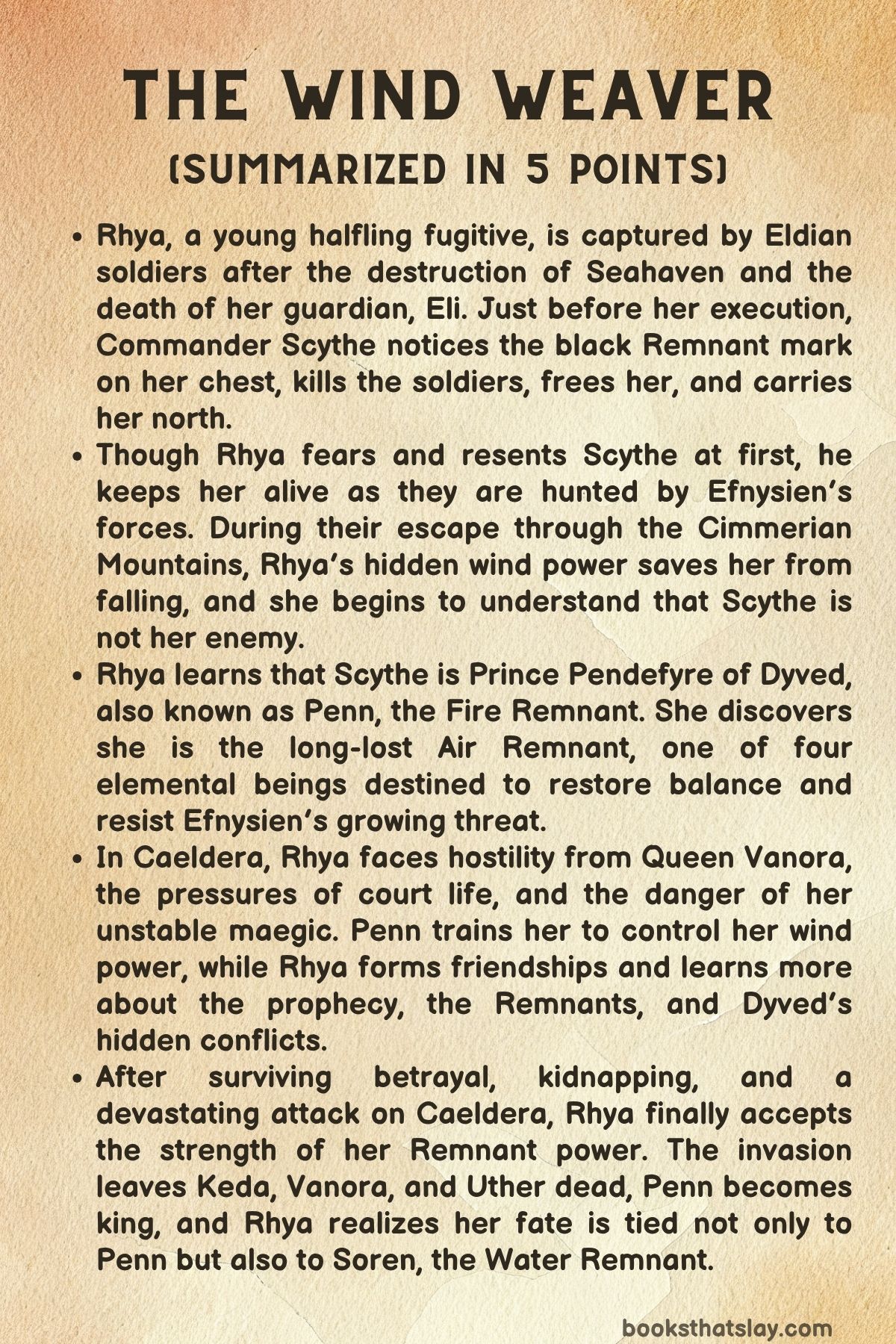
Rhya has been running for weeks after the destruction of Seahaven and the execution of Eli, the guardian who raised and protected her. Exhausted, starving, injured, and alone, she is finally captured by Eldian soldiers.
They bind her to a tree with iron shackles and place a noose around her neck, preparing to hang her as a fugitive. Captain Burrows leads the unit, treating her with cruelty and contempt.
Rhya believes death is moments away, especially when a commander named Scythe arrives and begins inspecting her like a prize.
Scythe notices the black mark on Rhya’s chest and studies her closely. Something changes when he looks into her eyes.
Instead of allowing the execution to continue, he kills Burrows and the soldiers under his command. Rhya is too weak and frightened to understand what is happening.
Scythe cuts her free, secures her to his horse, Onyx, and rides north with her. To Rhya, he seems like another captor, perhaps even more dangerous than the men he killed.
She is sick, angry, and terrified, but Scythe keeps her alive. He gives her water, food, shelter, and medicine, though his care is stern and often unwilling.
As they travel, Rhya begins to understand that Scythe is not an Eldian soldier. They are pursued by men in red and black who serve Efnysien, a powerful and dangerous enemy.
Scythe pushes north toward the Cimmerian Mountains, trying to keep Rhya away from the forces hunting her. Their escape becomes more dangerous when they reach a rope bridge over a deep ravine.
During the crossing, Rhya nearly falls, but a sudden unnatural wind lifts her back onto the bridge. Neither she nor Scythe can fully explain what happened.
In the attack that follows, Scythe is wounded by an arrow, but he manages to cut the bridge behind them, sending their pursuers into the gorge below. Rhya removes the arrow from his body and treats the wound, and after this, Scythe begins to trust her a little more.
In the mountains, Scythe reunites with Jac, one of his men. Rhya learns that the mark on her body is not random.
It is a Remnant mark, tied to an ancient power. Scythe’s true identity is revealed: he is Prince Pendefyre of Dyved, called Penn, and he is the Fire Remnant.
Rhya is told that she is the long-lost Air Remnant, one of four elemental beings reborn through time to restore balance. The knowledge overwhelms her.
She has spent her life thinking of herself as a halfling outcast, not as someone connected to prophecy, maegic, and the fate of kingdoms.
The journey through the northern lands exposes Rhya to dangers she had never imagined. Penn and his companions face monstrous cyntroedi and Reavers, while Rhya begins to discover strange gifts of her own.
She can see through glamours, illusions that hide truth from ordinary eyes. Penn’s men, including Jac, Uther, Mabon, Farley, and others, escort her onward, though not everyone knows what to make of her.
She is valuable, vulnerable, and dangerous all at once.
Rhya is also taken for a time to Soren of Llŷr, the Water Remnant. Soren explains more about the Remnants, the old prophecy, and Efnysien’s desire for maegic.
Efnysien is not merely a warlord or political enemy. He hungers for power and sees the Remnants as a way to gain it.
Soren’s calm knowledge contrasts with Penn’s guarded intensity, but Rhya is not sure whom to trust. Penn soon retrieves her, and they continue toward Dyved.
When Rhya reaches Caeldera, Dyved’s hidden crater-city, she enters a world very different from the forests, roads, and battlefields she has known. The city is protected, secret, and full of court rules.
She is presented to Queen Vanora and the nobles of Dyved. Vanora humiliates her in public, making it clear that Rhya is not welcome as an equal.
Penn, however, claims responsibility for Rhya’s safety and identifies her before the court as the Remnant of Air. His declaration protects her, but it also makes her impossible to ignore.
Life in Caeldera is difficult for Rhya. She struggles with confinement, formality, and the constant feeling that she is being watched.
Her power is also a threat. Penn trains her to contain the wind inside her Remnant, warning her that uncontrolled maegic can damage her mind and destroy those around her.
Rhya resents his control, but she also knows he understands Remnant power in a way no one else can. Their connection grows through conflict, training, fear, and moments of trust.
Rhya begins forming bonds in the palace. Her maids, Keda and Teagan, become friends and help her adjust to court life.
She also grows close to Carys, Uther’s pregnant wife, whose warmth gives Rhya a sense of ordinary kindness in a world filled with secrets. Through these relationships, Rhya learns more about Penn, his past, Enid, the prophecy, and the Ember Guild.
Yet even inside Caeldera, safety is not complete. Politics, jealousy, and fear surround her.
Restless and frustrated by palace limits, Rhya becomes vulnerable to betrayal. Gower kidnaps her, hoping to trade her to Efnysien in exchange for immortality.
His plan shows how valuable Rhya has become to those who seek power. Trapped and terrified, she loses control of her maegic.
A tornado erupts around her, destroying the wagon and killing her captors. Gower is mortally wounded.
Rhya gives him a mercy death, then flees into the forest, horrified by what she has done. Her power has saved her, but it has also revealed how destructive she can be when fear overtakes her.
Penn finds her after the escape. Their confrontation is tense, full of anger, guilt, and fear.
Rhya has seen the cost of her power, while Penn is forced to face the fact that protecting her does not mean controlling every choice she makes. They reconcile, and their bond becomes stronger.
They return to Caeldera together, changed by what has happened.
During Fyremas, Penn reveals himself to the court as the Fire Remnant in a dramatic display. His public acceptance of his identity shifts the balance of power and forces the court to reckon with the truth of the prophecy.
Later, Rhya dances with Soren, who warns her about Penn and the fate that connects them. His warning unsettles her, especially because she is still trying to understand what her own role means.
She is drawn to Penn, yet Soren’s presence suggests that the Remnant bond is larger and more complicated than she imagined.
Soon after, Caeldera is attacked. The city’s protective wards fail under assault from Efnysien’s forces.
Reavers and ice giants join the invasion, turning the hidden city into a battlefield. The violence is devastating.
Keda is murdered in front of Rhya, a loss that breaks through any illusion of safety. Palace towers collapse, Queen Vanora dies, and Uther is killed after Rhya sends him into danger.
His death leaves Rhya burdened by guilt, especially because of her closeness to Carys.
In the final battle, Rhya stops running from her power. She embraces the force within her and calls wind and lightning against the invaders.
Her maegic becomes a weapon, not only of survival but of defense. With Penn and the others fighting beside her, she helps drive Efnysien’s forces away.
Efnysien escapes, meaning the war is far from over, but Caeldera survives the attack.
After the battle, Penn becomes king of Dyved. The loss of his mother, the destruction within the city, and the deaths of those close to him harden his resolve.
He vows war against Efnysien. Rhya, meanwhile, must live with grief, guilt, and a deeper understanding of her place in the prophecy.
She has accepted that she is the Air Remnant, but that acceptance comes with danger and responsibility. By the end, she also discovers that her tether is not only to Penn, the Fire Remnant, but also to Soren, the Water Remnant.
This revelation opens a new uncertainty around her fate, her power, and the relationships that may shape the war ahead.
Characters
Rhya
Rhya is the central figure of The Wind Weaver, and her character is shaped by fear, grief, survival, and the gradual discovery of a power she never asked to carry. At the beginning of the book, she is a fugitive whose world has been destroyed by the burning of Seahaven and the execution of Eli, the guardian who seems to have represented safety, love, and identity for her.
Her capture by Eldian soldiers places her in a position of complete helplessness, yet even when she is bound, sick, and facing death, she remains emotionally fierce. Her anger is not simple stubbornness; it is the natural response of someone who has lost everything and expects cruelty from everyone around her.
Rhya’s development depends heavily on the tension between vulnerability and power. Physically, she is often weak, injured, exhausted, or dependent on others, especially in the early parts of the story.
Emotionally, however, she resists being reduced to a victim. Her suspicion of Scythe is understandable because he first appears as another threat, and her slow movement from terror to reluctant trust gives her arc emotional credibility.
She does not immediately accept protection, destiny, or affection. Instead, she tests every new truth against what she has suffered.
Her identity as the Air Remnant deepens her conflict. Rhya’s power is connected to freedom, movement, instinct, and force, but she herself is repeatedly confined, captured, controlled, or hidden.
This contrast makes her maegic feel like an extension of her deepest emotional state. When she nearly falls from the bridge and the wind saves her, the moment suggests that her power is not only a weapon but also a survival instinct.
Later, when she unleashes a tornado after Gower’s betrayal, the same power becomes terrifying because it responds to panic and rage before she can morally process its consequences.
Rhya is also morally important because she is not portrayed as innocent in a simple way. She is compassionate, but she is capable of violence.
She gives Gower a mercy death, which shows both the hardness forced upon her and the kindness she has not lost. Her guilt over Uther’s death also reveals that she takes responsibility deeply, even when the situation is chaotic and unfair.
By the end of the story, Rhya has changed from a hunted girl into a figure of elemental force, but her power does not erase her humanity. Her grief for Keda, her attachment to Penn, her confusion over Soren, and her fear of what she can become keep her emotionally grounded.
Prince Pendefyre / Penn / Scythe
Penn is one of the most complex figures in the book because he enters the story under the identity of Scythe, a dangerous and unreadable warrior who appears capable of extreme violence. His first major action is shocking: he kills Captain Burrows and the soldiers preparing to execute Rhya, then takes her away without explanation.
This immediately establishes him as both rescuer and threat. He saves Rhya’s life, but he does so in a way that makes him frightening, controlling, and impossible to trust at first.
As the story reveals his true identity as Prince Pendefyre of Dyved and the Fire Remnant, Penn’s character becomes easier to understand without becoming simple. Fire suits him symbolically because he is intense, destructive, protective, passionate, and often dangerous even when acting for the right reasons.
His care for Rhya is practical before it becomes emotionally open. He gives her water, food, shelter, medicine, and protection, but he does not initially offer warmth or full honesty.
This makes his affection feel guarded, as though he has trained himself to survive through discipline rather than tenderness.
Penn’s leadership is defined by burden. He is not only a prince but also a Remnant, which means he carries political responsibility, prophetic significance, and personal danger all at once.
His public claim of responsibility for Rhya in Caeldera shows courage because he protects her in front of a hostile court, yet it also reveals how much power he has over the way others perceive her. He becomes both shield and authority figure, which creates tension in his relationship with her.
He wants to keep her safe, but his instinct to control danger sometimes risks controlling Rhya herself.
His relationship with Rhya is central to his emotional development. He is drawn to her not merely because of fate or maegic, but because she challenges him, refuses to be passive, and sees the human being behind the feared commander.
Their reconciliation after Gower’s betrayal is important because it forces them to confront fear, anger, and trust directly. Penn’s final rise as king after Queen Vanora’s death completes his political transformation, but it also darkens his path.
His vow of war shows that he is ready to answer devastation with force, and the reader is left aware that his fire can defend, inspire, and destroy.
Soren of Llŷr
Soren, the Water Remnant, functions as a contrast to Penn and as a complication in Rhya’s understanding of fate. Where Penn is fiery, forceful, and often emotionally guarded, Soren appears more fluid, perceptive, and mysterious.
His role in explaining the Remnants, the prophecy, and Efnysien’s hunger for maegic makes him a source of knowledge, but he is not simply an exposition figure. His calmness gives him authority, and his connection to water suggests adaptability, depth, and hidden currents.
Soren’s warning to Rhya about Penn and their shared fate makes him morally ambiguous. He may be trying to protect her, but he may also be influencing her perception for reasons that are not entirely clear.
This ambiguity makes him interesting because he does not need to be openly villainous to create unease. His presence raises questions about whether destiny can be trusted, whether Remnants are bound by choice or by forces beyond them, and whether Rhya’s emotional ties are truly her own.
The discovery that Rhya is tethered not only to Penn but also to Soren changes the meaning of his character. He becomes more than an alternative influence or a prophetic guide; he is part of the larger maegical structure shaping Rhya’s future.
This tether complicates loyalty, romance, power, and identity. Soren represents the possibility that Rhya’s life is not moving toward one simple bond or one clear destiny.
Instead, he introduces emotional and supernatural uncertainty that will likely continue to challenge her sense of agency.
Efnysien
Efnysien is the major antagonistic force in the story, and his character is defined by hunger for maegic, domination, and immortality. Even when he is not physically present, his influence shapes the danger around Rhya.
His red-and-black soldiers, Reavers, monstrous forces, and invasion of Caeldera all extend his will into the world. He is frightening because he does not function only as an individual enemy; he represents a spreading corruption that turns people, creatures, and political instability into weapons.
His desire for maegic makes him a direct threat to the Remnants. He does not appear to respect power as something sacred, balanced, or tied to responsibility.
Instead, he seeks to consume or exploit it. This makes him a fitting enemy in a story where Rhya must learn control, restraint, and moral responsibility.
Efnysien embodies the opposite principle: power without humility, appetite without limit, and ambition without compassion.
Efnysien’s invasion of Caeldera shows the scale of his cruelty. The deaths of Keda, Queen Vanora, Uther, and others are not isolated tragedies; they are consequences of his larger campaign of terror.
His retreat at the end does not weaken him as a villain. Instead, it leaves him as an unresolved threat whose survival ensures that the conflict has only widened.
He is the kind of antagonist whose danger lies not only in what he has done, but in what his continued existence promises.
Eli
Eli’s importance comes from memory, loss, and emotional inheritance. Though he is dead before much of the action unfolds, his execution is one of the wounds that defines Rhya.
He appears to have been her guardian, and that role makes him central to her understanding of safety and belonging. His death is not merely a tragic backstory detail; it is the event that helps explain Rhya’s fear, rage, and distrust.
Eli represents the life Rhya has been violently separated from. Because Seahaven is burned and Eli is executed, Rhya does not begin the book as someone leaving home by choice.
She begins as someone whose home has been taken from her. This makes every later shelter feel uncertain.
Even Caeldera, despite its protection, cannot immediately replace what she lost. Eli’s absence therefore shapes Rhya’s reactions to Penn, court life, and the prophecy.
She has already learned that protectors can die and homes can burn.
His character also gives Rhya’s journey moral weight. She is not simply discovering power; she is surviving grief.
Eli’s memory helps keep her connected to the person she was before the Remnant identity begins to dominate her life. In that sense, he is a quiet but powerful presence in the story, reminding the reader that destiny does not erase personal loss.
Captain Burrows
Captain Burrows is a brief but significant character because he represents the cruelty of institutional violence. He commands the Eldian soldiers preparing to execute Rhya, and his treatment of her shows how easily authority can become brutality when a person is reduced to a category such as fugitive, enemy, or halfling.
His presence at the execution scene establishes the danger Rhya faces before the larger maegical conflict is fully revealed.
Burrows is important because he helps frame Scythe’s entrance. When Scythe kills him, the act is shocking, but Burrows’ cruelty makes the reader understand why his death functions as a rescue rather than a simple murder.
At the same time, the violence of the scene prevents Penn from appearing purely heroic. Burrows therefore serves two purposes: he embodies the immediate human threat to Rhya, and he helps introduce the morally severe world in which Penn operates.
Though Burrows does not remain in the story for long, his role matters because he shows that Rhya is endangered not only by monsters or ancient enemies, but also by ordinary soldiers carrying out orders. He is a reminder that political systems and military obedience can be just as terrifying as supernatural evil.
Jac
Jac is one of Penn’s trusted men and serves as part of the loyal network that helps carry Rhya into the northern lands and eventually toward Dyved. His reunion with Scythe in the mountains marks an important turning point because it begins to reveal that Scythe is not a lone killer or Eldian officer, but a man with allies, rank, and a hidden identity.
Jac therefore helps shift the story from pursuit and survival into the broader world of Remnants, kingdoms, and war.
As a supporting character, Jac contributes to the sense that Penn is surrounded by people who know him beyond his frightening exterior. His loyalty suggests that Penn has earned trust, not merely obedience.
This matters because Rhya’s view of Penn is initially shaped by fear. Characters like Jac help complicate that view by showing that others follow Penn with commitment and familiarity.
Jac also belongs to the group of fighters who create a rough but protective environment around Rhya. He is part of the bridge between her isolation and her gradual entry into a wider community.
His presence helps the book develop from a two-character survival journey into a larger political and military story.
Uther
Uther is one of the most emotionally important supporting characters because his death directly affects Rhya’s guilt and growth. As one of Penn’s men, he represents loyalty, courage, and the human cost of war.
His connection to Carys, especially because she is pregnant, gives him a life beyond his role as a fighter. He is not just a soldier in the background; he is a husband and soon-to-be father, which makes his death especially painful.
Uther’s relationship to Rhya becomes significant because she sends him into danger before he is killed. Whether or not she is fully responsible in a fair sense, Rhya feels the moral weight of that choice.
This moment forces her to understand leadership and power differently. Her commands, fears, and decisions can affect other people’s lives.
Uther’s death therefore becomes part of the painful education that comes with being the Air Remnant.
His character also shows how war destroys futures, not only lives. Through Carys and the unborn child, Uther’s death continues beyond the battlefield.
He represents the personal cost hidden inside heroic conflict. The story does not allow Rhya’s victory to feel clean because Uther’s loss remains attached to it.
Mabon
Mabon appears as one of Penn’s men and contributes to the protective circle that escorts Rhya through danger. While he may not receive the same emotional focus as Penn, Uther, or Keda, his presence helps establish the structure of loyalty around the prince.
Characters like Mabon make the world feel inhabited by people whose courage and service support the survival of the central figures.
His role is especially useful in showing that Rhya’s journey is not solitary once she enters Penn’s world. She is surrounded by trained fighters who understand threats she is only beginning to comprehend.
Mabon helps create the atmosphere of a dangerous passage through hostile lands, where survival depends not only on maegic but also on discipline, teamwork, and trust.
Mabon also reflects Penn’s leadership indirectly. The loyalty of his men suggests that Penn inspires confidence even when he appears harsh or secretive.
Through Mabon and the others, the reader sees that Penn’s authority is not empty title alone; it is supported by people willing to risk themselves under his command.
Farley
Farley is another member of Penn’s escort and, like Mabon, helps widen the story beyond the central Remnant figures. His inclusion among Penn’s men reinforces the importance of companionship, military loyalty, and collective survival.
In a book filled with prophecy and elemental power, Farley helps keep the conflict grounded in ordinary human bravery.
Farley’s role matters because Rhya’s movement through the northern lands requires more than Penn’s protection. The group around her becomes a temporary shield against monsters, soldiers, and the unknown.
Farley contributes to that shield. Even when a supporting character does not dominate the emotional arc, such a figure helps create the sense that the world is defended by many people whose names and actions matter.
He also participates in the gradual reshaping of Rhya’s experience of people. After betrayal, execution, and flight, she has reason to distrust groups of armed men.
Penn’s companions, including Farley, complicate that fear by showing forms of loyalty that are protective rather than predatory.
Queen Vanora
Queen Vanora is a proud, severe, and politically significant figure whose treatment of Rhya reveals the cruelty and rigidity of court life. When Rhya arrives in Caeldera, Vanora humiliates her rather than welcoming her as a vulnerable young woman or honoring her as the Air Remnant.
This shows that Vanora values status, control, and appearances, and that she is willing to use public shame as a weapon.
Her conflict with Rhya also exposes the difference between political authority and moral authority. Vanora holds royal power, but her behavior toward Rhya lacks compassion.
She appears threatened by what Rhya represents: uncontrolled maegic, disruption, prophecy, and Penn’s public loyalty. Rhya’s presence challenges the order Vanora understands, and Vanora responds by trying to reduce her.
Vanora’s death during the invasion is significant because it marks the collapse of an old order. Her rule, with all its pride and limitations, gives way to Penn’s kingship in a moment of violence and crisis.
She is not simply an antagonist within the court; she is a symbol of a political world unable to protect itself from the larger darkness approaching. Her death clears the way for a new ruler, but it also shows that status offers no safety when Efnysien’s forces break through.
Keda
Keda is one of the most sympathetic supporting characters because she offers Rhya kindness within the intimidating world of Caeldera. As one of Rhya’s maids, she helps humanize court life.
Her role is not based on power, prophecy, or command, but on care, companionship, and emotional warmth. For Rhya, who has been hunted, imprisoned, and judged, Keda’s friendship becomes deeply meaningful.
Keda’s murder is one of the most painful moments in the story because it attacks Rhya’s fragile sense of safety. Keda is not a warrior or a political ruler; she is someone who helps Rhya feel less alone.
Her death therefore demonstrates the cruelty of the invasion in personal terms. The war does not only target soldiers and leaders.
It destroys gentle, ordinary bonds that make survival bearable.
Her character also affects Rhya’s transformation. Seeing Keda murdered contributes to Rhya’s emotional breaking point and her eventual embrace of power.
Keda’s death becomes part of the grief that pushes Rhya into action, but the story does not treat her merely as a trigger. She matters because her kindness mattered.
Her loss reminds the reader what Rhya is fighting for: not abstract prophecy alone, but the people who make life worth protecting.
Teagan
Teagan, like Keda, is one of Rhya’s maids and helps create a space of companionship within the palace. Her presence is important because Rhya’s time in Caeldera could otherwise be defined only by humiliation, confinement, training, and political suspicion.
Teagan helps soften that environment by giving Rhya a connection to ordinary daily life.
As a supporting character, Teagan represents the quieter forms of loyalty and care that exist away from battlefields. In a story full of warriors and rulers, she shows that emotional survival often depends on people who help with small acts of steadiness.
Her friendship with Rhya is part of the process by which Rhya begins to belong somewhere again, even if that belonging remains fragile.
Teagan also helps reveal Rhya’s need for human connection. Rhya is powerful, but she is still young, traumatized, and lonely.
Through Teagan and Keda, the book shows that Rhya’s growth cannot come only from Penn’s training or Soren’s explanations. She also needs friendship, gentleness, and people who see her as more than a Remnant.
Carys
Carys is emotionally significant because she represents domestic hope within a world moving toward war. As Uther’s pregnant wife, she embodies family, continuity, and the future.
Her closeness with Rhya gives Rhya another bond within Caeldera, one that is not based on prophecy or politics but on warmth and trust.
Carys’s pregnancy makes the stakes of conflict more intimate. The coming child suggests life continuing despite violence, but Uther’s death turns that hope into grief.
Through Carys, the cost of battle becomes more than a battlefield loss. It becomes widowhood, fatherlessness, and a future altered before it begins.
Her character reminds the reader that every soldier has relationships beyond the fight.
For Rhya, Carys also becomes part of the emotional consequence of Uther’s death. Rhya’s guilt is sharpened because Uther was not only one of Penn’s men; he belonged to Carys and their unborn child.
Carys’s presence therefore deepens the moral seriousness of Rhya’s choices and reinforces the idea that power carries responsibility toward people who may never stand in the center of prophecy but suffer from its consequences.
Gower
Gower is one of the clearest examples of betrayal in the book. His decision to kidnap Rhya and trade her to Efnysien for immortality reveals greed, cowardice, and moral corruption.
He is dangerous not because he commands armies, but because he violates trust from within. His betrayal is especially harmful because Rhya is already struggling with confinement, suspicion, and uncertainty.
Gower proves that danger can come from someone close enough to exploit her restlessness.
His desire for immortality is important because it mirrors Efnysien’s larger hunger for power. Gower is not as grand or terrifying as Efnysien, but he reflects the same moral disease on a smaller human scale.
He is willing to sacrifice Rhya’s life and freedom for personal gain. This makes him a smaller but still meaningful version of the corrupt ambition threatening the world.
Gower’s death is also crucial to Rhya’s character arc. When she unleashes the tornado, the violence is uncontrolled and devastating.
Yet when she gives Gower a mercy death afterward, the moment becomes morally complicated. She is furious and traumatized, but not cruel for cruelty’s sake.
Gower’s betrayal forces Rhya to confront what her power can do, and his end marks one of the moments when she becomes painfully aware that survival may require choices she can never fully escape.
Enid
Enid is important because she is connected to Penn, the prophecy, and the deeper history surrounding the Remnants. Even if her role is less direct than Rhya’s or Penn’s, she helps expand the emotional and mythic background of the story.
Through what Rhya learns about Enid, the reader gains a stronger sense that the current conflict is tied to earlier lives, older wounds, and unresolved truths.
Enid’s significance lies partly in how she shapes Rhya’s understanding of Penn. Penn is not only the fierce protector Rhya knows in the present; he has a past, losses, and connections that existed before her.
Enid helps give that past emotional texture. She suggests that Penn’s guardedness and intensity may come from more than duty alone.
Her connection to the prophecy also reinforces the idea that the Remnants are trapped inside a larger pattern. Enid belongs to the web of history that Rhya must understand if she is to understand herself.
In this way, Enid’s character functions less through direct action and more through influence, memory, and revelation.
Onyx
Onyx, Penn’s horse, is not a human character, but he plays a meaningful role in the journey. He is associated closely with Penn’s strength, speed, and command.
When Rhya is strapped to him after being rescued, Onyx becomes part of her frightening transition from captivity into an unknown future. At first, the horse is connected to Rhya’s lack of control because she is carried away without understanding where she is being taken.
Over time, Onyx also becomes part of the survival structure around Rhya. In a landscape of forests, marshes, mountains, and pursuit, a horse is not just transportation but a lifeline.
Onyx helps carry Penn and Rhya through danger, and his presence adds physical realism to the journey. He belongs to the harsh, mobile world of flight, war, and rescue.
Symbolically, Onyx reflects Penn himself. Dark, powerful, disciplined, and battle-ready, the horse reinforces the image of Penn as a figure of controlled force.
Because Rhya’s earliest experience with Onyx is bound up with fear and helplessness, her later ability to ride upright marks a subtle shift in her own agency. She moves from being carried like a prisoner to traveling as someone beginning to reclaim herself.
The Reavers
The Reavers function less as individual characters and more as embodiments of horror, corruption, and the unnatural violence serving Efnysien’s cause. Their presence expands the danger of the story beyond ordinary soldiers.
They help create a world where the enemy is not only political but monstrous, suggesting that Efnysien’s influence twists the natural order.
Their importance lies in the fear they generate. For Rhya, encountering forces like the Reavers makes it clear that her survival is tied to a much larger conflict than the destruction of Seahaven.
She is not simply running from soldiers; she is being drawn into a war involving creatures and powers that challenge her understanding of reality.
The Reavers also help justify the urgency surrounding the Remnants. If such beings are part of Efnysien’s army, then restoring balance is not an abstract prophetic goal.
It is necessary for survival. Their presence makes the world of The Wind Weaver feel darker, more dangerous, and more deeply threatened by maegical corruption.
The Cyntroedi
The cyntroedi are monstrous beings that contribute to the danger of Rhya’s journey through the northern lands. Like the Reavers, they are not developed as individual personalities, but they are still important to the book’s atmosphere and conflict.
They show that the world outside sheltered places is filled with threats that are both physical and supernatural.
Their role is especially important during Rhya’s transition from fugitive to Remnant. Fighting or surviving creatures like the cyntroedi forces her to accept that she has entered a reality governed by maegic, ancient powers, and creatures she may not fully understand.
This helps widen the scope of the story and pushes Rhya beyond the concerns of ordinary survival.
The cyntroedi also serve as tests for Penn and his companions. Their presence allows the reader to see the skill and danger of the people escorting Rhya.
In this way, they strengthen the sense that Rhya is moving through a world where courage must be constant because safety is temporary.
The Ice Giants
The ice giants appear as part of the invading force that attacks Caeldera, and they help elevate the final conflict into something massive and catastrophic. Their presence makes the assault feel overwhelming, as though the city is being attacked not only by soldiers but by forces of nature turned hostile.
They also create a strong contrast with Penn’s fire and Rhya’s wind, emphasizing the elemental scale of the battle.
As figures within the invasion, the ice giants represent the destructive reach of Efnysien’s power. They are not merely battlefield obstacles; they show that the enemy can command or unleash beings capable of bringing down defenses that once seemed secure.
Their role helps transform Caeldera from hidden refuge into a place of collapse and death.
The ice giants also contribute to Rhya’s final embrace of her power. Against enemies of such scale, hesitation is no longer possible.
Rhya must become more than a frightened girl with uncontrolled maegic. Their presence helps push her into the role of a true elemental force, capable of summoning wind and lightning in defense of the people and place under attack.
Themes
Power, Control, and Responsibility
The Wind Weaver presents power as something that can protect, destroy, tempt, and terrify all at once. Rhya’s wind maegic first appears when she is desperate, cornered, or afraid, which shows that her gift is tied closely to survival rather than choice.
Yet every time she uses it without control, the results become dangerous: she saves herself, but she also kills, injures, and causes destruction she cannot fully accept. This makes her power morally complicated.
It is not treated as a simple blessing, because it demands discipline, emotional strength, and accountability. Penn’s training teaches her that maegic is not only about strength but also containment.
The more Rhya learns, the more she understands that fear cannot be the force guiding her abilities. Her final use of wind and lightning shows growth because she acts with purpose rather than panic.
The theme suggests that true power is not proven by how much one can unleash, but by knowing when, why, and how to use it.
Identity and Self-Acceptance
Rhya’s journey is shaped by the painful gap between what she believes herself to be and what others reveal about her. At first, she sees herself mainly as a halfling fugitive: unwanted, hunted, grieving, and powerless against the forces chasing her.
The Remnant mark changes that understanding, but it does not immediately give her confidence. Instead, it creates confusion, fear, and pressure.
Being named the Air Remnant forces her into a role she never asked for, surrounded by people who either fear her, use her, judge her, or expect greatness from her. Her struggle at court shows how difficult it is to accept an identity when that identity is imposed publicly before it is understood privately.
Rhya’s self-acceptance grows slowly through training, friendship, grief, and battle. She does not become stronger by rejecting her old self, but by accepting that the frightened fugitive and the Air Remnant are the same person.
Her identity becomes something she claims rather than something others define for her.
Trust, Betrayal, and Loyalty
Trust develops in the story as something fragile, earned through action rather than words. Rhya has every reason to distrust Penn when he first saves her, because his violence, secrecy, and forceful control make him seem like another captor.
Yet his care for her wounds, his protection during the journey, and his repeated willingness to risk himself complicate her fear of him. Their relationship grows through conflict, not instant comfort, which makes the trust between them feel hard-won.
In contrast, Gower’s betrayal shows how easily trust can be exploited when greed and fear take over. He sees Rhya not as a person but as a bargaining tool, and his actions push her into one of her most traumatic uses of power.
Loyalty is also shown through Penn’s companions, who protect Rhya despite danger and uncertainty. The deaths of Keda, Uther, and others deepen this theme by showing that loyalty often carries a heavy cost.
Trust becomes precious because betrayal can destroy safety in a moment.
Grief, Survival, and Transformation
Rhya’s survival begins in grief, with the loss of Seahaven and Eli shaping her fear, anger, and loneliness. She is not simply running from soldiers; she is running through the wreckage of a life that has already been violently taken from her.
This grief follows her even when she reaches safer places, because survival does not erase trauma. Her injuries, nightmares, anger, and distrust all show the emotional weight she carries.
Yet the story does not present survival as passive endurance. Rhya is repeatedly forced to adapt: she learns to ride, to heal, to face court hostility, to control her maegic, and to fight when escape is no longer enough.
The losses at Caeldera make her transformation even more painful, especially because she feels responsible for some of the harm around her. By the final battle, Rhya has changed from someone trying only to stay alive into someone willing to stand, act, and defend others.
Her transformation is born from grief, but not trapped by it.