The Stolen Life of Colette Marceau Summary, Characters and Themes
The Stolen Life of Colette Marceau by Kristin Harmel is a historical novel about theft, survival, memory, and justice. Moving between Nazi-occupied Paris and modern-day Boston, it follows Colette Marceau, an elderly woman with a secret life as a jewel thief who steals only from the cruel and corrupt.
Her past is tied to the French Resistance, a lost sister, a stolen bracelet, and a childhood love she thought was gone forever. The novel explores how war breaks families apart, how guilt and grief shape a life, and how truth can still bring healing after decades of silence.
Summary
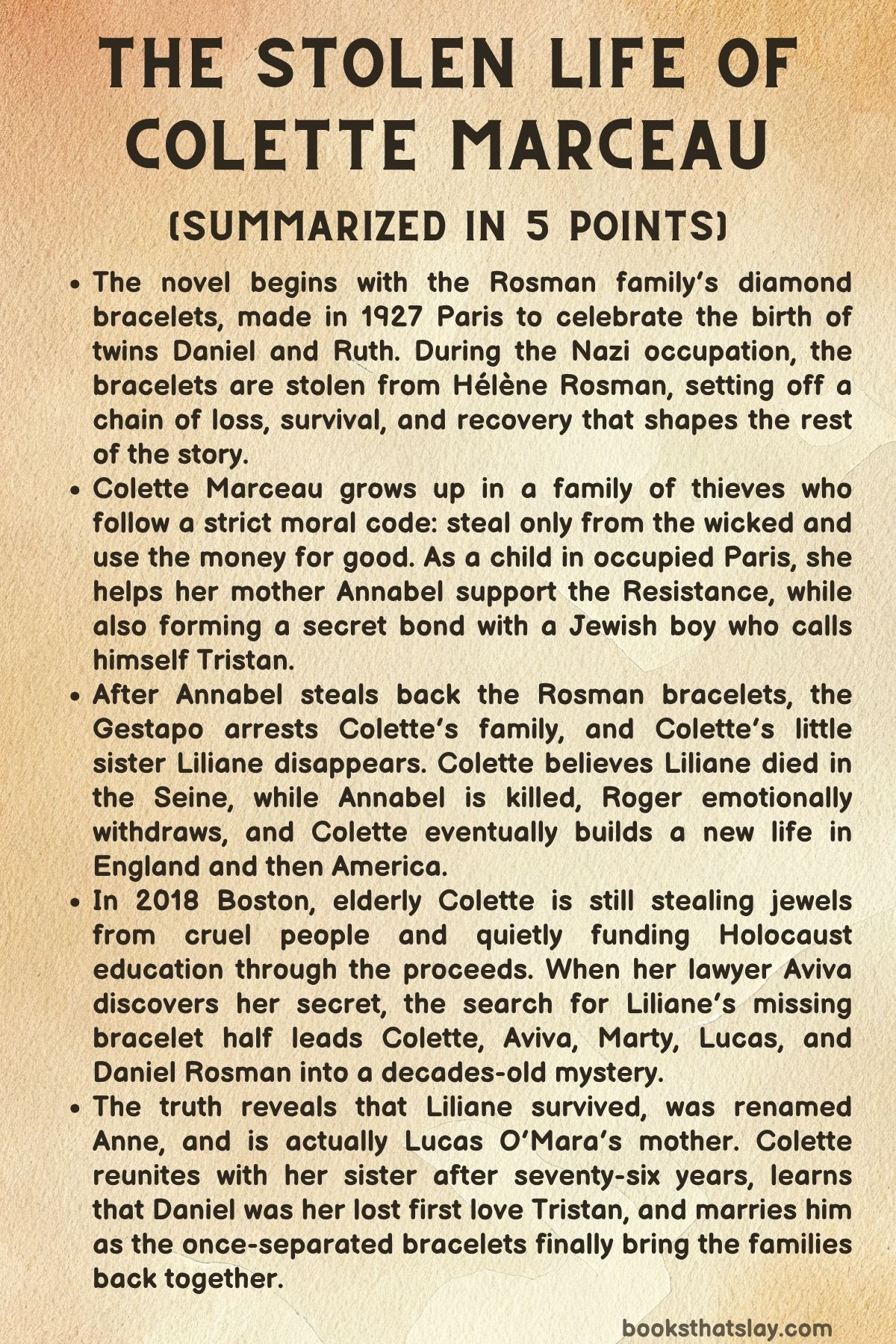
The Stolen Life of Colette Marceau begins in Paris in 1927, when Salomon Rosman asks jeweler Max Besner to create a special gift for his wife, Hélène, after the birth of their twins, Daniel and Ruth. The result is a pair of diamond bracelets designed as lilies when worn separately and as a butterfly when fastened together.
They are beautiful, personal, and full of meaning for the Rosman family. Years later, during the Nazi occupation of France, the bracelets are stolen by Nazi officer Möckel when the Rosman family is arrested.
Salomon and Hélène do not survive, but the jewels remain, carrying the history of a family torn apart by hatred.
The story then moves to Boston in 2018, where Colette Marceau is eighty-nine years old and living with a secret that almost no one knows. At an orchestra gala, she steals a yellow diamond ring from Linda Clyborn, a wealthy woman who supports neo-Nazi causes.
This theft is not an isolated act. Colette has spent much of her life stealing jewels from people she considers wicked and using the money for good.
Her crimes are guided by a strict moral code she learned as a child: take only from those who harm others, and use what is taken to help the innocent. With help from her longtime friend and fence, Marty, she has turned stolen wealth into charitable support, including the Boston Center for Holocaust Education, which she secretly founded.
Colette’s life as a thief began in childhood in Paris. Her mother, Annabel, told her that their family descended from Robin Hood and that stealing could be a form of justice when it was done for the right reasons.
Annabel trained Colette carefully, teaching her how to observe, move quietly, and take jewels without being noticed. At first, Colette’s lessons seem adventurous, but as the German occupation tightens its hold on Paris, theft becomes part of a larger fight.
Annabel works with the French Resistance, stealing jewels from corrupt men, Nazi sympathizers, and German officers in order to fund escape routes for Jewish families and others in danger.
As a girl, Colette becomes involved in this dangerous work despite the risks. She also meets a Jewish boy who calls himself Tristan.
Their connection grows through hidden notes and poems passed through a loose brick in a courtyard wall. Their friendship becomes one of the few bright parts of Colette’s youth during a time filled with fear, secrecy, and loss.
To Colette, Tristan represents hope, tenderness, and a possible future beyond war, though she does not know his real identity.
In 1942, Annabel steals the Rosman bracelets back from Nazi officer Möckel. Her intention is to protect them and one day return them to Hélène Rosman, though she does not yet know whether Hélène will survive.
Annabel hides the bracelets by sewing one half into Colette’s nightgown and the other half into the clothing of Colette’s little sister, Liliane. Soon after, the Gestapo arrests Annabel, Colette, and Colette’s father, Roger.
Liliane is left behind, and when Colette later hears that a child’s body has been found in the Seine, she believes her sister is dead. The bracelet hidden with Liliane is gone.
The arrest destroys Colette’s family. Annabel is killed, and Roger survives but withdraws emotionally from his daughter.
Colette is left with grief, guilt, and the belief that she failed to protect Liliane. Later, she leaves France and goes first to England and then to America with her uncle Leo, who also lives by the family’s thieving code.
In the years that follow, Colette builds a new life, but she never fully escapes the past. She continues stealing from those she sees as cruel and uses the profits to support causes connected to justice, remembrance, and protection of the vulnerable.
In 2018, Colette’s secret begins to unravel when Aviva Haskell, her lawyer and surrogate daughter, sees Colette in a newspaper photo from the gala where Linda Clyborn’s ring disappeared. Aviva confronts her, and Colette eventually admits the truth about her life as a thief.
Around the same time, a detective questions Colette, but she manages to mislead him. Although Aviva is shocked by Colette’s confession, she also begins to understand the pain and purpose behind it.
The past returns more forcefully when Marty discovers that the missing half of Liliane’s bracelet is on display at Boston’s Diamond Museum. Colette is stunned.
For decades, she believed the bracelet had vanished after Liliane’s death, but its presence in Boston suggests that the story she has carried for most of her life may not be true. Colette asks Aviva to investigate Lucas O’Mara, the museum’s director.
Aviva learns that the bracelet was loaned by Hubert Verdier, the grandfather of Lucas’s late wife. This discovery raises new questions about how the bracelet traveled from wartime Paris to an American museum.
Colette, Aviva, Marty, Lucas, and Daniel Rosman are gradually pulled into the search for the truth. Daniel, the surviving son of Salomon and Hélène Rosman, recognizes the bracelet as belonging to his mother.
His arrival gives the search deeper emotional weight, because the bracelets are not only valuable objects but the last physical link to a murdered family. Daniel and Colette travel to Paris together, where Colette returns to the places that shaped her childhood.
In the old courtyard wall, she finds a note left in 1952 by Tristan. The note proves that he survived the war and came back looking for her, but he believed she was dead.
This discovery reopens one of Colette’s oldest wounds while also giving her a small measure of comfort.
At first, the investigation seems to point toward Hubert Verdier, but the full truth is more complicated. Guillaume Charpentier, a French policeman and former student of Colette’s father, had tried to warn the Marceau family after his jealous wife exposed Annabel’s Resistance work.
When he found Liliane alone, he took her, believing he was saving her from danger. He renamed her Anne and raised her in America.
The body found in the Seine was not Liliane’s. Colette’s sister had survived.
Colette then learns that Lucas is Liliane’s son, which means the museum director she has been investigating is actually her nephew. The revelation changes everything.
After seventy-six years of believing Liliane was dead, Colette is reunited with her sister. The reunion is filled with shock, sorrow, and relief.
Both women have lived nearly whole lives apart because of war, fear, and the choices of adults trying, in flawed ways, to protect a child. Guillaume confesses what he did and dies soon afterward, leaving behind a truth that brings both pain and closure.
Daniel returns the bracelets to Colette and Liliane, recognizing that the jewels now belong not only to the Rosman family’s memory but also to the story of two sisters who were separated by the same violence. At last, another truth comes to light: Daniel was the boy who called himself Tristan.
The name had been a romantic pen name he used in his notes to Colette. Colette and Daniel realize that they were each other’s lost first love, separated by war and reunited only after a lifetime had passed.
Two months later, Colette and Daniel marry in Colette’s backyard, surrounded by Liliane, Aviva, Lucas, Millie, and Marty. The ending brings together people who were once separated by secrets, grief, and history.
The butterfly bracelets, broken apart by war and theft, are reunited, just as the families connected to them find their way back to one another. The Stolen Life of Colette Marceau closes with a sense of restoration, showing that even after great loss, truth and love can still return in unexpected ways.
Characters
Colette Marceau
Colette Marceau is the emotional center of The Stolen Life of Colette Marceau, and her character is shaped by loss, secrecy, guilt, courage, and a lifelong commitment to justice. As an old woman in 2018 Boston, she appears polished, intelligent, and controlled, but beneath that composed exterior is someone who has spent decades carrying the wounds of Nazi-occupied Paris.
Her decision to steal jewels from cruel or corrupt people is not simple criminal behavior; it grows out of the moral code taught to her by her mother and hardened by the horrors she witnesses as a child. Colette believes that wealth taken from wicked people can be transformed into protection, education, and healing for others.
This makes her a morally complex figure in the book because she breaks the law, yet her actions are guided by a deeply personal sense of justice.
Colette’s childhood reveals how early she is forced to grow up. She is trained by Annabel to steal skillfully, but she is also taught restraint, purpose, and responsibility.
The occupation of France turns that family tradition into something far more dangerous and urgent. Colette’s involvement in Resistance work shows her bravery, but it also exposes her to trauma at an age when she should have been protected.
Her bond with Tristan gives her a glimpse of tenderness and hope during a terrifying period, and the loss of that connection becomes one of the many griefs that follow her into adulthood. Her belief that Liliane died, her mother’s murder, and her father’s emotional abandonment all leave her with a sense that love can disappear suddenly and that survival often requires secrecy.
In old age, Colette is still sharp, daring, and resourceful, but she is also lonely in ways she does not always admit. Her relationship with Aviva shows her softer side, especially because Aviva becomes almost like a daughter to her.
Colette’s secret founding of the Boston Center for Holocaust Education also reveals that she has not merely been stealing for revenge; she has been trying to preserve memory and prevent cruelty from being forgotten. Her reunion with Liliane allows her to confront the central wound of her life: the belief that she failed to protect her sister.
By the end of the story, Colette’s life changes from one defined by hidden grief to one opened by truth, forgiveness, restored family, and unexpected love.
Annabel Marceau
Annabel Marceau is one of the most powerful influences in the book because her beliefs shape Colette’s entire life. She is bold, skilled, secretive, and morally disciplined, and she teaches Colette that theft is only justifiable when it is directed at wicked people and used to help the innocent.
Annabel’s claim that their family descends from Robin Hood is important not only as a family legend but also as a moral framework. She does not teach Colette to steal out of greed or vanity.
Instead, she teaches her to see theft as a weapon against cruelty and corruption, which becomes especially significant during the German occupation.
Annabel’s role in the Resistance deepens her character beyond that of a clever thief. She is a woman willing to risk her life to save Jewish families and fund escape routes.
Her theft of the Rosman bracelets from Möckel is an act of defiance against Nazi violence and theft. She understands the symbolic and emotional value of the jewels, especially because they belong to Hélène Rosman and are tied to a family shattered by persecution.
By sewing the bracelet halves into Colette’s and Liliane’s clothing, Annabel tries to protect both the jewels and her daughters, but this action also connects the sisters’ fates to the stolen bracelets for decades.
Annabel’s death becomes one of the defining tragedies of Colette’s life. She represents courage, resistance, maternal strength, and moral clarity.
Even after she is gone, her voice continues to guide Colette’s choices. Colette’s adult life as a thief who targets cruel people is, in many ways, a continuation of Annabel’s unfinished work.
Annabel’s legacy is complicated because the life she teaches Colette is dangerous, but it is also rooted in compassion and justice. She remains a heroic figure in the story because she chooses action over fear and uses her skills to protect those who are most vulnerable.
Roger Marceau
Roger Marceau is a tragic and disappointing figure because he survives the war physically but fails Colette emotionally. As Colette’s father, he should be a source of comfort after Annabel’s death and Liliane’s disappearance, yet he withdraws from her when she needs him most.
His emotional abandonment becomes another form of loss for Colette. She does not only lose her mother and sister; she also loses the father who remains alive but becomes distant and unable to care for her properly.
Roger’s weakness contrasts sharply with Annabel’s courage. While Annabel acts boldly and risks everything for others, Roger is marked by grief, fear, and collapse.
His inability to support Colette does not necessarily make him evil, but it does make him painfully inadequate as a parent. The war breaks him in a different way, leaving him unable to protect or nurture his daughter.
This makes him an important character because he shows how trauma can destroy people internally, even when they survive externally.
Roger’s connection to Guillaume Charpentier also becomes important later, since Guillaume was once his student. This link helps explain how Guillaume becomes involved in the Marceau family’s tragedy.
Roger’s presence in the story is quieter than Annabel’s, but his failure leaves a deep mark on Colette. His character represents the damage caused not only by violence and persecution but also by emotional absence after catastrophe.
Liliane Marceau / Anne
Liliane Marceau is one of the most important lost figures in the book, even before she fully appears as a living person. As Colette’s younger sister, she represents innocence interrupted by war.
Her disappearance through the bedroom window becomes the mystery that haunts Colette for most of her life. Colette believes Liliane died in the Seine, and this belief fills her with sorrow and guilt.
The missing bracelet half becomes a symbol of Liliane’s absence, making her both a beloved sister and a living question that remains unanswered for decades.
The revelation that Liliane survived but was renamed Anne changes the emotional meaning of the entire story. Her life was not ended, but it was stolen and reshaped by Guillaume Charpentier’s decision to take her.
Although Guillaume believed he was saving her, his actions separated Liliane from her true identity, her sister, and her family history. Liliane’s survival is therefore both a miracle and a tragedy.
She lived, but she lived without knowing the full truth of who she was.
Liliane’s reunion with Colette is deeply moving because it restores a bond that war, fear, and deception had broken. She is not merely a missing sister returned; she is proof that Colette’s life has been shaped by a false grief.
Her presence allows Colette to release some of the guilt she has carried since childhood. Liliane also connects the past to the present through Lucas, her son, making the reunion not only between two sisters but between two branches of a family that had been unknowingly separated.
Daniel Rosman / Tristan
Daniel Rosman is one of the most meaningful characters in the story because he connects Colette’s childhood hope, the Rosman family tragedy, and the final restoration of love. As a Jewish boy hiding under the name Tristan, he gives young Colette a sense of companionship and romance during a period defined by fear.
Their exchange of notes and poems through the courtyard wall shows how love and imagination can survive even in dangerous conditions. The name Tristan reflects his romantic nature and his desire to create beauty in a world that is becoming increasingly brutal.
As Daniel Rosman, he also carries the weight of his family’s suffering. His parents, Salomon and Hélène, are murdered, and the bracelets made for his mother become part of a larger history of theft, survival, and memory.
His recognition of the bracelet as his mother’s gives him an essential role in uncovering the truth. Daniel is not only Colette’s lost first love; he is also a survivor seeking connection to the family and life stolen from him.
Daniel’s return to Colette’s life in old age brings emotional closure to one of the story’s deepest wounds. The discovery that he was Tristan transforms what seemed like a lost childhood romance into a love that endured across time, misunderstanding, and grief.
His decision to return the bracelets to Colette and Liliane shows generosity and emotional wisdom. By marrying Colette, Daniel helps turn a story marked by separation into one of reunion.
His character represents memory, survival, tenderness, and the possibility of finding love again even after a lifetime of loss.
Aviva Haskell
Aviva Haskell is Colette’s lawyer, confidante, and surrogate daughter, and she plays a crucial role in bringing Colette’s hidden life into the open. At first, Aviva is shocked when she realizes that Colette may be involved in jewel theft, but her response is not merely judgmental.
She pushes for truth because she cares about Colette and wants to understand the woman behind the secrets. Aviva’s character brings a modern perspective to the story, especially because she must reconcile legality with morality.
Aviva’s relationship with Colette is one of the warmest emotional bonds in the novel. She is not related to Colette by blood, yet she behaves with the concern, loyalty, and persistence of family.
Her investigation into Lucas O’Mara and the bracelet at the Diamond Museum helps move the mystery forward, but her importance is not only practical. She becomes a bridge between Colette’s secretive past and the possibility of a more honest future.
Aviva also represents trust. Colette has lived most of her life hiding her crimes, her grief, and her history.
By confessing to Aviva, she allows someone else to carry part of the truth with her. Aviva’s willingness to stay by Colette’s side shows emotional maturity and compassion.
She helps prove that chosen family can be as meaningful as biological family, especially for someone like Colette, whose life has been marked by repeated losses.
Marty
Marty is Colette’s longtime fence and friend, and his character adds loyalty, practicality, and quiet affection to the story. On the surface, he helps Colette sell stolen jewels, which places him in the world of crime.
However, like Colette, Marty is not presented as greedy or heartless. He understands the purpose behind her thefts and supports the charitable mission that comes from them.
His role shows that Colette’s secret life depends not only on daring but also on trusted relationships built over many years.
Marty is important because he knows parts of Colette that most people do not. He understands her methods, her code, and her history of targeting cruel people.
His discovery that Liliane’s missing bracelet half is on display at the Boston Diamond Museum becomes one of the key turning points in the book. Without Marty’s knowledge and attention, the path to uncovering Liliane’s survival might never have opened.
Beyond his usefulness to the plot, Marty provides emotional steadiness. He is part of Colette’s small inner circle, someone who accepts her contradictions without abandoning her.
His presence at the end, when Colette’s life becomes filled with family and celebration, confirms that he has been more than a criminal associate. He has been a loyal companion in a life that often required secrecy and solitude.
Lucas O’Mara
Lucas O’Mara is first introduced through suspicion because of his connection to the bracelet displayed at the Boston Diamond Museum. As the museum director, he appears to be tied to the mystery of Liliane’s missing bracelet half, and Aviva’s investigation into him initially raises questions about his family history.
His connection to Hubert Verdier makes him seem like a possible link to wartime theft or concealment, but his true significance is far more personal.
The revelation that Lucas is Liliane’s son changes his role dramatically. He is not merely a museum director connected to a stolen jewel; he is Colette’s nephew.
Through Lucas, the story reveals that Liliane survived, built a life, and had a family of her own. This makes Lucas a living extension of the sister Colette thought she had lost.
His existence proves that the Marceau family line continued in secret, even though Colette did not know it.
Lucas also represents the way history can hide inside ordinary family stories. He has inherited a connection to the past without fully understanding it.
Once the truth emerges, he becomes part of the healing process that reunites Colette and Liliane. His character shows how the consequences of wartime choices pass through generations, shaping people who may not even know the full origin of their family’s pain.
Guillaume Charpentier
Guillaume Charpentier is one of the most morally complicated characters in the story. As a French policeman and former student of Roger Marceau, he is connected to the Marceau family before the central tragedy occurs.
His attempt to warn the family after his jealous wife exposes Annabel suggests that he is not purely malicious. He understands danger and tries, at least in part, to prevent disaster.
However, his decision to take Liliane and raise her under a new name changes the course of many lives.
Guillaume believes he is saving Liliane when he finds her alone, but his act of rescue becomes an act of theft. By renaming her Anne and raising her in America, he deprives her of her identity, her sister, and her true family history.
His motives may include fear, guilt, compassion, and self-justification, but the result is devastating. Colette spends seventy-six years believing her sister is dead, while Liliane grows up separated from the truth of who she is.
Guillaume’s confession near the end of the book is essential because it finally exposes the hidden chain of events behind Liliane’s disappearance. His death soon after confession gives his character a tragic finality.
He is not a simple villain, but he is responsible for enormous harm. His character forces the story to examine whether good intentions can excuse life-altering deception.
The answer is painful: even if Guillaume wanted to save Liliane, he also stole her life from her family.
Salomon Rosman
Salomon Rosman is a loving husband and father whose early act of commissioning the twin diamond bracelets gives the story one of its central symbols. By asking Max Besner to create bracelets for Hélène after the birth of Daniel and Ruth, Salomon expresses love, celebration, and family devotion.
The design of the bracelets, which can be worn separately as lilies or joined as a butterfly, reflects unity, beauty, and the bond between twins.
Salomon’s fate during the Nazi occupation reveals the brutality at the heart of the story. His family is arrested, his wife’s jewels are stolen, and he and Hélène are killed.
Although he does not occupy as much narrative space as Colette or Annabel, his role is deeply important because the stolen bracelets originate in his love for his family. What begins as a gift becomes a witness to violence, theft, and survival.
Salomon represents the lives and families destroyed by antisemitic persecution. His character reminds readers that stolen objects are never just objects; they carry the memories of the people who owned, gave, wore, and cherished them.
Through the bracelets, Salomon’s love survives long after his death and eventually helps reconnect the living descendants of two families marked by war.
Hélène Rosman
Hélène Rosman is central to the emotional meaning of the bracelets. They are made for her after the birth of her twins, Daniel and Ruth, and they symbolize motherhood, beauty, and family unity.
The fact that the bracelets can be separated into lilies or joined into a butterfly makes them especially meaningful, as they reflect both individuality and connection. Hélène’s ownership of the bracelets gives them a personal history before they become part of a wartime mystery.
Her arrest and death at the hands of the Nazis turn the bracelets into symbols of violation and loss. Möckel’s theft of her jewels is not just robbery; it is part of a larger pattern of dehumanization and plunder.
Annabel’s attempt to recover the bracelets and eventually return them to Hélène shows respect for Hélène’s dignity, even after Hélène herself has been murdered. The jewels continue to carry her memory when she can no longer speak for herself.
Hélène’s character represents the countless victims whose possessions, homes, families, and futures were stolen. Although she appears mainly through memory and through the objects connected to her, her presence remains powerful.
The eventual return of the bracelets to Colette and Liliane, with Daniel’s blessing, honors not only the Marceau sisters but also Hélène’s lost life and motherhood.
Ruth Rosman
Ruth Rosman is one of the Rosman twins and is part of the family history embodied by the bracelets. Her birth, alongside Daniel’s, inspires Salomon to commission the twin bracelets for Hélène.
Even though Ruth does not have the same active role in the later investigation as Daniel, her existence is essential to the symbolism of the jewelry. The paired design reflects the birth of two children and the joy surrounding their arrival.
Ruth’s importance lies in what she represents: the fragile beauty of family life before Nazi violence destroys it. The bracelets were created to celebrate life, motherhood, and twins, but war transforms them into objects marked by grief.
Ruth is part of that original world of love and promise. Her connection to the bracelets reminds readers that the jewels are not merely valuable because of diamonds; they are valuable because they were born out of family happiness.
As part of the Rosman family, Ruth also deepens the sense of loss surrounding Salomon and Hélène’s deaths. Her character helps complete the picture of a family torn apart by persecution.
Even when she is not central to the action, her presence gives emotional weight to the history behind the bracelets.
Max Besner
Max Besner is the jeweler commissioned by Salomon Rosman to create the twin diamond bracelets. His role is brief but symbolically important because he is the craftsman who transforms Salomon’s love for Hélène and their children into a lasting physical object.
The beauty and cleverness of the bracelets show his artistry. They can be worn separately as lilies or joined into a butterfly, making them not only jewelry but also a work of emotional design.
Max’s creation becomes one of the central symbols of The Stolen Life of Colette Marceau. Although he likely intends the bracelets to celebrate birth and family, they later become tied to theft, murder, hidden identity, and reunion.
This gives his craftsmanship a meaning far beyond decoration. The bracelets survive the people and events around them, carrying memory across generations.
Max represents the quiet power of objects made with care. His character reminds readers that art and craftsmanship can preserve human feeling even when history becomes violent.
The bracelets he creates are beautiful, but their true significance comes from the lives attached to them.
Möckel
Möckel is one of the clearest villains in the story. As a Nazi officer, he represents cruelty, violence, corruption, and the machinery of persecution.
His arrest of the Rosman family and theft of Hélène’s jewels show how personal greed and ideological hatred work together. He does not simply enforce oppressive power; he benefits from it by taking what belongs to the people he helps destroy.
His theft of the bracelets is especially significant because it turns a symbol of family love into stolen property. Möckel’s actions help set in motion the long journey of the bracelets through secrecy, loss, and eventual recovery.
He embodies the kind of wickedness that Annabel and later Colette define themselves against. In the moral world of the book, Möckel is exactly the sort of person from whom stealing becomes an act of justice rather than greed.
Möckel’s character does not require emotional complexity to be effective. He functions as a representation of historical evil and personal corruption.
His presence intensifies the danger faced by Annabel, Colette, and the Rosman family, and his actions leave consequences that echo for decades.
Linda Clyborn
Linda Clyborn is important because she shows how hatred and cruelty are not confined to the past. As a wealthy neo-Nazi supporter in 2018 Boston, she becomes one of Colette’s modern targets.
Colette’s theft of Linda’s yellow diamond ring at the orchestra gala demonstrates that Colette still follows Annabel’s code in old age. She steals not from the poor or innocent but from people whose values she sees as morally poisonous.
Linda’s role connects the horrors of the 1940s to the continued presence of extremist ideology in the present. She is not just a convenient victim of Colette’s theft; she represents the persistence of the same kind of hatred that destroyed families like the Rosmans and damaged Colette’s life.
Her wealth makes her dangerous because it allows her to support harmful causes with influence and resources.
Through Linda, the story shows why Colette’s mission has never fully ended. The war may be long over, but the beliefs that fueled it still survive in new forms.
Linda’s character helps explain why Colette remains active even at eighty-nine. For Colette, stealing from someone like Linda is not only about money; it is about resisting cruelty wherever it reappears.
Uncle Leo
Uncle Leo plays an important role in Colette’s survival after the collapse of her childhood world. After Annabel’s death, Liliane’s disappearance, and Roger’s emotional withdrawal, Leo becomes the adult who helps Colette leave France and eventually reach a new life.
His presence gives Colette a path forward when her immediate family can no longer protect her.
Leo is also connected to the family tradition of theft, which means he understands the unusual moral code that shaped Colette. His influence helps her continue living by that code beyond France.
By taking her to England and then America, he becomes part of the bridge between Colette’s wartime past and her later identity in Boston. He does not erase her trauma, but he helps her survive it.
His character represents imperfect but necessary protection. Colette’s life after the war might have become even more isolated without him.
Leo gives her movement, escape, and continuity, allowing her to carry Annabel’s lessons into a new country and a new era.
Hubert Verdier
Hubert Verdier is initially important because the missing bracelet half displayed at the Boston Diamond Museum is connected to him. As the late wife’s grandfather of Lucas O’Mara, Hubert appears to be a possible source of the bracelet’s mysterious path.
This makes him a figure of suspicion during the investigation, especially because objects that passed through European families during and after the war often carry complicated histories.
The investigation first points toward Hubert, which makes him useful as a character who reflects the uncertainty of inherited possessions. A jewel may sit in a museum case with a clean label, but its true history may involve theft, loss, or concealment.
Hubert’s connection to the bracelet raises questions about ownership, provenance, and whether families always know the origins of the treasures they possess.
Although the truth ultimately leads elsewhere, Hubert’s role helps widen the mystery. He represents the misleading trails that often surround stolen art and jewelry after war.
His character shows that the past is rarely simple and that recovering truth requires looking beyond the most obvious explanation.
Millie
Millie appears near the end as part of the circle surrounding Colette, Daniel, Liliane, Aviva, Lucas, and Marty. Her role may be smaller than that of the central characters, but her presence in the final gathering helps create a sense of community and warmth.
After a lifetime shaped by secrecy and loss, Colette is no longer isolated. Millie’s inclusion helps show that Colette’s world has expanded into one filled with witnesses, affection, and support.
Millie’s character matters because the ending is not only about romantic love or biological reunion. It is also about the creation of a fuller chosen family.
Colette’s backyard wedding becomes a symbol of healing, and Millie’s presence contributes to that atmosphere of belonging. She helps complete the emotional picture of a life that has moved from hiding to openness.
In a story filled with stolen identities, broken families, and long separations, even supporting characters like Millie help emphasize restoration. Her role shows that healing is not only found in solving mysteries but also in being surrounded by people who care.
Themes
Moral Justice and the Ethics of Theft
In The Stolen Life of Colette Marceau, theft is presented not as simple crime but as a moral question shaped by intention, target, and consequence. Colette’s family code teaches that stealing is only justified when it is directed at cruel, corrupt, or dangerous people and when the profit is used to help others.
This makes her actions different from greed-driven crime because her thefts become a form of resistance against people who abuse wealth and power. During the war, stolen jewels help fund escape routes and protect vulnerable people, turning criminal skill into a tool of survival.
In old age, Colette continues this pattern by taking from those who support hatred and using the money for education and remembrance. The theme becomes more complex because the story does not pretend theft is legally acceptable, yet it asks whether law and justice are always the same thing.
Colette’s life shows that morality can become complicated when official systems fail to protect the innocent.
Memory, Trauma, and the Burden of the Past
Colette’s life is shaped by memories she cannot fully escape, especially the loss of her mother, the disappearance of her sister, and the belief that she failed to protect Liliane. Her past does not remain behind her; it controls her choices, relationships, and sense of identity for decades.
She builds a life in America, but emotionally she remains tied to occupied Paris and to the night her family was destroyed. Her secrecy is also a response to trauma, because revealing the truth would mean confronting pain she has spent years containing.
The rediscovery of the bracelet forces her to revisit memories she had accepted as settled, only to learn that some of her deepest beliefs were incomplete or wrong. This theme shows how trauma can freeze people in a single version of the past, even when life continues around them.
Healing begins only when Colette faces the truth directly and allows others to share the weight she has carried alone.
Family, Loss, and Reunion
Family in the story is not limited to blood relations; it is also built through loyalty, protection, and chosen bonds. Colette loses her mother, is emotionally abandoned by her father, and spends most of her life believing her sister died as a child.
These losses leave her with a deep fear of attachment, yet she still forms strong connections with people such as Aviva, Marty, and later Lucas. Aviva functions almost like a daughter, offering care, confrontation, and emotional honesty when Colette can no longer hide from her past.
The eventual discovery that Liliane is alive transforms the meaning of family from grief into restoration. Their reunion does not erase the lost decades, but it gives both sisters a chance to reclaim a bond stolen by war, fear, and deception.
The bracelets symbolize this broken and repaired family connection: once separated, they carry the history of violence, survival, and return. Through family, the story shows that love can survive even when time has damaged almost everything else.
Resistance Against Hatred
The story presents resistance as both public and private, showing that courage can appear in many forms. Annabel resists Nazi power by using theft to support escape routes, while Colette resists by continuing that mission even as a child.
Their actions show that ordinary people can fight cruelty through intelligence, risk, and moral discipline, even when they lack official authority. The 2018 storyline extends this theme by connecting historical antisemitism to modern neo-Nazi ideology, making clear that hatred does not disappear simply because time passes.
Colette’s theft from Linda Clyborn is not only personal revenge; it is a statement against the continuation of the same poisonous beliefs that destroyed families during the war. The Holocaust education center also becomes a form of resistance because it turns stolen wealth into memory, learning, and prevention.
The theme argues that fighting hatred requires more than remembering the past; it requires active choices in the present. Colette’s life becomes a long act of defiance against cruelty and forgetting.