The Maid’s Secret Summary, Characters and Themes
The Maid’s Secret by Nita Prose is a mystery about memory, inheritance, hidden identity, and the sudden dangers of wealth. The story follows Molly Gray in the 3rd book of Molly the Maid series, a hotel maid whose orderly life is overturned when a forgotten golden egg from her past is revealed to be worth millions.
As Molly faces public attention, suspicion, and questions about ownership, her late grandmother’s secret history begins to surface through diary entries. The novel connects Molly’s present-day troubles with Gran’s earlier life as Flora Gray, showing how love, class, shame, and family secrets can shape more than one generation.
Summary
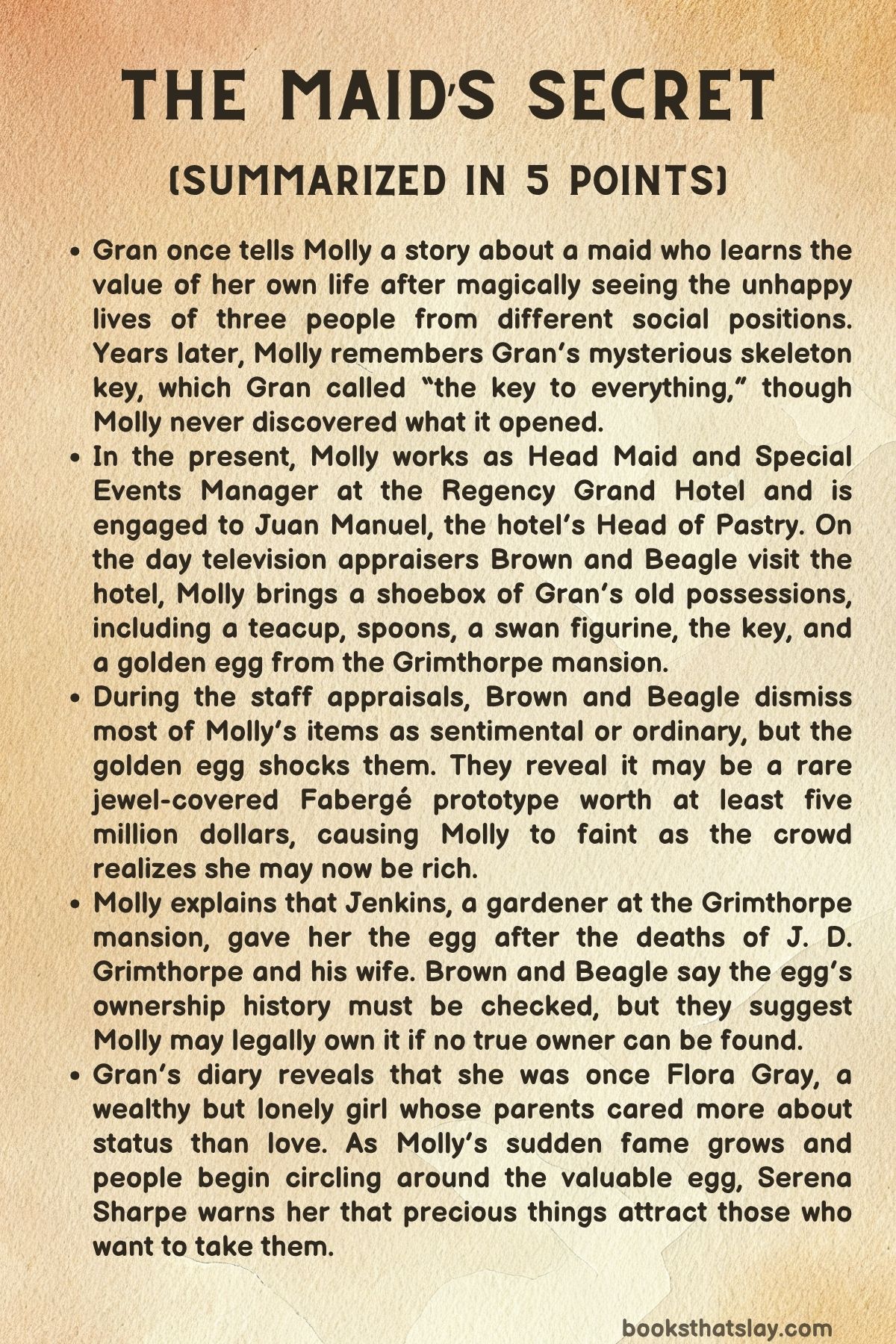
The Maid’s Secret begins with a story Gran once told Molly about a maid who feels unhappy with her ordinary life. In the tale, the maid comes across discarded shoes and, through a strange kind of magic, experiences the lives of three people who once owned them.
One is a lonely stable boy, another is a young belle who has been rejected, and the third is a rich but harsh matron. Each life seems different from the maid’s own, yet each lacks love in a painful way.
By the end of the story, the maid understands that her own life has value because she is loved. This lesson stays with Molly long after Gran is gone.
Years later, Molly remembers another moment with Gran: shortly before her death, Gran gave Molly an old, tarnished skeleton key and called it “the key to everything.” Molly never discovered what the key opened, but she kept it with Gran’s other small belongings. In the present, Molly works at the Regency Grand Hotel as Head Maid and Special Events Manager.
Her life is usually guided by routine, clear standards, and careful work. That order is broken when an astonishing discovery makes her the focus of reporters, guests, cameras, and public attention.
The day begins quietly at home with Molly waking beside her fiancé, Juan Manuel, the hotel’s Head of Pastry. They talk about their upcoming city-hall wedding, which they plan to keep simple because their money is limited.
They are happy despite the modest plans, and both are also excited about the hotel’s special event. Brown and Beagle, the television appraisers from Hidden Treasures, are coming to the Regency Grand to examine objects brought in by staff and guests.
Before leaving, Molly gathers a few of Gran’s possessions in a shoebox. She packs a teacup, silver spoons, a Swarovski swan, the skeleton key, and, after Juan encourages her, a decorative golden egg.
Molly once received the egg from Jenkins, a gardener at the Grimthorpe mansion, where she and Gran had worked when Molly was a child. To Molly, the egg is only a keepsake.
She has no reason to think it is especially valuable.
At the hotel, Molly and Juan meet Mr. Preston, Molly’s grandfather, and Speedy, the young doorman. The lobby is crowded with fans of Brown and Beagle, who call themselves Bee-lievers.
Angela, Molly’s friend from the hotel bar, is having trouble managing the crowd. Molly soon learns that the television crew has arrived early and is already filming staff appraisals in the tearoom.
Mr. Snow, the hotel manager, allows the filming to continue.
The appraisals begin with ordinary disappointments. Mr. Snow presents a pocket watch that means a great deal to him, but Brown and Beagle value it at only around two hundred dollars.
Speedy brings what he believes is an ancient Roman coin, only to be told it is a penny from 1980. Molly comes forward next with Gran’s things.
The appraisers examine the teacup, spoons, swan, and key. Each item is dismissed as having little market value, though Molly still values them because of Gran.
Brown suggests the key might once have opened a diary, but Molly knows of no diary.
Then Brown and Beagle notice the golden egg. Their attitude changes at once.
They inspect it carefully and grow visibly shocked. The object is not a decorative trinket but a rare, jewel-covered Fabergé prototype connected to the Russian imperial tradition of precious Easter eggs.
They estimate its minimum value at five million dollars. Molly is stunned.
The crowd reacts loudly, people shout that she is rich, and the pressure overwhelms her. She faints onstage.
When Molly recovers, filming resumes. She explains that the egg came from the Grimthorpe mansion and that Jenkins gave it to her after the deaths of J. D. Grimthorpe and his wife.
Brown and Beagle explain that the egg’s history must be investigated, but they believe Molly may have a legal claim if no true owner can be found. They suggest that she sell it through their auction house.
The possibility of sudden wealth feels unreal to Molly, and it also creates immediate risk.
As Molly’s present becomes chaotic, Gran’s hidden past begins to appear through diary entries written for Molly. Gran reveals that her real name was Flora Gray and that she was born into privilege at Gray Manor.
Her father, Reginald Gray, was a powerful businessman, and her mother, Audrey, cared deeply about status, beauty, and proper marriage. Flora’s childhood was filled with money but not warmth.
Her parents did not truly understand or cherish her. The people who gave her real affection were the servants, especially Mrs. Mead and Uncle Willy.
Flora wanted an education and hoped for a life beyond the narrow role her parents expected her to play. As a teenager, she convinced them to allow her to take university entrance preparation classes.
Her parents mocked her ambitions and assumed she would eventually marry someone suitable. Still, Flora longed to learn and to decide her future for herself.
At school, Flora met John, Uncle Willy’s son, who was studying through the Gray Scholarship. John was poor compared with the other students, and the boys mocked him for it.
Flora had a chance to defend him but did not. Instead, she protected her own social standing and acted with the same class prejudice she had learned from her parents.
Later, she felt ashamed of her cruelty. Her diary shows that she understood, with regret, how much damage privilege and fear could cause.
In the present, Molly tries to return to her normal work, but the world around her has changed. Guests, staff, reporters, and strangers begin treating her like a celebrity.
Clips of her appraisal spread online, and news shows start calling her “Molly, the Millionaire Maid.” The label makes her uncomfortable because it turns her into a public figure before she understands what has happened or what it will mean.
The golden egg also attracts people with less innocent intentions. A suspicious bearded man asks staff members for Molly’s home address.
Later, he questions Juan about Mr. Snow’s office, where the egg is being kept in the safe. The attention around the egg grows more threatening.
Molly has always valued honesty, routine, and clear rules, but wealth brings confusion, pressure, and danger.
Public opinion begins to form around Molly’s claim. Jenkins confirms on television that he gave her the egg, supporting her story.
Serena Sharpe also says the egg belongs fairly to Molly, but she warns her that valuable things bring trouble. When someone owns something others want, people may try to take it away.
The story sets Molly’s sudden fortune against Gran’s buried history. Molly’s life is built on the love and guidance Gran gave her, while Gran’s own diary reveals a past marked by wealth without tenderness.
The golden egg may change Molly’s future, but it also opens questions about ownership, family, identity, and the secrets Gran carried. What first appears to be a lucky discovery becomes the beginning of a much larger mystery, one tied to Molly’s inheritance and to the truth of who Gran really was.
Characters
In The Maid’s Secret by Nita Prose, the characters are shaped by questions of love, class, inheritance, honesty, and personal worth. The book uses Molly’s present-day discovery and Gran’s hidden past to show how people are changed by what they inherit, what they lose, and what they choose to protect.
Molly Gray
Molly Gray is the central character of the book, and her journey is built around the sudden clash between her ordinary, carefully ordered life and the chaos created by fame, money, and family secrets. As Head Maid and Special Events Manager at the Regency Grand Hotel, Molly takes pride in service, cleanliness, routine, and doing things properly.
Her life is modest, but it is also meaningful because it is rooted in work, loyalty, love, and the values Gran taught her. When the golden egg is revealed to be worth millions, Molly is forced into a world that does not suit her nature.
Reporters, strangers, hotel guests, and opportunists begin treating her not as Molly the person, but as a spectacle. This makes her character especially sympathetic because she does not seek attention or wealth; she simply wants to understand what is right.
Molly’s innocence is not the same as weakness. She may be overwhelmed by the public reaction to the egg, but she also has a strong moral center.
Her first instinct is not greed, but confusion and responsibility. She wants to know where the egg came from, whether it truly belongs to her, and what Gran’s key and past might mean.
This makes her a character of integrity. She is vulnerable because she can take people literally and may not always recognize hidden motives immediately, yet she is also observant in her own way.
Molly notices details, remembers lessons, and trusts the quiet truths that others overlook. Her growth in the book comes from learning that her inheritance is not only an object of financial value, but also a deeper emotional legacy connected to Gran’s sacrifices, secrets, and love.
Gran / Flora Gray
Gran, whose real name is Flora Gray, is one of the most important and emotionally layered figures in the book. To Molly, Gran is a loving guardian, teacher, and moral guide.
She is the person who shapes Molly’s understanding of dignity, kindness, work, and self-worth. Even after her death, Gran continues to influence Molly through memory, story, the skeleton key, and the truths hidden in her diary.
Her presence in the book is powerful because she is both absent and deeply present. Molly’s choices are guided by Gran’s voice, and the mystery of Gran’s life becomes the emotional heart of the story.
As Flora Gray, Gran’s past reveals a painful contrast between wealth and love. She was born into privilege at Gray Manor, yet her childhood was emotionally poor because her parents cared more about status, beauty, and marriage than about her inner life.
Flora’s loneliness helps explain why she later becomes such a nurturing figure to Molly. She knows what it means to live without genuine parental affection, so she gives Molly the love, patience, and wisdom she herself was denied.
Flora is also a character marked by regret and growth. Her treatment of John at school shows that she once absorbed the class prejudices of her family, but her later remorse proves that she is capable of moral awakening.
Gran’s life shows that true value does not come from wealth or birth, but from love, humility, and the courage to become better than the world that raised you.
Juan Manuel
Juan Manuel is Molly’s fiancé and one of the warmest stabilizing figures in the book. As Head of Pastry at the Regency Grand Hotel, he shares Molly’s world of honest work, routine, and service.
His relationship with Molly is built on tenderness, respect, and emotional safety. He understands her in ways that many others do not, and he supports her without trying to change the core of who she is.
Their conversations about a modest city-hall wedding and limited finances show that their love is not based on luxury or social performance. They are not wealthy at the beginning of the story, but their relationship is rich in trust and companionship.
Juan also plays an important role in the discovery of the egg because he encourages Molly to include it with Gran’s other possessions. This small action changes everything, but it does not make Juan seem greedy or calculating.
Instead, it shows that he values Molly’s memories and wants her belongings to be properly seen. After the appraisal, Juan becomes even more important because Molly needs someone who loves her for herself, not for the fortune others suddenly attach to her name.
In a book where money attracts danger, suspicion, and selfish attention, Juan represents steady love. He reminds the reader that Molly’s real security does not come from the egg, but from the people who genuinely care for her.
Mr. Preston
Mr. Preston, Molly’s grandfather, is a figure of family connection, quiet support, and emotional continuity. His presence matters because Molly’s family history is complicated by secrecy, loss, and delayed revelations.
As her grandfather, he helps expand Molly’s sense of belonging beyond the memory of Gran alone. He is connected to the older generation, yet he is also part of Molly’s present life at the hotel.
This makes him a bridge between past and present, between what Molly has lost and what she is still able to claim.
Mr. Preston’s character offers steadiness during moments when Molly’s world becomes unstable. The discovery of the egg draws public attention, danger, and confusion, but Mr. Preston represents calm familial loyalty.
He is not shown as someone who values Molly because of the egg’s price. Instead, he belongs to the small circle of people who see her humanity before her sudden fame.
His role also reinforces one of the book’s central ideas: inheritance is not only about objects, money, or legal ownership. It is also about family bonds, memory, protection, and the truth finally coming into the open.
Mr. Snow
Mr. Snow, the hotel manager, represents authority, order, and the public reputation of the Regency Grand Hotel. He is responsible for keeping the hotel functioning even when the television event begins to spiral into something much bigger than expected.
His pocket watch appraisal shows an important contrast between sentimental value and market value. To the appraisers, the watch is worth only a modest amount, but to Mr. Snow it carries personal meaning.
This moment prepares the reader for the larger question raised by Molly’s egg: how should value be measured?
Mr. Snow’s character is also important because he stands at the intersection of hospitality, spectacle, and crisis management. He allows the filming to continue, which places the hotel and its staff in the public eye.
Once the egg’s value is revealed, the hotel is no longer merely a workplace; it becomes the center of media attention and potential danger. Mr. Snow is not as emotionally central as Molly, Gran, or Juan, but he helps show how institutions react when private life becomes public drama.
Through him, the book explores the tension between professionalism and human vulnerability.
Speedy
Speedy, the young doorman, brings youth, energy, and a touch of comic disappointment to the book. His belief that he owns a Roman coin, only to learn that it is merely a 1980 penny, creates a humorous moment, but it also serves a deeper purpose.
Speedy’s failed appraisal contrasts sharply with Molly’s unexpected fortune. Many people come to the event hoping that an ordinary object might become extraordinary, and Speedy embodies that hope in a lighthearted way.
Speedy is also part of the hotel community that surrounds Molly before her life changes. He is not a powerful person, but his presence helps make the Regency Grand feel like a living workplace full of personalities, routines, and small dreams.
His disappointment over the coin is harmless compared with the greed and danger that later emerge around the egg. Because of this, Speedy’s character helps distinguish innocent hope from true opportunism.
He wants to believe in treasure, but he does not become predatory or cruel when treasure appears in someone else’s hands.
Angela
Angela is Molly’s friend from the hotel bar and a practical, loyal presence in the book. At the beginning of the appraisal event, she is already struggling with crowd control, which shows her as someone who works hard and deals directly with the messy behavior of others.
Her role becomes more meaningful because she is part of Molly’s trusted circle. When fame and wealth isolate Molly, Angela’s friendship matters because it is based on who Molly was before the world started calling her rich.
Angela represents grounded common sense. She understands people, crowds, and pressure in ways Molly may not always immediately grasp.
This makes her a useful contrast to Molly’s more literal and orderly way of seeing the world. Angela’s loyalty helps protect Molly from being completely swallowed by public attention.
In a story where strangers want Molly’s address, reporters want her image, and experts want control over the egg, Angela stands for friendship that is active rather than merely sentimental. She is not just fond of Molly; she is willing to help her navigate danger and confusion.
Brown
Brown is one half of the television appraisal duo Brown and Beagle, and he represents expertise, performance, and the complicated relationship between truth and profit. At first, Brown appears as a polished professional whose job is to identify the value of objects.
He and Beagle dismiss several of Gran’s possessions as ordinary, which makes the sudden discovery of the egg even more dramatic. Brown’s reaction to the egg shows that he understands the magnitude of what Molly has brought before him.
His knowledge gives him authority, but that authority also places him in a position to influence Molly’s choices.
Brown’s character is morally complicated because his world is tied to auctions, ownership, provenance, and money. He may recognize the egg’s historical significance, but he also encourages Molly toward a sale through his auction house.
This creates a tension between helping her and benefiting from her discovery. Brown is not simply a villainous figure in the material provided; rather, he represents the polished face of a system that turns personal objects into public commodities.
Through Brown, the book questions whether expertise always serves truth or whether it can also serve ambition, branding, and financial interest.
Beagle
Beagle, Brown’s partner on the appraisal show, is another figure connected to expertise, showmanship, and hidden motives. Like Brown, he initially appears as a professional appraiser whose authority comes from knowledge and reputation.
His role in identifying the golden egg gives him power over Molly’s future because he helps transform the object from a personal keepsake into a priceless treasure. This makes him central to the shift from private memory to public spectacle.
Beagle’s character carries suspicion because the world around the egg quickly becomes dangerous. The appraisal is not just a charming television moment; it opens the door to questions of ownership, greed, and manipulation.
Beagle’s connection to the appraisal industry means he is part of the machinery that can either reveal truth or exploit vulnerability. He helps show how easily people with specialized knowledge can dominate people who are honest, inexperienced, or emotionally overwhelmed.
In the book, Beagle’s importance lies in the way he turns the egg into a contested object and helps intensify the pressure around Molly.
Jenkins
Jenkins, the gardener from the Grimthorpe mansion, is a crucial figure because he is the person who gave Molly the golden egg. His action appears simple at first, almost like the passing along of a decorative trinket, but it becomes one of the most important events in Molly’s life.
Jenkins represents the unpredictable way objects move through time. What seems like junk, kindness, or a small token can later reveal itself to be connected to wealth, history, and danger.
Jenkins also helps support Molly’s claim to the egg because he confirms that he gave it to her after the deaths of J. D. Grimthorpe and his wife. This makes him important not only emotionally, but also legally and morally.
His confirmation gives Molly’s story credibility in a world where people might doubt her or try to take advantage of her. Jenkins is a reminder that ordinary workers often know the hidden histories of great houses better than the wealthy people who own them.
As a gardener, he belongs to the servant world that the book repeatedly treats with dignity and importance.
Serena Sharpe
Serena Sharpe is an important voice of warning and practical wisdom. She publicly says that the egg belongs to Molly fairly, which gives Molly support at a moment when public opinion and legal uncertainty could easily turn against her.
Serena’s statement matters because Molly needs people who will defend her right to be treated justly. At the same time, Serena does not romanticize the situation.
She warns Molly that when someone possesses something valuable, others will try to take it.
This warning reveals Serena as perceptive and realistic. She understands that value attracts danger, and she sees how quickly Molly’s life can be invaded by people motivated by greed.
Serena’s role is not simply to comfort Molly, but to prepare her. She helps voice one of the book’s central conflicts: the possession of treasure can make a person less safe, not more secure.
Through Serena, the story shows that fairness and ownership are not enough when other people are willing to scheme, pressure, or steal.
Detective Stark
Detective Stark represents investigation, order, and the search for truth when the situation around Molly becomes dangerous. Her presence is important because the golden egg is not merely an exciting discovery; it becomes connected to suspicion, threats, and criminal behavior.
Stark’s role brings the story more fully into mystery territory by shifting attention from appraisal and inheritance to motive, evidence, and accountability.
Stark is significant because she belongs to the world of facts rather than appearances. While the media sees Molly as a sensational figure and the appraisers see the egg as a valuable object, Stark must consider who might exploit the situation and why.
Her function in the book is to cut through performance. She helps balance Molly’s emotional and personal search with a more formal pursuit of justice.
In this way, Stark strengthens the book’s concern with truth: family truth, legal truth, and moral truth.
Baxley
Baxley is a more suspicious figure in the book’s present-day plot. As the bearded man who asks staff for Molly’s address and later asks Juan about Mr. Snow’s office, he represents the immediate danger created by Molly’s sudden fame.
He is important because he shows how quickly public attention can become invasive. Molly’s discovery does not remain safely on a television stage; it follows her into the workplace, her relationships, and her private life.
Baxley’s behavior makes him a symbol of predatory curiosity. He does not approach Molly with care or respect.
Instead, he tries to gather information that could expose or endanger her. Through him, the book shows the darker side of celebrity and wealth.
Once Molly is labeled a millionaire, some people stop seeing her as a person and start seeing her as an opportunity. Baxley’s role is therefore to create tension and to remind the reader that treasure can attract not only admiration, but also threat.
Maggie
Maggie, Molly’s mother, is important because she belongs to the painful family background that shapes Molly’s understanding of abandonment, love, and belonging. Even when she is not at the center of the present action, her significance lies in what her absence or failure means to Molly.
Molly’s deepest emotional foundation comes from Gran rather than from her mother, and that fact says a great deal about the kind of childhood Molly experienced.
Maggie’s character helps highlight the difference between biological connection and true care. A parent may be linked by blood, but love is proven through protection, patience, and presence.
Gran becomes Molly’s real emotional parent because she gives Molly the guidance and security that Maggie does not provide. Maggie’s role therefore deepens the book’s exploration of family.
Family is not presented as a simple matter of inheritance or bloodline; it is shown as something created by loyalty, sacrifice, and daily acts of love.
Reginald Gray
Reginald Gray, Flora’s father, represents wealth without tenderness. As a powerful businessman, he has status and authority, but he fails to give his daughter the emotional support she needs.
His attitude toward Flora’s ambitions shows that he values social expectations more than her individuality. He is willing to let wealth define worth, and this makes him one of the figures responsible for Flora’s loneliness.
Reginald is important because he embodies the class system that Flora must eventually see through. He belongs to a world where education, marriage, reputation, and social rank are controlled by privilege.
His lack of warmth helps explain why Flora later understands the importance of love so deeply. Reginald’s failure as a father becomes part of the moral contrast at the center of the book.
He has money and power, but he lacks the human generosity that would make those things meaningful.
Audrey Gray
Audrey Gray, Flora’s mother, is a character shaped by status, beauty, and social ambition. She values the appearance of success and expects Flora to fit into a narrow role defined by marriage and class.
Her inability to nurture Flora emotionally makes her a painful figure in Gran’s past. Audrey’s priorities show how damaging it can be when a parent treats a child as a social project rather than as a person.
Audrey’s character also reveals the pressures placed on women within elite society. She upholds the very system that limits Flora, teaching her daughter that beauty and marriage matter more than curiosity, education, or independence.
This makes Audrey both harmful and trapped. She has internalized the values of her world so completely that she passes them on as truth.
Through Audrey, the book criticizes a form of privilege that appears elegant on the outside but is emotionally barren within.
Mrs. Mead
Mrs. Mead is one of the loving servant figures in Flora’s childhood, and her importance lies in the contrast she provides to Flora’s parents. While Reginald and Audrey offer status without warmth, Mrs. Mead offers care, attention, and emotional shelter.
She helps show that love in the book often comes from unexpected places, especially from people whom the wealthy might overlook.
Mrs. Mead’s role is also connected to the dignity of service. She is not wealthy or socially powerful, but she gives Flora something more valuable than luxury: a sense of being seen and cherished.
This makes her part of the moral foundation that later shapes Gran’s treatment of Molly. The love Flora receives from servants helps her understand that kindness is not determined by class.
Mrs. Mead therefore contributes to one of the book’s strongest ideas: people who are treated as socially invisible may be the ones who offer the deepest humanity.
Uncle Willy
Uncle Willy is another servant figure who gives Flora the affection and stability missing from her parents. His importance comes from the way he helps create a chosen family around Flora.
Like Mrs. Mead, he belongs to the world of service, but his emotional value in Flora’s life is greater than that of the wealthy adults who are supposed to protect her. He represents warmth, humility, and dependable kindness.
Uncle Willy is also important because he is connected to John, whose experiences at school expose Flora to the cruelty of class prejudice. Through Uncle Willy and his son, Flora sees the human cost of the social hierarchy she has been raised to accept.
Uncle Willy’s presence helps make that lesson personal rather than abstract. He is not merely a servant in the background; he is part of the emotional world that teaches Flora what love and loyalty actually mean.
John
John, Uncle Willy’s son, is a significant figure in Flora’s moral development. He attends prep school through the Gray Scholarship, which places him in an environment where class prejudice becomes visible and painful.
When the boys mock him for being poor, Flora fails to defend him because she is trying to protect her own position. This moment is important because it reveals the prejudice Flora has absorbed from her parents and social class.
John’s role is not only to suffer rejection, but to awaken regret in Flora. Through him, she begins to recognize the cruelty of silence and the harm caused by choosing status over kindness.
John becomes a mirror in which Flora sees the kind of person she does not want to remain. His character helps move Flora from inherited prejudice toward moral awareness.
In a book concerned with hidden truths, John represents one of the truths Flora must confront about herself.
J. D. Grimthorpe
J. D. Grimthorpe is important because of his connection to the mansion where Molly once worked with Gran and where the golden egg was found. Though he is not presented as intimately as Molly or Flora, his household forms part of the object’s mysterious history.
The Grimthorpe mansion is a place where wealth, service, death, and forgotten possessions intersect. J. D. Grimthorpe’s significance comes from the fact that the egg passes out of that world and eventually into Molly’s hands.
As a figure connected to property and inheritance, J. D. Grimthorpe helps deepen the book’s questions about ownership. Did the egg belong to the family?
Was it forgotten, discarded, hidden, or misunderstood? His death creates the circumstances in which Jenkins gives the object to Molly.
This makes Grimthorpe part of the chain of events that transforms Molly’s life. He represents the old wealthy world whose leftovers can carry secrets far beyond their original owners.
Mrs. Grimthorpe
Mrs. Grimthorpe, like her husband, is tied to the mansion and the history of the golden egg. Her importance lies less in direct action and more in the atmosphere of wealth, secrecy, and disappearance surrounding the object.
After her death and her husband’s, the egg becomes detached from its former household and enters Molly’s life as a seemingly decorative item. This shift from mansion to shoebox is central to the book’s exploration of hidden value.
Mrs. Grimthorpe’s character also helps reinforce the contrast between possession and appreciation. The egg may have once belonged to a wealthy household, but Molly is the one whose life is most deeply changed by it.
The Grimthorpes’ connection to the object raises questions about what people truly own and what they merely hold for a time. Through Mrs. Grimthorpe, the book suggests that wealth can leave behind mysteries long after its owners are gone.
Cheryl
Cheryl belongs to the hotel world that forms Molly’s daily environment. Her importance comes from the way she reflects the social tensions and workplace relationships around Molly.
In a story where Molly’s life is suddenly changed by fame and fortune, the reactions of colleagues matter because they reveal who truly respects her and who must learn to see her differently.
Cheryl’s reconciliation with colleagues later in the story suggests growth, repair, and the possibility of better community. She helps show that not every flawed character is fixed in selfishness or resentment.
Some people can change their behavior and return to others with more humility. Cheryl’s role supports the book’s broader belief in second chances.
Just as Flora grows beyond the prejudices of her youth, Cheryl’s arc points toward the possibility of improved relationships in the present.
Madame Orange
Madame Orange is a more unusual and strategic figure connected to the later handling of the egg. Her importance lies in the way she becomes part of a plan rather than simply part of the hotel’s ordinary life.
She represents performance, disguise, and clever maneuvering in a story where appearances often hide deeper truths. The use of Madame Orange shows that solving the mystery requires not only honesty, but also imagination.
Madame Orange’s role adds theatrical energy to the book. The world of television appraisal is already a world of cameras, staging, and public performance, and Madame Orange extends that sense of drama into the investigation itself.
She helps show that deception can be used for selfish purposes, but performance can also be used to expose wrongdoing. Her character therefore contributes to the book’s playful mystery structure while still serving the serious goal of protecting Molly and revealing the truth.
Themes
The Value of Love Over Wealth
Molly’s understanding of value is shaped by Gran’s story, where the maid learns that outward comfort does not guarantee happiness. The lives connected to the discarded shoes show different forms of emptiness: loneliness, rejection, and cruelty hidden behind status or privilege.
This lesson becomes important when Molly’s golden egg is declared to be worth millions. The sudden discovery makes the world around her measure her in financial terms, calling her rich and treating her like a spectacle.
Yet the earlier story suggests that money without affection, kindness, and belonging can become hollow. Molly’s life has never been materially grand, but she has experienced deep love through Gran, Juan Manuel, Mr. Preston, and her chosen circle at the hotel.
The contrast between the priceless egg and Gran’s emotional teachings shows that true worth does not come from possessions alone. In The Maid’s Secret, wealth attracts attention, suspicion, and greed, while love gives Molly the steadiness to remain herself.
Class, Prejudice, and Social Judgment
Flora’s diary reveals how deeply class prejudice can shape a person’s behavior before they fully understand its harm. Raised in wealth, she absorbs her parents’ belief that status decides a person’s worth.
This becomes clear when she refuses to defend John at school, even though she knows he is being mocked unfairly. Her silence is not simple cruelty; it comes from fear, training, and the pressure to protect her own place in a rigid social order.
The regret she later feels shows that moral growth begins when someone recognizes the damage caused by inherited prejudice. Molly’s present-day experience also reflects social judgment, but from another angle.
As a maid, she is first dismissed and underestimated, then suddenly celebrated when the egg appears valuable. The change in how people treat her exposes how shallow society’s judgments can be.
The story criticizes a world where people are valued according to money, family background, job title, or public image rather than character.
Identity, Hidden Pasts, and Self-Discovery
Gran’s hidden identity as Flora Gray changes the way her past is understood, but it does not erase the person Molly knew and loved. The diary entries show that identity is not fixed by birth, wealth, or family name.
Flora begins life surrounded by privilege, yet she feels unloved and trapped by expectations. Over time, her choices, losses, regrets, and relationships shape her into Gran, a woman whose wisdom becomes Molly’s moral foundation.
The skeleton key symbolizes this hidden history because it represents knowledge Molly does not yet possess. Gran calls it “the key to everything,” suggesting that the truth about the past can unlock a fuller understanding of the present.
Molly’s discovery of the egg and Gran’s diary both force her to reconsider what she has inherited. She receives not only objects, but also secrets, lessons, and emotional responsibility.
The theme shows that self-discovery often comes through uncovering family history, but the meaning of that history depends on compassion and understanding.
Greed, Public Attention, and the Loss of Privacy
The moment the golden egg is identified as valuable, Molly’s ordinary life is disrupted by public attention. Cameras, reporters, hotel guests, television clips, and strangers turn her private story into entertainment.
The nickname “Molly, the Millionaire Maid” reduces her identity to a headline, ignoring her emotions, her work, and the personal meaning of Gran’s belongings. This sudden fame also brings danger, as the suspicious bearded man begins asking questions about Molly’s address and the safe where the egg is kept.
Serena Sharpe’s warning captures the darker side of possession: valuable objects can make people targets. The theme is not only about greed for money, but also about greed for access, information, and control.
People who once overlooked Molly now want something from her, whether it is a story, a sale, or the egg itself. The public excitement around the discovery shows how quickly admiration can become invasive, and how easily a person’s dignity can be threatened when wealth enters the picture.