Felicia’s Favorites Summary, Characters and Themes
Felicia’s Favorites by Danielle Steel is a family drama about loss, secrets, reinvention, and the complicated gifts parents leave behind. The story begins with the sudden death of Felicia Morgan Weston, a widowed mother whose daughters believe they knew her completely.
After her death, they discover that she had hidden a stunning second identity, a great fortune, and a private life none of them suspected. Through Felicia’s five daughters, the novel explores how grief can uncover truth, how money can change choices, and how each woman must decide what kind of future she wants to build.
Summary
Felicia Morgan Weston appears to the world, and even to her own children, as a devoted widowed mother who has lived a quiet, disciplined, and private life. Her five daughters know her as loving, organized, protective, and slightly mysterious, but they do not suspect the scale of what she has kept from them.
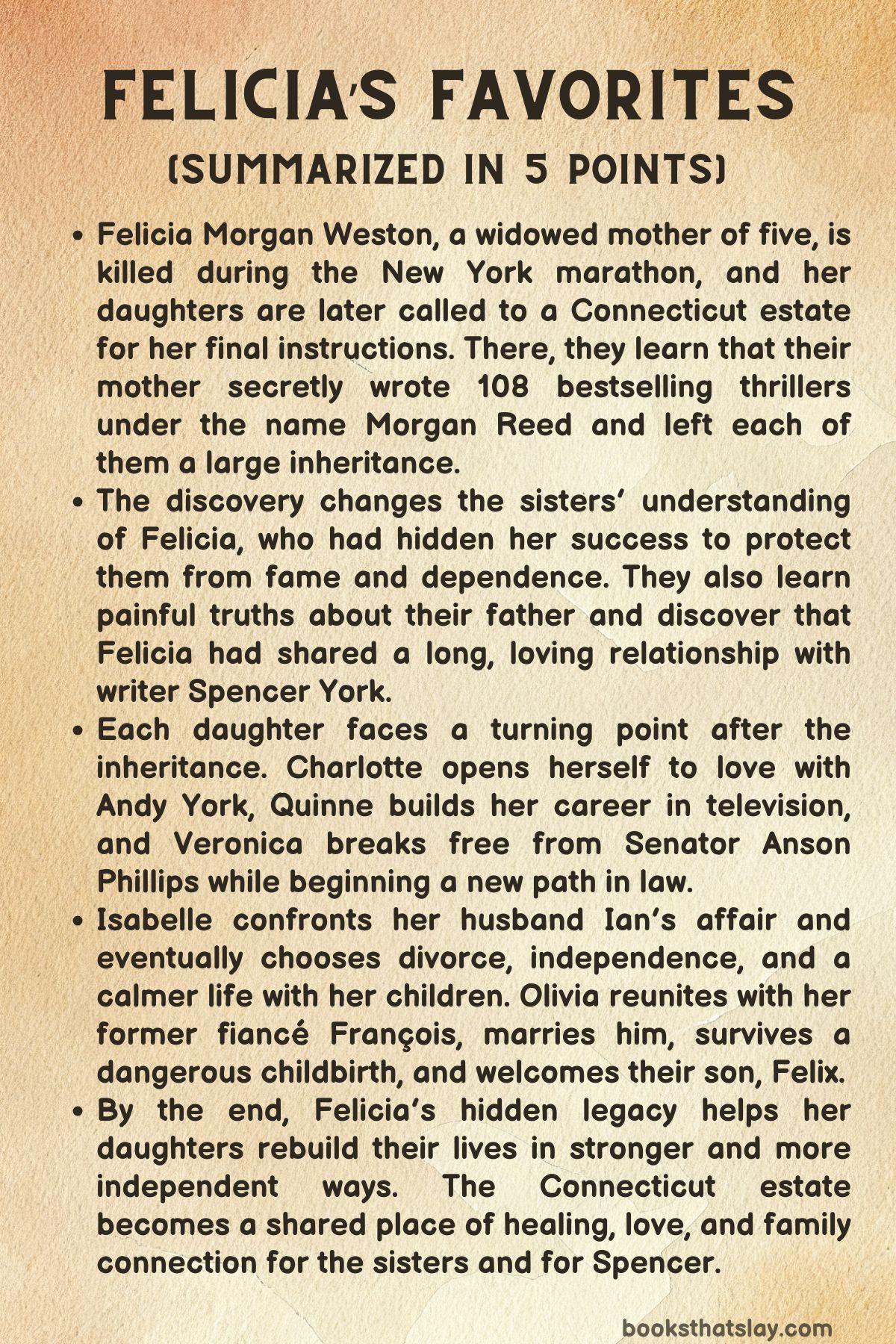
Her death comes without warning. While running the New York marathon, Felicia is killed in a random sniper attack.
The violence of her death shocks her daughters and leaves them trying to understand how a life so carefully managed could end in such chaos.
A month after Felicia’s death, her attorney, Scott Freeman, contacts the five sisters: Charlotte, Quinne, Olivia, Veronica, and Isabelle. He asks them to come to a house in Connecticut for the reading of their mother’s final instructions.
The request confuses them because none of them knows their mother owned a property there. They arrive with grief, questions, and very different attitudes toward one another and their own lives.
At the Connecticut house, Scott reveals the first of many truths. Felicia had not been simply the private editor of Morgan Reed, a famous thriller writer.
She was Morgan Reed herself. Under that name, Felicia had written 108 bestselling novels and had earned a huge fortune.
She had bought the Connecticut estate as a private retreat where she could write and live freely. For decades, she had hidden her success from her daughters because she did not want fame or wealth to shape them.
She wanted them to work, make choices, and build lives without depending on her fortune.
The sisters are stunned. They inherit about eighteen million dollars each, and they jointly inherit the Connecticut estate.
The money gives them freedom, but it also forces them to face the lives they have been living. Felicia’s secret identity changes their understanding of their mother.
They had seen her as modest and dependable, but now they recognize her as brilliant, daring, and deeply independent.
Charlotte, the oldest daughter, is a successful businesswoman, but she carries bitterness from failed relationships. She has two children and has learned to distrust men.
She is practical and guarded, often using her strength as armor. The inheritance does not solve her loneliness, but it gives her room to think differently about her life.
She takes her children to Paris for Christmas and later becomes close to Andrew “Andy” York, the son of Spencer York, who lives near Felicia’s Connecticut farm. Andy is kind and steady, and his presence helps Charlotte lower some of her defenses.
Over time, she begins to believe that love does not always have to lead to disappointment.
Quinne works as a television producer and is in a long-term relationship with Cooper, an actor. She is ambitious and creative, but she has also lived in the shadow of other people’s projects.
Felicia’s literary estate opens a new door for her. She becomes involved in adapting one of Morgan Reed’s novels into a streaming series and is named an executive producer.
Cooper also receives a role in the project. Quinne begins developing her own production company, and for the first time, she sees a path where her talent and her family’s legacy can work together.
Olivia’s life has been shaped by tragedy. She was once a gifted ballerina, but a car accident left her paraplegic and ended both her dancing career and her engagement to François.
After the accident, Olivia pushed him away because she believed she could no longer give him the life he deserved. Years later, the inheritance and the gathering at the Connecticut estate lead her toward a different kind of courage.
François returns to her life, now divorced and still in love with her. Olivia learns that she does not have to punish herself for what happened.
She and François reunite, marry at the estate, and begin a new life together. When Olivia becomes pregnant, the family celebrates, though her pregnancy later becomes dangerous.
Near her due date, she suffers a severe hemorrhage and needs an emergency C-section. Olivia and the baby survive, and her son, Felix, becomes a living sign of hope after years of loss.
Veronica has spent ten years as the secret mistress of Senator Anson Phillips. Her relationship with him has given her comfort and status, but it has also kept her hidden and dependent.
Anson controls the terms of their life together, and Veronica has accepted too little for too long. After learning about Felicia’s books and estate, Veronica begins studying intellectual property law so she can help manage her mother’s literary legacy.
Her decision to become independent angers Anson. When she no longer obeys his expectations, he forces her out of the apartment he has provided.
Instead of falling apart, Veronica finds her own apartment, continues her studies, and refuses to return to the old arrangement. Later, when Anson tries to regain control, she rejects him.
Her connection with Scott Freeman grows into a healthier relationship built on respect rather than secrecy.
Isabelle, the youngest sister, seems to have the most stable life. She is a wife and mother, and from the outside her marriage to Ian appears secure.
That image breaks when she discovers Ian is having an affair with a woman named Leila. Isabelle confronts him, hoping he will choose their marriage, but Ian refuses to give up the affair.
His refusal forces Isabelle to see the truth clearly. The marriage cannot survive if only one person is committed to it.
With pain but also growing strength, she files for divorce. The Connecticut farm becomes a place of recovery for her and her children, giving her space to imagine a future not defined by Ian’s betrayal.
The sisters also learn more about Felicia’s past from Robert Farr, her agent. Robert explains that their father, Bill, had not been the ideal husband they remembered.
Before his death in the plane crash that widowed Felicia, Bill had been planning to leave her for another woman. Felicia had hidden this truth from her daughters so they could keep a loving memory of their father.
This revelation is painful, but it also shows the depth of Felicia’s sacrifice. She had carried private hurt so her children would not have to carry it with her.
Robert also reveals another important part of Felicia’s life. For the last fifteen years, she had been in a loving relationship with Spencer York, a famous writer who lived next door to the Connecticut farm.
Spencer is devastated by Felicia’s death. To the sisters, he is proof that their mother’s life was fuller than they had imagined.
Felicia had known love, companionship, creative success, and personal freedom. She had not been only their mother; she had been a woman with desires, secrets, and a private happiness of her own.
As the sisters spend more time with the estate and with one another, the Connecticut farm becomes the center of their new family life. It is no longer just the place where Felicia hid her writing career.
It becomes a home where each daughter can recover, make decisions, and begin again. Felicia’s fortune does not remove pain from their lives, but it gives them choices.
More importantly, her example gives them permission to be braver.
By the end of Felicia’s Favorites, each sister has changed. Charlotte marries Andy and opens herself to love again.
Quinne and Cooper build stronger professional lives through the adaptation of Felicia’s work. Veronica becomes engaged to Scott and continues her path in law.
Isabelle heals after divorce and finds steadiness with her children. Olivia has François, their marriage, and their son Felix, whose christening brings the family together at the farm.
Spencer, once Felicia’s private companion, becomes part of the family she left behind. Felicia’s daughters begin the story in grief, but they end it with a deeper understanding of their mother and a stronger sense of themselves.
Characters
In Felicia’s Favorites, the characters are shaped by grief, secrets, inheritance, betrayal, and the difficult process of rebuilding their lives. The story uses Felicia’s hidden identity and legacy to reveal not only who she truly was, but also who her daughters are capable of becoming once they are forced to confront the truth about their mother, their relationships, and themselves.
Felicia Morgan Weston
Felicia Morgan Weston is the emotional center of the book, even though she dies at the beginning of the story. Her death in a random sniper attack is shocking and sudden, but her presence continues to guide the lives of her daughters long after she is gone.
Felicia appears at first to have been a devoted widowed mother who lived a modest, private life as an editor, but the revelation that she was actually the famous thriller writer Morgan Reed transforms the way her daughters understand her. She was not simply a mother who sacrificed for her children; she was also an extraordinarily successful, disciplined, creative woman who built an entire hidden world of achievement.
Her secrecy was not born from selfishness, but from protection. She wanted her daughters to grow into independent women without being shaped by fame, wealth, or entitlement.
Felicia’s character is defined by quiet strength and emotional restraint. She endured the death of her husband, raised five daughters, managed a brilliant writing career, and maintained a secret personal life without allowing any of those burdens to consume her family.
Her choice to protect Bill’s reputation, even after learning he had planned to leave her, shows her generosity and self-control. She chose her children’s emotional security over her own need for truth or revenge.
At the same time, Felicia was not merely self-sacrificing. Her relationship with Spencer York reveals that she allowed herself love, companionship, privacy, and happiness.
This makes her a deeply layered figure: she was a mother, an artist, a lover, a protector, and a woman who understood that not every truth must be revealed at once.
Charlotte Weston
Charlotte, the oldest daughter, is one of the most guarded and emotionally hardened characters in the book. She is successful in business, but her success has not brought her peace.
Her bitterness, especially toward men, is shaped by failed relationships and disappointments that have made her distrustful and sharp. As the eldest sister, she carries a sense of responsibility, but she also carries resentment and emotional fatigue.
Her confidence often appears strong from the outside, yet much of it is defensive. She has learned to protect herself by expecting little from love and by keeping control over her life.
Charlotte’s transformation begins when the inheritance and the revelation about Felicia force her to reconsider the assumptions she has made about family, love, and independence. Her time in Paris with her children suggests that she still values beauty, connection, and experience, even if she has tried to bury her vulnerability.
Her relationship with Andy York becomes important because it challenges her belief that men will inevitably disappoint her. Andy does not simply rescue Charlotte; rather, he gives her the emotional safety to soften.
Through him, Charlotte begins to move away from bitterness and toward trust. By the end of the story, her marriage to Andy represents not just romantic fulfillment, but the healing of a woman who had almost given up on emotional openness.
Quinne Weston
Quinne is ambitious, practical, and professionally driven. As a television producer, she is already connected to the entertainment world, which makes her involvement in adapting one of Felicia’s novels feel both natural and meaningful.
Unlike some of her sisters, Quinne does not appear to be trapped by a destructive relationship or a traumatic past in the same way, but she is still searching for a fuller version of herself. Her mother’s secret success becomes a kind of mirror for her own ambitions.
Felicia’s hidden literary empire helps Quinne recognize that creative independence and business power can coexist.
Quinne’s relationship with Cooper also reveals her ability to balance love and work. Cooper’s role in the adaptation connects their personal and professional lives, but Quinne is not defined only by his success.
Her decision to build her own production company shows that she is ready to claim authority for herself. She becomes one of the clearest examples of how Felicia’s legacy is not merely financial.
For Quinne, the inheritance opens a door to professional expansion, creative control, and confidence. She grows by stepping into a future where she can be both emotionally committed and professionally independent.
Olivia Weston
Olivia is one of the most emotionally moving characters in the story. Once a gifted ballerina, she loses not only her career but also her sense of identity after the car accident that leaves her paraplegic.
Her physical disability is tied to deep emotional wounds, especially because it also ends her engagement to François. Olivia’s tragedy is not simply that she can no longer dance; it is that she believes she has lost the life, love, and future she once imagined for herself.
Her withdrawal from François after the accident suggests that she internalized her pain and may have believed she was no longer worthy of the love she once had.
Her reunion with François becomes one of the book’s strongest examples of second chances. François’s continued love helps Olivia confront the possibility that she is not broken beyond repair.
Their marriage and the birth of their son, Felix, mark a profound emotional renewal for her. The dangerous hemorrhage near her due date adds another moment of vulnerability, but Olivia’s survival and Felix’s safe birth reinforce her resilience.
Olivia’s arc is not about erasing suffering; it is about discovering that life can still hold love, motherhood, and joy after devastating loss. She becomes a symbol of endurance, courage, and the possibility of reclaiming happiness.
Veronica Weston
Veronica begins as a character trapped in secrecy and emotional dependence. Her ten-year relationship with Senator Anson Phillips has kept her in the position of a hidden mistress, someone expected to wait, accept limitations, and remain convenient.
Although she may have believed their relationship was based on love, it becomes clear that Anson values control more than partnership. Veronica’s life with him has limited her independence, and his anger when she begins making choices for herself reveals how unequal their relationship has always been.
The inheritance gives Veronica the practical freedom to change, but her growth comes from her own courage. Her decision to study intellectual property law is especially important because it connects her future to Felicia’s legacy while also allowing her to build a professional identity.
When Anson forces her out of the apartment, he expects her to collapse, but instead she becomes stronger. Her refusal to return to him shows that she has finally recognized the difference between love and possession.
Her relationship with Scott Freeman is healthier because it is based on respect rather than secrecy. Veronica’s development is one of liberation: she moves from being hidden in another man’s life to becoming the author of her own.
Isabelle Weston
Isabelle is introduced as the youngest sister whose life seems outwardly stable and ideal. As a wife and mother, she appears to have the kind of domestic security that others might envy.
However, Ian’s affair with Leila exposes the fragility beneath that appearance. Isabelle’s crisis is painful because it forces her to question not only her marriage but also the image of happiness she may have believed in.
Ian’s refusal to give up Leila makes the betrayal even more humiliating, because it shows that he is not simply guilty of a mistake; he is unwilling to choose his family fully.
Isabelle’s growth lies in her decision not to remain in a marriage that no longer honors her. Filing for divorce becomes an act of self-respect.
She does not instantly become free of pain, but she begins to understand that peace can exist outside a broken marriage. Her movement toward independence at the Connecticut farm shows that Felicia’s legacy gives her both shelter and strength.
Isabelle’s story is quieter than some of her sisters’ arcs, but it is deeply meaningful because it portrays the courage required to leave behind a life that once looked perfect. She becomes a figure of dignity, healing, and emotional self-preservation.
Scott Freeman
Scott Freeman serves as a bridge between Felicia’s hidden life and her daughters’ new understanding of her. As Felicia’s attorney, he is responsible for delivering the letters and revealing the existence of the Connecticut estate.
His role requires professionalism, discretion, and trustworthiness. Because Felicia entrusted him with such important final instructions, Scott clearly represents stability and reliability within the story.
He is not merely a legal figure; he becomes part of the emotional process through which the sisters discover the truth.
Scott’s relationship with Veronica also reveals his gentleness and integrity. In contrast to Anson, Scott does not try to control her or define her life for her.
He enters her world after she has begun the process of becoming independent, which makes their relationship feel healthier and more equal. Scott’s importance lies in the way he respects boundaries and supports transformation without dominating it.
He represents a kind of love and partnership that is calm, honest, and secure.
Robert Farr
Robert Farr, Felicia’s agent, is an important keeper of truth in the book. He reveals details about Felicia’s past that even her daughters did not know, including Bill’s plan to leave her and Felicia’s long relationship with Spencer York.
Robert’s role is significant because he helps complete the portrait of Felicia as a woman with private grief, private love, and extraordinary professional discipline. Through him, the sisters learn that their mother’s life was far more complex than they had imagined.
Robert also represents loyalty. As Felicia’s agent, he must have been closely connected to her career and her secret identity as Morgan Reed.
His protection of that secret suggests deep respect for her wishes. He does not expose her life carelessly; he reveals what needs to be known when the time is right.
In this way, Robert functions as a witness to Felicia’s hidden greatness. He helps the daughters move beyond shock and toward understanding.
Spencer York
Spencer York is one of the most tender figures in the story. As Felicia’s longtime partner and neighbor near the Connecticut estate, he represents the private happiness she allowed herself after years of responsibility and loss.
His devastation after her death shows that their relationship was not casual or secondary. He loved Felicia deeply, and his grief helps the sisters recognize that their mother had been cherished not only as a parent or writer, but as a woman.
Spencer’s presence also expands the idea of family in the book. Though he was hidden from Felicia’s daughters for many years, he eventually becomes part of the world she leaves behind.
His connection to Andy, and Andy’s later relationship with Charlotte, further ties him to the family. Spencer’s character adds warmth and emotional depth because he shows that Felicia’s secret life was not only about work and wealth.
It was also about love, companionship, and a shared private refuge.
Bill Weston
Bill Weston is a complicated figure because much of what the daughters believed about him is shaped by Felicia’s protection of his memory. As their deceased father, he exists largely through the family’s idealized image of him.
The later revelation that he had planned to leave Felicia for another woman changes his role in the story. He becomes a symbol of the painful truths parents sometimes hide from their children in order to preserve love, stability, and innocence.
Bill’s character also helps reveal Felicia’s moral strength. His betrayal could have made her bitter or vengeful, but she chose not to burden her daughters with that knowledge while they were growing up.
Although Bill’s actions suggest weakness and selfishness, the story does not center on punishing him. Instead, his hidden betrayal deepens the daughters’ understanding of their mother’s sacrifices.
Bill matters less for who he was in life than for what his secret reveals about Felicia’s endurance and grace.
Andrew “Andy” York
Andy York is Spencer’s son and becomes a major figure in Charlotte’s emotional healing. His importance lies in the way he challenges Charlotte’s distrust without forcing her to change.
Andy is patient, steady, and affectionate, and his relationship with Charlotte develops as a contrast to her history of disappointing relationships. He seems to understand that Charlotte’s sharpness comes from hurt rather than cruelty, and he gives her room to become softer without making her feel weak.
Andy also connects the Weston family to Spencer’s world. Through his romance with Charlotte, Felicia’s private life and her daughters’ future become intertwined.
His marriage to Charlotte at the end of the story suggests renewal across generations. Andy is not simply a romantic reward for Charlotte; he represents the possibility that love can arrive after disappointment and that trust can be rebuilt when it is met with consistency and kindness.
Cooper
Cooper, Quinne’s long-term partner, is connected to both her personal life and her professional world. As an actor, he fits naturally into the entertainment-related part of the story, especially when he receives a role in the adaptation of Felicia’s work.
His presence supports Quinne’s arc, but he does not overshadow it. Instead, he becomes part of the new creative life she is building.
Cooper’s relationship with Quinne appears stable compared with the more troubled relationships surrounding some of the other sisters. This stability is important because it shows that not every romantic partnership in the story is defined by betrayal or control.
Cooper’s role suggests companionship, shared ambition, and mutual benefit. He helps reflect Quinne’s ability to pursue success without sacrificing emotional connection.
Anson Phillips
Anson Phillips is one of the clearest examples of control and selfishness in the book. As a married senator who keeps Veronica as his secret mistress for ten years, he benefits from her loyalty while denying her a public, equal place in his life.
His position of power makes the relationship even more unequal. He expects Veronica to remain available, dependent, and discreet, while he continues to protect his own reputation and marriage.
Anson’s anger when Veronica begins making independent decisions reveals his true nature. He is not threatened because she has stopped loving him; he is threatened because she has stopped obeying the limits he placed around her life.
Forcing her out of the apartment is meant to punish and destabilize her, but it instead becomes the moment that proves her strength. Anson functions as the obstacle Veronica must overcome in order to claim dignity, independence, and a healthier form of love.
Ian
Ian is Isabelle’s husband, and his affair with Leila exposes the collapse of their marriage. His betrayal is painful not only because he is unfaithful, but because he refuses to give up the other woman when confronted.
This refusal shows a lack of remorse and a failure to honor the life he built with Isabelle. Ian’s character represents the kind of person who wants the benefits of marriage without accepting its emotional responsibilities.
Ian’s role in the story is important because he forces Isabelle into a painful but necessary awakening. Before learning of his affair, she may have believed her marriage was secure.
His actions destroy that illusion, but they also push her toward self-respect. Ian does not grow in the way the sisters do; instead, he serves as a catalyst for Isabelle’s growth.
Through his betrayal, she discovers that maintaining the appearance of a perfect family is not worth sacrificing her peace.
Leila
Leila is the woman with whom Ian has an affair. Although she is not developed as deeply as the central family members, her presence has a major effect on Isabelle’s life.
Leila represents the truth Isabelle can no longer ignore. The affair forces hidden weakness in the marriage into the open and makes it impossible for Isabelle to continue pretending that everything is fine.
Leila’s importance comes less from her individual personality and more from her function in the story. She is the figure who exposes Ian’s disloyalty and forces Isabelle to confront the reality of her marriage.
Through Leila’s involvement with Ian, Isabelle’s life is disrupted, but that disruption eventually leads her toward freedom. In this way, Leila becomes part of the painful process that helps Isabelle reclaim herself.
François
François is Olivia’s former fiancé and later her husband. His character is defined by enduring love, patience, and emotional constancy.
After Olivia’s accident, their relationship ends, but his continued love for her shows that his feelings were not dependent on her career as a ballerina or on the life they originally planned. When he returns, he gives Olivia the chance to believe that she can still be loved fully.
François is essential to Olivia’s healing because he does not treat her as diminished by her disability. His love helps her reconnect with the part of herself that believed in intimacy, marriage, and family.
Their reunion, marriage, and the birth of Felix show that love can survive separation, grief, and time. François represents devotion, second chances, and the kind of love that sees beyond loss.
Felix
Felix, the son of Olivia and François, represents renewal and hope. His birth follows a dangerous medical emergency, which makes his survival especially meaningful.
He is not only Olivia’s child; he is a symbol of the life she once believed she had lost after her accident. Through Felix, Olivia’s story comes full circle from grief and physical trauma to love, motherhood, and new beginnings.
Felix also strengthens the family’s connection to the Connecticut estate, where he is later christened. His presence brings joy after so much sorrow and uncertainty.
In a story filled with secrets, deaths, betrayals, and painful revelations, Felix represents innocence and the future. By the end of Felicia’s Favorites, he stands as one of the clearest signs that Felicia’s legacy has not trapped her daughters in the past, but has helped them build new lives.
Themes
Hidden Identity and Private Sacrifice
In Felicia’s Favorites, Felicia’s secret career shows how a person can carry a whole hidden world behind an ordinary public life. Her daughters know her as a devoted mother, but after her death they discover that she was also a hugely successful writer who built wealth, fame, and creative power in silence.
Her secrecy is not presented as selfish deception; it comes from a desire to protect her children from entitlement, public attention, and the pressure of living under a famous name. This makes her sacrifice complex because she gives her daughters comfort and stability while denying herself open recognition from the people closest to her.
The revelation also changes the daughters’ understanding of motherhood. They realize that Felicia was not only their parent but also an artist, a businesswoman, and a woman with private needs.
The theme suggests that love can involve choices that remain misunderstood until much later.
Grief as a Beginning of Change
Felicia’s death first appears as a sudden and senseless tragedy, but it becomes the event that forces her daughters to confront the unfinished parts of their lives. Their grief does not remain limited to mourning; it opens questions about identity, dependence, love, and courage.
Each sister arrives at the Connecticut estate carrying emotional damage, whether from betrayal, failed relationships, disability, bitterness, or insecurity. The reading of Felicia’s instructions becomes more than a legal formality because it pushes them into a new understanding of themselves.
Loss removes the emotional structure they had taken for granted, but it also gives them the chance to rebuild. The theme is powerful because healing does not happen instantly or neatly.
The sisters still struggle, make hard decisions, and face painful truths, but Felicia’s legacy gives them the means and the emotional push to move forward. Grief becomes painful, but not empty.
Independence and Self-Respect
The inheritance gives the sisters money, but the deeper gift is the chance to stop accepting lives that diminish them. Veronica’s transformation shows this clearly, as she moves away from a relationship built on secrecy, control, and emotional imbalance.
Isabelle also has to face the collapse of a marriage that once looked secure, choosing dignity over denial. Charlotte’s independence is different because she is already successful, yet emotionally guarded; her growth comes from allowing trust without surrendering her strength.
Quinne uses the opportunity to expand her professional life instead of remaining only attached to another person’s career. Olivia’s journey also reflects independence, because her reunion with François does not erase her past suffering but allows her to accept love without defining herself only through injury.
The theme shows that independence is not the same for every woman. For some, it means leaving.
For others, it means beginning again, trusting again, or finally claiming a future.
Family, Legacy, and Renewal
Felicia’s legacy is not only financial; it is emotional, creative, and moral. The estate becomes a place where the sisters discover hidden truths, reconnect with one another, and build new lives from what their mother left behind.
The money gives them freedom, but the greater inheritance is the example of a woman who created something lasting through discipline, imagination, and quiet strength. Her daughters gradually transform the shock of discovery into a shared sense of purpose.
The family also expands through Spencer, Scott, Andy, François, Cooper, and the children, showing that legacy is not fixed in the past. It continues through new relationships, marriages, births, and personal choices.
The theme suggests that what people leave behind is not measured only by property or success, but by the courage they pass on to others. Felicia’s hidden life becomes the foundation for renewal, allowing her family to grow beyond grief into connection and hope.