Fighting Chance Summary, Characters and Themes
Fighting Chance by Mads Rafferty is a contemporary romance about survival, unexpected parenthood, found family, and learning to accept love after years of pain. The story follows Kieran Ashford, a professional hockey player whose past in foster care has left deep scars, both visible and hidden.
When he discovers he has a traumatized young daughter, Emmy, his life changes completely. With the help of Layla Carson, a woman rebuilding her own life after illness, Kieran begins to understand what family can mean. The book is about healing, trust, and choosing love even when fear says to run. It’s the 2nd book of the IceHawks series.
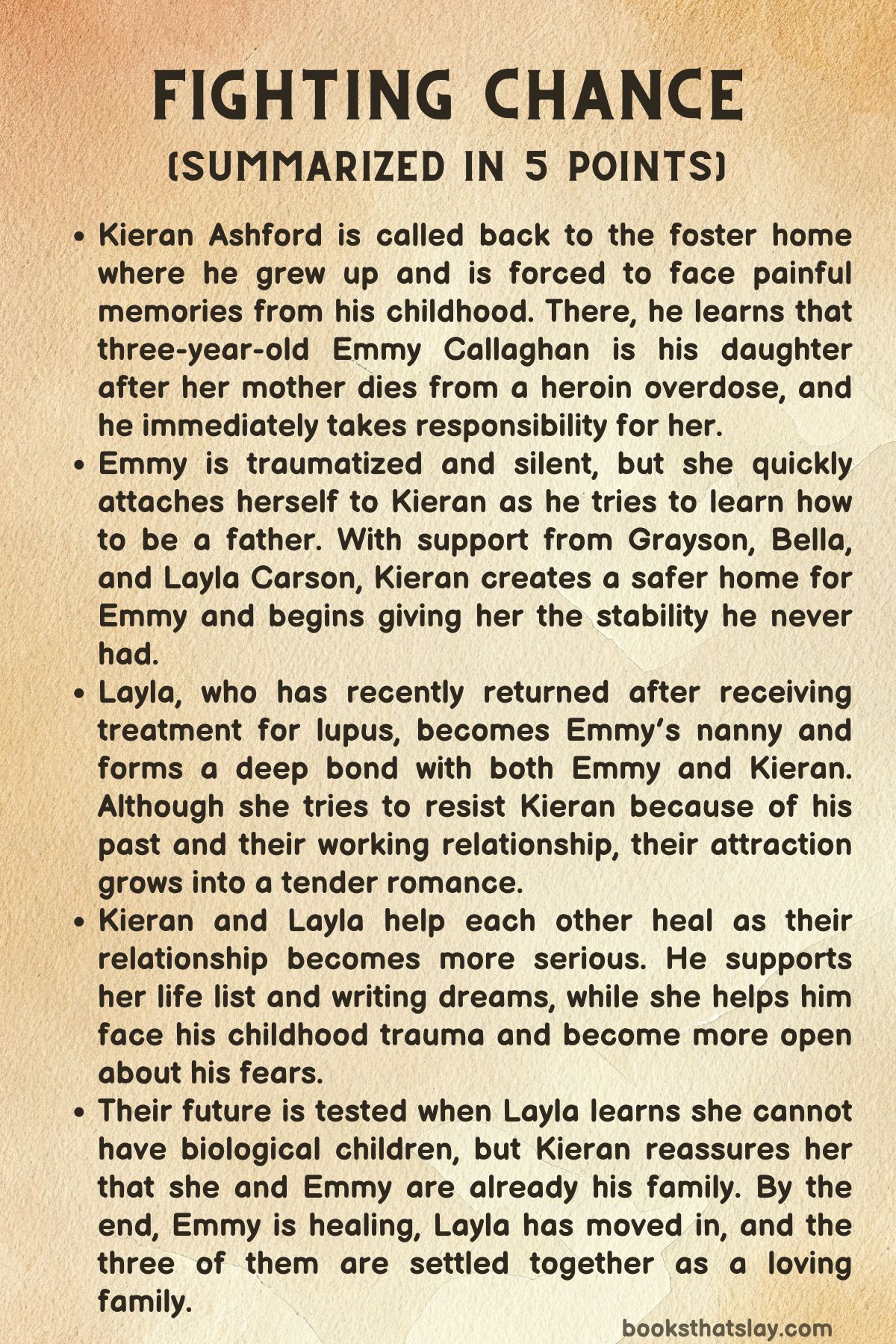
Summary
Kieran Ashford has spent most of his adult life keeping people at a careful distance. As a successful hockey player for the IceHawks, he has built a public image around confidence, charm, and a carefree attitude, but beneath that surface lives a man shaped by abandonment and cruelty.
As a child, Kieran was left on the side of the road by his mother and sent into foster care, where the home that should have protected him became another place of fear. The memories of that time still live under his skin, hidden beneath tattoos, jokes, and the life he has made for himself.
His past comes back without warning when he is called to the foster home where he grew up. The place itself carries too much pain for him, and returning there forces him to face memories he has spent years trying to bury.
But the reason for the call is even more shocking. A three-year-old girl named Emmy Callaghan has been brought to the home after her mother, Natasha, died of a heroin overdose.
DNA records show that Emmy is Kieran’s daughter.
Kieran is stunned. He had no idea Emmy existed, and he is terrified by the sudden responsibility of fatherhood.
Still, the moment he sees her, he knows he cannot leave her there. Emmy is small, silent, frightened, and clearly traumatized.
The thought of her growing up in the same place that damaged him is unbearable. Kieran claims her immediately and takes her away, even though he has no idea how to care for a child.
At first, everything feels uncertain. Emmy barely speaks and clings to Kieran with quiet desperation.
Kieran is afraid of doing the wrong thing, but his protective instincts are immediate and strong. He turns to his closest friend, Grayson, and Grayson’s girlfriend, Bella, for help.
They become part of the support system Kieran never expected to need. Realizing his apartment is not suitable for a young child, he buys a house across the street from Grayson and Bella, wanting to give Emmy safety, space, and stability from the start.
Through Bella, Kieran meets Layla Carson. Layla has recently returned from Berlin, where she received a trial medication that helped control her lupus after years of illness, treatments, fear, and missed opportunities.
She is trying to find her place again now that her body is giving her a chance to live more freely. When Layla meets Emmy, something important happens.
Emmy, who has been silent for weeks, speaks Layla’s name. The moment surprises everyone and shows that Layla has reached a part of Emmy that others have not.
Kieran asks Layla to become Emmy’s nanny. Layla needs work, and she already feels connected to Emmy, so she accepts.
The arrangement is practical, but the attraction between Layla and Kieran makes it complicated from the beginning. Kieran flirts openly, while Layla tries to keep boundaries in place.
She knows his reputation as a playboy, and she also knows he is now technically her employer. Even so, their connection keeps growing.
As Kieran settles into fatherhood, he learns through trial, error, and love. He relies on Grayson, Bella, Layla, Allie, Momma Bear Carson, and his IceHawks teammates.
Emmy slowly begins to feel safer. She responds to routine, care, and patience.
She also becomes attached to Bambi, Grayson and Bella’s dog, whose gentle presence helps her feel calm. Kieran introduces Emmy to his team and eventually goes public about being her father so rumors cannot twist the truth.
This choice shows how serious he is about protecting her and building a real life with her.
Layla becomes central to Emmy’s healing and to Kieran’s growth. She helps with daily routines, clothing, therapy, meals, and all the small details that make a home feel secure.
Kieran watches her with Emmy and sees warmth, patience, and strength. At the same time, Layla sees a side of Kieran that many people miss.
He is not just a flirt or a famous athlete. He is a scared new father trying his best, a man who loves fiercely once he lets someone close.
Their relationship develops through teasing, trust, and honest moments. Kieran learns about Layla’s life list, a collection of experiences she missed while lupus controlled so much of her life.
Instead of treating her illness as a weakness, he sees her desire to live fully and begins helping her complete the list. Their bond grows through playful moments, including a water fight, and through dates that let Layla experience joy without feeling fragile.
They also share more serious conversations, slowly revealing the wounds each of them carries.
Kieran opens up about his childhood, including the pain of being abandoned and abused in foster care. His tattoos cover scars, but they cannot erase what happened to him.
Letting Layla see that history is a major act of trust. Layla does not pity him or turn away.
She listens, accepts him, and gives him the kind of emotional safety he has rarely known. Kieran, in return, supports her dreams, especially her wish to write children’s books.
He makes her feel seen as more than her illness.
Their romance becomes deeper after a Halloween outing. By then, Layla is no longer just Emmy’s nanny, and Kieran is no longer just the man she tried to resist.
They confess their love and sleep together, crossing fully into the relationship both of them have been moving toward. Emmy also grows more attached to Layla, beginning to see her as family.
Kieran starts imagining a future that includes Layla, Emmy, and perhaps more children. For the first time, he allows himself to believe he can have the loving home he never had as a child.
That hope is shaken when Layla suffers a lupus flare. The flare is frightening on its own, but the news that follows hurts her even more.
Her doctor tells her she cannot have biological children. Layla is devastated.
Because she knows Kieran has dreamed of a big family, she convinces herself that she has taken something essential from him. Instead of leaning on him, she shuts down.
Her grief tells her she is not enough, even though Kieran has never made her feel that way.
Kieran refuses to let Layla disappear into that belief. He brings her to a mountain campsite and recreates a scene from her favorite book, giving her a moment filled with care, intention, and love.
There, he tells her the truth: she and Emmy are already his family. He explains that his dream of family was never limited to biological children.
Because of his own childhood in foster care, he has always wanted to adopt and give children the safety he was denied. Layla begins to understand that she has not ruined his future.
She is part of it.
This moment helps Layla hope again. It also strengthens the life Kieran, Layla, and Emmy are building together.
Kieran continues taking steps to face his past, including reporting the abusive matron who ran the foster home. His decision to push for an investigation shows that he is no longer only surviving what happened to him.
He is trying to stop the same harm from reaching other children.
By the end, Kieran’s life looks very different from the one he had before Emmy. Months later, the IceHawks lose the Stanley Cup, but the loss does not define him.
What matters most is that Layla and Emmy are with him. Emmy is still healing, still in therapy, and still learning to feel secure, but she has made great progress.
She now calls Layla “Mommy,” a sign of the love and trust that has grown between them.
Layla has moved in with Kieran and is building a fuller life of her own. She continues managing lupus, but it no longer controls every part of her future.
She is writing a children’s book, with Bella creating the illustrations, turning one of her dreams into something real. Kieran, Layla, and Emmy stand together as a family formed through choice, care, and patience.
Fighting Chance ends with them on the ice together, not as people who have escaped pain completely, but as people who have found a way to live beyond it. Kieran has become the father Emmy needs, Layla has found a love that accepts all of her, and Emmy has found the safe home she deserves.
Their family is not built by blood alone. It is built by showing up, staying, and choosing one another again and again.
Characters
Kieran Ashford
Kieran Ashford is the emotional center of Fighting Chance, and his character is shaped by abandonment, survival, fear, and the slow discovery of what it means to be loved. As a child, Kieran was left by his mother and forced into a foster home that became a place of pain rather than protection.
Because of this, he grows into a man who hides his wounds behind confidence, charm, tattoos, flirtation, and a reputation as a playboy. At the beginning of the book, he appears carefree on the outside, but his return to the foster home exposes how deeply his past still controls him.
The discovery that Emmy is his daughter shocks him, but it also awakens a fierce protective instinct. His decision to claim her immediately shows that, despite his fear and lack of experience, he refuses to let another child suffer the way he did.
Kieran’s growth is most visible through fatherhood. He does not become perfect overnight; he is frightened, uncertain, and aware that he has no model for healthy parenting.
However, his love for Emmy pushes him to change his entire life. He buys a safer home, builds routines, seeks help, introduces Emmy to a wider circle of support, and puts her needs before his own comfort.
His tenderness with Emmy reveals the softer side he has kept hidden from most people. He becomes patient with her silence, careful with her trauma, and determined to make her feel chosen.
Through Emmy, Kieran begins healing the abandoned child inside himself, because giving her safety becomes a way of proving that his own past does not have to define the future.
His relationship with Layla adds another important layer to his character. Around her, Kieran is playful and flirtatious, but he also becomes vulnerable in ways he rarely allows himself to be.
Layla sees beyond his charm and recognizes the pain beneath it, which gives him the courage to share the truth about his scars and memories. Kieran’s love for Layla is not only romantic; it is deeply restorative.
He supports her dreams, encourages her life list, and helps her believe she deserves joy after years of illness. When Layla believes her inability to have biological children makes her unworthy of him, Kieran’s response shows his maturity.
He does not treat family as something limited to blood. Because of his own experience in foster care, he understands that love, commitment, and choice are what create a home.
By the end of the story, Kieran has transformed from a man haunted by abandonment into a devoted father and partner. His happiness is no longer tied to his public success, his hockey career, or his image.
Even after the IceHawks lose the Stanley Cup, he is content because Layla and Emmy are beside him. Kieran’s journey is powerful because he does not erase his trauma; instead, he learns to build a life around love rather than fear.
He becomes proof that someone who was denied safety as a child can still become a source of safety for others.
Layla Carson
Layla Carson is one of the most emotionally resilient characters in the book. Her life has been shaped by lupus, medical trauma, lost opportunities, and the painful feeling that illness has stolen parts of her youth.
When she returns from Berlin after receiving treatment that helps control her condition, she is not simply looking for a job; she is trying to reclaim a life that has often felt paused. Her life list symbolizes this desire.
It is not just a collection of fun activities, but a record of everything she wants to experience after years of being limited by sickness. Layla’s character is built around quiet strength, hope, fear, and the longing to be seen as more than her illness.
Layla’s bond with Emmy reveals her natural warmth and emotional intelligence. Emmy has been silent and traumatized, yet she responds to Layla in a way that surprises everyone.
Layla does not force Emmy to open up; she creates a gentle space where the child feels safe enough to speak. This shows Layla’s patience and sensitivity.
As Emmy’s nanny, Layla becomes much more than a caregiver. She helps with routines, clothes, therapy, emotional comfort, and the everyday structure Emmy needs.
Her presence brings softness and stability into Kieran and Emmy’s home, and her connection with Emmy gradually becomes maternal. Layla’s love is careful, nurturing, and selfless, but it also leaves her vulnerable because she begins to want a permanent place in their family.
Her romance with Kieran develops through humor, emotional honesty, and mutual healing. At first, Layla is cautious because she knows his reputation and understands the complications of working for him.
Yet she is drawn to the sincerity beneath his teasing. Kieran helps her complete parts of her life list, and in doing so, he encourages her to live boldly rather than simply survive.
Layla, in return, helps Kieran face the wounds he has buried. Their relationship works because both of them carry pain, but neither reduces the other to that pain.
Layla sees Kieran as more than his past, and Kieran sees Layla as more than her illness.
Layla’s deepest emotional struggle comes when she learns that she cannot have biological children. This news devastates her because she believes she has ruined Kieran’s dream of a big family.
Her reaction shows how deeply she fears being a burden or a disappointment. Even though she is loved, she temporarily retreats into the belief that love requires her to provide everything Kieran might want.
Kieran’s reassurance helps her understand that she is already enough. By accepting his love and allowing herself to hope again, Layla completes one of the most meaningful parts of her journey.
She learns that her worth is not measured by health, fertility, or perfection, but by who she is and how deeply she loves.
Emmy Callaghan
Emmy Callaghan is a small child, but her presence changes the entire direction of the story. At only three years old, she has already experienced severe trauma through neglect, loss, and instability.
Her mother Natasha’s death from a heroin overdose leaves Emmy alone and frightened, and her silence shows the depth of her emotional shock. She cannot explain her pain in adult language, so her trauma appears through quietness, fear, attachment, and hesitation.
From the moment she reaches for Kieran, she becomes the heart of his transformation. Her need for protection forces him to confront both his past and his future.
Emmy’s attachment to Kieran is immediate and meaningful. Even though he is shocked to learn he is her father, Emmy seems to recognize safety in him.
Her bond with him is not loud or dramatic at first; it is fragile, instinctive, and rooted in her desperate need for someone who will not leave. Kieran’s decision to take her away from the foster home gives Emmy her first real chance at security.
Through him, she begins to experience a home where she is wanted rather than handled as a problem. Her gradual progress shows that healing for a traumatized child is slow and delicate.
Every small step, including speaking Layla’s name, matters deeply.
Emmy’s relationship with Layla is one of the most tender parts of the novel. Layla becomes a calm and loving presence in her life, and Emmy’s willingness to speak to her shows trust forming after fear.
Over time, Layla becomes a mother figure, not because she replaces anyone by force, but because she earns Emmy’s love through patience and consistency. Emmy’s eventual use of the word “Mommy” for Layla shows how far she has come emotionally.
It marks a shift from survival to belonging. She is no longer simply a child who has lost someone; she is a child who has found a family.
Bambi, Bella and Grayson’s dog, also plays an important role in Emmy’s healing. Emmy’s comfort around Bambi shows that animals can provide a kind of safety that does not demand words.
Bambi helps Emmy relax, connect, and express herself without pressure. By the end of the book, Emmy is still healing, but she is no longer frozen by fear in the same way.
Therapy, love, routine, and family help her become more secure. Her journey is not presented as magically fixed, which makes it feel more honest.
Emmy represents innocence wounded by adult failures, but she also represents the possibility of recovery when a child is finally surrounded by steady love.
Grayson
Grayson is Kieran’s best friend and one of the strongest sources of support in Fighting Chance. He provides the kind of friendship Kieran needs when his life changes suddenly.
When Kieran discovers that he has a daughter, Grayson does not judge him or leave him to figure everything out alone. Instead, he becomes part of the support system that helps Kieran adjust to fatherhood.
His role is important because Kieran has spent much of his life believing he has to survive on his own. Grayson’s loyalty proves that Kieran is not alone anymore.
Grayson also represents stability. His relationship with Bella, his home, and his willingness to help create a sense of community around Kieran and Emmy.
When Kieran buys a house across the street from him and Bella, it shows how much he trusts them. Grayson’s presence gives Kieran practical and emotional reassurance.
He may not be the central romantic figure, but his friendship helps make Kieran’s new family possible. He is the kind of character whose importance lies in consistency, loyalty, and quiet dependability.
Through Grayson, the story also shows that family can be built through friendship. Kieran’s biological family failed him, but Grayson becomes a chosen brother figure.
He helps create a wider home environment for Emmy, where she is surrounded not only by her father and Layla, but also by adults who care about her well-being. Grayson’s importance is not measured by dramatic speeches, but by the fact that he shows up when he is needed.
Bella
Bella is warm, practical, creative, and emotionally generous. As Grayson’s girlfriend and Layla’s best friend, she connects several important relationships in the story.
Her decision to bring Layla into Kieran and Emmy’s life becomes a turning point, because Layla quickly forms a bond with Emmy and eventually becomes central to both Emmy and Kieran’s healing. Bella’s instincts are compassionate and perceptive.
She understands people’s needs and helps bring the right people together at the right time.
Bella’s relationship with Emmy is also important. Along with Grayson and Bambi, she helps create a safe and welcoming environment for the child.
Bella’s dog becomes a source of comfort for Emmy, which reflects Bella’s broader role as someone associated with warmth and safety. She does not try to take over Emmy’s life, but she contributes to the circle of care that helps Emmy recover.
Her presence makes Kieran’s transition into fatherhood less isolating.
Bella is also meaningful in Layla’s life. As her best friend, she understands Layla’s history with illness and supports her return to ordinary life.
In the epilogue, Bella’s role as the illustrator of Layla’s children’s book shows that their friendship also supports creativity and dreams. Bella is not only a side character; she is part of the emotional foundation that allows other characters to grow.
She represents friendship, encouragement, and the everyday kindness that helps people rebuild.
Natasha Callaghan
Natasha Callaghan is Emmy’s mother, and although she is not physically present for most of the story, her choices and death have a major impact. Her heroin overdose leaves Emmy orphaned and traumatized, creating the crisis that brings Kieran into his daughter’s life.
Natasha’s character is tragic because she is connected to pain, addiction, loss, and consequences that fall heavily on a child. The story does not provide enough detail to fully understand every part of her life, but her death makes clear that Emmy has already suffered because the adults around her were unable to protect her.
Natasha also functions as a shadow over Kieran’s new role as a father. Because she never told him about Emmy, Kieran loses the first three years of his daughter’s life.
This creates shock, guilt, anger, and grief, even if those emotions are complicated. Natasha’s absence forces Kieran to step into parenthood suddenly, without preparation.
Her character therefore represents both the damage caused by secrecy and the painful reality that children often suffer most from adult instability.
At the same time, Natasha should not be seen only as a plot device. Her addiction suggests a life marked by struggle, even if the story focuses more on the aftermath than on her personal history.
She is a tragic figure because her death ends her chance to repair anything with Emmy or Kieran. Through Natasha, the book explores how addiction can leave emotional wreckage behind, especially for children who are too young to understand what has happened.
The Matron
The matron of the foster home is one of the most damaging figures in Kieran’s past. She represents institutional cruelty, neglect, and the betrayal of children who should have been protected.
For Kieran, the foster home is not simply a place where he lived; it is a place where he was mistreated and emotionally scarred. The matron’s abuse helps explain why returning there is so painful for him.
She is tied to his deepest fears about abandonment, helplessness, and being trapped in a system that ignored his suffering.
Her role becomes even more disturbing when Emmy is brought to the same foster home. Kieran’s immediate refusal to leave Emmy there shows how strongly the matron’s cruelty still affects him.
He knows from experience what that environment can do to a child, and his protective reaction is partly driven by the terror of history repeating itself. The matron therefore becomes a symbol of the past Kieran must fight against.
Saving Emmy from that place is also a way of saving the child version of himself who had no one to rescue him.
Kieran’s decision to report the matron and push for an investigation is an important act of courage. It shows that his healing is not only personal but also moral.
He does not simply escape the past; he tries to prevent others from being harmed. The matron’s character is important because she gives shape to the abuse Kieran survived and highlights the importance of accountability.
She represents the kind of authority that wounds, while Kieran becomes the opposite: an adult who protects.
Allie
Allie is part of the supportive network surrounding Kieran, Emmy, and Layla. Although she is not as central as Kieran, Layla, or Emmy, her presence matters because the story emphasizes that healing does not happen through one relationship alone.
Kieran needs a community, and Allie contributes to that sense of care. She is one of the people who helps make Kieran’s new life feel less overwhelming and more stable.
Allie’s importance lies in the way she reflects chosen family. Kieran’s past taught him that adults could abandon or hurt him, but characters like Allie help challenge that belief.
She belongs to the circle of people who show up for him and Emmy, proving that support can come from many directions. Her role may be quieter, but it adds warmth to the family structure forming around Emmy.
Through Allie, the book shows that secondary characters can still carry emotional weight. She helps widen the world of the story beyond the central romance, making Kieran and Emmy’s home feel connected to a larger community.
Her presence reinforces the idea that love is not limited to parents or partners; friends and extended support systems also help people heal.
Momma Bear Carson
Momma Bear Carson is a nurturing and protective figure, especially within Layla’s world. Her name itself suggests warmth, strength, and fierce care.
As part of Layla’s support system, she represents the kind of family presence that contrasts sharply with Kieran’s childhood. Where Kieran experienced abandonment and mistreatment, Momma Bear Carson represents steadiness, concern, and emotional shelter.
Her role helps explain why Layla, despite her suffering, still has a strong capacity to love and care for others.
She also contributes to the broader theme of family as protection. Her presence around Kieran, Emmy, and Layla helps create a sense of intergenerational support.
For Emmy, having adults like Momma Bear Carson in her extended circle means being surrounded by people who are invested in her safety and happiness. For Kieran, it offers another example of what healthy family care can look like.
This matters because he is still learning how families are supposed to function.
Momma Bear Carson’s role may not dominate the plot, but she strengthens the emotional environment of the story. She represents comfort, acceptance, and the kind of fierce love that protects without controlling.
Her presence supports Layla and indirectly supports the family Layla is building with Kieran and Emmy.
The IceHawks Teammates
The IceHawks teammates represent Kieran’s professional world, but they also become part of his personal support system. At first, Kieran’s identity is strongly connected to hockey, public attention, and the image he has built around himself.
When Emmy enters his life, that image changes. Introducing Emmy to his team and going public about being her father show that Kieran is no longer trying to separate his private responsibilities from his public identity.
He accepts fatherhood openly, even though it could invite media attention and judgment.
The teammates also help show that Kieran is not isolated. Their presence gives him a larger community beyond Grayson, Bella, and Layla.
They are part of the world that watches him change from a carefree athlete into a devoted father. This shift is important because Kieran’s growth is visible not only at home but also in the public spaces of his life.
He does not hide Emmy as a complication; he claims her as his daughter.
The team’s loss of the Stanley Cup in the epilogue also helps clarify Kieran’s priorities. Earlier, a major career loss might have defined his happiness, but by the end, his family matters more.
The IceHawks therefore serve as a contrast between public success and private fulfillment. Hockey remains important to Kieran, but it is no longer the center of his emotional world.
Bambi
Bambi, Bella and Grayson’s dog, plays a gentle but meaningful role in Emmy’s healing. Though Bambi is not a human character, the dog becomes emotionally important because Emmy responds with comfort and trust.
For a traumatized child who struggles to speak, an animal can feel safer than adults. Bambi does not ask questions, pressure Emmy, or demand explanations.
This allows Emmy to relax and connect in a way that feels natural.
Bambi’s role also shows the importance of small sources of comfort in recovery. Emmy’s progress is not built only through major emotional conversations or dramatic moments.
It also comes through ordinary experiences: being near a friendly dog, feeling safe in a home, and learning that the world can be gentle. Bambi helps create that gentleness.
The dog becomes part of the safe environment that allows Emmy to slowly open up.
In the larger story, Bambi reflects the warmth of Grayson and Bella’s home. The dog is connected to a space where Emmy is welcomed and protected.
Bambi’s presence may seem simple, but it adds emotional softness to the book and supports one of its central ideas: healing often begins through trust, and trust can start in the quietest ways.
Layla’s Doctor
Layla’s doctor has a smaller role, but the character is important because they deliver life-changing information about Layla’s health and fertility. The news that Layla cannot have biological children becomes one of the major emotional conflicts in the story.
Through the doctor, the medical reality of Layla’s lupus becomes unavoidable. Her illness is not just background information; it continues to affect her choices, fears, and hopes for the future.
The doctor’s role also highlights Layla’s vulnerability. Even after treatment in Berlin helps her manage her condition, she is not completely free from the consequences of illness.
The conversation about fertility reopens old wounds and makes Layla feel as though her body has betrayed her again. This moment is painful because it threatens the future she has started to imagine with Kieran and Emmy.
Although the doctor is not emotionally close to Layla in the way Kieran or Bella is, the character serves an important function in the book. They bring medical truth into the romance and force Layla and Kieran to confront what family really means.
The result is one of the most important affirmations in the story: love and family are not limited to biology.
Themes
Healing from Childhood Trauma
In Fighting Chance, Kieran’s return to the foster home forces him to face memories he has spent years trying to bury. His childhood was shaped by abandonment, fear, and mistreatment, leaving him with emotional wounds that still affect how he sees himself.
The arrival of Emmy becomes a painful reminder of his own past because she is also a frightened child placed in an unsafe system. Instead of running from that memory, Kieran chooses to protect her in the way no one protected him.
His healing does not happen through forgetting what happened, but through breaking the cycle. By claiming Emmy, reporting the abusive matron, and building a safe home, he turns his pain into responsibility.
The theme shows that trauma may leave lasting marks, but it does not have to control a person’s future. Kieran’s growth comes from choosing care over bitterness and action over silence.
Found Family and Emotional Safety
Family in the story is built less through biology and more through loyalty, care, and daily presence. Emmy may be Kieran’s daughter by blood, but their bond becomes meaningful because he chooses her fully, even when he is scared and unprepared.
The wider support system around them also becomes essential. Grayson, Bella, Layla, Allie, Momma Bear Carson, and the IceHawks teammates help create the sense of safety that both Kieran and Emmy need.
This theme is especially important because both father and daughter have experienced instability. The people around them offer practical help, emotional warmth, and steady acceptance.
Layla’s place in the family grows naturally through patience, affection, and trust rather than force. Emmy calling Layla “Mommy” shows that family is formed through love that proves itself over time.
The story presents home as a place where people are protected, accepted, and allowed to heal.
Love as Acceptance Rather Than Perfection
Kieran and Layla’s relationship develops through honesty, support, and the willingness to accept each other’s fears. Layla carries the emotional burden of years spent fighting illness, missing out on normal experiences, and fearing that her body makes her less worthy of love.
Kieran carries shame and pain from his childhood, hidden beneath confidence and charm. Their romance becomes meaningful because they do not expect each other to be untouched by hardship.
Instead, they create space for vulnerability. Kieran supports Layla’s life list and her dream of writing children’s books, while Layla helps him trust that he can be a good father and partner.
When Layla learns she cannot have biological children, she believes she has failed him, but Kieran’s response proves that love is not dependent on a perfect future. His commitment shows that real love accepts changed plans, emotional scars, and difficult truths without making the other person feel like a burden.
Parenthood as Choice and Responsibility
Kieran’s journey into fatherhood begins with shock, fear, and uncertainty, but it quickly becomes one of the strongest parts of his character. He does not know how to raise a child at first, yet he understands immediately that Emmy needs safety, patience, and love.
His decision to take her from the foster home shows that parenthood is not only about biological connection but about choosing responsibility every day. He changes his living situation, seeks help, builds routines, supports therapy, and allows his life to reshape around Emmy’s needs.
His growth as a father is not presented as effortless; it is built through learning, mistakes, and emotional courage. The theme also connects to his past because Kieran knows what happens when adults fail vulnerable children.
By becoming the kind of parent he never had, he proves that love is shown through protection, consistency, and presence.