The Shark House Summary, Characters and Themes
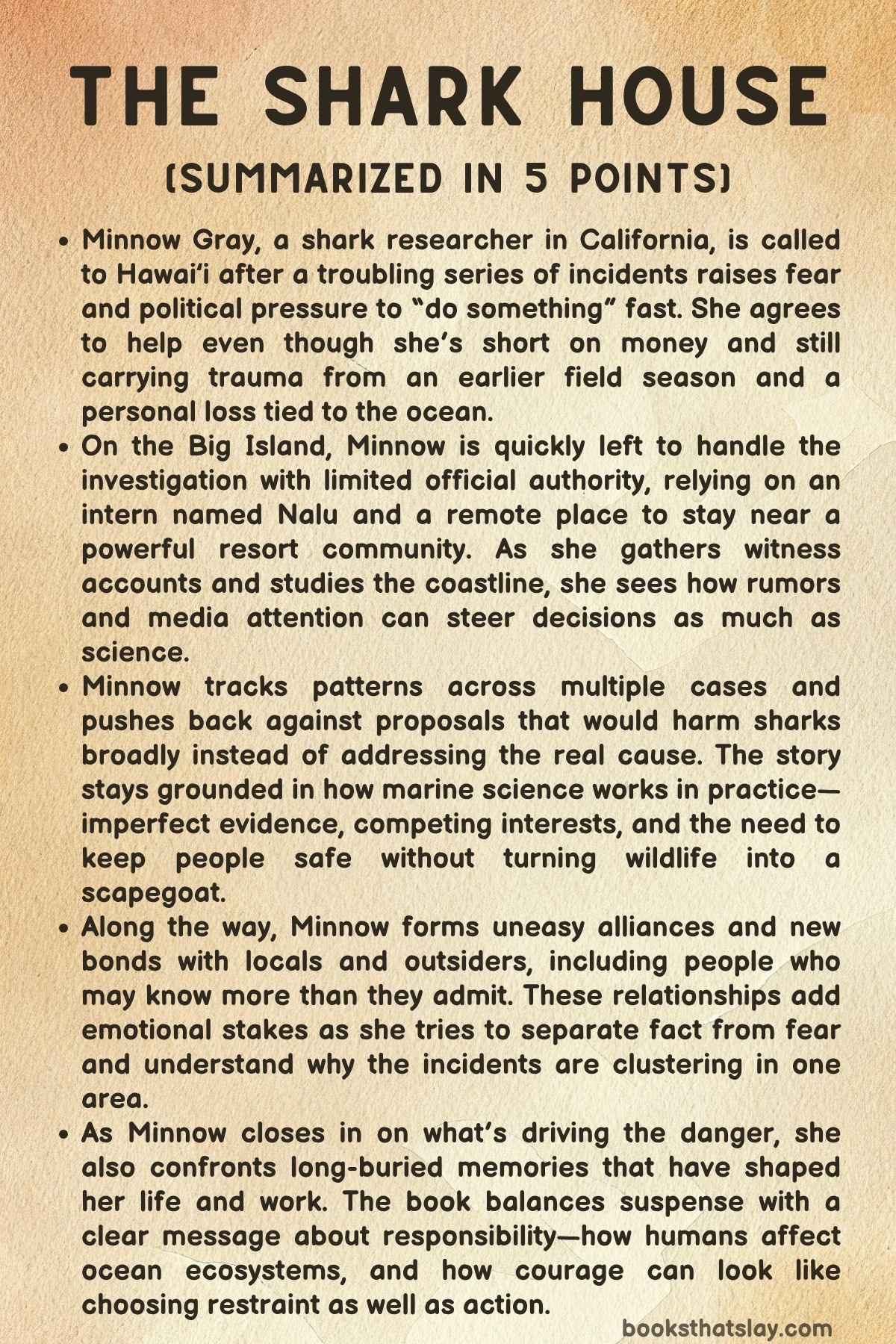
The Shark House by Sara Ackerman is a coastal suspense novel set on Hawaiʻi’s Big Island, told through the eyes of Minnow Gray, a shark researcher who is both skilled in her field and scarred by personal loss. When a string of attacks threatens to trigger a state-backed shark hunt, Minnow is pulled into a fast-moving situation shaped by fear, politics, tourism money, and media pressure.
As she investigates what’s driving the incidents, she also confronts the memory of her father’s death and the guilt she has carried for years. The story balances ocean science, local community tensions, and a search for truth beneath the panic.
Summary
Minnow Gray, a shark researcher based in California, wakes from a terrifying dream of dark water and a circling shark, only to be called into real trouble. Dr. Joe Eversole from the University of Hawaiʻi asks her to fly to the Big Island immediately.
A cluster of shark incidents is escalating, and officials are already talking about killing sharks to calm the public. Joe’s full team is away, and he needs Minnow’s expertise—especially if a great white is involved.
Minnow is hesitant. Her finances are strained as she tries to launch a nonprofit called Sea Trust, and she is still carrying the aftermath of a brutal research season at the Farallon Islands.
But Joe offers to cover travel, provide housing, and give her enough support to do the job. Minnow agrees.
On the flight, she reviews what has happened. A young surfer, Stuart Callahan, was attacked at a remote break while his father watched in horror.
Stuart made it to shore, but the wound was catastrophic and he died from blood loss. Another swimmer, Hank Johnson, disappeared while training for the IRONMAN.
A helicopter pilot claimed to have seen a shark of enormous size. Minnow knows fatal attacks are rare and that Hawaiʻi typically sees tiger sharks involved in dangerous encounters, not great whites.
Still, the pattern and the location feel unusual, and the missing evidence—especially Stuart’s surfboard—makes it harder to identify the species.
At the Kona airport, Minnow meets Joe, who immediately drops bad news: his wife has gone into premature labor on Oʻahu, and he has to leave the island that evening. Minnow is stunned that she is expected to carry the investigation without him, but Joe argues that her presence alone may prevent leaders from choosing the worst option.
He gives her an ID card, access to his boat, a small stipend, and a borrowed truck. He also leaves her with an intern, Nalu, who will act as her driver and assistant.
Over lunch, Joe shows her photographs and measurements from Stuart’s injuries. The bite is a huge, clean crescent across the thigh, suggesting an extremely large shark.
Joe is concerned because the reported behavior doesn’t match what most people associate with tiger sharks. Then he tells Minnow the second major incident: Angela Crawford, an Oscar-winning actress, was badly injured while swimming far offshore.
Her partner, Zach Santopolo, describes a violent hit and a struggle in deep water. Angela’s injuries are severe enough that she may lose an arm.
Minnow understands instantly what this means: celebrity attention will turn fear into frenzy, and politicians will feel cornered into action.
Minnow travels with Nalu along the volcanic coastline to her lodging at Hale Niuhi, a rustic Kaupiko family property near the luxury Kiawe resort. The house is isolated and dark, with no electricity unless she runs a generator.
The shoreline is rough lava rock, and the ocean feels both inviting and threatening. Minnow thinks of her father, who died from a shark bite when she was young.
The ocean has shaped her life, but it has also taken from her, and the new assignment presses on that old wound.
The next day, Minnow and Nalu take a boat to Bird Rock, the break where Stuart was attacked. Minnow free dives to study the underwater terrain.
She finds steep drop-offs and deep channels close to the reef edge—terrain that could allow a large shark to cruise past unseen. The dive gives her a better sense of how an attack could happen there without warning, but it doesn’t give her proof.
Minnow tries to contact Angela at the hospital, but staff refuse to share details or allow a visit. She turns to the political problem and calls Mayor Lum, who is polite but clearly focused on tourism, upcoming events, and avoiding headlines that could scare visitors away.
He gives Minnow two weeks to “figure it out.” If she cannot, he will authorize a hunt. Minnow argues that killing sharks won’t solve the problem and will damage the ecosystem, but Lum is already hearing from business leaders who want a dramatic response.
Minnow and Nalu return to the water to speak with surfers and search for Stuart’s missing surfboard. Some locals avoid them, but a spearfisher named Sly describes seeing an enormous white shark in Opihi Bay, moving through the deep like something built for distance and power.
The description fits what Minnow fears. Later, while traveling along the coast, Minnow notices a high-end boat anchored in a bay that reeks of bait.
A guarded man confronts them for coming close. Minnow recognizes him from the Kiawe bar—someone watching her earlier while she read headlines about the proposed hunt.
He claims he is collecting ʻopihi, but the gear and the smell suggest something else. Minnow leaves unsettled, sensing that human behavior may be part of what is happening.
At the resort, the owner, Don Sawyer, pressures Minnow for certainty and favors shark killing as a clean solution. Minnow pushes back and asks instead for help accessing Angela.
Sawyer agrees to pull strings. Outside, Minnow runs into the same guarded man again.
He introduces himself as Luke Greenwood, says he’s from Washington, and hints he works around boats and charters. He’s charming but evasive, and Minnow’s suspicion grows when she notices signs that he knows more than he is admitting.
That night, Minnow suffers a frightening interruption of her own body’s limits when she is bitten by a centipede. Nalu rushes her to the ER.
While being treated, Minnow uses the opportunity to press for access to Angela. With Nalu’s help, she is allowed into Angela’s room.
Angela is heavily medicated and has already lost an arm. Despite her condition, she insists she remembers everything.
She tells Minnow that Zach removed a shark tooth from her shin during the rescue and kept it for safekeeping. Angela describes a dark-backed shark with a bright white underside and a pointed nose, and she recalls being hit hard, grabbed, and pulled seaward.
Minnow studies the damage and is overwhelmed by flashes of her father’s death.
Soon after, Minnow and Nalu find Stuart’s surfboard wedged between rocks. It is buckled with a massive bite taken out of it, further supporting the idea that the same animal attacked both Stuart and Angela.
Woody Kaupiko arrives at Hale Niuhi with supplies and steadiness. He helps Minnow feel less alone and explains local place names and shark traditions.
The area’s old meaning ties it to sharks, and Hale Niuhi itself carries the sense of giant sharks in story and memory. Minnow takes comfort in the way Woody speaks about balance instead of fear.
A shark task force meeting is held at the Kiawe resort. Media swarm Minnow, hoping for celebrity details and a simple answer.
Inside, community leaders and officials argue about what to do. Minnow presents her evidence and explains that two incidents close together do not necessarily mean more are coming.
She warns that a hunt could kill the wrong animals and harm shark populations that recover slowly. Others argue from grief, panic, and economic pressure.
Mayor Lum ends the meeting without committing, but Minnow senses which direction he is leaning.
A reporter, Josh Brown, corners Minnow afterward. She decides to speak on camera and reads a statement from Angela that shifts some responsibility back onto human choice—Angela admits she put herself in risky conditions far offshore.
Luke appears during the interview and stays close to Minnow afterward. They talk late into the evening, sharing personal history.
The connection between them grows, but Minnow senses Luke is carrying secrets.
Minnow’s suspicions sharpen when she hears about signs of chum in the water near the Kiawe coastline. She begins to suspect someone has been dumping bait to draw sharks closer to shore.
If that is true, it would explain why a large white shark might be lingering in an area where it typically passes through. Minnow calls officials and is told to watch the news.
Mayor Lum announces a controlled shark hunt will begin Saturday. Minnow is crushed.
She feels that everything she has argued—science, ethics, ecology—has been ignored. She decides to leave rather than witness what she believes will be a massacre.
That night, Luke takes Minnow out by boat. A storm builds, and they return drenched, shaken, and close.
They almost cross a line into a deeper relationship, but Minnow admits she is leaving. Luke reacts with anger and frustration, accusing her of running away.
He storms off, still refusing to fully explain himself.
The next day, Minnow goes snorkeling alone, trying to steady herself in the water. She encounters a large tiger shark that circles with curiosity rather than attacking.
The moment is tense but controlled, reminding her that fear and reality are not always the same thing. Still, she returns home more convinced that misunderstanding is steering policy, not truth.
Minnow heads to Pāpapa Bay to look for evidence of a shark-tour or chumming operation. She finds boats and signs of recent use, then waits near a buoy where sharks might associate engine noise with food.
When she dives, she sees a massive white shark rise from the deep. Minnow recognizes her: Luna, a huge female white shark from Minnow’s past.
The sight hits Minnow with force—Luna is real, present, and marked with scars. Minnow realizes the hunt will likely target Luna, and that many other sharks will die without changing anything.
The encounter breaks open Minnow’s buried memory of her father’s death near Catalina. For years she believed her father died saving her because she had taken a kayak out.
In the full memory, she understands the truth: she hadn’t taken the kayak at all. Her father went after it for another reason, and the shark struck him during that attempt.
The guilt she carried begins to lift, replaced by a clearer grief and a new sense of how trauma can rewrite a life.
Back at Hale Niuhi, Minnow finds a threatening note telling her to leave, along with a dead fish left as a warning. Fear becomes personal.
Luke returns and finally confesses. He explains he once worked in marine research but lost everything after a tragic accident at sea.
Later, in Hawaiʻi, a man named Bob offered him money and a boat to catch and land big sharks, with extra pay for a great white. Luke says he couldn’t go through with it and quit, but he believes the scheme connects to Stuart’s father, Sam Callahan, who might have been seeking revenge.
Before the hunt begins, local resistance erupts. A harbor blockade is organized, led by Cliff Kaupiko, to stop boats from going out.
Minnow joins Woody, Nalu, Luke, and others, including a scientist named Chip Young, to catch the chummers in the act. In the darkness, they track a Radon boat approaching the buoy with a shark cage.
The crew dumps chum into the water and prepares the cage. Minnow’s group confronts them, documenting faces, the boat, and the bloody slick.
The operators flee, but the evidence is enough to ignite a scandal.
As reporting expands, the story shifts. The chumming operation is exposed as a profit-driven shark-diving business, and bribery and political back-channeling come into view.
The hunt loses public momentum as attention moves to corruption and exploitation. Minnow’s work helps redirect blame away from sharks and toward the humans who manipulated the situation for money and revenge.
In the aftermath, Minnow chooses to swim the open-water race as a statement that fear will not control her life. She finishes alongside people who have become her allies.
Later, back in California, she receives a letter connected to her late mother and a Hawaiian middle name chosen for her: Ka‘ahupahau. Minnow buys a new boat and names it Luna, continuing her research and committing herself to shark protection with renewed clarity.
Luke eventually finds his way to California, and they reunite in the ocean that shaped them both.
Months later, Minnow returns to the Big Island and celebrates her birthday with a chosen family that includes Woody, Nalu, Luke, and the Kaupikos. Luke works at the resort and helps care for Hale Niuhi.
Minnow and Luke commit to a life that moves between Hawaiʻi and California, tied together by the same water that once terrified her, and now also sustains her work, her healing, and her future.
Characters
Minnow Gray
Minnow is the emotional and ethical center of The Shark House: a brilliant great white shark researcher whose expertise is inseparable from her trauma. Her recurring nightmare and hypervigilance in the water aren’t just “backstory”—they shape how she reads every clue, how quickly she spots human scapegoating, and how fiercely she argues against a hunt.
Financial precarity and her fragile attempt to build Sea Trust put her in a constant squeeze, which makes her decision to fly to Hawaiʻi both practical and perilous: she needs the work, but the ocean is also where her grief lives. As the investigation deepens, Minnow’s arc becomes less about “solving the shark” and more about reclaiming truth—especially the truth of her father’s death, which she has carried as personal blame.
By the time she identifies Luna and confronts the chumming operation, Minnow has moved from isolated expert to public advocate, willing to be disliked, threatened, and misunderstood if it means preventing violence against sharks and restoring balance to the community.
Dr. Joe Eversole
Joe functions as the catalyst who drags Minnow into the Big Island crisis, but he’s also a symbol of imperfect institutional response. He understands enough science to fear public panic and political overreaction, and he knows Minnow’s credibility can slow the rush to cull.
Yet his abrupt departure for his wife’s premature labor leaves Minnow with responsibility but not real authority, exposing how fragile “official action” can be when it’s more optics than infrastructure. Joe’s role highlights the tension between academic expertise and public policy: he’s trying to do the right thing within limits, but those limits push Minnow into a lonely, high-stakes position where her competence must substitute for formal power.
Nalu
Nalu is Minnow’s on-the-ground anchor—driver, boat support, and cultural bridge—while also being young enough to still be learning what it means to hold authority in a tense community. His initial hesitation in the water and his spear reflect a local survival pragmatism that contrasts with Minnow’s research-driven calm; he’s not reckless, but he’s conditioned to treat the ocean as something you respect through readiness.
Across the story, Nalu grows into a protector and collaborator: he helps her access Angela, gathers old incident details, bluffs tourist boats away from whales, and stands with Minnow when opinions harden around fear. His flirtations and social ease with Dixie and locals also matter narratively because they keep Minnow connected to ordinary life, reminding her that the island is a community—not just a case file.
Woody Kaupiko
Woody embodies steadiness, lineage, and place. He’s practical—showing up with supplies, teaching centipede-proofing tricks—but he also carries the spiritual and historical memory of the coastline, explaining names like Kalaemanō and the meaning behind Hale Niuhi.
Woody doesn’t argue from abstract ecology the way Minnow does; he argues from lived relationship with the land and sea, which gives Minnow’s scientific stance moral and cultural reinforcement. He’s protective without being controlling, and his presence transforms Minnow’s lodging from an eerie isolation chamber into a shared base of operations.
Woody represents the kind of local leadership that isn’t elected or loud but becomes essential when institutions tilt toward profit and panic.
Cliff Kaupiko
Cliff begins as an intimidating absence—spoken of as protective and intense—then becomes the story’s most overt expression of organized resistance. His harbor blockade is not mere drama; it’s a strategic act of community power meant to stop an immoral hunt and buy time for truth to surface.
Cliff’s protectiveness extends beyond family into guardianship of cultural values, and his willingness to confront armed or badge-wielding intimidation shows how seriously he views the stakes. The late reveal involving Minnow’s mother’s letter and the Hawaiian middle name ties Cliff to Minnow’s identity in a deeply intimate way, reframing him from “scary older brother” into a long-held keeper of belonging and reconciliation.
Mayor Lum
Lum is the face of political calculation: polite, image-conscious, and fundamentally driven by tourism pressure and public optics. He positions Minnow’s work as a ticking clock—two weeks to “figure it out”—which reduces ecological complexity to a deadline shaped by events and revenue.
His eventual decision to authorize a controlled shark hunt shows how leaders often pick visible action over correct action when fear escalates. Lum’s role becomes even more damning once corruption enters the picture, because his public posture of safety is revealed as entangled with self-interest and payoffs, turning him into a cautionary figure about how power can weaponize fear.
Don Sawyer
Sawyer represents the commercial engine behind the hysteria: a resort owner who hears “shark incidents” as “economic threat.” He pushes for killing as a clean solution because it promises quick reassurance, even if it’s scientifically misguided and ethically brutal. At the same time, he is savvy enough to realize Minnow’s access and credibility have value, so he assists when it suits him, helping with hospital access and covering tabs while still pressuring the narrative toward a monster in the water.
Sawyer’s complexity lies in how believable he is: he doesn’t need to be cartoonish to be dangerous—he only needs to prioritize business continuity over ecological reality.
Luke Greenwood
Luke is the story’s most volatile blend of charm and concealment. Introduced as a watchful, evasive presence, he carries the aura of someone who knows more than he says, which keeps Minnow and the reader constantly recalibrating trust.
His tenderness with marine life and his genuine discomfort with a mass hunt place him near Minnow ethically, but his guarded support for a “targeted” kill reveals a compromise mindset shaped by fear and guilt. The confession about the intern’s death and his subsequent recruitment into shark-catching work makes Luke a study in moral injury: he isn’t a villain, but he has been bent by shame, exile, and financial desperation.
His relationship with Minnow becomes a parallel healing journey—two people pulled toward the ocean for opposite reasons, love and loss, choosing honesty as the only way forward. His eventual move to California and their shared life signals that Luke’s redemption isn’t a single confession; it’s a sustained commitment to live differently.
Angela Crawford
Angela is more than a celebrity victim; she becomes a narrative pivot that forces the story into the spotlight and raises the stakes of misinformation. Her injuries are catastrophic, yet she retains a clear memory of events, and her decision to preserve the tooth through Zach is a surprisingly rational act amid chaos.
Angela’s statement—taking responsibility for being offshore and vulnerable—cuts against the “shark as villain” script and gives Minnow a rare ally who can shift public sentiment. Her role highlights how fame can distort crises while also offering a platform to correct them, depending on who controls the story.
Zach Santopolo
Zach is defined by crisis response and protectiveness. His account of the impact, his role in rescuing Angela, and his decision to keep the tooth suggest a person who thinks fast and distrusts systems that might exploit evidence.
He also functions as a lens into how people narrate trauma in real time: his descriptions are visceral, shaped by shock, and they feed the early frenzy even as they preserve crucial details. Zach’s presence shows how partners of victims become secondary casualties—forced to replay the horror, defend their choices, and withstand public scrutiny.
Stuart Callahan
Stuart is the tragedy that ignites the investigation, and his death becomes the emotional fuel behind calls for vengeance. The detail that he makes it to shore but dies from blood loss underscores the cruelty of misfortune rather than malice, while the missing surfboard initially blocks scientific certainty.
Even after his board is recovered, Stuart remains less a “character with dialogue” and more a haunting absence whose story is repeatedly used by others—politicians, business owners, grieving family—to justify whatever outcome they already want.
Sam Callahan
Sam is grief sharpened into pressure. As Stuart’s father, he carries the image of the breach, the blood, and the impossible choices, and those memories make him vulnerable to anyone promising control or closure.
His overwhelm at the task force meeting shows a man caught between personal loss and public spectacle, and later revelations tie him to ethically compromised actions—hiring intermediaries to pursue sharks—suggesting how grief can be manipulated into harm. Sam’s arc doesn’t erase his love for his son; it reveals how sorrow, when paired with power and influence, can metastasize into destructive certainty.
Hank Johnson
Hank is the unsettling “missing” that broadens the case beyond two high-profile attacks. His disappearance while training, the report of a massive shark, and the uncertainty about details like fins create the kind of ambiguity that panic feeds on.
Narratively, Hank represents the gap between what is known and what is assumed, and his absence becomes a blank canvas for rumor, policy overreach, and the temptation to treat correlation as cause.
Tommy Warren
Warren operates as a bureaucratic enabler of fear and, later, as part of the corruption chain. In the task force context, he’s aligned with the hunt-minded bloc, projecting authority that sounds like stewardship but functions as escalation.
When the chumming scandal breaks and payoffs are exposed, Warren’s role clarifies how “public safety” rhetoric can be used to protect private profit, turning him into a figure of institutional rot rather than protection.
Josh Brown
Josh is the embodiment of media incentives: he doesn’t invent fear out of nothing, but he amplifies it into something profitable. His language pushes toward “man-eater” framing, and he pressures Minnow to validate spectacle, which forces her to become not just a scientist but a disciplined communicator.
Yet he’s also pragmatic enough to follow the real story when it surfaces, and the later collaboration—especially with Luke’s testimony—shows that media can pivot from sensationalism to accountability when given evidence and access. Josh functions as a reminder that narratives are battlegrounds, and whoever controls the frame controls the public response.
Chip Young
Chip is the “extra scientist” whose presence matters less for personality than for legitimacy and coordination. He represents coalition-building: expertise joining local leadership and investigative strategy rather than standing apart.
In a story where Minnow is often isolated as the lone expert, Chip’s inclusion signals that the fight against the hunt eventually becomes collective and organized, not just emotional pleading.
Kamaki
Kamaki is intimidation in human form: an ex-cop with a badge and a pistol confronting people in boats under darkness and chum-stink. He personifies the threat of coercive authority being rented out to private interests.
Even without lengthy backstory, Kamaki’s presence raises the temperature of the confrontation, making clear that what’s happening offshore isn’t harmless tourism—it’s enforcement, profit, and menace layered together.
Alex Dickerson
Alex is the named face of the shark-tour/chumming operation, the person bold enough to lead the act and identify himself when challenged. He represents predatory entrepreneurship—creating danger to sell the thrill of “managing” it.
His involvement helps shift the story from “mysterious shark behavior” to “human behavior shaping shark behavior,” which is the moral hinge of the novel: the real monster is often the incentive structure, not the animal.
Bob
Bob functions like a shadow recruiter—an intermediary who makes unethical work feel like a “job opportunity.” His approach to Luke shows how exploitation often operates through plausible deniability: money and gear appear, responsibility blurs, and the dirty outcome is pushed onto the desperate. Bob’s importance is not his personality but his role as the connective tissue between grief, profit, and the machinery that tries to turn sharks into commodities or trophies.
Dr. Bush
Dr. Bush plays a quiet but crucial role by grounding Minnow in ordinary human vulnerability. Treating Minnow’s centipede bite, offering calm medical perspective, and indirectly confirming Angela’s condition, he provides a rare space where Minnow is not the expert in charge.
In a narrative dominated by ocean danger and public aggression, Dr. Bush represents the steadier systems of care that still function even when politics and media distort everything else.
Dixie
Dixie appears briefly, but she matters because she shows Nalu’s social world and the normal rhythms of island life continuing amid crisis. Her flirtation subplot isn’t filler; it contrasts the escalating hysteria with everyday human connection, underscoring that communities are not only their emergencies.
George
George, the bartender who recognizes the Kaupiko connection and extends hospitality, signals how reputation and relational networks operate in this setting. His willingness to help Minnow on Woody’s tab is a small act of trust that foreshadows the broader alliance Minnow will eventually build with locals.
Chris
Chris, another bartender figure at the resort, functions as a warning system—someone who understands power dynamics, Sawyer’s temper, and the resort’s stance, and tries to keep Minnow from stepping on a landmine. He reinforces that information on the island is filtered through relationships, and that speaking about sharks isn’t just “talk”—it’s political.
Dave Morrow
As the race organizer, Dave embodies the conflict between tradition, athletics, and perceived danger. Events like the Kiawe Roughwater Swim become pressure points where leaders fear cancellations, lawsuits, and public backlash.
Dave’s pro-hunt lean reflects how quickly civic pride and community gatherings can be leveraged to justify harmful “solutions.”
Dragon
Dragon, the police officer present at the task force, represents formal enforcement hovering at the edge of a morally messy situation. Even without deep characterization, his presence signals that decisions are drifting toward force—boats, rules, punishments—rather than science or patience.
Hina
Hina enters late but powerfully as a symbol of future, courage, and continuity with the ocean. Meeting her during the open-water race reframes the sea from trauma zone to communal arena, and her presence reinforces Minnow’s transformation: Minnow isn’t proving fearlessness to herself anymore—she’s modeling a different relationship with the ocean for the next generation.
Luna
Luna is the most “character-like” animal in The Shark House, not because she is anthropomorphized, but because Minnow’s history gives her a narrative identity. The scars, the recognizable fin slices, and the eye contact turn Luna into a living thread between past and present, forcing Minnow to face the reality that what haunts her is not an abstract shark but a specific encounter embedded in memory.
Luna’s reappearance also reframes the crisis: the threat is not an evil creature “lurking,” but a powerful migratory animal being pulled into danger by human chumming and human panic. In the end, Luna becomes a symbol of what Minnow is fighting for—wildness that deserves respect, not punishment.
Stefan
Stefan’s role in Angela’s rescue makes him part of the human chain that keeps her alive. Though he remains mostly in the background, his presence reinforces that survival in the ocean often comes down to imperfect, improvised teamwork rather than heroics.
Themes
Fear, Memory, and the Body’s Alarm System
Minnow’s work depends on careful observation, but her nervous system keeps pulling her into a different kind of attention—one shaped by a childhood loss and the way trauma lingers in physical reactions. The nightmares that open the story are not random; they set the emotional baseline of being watched, surrounded, and alone in an element that can’t be controlled.
Once she arrives in Hawai‘i, that baseline keeps getting reinforced by sensory cues: darkness in an unfamiliar house, the sound of engines near shore, the isolation of a property without electricity, the constant awareness of deep water just beyond the reef. These details matter because they show fear as something embodied rather than purely intellectual.
Minnow knows the statistics and the ecology, yet her panic episodes, the centipede bite, and the way her mind blanks during stress all show how quickly the body can override expertise. The theme deepens when her encounter with Luna triggers the memory she has avoided finishing.
The recovered fragment is not only about the moment her father died; it is about the story Minnow told herself afterward to survive—especially the belief that she caused it by taking the kayak. When she finally realizes she hadn’t taken it, the emotional shift is profound: guilt loosens its grip, and grief becomes something she can carry without self-punishment.
That change doesn’t erase fear, but it changes its meaning. Fear stops being proof that she is weak or unfit for the ocean and becomes evidence that she is human, shaped by loss, still capable of choosing to return to the water anyway.
In The Shark House, this theme frames courage as a practice that happens alongside fear, not after fear disappears.
Science Versus Panic, and How Narratives Drive Policy
The crisis in Hawai‘i escalates less because of what is proven and more because of what people imagine. Minnow arrives to help determine what is happening, but the pressure on decision-makers is already set by headlines, tourism anxiety, and the optics of “doing something.” The mayor’s deadline and the repeated references to spring break and a major swim event show that public safety is being discussed in the same breath as revenue and reputation.
Minnow argues from evidence: migration patterns, low reproduction rates, the likelihood that a hunt won’t catch the “right” animal, and the ecological damage of killing apex predators. Yet the opposition argues from a story of immediate threat, using language that turns uncertainty into a monster with intent.
That conflict highlights how policy can tilt toward symbolic action—especially violence—when fear becomes a political resource. The presence of a celebrity victim raises the stakes further: it converts a local tragedy into a national spectacle, making restraint feel like weakness.
Media dynamics reinforce this. A reporter pushes for a simple villain and a simple solution, and Minnow has to fight for careful phrasing while cameras wait for a quote that fits a frightening script.
The task force meeting becomes a staged contest between complexity and certainty, with Minnow often isolated, including socially, as the only woman at the table. The theme sharpens when the story reveals that the worst “shark behavior” near shore is not natural behavior at all but conditioning caused by chumming for profit.
That twist doesn’t just expose corruption; it shows how easily institutions will punish the visible target—sharks—while ignoring human incentives that create danger. Rational science is not presented as cold detachment; it is presented as a moral stance against reactive violence, insisting that decisions should follow evidence rather than the loudest narrative.
Exploitation of Nature, and the Economy of Risk
A constant tension sits beneath the investigation: the ocean is treated as both a sacred ecosystem and a marketplace where danger can be sold. Different characters profit from different versions of the sea.
Resort leadership worries about visitor perception and pushes for lethal measures not only because of safety but because fear threatens business. Meanwhile, the illegal chumming operation shows a darker economy: risk is deliberately manufactured to create thrilling encounters, and sharks are treated as props that can be summoned and controlled.
The more chaotic the situation becomes, the more valuable it can be to those selling an experience, a headline, or a political promise. Even the idea of a “controlled hunt” has this quality—an attempt to package violence as management, offering reassurance as a product to anxious residents and tourists.
Minnow’s nonprofit ambition sits in sharp contrast to that economy. She is nearly broke, yet she’s trying to build Sea Trust, which implies a different value system: long-term conservation, public education, and responsibility toward an animal widely misunderstood.
The theme also appears in smaller details: the smell of mackerel bait near the luxury coastline, expensive gear that doesn’t match the story of casual shellfish collecting, and the quiet presence of money shaping who has access, who gets heard, and who gets protected. The scandal that eventually surfaces—payoffs, coordination, manipulation—makes it clear that “shark panic” can be useful cover.
It distracts communities from human wrongdoing and redirects anger toward animals that cannot defend themselves in a public forum. Exploitation is not only about killing sharks; it is about using them, using fear of them, and using the ocean as a stage where profit and power can hide behind claims of safety.
Belonging, Chosen Family, and the Ethics of Place
Minnow arrives as an outsider with expertise but without roots, and the story keeps testing what it means to be welcomed into a place that is not hers. Hale Niuhi is more than lodging; it is a threshold space where Minnow has to adapt—no electricity, a rugged shoreline, family photos that remind her she is living inside someone else’s history.
The Kaupiko family’s protectiveness carries an implicit lesson: belonging is earned through respect, not claimed through credentials. Nalu becomes her bridge into local rhythms and local skepticism, and Woody offers both practical support and cultural context, including the meaning of “Hale Niuhi” and the way shark stories exist in tradition without reducing sharks to cartoon villains.
That perspective challenges the mainland habit of treating Hawai‘i as a backdrop for personal transformation or adventure. Minnow’s growth depends on recognizing that the community’s relationship with sharks includes memory, language, and place-based knowledge, not just data.
The harbor blockade is a key expression of this theme: it is collective action grounded in local values, and Minnow chooses to stand with it publicly. Her alliance with Cliff and others becomes a statement that she is willing to risk reputation to support a community’s right to refuse a violent solution imposed by politics and tourism pressure.
Even her relationship with Luke is shaped by belonging and accountability. His confession forces the question of how people re-enter community after harm, how shame isolates, and how honesty can become a first step toward repair.
The ending completes the theme through continuity rather than finality: Minnow’s life becomes split between California and Hawai‘i, with a chosen family and ongoing commitments rather than a single triumphant departure. The middle name revealed to her, and her promise to return, matters because it marks a relationship of responsibility, not ownership.
Belonging is portrayed as mutual care—showing up, listening, defending what matters to others, and letting a place change you without trying to control it.