The Slow Burn Summary, Characters and Themes
The Slow Burn by Ali Rosen is a contemporary romance about a chef whose life is built on control—and what happens when that control disappears overnight. Kit Roth’s New York restaurant burns, her boyfriend ends things with practiced calm, and the familiar rhythm of service suddenly vanishes.
With nowhere to put her energy, Kit takes a temporary job in Tuscany at a tiny pasta shop run by a sharp-tongued grandmother who doesn’t care about Manhattan prestige. In the quiet routines of flour, dough, and small-town rules, Kit starts to notice what she’s been avoiding: grief, loneliness, and the possibility of wanting more than work.
Summary
Kit Roth is an executive chef in New York City whose identity is tied to her restaurant, her schedule, and her ability to keep everything running. One night, the restaurant catches fire.
She comes home rattled and exhausted, only to find her boyfriend, John, already packed and ending their relationship. He gives polished reasons about needing more and not wanting to hold her back, and Kit is too stunned to argue.
She drinks until she can’t think, then wakes up sick, furious, and numb.
Her best friend, Anita, drags her out to a diner the next morning. Anita tries to force Kit to face what happened: the fire is a disaster, but also a pause Kit never allows herself.
Insurance should cover repairs, and Kit could take time away from the pressure. Kit refuses, saying she can’t do nothing.
She suggests working at Anita’s small trattoria, but Anita says no—Kit’s intensity and perfectionism would crush the restaurant’s relaxed spirit. When Kit admits John broke up with her during the fire, Anita is outraged.
Kit shrugs it off, but her defenses start slipping. She confesses she’s scared no one will ever want her just for herself because she isn’t “fun,” and because work is all she knows.
Anita insists love isn’t supposed to feel like a convenient arrangement built around restaurant talk and industry events.
Kit visits the wreckage of her restaurant and feels the loss in a way she can’t control: charred equipment, soaked walls, the kitchen space that used to feel like the only safe room in her life. John texts her about international residencies and future pop-ups, speaking as if she’s still a resource he can deploy.
Her father also texts, demanding a renovation plan and pushing her toward action and performance. Staring at the messages together, Kit realizes she’s spent years letting powerful men steer the chaos around her.
Overwhelmed by a city that keeps moving while her life is stalled, she makes a sudden choice. She books a one-way ticket to Italy.
Anita has a plan waiting: Kit can spend the summer helping Anita’s grandmother, Gianna—known as Gia—who runs a tiny pasta shop in southern Tuscany and needs an assistant while her usual helper is on maternity leave. Kit arrives in the hill town of Manciano and finds a small sublet apartment with old movie posters and a balcony view of rooftops and rolling hills.
Everything feels slower, stranger, and less controllable than New York, which is both terrifying and oddly calming. John keeps texting, so Kit finally calls him and demands he stop acting as if their breakup didn’t happen.
John tells her flatly they weren’t in love, that they were coasting, and that Kit is more upset about losing control than losing him. He offers to “help” by managing repairs and parading her through investor-friendly appearances abroad.
Kit refuses, calls him condescending, and cuts him off.
Kit reports to Pasta Fresca and meets Gia—blunt, unimpressed, and quick to criticize. Gia insults Kit’s clothes, her hair, and her attitude, then assigns her endless prep: chopping, cleaning, shelling, hauling supplies, and running errands.
The shop runs by Gia’s rules. There are no orders.
People take what’s available from the fridge, leave cash, and don’t ask questions. Gia cooks until she sells out and refuses to cater to preferences, restrictions, or complaints.
Kit, used to managing staff and standards, is forced into a role where she has to listen, obey, and endure being corrected in public.
A week into the job, Kit has an accident that announces her presence to the town in a dramatic way. While cleaning high shelves on a ladder with noise-canceling headphones, she’s startled by someone touching her ankle.
She falls, and a massive bag of flour crashes and explodes, coating the kitchen in white dust. The culprit is Nico Ruspoli, a striking man who speaks English and apologizes as he helps her clean.
Gia arrives mid-chaos and calls Nico her grandson-in-law, which makes Kit assume he’s married. Nico leaves with a teasing grin, promising not to tell Gia about the ruined flour.
On Gia’s day off, Kit wanders and finds Belpagna, a celebrated pastry shop. The owner, Emilia, recognizes Kit, reads her mood quickly, and feeds her without fuss: pastries, tea, and blunt conversation.
Kit tells Emilia about the fire, the breakup, and landing with Gia. Emilia insists Kit needs to see more than her apartment and the pasta shop, and she also needs transportation.
Emilia arranges a scooter loan through an older woman named Flavia in exchange for Kit cooking her dinner a few times.
Nico turns up at Belpagna again, and Emilia immediately volunteers him to take Kit to see olive groves. Kit is annoyed by how easily the town organizes her life, but she’s curious, and she agrees.
After some shaky scooter practice, Kit follows Nico to his farm: a stone cottage near wide stretches of olive trees. Nico shows her the land, explains harvest season, introduces his small dog Luce, and points out how Gia’s cattle help keep brush down and reduce fire risk.
He reveals that his wife is “gone,” and Kit gradually understands he’s a widower—until later details complicate that assumption.
Life settles into routines. Kit works long days for Gia, absorbing criticism and learning the rhythm of a kitchen that’s nothing like fine dining.
She starts visiting Belpagna often, letting Emilia choose pastries for her and listening to local gossip she doesn’t fully understand. Nico becomes a regular part of those mornings, and the three of them form an easy, familiar triangle that Kit pretends is only friendship.
Quietly, she builds a private habit of climbing to a lookout bench and reading a poem carved there, sitting above the town and letting the view stretch her breath out.
Kit pushes to learn pasta from Gia, and when Gia finally allows it, Kit is shocked by what she finds. Gia’s technique is precise but not formulaic.
She measures by feel, adjusts for weather and humidity, and relies on repetition and senses instead of numbers. Kit tries to weigh ingredients to capture the “real” recipe, then realizes the point isn’t a set of measurements—it’s knowledge earned through practice and attention.
For the first time in a long while, Kit feels the pleasure of learning instead of proving.
When Kit visits Nico’s olive mill, he lights up showing her the machines and the process, explaining how control of time and temperature shapes quality. The moment is intimate in a way that isn’t about flirting—until a local man, Tommaso, storms in and starts an argument with Nico in Italian.
Nico hustles Kit out, and afterward explains the conflict: hunting rules allow armed boar hunters onto designated land. In the past, hunters accidentally shot one of Gia’s cows, and since then Gia has guarded her herd at night during hunting season.
Now her arthritis makes that dangerous, and Nico plans to take over the watch. Kit offers to help, partly out of loyalty to Gia and partly because she can’t stand the idea of being useless again.
Nico agrees.
The night watches change everything. Kit and Nico sit in the dark with reflective vests, folding chairs, sleeping bags, snacks, beer, and an unloaded rifle meant to scare off hunters.
In the stillness, they talk more honestly than either of them seems used to. Kit shares pieces of her upbringing and the competitive drive that shaped her.
Nico talks about the land, his grandfather, and his complicated ties to the town. He also admits the truth about his wife, Lorena: she didn’t die—she left him.
She wanted a bigger life than Manciano could offer, and leaving tore open old wounds for Nico and Gia. Kit is furious on his behalf, then has to face the mirror of her own story: John left her too, and she’s been pretending it didn’t matter.
As the stakeouts continue, Kit grows exhausted but keeps showing up. She and Nico buy fencing supplies, and Kit insists on using GPS, which leads them onto a narrow, rocky path that becomes nearly impassable.
Kit panics, ashamed of her mistake, but Nico stays calm and guides them out inch by inch. When they finally escape, Kit hugs him with sudden intensity, and the moment hangs between them.
Anita arrives unexpectedly in Italy, bursting into Kit’s apartment as a surprise. Kit is overjoyed, but Anita brings unsettling news: repairs on the burned restaurant in New York are moving fast, and John seems involved.
Anita suspects he’s still trying to control Kit’s life through “help.” At Belpagna, Emilia greets Anita warmly, and the conversation turns toward Nico and Lorena. Anita argues that leaving a life that doesn’t fit can be the kinder choice, even if it hurts people left behind.
The town’s past and present start to look less like simple betrayals and more like messy human choices.
Kit tries to prove she can be casual by agreeing to a date with Beppe, a local man who asks her out after her shift. The date is pleasant and easy, but Kit feels no real pull.
When Beppe touches her knee, Kit’s reflex is to look for Nico—and she catches Nico watching. The tension she’s been avoiding flares into something obvious.
After midnight, Nico shows up at Kit’s door, agitated and jealous. He begs her not to go out with Beppe again.
Kit pushes back hard, calling out the unfairness of him acting possessive after insisting they couldn’t be together. Nico admits he never said he didn’t want her, but he can’t explain how to want her without being afraid of losing her.
Kit, trying to end the conflict, agrees not to see Beppe again. Nico leaves, then returns almost immediately, unable to stop himself.
He kisses Kit, and weeks of restraint break. They have sex with urgency and relief, but Nico still checks in with her, giving her space to choose.
Kit chooses him.
In the morning, they wake together and fall back into each other, then finally talk. Kit admits she accepted Beppe’s invitation because she felt restless and desperate and didn’t know what to do with wanting Nico.
Nico apologizes for confusing her and for the way he handled his jealousy. They agree to be together for the summer without trying to solve the future too soon, even though they both know Kit will eventually return to New York.
Emilia notices immediately and warns Kit that the town sees everything and that Nico isn’t the kind of man who can treat this as a temporary arrangement without consequences. Still, the relationship becomes real: shared meals, more stakeouts, honest conversations under the stars.
Kit tells Nico about the pressure of fine dining and how hard she’s had to fight for respect. Nico listens without trying to fix her, which is new for Kit.
Nico takes her on a proper date, cooking for her at his house and offering tenderness alongside desire. For the first time, Kit feels like she can rest in someone’s presence without performing.
Then danger returns in a way that echoes Kit’s trauma. A dry lightning strike starts a fire in Nico’s olive grove.
Kit rushes to him and finds flames spreading, smoke choking the night, and Luce panicking. Nico is exhausted from trying to fight it alone.
He orders Kit not to risk herself, and his fear for her is so raw it cuts through everything else. While he moves the cows to safety, Kit stays near the fire, stamping out small flare-ups and using a fire blanket carefully.
They work side by side until firefighters arrive and bring it under control. One major tree is destroyed, others damaged, and the ground is burned in patches.
Afterward, Nico and Kit cling to each other, shaken and full of adrenaline, and collapse into sleep without words.
In the daylight, they clear ash and debris. Nico explains olive trees can regenerate, their roots deep and stubborn, and he believes the grove will recover.
Kit hears hope in his certainty—and also hears her own fear, because she knows she must return to New York. At Pasta Fresca, Gia reveals she knows Kit helped in the grove.
She needles Kit about secrecy, then tells a story from her own life: she once had a serious romance with Nico’s grandfather. They loved each other and couldn’t make it work, and the unresolved feeling stayed with her for years.
Gia uses the story to deliver a truth Kit needs: love can change you, but you can’t erase yourself for it. Kit admits she loves Nico and still can’t stay in Italy.
Gia tells her the hard choice is still the right one.
Kit tells Nico she loves him even though she’s leaving. Nico doesn’t argue.
He thanks her for saying it and tells her loving her made his life richer, even if it hurts. Kit finishes her last days in town.
Emilia sends her off with strict pastry instructions. Gia refuses to let Kit talk about coming back as if Italy is an escape hatch, pushing her toward the life she built.
Nico drives Kit to the Rome airport, and their goodbye is quiet, long, and devastating.
Back in New York, Kit returns to what she knows: rebuilding the restaurant, reopening, and preparing to announce another. The reopening succeeds, the press is glowing, and Kit is good at this world—but she notices she’s different now.
She’s calmer, less frantic for validation, and she can’t pretend she didn’t change in Tuscany. The missing piece is sharper because it’s real.
She goes to Anita and finally admits she’s in love with Nico and doesn’t know how to stop hurting. Anita challenges Kit’s assumptions, especially the belief that Nico could never leave Italy.
Nico travels for work, and life can be built in more than one place.
Kit plans to fly to Rome for a grand gesture, but before she can, Nico appears in New York, waiting for her in the bar at her restaurant. He tells her life without her felt unbearable.
He doesn’t want her to shrink her ambition or abandon her work. He wants to build something that fits them both, because being with her feels like home.
Kit admits she was about to fly to him and wanted the same thing. They choose each other without demanding either person become smaller.
Three years later, Kit and Nico return to Manciano for the Palio. Their life has become a shared rhythm: Nico spends most of his time in New York, returning to Italy for harvest and regular visits, while Kit grows her career with more space for rest and community.
At the rainy Palio, their team loses, and they laugh anyway, steady together in disappointment and joy. Later, they visit the olive grove and see the trees that once burned now growing back and producing olives, a living reminder that what’s damaged can recover—and that rebuilding can lead to something stronger than what came before.
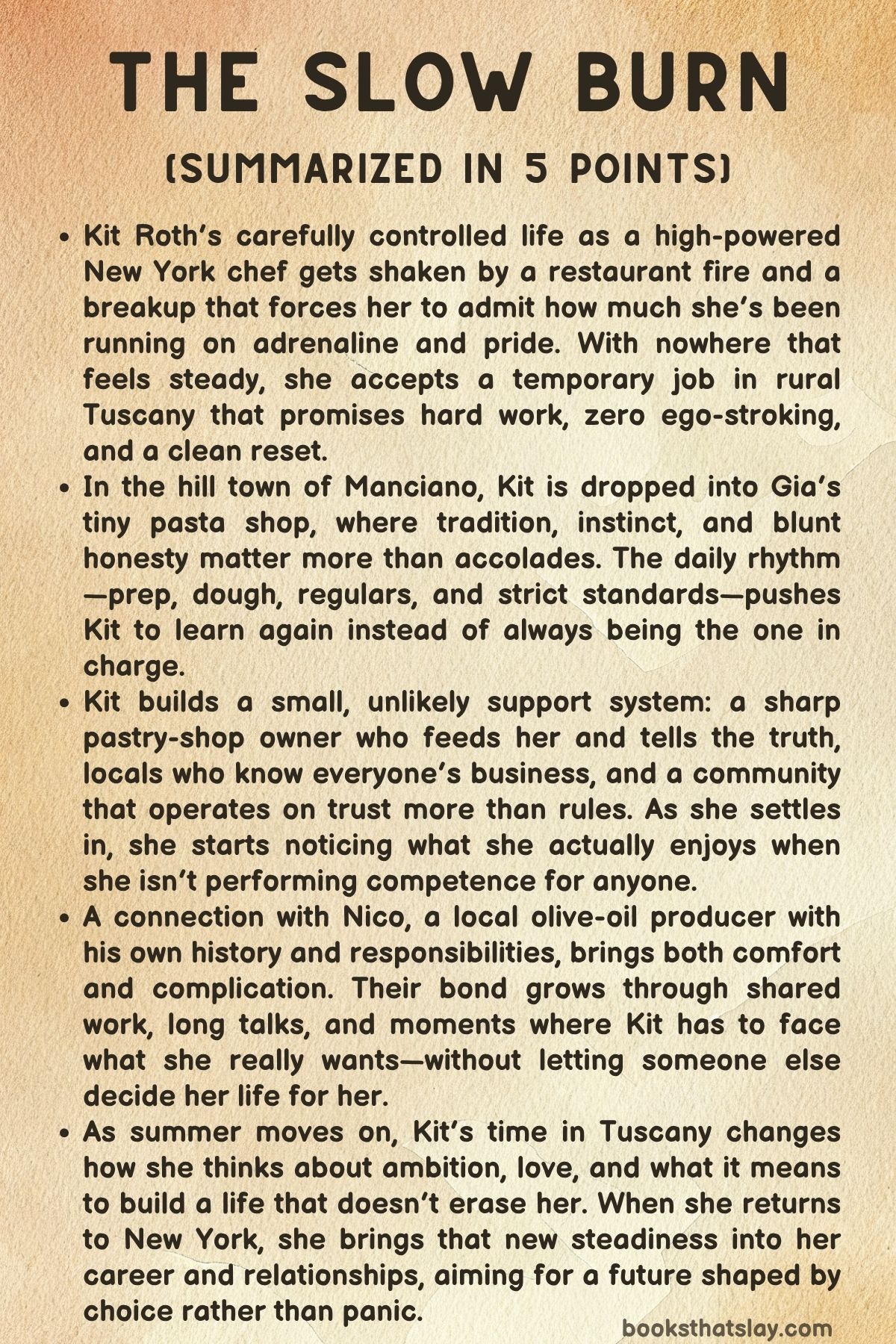
Characters
Kit Roth
Kit is defined, at the start of The Slow Burn, by control: she’s a high-achieving New York executive chef who treats her kitchen as a sterile sanctuary and her career as proof of worth. The restaurant fire and John’s abrupt breakup rip away the two structures that keep her steady—professional mastery and a relationship that, while emotionally thin, let her avoid deeper vulnerability.
What makes Kit compelling is that her toughness is both real strength and a defensive posture: she has trained herself to be “useful,” “excellent,” and relentlessly productive, but she secretly fears that if she isn’t exceptional, she won’t be lovable. Italy becomes a pressure-release valve where she can’t dominate the environment through competence alone; Gia’s kitchen forces her to become a student again, and that shift cracks open a softer, more curious Kit who remembers what it feels like to learn rather than perform.
Her arc isn’t about becoming less ambitious—it’s about loosening the idea that ambition must be paid for with loneliness, and learning that love can exist without shrinking herself.
Nico Ruspoli
Nico initially reads as effortless—handsome, capable, rooted in the landscape, and quietly confident in a way that contrasts Kit’s tightly wound intensity. But the story gradually reveals that his calm is partly a practiced restraint, shaped by loss that isn’t death so much as abandonment: Lorena leaving created a wound that made him cautious, prideful, and slow to reach for what he wants.
Nico’s connection to the olive grove and mill is not just “local charm”; it’s identity, duty, and continuity, and he measures life in seasons and stewardship rather than accolades. His romantic tension with Kit comes from opposing instincts: he wants her badly, but he’s terrified of repeating the same story—falling in love with someone who will eventually choose “bigger” over him.
That fear makes him behave unfairly at first, especially when jealousy breaks through his self-control, yet the relationship pushes him toward emotional honesty and risk. By choosing to show up in New York, he proves that devotion doesn’t have to mean possessiveness or sacrifice—it can mean adaptation, movement, and building a shared home without demanding that either person abandon who they are.
John
John functions as the clean, corporate version of intimacy—someone who speaks the language of logic, opportunity, and “what makes sense,” while quietly dehumanizing Kit by treating her like a high-value asset. His breakup is packaged as concern, but his actions show a desire to control the narrative and keep Kit orbiting his plans, whether that’s arranging residencies, offering to “handle” repairs, or continuing to text as if access to her is a given.
He isn’t written as a mustache-twirling villain; he’s more dangerous than that because he is plausible—smooth, powerful, and skilled at making his preferences sound like inevitabilities. The story uses him to expose Kit’s old pattern of letting men “clear the path,” which is really about surrendering agency in exchange for stability.
John’s role is to embody the life Kit thought she was supposed to want—status, momentum, a partnership that never demands emotional mess—and then to make it undeniable how empty that bargain feels once her world collapses.
Anita
Anita is Kit’s emotional anchor and the voice that refuses to let her minimize pain or rationalize mistreatment. She loves Kit fiercely, but not softly—she challenges Kit’s narratives about being “not fun,” about love being low-maintenance, and about deserving relationships that ask nothing of her beyond performance.
Anita’s gift is reframing: she sees the fire as a brutal opening rather than only a loss, and she is the one who creates the conditions for Kit’s transformation by sending her to Gia. Yet Anita isn’t only a pep-talk best friend; she also becomes a truth-teller later when she notices John’s suspicious involvement in the restaurant repairs and when she pushes Kit to question her own fatalistic assumptions about Nico’s immovability.
Through Anita, the book underscores a major theme: genuine love—romantic or not—doesn’t pacify you into staying small; it confronts you into becoming freer.
Gianna “Gia”
Gia is the hard-edged mentor figure in The Slow Burn, but her sharpness isn’t cruelty for its own sake—it’s a life philosophy formed by disappointment, endurance, and an almost sacred respect for honest work. She runs Pasta Fresca with a worldview that rejects performative hospitality: no pandering, no bending to whims, no pretending that comfort is the purpose of food.
In that sense, she becomes the antidote to Kit’s fine-dining obsession with control and validation; Gia’s cooking is precise but not quantified, disciplined but not sterile, and rooted in sensory knowledge rather than ego. Her bluntness pries open Kit’s guarded interior, especially when she names the ways Kit is pretending she’s fine, or when she warns her not to lose herself in a man.
Gia’s own history—overlooked by her father, stuck in an unhappy marriage, carrying unresolved love—quietly explains why she refuses sentimentality: she knows how easily women can disappear inside other people’s expectations. By the time she tells Kit that the hard choice can still be necessary, she isn’t pushing her away; she’s protecting Kit’s future self, insisting that love must coexist with self-possession.
Emilia
Emilia, the pastry shop owner, is a kind of social alchemist—she turns Kit’s isolation into connection by feeding her, teasing her, and steadily weaving her into the town’s rhythms. Where Gia challenges Kit through criticism and labor, Emilia nurtures her through pleasure and ritual: tea chosen without judgment, pastries selected like small acts of care, and the daily space to talk about food without the New York pressure of proving herself.
Emilia also acts as a perceptive chorus; she reads emotional shifts quickly, calls out what’s happening between Kit and Nico, and understands how gossip and community attention can both cradle and crush a relationship. Her practicality—arranging the scooter, orchestrating introductions, nudging Kit toward experiences—makes her a quiet engine of the plot, but her deeper role is thematic: she represents a femininity that is unapologetic, competent, and communal, showing Kit that softness can be strength and that being cared for doesn’t make you weak.
Lorena
Lorena is largely off-page, yet her presence shapes Nico’s emotional landscape and the town’s collective memory. The key to Lorena is that she isn’t framed as purely villainous or purely heroic; she is someone who panicked at the smallness she felt closing around her and chose escape over endurance.
That choice wounded Nico and Gia deeply, and it left Nico with a fear that love is conditional on geography, ambition, or novelty—that sooner or later, the person he loves will decide he is not enough. Lorena’s story becomes a mirror for Kit: Kit is also ambitious, also drawn to a “bigger life,” and Nico’s terror is that history will repeat itself with her.
At the same time, the conversation around Lorena—especially the way others concede that endings can be necessary—keeps the book from moralizing about leaving. Instead, Lorena becomes a catalyst for a more mature idea: wanting more doesn’t make you wrong, but how you leave, what you communicate, and what you allow yourself to face matters.
Tommaso
Tommaso operates as an external antagonist, but his function isn’t just conflict for conflict’s sake; he embodies entitlement and local power games, using tradition—hunting rules and land access—as justification for intimidation. His hostility toward Kit as “the American” exposes the social boundaries of the town and the way outsiders can become symbols in existing feuds.
More importantly, Tommaso’s aggression raises the stakes for Nico and Kit’s bond, giving them a shared responsibility that turns attraction into partnership. Through him, the story shows how community disputes aren’t abstract—they affect safety, livelihoods, and the emotional burdens people carry, especially Gia, whose fierce protectiveness over her cattle becomes a form of love expressed through vigilance.
Beppe
Beppe is a deliberate contrast point—kind, socially easy, and genuinely interested, but ultimately a reminder that compatibility isn’t the same as connection. He offers Kit a socially “safe” option: a pleasant flirtation that might help her feel normal again without demanding vulnerability.
Kit’s lack of spark with him clarifies something she can’t rationalize away: what she feels with Nico is not just attention or novelty, but an intensity tied to recognition and emotional risk. Beppe’s presence also exposes Nico’s fracture—his jealousy and fear—forcing the relationship’s truth to the surface.
Rather than being a disposable rival, Beppe functions as a litmus test: he helps Kit see the difference between being chosen and being moved.
Flavia
Flavia appears briefly, but she represents the town’s informal economy of favors and mutual reliance. By lending Kit the scooter in exchange for dinners, she participates in the same communal logic that underpins Gia’s cash drawer and no-order system: people contribute what they can, trade value without bureaucracy, and build trust through repeated small exchanges.
Flavia’s role matters because she helps make Kit mobile—literally and symbolically—giving her independence in a place where she could otherwise remain a stuck outsider. She’s part of the quiet network that turns Maremma from a backdrop into a living community.
Marna
Marna, Gia’s sous chef on maternity leave, is a small but meaningful presence because she highlights what “continuity” looks like in this world. Her absence creates the opening for Kit’s arrival, and her return—carrying new life—emphasizes that the town operates in cycles, not just dramatic turning points.
Marna’s baby and Nico crocheting a rabbit for the child soften Nico’s image, revealing tenderness and domestic instinct beneath his stoicism. In narrative terms, Marna grounds the story’s themes of caretaking and legacy: food, family, and community as things passed forward, not merely produced for applause.
Matteo
Matteo is mostly off-stage, but his apartment—and the fact that Kit is living in someone else’s space filled with history and personality—matters to Kit’s internal shift. It contrasts sharply with her previous “controlled sanctuary” kitchen and reinforces the sensation of stepping into a life that isn’t optimized for her.
The local familiarity with whose space she occupies also underscores how visible she is in Manciano, how quickly stories travel, and how impossible it is to hide behind anonymity the way she can in New York. Matteo’s role, though minor, supports the book’s broader idea that places hold people, and living inside a place changes you.
Kit’s Father
Kit’s father represents the pressure-cooker origin of her drive—the voice of expectation that treats achievement as baseline and emotional needs as secondary. His demand for a renovation plan, arriving alongside John’s texts, becomes a turning point because it forces Kit to see how male authority has shaped her life from multiple angles: one through family standards, the other through corporate control masquerading as care.
The father figure helps explain why Kit equates worth with performance and why she panics when she can’t “fix” a crisis through work. Even when he isn’t present on the page, he is present in Kit’s reflexes, and her growth includes loosening his grip on how she measures success.
Luce
Luce, Nico’s small dog, isn’t just a cute detail; Luce functions like an emotional barometer for Nico’s home life. The dog’s panic during the grove fire raises the urgency and makes the danger feel intimate, not abstract.
Luce’s habit of settling at the foot of the bed after Kit and Nico finally stop running from their feelings quietly signals domestic belonging—Kit is not merely visiting Nico’s world; she is fitting into it. In a story about building a shared home across two lives, Luce becomes a soft symbol of what “home” feels like when it’s safe enough to sleep.
Themes
Control, Identity, and the Fear of Standing Still
Kit’s first instinct after the fire and the breakup is not grief, reflection, or recovery; it is motion. She treats stillness as a threat because her sense of self has been built on competence, intensity, and the ability to steer outcomes.
The restaurant kitchen functions as her safest form of order: a space where effort equals results, where authority is earned, where precision is rewarded. When the fire destroys that environment, it doesn’t only damage her business; it removes the structure she uses to regulate her inner life.
That loss exposes how much she relies on control to avoid uncertainty and emotional need. The text messages from John and her father land like parallel commands, and Kit’s reaction—feeling boxed in by both—shows that even when she appears powerful, her choices have often been shaped by men who assume they can manage her path.
Her decision to leave New York is therefore not romantic escapism; it is a refusal to be treated as a project to be deployed or repaired.
Italy confronts her with a different definition of competence. Gia’s kitchen is not a stage for perfection or acclaim.
It is small, blunt, repetitive, and centered on what must be done today, not on how it will be judged tomorrow. Kit initially tries to convert that world into something measurable by secretly weighing ingredients, but she learns that mastery can live in sensory memory and adaptation rather than in numbers.
That lesson is uncomfortable because it threatens her preferred identity: the one who knows, the one who leads, the one who stays ahead. As she begins to enjoy being a learner again, she also begins to see how her “work obsession” has been both a genuine calling and a shield.
Her dread that no one will want her “for herself” is not solved by a new romance alone; it is challenged by a life that proves she can be valued even when she is not performing excellence for an audience. By the end, Kit’s growth is visible not in abandoning ambition but in no longer needing ambition to anesthetize fear.
The calmer confidence she brings back to New York is a sign that she has stopped confusing relentless motion with stability, and she has started building an identity that can hold both drive and vulnerability without collapsing.
Love Without Possession: Choice, Consent, and Emotional Responsibility
The romantic arc is charged precisely because it keeps running into the question of what love is allowed to demand. Kit’s relationship with John is presented as efficient and emotionally thin, a partnership that fits neatly around work and status.
It ends during a crisis, and his behavior afterward—offering residencies, proposing new postings, speaking as if her availability is an asset—shows that he experiences intimacy as management. His “support” is another attempt to define her options.
Kit’s refusal of that model is not only anger at being dumped; it is anger at being treated as someone whose desires can be overridden by a corporate-friendly plan. She is forced to notice how often she has accepted that kind of control because it removed difficult choices from her hands.
Nico presents a different problem: not cold detachment, but emotional conflict that still risks becoming coercive. His initial story about being a widower is an attempt to simplify his past into something that will not invite judgment.
When he later admits Lorena left, it reframes his fear as abandonment rather than bereavement, and that fear becomes the engine behind his jealousy. His late-night demand that Kit not see Beppe crosses a line because it tries to restrict her freedom while he simultaneously refuses the clarity of commitment.
The scene matters because it forces the story to address a common romantic trap: intense feeling used as an excuse for unfair behavior. Kit does not accept that trap quietly.
She names the contradiction—he cannot reject her and then act entitled to her choices—and her pushback keeps the relationship from being framed as desirable simply because it is passionate.
The eventual shift toward health is not that their desire cools; it is that they begin to treat each other as people with agency rather than as solutions to loneliness. Nico’s explicit check-in—asking what she wants and affirming he can stop—grounds their intimacy in consent rather than in assumption.
Later, the pattern repeats at a larger scale: when they admit love while still acknowledging separation, they resist using love as leverage. The ending is a deliberate rejection of the idea that romance is proven through sacrifice of identity.
Nico comes to New York not to rescue Kit or redirect her ambition, but to participate in her life without shrinking it. Kit, in turn, does not abandon her work to prove devotion.
The relationship becomes sustainable when both accept emotional responsibility: honesty instead of protective stories, boundaries instead of possessiveness, and the understanding that love is not validated by control. That is why the final resolution feels earned: it is built on negotiated logistics and mutual respect, not on a fantasy that one person will bend so the other can stay comfortable.
Learning a New Rhythm: Craft, Community, and the Value of Simplicity
Kit arrives in Maremma with elite credentials and an identity shaped by fine dining culture, where scarcity, perfection, and constant striving are often treated as virtues. What unsettles her is that Gia’s world does not reward that posture.
Pasta Fresca is not trying to become famous; it is trying to feed its town well, day after day. Customers take what is available without negotiation, and money is left with quiet trust.
Allergies and preferences do not reorganize the kitchen’s purpose. At first, this reads as stubbornness or lack of professionalism from Kit’s viewpoint, but as she stays, it becomes a lesson in a different kind of integrity: a business can be excellent without being performative, and a craft can be serious without being glamorous.
The simplicity is not a lack of standards; it is a refusal to let external pressure dictate internal rhythm.
This shift is reinforced by the social ecosystem around food. Emilia at Belpagna functions like a gatekeeper of care, noticing Kit’s need for comfort before Kit can name it.
Tea appears as an antidote to Kit’s instinct to punish herself, and the act of having someone choose pastries for her becomes an exercise in receiving rather than producing. Flavia’s scooter arrangement shows reciprocity that is practical and relational: you feed me, I lend you mobility.
Even the morning trio—Kit, Emilia, Nico—builds a sense of belonging that does not require Kit to be impressive. She is allowed to be new, uncertain, and occasionally wrong.
That is a radical change from the environment where she is usually the authority. The town’s gossip, while intrusive, also highlights a communal attentiveness that New York’s scale can dilute; people notice, for better and worse, because lives overlap.
The craft lessons are equally important. Gia’s pasta-making is disciplined but not rigid.
It adapts to humidity, texture, and time, demanding presence rather than calculation. Kit’s attempt to capture it through weights and secret measurements reflects her dependence on systems that guarantee repeatable outcomes.
Learning that the “recipe” is partly relationship—between hands, flour, air, and experience—teaches her to respect uncertainty without panicking. This new rhythm also changes her body: she becomes tired from real work rather than from anxious overdrive, and she begins to build routines that restore her rather than just drive her.
By the time she returns to New York, her success is still ambitious—reopening, media coverage, expansion plans—but the internal tempo is different. The Slow Burn argues that simplicity is not smallness; it is a form of clarity.
Kit does not become less talented. She becomes less addicted to intensity as proof that her life matters, and that lets her practice her craft with more steadiness, not less passion.
Fire, Recovery, and Rebuilding Without Repeating the Same Life
Fire appears twice, and each occurrence forces Kit to confront what rebuilding actually means. The first fire in New York destroys the place where she feels most capable and protected.
It also arrives at the exact moment her relationship collapses, making the devastation feel total: home, work, and identity all destabilized at once. Kit’s initial reaction is to search for the fastest route back to her previous structure—insurance repairs, renovation plans, global residencies—anything that restores the narrative of forward momentum.
But the story pushes her to see that returning to the old shape of life without changing anything inside it would be a kind of defeat. It would mean she survived the event but learned nothing from it, and it would keep her vulnerable to the same control dynamics that made John’s and her father’s messages feel like parallel traps.
The second fire—Nico’s olive grove—plays out differently because Kit is no longer trying to dominate crisis through ego. She responds with action, but her action is guided by care rather than by the need to prove competence.
Nico’s sharp insistence that she not risk herself reframes what matters: not the asset, not the symbolic value of the trees, but her safety. That moment matters because it reveals how control can be loving when it is about protection and consent, and dangerous when it is about ownership.
Kit’s work beside Nico in the grove is coordinated, quiet, and humble; she does not take charge of him, and he does not treat her as replaceable. Their shared focus becomes a model of partnership that the earlier relationships lacked.
The aftermath of the grove fire introduces the theme of recovery as something that is uncertain but real. Older olive trees may regenerate; deep roots can support new growth after visible destruction.
That detail mirrors Kit’s own arc: the parts of her that seemed burned out—her ability to rest, to learn, to be emotionally honest—were not gone, just neglected under a life built around constant proving. Gia’s own story about an intense romance with Marcello adds another layer: love can be lasting in its impact even when it does not resolve neatly, and wisdom sometimes means accepting pain without surrendering autonomy.
When Kit chooses to return to New York, it is not a rejection of what she found; it is a commitment to rebuild a life that includes what she learned rather than one that erases it.
The ending confirms that rebuilding is not restoration of the past but construction of a new structure. Kit’s restaurant reopens successfully, yet she is calmer, less dependent on anxious validation.
Nico’s decision to move primarily to New York while still returning for harvest respects both of their roots, refusing the false binary that one person must lose their home for the other to keep theirs. The final image of the grove producing olives again is not a sentimental promise that damage disappears.
It is a statement that survival can create a different kind of strength, and that what grows back is shaped by the choices made after the crisis.