The Rachel Incident Summary, Characters and Themes
The Rachel Incident by Caroline O’Donoghue is a coming-of-age novel set in Ireland during the late 2000s, exploring friendship, love, betrayal, and the complicated passage into adulthood. The story follows Rachel, a young woman caught between ambition and uncertainty, and her best friend James, who struggles with his sexuality while seeking freedom in a conservative environment.
Their lives become entangled with Dr. Fred Byrne, a charismatic lecturer, and his wife Deenie, whose marriage hides as many secrets as the students around them. O’Donoghue captures the humor, recklessness, and intensity of youth while examining how choices echo long into the future.
Summary
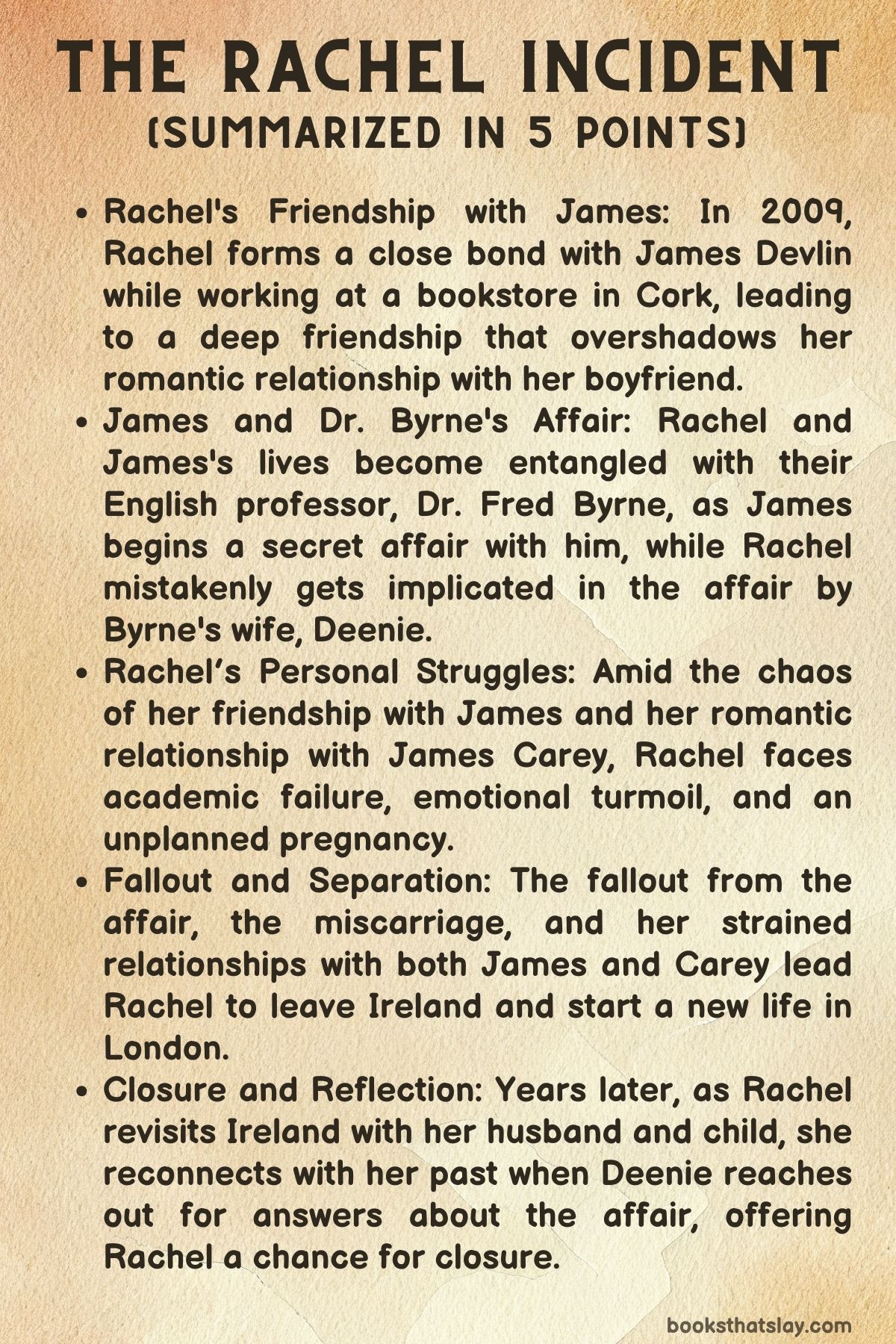
The novel opens years later in London, with Rachel, now a pregnant journalist, reflecting on her past after learning that Dr. Fred Byrne, her former lecturer, is in a coma. This news pulls her back to 2009, when she was a university student in Cork.
At that time, she met James Devlin while working in a bookshop, and the two quickly formed a deep and inseparable bond. Their friendship became the center of Rachel’s world, providing humor, intimacy, and loyalty, while her relationship with her long-term boyfriend Jonathan unraveled.
They soon moved in together in a shabby house, surviving on inside jokes and late-night confessions while ignoring their financial struggles and James’s closeted sexuality.
Parallel to this, Rachel developed a fascination with Dr. Byrne, a charismatic Victorian literature professor known for his provocative teaching style. She managed to join his exclusive seminar, interpreting his every word as personal, and became further drawn to him.
When Byrne published his book The Kensington Diet, Rachel and James, eager to impress him, faked customer orders and even organized a book launch at their shop. On the night of the event, Rachel’s illusions were shattered when she accidentally discovered Byrne kissing James in the stockroom.
Though hurt and jealous, Rachel remained loyal to James, who admitted to a history of secret relationships with men. Their bond survived the shock, though Byrne’s affair with James continued.
Rachel’s personal life grew more complicated when she entered a passionate but unstable relationship with James Carey, a man from Northern Ireland. His unreliability and frequent disappearances left her emotionally strained, while her academic performance suffered.
Byrne intervened, helping her excuse missed deadlines and even securing her an internship with his wife Deenie, who worked in publishing. This created an uneasy dynamic: Rachel admired Deenie while resenting her, and at the same time, she was forced to live with Byrne’s dual role as both James’s secret lover and her academic benefactor.
During this period, Rachel and James indulged in wild nights they jokingly dubbed the “Gaynaissance,” living beyond their means and propping each other up through heartbreaks and ambitions. Byrne, meanwhile, grew increasingly unstable, torn between his marriage and his affair with James.
Rachel’s relationship with Carey deteriorated as his family obligations pulled him away, leaving her adrift. She later discovered she was pregnant with Carey’s child.
At the time, abortion was still illegal in Ireland, forcing Rachel to secretly arrange a trip to England with James’s support. The financial and emotional strain of this decision weighed heavily on her, especially as she concealed it from both her family and Carey.
As her graduation approached, Rachel continued to juggle her complicated relationships: she worked for Deenie, endured Byrne’s hovering presence, and kept her pregnancy hidden while making plans for her procedure. At the same time, James’s relationship with Byrne became strained as James began to embrace his sexuality more openly.
Their once carefree friendship also shifted when James revealed he was leaving Ireland for a comedy-writing opportunity in New York, abandoning their shared dream of moving to London together. Heartbroken, Rachel reluctantly set out for London on her own.
Life in London was initially harsh. Rachel lived in a rundown flat and struggled with unstable jobs before finding purpose in a large bookshop.
Over time, she built a career in journalism, developed her writing voice, and created a new identity for herself in the city. James, meanwhile, began to succeed in New York, gaining recognition in comedy and building an online following.
Although separated, their friendship endured across distance.
Years later, Rachel’s life intersected again with James Carey, her old boyfriend and the father of her child from 2010. Now a physiotherapist in London, Carey had endured personal losses but rebuilt his life.
Their reunion rekindled their connection, leading to a committed relationship. By 2022, Rachel and Carey were living together with their newborn son, Shay.
Though her life had stabilized, the past still lingered, particularly the unresolved story of Byrne and Deenie.
In the final section, Rachel travels back to Cork with her baby and receives a message from Deenie Byrne. Deenie reveals that Fred Byrne suffered a rare brain infection and is now alive but permanently altered.
During their meeting, Deenie cautiously asks Rachel for the truth about the events of years ago. Rachel admits she never had an affair with Fred and that her pregnancy was with Carey, now her husband.
Deenie discloses her own later affair and current living situation, showing how both women’s lives were marked by secrecy and betrayal. Rachel, however, refuses to speak for James Devlin, instead giving Deenie his contact details so she can seek answers directly from him.
The story closes with Rachel reflecting on how her youth was shaped by friendship, mistakes, and unspoken truths. While her bond with James Devlin remains central to her story, her present life with Carey and their child gives her a sense of stability that was once unimaginable.
The past, though never fully resolved, no longer defines her entirely—it is something she carries, but no longer something that controls her.
Characters
Rachel
Rachel is the heart of The Rachel Incident, a narrator whose story captures the messy, exhilarating, and often painful transformation from adolescence into adulthood. At the beginning, she is defined by yearning—for love, intellectual recognition, and escape from the limitations of her small Cork life.
Her bond with James provides her with intimacy and belonging, but her desire for Fred Byrne represents both a craving for intellectual validation and a dangerous flirtation with power. Over time, Rachel’s choices reveal her naivety, impulsiveness, and capacity for both deceit and loyalty.
Her relationships—with Jonathan, James Carey, and most enduringly James Devlin—trace her longing for connection in forms that often blur friendship, desire, and dependency. By the time she becomes a journalist and mother, Rachel’s voice grows more assured.
Yet, she remains haunted by the unresolved tensions of her past—the secrecy of her abortion, the moral ambiguity of her part in Byrne’s deception, and the bittersweet loyalty to James. She emerges as flawed but deeply human: a woman shaped as much by her mistakes as her growth.
James Devlin
James is Rachel’s soulmate in friendship, the figure who defines her twenties as much as any romantic partner. Outwardly witty, flamboyant, and irreverent, James hides deep insecurities tied to his sexuality and his place in Cork’s conservative society.
His closeted fear dictates much of his early behavior, yet with Rachel, he is freer—creating a world of shared rituals, jokes, and mischief. His affair with Fred Byrne reveals both his vulnerability and his hunger for affirmation, even when it leads him into precarious and morally complex situations.
James is also ambitious, eventually leaving for New York to pursue comedy writing, a decision that fractures his bond with Rachel but does not destroy it. His arc represents the tension between loyalty to the life he built with Rachel and his need to claim independence.
Despite his betrayals and evasions, James is ultimately portrayed with tenderness—a complicated friend who offers Rachel unconditional love, even as he carves out his own future.
Dr. Fred Byrne
Fred Byrne embodies both charisma and corruption in the novel. As a lecturer, he is brilliant, provocative, and magnetic, captivating students with his intellect and irreverence.
Yet beneath his surface charm lies a man consumed by vanity, insecurity, and self-indulgence. His affair with James, while passionate, exposes his cowardice: he is unwilling to confront his marriage honestly and exploits his power as both a professor and an older man.
Byrne vacillates between generosity—helping Rachel with her career, offering indulgent gestures to James—and cruelty, avoiding Rachel in class, manipulating both her and James, and clinging to his fragile image. Later in life, his illness renders him a diminished figure, reliant on Deenie’s care and stripped of the commanding presence that once defined him.
Byrne becomes a cautionary emblem of squandered brilliance and the dangers of unchecked ego, leaving behind a legacy entangled in secrecy, betrayal, and longing.
Deenie Harrington
Deenie stands as both foil and mirror to Rachel. Intelligent, composed, and perceptive, she is Fred Byrne’s wife and professional partner, embodying the kind of polished literary success Rachel yearns for.
Her warm professionalism hides a private life marred by failed attempts at conception and her husband’s infidelity. While Deenie initially appears almost threatening in her awareness of Rachel’s crush on Fred, she later reveals surprising vulnerability, inviting Rachel into her home and workplace.
Over time, Deenie emerges as one of the most quietly resilient figures in the novel—navigating betrayal, carving out her own affair, and ultimately redefining her life outside Fred. Her presence underscores the costs of ambition, love, and loyalty in a world where private sacrifices often go unseen.
James Carey
James Carey represents both passion and instability in Rachel’s young life. Their relationship is intense, chaotic, and frequently destructive, marked by a physical magnetism that blinds Rachel to his unreliability.
Carey’s constant disappearances, his struggles with family obligations, and his self-sabotaging tendencies leave Rachel repeatedly wounded yet unable to let go. Despite this turbulence, his place in her life is pivotal: it is with Carey that Rachel conceives her first child, a pregnancy that forces her into difficult decisions and ultimately shapes her adult trajectory.
Years later, when Carey reappears in London as a grounded, compassionate physiotherapist, their relationship is reborn with new steadiness. His transformation—from reckless youth to dependable partner—offers Rachel the domestic stability and love she longed for but could not find in her early years with him.
Themes
Friendship and Chosen Family
At the heart of The Rachel Incident, the bond between Rachel and James serves as the emotional anchor of the novel. Their relationship goes beyond the boundaries of ordinary friendship; it provides both with a sanctuary from the instability of their romantic entanglements and professional uncertainties.
Living together in shabby conditions, they build a shared world of humor, rituals, and confidences that reflects the comfort of a chosen family rather than just companionship. The intimacy of their connection—whether in the form of domestic chores, late-night talks, or even reckless schemes like fabricating Byrne’s book sales—demonstrates how essential it is to have someone who validates your identity and choices during formative years.
James’s struggle with his sexuality, compounded by Cork’s conservative backdrop, finds a safe space in Rachel’s unwavering loyalty. Simultaneously, Rachel’s oscillation between ambition, infatuation, and heartbreak becomes bearable because of James’s presence.
Their friendship endures betrayals, secrets, and life-altering shifts, proving more enduring than romantic attachments. In portraying this dynamic, the novel emphasizes that sometimes the most profound love stories are not romantic but rooted in the fierce devotion between friends who act as each other’s family.
Sexuality, Identity, and Secrecy
The novel situates sexuality not only as a personal journey but as a reflection of societal pressures in Ireland during the late 2000s. James’s closeted identity and his secretive relationship with Dr. Byrne illustrate the fear, denial, and concealment many queer individuals faced.
His insistence that he was not gay, despite clear evidence of attraction and involvement with men, underscores how societal disapproval forced people into self-denial. Byrne himself embodies a different form of repression: married, professionally admired, yet entangled in an affair that simultaneously excites and torments him.
For Rachel, navigating her attraction to Byrne and later her turbulent romance with Carey highlights the complexity of sexual desire when entangled with power dynamics, secrecy, and betrayal. The secrecy surrounding relationships in the book parallels the secrecy around Rachel’s pregnancy and abortion, suggesting how Irish cultural norms forced private struggles into the shadows.
Sexual identity in the novel is thus not only personal but shaped by silence, shame, and the necessity of hidden lives.
Power, Ambition, and Exploitation
The interactions with Dr. Byrne and Deenie Harrington highlight the theme of power imbalances, particularly in academic and professional spaces. Byrne, as a lecturer, holds intellectual authority and uses his charisma to blur boundaries with students, which becomes more troubling as his affair with James unfolds.
His role as both Rachel’s academic mentor and James’s secret lover places him in a position of manipulation, whether intentional or not. Rachel, meanwhile, is caught in the contradictions of seeking validation from Byrne while recognizing his flaws, using her connection to him and Deenie to secure a career foothold.
Ambition drives Rachel into morally dubious acts—lying about book orders, snooping through Deenie’s belongings, and accepting Byrne’s assistance despite resenting his avoidance in class. The professional gatekeeping of the publishing world, embodied by Deenie, further reflects the precarious balance of opportunity and exploitation.
This theme underscores how ambition often collides with vulnerability, and how young people navigating early careers can be exploited by those with institutional and social power.
Reproductive Rights and Bodily Autonomy
Rachel’s unplanned pregnancy and her subsequent decision to seek an abortion in England expose the harsh realities faced by women in Ireland prior to the legalization of abortion. Her pregnancy becomes a crucible for examining shame, secrecy, and the lack of institutional support for women’s reproductive choices.
The need to conceal her condition from Carey, her family, and even from Byrne and Deenie reflects the culture of silence surrounding abortion at the time. The financial and emotional burden of arranging travel, paying for the procedure, and keeping the matter hidden highlight the structural inequalities that forced women into isolation during one of the most vulnerable moments of their lives.
This personal narrative echoes the broader sociopolitical struggles that later culminated in Ireland’s referendum on abortion rights. Rachel’s experience demonstrates how bodily autonomy is not only a matter of personal decision but also one constrained by legal systems, social stigma, and cultural expectations.
Memory, Growth, and Reconciliation
The novel frames Rachel’s story as one of retrospective reflection, where memory becomes both painful and redemptive. Meeting Carey years later and building a stable life with him contrasts sharply with their chaotic youth, underscoring how people can evolve and reconcile past mistakes.
Similarly, James’s transformation from a closeted, anxious young man in Cork to a successful comedy writer in New York represents growth made possible through distance, opportunity, and time. Rachel’s eventual conversation with Deenie about the so-called “Rachel Incident” highlights the importance of clarifying and owning the past, even if certain truths remain left to others to tell.
Memory in this book is not static but reinterpreted through new experiences—such as Rachel becoming a mother herself, which reframes her earlier abortion and sense of secrecy. Growth arises from surviving messy entanglements, and reconciliation comes not by erasing the past but by finding peace with its lingering complexities.
In this way, the novel situates memory as both a burden and a pathway to understanding one’s present self.