The Shadows Between Us Summary, Characters and Themes
The Shadows Between Us by Tricia Levenseller is a YA fantasy romance set in a tense royal court where power is as dangerous as desire. Alessandra Stathos is ambitious, sharp, and openly willing to do terrible things to get what she wants.
With her family’s fortunes collapsing, she targets the Shadow King, Kallias—an isolated young ruler whose living shadows make him feared and nearly untouchable. Alessandra arrives at the palace with a simple plan: win his hand, take the crown, and remove him. But court politics, assassination attempts, and unexpected attachment complicate everything, forcing her to choose what kind of queen—and person—she intends to be.
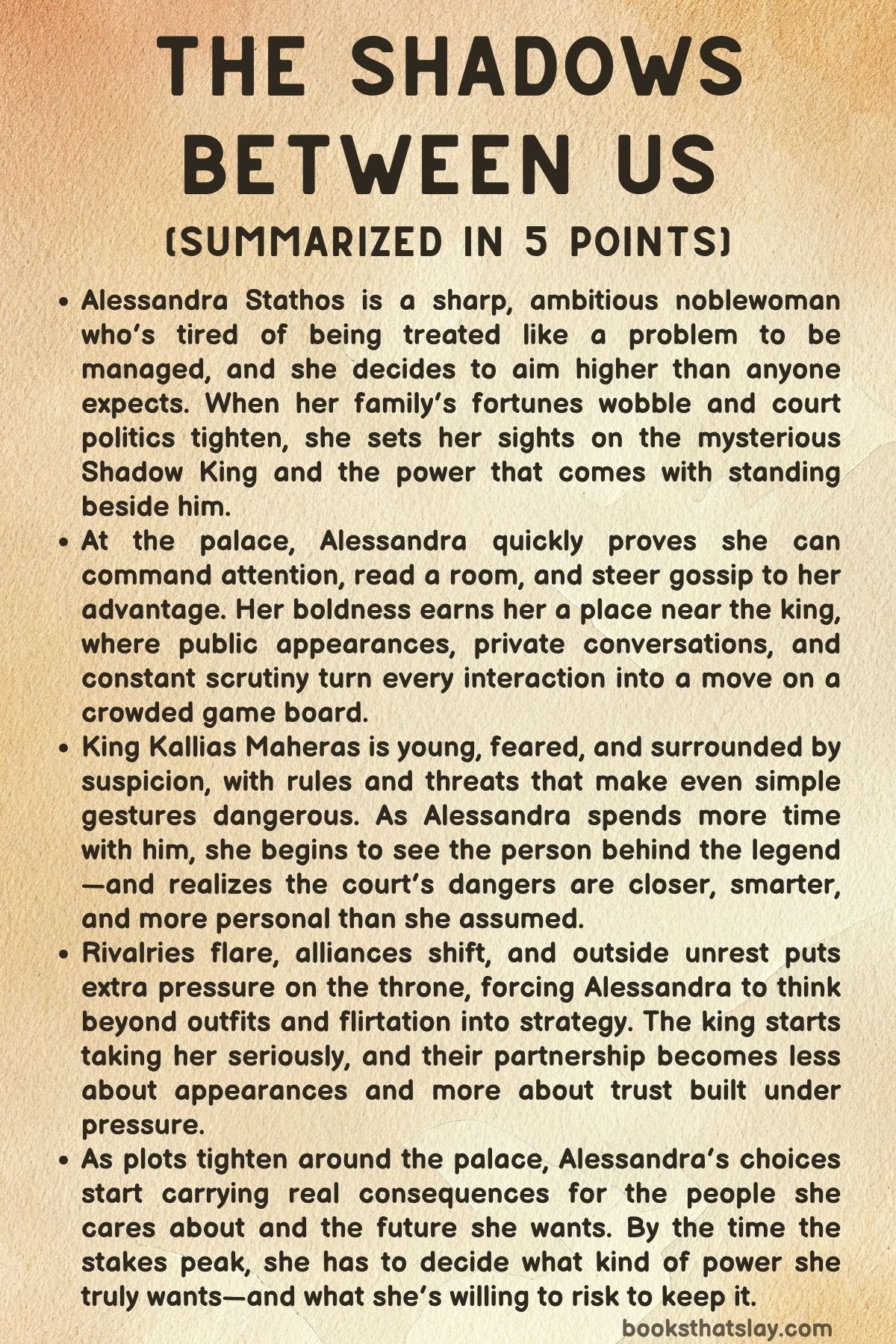
Summary
Alessandra Stathos begins with a secret that defines her: years ago, when her first love Hektor Galanis ended their relationship, she killed him and buried the body so thoroughly it will never be found. She carries the memory with satisfaction rather than regret, convinced she handled betrayal the only way it deserved.
Now older, Alessandra lives by her own rules. She keeps lovers for pleasure and gifts, discarding them when they stop being useful.
When Myron Calligaris proposes and offers her an expensive ring, she laughs and refuses, already treating the ring as her final payment. Her father, Lord Masis, catches Myron in her room and rages about her reputation.
Alessandra reminds him she cannot marry until her older sister, Chrysantha, is wed. Their father reveals the family’s situation is worse than ever: the estate is failing, tenants are leaving, and a marriage bargain is their best chance to survive.
Since Chrysantha has not attracted the attention of the Shadow King at court, she has been promised to an aging duke for money the family desperately needs.
Alessandra refuses to accept a future built on other people’s choices. She declares she will marry the Shadow King herself.
Her father mocks her chances, but Alessandra knows how to control men: she has collected secrets about their gambling, smuggling, and drugs, ensuring their silence about her past. She demands passage to the palace with the next group of women.
In private, she lays out the real goal. She will seduce the king, accept a proposal, marry him, and then poison him.
With the king dead, she intends to keep the throne, blame someone else, and rule as queen.
At the palace, Alessandra chooses a strategy designed to disrupt. While most women wear green to match the king’s preference, she arrives dressed in black—bold, fitted, and deliberately different.
She refuses to wait in the formal introduction line and instead enters the ballroom to watch the court. On the dais sits the Shadow King: young, striking, and surrounded by living shadows that curl and move like loyal guardians.
Rumors say those shadows can become weapons and shields, and can also spy by listening and reporting whispers back to him.
Alessandra draws attention by dancing in the center of the floor, forcing the room—and the king—to notice her. When the king finally approaches, she meets him with bluntness and humor rather than flattery.
She challenges him, mocks the dull rituals, and refuses to behave like someone begging for approval. The king is amused enough to ask her to dance.
Their dance becomes the focus of the entire room, charged with tension and control, and afterward the king abruptly ends the evening and leaves. Alessandra believes she has been dismissed—until a servant delivers a sealed invitation: the king wants her at court.
Installed in a luxurious guest room, Alessandra begins setting pieces in place. She hides poison research inside harmless herbal texts and dresses with intention, making sure her presence stays impossible to ignore.
The king tests her quickly. She is invited to tea in the orchards, where a huge dog barrels into her and steals attention.
Alessandra responds with ease and play rather than embarrassment, and the king reveals the dog is his—Demodocus—and the scene was arranged to measure her reactions. Alessandra also notices an immediate shift in court fashion: women begin copying her black clothing, trying to ride her wave.
The king’s councilors interrogate her next, led by Ikaros Vasco, who hints that men have spoken about her. Alessandra spins the story, framing Myron as a bitter suitor angry he was denied “proper” courtship.
To satisfy the council’s demands that she socialize with women, she attaches herself to two allies: Hestia Lazos and Rhoda Nikolaides, a wealthy widow. She also meets Leandros Vasco, Ikaros’s supposed nephew, who claims he was once close to the king but was pushed away after the murder of the king’s parents.
From Rhoda, Alessandra learns the king has kept many nobles close because he believes someone at court killed his parents and still threatens him.
Kallias Maheras—who finally shares his name—invites Alessandra to a private dinner in a library and proposes a bargain. He is nineteen, and until he is twenty-one his council tries to control him.
They want him married and producing an heir. He refuses, focused on expanding power and finding traitors.
He wants Alessandra to remain as his public courtship partner to quiet the council. In return, she will gain status and influence.
He insists he chose her because she is honest and “perfect” for the role—beautiful, but not tempting to him. Alessandra accepts the arrangement while quietly deciding she will still win him for real.
Trouble follows her into the palace. Myron sneaks into her rooms and threatens to expose her lack of virginity, claiming her leverage over him is gone now that his father has died.
Alessandra shifts tactics, gathering new dirt on him and promising cooperation while planning his removal. She begins building her public image with calculated invitations and appearances, making sure the court sees her as the center of attention.
When Kallias publicly announces he is courting her and seats her beside him in a chair no one else is allowed to use, her position becomes undeniable.
As Alessandra settles into palace life, the kingdom’s problems crowd in. A masked bandit attacks nobles on the roads, stealing money and redistributing it to peasants, which makes the poor treat him like a hero and refuse to cooperate with investigations.
Rebellion simmers in Pegai as well. Alessandra begins offering Kallias ruthless political advice—giving rebels symbolic representation to identify leaders, and marking coins to trace the bandit’s network.
Kallias respects her cold practicality, and their partnership becomes real in ways neither of them admits out loud.
Their dynamic shifts as jealousy and desire creep in. Alessandra spreads a rumor that Kallias kisses her gloved hands in private, enjoying the romantic attention it generates.
Kallias storms into her room furious—not because he dislikes her, but because the rumor suggests he broke the strict law against touch, and he fears appearing weak. Later he apologizes, and their closeness grows.
Alessandra notices he reacts strongly to male attention around her, especially from Orrin (Lord Eliades) and Leandros.
When an assassin shoots Kallias during a quiet moment in the gardens, Alessandra acts instantly, stabbing the attacker and trying to protect the king. Kallias’s shadows allow him to shift into an insubstantial form so bullets and blades pass through him.
He kills the assassin, then moves Alessandra into the former queen’s rooms for safety, keeping her near him. That night, shaken and unable to sleep, Alessandra reaches for him, and they hold hands in bed.
Kallias confesses he believes someone at court killed his parents and that another attempt is coming. He offers her a chance to leave.
Alessandra refuses, choosing to stay and fight alongside him.
Alessandra continues plotting in parallel: she wants to eliminate Myron and free Rhouben (a lord trapped in an engagement to Melita) by staging a scandal. To complete the plan, she needs Orrin’s seal and handwriting.
Kallias helps her slip into Orrin’s rooms by turning them to shadow and passing through barriers. Inside, Alessandra finds something more valuable than a seal: the bandit’s mask.
Orrin is the masked thief. She keeps quiet long enough to finish her own scheme, then gives the mask to Kallias.
Orrin is arrested.
Soon after, an unsigned warning instructs Alessandra to meet a contact at a private gentlemen’s club, suggesting the king cannot trust his council. Kallias decides to go in disguise, and Alessandra insists on coming.
The meeting only deepens their suspicion that the threat is close, organized, and willing to use vulnerable people as tools.
Alessandra hosts a grand garden-themed ball, intending it to solidify her standing and showcase her control. Instead, guests begin avoiding her, and the mood turns sharp.
Her father arrives claiming rumors are spreading that she murdered Hektor Galanis. He says he has come to “rescue” her by forcing a quick marriage to protect the family, proposing she marry Viscount Thoricus—Rhouben’s father.
Alessandra refuses, calls the king’s guards, and has her father removed. The court’s behavior changes instantly when they see she can command soldiers.
At last Kallias approaches her publicly, dances with her closely, and admits he kept distance because he didn’t trust himself not to pull her in. Then he reveals a second throne beside his and proposes in front of everyone, offering her a ring and calling her his equal.
Alessandra accepts, and the room erupts in celebration.
The celebration turns into an attack. A toast is called, wine is rushed out, and Alessandra spots a child she recognizes from the club.
Kallias’s shadows vanish, and Alessandra realizes too late that the poison is already in play. Kallias collapses, convulsing.
Alessandra orders guards to block the dais, lets only a few trusted men through, and chases the child into the city. The girl, Drea, sobs that she was forced to touch Kallias earlier and then made to do more at the party.
She can barely name who controlled her, but she identifies two figures: the man who called for the toast and a woman known for wearing black, though tonight she wore green. Alessandra realizes the woman is Lady Zervas.
Both Zervas and Ikaros Vasco are arrested.
Kallias survives. In the aftermath, he chooses vulnerability.
He says he is done living isolated behind shadows and laws, and he kisses Alessandra openly, declaring he wants her fully. He decides to remove the law forbidding touch.
Alessandra, who came intending to poison him, finds herself wanting him alive.
Then the trap snaps shut around her. Guards drag Alessandra to the library where Kallias stands cold, holding a vial of poison found among her belongings—minalen, linked to the earlier attempt on his life.
He accuses her of treason. Alessandra confesses the truth: she came to court planning to marry him and poison him to take the throne.
She insists she abandoned the plan because she fell in love with him, but Kallias orders her out of the palace and threatens to kill her if she returns.
Broken, Alessandra leaves in the king’s carriage, still wearing his ring. Leandros comforts her, and in anger she kisses him, hoping it will sting Kallias somehow, but it only leaves her emptier.
On the road, she notices a stubborn brown smudge on her hand that smells like hair dye and connects it to Leandros’s damp hair. A realization hits: Leandros resembles Kallias too closely, and the story about being Ikaros’s nephew never fully fit.
Alessandra forces the carriage to turn back.
She finds Kallias in the former queen’s sitting room—alone, except Leandros is there. Alessandra shouts for Kallias to run and exposes the truth: Ikaros has no nephew.
Leandros is actually Xanthos, Kallias’s older brother, supposedly dead in a carriage accident. Xanthos admits he staged the accident and has been plotting for years.
Vasco helped him after their father nearly beat him to death. Xanthos says he killed their father quickly and killed their mother when she began to suspect him.
He wanted the throne and wanted Alessandra too, not as a partner but as a prize stolen from his brother.
Kallias attacks Xanthos, and the brothers fight violently. Alessandra grabs a sword and intervenes.
When Xanthos presses forward again, Alessandra drives the blade into his throat, killing him. She tells him she has killed for love before, and she does it again now—choosing Kallias’s life over any path to power beside a usurper.
Alessandra summons guards and healers and then leaves once more, convinced Kallias will still reject her when he recovers. She hides at Rhoda’s estate for a week, miserable and isolated, selling some of her gifts to build funds and preparing for the possibility that survival will require starting over alone.
Kallias arrives at the estate bruised and unhealed, choosing to feel pain without relying on shadows. Alessandra assumes he has come to execute her.
Instead, he admits he was wrong to cast her out so cruelly. He says he knew she truly chose him when she killed Xanthos rather than letting Kallias die and stepping into a crown beside the man who wanted to steal everything.
He apologizes, admits he cannot imagine a future without her, and finally shares a love letter he wrote. Alessandra answers that she values actions over words, but his actions have already spoken.
They reunite, committed to ruling together—two people who understand exactly what the other is capable of, and who choose each other anyway.
Characters
Alessandra Stathos
In The Shadows Between Us, Alessandra is introduced as a woman who has learned to treat power like a currency and intimacy like a tool, and the story never lets the reader forget how deliberate she is about both. Her defining trait is control: she controls her image by collecting secrets about the men she sleeps with, controls her family’s survival by positioning herself as the solution to their financial collapse, and controls her own emotional exposure by turning vulnerability into strategy.
Yet she is not merely a calculating climber; she is also someone shaped by resentment, pride, and a fierce refusal to be reduced to the role society assigns her. Her confession about killing Hektor establishes her capacity for brutality early, but it also exposes something more intimate—Alessandra does not simply lash out; she makes decisions and lives with them, even savoring the certainty of having “won” the final moment.
What makes her compelling is the tension between her practiced ruthlessness and the gradual intrusion of genuine attachment. As her relationship with Kallias deepens, she keeps trying to translate real feeling back into something manageable—schemes, leverage, contingency plans—until she reaches a point where love forces a choice she cannot rationalize away.
By the end, her arc is not a softening into goodness so much as a recalibration of ambition: she still wants influence, still values strength, and still believes in decisive action, but she stops treating people as disposable pieces on a board once she recognizes what it costs to live that way. Her final decisive act—killing Xanthos to save Kallias—does not erase her earlier darkness; it proves that her most dangerous trait is also her most loyal one: when she commits, she commits completely.
Kallias Maheras
Kallias, the Shadow King, is defined by contradiction: he is both untouchable and profoundly lonely, both terrifying in capability and restrained in how he allows himself to live. His shadows operate as an extension of his will—weapon, shield, intelligence network, and even a kind of biological safeguard—so his authority feels supernatural, but his core conflict is human: he cannot trust.
The murder of his parents and the constant threat of assassination have turned him into a ruler who equates closeness with danger, and the kingdom’s obsession with heirs and appearances traps him inside expectations he resents. At first, he chooses Alessandra because she seems “honest” in her audacity and useful as a political signal rather than a temptation; that choice reveals how he protects himself through distance and analysis.
What changes him is not that Alessandra becomes safer, but that she becomes real to him—someone who can look directly at his darkness, match it with her own, and still stay. His jealousy, his flashes of anger, and his insistence on rules around touch show that he experiences desire as a threat to his control, which is why the decision to abolish the anti-touch law becomes such a significant turning point: it is not only romantic, it is political and existential, a declaration that he is choosing life over self-imposed isolation.
Even when he banishes Alessandra after learning her original plot, his cruelty reads less like vindictiveness and more like panic—he cannot bear the idea that the one person he let close may have been the most dangerous of all. His later return, bruised and refusing shadow-healing, signals a transformation in how he understands strength: he stops hiding behind invulnerability and starts accepting the risks of ordinary human attachment.
By the end, Kallias emerges as a ruler who still has steel and suspicion, but who is no longer willing to live as a monument surrounded by darkness; he wants partnership, tenderness, and a future that is chosen rather than merely survived.
Sergios Stathos (Lord Masis)
Sergios embodies the anxious pragmatism of a failing noble house, and his relationship with Alessandra is built on equal parts outrage, dependence, and fear. He presents himself as a moral authority when he storms into her room, but his anger is inseparable from the social and economic terror underlying it: his estate is collapsing, tenants are leaving, and he is running out of respectable options.
His attempt to marry Chrysantha off to an aging duke for a bride-price reveals a man who prioritizes survival and optics over his daughters’ autonomy, and it also highlights the transactional worldview of the society he represents. With Alessandra, he oscillates between dismissal and exploitation—he mocks her ambitions until he realizes her proximity to the king could become a lifeline, and then he tries to reclaim control the moment rumors threaten to ruin that lifeline.
His impulse is always to manage scandal through force and arrangement rather than truth, which is why his “rescue” at the ball feels less like protection and more like ownership. Ultimately, Sergios functions as both a personal antagonist and a thematic symbol: he is the voice of tradition insisting that women’s value is determined by marriageability, and his failure to truly understand Alessandra is what repeatedly drives him into conflict with her.
Chrysantha Stathos
Chrysantha exists primarily as a pressure point in Alessandra’s life, but that role still carries weight because it reveals how limited women’s options are in their world. As the older sister, she is the barrier that delays Alessandra’s marriage prospects, and the family treats her dismissal from palace service as evidence of diminished worth rather than a social circumstance.
The promise of marrying her off to the Duke of Pholios positions her as an asset to be liquidated for the estate’s survival, and her later harsh letter underscores the internalized cruelty that can grow in a system where women are pitted against each other for security. Even without extensive page-time, Chrysantha’s presence clarifies what Alessandra is fighting against: the expectation that a woman should accept narrowing choices with gratitude, and the resentment that builds when someone refuses to do so.
Hektor Galanis
Hektor’s importance is not in who he becomes on the page, but in what he reveals about Alessandra and the world’s accountability structure. As Alessandra’s first heartbreak and her first murder, he is the origin point for her belief that she must never be powerless in love again.
The fact that his body is never found and that Alessandra experiences satisfaction rather than remorse establishes early that consequences in this world often depend on status, secrecy, and nerve. When the investigation resurfaces through his father, Hektor becomes a haunting tether between Alessandra’s past and present, forcing her to confront the vulnerability she thought she had buried permanently.
He functions as a moral shadow over her ambitions: even when she begins to love Kallias, Hektor’s death is a reminder that her version of love has previously expressed itself through possession and punishment.
Myron Calligaris
Myron represents the entitlement of men who believe access should guarantee ownership, and his character is most clearly defined by how quickly desire turns into coercion. He begins as a convenient source of pleasure and gifts for Alessandra, but his proposal and outrage reveal that he interprets their arrangement as a contract that should end in possession.
His threats to expose her sexual history show how reputational harm is weaponized against women, and his shifting leverage—first dependent on his father’s status, then freed by inheritance—turns him into a petty but real danger because he understands exactly which social rules can hurt her most. Yet he is not a mastermind; he is a social predator operating within a system that rewards his kind of cruelty.
Alessandra neutralizes him not by out-muscling him, but by understanding his weaknesses—gambling, ambition, desperation to be taken seriously—and redirecting them until he becomes manageable. In narrative terms, Myron is a test of Alessandra’s philosophy: he proves why she collects secrets, why she refuses to be cornered, and why she treats romance as a battlefield long before it becomes something else.
Orrin Eliades (Lord Eliades)
Orrin is a portrait of hypocrisy wrapped in charm, a man who performs virtue while privately indulging greed and duplicity. Socially, he is the kind of suitor families consider “safe,” which makes Alessandra’s disdain for him more pointed—he represents the respectable cage she refuses.
His ridiculous love letters and public posturing expose a need to be admired, while his secret identity as the masked bandit reveals a far more cynical relationship with power: he enjoys disrupting the nobility and playing folk hero, but he also keeps the theft structured around spectacle and control rather than genuine justice. His double life mirrors the broader court, where everyone is acting; the difference is that Orrin is not acting to survive, but to satisfy ego and appetite.
When he is unmasked and arrested, the story uses him to demonstrate that crimes are tolerated until they threaten the king’s stability, and that rebellion can be commodified as performance when it suits the perpetrator.
Ikaros Vasco
Ikaros functions as the council’s blade—polished, direct, and convinced of his own necessity. His questioning of Alessandra and later confrontation over her influence on Kallias show a man who views the monarchy as an institution to be managed rather than a relationship to be trusted.
He is hostile to disruption, particularly disruption caused by a woman who refuses to behave predictably, and his emphasis on propriety reads as political strategy disguised as moral concern. Even when he is not the final architect of betrayal, his presence matters because he embodies the central threat around Kallias: governance captured by people who believe they have the right to rule from behind the throne.
His conflict with Alessandra is less personal dislike than a clash of authority—he cannot stand that she might become a political force the council cannot control.
Leandros Vasco (Xanthos)
Leandros is the story’s most dangerous shape because his defining talent is imitation—of loyalty, of friendship, of intimacy, even of grief. As “Leandros,” he plays the role of the charming insider pushed away by tragedy, cultivating sympathy while watching the king and testing boundaries.
He flirts with Alessandra not only out of desire but as a probe, offering himself as an alternative whenever Kallias disappoints her, because he wants to be the person she turns to when trust fractures. The revelation that he is actually Xanthos reframes every earlier interaction into a long con driven by entitlement and resentment: he believes the throne is his by right and that deception is justified because he sees himself as the true victim of his father’s violence and his family’s hierarchy.
His willingness to kill both parents collapses any claim to righteous revenge and reveals a core of predatory ambition—he does not just want power, he wants the power to rewrite reality so that his crimes become the story of his “survival.” What makes him chilling is that he understands the emotional grammar of people; he knows how to appear wounded, how to appear romantic, how to appear loyal, and he uses those performances to get close enough to strike. His end at Alessandra’s hand completes her arc in a stark way: she recognizes the pattern of possessive violence because she has lived it, and she chooses to end it for someone else rather than repeat it for herself.
Petros
Petros operates as a stabilizing presence among the younger lords, someone who understands the social mechanics of the court and helps manage them without demanding the spotlight. His role in dance partner swaps and gossip control highlights how much of court survival depends on subtle choreography, and his friendship with Leandros and Rhouben places him close to both genuine camaraderie and hidden danger.
He may not drive major plot turns, but his presence gives texture to the social world Alessandra navigates: not every man is a predator, not every ally is romantic, and some people simply know how to survive the court without trying to dominate it.
Rhouben
Rhouben is introduced as someone constrained by obligation, and his storyline shows how even privileged men can be trapped by political marriage arrangements. His engagement to Melita is less romance than transaction, and his willingness to work with Alessandra reveals both desperation and a pragmatic openness to morally gray solutions when the alternative is a life he does not want.
He is careful about reputation, understands timing, and plays the dutiful fiancé role convincingly when the plan requires it, which suggests a man who has learned performance as a survival skill just like Alessandra has. After his engagement is broken, his gratitude feels genuine, and his continued presence around Alessandra and the king positions him as one of the rare characters who benefits from her scheming without being reduced to a casualty of it.
Melita Xenakis
Melita reflects the competitive marketplace of courtship, where alliances and appearances matter as much as feeling. Her engagement to Rhouben ties her to status, and her interest in Orrin—along with her involvement in the staged scandal—shows how quickly desire and ambition blur in this environment.
Even when she is being manipulated, Melita is not simply passive; she is a participant in the same social game, just outplayed by someone more ruthless and more experienced. Her character underscores a major theme of the court: women are judged constantly, but they are also taught to use the same tools—rumor, flirtation, leverage—because straightforward honesty rarely protects them.
Rhoda Nikolaides
Rhoda brings a different kind of power into the story: the financial independence and social freedom of a wealthy widow, paired with a cautious heart that still fears vulnerability. Her friendship with Alessandra is significant because it is not purely transactional—Rhoda benefits from proximity, but she also offers companionship and a grounded view of court dynamics.
Her romantic attachment to Galen reveals a tenderness that contrasts with Alessandra’s initial cynicism; Rhoda wants affection that is mutual and visible, yet she hesitates because class boundaries and public scrutiny make such love feel risky. When she finally asks Galen to dance, it becomes a small but meaningful act of self-assertion, suggesting that courage can look like softness as much as it looks like dominance.
Hestia Lazos
Hestia functions as social glue, a companion who helps normalize Alessandra’s presence at court and provides a safer space for the kind of female camaraderie Alessandra initially dismisses. Her involvement in planning, gossip circles, and public appearances illustrates how influence is often built through community rather than confrontation.
While she is not positioned as a political operator in the same aggressive way Alessandra is, Hestia’s importance lies in showing Alessandra a model of connection that is not purely competitive—friendship as protection, not just leverage.
Demodocus
Demodocus is more than a royal pet; he is an extension of Kallias’s guarded inner world. The dog’s immediate physical affection provides a contrast to the kingdom’s laws against touch and the king’s own fear of intimacy, making Demodocus a living symbol of uncomplicated trust.
His role in “testing” Alessandra early on also highlights how Kallias evaluates people: he watches how they treat something that cannot be bribed by status. Demodocus softens scenes that might otherwise be purely political, and he helps reveal that Kallias’s longing for closeness has always existed beneath the shadows.
Galen
Galen represents the invisible labor that props up nobility, and his romance with Rhoda becomes a quiet challenge to the rigid hierarchy of court life. Even when dressed in finery, he instinctively stays at the wall and behaves like a servant because social conditioning tells him visibility is dangerous.
His eventual ease on the dance floor is not just romantic progress; it is a moment of reclaimed personhood. When Kallias offers to elevate him, the gesture shows how power can be used to legitimize love rather than police it, and it also forces Rhoda and Galen to confront what they want publicly rather than privately.
Lady Zervas
Lady Zervas is one of the most instructive villains because she demonstrates how resentment can wear the mask of refinement. She positions herself as a voice of experience, warning Alessandra that love for the king leads only to misery, and for a time she appears to be a rival who has simply learned to accept defeat.
Her later involvement in the poisoning plot, and her tactic of wearing green when she is usually in black, reveal a mind that understands symbols and uses them to manipulate perception. She also embodies a particular kind of courtly bitterness: someone who once competed for royal attention and, after losing, chooses sabotage over surrender.
Even in captivity, her refusal to fully confess and her insistence on scapegoats underline her core strategy—control the narrative, even when the facts are closing in.
Baron Faustus Galanis
Faustus Galanis introduces the threat of the past returning to claim payment. His search for Hektor is paternal grief sharpened into coercion, and his willingness to escalate the issue to the palace makes him dangerous because he can turn a private crime into a public scandal.
He is not portrayed as wrong to want answers, but the way he exerts pressure shows how power functions in this world: justice is pursued most aggressively when the missing are wealthy and connected. His presence keeps Alessandra’s earlier violence from fading into mere backstory and forces the plot to acknowledge that a body buried deep can still cast a shadow.
Drea
Drea is a small character with a heavy role, because she exposes the ugliest method of court conspiracy: using a child as a disposable instrument. Her fear, confusion, and inability to clearly name her handlers underline how thoroughly she has been controlled and threatened, and the fact that she is made to “touch” Kallias ties directly into the story’s motif of bodily autonomy being politicized.
Drea’s testimony becomes the thread that connects visible ceremony to hidden violence, and her presence forces Alessandra into an unambiguously protective stance, revealing that even someone as ruthless as Alessandra has a moral line when confronted with innocence being exploited.
Proteus Calligaris
Proteus appears more as a strategic factor than a developed personality, but his existence changes the balance of power around Myron. Once Myron’s father dies, inheritance and family position shift, and Proteus becomes part of the web Alessandra studies to keep Myron contained.
In that sense, Proteus represents how aristocratic systems generate endless leverage points—titles, estates, brothers, succession—and how someone like Alessandra reads those structures as a map for control.
Crown Prince Xanthos (as the “dead” brother)
Before his reveal, Xanthos exists as a haunting absence in The Shadows Between Us, a tragedy used to explain Kallias’s isolation and the court’s anxieties about succession. The story leverages that absence to build sympathy and to deepen the sense that the royal family has been systematically erased.
When Xanthos becomes real again through Leandros, the absence transforms into the most personal betrayal possible: the threat was never only political; it was familial. His arc shows how narratives of death can be weaponized, and how the court’s belief in a closed past is exactly what allows the most dangerous conspirator to move freely in the present.
Themes
Ambition as a Survival Strategy and a Form of Self-Authorship
Alessandra’s hunger for status is not presented as a vague desire for luxury; it is a targeted response to a world where security is fragile and dignity can be bargained away by men with titles, fathers with debts, and councils with agendas. Her family’s estate is collapsing, her sister is treated like a negotiable asset in a bride-price transaction, and her father’s authority over the household is enforced through shame rather than care.
In that context, Alessandra’s ambition becomes a method of self-authorship: she chooses the battlefield, controls the narrative, and attempts to outmaneuver a system designed to turn her into someone else’s solution. The way she curates her reputation is central to this.
She treats scandal as a currency, collecting evidence about lovers’ crimes so she can dictate their silence. That is morally compromised, but it is also a sign that she understands power as information management, not virtue.
Her plan to marry and poison the king is the most extreme expression of the same logic: if rule is inherited and protected by institutions she cannot access, then she will access it by direct force. What complicates this theme is that her ambition does not vanish when love arrives; it shifts shape.
Even after she begins to care for Kallias, she keeps using strategic thinking as her default language—suggesting political traps, reading court dynamics, anticipating threats. The story treats ambition as something that can be ugly and necessary at the same time.
By the end, Alessandra’s desire for control is still present, but it is no longer only about rising above others. It becomes tied to protecting what she chose, and to proving that her identity is not defined by what men assume about her.
In The Shadows Between Us, ambition is both a weapon and a shield, and Alessandra’s growth comes from learning the cost of each.
Power, Consent, and the Politics of Touch
The law against touching the Shadow King is not merely a fantasy-world detail; it functions like an entire political philosophy made physical. Kallias’s body is treated as public property that cannot be accessed, and the rule is framed as protection for him, but it also becomes a tool that keeps everyone around him in a state of managed distance.
For Alessandra, who is used to controlling men through desire and leverage, this restriction creates a new kind of tension: attraction cannot be resolved through the usual transactional patterns. It also forces a different conversation about consent.
Kallias’s fear of assassination means he experiences closeness as danger, so physical intimacy becomes inseparable from trust and risk assessment. When rumors spread that he kissed her gloved hand, his anger is not prudishness; it’s an alarm that the court will interpret vulnerability as weakness and exploit it.
That response exposes how the kingdom’s politics train him to treat his own wants as liabilities. Alessandra, meanwhile, tests boundaries constantly—through provocative clothing, staged closeness, and deliberate public scenes—because she understands that perception can be as powerful as reality.
The turning point arrives when Kallias chooses to make himself tangible so Alessandra can touch him. That choice is not forced by seduction alone; it is his decision to accept the risk because he wants a life that includes human contact rather than endless guarded isolation.
Later, the poisoning attempt weaponizes touch and proximity in the most brutal way, using a child to carry out physical access others cannot achieve. That incident sharpens the theme further: bodies become instruments in political plots, and “access” becomes a form of violence.
When Kallias decides to remove the anti-touch law, it is framed as a moral and emotional declaration, but it is also a political one—he is rejecting a structure that kept him safe while also keeping him lonely. Touch becomes the language of consent, trust, and political vulnerability, showing how intimacy can be both liberation and exposure.
Deception, Performance, and Social Reality as a Controlled Narrative
Life at court operates on performance, and Alessandra treats it like a stage she was trained to survive on. She arrives dressed to disrupt expectations, refuses the introduction line, and uses a public dance to force the king’s attention.
None of this is accidental; it is an understanding that “truth” at court is what people repeat, not what actually happened. Alessandra builds her influence by shaping the story others tell about her, which is why she gathers invitations, cultivates alliances, and calculates how to appear desired without looking desperate.
Even her friendships have strategic roots at first: she chooses companions who can stabilize her socially and help her navigate power networks. The arrangement with Kallias is built on mutual performance—he wants a visible courtship to quiet the council, and she wants proximity to the throne.
Their agreement makes the theme explicit: public romance is governance. What becomes increasingly interesting is how performance starts producing real consequences.
Alessandra’s invented “gloved kisses” create rumors that threaten Kallias’s security and authority. The king’s gifts, meant to reinforce the public illusion, begin to irritate Alessandra because they feel like props rather than attention that sees her as a person.
Meanwhile, the court copies her clothing and follows her lead, proving that imitation is a form of political alignment. Deception also operates on the larger scale of state threats: assassins dressed to suggest foreign involvement, rebellion managed through appearances of representation, and a bandit whose legend grows because peasants prefer the story of a hero to the reality of a criminal.
The most devastating deception is personal: Leandros’s identity is a constructed role designed to manipulate both Alessandra and Kallias, showing how performance can become predation when it is used to rewrite a family history and seize power. By the end, the story argues that performance is not separate from reality; it is one of the main ways reality is built at court.
Deception is not just lying—it is social engineering, and the characters’ survival depends on how well they can read, resist, or control the narratives around them.
Love as Accountability and the Refusal to Be Reduced to a Past Self
The romance in the story is not a softening device that excuses harm; it becomes a mechanism that forces both leads to confront who they are when no one is watching. Alessandra begins with a chilling sense of satisfaction about murder and a practical belief that people exist to be used or outsmarted.
Kallias begins with isolation, suspicion, and a habit of treating emotional need as a threat to his reign. When their relationship turns real, it does not erase those traits; it places them under pressure.
Alessandra’s shift is not that she suddenly becomes “good.” It is that she begins making choices that cost her something without a guaranteed payoff. She risks herself during the assassination attempt, she protects the poisoned child long enough to extract truth, and ultimately she returns to the palace to warn Kallias even when she believes he will never forgive her.
That return matters because it is action without reward, and it contrasts with her earlier worldview where every move is a trade. Kallias’s shift is similar: he chooses vulnerability on purpose, not because it is safe.
He alters his approach to rule—more guards, practical defenses, and less reliance on an untouchable image—because he wants a life where he can be close to someone. The story also insists on accountability.
Alessandra confesses her original plan to poison him, and Kallias reacts with real cruelty and rejection; the narrative does not treat betrayal as something that can be waved away by attraction. At the same time, it refuses to freeze her in her worst intention.
Kallias ultimately judges her by what she did when it counted: she killed the usurper, saved him, and chose him over a clearer path to power. His forgiveness is not framed as forgetfulness; it is a decision to let current actions matter more than an earlier version of her.
The ending continues that idea: Alessandra says she values actions over words, and Kallias responds with sustained effort rather than theatrical romance. Love becomes a demand for honesty and repair, and it becomes the space where both characters argue—through choices, not speeches—that a person is not only the sum of their worst plans.