The Seven Daughters of Dupree Summary, Characters and Themes
The Seven Daughters of Dupree by Nikesha Elise Williams is a multigenerational family story that moves between 19th-century plantations and late-20th-century Chicago, following Black women who inherit more than names and land—they inherit questions. A teenage girl in 1995 wants to know who her father is.
Long before her, an orphaned child is folded into the legacy of a white landowner, while a midwife guards truths that feel dangerous to speak. Across time, the women in this line wrestle with secrecy, faith, blame, survival, and the cost of being “enough” when the world keeps demanding more.
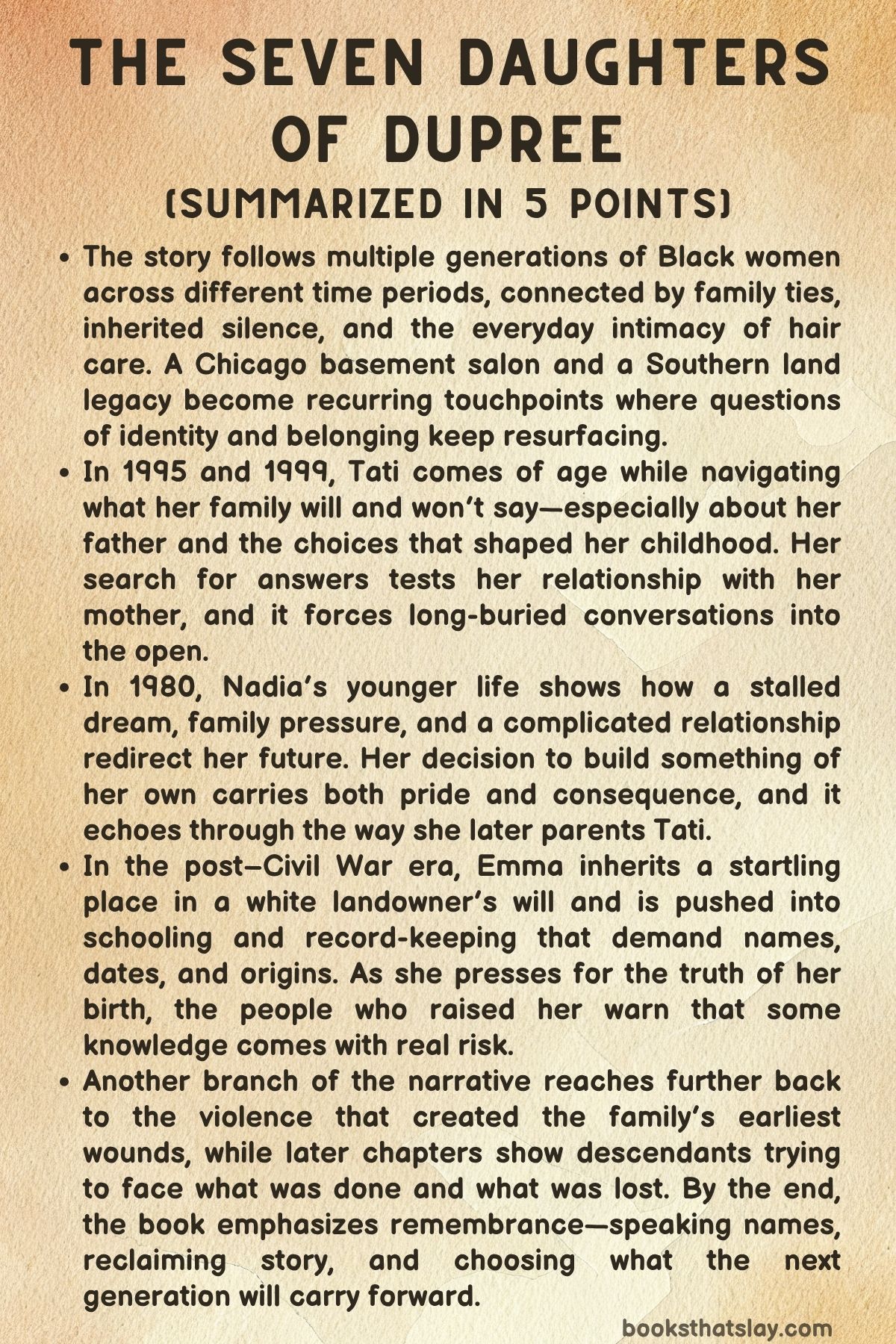
Summary
In March 1995, fourteen-year-old Tatiana “Tati” spends her birthday weekend doing what she often does—helping her mother, Nadia, in the basement salon of their Chicago home. The air is thick with relaxer and hot tools, music thumps, and the salon chair is occupied by Mimi, the older woman who holds court in the family, sharp-tongued and certain she knows what is best.
Mimi’s questions slide from ordinary to personal, and the moment Tati’s first period is mentioned aloud, Tati feels exposed in a way she can’t fix. Mimi’s real target, though, is the silence around Tati’s father.
Nadia refuses to entertain it, repeating her familiar defense: the man is gone, and she has raised her daughter alone—so why isn’t that enough?
The argument swells the way it always does in that basement, with Mimi pushing at Nadia’s choices and Nadia snapping back with anger that comes from years of being judged. Tati’s best friend, Desirée, appears, and Desirée’s mother, Toya, drops in with her easy laughter, briefly shifting the mood.
Mimi warns the girls are becoming young women and suggests their mothers are careless for not watching them closely. Nadia tries to hold the line—breakfast, a trip downtown, celebrating Tati’s birthday—but Tati hears what sits underneath the day: adults using her body and her future as proof in an old fight.
When Nadia sends Tati to walk Mimi out, Mimi changes tone upstairs, wrapping Tati in a sudden hug and telling her to be careful. Mimi also hints at a train ride she once took with Eugene, a ride she calls the hardest of her life, but she refuses to give details.
Tati is left with another sealed door. Overwhelmed, she runs to her room and opens her journal.
Instead of writing about school or friends, she writes to the father she has never met, trying to introduce herself as if words alone could pull him into view. She wants to know what parts of him live in her face.
The story reaches back to the years after the Civil War. In 1870, a girl named Emma has no birthday to claim and no parents she can name.
She has been raised by Evangeline, a midwife and root worker who is respected and feared in equal measure. When the white landowner Zephaniah Foster Dupree lies dying, Evangeline and Emma tend him.
Zephaniah talks too much in his final hours, circling around guilt and debt. After his death, the town gathers for the reading of his will, and what is announced shocks the room: Zephaniah leaves his property not to any white heir, but to Evangeline and “daughter Emma,” with the condition that Emma attend school so she can manage what she has inherited.
This inheritance doesn’t bring peace. It brings scrutiny and danger.
Evangeline responds by telling freed families to take what they can and tear down what they must, as if breaking the old house apart is the only way to keep it from swallowing them. At the freedmen’s school, Emma is asked the questions she can’t answer—how old are you, when were you born, who are your parents.
Evangeline, who cannot read official records but remembers births with painful clarity, tries to protect Emma with partial truths. When a census marshal arrives, Evangeline gives Emma an age and names Zephaniah as the father, but refuses to identify the mother.
Emma senses the missing piece is not a small omission; it is a wound Evangeline is trying to keep covered.
Emma grows into a young woman carrying both a new social status and an old emptiness. She pushes Evangeline for answers and is warned that digging can bring harm.
The more Emma insists on naming her beginnings, the more Evangeline tightens her grip on what she knows, claiming that sometimes the only mercy is silence. Yet the silence has its own cost: Emma learns early that a life can be built on what is not said, and that those gaps become a kind of inheritance too.
Decades later, the pattern repeats in different forms. Ruby Ann, a teenager living in a place called Land’s End with her mother Jubilee (“Jubi”) and her grandmother Emma, experiences a strange moment of knowing in her own hands.
She braids her hair without ever being taught, as if memory sits inside her body. Jubi reacts with anger that sounds bigger than the act itself, accusing Ruby of trying to hurt her, then spiraling into bitterness about what their family has lost.
Ruby is used to absorbing moods she didn’t create. She stays quiet, even as she wonders what this sudden skill says about who she is and what she comes from.
The narrative also steps into Nadia’s past. In June 1980, Nadia is twenty-five and stalled, her college plans derailed by family pressure and money problems.
She works at a department store, exhausted and uncertain, and spends nights with a married man named Roman Brown—someone who offers attention without commitment. Their relationship is built on half-promises and evasions.
When Nadia tries to claim space for herself, even in small ways, she is made to feel unreasonable, as if wanting a real life is asking for too much.
At home, Nadia’s mother Gladys—also called Mimi—meets her with judgment and religious threat, insisting Nadia has wasted her potential and shaming her for “running behind” a man. Nadia fights back, pointing out how much she has been asked to carry.
In a moment of defiance, she decides she will go to cosmetology school and build something of her own, even if her mother refuses to respect it. The choice is both practical and symbolic: Nadia wants a skill, a business, and a way to survive outside the narrow future being pressed onto her.
Nadia’s relationship with Roman becomes the hinge that turns everything. She meets him through Toya and Lou, tries to keep him at a distance when he admits he is married, then is drawn in anyway.
Roman speaks of separation and divorce as if words can erase the reality of his wife and children. After nights of waiting and arguing about what his promises mean, Nadia ends up in a situation she cannot undo: she becomes pregnant.
When she finally tells Roman, he responds with cold denial and calculated blame. He claims he can’t be sure the baby is his because time has passed, even though he never questions paternity inside his marriage.
He offers Nadia no help, no apology, no plan—only a shrug dressed up as choice. Keep it or don’t, he suggests, as if her body is a problem he can walk away from.
Nadia returns to Toya’s apartment sick with anger and grief, and when she cannot reach Roman again, she goes home to face her parents. Gladys turns Nadia’s pregnancy into a public punishment at church, forcing her to sit under the weight of communal judgment.
Nadia is humiliated, but she keeps moving forward, carrying a child who seems to grow on her own schedule.
Back in 1995, Tati’s life continues to brush against the same family tensions. At her eighth-grade graduation, Mimi demands “family only” photos and pointedly excludes Toya and Desirée, turning a celebration into another boundary line.
Tati notices how adults use belonging like a weapon. Later, after her first homecoming dance, Mimi and Nadia interrogate her about boys, and the pressure in the basement salon becomes unbearable.
The argument between mother and grandmother finally breaks open the secret Tati has lived beside for years: Mimi blurts out the name of Tati’s father—Roman Brown.
Tati’s world tilts. She demands answers, and Nadia, cornered and furious, insists again that she has been enough.
But “enough” does not erase Tati’s need to know. Tati retreats to her room and writes to Roman with a new voice—less hopeful, more direct—trying to make sense of why her existence has been treated like a shameful fact instead of a life.
In December 1999, now in college, Tati acts on what she has carried since childhood. She finds Roman’s information and drives to Indianapolis to meet him at his club, Worship Haus.
Their first interaction is stiff, like strangers forced into a performance neither wants. Roman shows her the club’s carefully named rooms—spaces that mimic religion while serving profit—and eventually brings her into his hidden office.
There, Tati sees a framed family photo: Roman with his wife Deborah and their children. Roman confirms his daughter Faith is the same age as Tati.
The symmetry is brutal.
Tati presses him for the truth, and Roman responds with familiar defenses: he was married, he wasn’t sure, Nadia was difficult, women lie. He refuses accountability while trying to rewrite the past into something that excuses him.
When Tati reveals her middle name is Merét—Roman’s mother’s name—Roman’s mask slips for a moment. Nadia knew that name; Nadia marked the child with a link Roman cannot deny.
Still, he insists Tati should let it go, and he makes it clear he intends to keep her hidden from his public family life.
Tati leaves furious and shaken. Back home, she burns the old pages of her childhood letters to “Dear Daddy,” destroying the version of herself who believed a father might one day arrive ready to claim her.
Nadia finally speaks more openly about how Roman entered her life and what she felt back then—wanted, seen, then discarded. In a quiet act of repair, Tati does Nadia’s hair in the basement, reversing roles and taking care in a way that becomes its own kind of language.
Gladys arrives with a family Bible and begins telling a broken family legend connected to Land’s End and an older violence that the family has carried in fragments. The narrative then moves to the origin point: an enslaved African girl captured and renamed “Sarah” by Zephaniah Foster.
She is brutalized and controlled, yet she listens, watches, and plans. She learns of an escape and makes herself useful by turning hair into a record—braiding a map into her own head.
When she runs, pregnant and determined, she is hunted down. Zephaniah punishes her publicly, destroys the braided map, forces Evangeline to deliver the baby, and then kills Sarah.
The child survives, and the line continues, shaped by the fact that one woman’s attempt at freedom was answered with cruelty that echoed forward.
In the ending, after Gladys’s death, Nadia and Tati feel pulled toward Land’s End, as if the family’s buried history is calling them home. Nadia sells her Chicago salon, and in 2020 she, Tati, and Curtis move south.
Tati researches records, writes their story, and builds a life that does not depend on silence. She forms a relationship with Joshua Freeman IV, becomes pregnant, marries him, and gives birth to a daughter.
On their land and among the graves and preserved sites, Tati claims what earlier women were denied: the right to speak names aloud. She dedicates her work to Sa’rah, Emma, Jubi, Ruby, Gladys, Nadia, herself, and the newest girl in the line, insisting that they will be remembered—not as secrets, not as warnings, but as family.
Characters
Tatiana “Tati” Merét
Tati is the story’s emotional lens for what it means to come of age inside a family that treats certain truths like live wires. At fourteen, she is observant, quietly absorbing adult conflict in The Seven Daughters of Dupree while being told—explicitly and implicitly—to stay a child.
Her first period and her birthday become occasions for surveillance and commentary, and that scrutiny makes her intensely self-aware about her body and about the meanings adults attach to it. Writing letters to the father she has never met becomes her private technology for survival: a way to name longing without being shamed for it, and to claim a narrative when the people who love her still control the facts.
By nineteen, she turns that private yearning into action, tracking Roman down and demanding recognition, only to learn that information alone does not guarantee care or accountability. The burning of her “Dear Daddy” pages is not a simple rejection of her father but a self-protective rite—an attempt to cauterize hope that has been repeatedly humiliated.
Yet Tati’s later trajectory shows she is not defined by rejection; she becomes someone who records and restores, transforming inherited silence into testimony, and in doing so, she shifts from a daughter asking to be seen into a woman determined to see—and speak—the names others tried to erase.
Nadia (Tati’s mother)
Nadia is a woman built out of grit, ambition, and a fierce insistence that her love should be sufficient in a world that keeps demanding proof. Her central refrain—“Ain’t I enough?”—is both armor and wound: it asserts that she has provided and protected, but it also reveals how often she has been forced to defend her worth against judgment, abandonment, and the moral policing of her own mother.
Nadia’s conflict with Gladys over education and “respectability” exposes how her life gets narrowed by other people’s plans, until hair becomes the thing she can claim as hers—skill, autonomy, and eventual ownership. Her relationship with Roman begins in loneliness and stalled possibility, and the pregnancy becomes the moment she learns how disposable he considers her; his refusal forces her into choices she must carry without social mercy.
Nadia’s parenting is shaped by that trauma—she is protective to the point of secrecy, trying to spare Tati the poison of Roman’s indifference and of the community’s judgment. But secrecy becomes its own inheritance, and when the truth finally erupts, Nadia is confronted with the fact that being “enough” emotionally is not the same as giving a child the right to know where they come from.
Her later willingness to tell Tati the whole story, and to let their hair routine become a site of repair rather than control, shows her capacity for growth: she is not only a survivor, but a mother learning to loosen her grip so her daughter can breathe.
Gladys “Mimi” (Nadia’s mother, Tati’s grandmother)
Gladys moves through the story like a guardian who confuses protection with condemnation, using church language and generational authority to keep fear at bay. Her “nosiness” is not just meddling; it is a vigilance born from history, the kind that believes danger arrives through what girls do not say and men do not admit.
She polices Nadia and Toya as “single mothers” partly because she genuinely worries about their daughters, but her worry expresses itself as shame—publicly, sharply, and often cruelly. Mimi’s fixation on responsibility and “sin” reads as moral judgment, yet the story keeps hinting that her harshness is also a screen for what she has endured and what she refuses to remember aloud, especially around trains, segregation, and the “longest… hardest ride” of her life.
Her contradictions are key: she humiliates, then hugs; she interrogates, then warns softly; she demands respectability, yet carries fragments of a family history rooted in violence and dispossession. When she finally brings the family Bible and begins piecing together the legend of Emma and Land’s End, Mimi becomes a bridge between the everyday arguments of a Chicago basement salon and the deeper ancestral story the family has tried to outrun.
She is difficult, often harmful, but also essential—one of the keepers of the archive, even when she can only hold it in broken, defensive pieces.
Roman Bishop Brown
Roman is the narrative’s most consistent portrait of how charisma and evasion can operate as a kind of cruelty. He offers Nadia attention during a vulnerable period, but he keeps the relationship in a permanent state of contingency—always almost leaving his wife, always asking Nadia to fit into the gaps of his real life.
When Nadia becomes pregnant, Roman’s response is not confusion or fear so much as strategy: he tries to unmake reality by claiming absence, questioning timelines, and reframing responsibility as “your choice,” a language that sounds like freedom while functioning as abandonment. Years later, his meeting with Tati in his club is a performance of control; he guides her through spaces named like church rooms—sanctuary, confessional—suggesting ritual and redemption, while refusing the most basic moral act of acknowledgment.
His insistence on secrecy, his comparison of women’s truthfulness, and his demand that Tati stop seeking him reveal a man invested in protecting his image and his household at any cost, including the psychic cost to his daughter. Roman is not written as a cartoon villain; he is recognizable precisely because his harm is bureaucratic and self-justifying, the kind that leaves others carrying consequences while he claims neutrality.
He embodies a recurring theme in the novel: the damage caused not only by overt violence, but by the steady refusal to name, claim, and stay.
Desirée (Tati’s best friend)
Desirée functions as both mirror and contrast to Tati, revealing what it looks like to grow up alongside someone whose family pressures resemble yours but land differently. Her presence in the basement salon scenes emphasizes how adolescence happens in the margins of adult life, where girls are expected to listen without reacting and absorb warnings meant to control them.
The disposable camera Toya gives her is a small but meaningful symbol: Desirée is the one capturing images, trying to hold moments still, and that instinct parallels Tati’s journaling and letter-writing—two girls reaching for tools that preserve truth in households that prefer certain truths remain unspoken. Desirée also becomes a flashpoint for Mimi’s exclusionary idea of “family,” and the way she is pushed out during Tati’s graduation gathering exposes how older generations use belonging as leverage.
She represents the chosen family that adolescence builds when biological family is complicated, and her steady companionship underscores that Tati’s story is not only about fathers and mothers, but also about the friendships that keep girls intact when adults are busy warring.
Toya Grant
Toya is the character who carries light into rooms heavy with judgment, not because she is naïve, but because she refuses to let shame define her. She banters, laughs, shows up, and shifts energy, offering a counterweight to Mimi’s moral surveillance.
At the same time, Toya is entangled in the plot’s most consequential mistake: she helps introduce Nadia to Roman through Lou’s connections, and later becomes Nadia’s first witness to the pregnancy crisis and Roman’s disappearance. Toya’s response is not passive sympathy; she is outraged on Nadia’s behalf, pushing for confrontation and demanding decency from a man who is unreachable.
Yet Toya also becomes a reminder that friendship cannot fix structural abandonment—she can provide a couch and concern, but she cannot make Roman accountable or remove the social penalties Nadia faces. Her parenting of Desirée, and her insistence on including her daughter in photos even when Mimi tries to erase her, mark Toya as someone who fights for visibility.
She embodies a stubborn, practical love, one that does not always prevent pain but refuses to let pain have the last word.
Eugene (Nadia’s father)
Eugene is a quieter kind of power in the family, often positioned between Gladys’s condemnation and Nadia’s desperation. He functions less as a driver of events and more as a stabilizing presence whose kindness reveals what Nadia might have become with more room to fail without punishment.
When conflict peaks, Eugene’s interventions are measured; he does not erase consequences, but he insists Nadia has agency, telling her she must decide whether to stay or leave. That framing matters because it contrasts sharply with the women’s generational pattern of control, shame, and surveillance.
Eugene’s gentleness does not solve the structural realities Nadia faces—money, childcare, judgment, stalled education—but it offers a model of care that is not conditional on moral purity. His role highlights the novel’s interest in how family can both trap and shelter, and how even limited tenderness can alter the shape of a young woman’s choices.
Bryan (Nadia’s brother)
Bryan appears as part of the family chorus that exposes Mimi’s impact on her adult children. His impatience with Mimi during Tati’s graduation gathering signals that her harshness has produced not only compliance but also fatigue and distance.
Bryan’s decision to leave early is a small act, but it communicates a boundary that Nadia struggles to set: he is unwilling to keep performing “family” at the cost of constant belittlement. Bryan helps illustrate that the family’s conflicts are not only about Nadia’s choices; they are about how Mimi’s worldview has governed the entire household, shaping how the siblings tolerate, resist, or reproduce her judgments.
Terry (Nadia’s brother)
Terry’s presence, especially alongside his wife Chloe, shows another angle of the family’s internal hierarchy—how Mimi’s scrutiny extends beyond Nadia to anyone close enough to be evaluated. When Terry and Chloe leave early after Mimi’s needling, the moment reveals how Mimi’s sense of authority can fracture gatherings meant to celebrate Tati.
Terry is part of the evidence that Mimi’s pain has not stayed private; it spills outward, making even ordinary occasions arenas for power struggles. His role deepens the portrait of a family where love is real but often expressed through criticism and control, and where adults learn to navigate the matriarch by either appeasing her or escaping her.
Chloe (Terry’s wife)
Chloe is important precisely because she is not deeply embedded in Nadia and Mimi’s long history; she experiences Mimi’s behavior as a present-tense indignity rather than an inherited pattern she must endure. Her discomfort and exit during the graduation gathering show how Mimi’s policing can alienate those who did not grow up trained to interpret it as “just how she is.” Chloe’s brief presence makes the family dynamics legible from an outsider-adjacent perspective: Mimi’s comments are not simply blunt; they are socially corrosive, and they reveal how quickly celebration can be turned into judgment.
Felix
Felix functions as a small but telling symbol of generational continuity—an innocent presence in rooms thick with adult history. In family gatherings, the inclusion of a younger child emphasizes what is at stake in the women’s conflicts: the next set of witnesses.
Felix’s role is less about plot and more about atmosphere, reminding the reader that these arguments, silences, and revelations are not isolated; they occur in front of children who learn what family means by watching how adults speak, exclude, and protect.
Xavier
Xavier represents the threshold of teenage intimacy that provokes Mimi’s fear and Nadia’s defensiveness. For Tati, he is not primarily a romance so much as a moment of experimentation—slow dancing, wearing a jacket, a first kiss—and the memory becomes charged because the adults treat it as evidence of risk.
Xavier helps show how girls’ early desires are often interpreted through adult anxieties about pregnancy, reputation, and abandonment, especially in families already haunted by men who do not stay.
Deborah (Roman’s wife)
Deborah is mostly seen through Roman’s framing and through the evidence of his family photograph, which makes her presence both distant and powerful. She represents the life Roman protects—the legitimate household that receives his commitment, his public identity, and his ongoing care.
Deborah’s pregnancy at the same time as Nadia’s becomes a brutal structural comparison: Roman treats one pregnancy as his family’s future and the other as a problem to be managed away. Even without extensive page time, Deborah embodies how “respectability” and marriage can function as shields that allow men to deny obligations elsewhere while maintaining social standing.
Faith (Roman’s daughter)
Faith’s significance lies in her parallel to Tati: a girl the same age, acknowledged openly, living inside Roman’s legitimate family story. The comparison of birthdays underscores the novel’s obsession with origins, dates, and what families choose to record.
Faith is not positioned as an antagonist; rather, she is a measuring stick that exposes the inequity of Roman’s choices. She represents the daughter Roman is willing to be proud of, which intensifies the sting of his insistence that Tati remain a secret.
Lou
Lou is a catalyst character whose social network helps initiate Nadia’s relationship with Roman. His role demonstrates how intimacy and fate often move through ordinary community connections—who knows who, who gets invited out, who can reach someone by pager.
When Roman disappears behind a disconnected number, Lou’s ability to contact him becomes briefly crucial, and that moment highlights how power operates socially: access determines whether someone can demand answers. Lou’s presence also emphasizes that Nadia’s life shift is not only personal; it is shaped by the informal ecosystems of friends, boyfriends, bars, and parties that can open doors—or lead someone into a trap disguised as opportunity.
Ruby Ann
Ruby is a descendant who carries the family’s haunted pattern into a later moment, embodying both the fear of repetition and the desire to name what has been hidden. Her spontaneous ability to braid—arriving like memory in the hands—suggests inheritance that is bodily rather than purely narrative, a theme the novel returns to through hair as archive and language.
Ruby’s pregnancy becomes a pressure point that forces older women to talk, and her insistence on asking about her father shows how the family’s culture of secrecy persists across generations. She is sensitive to the emotional weather around her; she notices Jubi’s fragility and Emma’s disgust at lies, and she senses that what is unsaid is shaping her future as much as what is known.
Ruby’s role is to stand at the edge of the family myth and ask whether it must continue—whether girls must arrive “on their own time” at the cost of boys, whether sacrifice is destiny, and whether love always comes braided with loss.
Jubilee “Jubi” (Emma’s daughter, Ruby’s mother)
Jubi is a woman forged by survival inside a lineage that has associated birth with danger and motherhood with grief. Her disgust at Ruby’s braids reads like jealousy, fear, and control braided together; she reacts as if Ruby’s body has accessed a knowledge Jubi cannot regulate.
Jubi’s bitterness—calling Ruby “the baby who lived”—suggests unresolved trauma around births that did not go the way they were supposed to, and around a family story where children’s survival feels like an accident rather than a promise. When Ruby asks about her father, Jubi invents a tale of a soldier turned chain-gang victim, performing a protective lie meant to deflect the most dangerous question: his name and their real history.
Her lie is not casual; it is practiced, strategic, and rooted in the belief that naming can summon consequences. Jubi represents the generation that learned silence as a form of protection, even when that protection becomes a prison for their daughters.
Emma
Emma’s life is shaped by the violence of origins and the politics of being named, recorded, and claimed. As a child, she is desperate for the basic coordinates of self—age, birthday, mother’s name—and Evangeline’s refusal to provide those facts turns identity into hunger.
Emma’s later miscarriages and the framing of those losses as spiritual retribution reveal how trauma seeks explanation when society offers none; the idea of a curse becomes a language for grief that would otherwise be unbearable. Emma is also the beginning of a matrilineal archive, the ancestor whose name enters the Bible, whose land and story echo forward into Gladys’s fragments and Tati’s later research.
Her resilience is not romanticized; she endures repeated bodily devastation, learns to live with what cannot be fixed, and becomes someone who both carries truth and participates in concealment. Her silent disgust when Jubi lies to Ruby shows that Emma knows the cost of secrecy, yet she has also lived long enough to understand why women choose it.
Evangeline
Evangeline is midwife, root-worker, protector, and gatekeeper of truth, a figure who holds power in a world designed to deny it to women like her. She raises Emma with fierce competence but also with a strict philosophy: some knowledge is dangerous, and some celebrations are forbidden because they would disrespect the dead.
Her refusal to name Emma’s mother or celebrate Emma’s birth reveals how trauma shapes ethics; to Evangeline, memory is not neutral—it can summon harm. Her act of naming Zephaniah as Emma’s father during the census is both strategic and radical, forcing official record to acknowledge a relationship built on exploitation, and perhaps securing protection or legitimacy for Emma within a hostile system.
Later, her rituals around Emma’s miscarriages show her willingness to confront suffering with spiritual technology when medicine and law provide only indifference. Evangeline’s most defining trait is not mysticism but control over narrative: she decides what is told, when, and to whom, because she understands that stories can be weapons as much as healing.
Zephaniah Foster Dupree
Zephaniah is written as wealth, entitlement, and violence made human—the kind of man whose power extends into naming, breeding, punishment, and legacy. In the postwar timeline, he becomes a dying landowner who tries to “make it right” through a will that shocks the town, leaving property to Evangeline and Emma.
That gesture might look like repentance, but the story keeps it morally complicated: his generosity arrives after lifetimes of harm, and it cannot undo the coercive relationships that produced Emma’s existence. In the earlier timeline, Zephaniah’s brutality toward Sa’rah is explicit and ceremonial, turning punishment into spectacle and control into ritual.
He embodies the foundational violence that the later family inherits not only as trauma but as land, records, silences, and the constant struggle over who gets to be named and remembered.
George Dupree
George appears primarily within Emma’s adult tragedy, representing an ordinary hope for family life that becomes extraordinary suffering through repeated loss. His role is bound to the miscarriages and the boys who do not survive, and he functions as part of the household that Evangeline tries to shield through ritual and warning.
George is less a fully individualized psychological portrait than a figure of shared grief; his presence underscores that the family’s losses are not only women’s burdens, even though women are the ones whose bodies and reputations carry the cost most visibly.
Watkins (the town attorney)
Watkins operates as the voice of official power and public order, the person who translates Zephaniah’s private decisions into communal shock. By reading the will and witnessing the reaction, he represents how legitimacy is conferred through paper, law, and male authority.
His presence emphasizes that inheritance is never only personal; it is a public confrontation with who is allowed to own, who is recognized, and how a community responds when the legal record contradicts its racial and social assumptions.
Sa’rah (the enslaved African woman renamed “Sarah”)
Sa’rah is the ancestral wound and the ancestral genius of the story, a woman whose life contains both extreme violation and extraordinary agency. Her renaming is the first theft—identity replaced by a word chosen by her captor—and her repeated rape and forced pregnancy show how slavery weaponizes reproduction.
Yet Sa’rah’s act of braiding a map into her hair is a profound reversal: she turns the very site of imposed labor and surveillance—her body and grooming—into a coded instrument of liberation. The punishment she endures after capture is designed to erase that agency, literally shaving away the braided map and attempting to reduce her to an object again.
Even so, Sa’rah’s legacy survives through the line that continues after her death, and through the later generations’ return to hair as archive and as language. Her significance is not only in her suffering but in her insistence on escape, on knowledge, and on leaving evidence of a will that refused to be owned.
Joshua Freeman IV
Joshua enters late as the possibility of a different pattern: a partnership not built on secrecy, contempt, or abandonment. His relationship with Tati matters less as romance detail and more as structural contrast—Tati choosing someone with whom she can build a family openly, and with whom naming and belonging do not require begging.
His presence supports the ending’s emphasis on repair: the family line continues, but with a shift toward honesty, shared responsibility, and remembrance rather than denial.
Curtis
Curtis’s role is bound to the family’s later re-rooting, part of the household that moves with Nadia and Tati toward Land’s End. He represents the practical continuity of family life—the person alongside the women as they transform inheritance into lived space.
While he is not foregrounded with the same psychological depth as the matrilineal characters, his inclusion signals that the women’s decision to return is not solitary; it becomes a family project, an act of rebuilding that includes partners and new domestic structures.
Merét (as a namesake)
Merét is not a living character in the main timelines, but as Roman’s mother’s name and Tati’s middle name, she functions like a ghostly hinge between secrecy and knowledge. When Roman recognizes the name, he realizes Nadia carried more truth than he admitted, and that recognition punctures his attempt to frame Tati as merely an unverified claim.
Merét symbolizes how names can carry lineage quietly through generations, waiting to be noticed, and how the smallest detail can expose a much larger moral evasion.
Themes
Inheritance, Naming, and the Fight to Own a Personal History
The story keeps returning to how a life can be shaped by what is known, what is withheld, and what is renamed by somebody else. Tati’s first period becomes community information before she can even decide how to feel about it, and her father’s absence becomes a question everyone handles except her.
That pattern reaches back to Emma’s childhood, where even something as basic as a birthday is denied, not because it is unimportant, but because it is tied to a death that Evangeline cannot bear to speak about. The refusal to name becomes a kind of power: it protects the older generation from pain and from exposure, but it also starves the younger generation of the tools needed to build a stable sense of self.
When Mimi shuts down the train story, or when Jubi invents a father story that is designed to end questions, the message is the same: knowledge is dangerous, and asking for it threatens the fragile order that keeps a family functioning. Yet the book also shows that secrecy has its own cost, because it forces daughters to carry questions inside their bodies the way they carry bloodlines—quietly, constantly, and with no clean place to put the ache.
That is why objects like the monogrammed journal and the family Bible matter so much. They are not just props; they are alternative archives when official records and honest conversations fail.
Emma is pushed into school and census categories that demand neat answers—age, parentage, legitimacy—while the truth of her origin is messy, violent, and unspeakable within the rules of the world around her. Later, Tati uses libraries and early internet searches to force open a closed door, and the modern tools feel different from Evangeline’s memory-based account, but the goal is the same: to retrieve a story that was taken.
The reveal of Roman’s name changes Tati’s life not because a name magically heals anything, but because it confirms that the blank space was not imaginary. It is real, it has an owner, and someone chose to keep it empty.
By the time the family reaches Land’s End and Tati writes the lineage in verse, the theme resolves into a refusal to let identity be decided by silence. Remembering and speaking names becomes an act of possession, a way to stop history from being something that happens to daughters and instead make it something daughters can claim, shape, and pass on without the same distortions.
Mothering Under Judgment, and the Weight of Respectability
In The Seven Daughters of Dupree, motherhood is never presented as a private relationship between parent and child; it is treated as a public performance that is constantly evaluated. Mimi’s comments about “sin and shame” are not merely personal opinions—they represent a larger social system where women’s worth is measured by marital status, sexual history, church approval, and the perceived control they have over their daughters.
Nadia’s basement salon becomes a stage where this scrutiny plays out in everyday rituals: hair appointments, Sunday routines, small talk that turns into interrogation. Mimi claims she is protecting the girls, but the protection is delivered as surveillance and humiliation, and that method teaches the next generation that womanhood is something to manage defensively rather than grow into safely.
Gladys escalates that logic to its most punishing form when she exposes Nadia’s pregnancy in church. The congregation’s public prayer is framed as care, but it functions as discipline—Nadia is made into an example of what happens when a woman steps outside the approved script.
At the same time, the book refuses to paint any of these women as simple villains. Mimi’s fixation on supervision and propriety is connected to her own memories of segregation, vulnerability, and what can happen to girls without protection.
Gladys’s harshness is tied to fear and to a belief that survival depends on being beyond reproach in a world eager to punish Black women. Even Nadia’s toughness—her demand that Tati “earn her keep,” her insistence that she is “enough”—is a response to abandonment and to the knowledge that softness does not guarantee safety.
The tragedy is that these strategies, built to guard against harm from outside, often create harm inside the home. Nadia learns to equate control with care, and Tati learns that her body and her choices will be debated in rooms where she is expected to stay quiet and grateful.
The theme becomes especially sharp when the narrative places Nadia’s stalled education beside her turn toward cosmetology. Gladys views hair school as beneath her daughter, but Nadia experiences it as a route to independence and ownership.
The conflict reveals two competing ideas of dignity: one rooted in institutional validation and “proper” careers, the other rooted in skill, community respect, and building something that cannot be taken away easily. The salon, then, is both freedom and burden.
It supports the family, but it also keeps them in close quarters with judgment, gossip, and generational conflict. By the end, when Nadia and Tati share hair work as a moment of repair, the same practice that once served as a site of criticism becomes a site of intimacy.
The book suggests that mothering cannot be separated from the social world that watches mothers, but it also suggests that families can renegotiate what care looks like when they stop performing for outsiders and start telling each other the truth.
The Body as Evidence: Girlhood, Sexual Power, and Control
The story treats the body as a kind of record that others read and interpret—often more loudly than the girl herself is allowed to speak. Tati’s shift into menstruation is immediately framed through adult anxiety, not her own understanding.
Mimi’s warnings, Nadia’s insistence that “neither girl is thinking about boys,” and the constant questions after homecoming show how quickly girlhood is recast as risk management. Desire is treated as something that happens to girls rather than something girls feel, and that framing makes it easier for adults to justify control.
Tati’s embarrassment in the salon is not only about privacy; it is about realizing that her body has become public currency, a topic that authorizes adults to pry, predict, and police. The book makes that transition feel claustrophobic: a girl can be celebrated for a birthday one moment and treated like a potential scandal the next.
The theme deepens through Nadia’s experience with pregnancy and the way Roman responds. Her body becomes contested territory: evidence of an affair, proof of “sin” for Gladys, a threat to Roman’s carefully arranged life, and a problem that society expects Nadia to solve alone.
Roman’s cold dismissal is not just personal cruelty; it reflects a broader gendered logic where men can separate sex from consequence while women are expected to absorb consequence as destiny. Nadia’s nausea around chemicals in cosmetology school adds another layer—her body reacts before her mind fully accepts the truth, and the workplace itself is filled with substances that symbolize both transformation and harm.
Relaxer, burnt hair, brine in wounds, smoke during pregnancy: the book repeatedly places bodies in contact with materials that promise improvement or control while also carrying damage. That pattern links everyday beauty practices to a longer history of forced control over Black bodies.
In the 1860–1861 storyline, the body is treated with open brutality, and the theme becomes impossible to ignore. Sa’rah’s capture, renaming, repeated rape, forced pregnancy, whipping, and murder show the most direct form of bodily ownership: a person treated as property whose reproduction and movement are controlled through violence.
The braided map in her hair is especially important because it turns the body into a tool of resistance rather than only a site of violation. Hair becomes a place where knowledge can be stored when paper and speech are not safe.
That same logic echoes forward in quieter forms—girls learning braiding without being taught, women practicing hair work as both livelihood and cultural memory, Tati and Nadia finding a way back to each other through hands and routine. Across time, the book insists that bodies carry stories whether families acknowledge them or not.
Control is shown as something that can be imposed by churches, partners, elders, and systems, but the body also holds the capacity to testify, to remember, and to refuse erasure through acts as small as writing a letter or as bold as running with a map hidden in plain sight.
Cycles of Trauma, Silence, and the Decision to Break the Pattern
The narrative is built on repetition with variation: daughters ask questions, mothers deflect, elders warn that truth is dangerous, and the unanswered question becomes the next generation’s burden. What changes across the book is not the presence of trauma, but how each woman responds to it.
Evangeline’s refusal to speak the mother’s name, Mimi’s partial stories that stop at the edge of pain, Jubi’s invented account of Ruby’s father, Nadia’s insistence that she alone can be enough—these are all coping strategies shaped by fear and survival. The book treats these strategies with seriousness because they often work in the narrow sense: they keep a household moving, they prevent immediate conflict, they avoid risks that feel too big to manage.
But the story also shows their long-term consequence: secrecy does not remove pain; it relocates it into the child who grows up sensing a missing piece and blaming herself for wanting it.
That is why Tati’s letters matter as more than teenage habit. Writing “Dear Daddy” entries is her way of creating a relationship with an absence, but it is also her attempt to build a coherent identity when the adults around her insist on incoherence.
When she finally meets Roman, she expects answers that might organize her life, and instead she receives a second abandonment dressed up as logic. Roman’s insistence that she is “too old” to ask, his demand for a paternity test while he never applied that suspicion to his marriage, and his desire to keep her secret reveal a pattern that has been operating for generations: powerful people define what counts as truth, and those with less power are asked to accept uncertainty as their portion.
Tati’s act of burning the pages is not just anger; it is grief for the version of herself that believed recognition would arrive if she explained herself well enough.
The book’s movement toward Land’s End and the naming dedication signals a different choice. Rather than continuing the pattern of partial stories and protective silence, Tati chooses record-making as repair.
She researches, writes, and constructs a lineage that does not hide the violence at its root. This is not presented as neat healing; it is presented as responsibility.
The dedication that speaks the names insists that the family will no longer depend on forgetting to function. Even the phrase Mimi uses—“a blessing in a burden”—takes on new meaning by the end: the burden is not the daughter herself, but the unspoken history placed on her shoulders.
Breaking the cycle requires refusing the old bargain where safety is purchased with silence. In that sense, the theme closes with a moral and practical shift: telling the truth becomes a form of protection, not a threat, because it prevents daughters from inheriting confusion as if it were fate.