A Resistance of Witches Summary, Characters and Themes
A Resistance of Witches by Morgan Ryan is a historical fantasy set against the violence and uncertainty of the Second World War.
The novel imagines a hidden magical society forced to decide whether centuries of secrecy should matter more than resisting fascism, while a dangerous grimoire threatens to turn supernatural power into a weapon of mass destruction. At its center are Lydia Polk, a gifted British witch; Rebecca Gagne, a French Resistance fighter; and Henry Boudreaux, an American curator with an unusual connection to the dead. Their separate battles gradually become one struggle over power, loyalty, identity, sacrifice, and the moral limits of resistance.
Summary
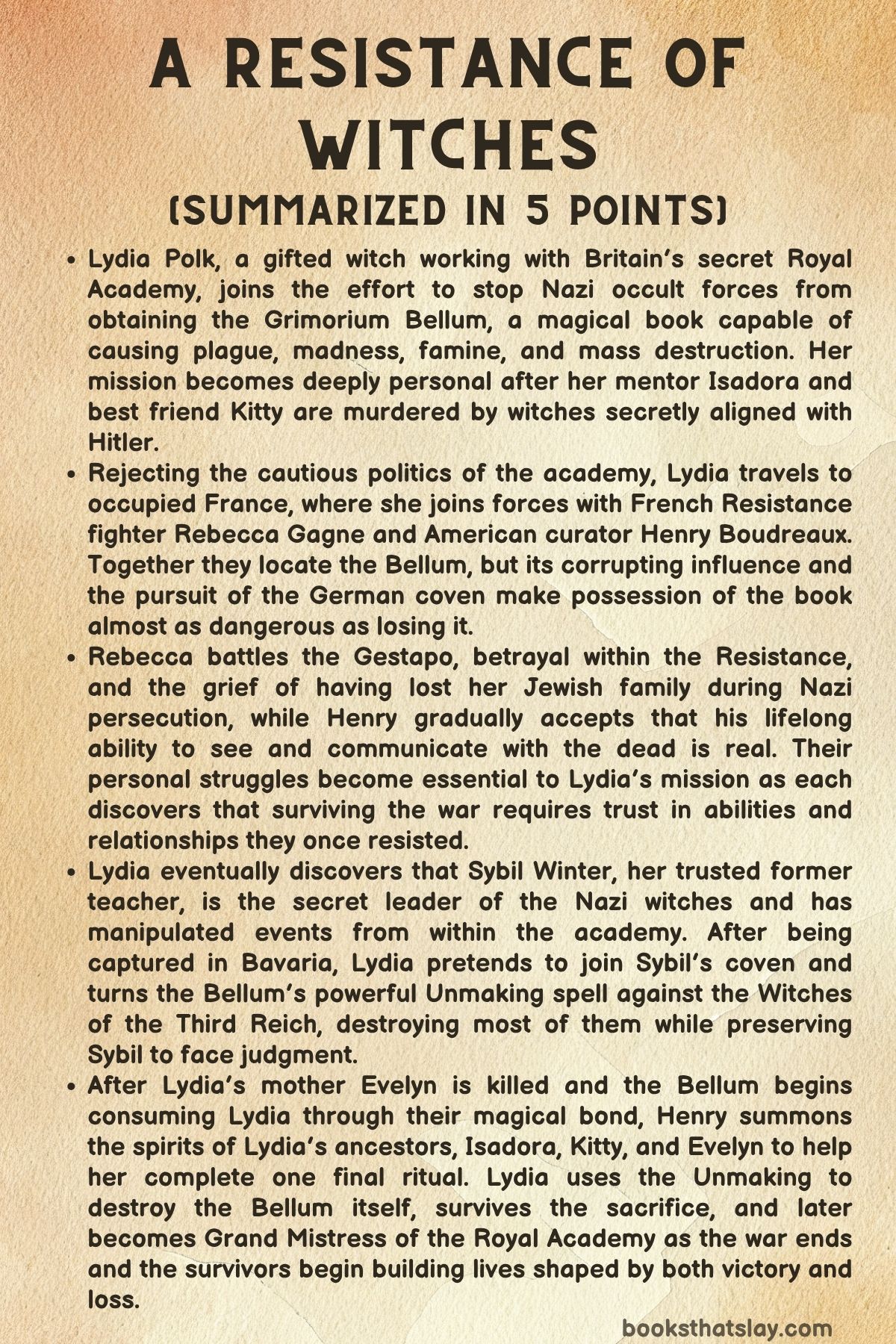
In 1940, sixteen-year-old Lydia Polk accompanies Isadora Goode, Grand Mistress of the Royal Academy of Witches, to a secret meeting with Winston Churchill. Isadora believes Nazi victory may become inevitable unless Britain’s witches abandon their traditional political isolation and assist the war effort, a decision Lydia comes to support after witnessing the destruction suffered by ordinary Londoners.
Three years later, Lydia has become Isadora’s trusted assistant and a teacher of projection, the magical ability to leave one’s body and travel as a spirit-like presence. Isadora has also established Project Diana, an operation devoted to locating powerful magical artifacts before German occult forces can acquire them.
The most dangerous object they seek is the Grimorium Bellum, an ancient Book of War associated with plague, famine, madness, destruction, and mass death. Evidence suggests that German witches serving Hitler are hunting the book while recruiting young women from magical bloodlines into a new coven.
Lydia’s best friend, Kitty Fraser, has already infiltrated Château de Laurier in occupied France and briefly touched the Bellum before escaping with a fragment. During a ritual intended to use Kitty’s connection to track the book, Lydia senses disturbing memories inside the woman beside her and realizes that someone has taken Kitty’s appearance.
The impostor reveals herself as a blond German witch and murders Isadora in front of the High Council. She steals the Bellum fragment and escapes, while Lydia later discovers that the real Kitty has also been murdered.
The double loss leaves Lydia furious with the academy’s leadership, whose members seem more concerned with choosing a new Grand Mistress than confronting the enemy who entered their supposedly protected home. Lydia retreats to Isadora’s London flat, but grief soon turns into determination when she realizes the stolen fragment can help the Germans locate the Bellum.
A political struggle develops between Lydia and Vivian, an elderly Seer who believes the academy should withdraw from the war. Vivian offers Lydia support for the position of Grand Mistress if she ends Project Diana, but Lydia refuses.
Soon afterward, Lydia discovers that someone has deliberately cut an opening through the academy’s ancient magical defenses. Because only a witch whose power is already part of those wards could have created such a breach, Lydia concludes that the German assassin had help from someone inside the academy.
The council then restricts the authority of the next Grand Mistress, making further wartime action dependent on unanimous approval. Rather than accept a powerful title that would leave her unable to pursue the Bellum, Lydia abandons the selection ceremony and secretly travels to occupied France.
There she is placed under the protection of Rebecca Gagne, a young French Resistance fighter who initially believes Lydia is merely an inexperienced English civilian. After magic saves them from discovery at a checkpoint, Lydia reveals the existence of witches, the Bellum, and the German coven.
Rebecca accepts the truth but disagrees with Lydia’s moral position on the book. Rebecca believes that a weapon capable of destroying the Nazis should be used against them, while Lydia insists that deliberately causing mass death would corrupt those who claim to be fighting tyranny.
At Château de Laurier, Lydia meets Henry Boudreaux, an American assistant curator who encountered Kitty during her earlier attempt to obtain the Bellum. Henry is suspicious of Lydia, yet his ability to hear the book whisper and sense Lydia during projection suggests that he possesses supernatural abilities of his own.
Henry eventually agrees to help Lydia after she explains that locating the Bellum may also reveal what happened to René Dreyfus, the missing curator whom Henry deeply cares about. During a tracking ritual, Lydia discovers the Bellum’s trail leading toward René’s family farmhouse.
Meanwhile, Rebecca is captured by the Gestapo after a witch magically takes control of her body. Under torture, Rebecca refuses to expose her Resistance contacts, and Lydia reaches her through projection long enough to help her create a counter-spell that allows Rebecca to kill the witch controlling her.
Rebecca escapes and rejoins Lydia and Henry. At the farmhouse, they discover René dead and find the Bellum hidden beneath the floorboards, along with evidence that the book had been influencing René’s thoughts and encouraging his despair.
Lydia discovers that she can understand the Bellum almost instinctively. Its spells offer disease, madness, destruction, and an ultimate spell called the Unmaking, but the book’s power also attracts Lydia in ways that frighten her.
Rebecca then reveals that her real family name is Gaiser and that she is Jewish. Her father was arrested, while her mother and younger sister disappeared during the Vel d’Hiv roundup, explaining both her commitment to the Resistance and the grief she usually conceals.
Their situation collapses when the Gestapo traces Lydia to the château. Desperate to defend them, Lydia uses a plague spell from the Bellum, killing several attackers but nearly killing herself in the process.
A witch named Fiona McGann magically returns Lydia to London, while Henry escapes with the Bellum and Rebecca remains behind to delay the Germans. Rebecca survives, reunites uneasily with former Resistance comrades, and later escapes execution with Henry after his long-suppressed ability to communicate with the dead becomes impossible to deny.
Henry gradually accepts that the figures he has seen since childhood are genuine spirits. His Haitian-born mother, Fabienne, had tried to teach him about the spiritual world, including Papa Legba, and Henry eventually learns that the dead can help the living if he is willing to open the mental barriers he created to shut them out.
Back in London, Lydia remains physically weak and unable to use magic. Her mother, Evelyn, eventually discovers that Lydia’s powers are not recovering naturally because someone has been secretly poisoning her with ingredients designed to suppress them.
The culprit is revealed through Gerda Horn, a captured young German witch. Lydia learns that the leader of the Nazi coven is not Vivian, as she had suspected, but Sybil Winter, her former teacher and one of the people she trusted most.
Sybil arranged Isadora’s assassination, manipulated the academy, and recruited vulnerable young witches into her movement. She believes centuries of secrecy have reduced witches to frightened shadows of what they once were and sees cooperation with Hitler as a temporary route toward restoring magical power.
Lydia decides that the Bellum cannot safely belong to either the Germans or the academy. She plans to destroy it by directing its own Unmaking spell against itself, interpreting the spell’s requirement for a “sisterhood” more broadly than the academy’s traditions would allow.
After locating Henry and Rebecca, Lydia returns to France and binds the Bellum to herself so that no other witch can safely use it. The German coven attacks, captures Lydia, Henry, and Rebecca, and carries them to Bavaria, where Evelyn has also been imprisoned.
Sybil tries to persuade Lydia to join her cause. Lydia pretends to accept, learning that Sybil intends to use the Unmaking during the winter solstice to destroy Stalingrad as a demonstration of magical power.
Lydia secretly drugs Sybil and Ursula with a protective potion prepared by Evelyn and undergoes initiation into the German coven. When the solstice ritual begins, Lydia turns the Unmaking against the Witches of the Third Reich instead of Stalingrad, reducing most of the coven to ash.
Sybil survives because of Evelyn’s potion, as does Ursula. Lydia frees Evelyn, but during the final confrontation Ursula is killed and Sybil fatally wounds Evelyn.
The Bellum offers Lydia the power to save her mother, but Evelyn refuses to let Lydia surrender herself to the book. She dies in Lydia’s arms, leaving Lydia devastated but still determined to finish what they began.
The Bellum then begins consuming Lydia because of the bond between them. Henry and Rebecca return and manage to separate its influence from her long enough for Lydia to attempt the Unmaking again, although she believes doing so without a magical sisterhood will kill her.
Henry sees Evelyn’s spirit and learns that Lydia’s family can still stand beside her. He opens himself fully to the dead, allowing generations of Lydia’s ancestors, along with Isadora, Kitty, and Evelyn, to gather around her.
Supported by both the living and the dead, Lydia completes the spell and names the Grimorium Bellum itself as the target. The book finally turns to ash, leaving Lydia alive but permanently changed by the magical bond she sacrificed to destroy it.
Sybil is kept alive to face judgment before the High Council, while Rebecca chooses to remain in France because the wider war continues. Henry returns to New Orleans after revealing to Rebecca that her mother’s spirit helped them escape and had remained close to her.
By Victory in Europe Day in May 1945, Lydia has become Grand Mistress of the Royal Academy of Witches. She continues directing magical assistance against surviving Nazi figures, learns that Rebecca remains active abroad, and prepares to travel to New Orleans to reunite with Henry, ending the story with victory tempered by memory, responsibility, and the lives lost along the way.
Characters
Lydia Polk
Lydia Polk is the central character of A Resistance of Witches, and her development is built around the conflict between extraordinary ability and incomplete understanding. At the beginning, she is talented, ambitious, stubborn, politically direct, and deeply devoted to Isadora, but she also carries the academy’s assumptions about legitimate magic, leadership, and superiority.
Her early confidence is repeatedly broken by experience. Isadora and Kitty are murdered, the High Council proves politically divided, her suspicions about Vivian are wrong, Sybil deceives her, and the Bellum exposes how easily noble intentions can become vulnerable to power.
Lydia’s habit of glamouring her face also reflects her wider struggle with control. She has learned to present a perfected version of herself, but losing her magic and returning to her mother gradually forces her to live without the polished identity she has constructed.
Her relationship with Evelyn becomes one of the strongest measures of her growth. Lydia once dismissed her mother’s practices as inferior hedge magic, yet eventually learns that Evelyn’s knowledge, moral discipline, Force ability, family traditions, and practical intelligence are every bit as meaningful as academy training.
Lydia’s greatest achievement is therefore not simply defeating the German coven. She learns to question institutions she once revered, reject power when it demands moral surrender, accept help from people outside her magical tradition, and understand that strength can exist in family, community, resistance, restraint, and sacrifice.
Rebecca Gagne / Rebecca Gaiser
Rebecca is defined by survival, anger, secrecy, and an intense sense of duty. She initially appears as a hardened Resistance operative who distrusts Lydia’s polished appearance and apparent inexperience, but her severity comes from living in a world where a single mistake can result in imprisonment, torture, or death.
Her Jewish identity adds another layer to her commitment. Rebecca has not entered the Resistance as an abstract political choice; Nazi persecution has destroyed her family, taken her father, mother, and sister, and forced her to live with the memory of having escaped when others could not.
That survival becomes a source of guilt. Rebecca interprets the moment when her mother silently told her to run as evidence of her own cowardice, when in reality Miriam wanted her daughter to live.
Her relationship with Lydia is especially effective because they disagree without becoming moral opposites. Rebecca initially sees the Bellum as a possible weapon against the Nazis, while Lydia fears becoming similar to the enemy by using mass killing as a solution, and their experiences gradually force both women to confront what resistance permits and what it must refuse.
Rebecca is also fiercely independent, but she repeatedly learns that survival does not require isolation. Her connections with Lydia, Henry, Claire, and eventually the memory of her mother allow her to understand that continuing to live can itself be an act of loyalty to those who were lost.
Henry Boudreaux
Henry begins as an intelligent, suspicious curator whose concern for art and for René draws him into Lydia’s mission. His apparent distance from the magical conflict is misleading, because his life has always been shaped by supernatural experiences he has spent years trying to suppress.
Since childhood, Henry has seen and heard the dead. His mother Fabienne attempted to teach him how to understand spirits and establish boundaries, but the increasing demands of the dead frightened him so badly that he created mental “doors” to keep them away.
His development depends on opening those doors again, but with greater maturity. Instead of treating his gift only as an invasion, Henry learns that communication with the dead can become an act of service, remembrance, and cooperation.
His identity as a Black American man also shapes the way he moves through France and understands danger. He recognizes differences between French and American racism without romanticizing either society, and the story repeatedly reminds the reader that supernatural danger exists alongside ordinary systems of prejudice.
Henry’s affection for Lydia grows slowly out of distrust, shared danger, intellectual respect, and mutual dependence. His final decision to call Lydia’s ancestors demonstrates how completely he has changed: the ability he spent much of his life closing away becomes essential to saving Lydia and destroying the Bellum.
Evelyn Polk
Evelyn initially appears to exist outside the academy’s prestigious magical culture, but the story gradually reveals that Lydia has badly underestimated her. She is an herbalist, tarot reader, Force, and inheritor of family magical traditions that the academy’s hierarchy has dismissed too easily.
Her moral restraint is one of her defining qualities. Evelyn possesses the ability to compel human movement, yet she rarely uses it because violating another person’s bodily freedom disgusts her.
The strained relationship between Evelyn and Lydia is rooted less in lack of love than in hurt. Evelyn resented the academy because Lydia returned from it ashamed of the forms of magic she had learned at home and increasingly devoted to Isadora, making Evelyn fear that she was losing her daughter emotionally as well as culturally.
Once Lydia becomes powerless and dependent on her, Evelyn responds without humiliation or revenge. She heals her, protects her, discovers Sybil’s poisoning, interrogates Gerda, supports the plan to destroy the Bellum, and ultimately joins Lydia in direct resistance.
Her death completes the reconciliation between mother and daughter but refuses an easy emotional reward. Evelyn will not allow Lydia to save her through corrupted magic, making her final act an extension of the ethical discipline that has guided her entire life.
Sybil Winter
In A Resistance of Witches, Sybil is dangerous precisely because she does not initially appear monstrous. She is Lydia’s former teacher, supporter, adviser, and maternal presence, which allows her betrayal to attack Lydia’s emotional foundations as well as her political beliefs.
Sybil genuinely believes that witches have been diminished by generations of hiding. Her family history has convinced her that secrecy produces fear, weakness, and shame, and she becomes obsessed with restoring the open power she associates with earlier magical generations.
The horror lies in the solution she accepts. Sybil knows Hitler’s regime is murderous and racist but treats those realities as temporary inconveniences in a larger plan to advance witches, revealing how completely ambition has corrupted her moral judgment.
Her treatment of younger witches also exposes the contradiction in her supposed liberation. She recruits abused, traumatized, and vulnerable girls, gives them belonging, and then turns their dependence into obedience.
Her relationship with Lydia follows the same pattern. Sybil repeatedly calls her beloved and treats her as a daughter, but that love depends on Lydia becoming the person Sybil wants her to be.
Isadora Goode
Isadora represents a form of leadership based on moral responsibility rather than institutional preservation. She breaks centuries of academy isolation because she believes possessing power creates an obligation to respond when ordinary people are suffering.
Her mentorship of Lydia is similarly unconventional. Isadora values Lydia not because she is diplomatic or obedient but because she is principled, stubborn, truthful, and unwilling to abandon convictions simply because authority disagrees with her.
Isadora is not presented as flawless. Her wartime decisions divide the academy, and she acts without full council approval, but her willingness to accept political risk separates her from leaders who hide behind tradition.
Her death occurs early, yet her influence remains central. Lydia spends much of the story learning how to inherit Isadora’s courage without simply reproducing Isadora’s authority.
Kitty Fraser
Kitty is Lydia’s closest friend and one of the earliest personal casualties of the magical war. Her bold infiltration of Château de Laurier establishes her as adventurous, inventive, humorous, and willing to take serious risks for Project Diana.
Her murder is particularly disturbing because Ursula does not merely kill her. She steals Kitty’s appearance and uses Lydia’s trust in her friend to enter the tracking ritual and reach Isadora.
Kitty therefore becomes both a personal memory and a reminder of how intimacy can be weaponized. Her later appearance among the spirits who help Lydia destroy the Bellum restores a measure of agency to a character whose identity had once been stolen by the enemy.
Ursula Wolfe
Ursula is the most visible physical representative of the German coven and one of Lydia’s most personal enemies. She murders Isadora, participates in Kitty’s death, repeatedly hunts Lydia, and embraces Sybil’s belief that witches can gain freedom by cooperating with the Nazi regime.
Her commitment is ideological rather than merely obedient. Ursula believes secrecy has reduced witches to powerless figures and accepts fascist violence because she imagines herself as part of a coming magical ruling class.
At the same time, her behavior reveals insecurity beneath that certainty. She resents Lydia’s importance to Sybil, distrusts Lydia’s sudden initiation, and reacts aggressively when Lydia receives authority over the final ritual.
Her survival after the first Unmaking is bitterly ironic because Evelyn’s protective potion saves her unintentionally. That survival creates one final confrontation in which Lydia must face the woman responsible for destroying two of her most important relationships.
Fiona McGann
Fiona is a Traveler whose loyalty becomes increasingly important once Lydia can no longer trust the academy’s leadership. She first rescues Lydia from Château de Laurier after the plague spell nearly kills her, demonstrating courage even though the Bellum is accidentally left behind.
Her later doubts about Sybil are crucial. Fiona realizes Sybil may have manipulated both orders and memories, which allows Lydia to find an academy ally who is willing to question official authority.
Fiona also becomes an important example of survival after trauma. By the end of the war she has been badly wounded, continued serving, and witnessed the horrors of a liberated concentration camp, yet she remains committed to helping bring escaped Nazi officials to justice.
Vivian
Vivian initially appears to be the likely internal traitor because she opposes Isadora’s wartime policies, challenges Lydia politically, and works to restrict the authority of the next Grand Mistress. Her hostility makes Lydia’s suspicion understandable but ultimately incorrect.
Vivian’s position is rooted in historical memory. Britain once persecuted witches, and she believes the academy exists primarily to protect magical people and preserve their knowledge rather than rescue a society that previously threatened them.
Her character therefore introduces a genuine political argument even though her choices often appear cowardly beside Lydia’s. Vivian demonstrates how legitimate historical grievance can produce defensive isolation when fear of repeating past persecution becomes stronger than responsibility toward present suffering.
René Dreyfus
René is physically absent for much of the story, yet his fate reveals the Bellum’s ability to corrupt people long before Lydia fully understands it. His writings indicate that the book amplified despair and pushed him toward suicide.
His relationship with Henry also humanizes the search for the Bellum. Henry does not help Lydia simply because an ancient magical weapon must be found; he hopes the search will answer what happened to a person he loves.
René continues influencing events after death by guiding Henry toward Rebecca’s location. His ghost therefore transforms him from one of the Bellum’s victims into an active source of assistance against the forces surrounding it.
Miriam Gaiser
Miriam, Rebecca’s mother, represents the love Rebecca has mistakenly remembered as abandonment. Her arrest and disappearance became central to Rebecca’s guilt because Rebecca survived by obeying Miriam’s silent instruction to run.
When Henry encounters Miriam’s spirit, the meaning of that memory changes. Miriam did not consider Rebecca cowardly; she wanted her daughter to survive.
Her spiritual presence later helps Henry and Rebecca escape imprisonment and assists in the confrontation with Ursula. Her fading reflections about birds singing after surviving the night turn Rebecca’s survival into a form of continuity rather than betrayal.
Claire
Claire is Rebecca’s former lover and one of the story’s clearest examples of how occupation damages trust. She still cares for Rebecca, but years of Resistance work have taught her that captured operatives may return as informants, whether voluntarily or under coercion.
Her suspicion is therefore cruel without being irrational. Rebecca’s lack of torture marks, which Lydia removed through healing magic, makes her survival look almost impossible from Claire’s perspective.
The unresolved love between them makes the conflict more painful. Their kiss confirms that affection survives, but affection cannot overcome the security rules Claire believes are necessary to keep everyone else alive.
Gerda Horn
Gerda is a sixteen-year-old German Traveler whose capture exposes Sybil’s betrayal. Her youth matters because she demonstrates how Sybil builds her movement from vulnerable girls who can be offered identity, protection, and belonging before being directed toward extremist violence.
Gerda provides Lydia with crucial information about the German coven, Ursula, Margot, and Sybil. At the same time, Lydia and Evelyn refuse to treat her age as irrelevant by simply killing her, choosing instead to bind her powers and send her to British intelligence.
Margot
Margot is the Force who captures Rebecca and uses magical control during interrogation. She represents one of the darkest possible uses of a gift similar to Evelyn’s because she turns control of movement into an instrument of torture.
Her contrast with Evelyn is especially important. Both women can override another person’s physical autonomy, yet Evelyn considers the ability morally dangerous while Margot uses it without restraint.
Rebecca’s killing of Margot is therefore more than a successful escape. It demonstrates that magical gifts are not moral or immoral by themselves; their meaning depends on the choices of the person using them.
Fabienne Boudreaux
Fabienne is Henry’s Haitian-born mother and the person who first gives him a language for understanding the supernatural. She teaches him about spirits, boundaries, and Papa Legba while trying to help a frightened child manage experiences most people cannot see.
Although Henry eventually distances himself from those lessons, Fabienne’s influence never disappears. Her appearance in his dream becomes the prompt that teaches him to understand his mental doors differently and call spirits from beyond his immediate physical surroundings.
Fabienne’s role also prevents Henry’s gift from appearing without cultural history. His connection to the dead comes through family memory, inherited spiritual knowledge, and practices he once tried to leave behind.
Papa Legba
Papa Legba appears during Henry’s journey carrying the Bellum and represents a supernatural power far older and more secure than the book’s threatening intelligence. The Bellum itself reacts with fear when Henry encounters him.
For Henry, the meeting reconnects childhood belief with adult experience. Following Papa Legba requires him to trust a spiritual world he spent years attempting to close out, making the encounter a turning point in his acceptance of his own abilities.
David Harlowe
David Harlowe serves as the British intelligence link who places Rebecca and Lydia together in occupied France. He understands more about Lydia’s mission than Rebecca does but deliberately limits the information Rebecca receives.
His secrecy reflects the wartime environment in which information itself is dangerous. Although he has relatively little direct development, his orders create the partnership that becomes central to the entire mission.
André
André is a Resistance contact whose capture leads to the destruction of Rebecca’s network. Under interrogation, he breaks and reveals information, creating consequences that continue even after he disappears from the active story.
Rebecca’s anger toward him is severe because she refuses to let his death transform him into a heroic symbol. Her refusal to remain silent when others praise him shows how strongly she values truth, even when speaking it makes her own position more dangerous.
Roger
Roger, André’s cousin, embodies the danger of loyalty based on personal attachment rather than evidence. Because he needs André to remain a hero in memory, he reacts aggressively when Rebecca exposes the betrayal.
His suspicion of Rebecca is partly understandable within Resistance security, but personal rage soon overtakes judgment. He becomes eager to execute Rebecca and Henry, demonstrating how fear and grief can turn internal mistrust into another form of violence.
Pierre
Pierre participates in the attempt to execute Rebecca and Henry, but Henry’s communication with the dead temporarily transforms his role. Hannah possesses Pierre’s body and uses him as the means through which the prisoners gain their chance to escape.
The episode gives Pierre limited individual characterization but important symbolic value. A man acting as an instrument of suspicion becomes, briefly and without understanding it, an instrument through which one of the dead protects the living.
Lucas
Lucas is a medical student working with Claire’s Resistance group who treats Rebecca’s gunshot wound. His practical medical role shows another form of resistance, one centered on keeping people alive rather than gathering intelligence or fighting directly.
Rebecca also perceives him through the unresolved emotions surrounding Claire. His apparent closeness to Claire intensifies Rebecca’s jealousy and reminds her that the personal world she left behind continued changing during her absence.
Helena
Helena is described as an accomplished healer, yet she fails to respond effectively when Isadora is dying. Her shock becomes one of the details that exposes the academy’s dangerous lack of readiness for actual violence.
Her failure is not necessarily evidence of cowardice or incompetence in ordinary circumstances. Instead, it shows the difference between possessing respected magical expertise and being psychologically prepared to use it during sudden catastrophe.
Eva and Ingrid
Eva and Ingrid receive limited individual development, but both belong to the younger generation of witches gathered around Sybil’s movement. Their presence supports Lydia’s realization that Sybil has built her authority by recruiting girls who can be shaped through dependence and promises of belonging.
Because the source gives relatively little personal history for them, they function more strongly as part of the coven than as fully independent figures. Their limited characterization itself reinforces how Sybil’s ideology reduces individual young women into members of a collective project.
Winston Churchill
Churchill appears mainly at the opening as the political figure before whom Isadora proposes an unprecedented alliance between Britain and its hidden witches. His presence establishes that the magical conflict is not separate from the historical war but is operating secretly inside it.
He also represents the uneasy relationship between witches and the British state. Isadora’s willingness to help his government does not erase the country’s history of persecuting witches, which makes the alliance a strategic and moral choice rather than simple patriotic obedience.
Themes
Power and the Moral Limits of Resistance
The struggle over the Grimorium Bellum repeatedly asks whether a righteous cause can justify using an immoral weapon. Lydia and Rebecca first embody opposite responses: Rebecca, shaped by Nazi occupation and the destruction of her family, initially believes that any weapon capable of defeating the regime deserves serious consideration, while Lydia insists that mass plague or indiscriminate destruction would reproduce the cruelty they claim to oppose.
That argument becomes much harder after Lydia actually uses one of the Bellum’s plague spells to save herself and her companions. The spell works, but its physical cost and horrifying effects demonstrate that power cannot be separated from what it requires a person to become while using it.
The Bellum strengthens this conflict because it never presents itself merely as an object. It tempts, manipulates, amplifies despair, offers solutions during grief, and constantly encourages its users to believe that greater violence will finally end violence.
A Resistance of Witches ultimately rejects the idea that moral restraint is weakness. Lydia defeats the Bellum not by becoming its greatest user but by refusing the endless logic of escalation it represents, even when that refusal costs her the possibility of saving Evelyn.
Secrecy, Visibility, and the Desire for Power
The witches’ centuries of secrecy create a genuine political problem rather than a simple background rule. Vivian views secrecy as protection against societies that once persecuted witches, Isadora believes hidden power must still answer human suffering, and Sybil sees secrecy as humiliation that has reduced witches to frightened versions of what they could become.
Sybil’s argument becomes dangerous because it begins with a real injury. Her family history gives her reason to hate the fear that forces witches to conceal themselves, but she transforms the desire for dignity into a desire for dominance.
Lydia’s personal use of glamour reflects the same issue on a smaller scale. She repeatedly hides her natural face behind magical perfection, suggesting that concealment is not only political but psychological, shaped by shame, expectation, and the wish to control how others see her.
By the end, Lydia does not solve the problem by choosing total exposure or permanent secrecy. Instead, she develops a more mature relationship with visibility, accepting her own face, questioning inherited rules, and becoming a leader capable of deciding when secrecy protects people and when it becomes an excuse to avoid responsibility.
Motherhood, Mentorship, and Chosen Family
Several of the strongest relationships are built around forms of motherhood that can either nurture or control. Evelyn loves Lydia without requiring ideological obedience, Isadora develops Lydia’s independence even when that independence may eventually challenge authority, while Sybil repeatedly describes younger witches as daughters but expects their loyalty to validate her own worldview.
The contrast between Evelyn and Sybil becomes especially important. Both are powerful older women who want to protect Lydia, yet Evelyn accepts disagreement and even death rather than force Lydia into dependence, whereas Sybil mistakes possession for love and believes that caring for someone gives her the right to determine that person’s choices.
Henry’s relationship with Fabienne and Rebecca’s bond with Miriam expand the theme beyond Lydia. Both characters spend years misunderstanding what their mothers tried to give them: Henry treats Fabienne’s spiritual teachings as something he must escape, while Rebecca interprets Miriam’s command to run as a source of shame.
The final destruction of the Bellum turns family into an active form of power. Lydia’s sisterhood is not defined by institutional membership alone but by living companions, ancestors, mentors, friends, and the dead who choose to stand with her, transforming belonging from obedience into mutual support.
Grief, Survival, and Continuing After Loss
Nearly every central character carries the dead with them. Lydia loses Isadora, Kitty, and eventually Evelyn; Rebecca lives with the disappearance of her family and the destruction of her Resistance network; Henry’s supernatural gift makes separation from the dead unusually complicated because for him death does not always produce silence.
The novel refuses the idea that victory cancels grief. Even after the Bellum is destroyed and Germany is defeated, Lydia still cries for the people she has lost, Fiona remains shaken by what she witnessed in the liberated camps, and Rebecca continues a war that has changed the meaning of home, safety, and family.
Rebecca’s recurring memory of birds singing after surviving the night gives this theme its clearest expression. She has treated survival as evidence that she failed the people she loved, but Miriam’s presence reveals that survival was precisely what her mother wanted for her.
Lydia reaches a similar understanding through Evelyn. The dead cannot simply be restored without consequence, and love does not remove the necessity of letting them go, but memory can still influence the living without imprisoning them in the past.
The ending therefore treats survival neither as uncomplicated happiness nor as guilt. Living on means carrying grief into whatever comes next, allowing loss and hope to exist together while choosing to continue acting, loving, resisting, and building a life after the night has passed.