Frozen by Stardust Summary, Characters and Themes
Frozen by Stardust by Elizabeth Helen is a dark fae romantasy about love, power, sacrifice, and the cost of old bargains. Set between the human world, the Enchanted Vale, and the dangerous Below, the story follows Rosalina O’Connell as she faces the truth of her heritage and the heavy destiny tied to her fated bonds.
With ancient magic failing, enemies rising, and the seasonal realms close to ruin, Rosalina must fight for the people she loves while learning that desire and duty do not always lead in the same direction. The book blends court politics, cursed princes, war, betrayal, and intense romantic tension. It’s the 5th book of the Beasts of the Briar series.
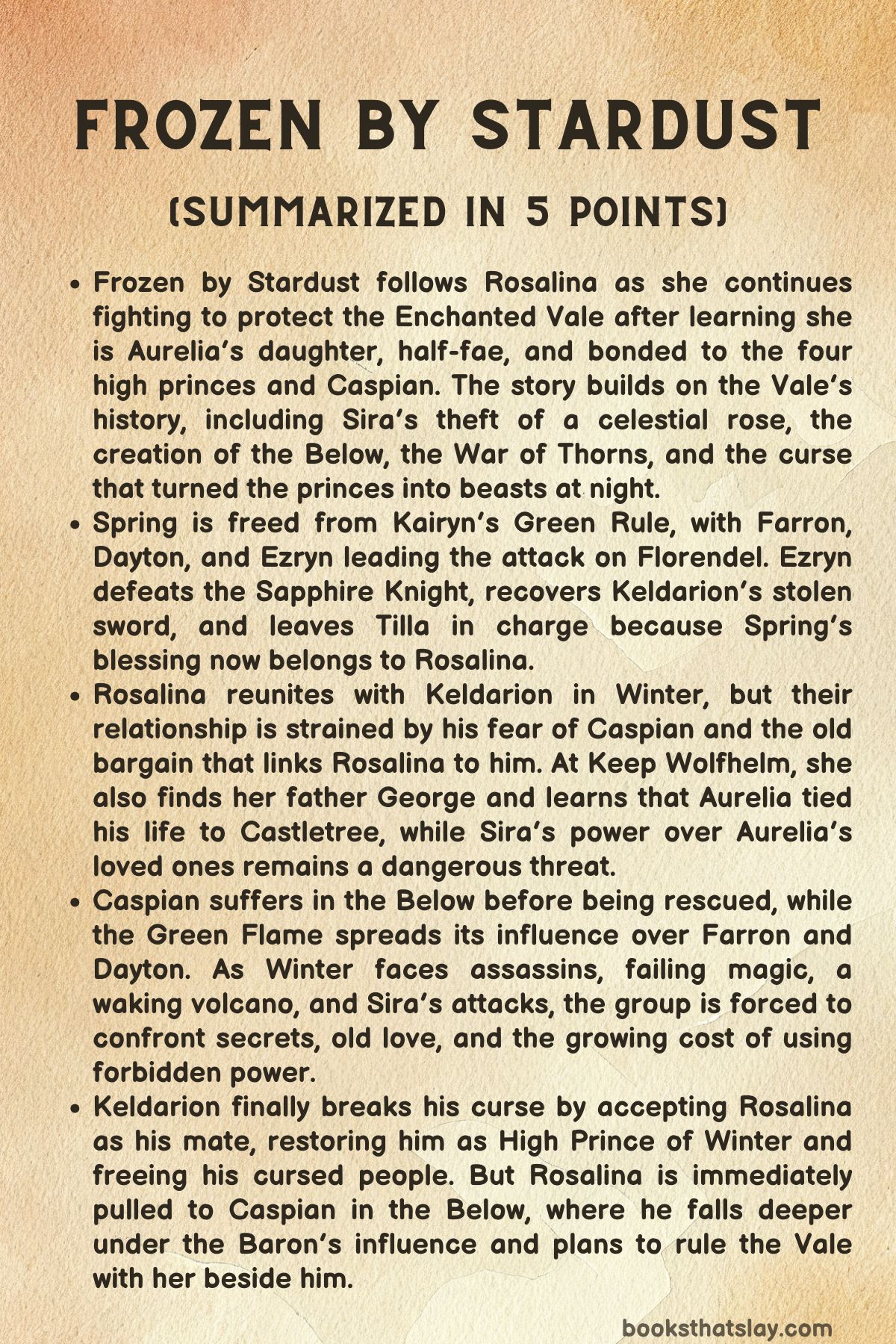
Summary
Frozen by Stardust begins against the background of an ancient fae history shaped by ambition, exile, and stolen power. Long before Rosalina O’Connell entered the Enchanted Vale, Sira, a fae from the Above, stole a celestial rose from the Gardens of Ithilias.
With it, she created the Below, but instead of beauty, her world produced warped and dangerous monsters. Rejected by the Above and consumed by rage, Sira turned against the old order and helped bring destruction to the world that had cast her out.
In the aftermath, Aurelia saved four celestial roses and used them to create the Enchanted Vale. She formed the seasonal realms, raised Castletree as the heart of the land, and became queen.
Yet peace did not last. Sira joined forces with Malekai Furiondemius, the Baron of the Green Flame, and raised her son, Caspian, the Prince of Thorns, inside a legacy of pain and vengeance.
When Aurelia vanished, the seasonal rulers struggled to hold the Vale together, and the realms began to weaken.
Caspian once stood close to Keldarion, the prince of Winter. They were lovers, and Caspian earned Keldarion’s trust before helping retrieve Sira’s missing rose.
But Sira twisted the situation to her advantage until Caspian attacked Winter and began the War of Thorns. Keldarion’s father died, the young princes inherited broken realms, and an enchantress later cursed Keldarion, Ezryn, Dayton, and Farron.
By day, they ruled as princes; by night, they became beasts. The curse could only be broken when their fated mate accepted their bonds.
That mate is Rosalina O’Connell, a woman from the human world who enters the Vale while searching for her missing father, George. Over time, she learns that she is not only half-fae but also Aurelia’s daughter.
She is bound by fate to the four high princes and to Caspian. By the time the events of this book begin, Summer has been freed, Dayton has been killed by Wrenley and then strangely revived, Spring has been taken over by Kairyn’s Green Rule, Aurelia is imprisoned by Sira, and Caspian has saved Rosalina only to be captured in the Below.
The story opens with the fight to free Spring. Farron, Dayton, and Ezryn lead an assault on Florendel, determined to end the Green Rule’s hold over the realm.
Ezryn defeats the Sapphire Knight and recovers Keldarion’s stolen Sword of the Protector, proving that the princes can still reclaim what has been taken from them. Yet Ezryn refuses to retake Spring’s throne.
The blessing has shifted to Rosalina, and he understands that the old structure of power has changed. Instead, he appoints Tilla as steward, trusting her to guide the realm while Rosalina’s role continues to grow.
Rosalina, meanwhile, is pulled into Winter through an old bargain between Keldarion and Caspian. At first, she falls briefly under Keldarion’s control, but she regains herself and reunites with him.
Their reunion is emotional but strained. Rosalina wants to save Caspian from the Below, while Keldarion refuses to help him.
His fear comes from history: Caspian once betrayed Winter, and Keldarion believes the old bargain could allow Caspian to trap Rosalina. Rosalina sees Caspian as someone who has saved her and suffered for her, but Keldarion sees the danger in loving someone tied so deeply to Sira.
At Keep Wolfhelm, Rosalina finds her father studying the shattered rose that Sira stole long ago. George reveals a painful truth: Aurelia once made a bargain with Sira that tied his life to Castletree.
He also explains that Sira owns whoever Aurelia loves more than him. This bargain adds another layer to the danger surrounding Rosalina, her mother, and the fate of the Vale.
Soon the princes arrive in Winter, and Rosalina reunites with Dayton, Ezryn, and Farron. Together, they discuss the threats before them: killing Sira, saving Caspian, healing Castletree, and defending Winter from whatever attack may come next.
Keldarion’s fear and refusal to accept his bond with Rosalina weaken him further. His curse worsens until he transforms into a monstrous wolf during the day, showing that the magic holding him together is breaking.
The curse is no longer just a private torment. It is becoming a threat to everyone around him.
In the Below, Caspian suffers under Emberlash’s torture while the Baron tempts him to accept the Green Flame. The power promises strength, but it comes with corruption and control.
Wrenley rescues Caspian, and Ezryn helps them escape to Winter. Their return does not solve the larger crisis.
Castletree continues to fail, staff members are losing themselves to their animal forms, and the Green Flame begins appearing around Dayton and Farron. The group eventually learns that Farron secretly used the Green Flame to bring Dayton back from death, though Caspian takes the blame to protect him.
This revelation shakes the trust among them because Farron’s love has led him toward a dangerous power.
An assassin attacks Keep Wolfhelm and warns that “the stars will fall.” The threat makes Rosalina realize that waiting will only allow Sira to grow stronger. She demands war, choosing action over fear.
The group travels through Winter to investigate the dangers spreading across the realm. During this time, Keldarion and Caspian slowly admit that their love for each other never truly died.
Their connection is filled with pain, betrayal, longing, and regret, but it also offers a chance at healing. For a short time, Rosalina and her mates feel like a family, united by shared purpose.
That unity is tested when Mount Rhuvenmark begins to awaken. Sira and Faustrius capture Kairyn and turn him into an Elderblood, using ancient magic to direct Winter’s volcano against the realm.
The attack threatens to destroy Winter from within. Farron responds by accepting more of the Green Flame in order to save everyone.
His choice works, but it frightens Dayton and the others because each use of that power seems to pull him closer to something unstable and inhuman.
Sira then invades Keep Wolfhelm with Wrenley and Faustrius. During the attack, Wrenley is revealed to be Kairyn’s mate.
Her bond gives her the strength to resist Sira, but Sira punishes that resistance by ordering Wrenley to kill herself. To save Wrenley, Caspian makes a terrible choice.
He bargains himself into Sira’s control and becomes her weapon once more.
Under the influence of the Green Flame, Caspian controls Dayton and Farron and turns against the others. He battles Keldarion, forcing the old wounds between them into open violence.
Keldarion nearly kills him, but Rosalina stops him. She refuses to give up on Caspian, even after everything he has done and everything Sira has made him become.
Caspian retreats to the Below, and Rosalina promises that she will come to him.
After this, Rosalina pushes Keldarion to finally face his curse and accept their bond. He proposes to her, mates with her, and is restored as the High Prince of Winter.
His transformation breaks the curse over the staff, freeing them from the animal forms that had been consuming them. It is a moment of victory, but it comes with an immediate cost.
Because of the bargain, Rosalina is sent to Caspian in the Below as his thrall.
Keldarion, newly restored and fully aware of what he stands to lose, rallies Ezryn, Dayton, and Farron. He is ready to fight not only for Rosalina but also for Winter and the future of the Vale.
When volcanic destruction threatens the realm, he uses immense celestial power, pulling stars from the sky to seal the lava and save his people. His act proves that Winter’s ruler has returned, but the larger war remains unresolved.
The book ends in a dark and uncertain place. Farron and Dayton investigate the damage left behind, while Caspian, now empowered by the Baron, takes Rosalina fully under his control in the Below.
He plans to rule the Vale with her beside him, not as the man who once saved her, but as a prince shaped by Sira’s cruelty and the Baron’s power. Rosalina’s fate, Caspian’s soul, and the future of the Enchanted Vale are left hanging between love and ruin.
Characters
In Frozen by Stardust, the characters are shaped by love, betrayal, ancient magic, inherited trauma, and the painful cost of power. Each major figure carries a different kind of wound, and the story uses those wounds to show how loyalty, fear, ambition, and sacrifice can either save a realm or destroy it.
Rosalina O’Connell
Rosalina O’Connell stands at the emotional center of the book because she connects the human world, the fae realms, the seasonal princes, Aurelia’s legacy, and Caspian’s darkness. At first, she appears to be a daughter searching for her missing father, but her journey becomes much larger when she discovers that she is half-fae and Aurelia’s daughter.
This revelation transforms her from an outsider into someone whose existence carries political, magical, and emotional consequences for the entire Vale. Rosalina is not merely pulled into the conflicts around her; she gradually becomes the person around whom those conflicts reorganize.
Her greatest strength is her capacity to love without surrendering her moral judgment. She loves Keldarion, Ezryn, Dayton, Farron, and Caspian in different ways, but she does not excuse their worst choices simply because she is bonded to them.
Her love is active, demanding, and often confrontational. She pushes Keldarion to face his fear, refuses to abandon Caspian even when others see him as too dangerous, and insists that the princes stop reacting only from pain.
This makes her a powerful emotional force because she does not simply comfort broken men; she challenges them to become worthy of healing.
Rosalina is also marked by increasing authority. By the time Spring’s blessing rests with her, she is no longer just someone discovering her identity.
She becomes a symbolic and magical heir to Aurelia’s unfinished work. Her demand for war after the assassin’s warning shows how much she has changed.
She begins the story searching for family, but she grows into someone willing to defend an entire world. Her tragedy lies in the fact that her compassion makes her vulnerable.
The same bond that allows her to reach Caspian also places her under his control, proving that love in this story can be both salvation and a weapon.
Caspian
Caspian is one of the most tragic and morally complex figures in the book. He is the Prince of Thorns, Sira’s son, Keldarion’s former lover, Rosalina’s fated mate, and a man repeatedly pulled between love and corruption.
His past with Keldarion gives him emotional depth because he was not always simply an enemy. He once earned Keldarion’s trust and love, but that trust was twisted through Sira’s manipulation and the events that led to the War of Thorns.
This history makes Caspian a character defined by both intimacy and betrayal.
Caspian’s greatest conflict is his struggle against control. He is dangerous, seductive, wounded, and capable of terrible acts, yet the story repeatedly shows that he is also a victim of forces stronger and older than himself.
Sira uses him, the Baron tempts him, and the Green Flame turns his pain into a weapon. His decision to bargain himself into Sira’s control to save Wrenley is especially revealing because it shows that beneath his darkness, he still has a self-sacrificing instinct.
He is not innocent, but he is not empty of goodness either.
His relationship with Rosalina deepens his tragedy. She sees the part of him that can still be saved, even when others are ready to kill him.
However, by the end, his empowerment through the Baron and his control over Rosalina show how far he has fallen. Caspian becomes frightening because his love and possessiveness blur together.
He wants Rosalina beside him, but under the influence of darker power, that desire becomes domination. He is a character whose longing for love is constantly poisoned by the need for control.
Keldarion
Keldarion is the High Prince of Winter and one of the most emotionally guarded characters in the story. His coldness is not simply a personality trait; it is a defense built from grief, betrayal, guilt, and fear.
Caspian’s betrayal and the death of Keldarion’s father left him deeply scarred, and those wounds shape nearly every choice he makes. His refusal to help Caspian is not born only from cruelty, but from terror that history will repeat itself and Rosalina will be trapped by the same darkness that once destroyed him.
His curse reflects his inner condition. Becoming a beast at night, and later worsening into a monstrous wolf during the day, symbolizes how much of himself he has tried to suppress.
Keldarion’s emotional repression makes him dangerous not because he lacks love, but because he fears what love can cost. He wants to protect Rosalina, yet his protection often becomes control.
This makes him a powerful romantic and dramatic figure because his arc depends on learning that love cannot survive if it is ruled by fear.
Keldarion’s restoration is one of the most significant transformations in the book. When he finally accepts his bond with Rosalina, proposes, and breaks his curse, he becomes not just a healed lover but the restored High Prince of Winter.
His later act of pulling stars from the sky to stop the volcanic destruction shows the full return of his power and purpose. Keldarion’s journey is about moving from isolation to leadership, from fear to trust, and from being ruled by the past to fighting for the future.
Ezryn
Ezryn is a disciplined, noble, and quietly powerful character whose actions often reveal his integrity more than his words. He plays a crucial role in the liberation of Spring, defeating the Sapphire Knight and recovering Keldarion’s stolen Sword of the Protector.
These actions show that Ezryn is not merely a supportive prince in Rosalina’s circle; he is a capable warrior and leader who understands duty. His strength lies in his ability to act decisively when the Vale is unstable.
What makes Ezryn especially admirable is his refusal to reclaim Spring’s throne when the blessing now rests with Rosalina. This decision shows humility and respect for the deeper magical order of the realm.
Many characters in the story struggle with power, inheritance, and possession, but Ezryn’s relationship with authority is more mature. He does not cling to a title simply because it once belonged to him.
Instead, he recognizes that true leadership sometimes means stepping aside and protecting what must come next.
Ezryn also serves as a stabilizing presence among the princes. He helps Wrenley and Caspian escape to Winter, participates in the larger effort to save Rosalina, and continues to act with honor even when the world around him is filled with betrayal and fear.
His character represents loyalty without possessiveness and strength without arrogance. In a story where power often corrupts or frightens people, Ezryn stands out as someone who tries to use power responsibly.
Dayton
Dayton is a character marked by passion, vulnerability, death, resurrection, and emotional intensity. His death at Wrenley’s hands and mysterious revival create one of the story’s most unsettling emotional threads.
Being brought back to life through the Green Flame places him in a deeply unnatural position. He is alive, but the method of his return carries consequences that neither he nor the others fully understand at first.
This makes Dayton a symbol of love’s desperate choices and the danger of refusing to let go.
Dayton’s connection with Farron is especially important because Farron’s decision to use the Green Flame to resurrect him reveals how deeply loved Dayton is. However, that love becomes frightening because it crosses a boundary.
Dayton’s existence after resurrection is tied to a magic associated with corruption, control, and the Baron’s influence. His fear when Farron embraces more of the Green Flame shows that Dayton understands the emotional cost of survival.
He does not want to be saved if saving him destroys someone else.
Dayton brings warmth and emotional openness to the group, but his arc is shadowed by the question of what his second life means. He is both a beloved prince and evidence of a dangerous secret.
Through him, the story explores whether love can justify forbidden magic and whether being brought back from death can ever be free of consequence. Dayton’s character is tender, painful, and deeply tied to the theme of sacrifice.
Farron
Farron is one of the most burdened characters in the story because his love leads him into morally dangerous territory. His secret use of the Green Flame to resurrect Dayton is an act of devotion, but it also reveals his willingness to risk corruption for the people he loves.
Farron’s tragedy is that his heart is often in the right place, while his methods place him and others in danger. He is not power-hungry in a simple sense; he reaches for forbidden power because he cannot bear loss.
His relationship with the Green Flame becomes one of the most important signs of his inner conflict. When the flame appears around him and Dayton, and when it is revealed that Farron used it, the story exposes how much fear and guilt he has been carrying.
Caspian taking the blame temporarily protects Farron, but it also shows how tangled the group’s loyalties have become. Farron is a character whose secrets are born from love, yet those secrets weaken trust.
Farron’s later decision to embrace more of the Green Flame to save everyone shows both his courage and his danger. He is willing to sacrifice himself, but the form that sacrifice takes terrifies Dayton and the others.
Farron represents the painful question of whether a good person can keep using a corrupting force without becoming corrupted. His arc is emotional because he is not careless; he is desperate, loving, frightened, and increasingly aware that his choices may have consequences he cannot undo.
Sira
Sira is the central destructive force behind much of the story’s suffering. As a fae from the Above, she stole a celestial rose and used it to create the Below, but her creations became twisted monsters.
Her rejection by the Above hardened into rage, and that rage eventually helped destroy the old world. Sira’s character is rooted in wounded pride, creative ambition, and resentment.
She wanted to make something of her own, but when her creation became monstrous and she was rejected, she chose vengeance instead of repentance.
Her relationship with power is deeply possessive. She does not simply want to rule; she wants to own, manipulate, and bend others to her will.
Her bargain with Aurelia, her control over Caspian, her imprisonment of Aurelia, and her command over Wrenley all show that Sira sees love as a weakness to exploit. She understands emotional bonds very well, but she uses that understanding cruelly.
This makes her especially dangerous because she attacks people through what they cherish most.
Sira is also a dark mirror to Aurelia. Both are creators connected to roses and realms, but Aurelia creates to preserve life while Sira creates from defiance and later rules through domination.
Sira’s transformation of Kairyn into an Elderblood and her use of ancient magic against Winter show that she is not only personally cruel but also cosmically dangerous. She is a villain shaped by rejection, but the story does not excuse her.
Her pain becomes monstrous because she turns it outward and makes entire worlds suffer for it.
Aurelia
Aurelia is one of the most important foundational figures in the story because her choices shaped the Enchanted Vale itself. After the destruction of the old world, she saved four roses and created the seasonal realms and Castletree.
This makes her a figure of preservation, creation, and sacrifice. Her queenship is not simply political; it is woven into the magical structure of the world.
The Vale exists because Aurelia acted when everything else had fallen apart.
Her disappearance leaves the seasonal rulers struggling to maintain stability, which shows how central she was to the balance of the realm. Yet Aurelia is not presented as flawless.
Her bargain with Sira, which ties George’s life to Castletree and gives Sira power over those Aurelia loves more than him, reveals the dangerous cost of desperate choices. Like many characters in the story, Aurelia makes decisions out of love, but those decisions create lasting consequences.
As Rosalina’s mother, Aurelia also represents hidden identity and inherited destiny. Rosalina’s discovery that she is Aurelia’s daughter changes the meaning of her presence in the Vale.
Aurelia’s legacy becomes both a gift and a burden. She created a world worth saving, but she also left behind bargains and secrets that threaten those she loves.
Her character is powerful because she embodies both maternal love and queenly responsibility, showing how difficult it is to protect a world without sacrificing parts of oneself.
Malekai Furiondemius, the Baron of the Green Flame
Malekai Furiondemius, the Baron of the Green Flame, is a sinister figure associated with temptation, corruption, and unnatural power. His alliance with Sira places him among the story’s most dangerous antagonistic forces, but his power is distinct from hers.
While Sira manipulates through bonds, bargains, and ancient resentment, the Baron tempts characters with the Green Flame, offering power at the cost of moral and spiritual safety.
His influence over Caspian is especially important. While Caspian is tortured in the Below, the Baron tempts him to accept the Green Flame, presenting corruption as survival and empowerment.
This makes the Baron dangerous because he does not always need to force people immediately; he waits for pain, desperation, or fear to make his offers appealing. He understands that people are most vulnerable when they are broken.
The Baron’s connection to the Green Flame also affects Farron and Dayton, even when he is not physically present. The flame’s role in Dayton’s resurrection and Farron’s increasing dependence on it show how the Baron’s power spreads through choices that seem loving or necessary.
By the end, Caspian’s empowerment through the Baron makes him even more threatening. The Baron functions as a corrupter who turns grief, love, and ambition into channels for domination.
George O’Connell
George O’Connell is Rosalina’s father and one of the most emotionally significant human connections in the story. His presence grounds Rosalina’s journey because her search for him is what first pulls her toward the truth of the Vale.
Although much of the story is filled with fae politics, curses, ancient wars, and magical realms, George represents family, human love, and the personal stakes beneath the larger conflict.
His study of Sira’s shattered rose shows that he is not passive or ignorant. He has been drawn into the magical history of the Vale and has tried to understand forces far beyond ordinary human life.
His connection to Castletree through Aurelia’s bargain makes him both protected and trapped. His life being tied to Castletree turns him into a living symbol of the consequences of Aurelia’s love and Sira’s cruelty.
George’s importance lies not in battlefield power but in emotional truth. Through him, Rosalina learns more about Aurelia, Sira, and the bargains that shape her own fate.
He reminds the story that the conflict is not only about thrones and realms; it is also about parents, children, and the terrible price of trying to keep loved ones alive. His character adds tenderness and sorrow to the larger magical struggle.
Wrenley
Wrenley is a conflicted and painful character because she moves between violence, loyalty, coercion, and resistance. She is responsible for Dayton’s death, which places her in a morally difficult position from the beginning.
Yet she is not presented as a simple villain. Her later rescue of Caspian from the Below shows that she is capable of courage and loyalty, and her connection to Kairyn adds emotional depth to her role.
The revelation that Wrenley is Kairyn’s mate makes her resistance to Sira especially meaningful. Sira tries to control her, even ordering her to kill herself, but Wrenley’s bond and inner will create a moment of defiance.
This shows that beneath the violence and manipulation surrounding her, Wrenley still possesses a self that Sira cannot fully erase. Her character reveals how people can be used by evil forces while still retaining the capacity to resist.
Wrenley’s role also affects Caspian’s arc. Caspian bargains himself into Sira’s control to save her, proving that Wrenley matters enough to him for him to sacrifice his freedom.
This act complicates both characters. Wrenley is not merely someone who has caused harm; she becomes someone whose survival exposes the remaining goodness in Caspian.
Her character is tragic because she is tied to pain on all sides, yet she still becomes a reason someone chooses sacrifice.
Kairyn
Kairyn is a figure connected to occupation, political control, and later personal victimization. Through the Green Rule, Spring falls under his authority, making him part of the oppressive force that must be overthrown.
His control over Spring places him in opposition to the princes and Rosalina’s growing claim, and his rule represents one of the ways Sira’s wider influence destabilizes the Vale.
However, Kairyn becomes more complicated when Sira and Faustrius capture him and transform him into an Elderblood. This shift changes him from an occupying power into someone who is also used by greater forces.
His transformation shows Sira’s cruelty and the way she treats even useful allies or pawns as material for her own plans. Kairyn’s body and fate become tools in her attack on Winter and the realm’s stability.
His bond with Wrenley also humanizes him. The revelation that Wrenley is his mate reframes part of her struggle and gives Kairyn emotional significance beyond his political role.
He is a character caught between being an antagonist and being a victim of monstrous manipulation. Through him, the story shows how power structures can consume even those who seem to benefit from them.
Emberlash
Emberlash is a cruel figure associated with Caspian’s suffering in the Below. His role in torturing Caspian makes him a direct embodiment of physical brutality and intimidation.
While some antagonists in the story operate through bargains, seduction, or ancient magic, Emberlash represents a more immediate kind of violence. He is the hand of punishment in a place already defined by corruption and pain.
His treatment of Caspian is important because it deepens the reader’s understanding of Caspian’s vulnerability. Caspian may be dangerous and morally compromised, but his torture shows that he is also trapped in systems of abuse and control.
Emberlash’s cruelty helps explain why the Below is not merely a place but a condition of suffering. It is a realm where pain is used to break people and make them easier to possess.
Emberlash does not need the same emotional complexity as the central characters to be effective. His function is to reveal the brutality behind the Baron’s and Sira’s worlds.
Through him, the story shows what happens to those who fall into the hands of powers that do not value freedom, mercy, or love.
Faustrius
Faustrius is a dangerous supporting antagonist whose actions help Sira escalate the threat against Winter. His involvement in capturing Kairyn and transforming him into an Elderblood makes him part of the ancient and horrifying magic that threatens the realm.
He is not simply a follower standing in the background; he actively participates in the manipulation of bodies, power, and natural forces.
His role in the awakening of Mount Rhuvenmark and the attack on Winter connects him to one of the story’s largest external threats. Where Sira’s cruelty is personal and strategic, Faustrius helps carry out the magical violence that turns the land itself into a weapon.
This makes him an extension of the story’s darker forces, especially those that corrupt the balance between realm, ruler, and magic.
Faustrius also appears during the invasion of Keep Wolfhelm, reinforcing his place among Sira’s most dangerous allies. He represents the type of character who enables evil not merely through loyalty, but through active participation in its rituals and plans.
His presence increases the sense that Sira’s campaign is organized, ancient, and deeply threatening.
Tilla
Tilla represents stability, trust, and practical leadership after the liberation of Spring. When Ezryn appoints her as steward, it signals that the realm needs more than warriors and heirs; it needs people capable of guiding recovery.
Tilla’s role may not be as dramatic as that of the princes or villains, but it is significant because rebuilding a realm requires dependable leadership.
Her appointment also reflects Ezryn’s wisdom. By placing Tilla in a position of authority, he acknowledges that Spring’s future must be handled carefully while Rosalina’s blessing changes the political and magical order.
Tilla becomes part of the transition between old rule and new possibility. Her character helps show that after occupation and war, survival depends on governance as much as victory.
Tilla’s importance lies in what she represents. She stands for the ordinary but essential work of restoration.
While others fight curses, flames, monsters, and ancient enemies, Tilla’s stewardship suggests that the Vale’s future will also depend on those who can preserve order, protect people, and help a wounded realm function again.
Themes
Love as Protection and Possession
Love in Frozen by Stardust is never simple, because nearly every bond carries both comfort and danger. Rosalina’s relationships with the princes show love as a force that can heal curses, restore identity, and give broken rulers the courage to face their failures.
Her acceptance of Keldarion’s bond does more than affirm romance; it releases Winter from years of fear, isolation, and beastly transformation. Yet the same idea of attachment becomes threatening when bargains and control enter the story.
Aurelia’s love is used against George, Caspian’s love for Wrenley traps him under Sira’s power, and Rosalina’s connection to Caspian becomes a path for domination rather than safety. The theme becomes powerful because love is shown as something that can save a person only when it is freely chosen.
When it is twisted into ownership, it becomes another kind of curse. The story repeatedly contrasts devotion with possession, asking whether love can remain pure in a world where magic turns emotional bonds into weapons.
Power, Corruption, and Moral Compromise
Power in the story is rarely neutral; it tests the character of whoever holds it. The Green Flame represents this most clearly, because it offers impossible solutions while demanding a hidden cost.
Farron uses it to bring Dayton back, an act born from grief and love, but that choice also stains him with fear, secrecy, and future danger. Caspian faces a similar struggle in the Below, where pain and desperation make the Baron’s offer more tempting.
Sira’s history shows the most extreme version of corruption: creation becomes control, rejection becomes vengeance, and wounded pride becomes war. Even rulers who want to protect their realms are forced into morally difficult choices.
Keldarion must decide whether to kill Caspian to protect Rosalina, while Rosalina must decide whether saving someone she loves is worth risking everyone else. The theme works because power does not simply make characters evil.
Instead, it exposes their deepest fears, their loyalty, and the limits of what they are willing to sacrifice.
Healing from Guilt, Fear, and Broken Trust
Many characters are trapped not only by magic, but by guilt and fear. Keldarion’s curse worsens because he cannot fully release his terror of being betrayed again, especially after Caspian’s past actions helped destroy his trust.
His emotional damage becomes physical, turning him into a monstrous version of the pain he refuses to face. Caspian also carries guilt, both for the harm he caused and for the ways he has been used by Sira.
His love for Keldarion remains, but it is buried under shame, manipulation, and survival. Rosalina becomes a force of healing because she insists that these wounds must be confronted rather than hidden.
She challenges Keldarion’s refusal to save Caspian, pushes him toward acceptance, and helps him break the curse by choosing love over fear. The story treats healing as difficult and incomplete.
Forgiveness does not erase betrayal, and trust does not return instantly. Instead, recovery requires honesty, vulnerability, and the courage to believe that broken people can still choose differently.
Identity, Inheritance, and the Burden of Destiny
Rosalina’s identity changes the entire political and magical structure of the Vale. She begins as someone searching for her father, but she learns that she is tied to Aurelia, the seasonal realms, the roses, and the fate of Castletree itself.
This revelation does not simply give her importance; it places an enormous burden on her. The blessings moving toward her suggest that leadership is no longer just about birthright or throne, but about who can restore balance when old systems fail.
Ezryn’s refusal to retake Spring’s throne strengthens this theme, because he recognizes that power has shifted and that clinging to the past will not save the realm. Caspian also struggles with inherited identity, shaped by Sira, the Baron, and the title of Prince of Thorns.
He is constantly pulled between who others made him and who he might still choose to become. The story presents destiny as both a calling and a trap, showing that identity is meaningful only when characters actively decide what to do with it.