Flirting with Murder Summary, Characters and Themes
Flirting with Murder by Amanda Sellet is a lively young adult mystery set inside a theatrical Florida condo community filled with secrets, suspects, and dramatic personalities. The story follows Virginia, who arrives at Castle Claude for a family friend’s celebration of life and quickly finds herself caught between grief, inheritance drama, and a real murder.
With Felix, a charming boy connected to the same will, she begins sorting through clues while trying to understand who can be trusted. The book mixes comedy, romance, family loyalty, and classic whodunit energy, creating a bright, playful mystery about legacy, greed, and unexpected connection.
Summary
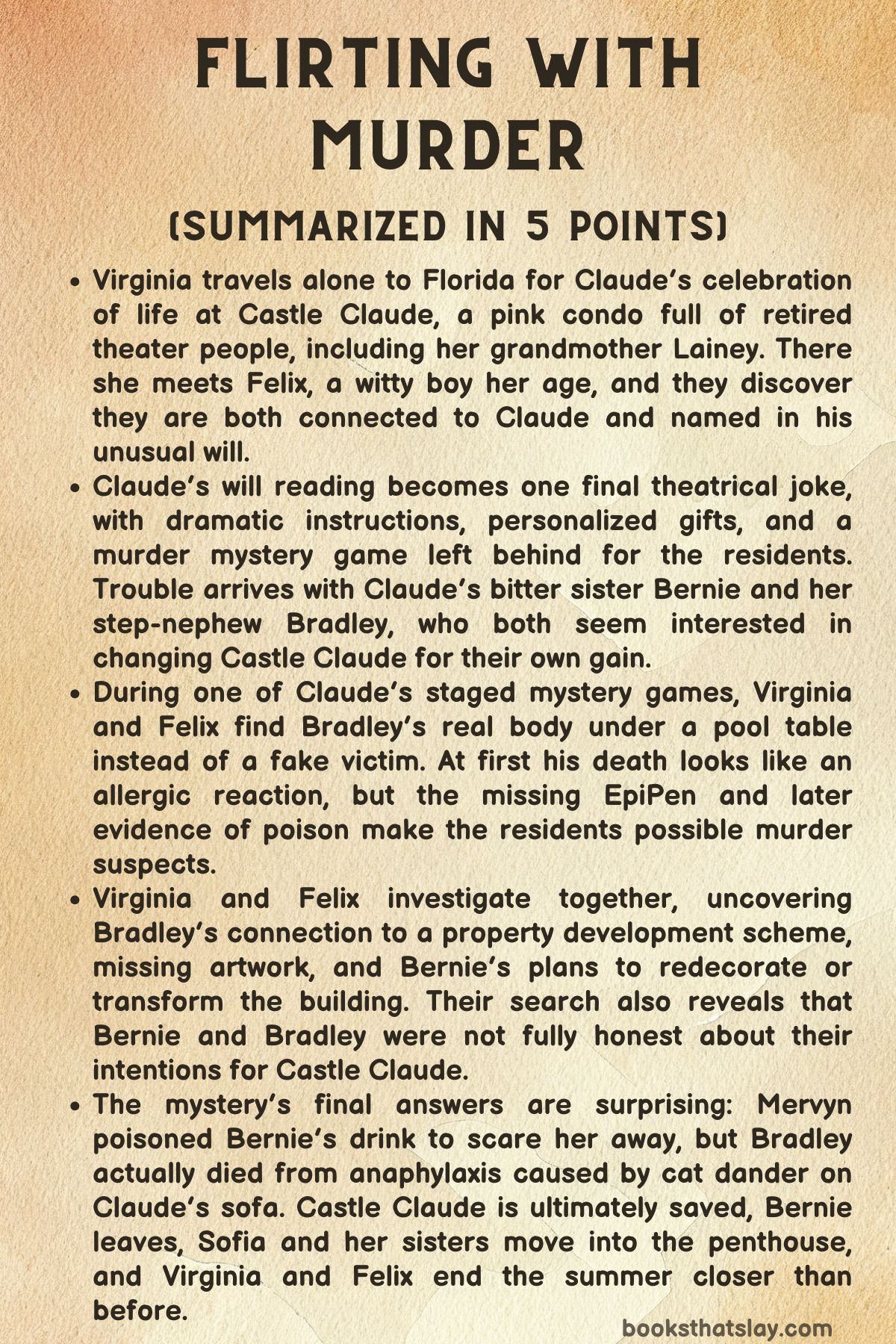
Virginia travels by herself to Florida to attend Claude’s celebration of life at Castle Claude, a bright pink condo building where her grandmother Lainey lives with a close group of retired theater people. Claude was not a blood relative, but he had been part of Virginia’s family world for years, and his death has pulled her into a strange new situation.
He was a former dinner-theater performer, beloved by the residents of Castle Claude, and apparently eccentric enough to arrange surprises even after his death. Virginia has also learned that Claude left her something in his will, though she does not yet know why or what it means.
Her trip begins with delays, awkward waiting, and a chance meeting with Felix, a boy around her age who is funny, dramatic, and quick with a joke. They meet while waiting for luggage, and their first conversation has the uneasy rhythm of two people who are interested in each other but unwilling to show it too clearly.
Their banter becomes sharper when they realize they are both headed to Castle Claude. The coincidence is even stranger when they discover they are both connected to Claude and both named in his will.
At Castle Claude, Virginia enters a world that feels part retirement community, part theater troupe, and part preserved shrine to Claude’s taste. The residents are colorful and devoted to one another.
Her grandmother Lainey is one of them, and so are several of Claude’s friends, each with their own habits, talents, and secrets. Claude’s celebration of life soon turns into one final performance, because even his will has been planned like a show.
His lawyer, Mervyn, follows Claude’s instructions with dramatic timing, theatrical sound effects, jokes, and carefully chosen gifts.
Claude leaves a strange portrait of himself to the building, complete with eyes that seem to move. He leaves a harp to Malia, knives to Mr. Namura, makeup supplies to Mrs. A, an art monograph to Mr. Gutierrez, and a baton to Lainey.
Virginia receives a ring and trench coat, while Felix receives a velvet jacket and pen. The gifts feel odd at first, but they suit Claude’s personality and seem chosen to draw everyone into his last game.
The mood changes when Claude’s sister Bernie arrives with her step-nephew Bradley. Bernie expected to inherit Castle Claude and is furious to learn that she does not.
Mervyn explains that she receives only Claude’s penthouse, and even that comes with a condition: she must live there for three months, or the apartment will revert to the condo board. Bernie immediately treats the building and its residents with contempt.
She insults Claude’s taste, the décor, and the people who loved him. Bradley is no better.
He behaves like an opportunist, lingering around the condo, bothering Virginia even after finding out she is still in high school, and talking about turning Castle Claude into something trendy and profitable.
Claude has also left behind instructions for one of the group’s murder mystery games. Virginia and Felix are pulled into the staged mystery, playing roles, searching for clues, and competing with each other.
Their rivalry gives them an excuse to spend time together. They tease, challenge, and test each other, and Virginia keeps shifting between attraction and suspicion.
Felix is charming, but because everyone at Castle Claude seems to have a motive for something, she does not fully rule him out as a possible threat.
Then the fake mystery turns real. During one of the games, Virginia and Felix investigate a staged body in the library: Mrs. A, playing her assigned part.
While they are searching and joking over clues, they hear a noise from the billiards room. There, under the pool table, they find Bradley’s actual body.
The shock tears through the building. Bernie screams and immediately accuses the residents of killing him.
Detective Ortiz first considers the possibility that Bradley died from an allergic reaction. He had severe allergies, so anaphylaxis seems likely.
But the situation becomes more troubling when his EpiPen cannot be found. The missing EpiPen suggests that someone may have kept him from saving himself.
Virginia and Felix begin investigating quietly. They want to protect their grandparents and the other residents, but they are also drawn to the puzzle.
The staged mystery has become a real one, and neither of them can resist trying to solve it.
Their search uncovers more than they expected. Bradley had ties to Odell Property Development, suggesting that his interest in Castle Claude was not casual.
Virginia and Felix also find one of Mr. Gutierrez’s paintings in a resale store, which raises the possibility that Bradley had been trying to sell art taken from the building. The discovery makes him look less like an annoying visitor and more like someone actively exploiting Claude’s home and friends.
Bernie’s plans also become suspicious. She clearly hates the building as it is, and Virginia and Felix learn that she has ideas for redecorating or transforming Castle Claude into something bland and marketable.
The building’s theatrical, strange, personal charm is exactly what she wants to erase. Later, Virginia and Felix break into Bernie’s apartment while she is away, hoping to learn more.
When Bernie returns unexpectedly, they hide in a broom closet and overhear enough to confirm that she and Bradley were involved in a deal that could threaten the future of Castle Claude. They also see plans that suggest the building might be stripped of its character and remade for profit.
When toxicology results show that Bradley had plant poison in his system, the case shifts from suspicious death to murder. The residents of Castle Claude become possible suspects.
Virginia and Felix interview people, compare stories, and search for clues hidden beneath everyone’s theatrical behavior. They look into Bernie’s special Crystal Light cup, the toxic plants that had once been removed from the courtyard, and the ways someone could have poisoned Bradley without being seen.
Claude’s strange portrait becomes important. The moving eyes are not just a creepy joke; they conceal a hidden viewing spot.
Virginia and Felix use it to spy on a staged confrontation between Mervyn and Bernie. During the confrontation, Bernie admits that Bradley came to her apartment, drank from her cup, and talked about his own plan for the building.
He then had some kind of attack in the billiards room. Bernie also suggests that she did not properly help him, and that she planted evidence to redirect suspicion.
Her actions are selfish and cruel, and she clearly cared more about protecting herself than saving Bradley.
The next revelation changes the case again. Mervyn confesses that he put poison in Bernie’s cup.
His goal was not to kill Bradley. He wanted to make Bernie sick enough that she would leave Castle Claude before completing the required three months in the penthouse.
If she left early, she would lose her claim, and the apartment would return to the condo board. Mervyn acted out of loyalty to Claude, the residents, and the building, but his plan went terribly wrong when Bradley drank from Bernie’s cup instead.
Detective Ortiz arrives while questions about missing paintings and property schemes are still unfolding, and Mervyn confesses to what he did. It seems at first that the murder has been solved: Mervyn poisoned the cup, Bradley drank from it, and Bradley died.
But later, Lainey learns the final truth. Bradley did not actually die from the poison.
He died from anaphylaxis caused by cat dander after sitting on Claude’s sofa, where Zenobia the cat often lounged. Bradley’s allergies, the missing EpiPen, and Bernie’s failure to help him created the fatal chain of events.
The poison would have killed him if he had survived the allergic reaction, so Mervyn is still responsible for a dangerous crime, but he did not cause Bradley’s actual death.
With the truth revealed, Castle Claude is saved from Bernie’s plans. Bernie leaves, and because she does not fulfill the terms of Claude’s will, the penthouse reverts to the condo board.
The future of the building remains in the hands of the people who truly loved Claude and the community he built. Sofia and her sisters move in, giving Castle Claude a new chapter without stripping away its personality.
Virginia’s summer ends very differently from how it began. She arrived alone, uncertain, and unsure why Claude had included her in his final plans.
By the end, she has helped uncover the truth, protected her grandmother’s community, and found a connection with Felix that is equal parts rivalry, friendship, and romance. Their final moments together in the pool are playful and open-ended.
They joke about what comes next, but the mystery has changed them. Castle Claude remains strange, theatrical, and alive, and Virginia leaves the case with a stronger sense of courage, family, and possibility.
Characters
In Flirting with Murder, the characters are shaped by secrets, performance, loyalty, greed, grief, and the desire to protect a strange but beloved home. Each person connected to Castle Claude adds something different to the mystery, whether through suspicion, humor, emotional warmth, or hidden motives.
Virginia
Virginia is the central young investigator of the story, and her role is important because she enters Castle Claude as both an outsider and someone with a personal connection to its people. She is curious, observant, and competitive, especially when she realizes that Claude’s will has placed her in the middle of a theatrical mystery.
Her intelligence shows through the way she notices inconsistencies, follows clues, and refuses to accept easy explanations. At the same time, she is not presented as perfectly calm or detached; she can be suspicious, awkward, and emotionally guarded, especially around Felix.
This makes her feel more realistic because her detective instincts are mixed with teenage uncertainty.
Virginia’s relationship with Castle Claude develops throughout the story. At first, she comes because of Claude’s celebration of life and because he has left her something in his will, but gradually she becomes invested in protecting the building and the people who live there.
Her connection to Grandma Lainey gives her a personal reason to care, yet her sense of justice also grows stronger as the mystery deepens. She does not investigate only for excitement; she investigates because she understands that the residents could be wrongly accused and that Castle Claude itself could be destroyed by greed.
Virginia’s dynamic with Felix is one of the most entertaining parts of her character. She treats him as a rival, possible suspect, and romantic interest all at once, which creates tension and humor.
Their banter reveals her sharpness, but it also reveals her fear of trusting too easily. By the end of the story, Virginia becomes more open, not only to Felix but also to the strange, theatrical world of Castle Claude.
Her growth comes from learning that mystery-solving is not just about finding the culprit; it is also about understanding people, protecting community, and accepting that affection can exist alongside suspicion.
Felix
Felix is witty, theatrical, and charming, and he immediately stands out because he matches the dramatic energy of Castle Claude. From his first meeting with Virginia, he brings humor and flirtation into the story, but he is more than just comic relief.
He is also intelligent, observant, and genuinely invested in solving the mystery. Like Virginia, he is connected to Claude and included in the will, which gives him a personal reason to remain involved.
His inherited velvet jacket and pen reflect his connection to performance, style, and storytelling.
Felix’s role in the book is especially important because he balances Virginia’s suspicion with playfulness. He enjoys the staged mystery games and seems comfortable with theatrical behavior, but he also recognizes when the game has turned into something dangerous.
His ability to joke during tense moments does not mean he lacks seriousness. Instead, humor becomes one of the ways he handles fear, uncertainty, and attraction.
He understands the absurdity of the situation, yet he does not dismiss the danger facing the residents.
His relationship with Virginia develops through competition and trust. Their bond begins with flirtatious awkwardness and grows through shared investigation.
Felix challenges Virginia, but he also supports her. He does not simply follow her lead; he contributes his own observations and takes risks alongside her.
By the end of the story, Felix becomes part of Virginia’s emotional journey as well as the mystery plot. He represents the possibility that rivalry can become partnership and that affection can grow in the middle of chaos.
Claude
Claude is physically absent for most of the story, but his personality dominates the entire novel. He is remembered as a beloved family friend, former dinner-theater performer, and the imaginative force behind Castle Claude’s strange charm.
Even after death, he controls the atmosphere through his will, gifts, jokes, dramatic instructions, and murder mystery game. His celebration of life is not ordinary; it becomes one last performance, showing that Claude saw life itself as something theatrical.
Claude’s gifts reveal how well he understood the people around him. He does not leave random objects; he leaves items that reflect the personalities, talents, and histories of his friends.
These gifts show affection, humor, and deep knowledge of the Castle Claude community. His portrait with moving eyes is especially symbolic because it turns him into a lingering presence in the building.
Even after death, Claude seems to be watching, guiding, and complicating events.
Claude also represents the heart of Castle Claude. The building’s bright, dramatic identity is tied to his personality, and the residents’ grief shows how much he meant to them.
His death creates the legal and emotional conflict that drives the story, but his legacy also helps protect the community he loved. Claude’s character shows that someone can remain active in a story even after death when their choices, relationships, and spirit continue shaping everyone else.
Grandma Lainey
Grandma Lainey is one of the emotional anchors of the story. As Virginia’s grandmother and one of the retired theater people living at Castle Claude, she connects Virginia to the building’s past and present.
She is not simply a sweet older relative; she belongs to a lively, theatrical community with its own loyalties, secrets, and traditions. Her inherited baton reflects her role as someone with authority, rhythm, and command within this group.
Lainey’s importance lies in her connection to family and community. Through her, Virginia sees that Castle Claude is not just a condo building but a chosen home for people who have built meaningful lives together.
Lainey helps make the stakes personal. If Bernie or outside developers succeed, the residents will lose more than property; they will lose a shared world built from friendship, performance, memory, and belonging.
Lainey also becomes important in the final understanding of Bradley’s death. Her discovery that Bradley died from anaphylaxis caused by cat dander gives the mystery a final twist.
This detail shows that she is not merely a background figure waiting to be protected. She contributes to the truth and helps clarify the difference between intention, guilt, and the actual cause of death.
Her role strengthens the idea that every resident of Castle Claude has value and agency.
Bernie
Bernie is one of the main antagonistic figures in the story. As Claude’s hostile sister, she arrives expecting to inherit the whole building and immediately makes herself unpleasant to almost everyone.
Her insults toward Castle Claude, the residents, and Claude’s taste reveal her arrogance and lack of emotional connection to the place. Unlike the residents, who see the building as a home full of history, Bernie sees it as an asset to control.
Bernie’s greed and resentment make her suspicious from the beginning. She is connected to plans for redecorating and possibly transforming Castle Claude into something bland and profitable.
Her alliance with Bradley strengthens the threat she poses because their scheme could erase everything unique about the building. She does not understand or respect the theatrical spirit that Claude cultivated, and this makes her a direct opposite to him.
However, Bernie is not the simple murderer everyone might first imagine. Her actions are still morally ugly, especially when she fails to properly help Bradley and tries to shift suspicion, but the story complicates her guilt.
She is selfish, manipulative, and willing to protect herself, yet she is also a target of Mervyn’s poisoning plan. Bernie’s character adds tension because she is guilty of many things even if she is not guilty in the most straightforward way.
She represents greed, bitterness, and the danger of treating a beloved home as a business opportunity.
Bradley
Bradley is an openly unpleasant character whose behavior makes him easy to dislike. He is sleazy, entitled, and predatory in the way he hits on Virginia despite knowing she is still in high school.
His presence at Castle Claude feels invasive from the start. He talks about turning the building into a party-house concept, which shows that he has no respect for the residents or the emotional history of the place.
Bradley’s role is important because his death transforms the story from playful mystery game into real murder investigation. Before his body is found, the residents and younger characters are participating in staged mysteries and theatrical clues.
Once Bradley dies, the game becomes dangerous reality. His death exposes hidden schemes involving property development, stolen or resold art, and attempts to reshape Castle Claude for profit.
Although Bradley is the victim, the story does not romanticize him. He is still morally compromised, opportunistic, and threatening to the community.
His connection to Odell Property Development and the attempted sale of art suggest that he was actively involved in exploiting the building. His final fate is also layered: he is poisoned by Mervyn’s plan meant for Bernie, but he actually dies from anaphylaxis caused by cat dander.
This makes Bradley’s death both tragic and darkly ironic. His character shows how selfish schemes can spiral into consequences no one fully controls.
Mervyn
Mervyn begins as Claude’s lawyer and the person responsible for carrying out the will reading. At first, he appears to be a formal but theatrical figure, following Claude’s scripted instructions with dramatic pauses, jokes, thunder effects, and carefully timed gifts.
His willingness to honor Claude’s strange final performance suggests loyalty and affection. He understands Claude’s dramatic style and helps preserve it after his death.
As the story develops, Mervyn becomes much more morally complicated. His loyalty to Castle Claude and its residents pushes him into dangerous action.
He poisons Bernie’s cup, hoping to make her sick enough to leave and lose her claim to the penthouse. His motive comes from a desire to protect the building, but his method is reckless and criminal.
This makes him one of the most morally conflicted characters in the book because his goal is sympathetic while his actions are deeply wrong.
Mervyn’s confession is important because it shifts the mystery away from simple villainy. He did not intend to kill Bradley, yet his actions could have caused death.
The later revelation that Bradley died from an allergic reaction does not erase Mervyn’s guilt, because the poison would have killed Bradley if he had survived the anaphylaxis. Mervyn represents the danger of believing that a good cause justifies harmful actions.
His character shows how loyalty can become destructive when it loses moral restraint.
Malia
Malia is one of Claude’s friends and part of the Castle Claude community. Claude leaves her a harp, which suggests elegance, artistry, and a connection to performance or music.
Even though she does not dominate the central investigation, her presence helps establish the residents as a group of distinctive retired theater people rather than ordinary background characters. Each resident has a theatrical identity, and Malia contributes to that atmosphere.
Her importance comes from being part of the community that Bernie threatens. Malia helps represent what Castle Claude stands for: creativity, eccentricity, and chosen family.
The harp she receives is not only a gift but also a symbol of Claude’s understanding of her personality. Through characters like Malia, the story shows that Claude’s relationships were personal and carefully remembered.
Malia also adds to the suspect circle once Bradley’s death becomes a murder investigation. Like the other residents, she has a motive to dislike Bradley and Bernie because their plans endanger the building.
This makes her part of the larger web of suspicion, even if she is not ultimately responsible. Her character helps maintain the mystery’s sense that anyone in Castle Claude might be hiding something.
Mr. Namura
Mr. Namura is another member of Castle Claude’s theatrical community, and Claude’s gift of knives to him gives his character an immediate air of danger and drama. In a murder mystery setting, knives naturally create suspicion, which makes the gift both funny and unsettling.
Claude clearly understands how to make even a bequest feel like part of a performance.
Mr. Namura’s character contributes to the atmosphere of theatrical suspicion. He is one of the residents who could seem suspicious simply because of the object associated with him and because everyone in Castle Claude has some reason to resent Bernie and Bradley.
His presence supports the story’s playful blending of stage mystery and real danger. The reader is encouraged to wonder whether dramatic props and personal gifts might become real clues.
At the same time, Mr. Namura is part of the endangered community. Like the others, he belongs to the world Claude built, and that world is threatened by outsiders who want to strip Castle Claude of its personality.
His character matters not only because he might seem suspicious but because he helps show the richness of the group Virginia and Felix are trying to protect.
Mrs. A
Mrs. A is one of the memorable Castle Claude residents and receives makeup supplies from Claude, connecting her to performance, appearance, and theatrical transformation. Her gift suggests that she values presentation and perhaps has a history connected to stage makeup or dramatic roles.
Like the other residents, she is defined through a specific theatrical detail that makes her stand out.
Mrs. A plays a direct role in the staged mystery game when she appears as the fake body in the library. This moment is important because it highlights the contrast between pretend murder and real death.
Virginia and Felix are still joking and competing over staged clues when the discovery of Bradley’s body shifts the mood completely. Mrs. A therefore becomes part of the turning point where performance gives way to genuine danger.
Her character also reinforces the theme of appearance versus reality. Makeup itself suggests disguise, illusion, and constructed identity, which fits a story filled with hidden motives and theatrical behavior.
Mrs. A may not be the central suspect, but she helps create the environment where everyone is performing in some way. Her presence strengthens the novel’s playful but suspenseful tone.
Mr. Gutierrez
Mr. Gutierrez is connected to art, and Claude’s gift of an art monograph to him reflects that identity. His character becomes especially important when Virginia and Felix find one of his paintings in a resale store.
This discovery suggests that Bradley may have been trying to sell art from Castle Claude, which deepens the mystery and connects the death to a larger scheme involving theft, greed, and redevelopment.
Mr. Gutierrez represents the artistic value of Castle Claude. His paintings are not just decorative objects; they are part of the building’s creative life and personal history.
When one appears in a resale store, it feels like a violation of the community. The discovery shows that Bradley’s actions were not limited to rude behavior or vague business plans.
He was actively exploiting what belonged to the residents.
As a possible suspect, Mr. Gutierrez also adds complexity. If Bradley was selling his art, then Mr. Gutierrez has a clear reason to be angry.
This makes him part of the mystery’s pool of plausible motives. However, his deeper function is to show how the residents’ personal creations and memories are threatened by people who see only financial opportunity.
Through him, the story connects art with identity, ownership, and dignity.
Detective Ortiz
Detective Ortiz represents the official investigation into Bradley’s death. At first, Ortiz treats the death as a likely allergic reaction because Bradley had severe allergies, which is a reasonable conclusion based on the early evidence.
However, the missing EpiPen and later toxicology results complicate the case. Ortiz’s role gives structure to the mystery by showing how the situation shifts from accident to suspected murder.
Detective Ortiz also creates pressure for Virginia, Felix, and the residents. Once the death is treated as murder, Castle Claude becomes a place full of suspects.
Ortiz’s investigation raises the stakes because the residents are no longer just protecting their home from Bernie’s plans; they are also protecting themselves from suspicion. The detective’s presence reminds the characters that real consequences exist beyond the theatrical games they enjoy.
Ortiz is important because the official investigation and the amateur investigation develop alongside each other. Virginia and Felix uncover secrets through curiosity, risk-taking, and personal access to the residents, while Ortiz represents legal authority.
The story uses this contrast to keep the mystery lively. Ortiz’s arrival near the confession helps bring the hidden truth into the open and prevents the investigation from remaining only a private game.
Zenobia
Zenobia the cat seems like a minor presence at first, but she becomes unexpectedly important to the final truth. As Claude’s cat, she is part of the domestic life of Castle Claude and another detail that makes the building feel lived-in rather than merely decorative.
Her presence on Claude’s sofa appears ordinary until it becomes the key to explaining Bradley’s actual cause of death.
Zenobia’s role is an example of how the story uses small details to create a major twist. Bradley dies from anaphylaxis caused by cat dander after sitting on the sofa where Zenobia lounged.
This revelation changes the understanding of the crime. Mervyn’s poison still matters because it would have killed Bradley eventually, but Zenobia’s presence explains why Bradley died when and how he did.
The cat also adds dark irony to the mystery. While the characters focus on poison, property schemes, and human motives, the actual immediate cause of death comes from something ordinary and easily overlooked.
Zenobia’s role shows that mysteries are not solved only by looking for dramatic villains. Sometimes the decisive clue is hidden in everyday life.
Sofia
Sofia becomes important near the end of the story when she and her sisters move into the penthouse after Bernie leaves and the apartment reverts to the condo board. Although she is not central to the investigation, her role represents renewal.
Her arrival shows that Castle Claude survives the threat against it and can continue as a living community rather than becoming a redeveloped or emptied space.
Sofia’s presence matters because the story is not only about solving Bradley’s death. It is also about protecting a home and deciding what kind of future that home will have.
By moving in, Sofia and her sisters become part of the building’s next chapter. Their arrival helps restore balance after Bernie and Bradley’s schemes nearly destroy the community.
In this way, Sofia symbolizes continuation. Castle Claude does not remain frozen in grief after Claude’s death, nor is it handed over to people who hate what it represents.
Instead, it welcomes new life. Sofia’s role may be small, but it helps give the ending warmth and hope.
Sofia’s Sisters
Sofia’s sisters share Sofia’s symbolic role in the ending. They represent the future of Castle Claude and the idea that the building will continue to be inhabited by people who belong there.
Their arrival contrasts strongly with Bernie’s attitude. Bernie sees the penthouse as a prize and the building as a project, while Sofia and her sisters suggest community, continuity, and new energy.
Although they are not deeply developed as individuals, Sofia’s sisters help complete the emotional resolution. The danger throughout the story is that Castle Claude will lose its personality and become something generic.
Their move into the penthouse shows that this threat has been avoided. The space once claimed by Bernie becomes part of the building’s shared future.
Their role also reinforces the theme that homes are shaped by the people who live in them. Castle Claude survives not just because the mystery is solved, but because the right people are able to remain and new people are able to join.
Sofia’s sisters help turn the ending away from loss and toward renewal.
Themes
Performance and Identity
The residents of Castle Claude treat life as something shaped by roles, costumes, timing, and dramatic effect, but the story also shows how performance can reveal truth rather than hide it. Claude’s final wishes turn death into a staged event, making grief feel strange, funny, and theatrical at the same time.
Virginia and Felix also slip into roles as rivals, detectives, suspects, and romantic interests, using playful banter to test each other before they are ready to be honest. This theme becomes important because almost everyone in the building has learned to survive through a chosen persona.
The retired performers are not simply pretending; their dramatic habits give them confidence, community, and a way to resist being dismissed as old or harmless. In Flirting with Murder, performance becomes a language through which people express loyalty, fear, love, and resistance.
The masks characters wear do not always make them false; often, they help them say what ordinary conversation cannot.
Loyalty to Found Family
Castle Claude is more than a place to live; it is a chosen family built from shared history, affection, arguments, and mutual protection. The residents may not all be related by blood, but their bonds are strong enough that they defend one another when the building and their way of life come under threat.
Claude’s will shows how carefully he understood each person, leaving gifts that reflect their personalities rather than their monetary value. This makes inheritance feel emotional instead of financial.
Virginia’s involvement also grows from loyalty: she wants to protect her grandmother and the people who mattered to Claude. Felix feels a similar pull through his own connection to the community.
The contrast between the residents and Bernie is important because Bernie sees Castle Claude mainly as property, while the others see it as memory, safety, and belonging. The theme suggests that family can be created through care, shared rituals, and the decision to stand together when outsiders try to break that bond.
Greed and the Threat of Erasure
The conflict around Castle Claude is driven by greed, but the danger is not only that someone wants money. The deeper threat is erasure: the possibility that a colorful, strange, personal place could be flattened into something generic and profitable.
Bernie and Bradley represent a worldview that measures value through ownership, deals, and development plans. To them, the building’s theatrical style, memories, and elderly residents are obstacles.
Their plans show how greed often disguises itself as improvement, modernization, or business sense while ignoring the human meaning of a place. Bradley’s attempt to sell art from the building makes this threat more personal because he is not only targeting property but also stealing pieces of the residents’ shared life.
The mystery plot turns this theme into action, as Virginia and Felix uncover evidence of a scheme that would destroy the building’s identity. The story argues that places carry history, and protecting them can also mean protecting the people whose lives are rooted there.
Justice, Truth, and Moral Complications
The mystery does not offer a simple version of justice where one villain commits one clear crime and the truth neatly solves everything. Instead, the investigation reveals layered wrongdoing, mixed motives, and consequences that do not match intentions.
Bradley is unpleasant and predatory, but his death still demands truth. Bernie behaves selfishly and tries to shift blame, yet she is also not the straightforward murderer everyone might expect.
Mervyn’s actions are especially complicated because his motive comes from protecting Castle Claude, but his method is dangerous and morally wrong. The final revelation that Bradley’s actual death was caused by an allergic reaction adds another layer, separating legal guilt, moral guilt, and direct cause.
This makes the theme stronger because justice becomes more than finding the most disliked person and blaming them. Virginia and Felix must learn to look beyond assumptions, jokes, and personal loyalties.
The story suggests that truth can be messy, and doing the right thing requires facing uncomfortable facts even when they involve people one wants to protect.