You Won’t Forget Me Summary, Characters and Themes
You Won’t Forget Me by Mazey Eddings is a contemporary romance about music, friendship, identity, fame, and the difficult process of learning what healthy love actually feels like.
At its center is Cubby Clark, a musician trying to rebuild her career after a damaging relationship while slowly recognizing that the person she has loved most deeply may have been beside her all along. The book combines the pressures of the music industry with questions about sexuality, depression, creative ownership, friendship, and public identity, following Cubby as she learns to separate other people’s expectations from her own desires.
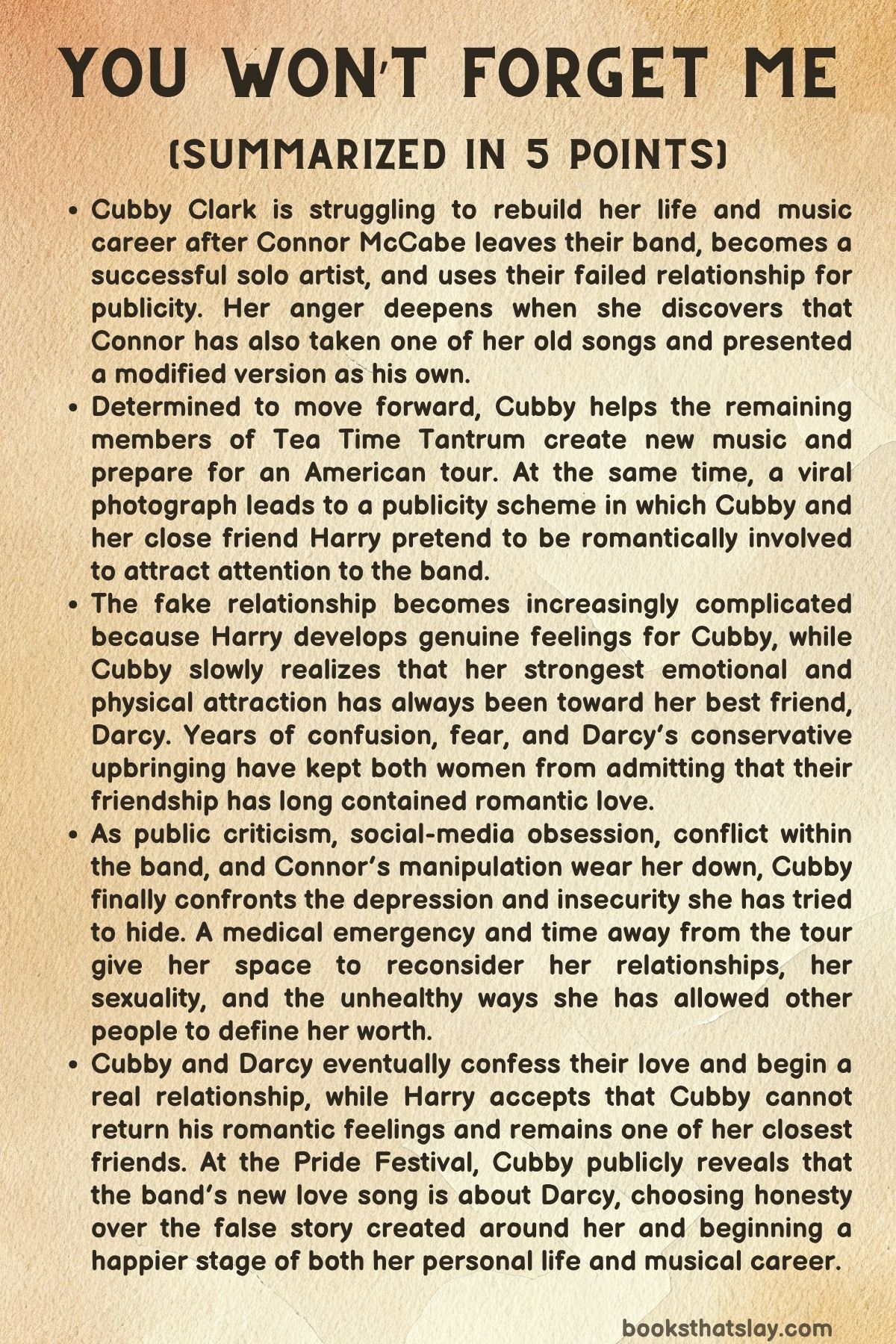
Summary
Five years before the main events of You Won’t Forget Me, eighteen-year-old Cubby Clark is preparing for what she expects will be her first serious kiss with Connor McCabe, her longtime crush and fellow musician. Nervous about her lack of experience, she asks her best friend Darcy Burton for help, leading to an unexpectedly intense practice kiss that affects Cubby far more strongly than she understands.
Cubby later kisses Connor and immediately notices how different the experience feels, yet she convinces herself that her feelings for him will strengthen over time. She refuses to examine why intimacy with Darcy seemed instinctive while romance with Connor already required rationalization, establishing a pattern in which Cubby repeatedly ignores emotions that do not fit the life she believes she is supposed to want.
Five years later, Cubby is living in Reykjavík and struggling after Connor has abandoned their band to become a successful solo artist. His career has been built partly on songs about their failed relationship, including material that encourages strangers to speculate about Cubby’s private life, leaving her depressed, creatively blocked, and increasingly convinced that she is somehow responsible for everything that went wrong.
The surviving band members are Darcy, Harry, violinist Kale, and drummer Jökull, who insists on being called Skull. Their producer Sigrún names the previously nameless group Tea Time Tantrum and pushes them to create new music quickly, believing that Connor’s departure has created an opportunity as well as a crisis.
The situation becomes far worse when the band watches Connor perform on American television. Cubby recognizes his new single as a song she wrote years earlier after discovering him kissing another woman, a song Connor had once mocked as overly emotional but has now altered and presented publicly as his own.
Cubby wants to confront him legally and publicly, but proving ownership would be difficult because she never released the original song. She also understands that Connor’s fame allows him to control the public narrative, while accusations from Cubby could easily be dismissed as revenge from a bitter former girlfriend.
Rather than rushing old material into release, Cubby decides the band should abandon anything Connor knew and create an entirely new body of work. The decision is painful because depression has made songwriting difficult, but a spontaneous studio session reminds her that making music can be joyful when it is based on collaboration rather than fear of Connor’s approval.
As Tea Time Tantrum begins creating again, the emotional relationship between Cubby and Darcy becomes harder to ignore. After celebrating one successful recording session, the two return home together, begin kissing, and eventually become physically intimate in an experience that feels more emotionally meaningful to Cubby than anything she experienced with Connor.
The following morning, however, Darcy retreats after receiving a shaming call from her conservative mother. When Cubby attempts to discuss what happened between them, Darcy dismisses the encounter as a result of alcohol and loneliness, so Cubby hides her hurt by pretending she barely remembers it.
Another problem develops when a photograph of Cubby and Harry accidentally kissing goes viral. Because the image attracts attention to the band, Sigrún proposes that Cubby and Harry encourage the public to believe they are dating while Tea Time Tantrum tours the eastern United States.
Cubby dislikes turning her personal life into promotion, but the rest of the group believes the attention may provide the career opportunity they have been waiting for. She reluctantly agrees, beginning an eight-week tour during which the supposed romance with Harry becomes increasingly convincing to outsiders.
The band’s first performances are successful, although Cubby initially struggles with severe anxiety. Harry repeatedly supports her onstage, while Darcy remains the person whose smallest gestures affect Cubby most deeply, creating a painful contrast between the romance the public believes and the relationship Cubby privately wants.
During the tour, Cubby becomes increasingly dependent on social media. She constantly reads reactions to herself, Harry, and Connor, finding that Harry is frequently praised while she is blamed, mocked, sexualized, or accused of manipulating the men around her.
Her bond with Darcy becomes equally unstable because both women are afraid to acknowledge what exists between them. Darcy shows flashes of jealousy whenever Cubby and Harry appear close, but Cubby distrusts her own interpretation and continues assuming that Darcy does not reciprocate her feelings.
Cubby eventually visits her twin brother Oliver and his girlfriend Tilly and tells them how unhappy she has become. Their questions force her to reconsider her assumptions about her sexuality, particularly when Oliver points out that while Cubby rarely discussed crushes on men before Connor, she talked constantly about Darcy.
Cubby begins realizing that feelings she previously categorized as ordinary admiration toward women may have included attraction. She cannot immediately decide whether bisexual, gay, or another label describes her, but Tilly assures her that she does not need to settle the question immediately.
Soon afterward, Harry unexpectedly kisses Cubby during a performance. Darcy is furious that he crossed a boundary without asking, but Cubby points out that the entire band has already participated in turning her private relationships into publicity.
Harry apologizes and later admits that his feelings are no longer entirely fake. He genuinely wants a romantic relationship with Cubby, and although Cubby knows she does not feel for him what she feels for Darcy, she tries to convince herself that wanting him would be easier.
Their private kiss only confirms the emotional difference, but Darcy sees them together before Cubby can explain. Hurt, Darcy becomes increasingly distant, while Harry and Cubby continue their staged romance during later performances.
Cubby eventually meets Connor in New York after he contacts her privately. He proposes a public musical collaboration because his label enjoys the attention surrounding their conflict, then claims that his success has helped make Cubby famous.
Cubby finally confronts him about stealing her song and about the deeper damage he caused throughout their relationship. Connor refuses meaningful responsibility and once again attacks her deepest insecurity by suggesting that her sadness made her difficult to love.
Shortly afterward, photographs of the meeting appear online beside a false story claiming Cubby begged Connor to reunite with her. When Kale and several other band members question whether she has betrayed them, Cubby is devastated that the people closest to her could believe strangers rather than trust her explanation.
Overwhelmed by physical pain, depression, exhaustion, and anger, Cubby quits the band. She calls her mothers and finally speaks openly about how long she has been struggling emotionally, admitting that her sadness existed before Connor and that she has felt guilty for being depressed despite having a loving family.
Cubby also asks her mothers how they understood their attraction to women. Their different experiences reassure her that sexuality does not have to become immediately clear simply because someone grows up around queer people.
Her worsening jaw pain turns out to be a serious infection caused by impacted wisdom teeth, requiring emergency surgery. Kevin, the band’s inexperienced but increasingly dependable manager, takes care of her and secretly contacts Darcy when Cubby is too frightened of another rejection to do so herself.
Cubby awakens after surgery with Darcy caring for her and taking her to recover in Cape May. Away from touring and social media, they gradually rebuild their closeness, while Darcy acknowledges that the band failed Cubby by doubting her.
Their emotional breakthrough arrives after Darcy hides Cubby’s phone because she cannot stand watching her obsess over hostile online comments. When Cubby retrieves it and immediately begins reading new attacks, Darcy throws the phone into the ocean, provoking an argument that finally forces both women to say what they have avoided for years.
Darcy admits that she was jealous of Harry because she has wanted Cubby romantically for a long time. Her deeply homophobic upbringing made her afraid to acknowledge her sexuality, and she feared that confessing her feelings might destroy the friendship that had provided the safest relationship of her life.
Cubby admits that she loves Darcy too, and their friendship openly becomes romantic. Unlike their previous encounter, neither woman attempts to dismiss the significance of what happens between them, and they begin communicating honestly about love, attraction, fear, and consent.
The next morning, Darcy refuses to repeat their old pattern of denial. She agrees to become Cubby’s girlfriend, and the honesty between them immediately changes their songwriting because Cubby can finally write the promised love song about the person who genuinely inspires it.
Their happiness remains complicated by Darcy’s fear of coming out publicly. Cubby initially worries that she will become a secret, but Darcy explains that her parents’ homophobia has made public acknowledgment of her identity emotionally dangerous, so Cubby agrees to give her time.
The rest of Tea Time Tantrum eventually reunites with them. Harry and Kale apologize for doubting Cubby, while Kale reveals that fear of losing the band caused much of his hostility and insecurity.
Harry also begins developing a connection with Kale, although the nature of it initially remains uncertain. Cubby finally explains that she loves Harry deeply as a friend but cannot return his romantic feelings.
At the Jersey Shore Pride Festival, Cubby feels uncertain about her own place within the queer community because she still lacks a precise label. Watching others celebrate themselves helps her understand that uncertainty does not invalidate her experience and that she can define herself at her own pace.
Darcy then decides that hiding has become more painful than honesty. She prepares a public post identifying herself as pansexual and acknowledging that she is deeply in love with a woman.
Harry accidentally discovers Cubby and Darcy kissing before the festival performance, forcing the three friends to speak openly. Rather than becoming angry, Harry admits that he suspected their feelings years earlier and reassures Cubby that his disappointment does not outweigh his love for both women.
During Tea Time Tantrum’s largest performance yet, Cubby finally takes control of the story surrounding her life. She explains that her relationship with Connor taught her to accept forms of love that diminished her because she believed romance was supposed to look a certain way.
The audience expects the band’s new love song to be about Harry, but Cubby publicly announces that it is about Darcy. She sings directly to her, and the two women kiss onstage, replacing the invented romance that built the band’s publicity with a relationship Cubby freely chooses to reveal.
One year later, Tea Time Tantrum has become internationally successful. Public opinion has turned against Connor, whose earlier treatment of Cubby is increasingly recognized as exploitative, but Cubby refuses to build her identity around his downfall.
Cubby and Darcy remain together, the band has largely withdrawn from social media, and Harry reveals that he and Kale have developed their own romantic relationship. Tea Time Tantrum prepares for a new album and world tour, while Cubby proudly notes how thoroughly her music has changed: after spending years afraid that love would hurt or silence her, she is finally writing love songs.
Characters
Cubby Clark
Cubby is the emotional and creative center of You Won’t Forget Me, and much of her development concerns learning to trust her feelings after years of being taught that those feelings are excessive. Her relationship with Connor conditions her to believe that sadness makes her undesirable, emotional honesty makes her embarrassing, and romantic relationships require her to reduce herself until another person finds her manageable.
Her depression therefore affects far more than her mood. It influences how she evaluates her talent, interprets conflict, responds to criticism, and assumes that other people will eventually become tired of her.
Music provides both refuge and vulnerability for Cubby because songwriting is the place where she expresses emotions she cannot comfortably discuss elsewhere. Connor stealing her song is consequently not simply professional betrayal; it represents him taking emotional material he once rejected and exploiting it only after removing Cubby from it.
Her relationship with social media creates another version of the same problem. Cubby begins allowing strangers to define her character just as she once allowed Connor to determine whether her feelings were legitimate, turning public attention into a constantly changing measurement of self-worth.
Her romance with Darcy requires Cubby to reconsider both sexuality and the definition of love she has accepted for years. She initially fails to recognize her attraction because she has placed Darcy inside the supposedly fixed category of best friend while assuming that heterosexual romance with Connor represents the expected path.
Cubby’s growth comes through recognizing that uncertainty does not make her feelings less valid. She does not need an immediate sexuality label, nor does she need public approval before accepting what she wants.
Her final public declaration is therefore about more than choosing Darcy. Cubby finally claims authority over her own emotional life, music, privacy, identity, and understanding of love.
Darcy Burton
Darcy is Cubby’s closest friend, eventual romantic partner, creative collaborator, and one of the most emotionally complicated figures in You Won’t Forget Me. Her confidence, humor, rebellious clothing, and apparent comfort with independence initially conceal how profoundly her conservative upbringing has shaped her behavior.
Growing up with parents who expected a particular version of femininity taught Darcy that love could be withdrawn when she failed to conform. Her family’s homophobia makes queerness especially frightening because acknowledging her sexuality risks confirming her deepest fear that authenticity could cost her family entirely.
That fear explains why Darcy can recognize her attraction to Cubby physically while repeatedly retreating from its emotional meaning. After their intimate night together, she hurts Cubby by pretending the experience meant nothing, but the rejection comes less from indifference than from panic.
Darcy’s jealousy of Harry gradually exposes what she refuses to say directly. She can tolerate wanting Cubby privately more easily than she can tolerate watching Cubby choose someone else, making the fake relationship increasingly painful.
Her protection of Cubby is loving but occasionally controlling. Throwing Cubby’s phone into the ocean crosses a boundary, yet the action also reveals Darcy’s desperation after watching someone she loves become psychologically consumed by public criticism.
Darcy’s strongest development comes when she stops confusing concealment with safety. She admits her failures, takes responsibility for hurting Cubby, openly acknowledges her love, and later decides that fear of her parents can no longer determine whether she recognizes her own sexuality.
Her statement that Cubby feels like home captures her emotional arc. Home ceases to mean the family environment in which Darcy learned to hide and instead becomes the relationship where she can exist without constantly editing herself.
Connor McCabe
Connor functions as both an antagonist and an example of emotionally damaging love disguised as familiarity. Because he begins as Cubby’s longtime friend, bandmate, and romantic ideal, she spends years interpreting his behavior through the belief that loving someone requires patience with the ways they hurt her.
His repeated cheating establishes the obvious betrayal, but his influence is more damaging in the way he teaches Cubby to distrust herself. He calls her emotions dramatic, makes her believe her sadness is exhausting, and creates an environment where she learns that vulnerability can be used as evidence against her.
His theft of Cubby’s song reveals his attitude toward her creativity particularly clearly. He dismisses the work when it represents her emotional pain but values it once he can separate the art from the woman who created it and turn it into professional success.
Connor also understands public performance extremely well. He presents himself as reasonable and compassionate while allowing narratives that portray Cubby as unstable, sexually inadequate, jealous, or incapable of moving on.
His later claim that Cubby was difficult to love because she was too sad confirms that he has learned very little. Even when she directly explains the damage he caused, he responds by returning responsibility for the failed relationship to her emotional condition.
Connor matters because Cubby does not defeat him by destroying his career. She defeats his influence when she stops accepting his interpretation of who she is and refuses to let opposition to him remain the center of her identity.
Harry
Harry represents emotional safety, loyalty, and the complicated boundary between deep friendship and romantic possibility. He is affectionate with Cubby from the beginning, which makes Connor suspicious even when their relationship is genuinely platonic.
During the tour, Harry becomes one of Cubby’s strongest sources of practical support. When anxiety prevents her from singing, he joins her at the microphone and helps her return to the music without embarrassing or criticizing her.
His participation in the fake relationship gradually produces real feelings, revealing that manufactured intimacy can still create genuine emotional consequences. Harry begins wanting a romantic future with Cubby because their existing friendship already contains trust, affection, humor, and physical ease.
His decision to kiss Cubby onstage without asking is an important failure. Although he apologizes sincerely, the moment shows that even fundamentally kind characters can cross boundaries when excitement and expectation encourage them to assume consent.
Harry’s strongest quality appears after he learns about Cubby and Darcy. He allows himself to acknowledge disappointment without turning that disappointment into resentment or entitlement.
His observation that being alone does not automatically mean being lonely directly contrasts with the fear-based relationships surrounding the other characters. Harry understands that romantic partnership is valuable but does not need to be forced simply to avoid solitude.
His later relationship with Kale also suggests that emotional possibilities can emerge unexpectedly when characters stop trying to make affection fit predetermined forms.
Kale
Kale initially appears abrasive, judgmental, and frequently hostile toward Cubby. His criticism of her fixation on Connor often contains legitimate concerns, but his confrontational approach makes those concerns sound more like personal attacks.
His later confession reveals that his behavior is rooted partly in social insecurity. Music is the environment in which Kale feels competent and connected, and joining the band gives him a sense of belonging that he fears losing.
That fear explains his harsh reaction when the tabloid photographs suggest Cubby might return to Connor. Rather than calmly considering whether the story is credible, he reacts defensively because he interprets the possibility as a threat to the community he has come to depend upon.
His eventual apology gives him greater emotional depth. Kale recognizes that protecting the band does not excuse distrusting Cubby, and Cubby similarly acknowledges that she has often responded to him with hostility.
The suggestion of a developing relationship with Harry also softens Kale’s role in the group. Their connection indicates that beneath his combative communication style, Kale wants intimacy, acceptance, and the reassurance that he belongs somewhere.
Jökull “Skull”
Skull brings humor and unpredictability to the band, beginning with his sudden insistence that everyone use his new nickname. His behavior frequently helps prevent the group from becoming overwhelmed by its own seriousness.
He is nevertheless more than comic relief. Skull participates naturally in the band’s collaborative creative process, contributing to the sense that Tea Time Tantrum succeeds because no single musician entirely controls the music.
His relationship with Deja also reveals that he has an independent personal life the others know surprisingly little about. The casual way he announces that she will join the tour fits his tendency to treat surprising developments as completely ordinary.
Skull’s weakness appears during the conflict over Cubby’s meeting with Connor. Like the others, he allows suspicion to override the trust their friendship should have earned.
His later continued presence within the reunited group demonstrates the resilience of their relationships. The band survives not because its members never disappoint one another but because they eventually acknowledge those failures and continue choosing the community they have built together.
Sigrún
Sigrún is highly pragmatic, commercially minded, and often far more comfortable with publicity than Cubby. She understands that the music industry rewards attention, and she repeatedly looks for ways to turn Connor’s betrayal and the resulting online drama into opportunities for Tea Time Tantrum.
Her decision to encourage the fake relationship between Cubby and Harry is ethically uncomfortable. Sigrún recognizes the promotional value of the story but does not initially appreciate how severely the arrangement may affect Cubby’s already fragile relationship with privacy and public criticism.
At the same time, Sigrún is not presented as simply exploitative. She believes in the band’s music, pushes them to continue creating when their confidence collapses, and helps turn a group recovering from Connor’s departure into a viable professional act.
Her character represents the tension between artistic authenticity and commercial survival. She repeatedly reminds the musicians that careers are shaped not only by songs but also by timing, narratives, branding, and public attention.
Kevin Cho
Kevin begins as an inexperienced young manager whose enthusiasm exceeds his practical expertise. His chaotic driving and uncertain management skills initially make him seem like another source of disorder during the tour.
As Cubby’s situation becomes more serious, however, Kevin proves unexpectedly dependable. When her wisdom-tooth infection requires emergency treatment, he prioritizes her health over canceled performances and logistical problems.
His decision to contact Darcy before Cubby’s surgery is particularly important. Although Cubby is too frightened to ask Darcy to come, Kevin recognizes who she actually needs and acts from concern rather than publicity strategy.
Kevin grows into his role by learning that management means caring for the people making the music rather than merely protecting schedules. His support during Cubby’s medical crisis demonstrates the kind of professional relationship the band needs after spending so much time around people who treat personal vulnerability as usable material.
Oliver Clark
Oliver is Cubby’s twin brother and one of the few characters able to challenge her without making her feel judged. His familiarity with her history allows him to notice patterns that Cubby herself has overlooked.
When Cubby describes the fake relationship, social-media obsession, conflict with Darcy, and continuing damage caused by Connor, Oliver recognizes that she has begun sacrificing her well-being for the band. He does not romanticize professional success enough to believe that suffering is automatically justified by career opportunity.
His observations about Cubby’s sexuality are equally important. Rather than assigning her a label, he reminds her that she rarely discussed conventional crushes before Connor but constantly talked about Darcy.
Oliver therefore helps Cubby reinterpret her own history without claiming authority over her identity. He gives her information about herself that she can examine while leaving the conclusions to her.
Tilly
Tilly plays a smaller but strategically important role in Cubby’s self-recognition. Her question about whether Cubby genuinely wants only friendship from Darcy breaks through the assumptions Cubby has maintained for years.
When Cubby becomes anxious about whether she is gay, bisexual, or something else, Tilly refuses the idea that identity must be solved immediately. Her response creates space for uncertainty rather than treating uncertainty as a problem.
Tilly represents a healthier form of support because she neither dismisses Cubby’s confusion nor pressures her toward a specific conclusion. She helps transform sexuality from a test Cubby believes she must pass into something she has permission to understand gradually.
Cubby’s Mothers
Cubby’s mothers provide one of the book’s clearest examples of secure familial love. When Cubby finally tells them about her depression, they do not treat her suffering as ungrateful simply because she has grown up with support and material security.
Their response directly challenges Cubby’s belief that emotional pain requires justification. They recognize that her sadness has become persistent and serious while still refusing to shame her for experiencing it.
Their different stories about discovering attraction to women also help Cubby understand that queer identity has no single timetable. One recognized her sexuality relatively early, while the other spent years dating men because heterosexuality seemed like the unquestioned default.
Their presence gives Cubby a family environment sharply different from Darcy’s. This contrast helps explain why Cubby can approach questions of sexuality with confusion but without the same expectation of abandonment that Darcy carries.
Doreen Burton
Doreen, Darcy’s mother, represents the emotional consequences of conditional parental acceptance. Her criticism of Darcy’s clothing and behavior reinforces the idea that femininity must be performed according to strict family expectations.
More seriously, her reaction to the possibility of Darcy being queer teaches Darcy that open acknowledgment could result in emotional erasure. Ignoring Darcy’s attempted disclosure becomes a warning more frightening than an argument because it suggests that certain truths may cause Darcy to stop being recognized as a daughter.
Doreen’s influence remains powerful even when she is physically absent. Much of Darcy’s hesitation with Cubby comes from internalizing the belief that authenticity risks destroying important relationships.
Darcy’s eventual decision to identify publicly as pansexual therefore represents a direct rejection of the emotional rules Doreen imposed. She stops allowing anticipated parental rejection to determine the boundaries of her adult identity.
Deja
Deja enters the story unexpectedly as Skull’s American girlfriend. Her appearance surprises the rest of the group because Skull had barely mentioned having a relationship at all.
Although she has less influence on the central conflict, Deja contributes to the expanding sense of community around the band. Her immediate warmth contrasts with the suspicion, jealousy, and public hostility surrounding many of Cubby’s other relationships.
She also reminds the reader that the tour contains personal lives beyond Cubby’s crisis. The band members are becoming adults with relationships and identities that do not always develop within the group’s shared history.
Terry
Terry, the Cleveland interviewer, represents institutional sexism within music criticism. His questions focus on the band’s lack of formal training and suggest that emotionally direct music associated with young women is inherently less serious.
Cubby’s confrontation with him becomes an important moment in her development because she refuses to make herself agreeable for the sake of publicity. Instead of accepting his assumptions, she identifies the contempt hidden inside supposedly professional questions about emotional music, dating histories, and artistic legitimacy.
Terry reacts by ending the interview and criticizing Cubby’s lack of public-relations training. His response demonstrates how women may be punished professionally for challenging the biases built into the questions they are expected to answer politely.
Dr. Harper Horowitz
Dr. Harper Horowitz appears during Cubby’s medical crisis but becomes significant because her simple compassion arrives when Cubby is emotionally exhausted. She identifies the severity of Cubby’s wisdom-tooth infection and treats the physical problem decisively.
More importantly, Cubby unexpectedly begins crying in front of her about everything that has accumulated over the previous months. The doctor does not require Cubby to make the distress tidy or reasonable before offering care.
Her brief presence reinforces a larger idea running through the story: care can be direct, practical, and nonjudgmental. Cubby has spent years expecting vulnerability to create embarrassment, so an authority figure responding to distress with straightforward kindness becomes surprisingly meaningful.
Themes
Love Without Self-Erasure
Love in You Won’t Forget Me is repeatedly measured by whether a relationship allows a person to remain fully herself. Cubby’s relationship with Connor teaches her the opposite lesson: she comes to believe that being loved requires becoming less emotional, less sad, less demanding, and generally easier for someone else to tolerate.
Because Connor presents emotional suppression as maturity, Cubby initially mistakes endurance for commitment. She assumes that relationships naturally require discomfort and interprets her inability to feel secure with him as evidence that she needs to work harder.
Darcy offers a radically different experience because Cubby does not have to reduce emotional intensity around her. Once the two women finally communicate honestly, expressions of love that would once have embarrassed Cubby are welcomed and returned.
The contrast is especially visible in their physical relationship. With Connor, Cubby often seems detached from what she actually wants, whereas intimacy with Darcy depends on communication, mutual attention, consent, curiosity, and emotional presence.
The theme also extends beyond romance. Harry demonstrates love by accepting that Cubby cannot return his romantic feelings, while Cubby’s family demonstrates love by allowing depression and uncertainty to exist without treating either as a personal failure.
Healthy love therefore becomes less about being chosen at any cost and more about being known without punishment. Cubby’s growth depends on realizing that affection requiring continual self-erasure is not the standard against which she should measure every future relationship.
Art, Ownership, and Emotional Honesty
For Cubby, songwriting is never merely professional production. Music contains experiences and emotions she often struggles to communicate directly, which makes creative ownership inseparable from personal identity.
Connor’s theft of her song is especially damaging because he once rejected the emotions from which the song was created. He dismisses Cubby when her sadness requires empathy but values the artistic product once it can advance his career.
That contradiction exposes a broader conflict between respecting art and respecting artists. Connor wants access to the language Cubby creates from pain without accepting responsibility for how he contributed to that pain.
Cubby initially responds by becoming afraid of honest songwriting. If exposing emotion gives other people something they can dismiss, steal, criticize, or reinterpret, withholding it begins to feel safer.
Her recovery requires accepting that releasing art always involves surrendering some control over how audiences understand it. The love song she writes with Darcy will inevitably be interpreted through the false Harry romance, yet its private meaning remains real because Cubby knows why it was created.
By the final performance, creative honesty and personal honesty become connected. Cubby no longer writes according to Connor’s approval, public expectations, or publicity strategy, allowing music to become an expression of choice rather than another environment in which she must perform an acceptable version of herself.
Public Image, Social Media, and the Loss of Privacy
Public attention repeatedly transforms people into simplified characters. Cubby becomes the bitter ex-girlfriend, Harry becomes the desirable new boyfriend, Connor becomes the misunderstood former lover, and complicated personal histories are reduced to narratives that generate reactions.
The gendered nature of this attention is especially damaging. Harry receives admiration for the supposed romance while Cubby is accused of manipulation, infidelity, desperation, and opportunism, demonstrating how identical situations can produce dramatically different judgments.
Cubby gradually internalizes the public gaze. She checks comments compulsively because each positive reaction briefly offers reassurance, yet every hostile response creates another reason to keep checking.
The cycle gives strangers increasing authority over her emotional state. Instead of asking what she believes about herself, Cubby begins searching online to discover which version of her identity is currently winning.
Darcy throwing the phone into the ocean is extreme, but the act exposes how completely digital attention has entered Cubby’s private consciousness. Even moments of friendship, music, travel, and romance become difficult to experience without imagining how they will appear online.
The ending offers privacy as an active choice rather than secrecy. Cubby and Darcy eventually share their relationship publicly but later reduce their social-media presence, showing that authenticity does not require permanent access to every private detail.
Their boundary is therefore not withdrawal from life. It is a refusal to believe that visibility creates an obligation to surrender intimacy.
Identity, Fear, and the Right to Change
Cubby and Darcy both struggle with identity because they have spent years accepting categories that once seemed fixed. Cubby assumes she is straight largely because she dated Connor and never seriously questioned heterosexuality, while Darcy suppresses her queerness because acknowledging it threatens her relationship with her family.
Cubby’s discovery is gradual rather than dramatic. She reinterprets earlier experiences, including her attraction toward women and the emotional intensity of her bond with Darcy, and realizes that feelings she once considered ordinary friendship may have contained desire.
Her anxiety about choosing the correct label reflects a larger pressure to make identity immediately understandable. Tilly, Oliver, and Cubby’s mothers help her recognize that uncertainty is not evidence that her feelings are false.
Darcy faces a different obstacle because she understands more clearly what she wants but fears the consequences of admitting it. Her parents have taught her that acceptance depends on conformity, making honesty feel dangerous even when she is physically far from them.
Pride becomes important to both women because it provides a space where identity can exist without requiring perfect certainty. Cubby realizes she does not need a final label before belonging, while Darcy decides that fear of rejection cannot continue governing her life.
Their development shows identity as something a person is allowed to reconsider, rename, and understand over time. Freedom comes not from producing a perfect definition of the self, but from refusing to let inherited expectations decide which parts of that self are permitted to exist.