West of Forever Summary, Characters and Themes
West of Forever (Heartstone Ranch #1) by Corinne Michaels is a romance about two people caught between inherited family hostility and the possibility of creating a life that belongs entirely to them.
Tristan Stone is a widowed rancher who has spent years protecting himself from another devastating loss, while Lark Gatlin is independent, loyal to her family, and increasingly unwilling to accept old grudges without question. A storm, a roadside rescue, and a growing attraction force them into each other’s lives. Their relationship becomes a story about grief, fear, family loyalty, second chances, and the difficult choice to love someone even when love offers no guarantee of safety.
Summary
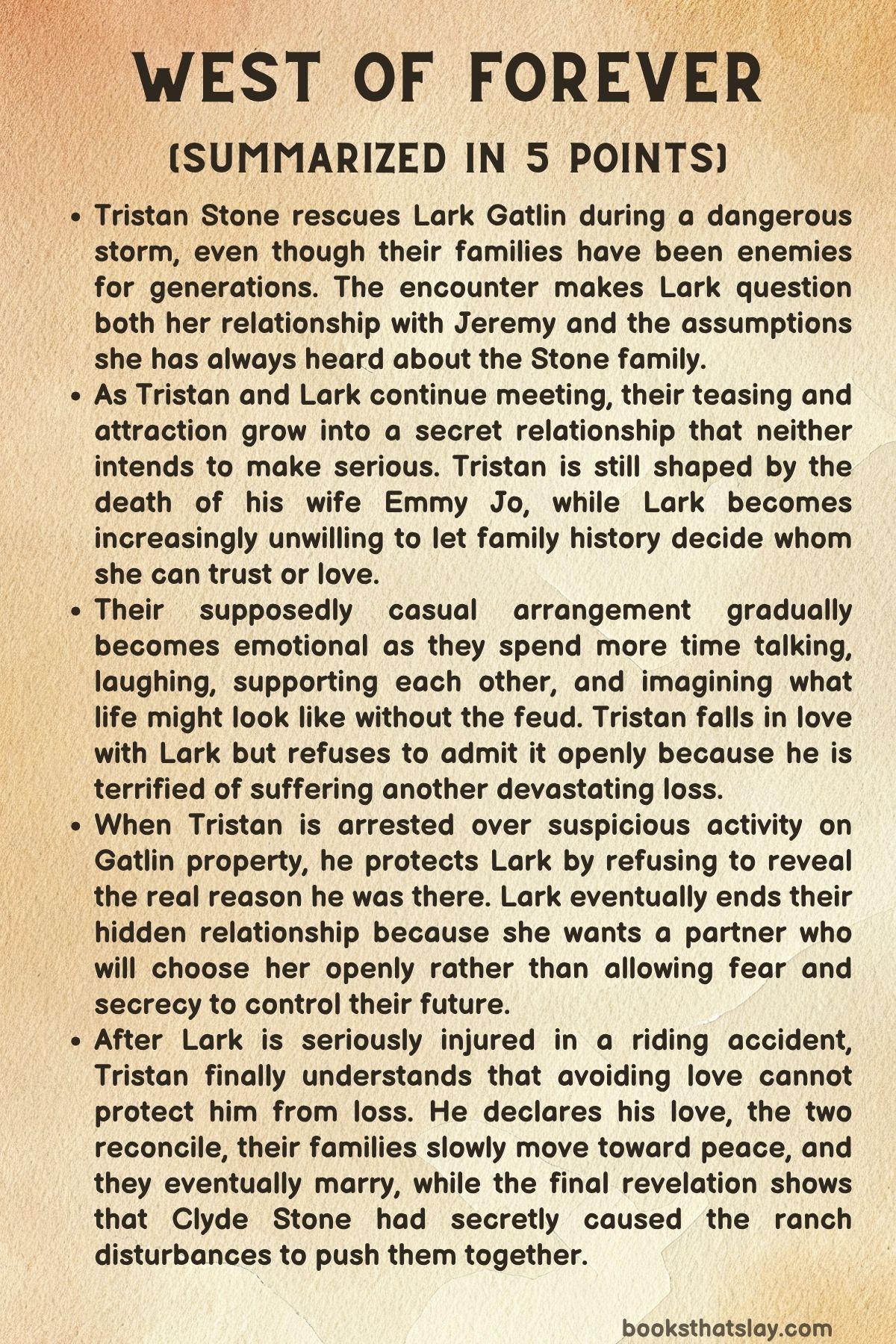
Tristan Stone is returning to Heartstone Ranch during a violent rainstorm when he nearly collides with a stranded vehicle. The driver is Lark Gatlin, a woman whose surname alone should be enough to make him keep driving because the Stones and Gatlins have been enemies for generations.
Instead, Tristan helps her. He pulls her truck from the mud, discovers that her boyfriend Jeremy refused to come for her because of the storm, and drives her home while teasing her about their families and trying to ignore how strongly she affects him.
Lark is equally unsettled by the encounter. Tristan tells her that she deserves a man who would cross a flood when she needed him, and the remark forces her to recognize something she has been avoiding: Jeremy may be dependable under ordinary circumstances, but he is not the man she wants beside her when life becomes difficult.
Tristan has reasons of his own for fearing emotional change. Nine years earlier, his wife Emmy Jo died, leaving him to raise their daughter Sadie and convincing him that loving someone deeply only creates another person he might lose.
That fear also shapes his relationship with Sadie. After a riding accident shattered her leg and nearly killed her because of surgical complications, Tristan forbids her from riding Cloud again, even though Sadie desperately wants to return to the horse she loves.
As Tristan and Lark continue texting and repeatedly encounter one another around town, the hostility expected between a Stone and a Gatlin gives way to friendship, teasing, and obvious attraction. Lark also begins questioning her family’s insistence that the Stones are responsible for a series of strange incidents occurring around the Gatlin ranch.
Lark ends her relationship with Jeremy after accepting that they want different lives. She wants horses, ranching, family, children, and the community she has always known, while Jeremy represents a safer relationship that does not truly understand the future she wants.
When Lark reveals to her family that Tristan was the man who rescued her in the storm, the admission causes conflict. Her relatives have difficulty accepting that a Stone could have helped her without an ulterior motive, while Lark becomes increasingly frustrated by the way both families judge people according to their surnames.
Tristan and Lark continue drawing closer. After a night out leaves Lark too intoxicated to drive, Tristan takes her home, cares for her when she becomes sick, and carries her toward the house when she can no longer walk safely.
They nearly kiss before being interrupted by Lark’s father. The unfinished moment only strengthens the attraction they are both trying to deny, and when they later meet at the ridge between their properties, Tristan finally admits that Lark has become the person occupying his thoughts.
Both insist that a relationship is impossible. Tristan says he cannot offer his heart because he has already loved and lost Emmy Jo, while Lark understands that their families would strongly oppose them.
They convince themselves that one kiss might settle the matter. Instead, the kiss makes their attraction impossible to dismiss, and Lark eventually proposes a secret physical relationship with no promises, no public commitment, and supposedly no emotional expectations.
Tristan insists that they wait five days before acting on the decision. Neither changes their mind, and when the waiting period ends, they meet privately at the ridge and begin an affair that both claim can remain separate from the rest of their lives.
The arrangement quickly becomes more intimate than either intended. They do not simply meet for physical reasons; they talk, laugh, play games, share private fears, discuss their families, and begin turning the ridge into a world where neither has to behave like a representative of a feuding family.
Tristan becomes increasingly comfortable with Lark around Sadie, while Lark discovers how naturally she fits into parts of his life he has kept emotionally guarded. At the same time, Tristan begins defending Lark when his own family speaks about the Gatlins as though every member of the family must be equally guilty.
Their relationship becomes even more serious when Tristan takes Lark away for an overnight trip near the Grand Canyon. Away from Infinity Ridge, they can hold hands, eat together, share a room, and behave like an ordinary couple without fearing that someone will report them to their relatives.
The trip exposes how false their rules have become. Tristan encourages Lark’s ambitions and tells her that she is capable of running a ranch despite her belief that her brothers would always be favored, while Lark becomes increasingly attached to the ordinary pleasure of waking beside him and sharing everyday routines.
Tristan eventually recognizes that he has already fallen in love with her. Yet he remains frightened of acknowledging what that means, because admitting he loves Lark would also mean admitting that he has once again given someone the power to break him through loss.
The continuing trouble at the Gatlin ranch soon forces their secret relationship into a crisis. Security footage places Tristan on Gatlin property at the time of one of the incidents, but explaining why he was there would require revealing that he was secretly meeting Lark.
Tristan chooses silence and allows himself to be arrested rather than expose her. Lark initially sees the sacrifice as protective, but she also begins to understand the emotional cost of always being hidden.
After Tristan is released, Lark confronts him at the ridge. She tells him that she loves him and no longer wants secret meetings with a man who refuses to stand beside her publicly.
Tristan finally acknowledges that loving her is not the problem. The problem is that he knows exactly how much it hurts to lose the person he loves, and he is terrified of surviving that experience again.
Lark realizes that Tristan’s secrecy is no longer about protecting her from the feud. It is about protecting himself from vulnerability, so she ends their relationship and tells him that if he ever becomes ready to love her openly, he knows where to find her.
Heartbroken, Lark begins working with Sadie and Cloud. She believes the horse was not inherently dangerous and that Sadie’s earlier injury resulted from an accident rather than proof that Cloud can never be trusted again.
Lark rides Cloud herself to evaluate him. The horse initially behaves well, but Lark is eventually thrown and suffers a serious head injury, leaving her alone, disoriented, and unable to reach help normally.
She manages to activate her phone’s emergency feature before losing consciousness. By the time Tristan learns what has happened, the Gatlins have found her and taken her to the hospital.
The accident forces Tristan to confront everything he has been trying to avoid. Shortly before learning about Lark, Clyde tells him that protecting people cannot mean stopping them from living and that the possibility of loss should make a person love more fully rather than refuse love altogether.
At the hospital, Tristan no longer hides his feelings. With Lark unconscious in intensive care, he tells her that he loves her, admits that fear has controlled him for too long, and promises that if she wakes up, he will choose their relationship openly rather than allowing the feud or his grief to determine his future.
Lark eventually wakes and remembers hearing Tristan’s voice while she was unconscious. When she asks whether his declaration of love was real, he confirms that it was and explains that refusing happiness never protected him from tragedy; it only prevented him from fully living.
They reconcile, and Tristan begins proving through action that secrecy is over. He works with members of Lark’s family to improve the path to their ridge while she recovers, transforming the place from a hidden meeting spot into a symbol of the future they are deliberately creating.
Lark also visits Emmy Jo’s grave. She does not see loving Tristan or becoming important to Sadie as replacing Emmy Jo, and she promises to respect the place Tristan’s first wife will always hold in their family.
The Stone family gradually welcomes Lark, while the Gatlins begin accepting Tristan. The feud does not disappear overnight, but both sides start choosing individual relationships over inherited hostility.
Tristan also faces his fears surrounding Sadie and Cloud. With Lark guiding the process carefully, Sadie begins reconnecting with the horse and eventually returns to riding on Olympia while Tristan watches.
He remains afraid, but the fear no longer makes the decision for him. He learns that loving Sadie and Lark means trusting their strength rather than trying to remove every possible danger from their lives.
Tristan and Lark eventually stop hiding in public. They dance together openly, and Tristan tells Lark that she is not merely the person who brought happiness back into his present but the person he wants in his future.
One year later, they prepare to marry. The Stones and Gatlins have reached an uneasy but functional truce, Sadie is deeply attached to Lark, and even members of both families who once opposed the relationship have accepted that Tristan and Lark belong together.
The final revelation changes the meaning of many earlier events. Clyde admits at his late wife Virginia’s grave that he was responsible for the mysterious trouble around the Gatlin ranch, deliberately creating harmless problems that would keep forcing Tristan and Lark into each other’s paths.
Virginia had apparently recognized Lark’s importance before Tristan did, and Clyde decided to help fate along. Having successfully pushed Tristan toward happiness, he now turns his attention toward the remaining members of his family, fully intending to continue interfering in their romantic lives.
Characters
Tristan Stone
Tristan Stone is the central male character of West of Forever, and his deepest struggle is not the feud with the Gatlins but the fear created by losing Emmy Jo. He has built his adult life around responsibility, control, and protection because controlling practical matters gives him the illusion that he can prevent another devastating loss.
That instinct is especially visible in his parenting. His refusal to let Sadie ride again comes from love, but the intensity of his fear prevents him from recognizing that protection can become restrictive when it denies another person the chance to recover confidence and independence.
His relationship with Lark exposes the weakness in the emotional system he has constructed. Tristan initially believes he can enjoy attraction without allowing himself to love, yet his actions repeatedly reveal attachment long before he admits it to himself.
He rescues Lark, arranges for her truck to be returned, protects her from an uncomfortable situation, cares for her when she is intoxicated, encourages her ambitions, accepts arrest rather than expose their relationship, and gradually begins defending her against his own family. These choices show that his heart has already moved beyond the boundaries he keeps describing.
Tristan’s development depends on understanding that fear and love cannot be separated by simply refusing commitment. By the end of the novel, he does not become fearless; instead, he accepts that loving Lark and Sadie requires remaining emotionally present even when he cannot guarantee their safety.
Lark Gatlin
Lark Gatlin is the emotional catalyst of West of Forever, but she is far more than the woman who helps Tristan love again. She is independent, competent with horses, deeply connected to ranch life, and increasingly unwilling to accept beliefs simply because her family has repeated them for generations.
Her breakup with Jeremy establishes one of her most important qualities: Lark values being truly understood more than being comfortable. She recognizes that Jeremy offers stability, but he does not share or fully respect the life she wants, and she refuses to stay simply because leaving is difficult.
Her relationship with Tristan develops alongside her growing resistance to inherited prejudice. She repeatedly judges him by what he actually does rather than by what the Gatlin family says a Stone must be, even when accepting his goodness creates conflict inside her own home.
Lark is also emotionally courageous. She is the first to admit openly that their supposedly casual relationship has become love, and she eventually refuses to accept secrecy simply because secrecy is easier for Tristan.
Her work with damaged or frightened horses reflects her broader way of relating to people. She believes that injury does not automatically mean permanent brokenness and that trust can be rebuilt through patience, attention, and reasonable risk.
Sadie Stone
Sadie is essential to Tristan’s emotional development because she reveals both the tenderness and the limitations of his love. Her riding accident left Tristan terrified, but Sadie experiences his protection as a barrier preventing her from reclaiming something central to her identity.
She is remarkably perceptive about her father. Sadie understands that Tristan can love Lark without betraying Emmy Jo, and she often reaches emotional conclusions before the adults around her are willing to admit them.
Her connection with Lark also helps create the possibility of a blended family. Rather than seeing Lark as a replacement for her mother, Sadie responds naturally to her kindness, humor, understanding of horses, and willingness to treat her as capable rather than fragile.
Sadie’s eventual return toward riding parallels Tristan’s return toward romantic love. Both father and daughter must learn that one terrible experience does not have to determine every future decision.
Clyde Stone
Clyde initially appears to be the eccentric, stubborn patriarch of the Stone family. His age and occasional confusion create legitimate concerns for Tristan, particularly when Clyde undertakes dangerous work or makes questionable ranching decisions.
At the same time, Clyde often possesses greater emotional wisdom than his son. He challenges Tristan’s attempt to protect everyone by limiting their choices and argues that the possibility of losing people should make life and love more precious, not less worth experiencing.
The final revelation transforms his role. Clyde has secretly been responsible for the incidents at the Gatlin ranch, deliberately creating manageable trouble in order to place Tristan and Lark in situations where they might continue encountering each other.
His interference is ethically questionable, even if his intentions are affectionate. Yet it also fits his personality: he is a man who has experienced enduring love with Virginia and believes strongly enough in that kind of happiness to interfere with his children until they allow themselves the possibility of finding it.
Emmy Jo Stone
Emmy Jo is dead before the central events begin, yet her presence shapes nearly every important choice Tristan makes. She represents both the happiest period of his life and the loss that convinced him happiness could become unbearable pain.
The book does not treat her as an obstacle that Tristan must forget before loving Lark. Instead, his growth comes from understanding that continuing to love Emmy Jo and allowing himself to love another woman are not contradictory acts.
Her continuing importance is also respected by Lark. Lark’s visit to Emmy Jo’s grave shows that she does not want to erase Sadie’s mother or compete with a dead woman, but rather become part of a family whose history will always include her.
Jeremy
Jeremy functions as a contrast to Tristan rather than as a serious romantic rival for most of the story. His refusal to help Lark during the storm does not single-handedly destroy their relationship; instead, it exposes differences that were already present.
He appears to want a version of Lark whose future fits more comfortably with his own expectations. Lark recognizes that he does not fully understand her attachment to horses, ranch life, family, and the environment in which she wants to build her future.
Jeremy later tries to repair the relationship after realizing Tristan may be involved, but his effort comes too late. His role demonstrates that affection alone does not create compatibility when two people imagine fundamentally different lives.
Deacon Gatlin
Deacon is protective of Lark and strongly influenced by the long-standing hostility between the families. His anger when he learns that Tristan rescued his sister reflects both genuine concern for Lark and his automatic suspicion of anyone named Stone.
At the same time, one of Deacon’s early conversations helps Lark recognize the weakness in her relationship with Jeremy. When he says that he would immediately go to someone he loved if they called for help, even without knowing how he would solve the problem, he unintentionally gives Lark the standard against which Jeremy fails.
Deacon therefore represents both the strength and difficulty of family loyalty. His devotion to his sister is sincere, but that same loyalty can become rigid when family history tells him whom he is supposed to distrust.
Ryan Gatlin
Ryan carries significant responsibility for the financial condition of the Gatlin ranch. His unsuccessful investments have increased pressure on the family, making the continuing incidents around the property more serious than harmless inconveniences from his perspective.
His suspicion of the Stones is therefore connected not only to inherited hostility but also to anxiety about protecting a vulnerable family business. That does not make his accusations automatically justified, but it explains why he is inclined to interpret every problem as another attack.
Ryan can also be controlling toward Lark, particularly when he questions her interactions with Tristan. His behavior reflects a family structure in which the brothers often assume authority, while Lark quietly recognizes that her own skill and commitment to ranching deserve equal respect.
Carter Gatlin
Carter is less directly developed in the supplied material, but his return carries emotional weight because it affects the balance among the Gatlin siblings. Lark describes his distance from the family as part of a larger history of resentment involving Ryan, Deacon, and Maverick.
His later participation in improving the route to the ridge is significant. Working alongside Tristan and the other Gatlin men suggests that Carter is capable of placing Lark’s happiness above inherited hostility.
Because the supplied material gives limited direct access to his thoughts or personality, his importance lies mainly in the way his presence reflects the complicated structure of the Gatlin family and the gradual movement toward cooperation.
Maverick Gatlin
Maverick is largely absent from the present action, but his past actions created one of the deepest wounds between the families. He was responsible for the death of Carrick, Fallon Stone’s fiancé, making the feud far more emotionally serious than a collection of old ranching arguments.
His actions become a burden that Lark is unfairly expected to carry. Fallon initially treats Lark as though sharing Maverick’s surname makes her partly responsible for what happened, even though Lark cannot undo her brother’s choices.
Maverick therefore represents inherited guilt as well as inherited conflict. His story raises the question of whether family members should be morally judged for actions they did not commit simply because they belong to the same household.
Fallon Stone
Fallon’s hostility toward the Gatlins is rooted in personal devastation rather than abstract family pride. Carrick’s death left her grieving, and because Maverick was responsible, the Gatlin name has become connected in her mind with the person and future she lost.
Her confrontation with Lark reveals how grief can become unfair when pain is transferred onto someone who did not cause it. Fallon’s fear that another Gatlin might hurt someone she loves is emotionally understandable, but her attempt to keep Lark away from Sadie makes Lark answer for a tragedy that was never hers.
Tristan’s eventual confrontation with Fallon is important because he refuses to allow either Carrick or Emmy Jo to be used as reasons for attacking Lark. Fallon therefore becomes part of the wider examination of whether grief will remain a private wound or become a justification for controlling other people.
Harper Stone
Harper appears as a sharp observer of Tristan and understands him well enough to doubt the accusation that he has been sabotaging the Gatlin ranch. When she bails him out, she recognizes that his behavior makes far more sense if he is protecting someone than if he has suddenly become a careless vandal.
Her ability to detect his evasions shows the closeness within the Stone family even when Tristan tries to hide parts of himself. She also contributes humor and sibling pressure, particularly as Tristan approaches his wedding.
Harper is not developed as extensively as Tristan or Fallon in the supplied material, but she represents the kind of family relationship in which affection includes teasing, interrogation, and an unwillingness to accept obvious lies.
Veronica Stone
Veronica participates in the Stone family’s energetic and intrusive sibling dynamic. She becomes involved when Tristan’s sisters begin questioning him about his interactions with Lark and later takes an active role in organizing the wedding.
Her purchase from Suzanne’s struggling bakery also suggests that the automatic Stone-Gatlin hostility does not necessarily extend to every interaction in the community. Lark is able to appreciate Veronica’s support of Suzanne rather than interpreting it through the feud.
By the wedding, Veronica’s planning represents the Stone family’s acceptance of the relationship. A marriage that once seemed impossible has become something the family is willing to celebrate publicly.
Ares Stone
Ares receives very little direct characterization in the supplied material. The main information attached to Ares comes at the end, when Clyde identifies the remaining unmarried members of his family as future targets for his matchmaking efforts.
That brief mention nevertheless reinforces the larger family pattern. Clyde sees his children’s emotional happiness almost as an unfinished responsibility, and Ares becomes part of the promise he believes he made to Virginia.
Any more specific psychological interpretation of Ares would go beyond what the supplied material establishes.
Officer Jimmy Langston
Jimmy is both a police officer and Tristan’s longtime friend, placing him in an uncomfortable position as the Stone-Gatlin conflict begins creating legal problems. He investigates the incidents seriously even while understanding Tristan well enough to recognize that something about the evidence does not fit.
His role becomes especially important when security footage appears to implicate Tristan. Jimmy repeatedly gives him opportunities to explain why he was on Gatlin property, but Tristan refuses because the real explanation would expose Lark.
Jimmy also provides an outside perspective on the absurdity of the feud. As someone forced to respond whenever the families accuse each other, he sees how inherited hostility creates unnecessary suspicion, wasted effort, and escalating consequences.
Lark’s Mother
Lark’s mother is physically vulnerable because of declining health after a fall and a suspected ministroke, but she remains emotionally important within the Gatlin household. Her condition also strengthens Lark’s sense that family obligations and time together matter deeply.
She initially shares some of the family’s concern about Tristan, warning Lark about the danger of becoming involved with him. Yet when Lark finally admits that she loves Tristan, her mother listens, and her response begins changing once she sees what the relationship actually means to her daughter.
Her most significant act occurs at the hospital. When Tristan expects the Gatlins to keep him away from Lark, she understands that her daughter would want him there and sends him into the ICU, choosing Lark’s needs over family pride.
Lark’s Father
Lark’s father represents the older authority of the Gatlin family and initially shares the assumption that the Stones are responsible for the problems on their ranch. His surprise when he learns Tristan rescued Lark shows how difficult it is for him to reconcile actual evidence of kindness with inherited expectations.
He also witnesses Tristan returning an intoxicated Lark home, an encounter that could easily intensify his distrust. Later events force him to reconsider the certainty with which the families have defined one another.
At the hospital, his daughter’s condition makes the feud seem less important than her survival. Although he does not instantly become enthusiastic about Tristan, he gradually accepts the seriousness of Tristan’s feelings and participates in the broader family truce.
Suzanne
Suzanne is Lark’s close friend and the owner of the Daily Knead bakery. Her business struggles give some of the community scenes practical weight, and Veronica Stone’s support of the bakery provides another example of ordinary kindness existing outside the official rules of the feud.
Suzanne also recognizes Lark’s attraction to Tristan very quickly. As a friend, she provides companionship, humor, and a social space in which Lark can exist outside the constant pressures of family loyalty.
She accompanies Lark to events such as the rodeo and helps create the ordinary friendships surrounding the central romance. Her presence makes Lark’s life feel larger than her relationship with Tristan or her responsibilities at the ranch.
Mary Lou
Mary Lou is another of Lark’s friends and brings a more playful, outspoken energy to the group after returning to town from Montana. Her drunken warning to Tristan not to hurt Lark is humorous, but it also shows immediate loyalty toward her friend.
She later becomes useful as part of Lark’s cover story when Lark secretly leaves town with Tristan. Mary Lou therefore occupies the role of a trusted friend who exists close enough to the secret relationship to help make it possible, even when she does not control where it is heading.
Her characterization is lighter than that of the central family members, but she contributes to the social world around Lark and provides moments of relief from the heavier family conflict.
CJ
CJ appears briefly during the night when Lark has been drinking. His interest becomes uncomfortable because he grows overly physical and seems attracted not only to Lark herself but also to the status or associations attached to her family.
His narrative purpose is largely to reveal Tristan’s instinctive protectiveness. Tristan notices Lark’s discomfort and intervenes despite knowing that becoming involved in a Gatlin matter could create further complications.
CJ does not receive enough development to support a more extensive psychological reading. He functions primarily as a short-term source of tension that demonstrates the degree to which Tristan is already watching over Lark.
Virginia “Ginny” Stone
Virginia is Clyde’s late wife and the emotional inspiration behind Heartstone Ranch. Clyde renamed the ranch to honor her, combining the idea of her being his heart with the Stone family name, which gives the property a deeply personal meaning beneath its practical identity.
Although she is absent from the present timeline, the final revelation shows that her influence continues to shape Clyde’s choices. She had apparently seen something promising in Lark, and Clyde interprets her judgment as part of the reason he should encourage Tristan toward a relationship with her.
Virginia therefore represents enduring influence after death in a manner that parallels Emmy Jo. The people who have died are not erased from the lives of those who remain; their love, memory, and earlier judgments continue affecting the future.
Carrick
Carrick is Fallon’s deceased fiancé, and his death gives the Stone-Gatlin feud one of its most painful personal foundations. Because Maverick Gatlin was responsible, Carrick’s absence becomes connected to Fallon’s anger toward the entire Gatlin family.
He is less a fully developed present-day character than a continuing emotional presence. Fallon’s grief, Tristan’s attempts to understand his sister, and Lark’s guilt over something she did not do all show how Carrick’s death continues affecting relationships long afterward.
His importance also reinforces the story’s distinction between remembering the dead and allowing grief to control the living. Fallon’s challenge is not to stop loving Carrick but to stop making unrelated people responsible for his loss.
Cloud
Cloud is Sadie’s horse and an important nonhuman presence in the story. After the accident that badly injured Sadie, Tristan treats Cloud as a symbol of unacceptable danger, while Sadie continues seeing him as an animal she loves and wants to trust again.
Lark’s work with Cloud challenges the assumption that one frightening event permanently defines either the horse or Sadie’s future. She patiently tests his behavior and concludes that the earlier incident was caused by panic rather than an inherently dangerous temperament.
Lark’s own accident while riding Cloud complicates that conclusion without completely destroying it. The later rehabilitation process shows that risk cannot be eliminated, but it can be approached with patience, preparation, and respect.
Themes
Love Versus Fear
Fear repeatedly presents itself as a form of protection, particularly in West of Forever, where Tristan believes that avoiding deep attachment will reduce the possibility of future pain. His logic is understandable because he has already experienced the death of Emmy Jo and nearly lost Sadie, so emotional distance begins to feel like a practical survival strategy rather than simple avoidance.
The difficulty is that fear does not actually prevent loss. It only changes how Tristan behaves while the people he loves are still present, causing him to limit Sadie’s choices and hide his relationship with Lark even after that secrecy begins hurting them both.
Lark’s accident makes the contradiction impossible for him to ignore. Tristan could have continued refusing to acknowledge his love and still nearly lost her, proving that withholding commitment offers no protection against uncertainty.
Clyde expresses the alternative philosophy that ultimately transforms Tristan: because loss is possible, love should be expressed more fully rather than rationed. Tristan’s final growth therefore does not consist of becoming certain that nothing bad will happen.
He instead accepts the harder truth that meaningful love includes vulnerability. His willingness to remain beside Lark and Sadie even when he cannot control their futures becomes evidence that courage is not the absence of fear but the refusal to let fear determine every choice.
Inherited Conflict and Individual Judgment
The Stone-Gatlin feud shows how inherited beliefs can become self-sustaining even when the people repeating them no longer fully understand their origins. Both families are trained to interpret ordinary events through suspicion, meaning that a damaged fence, moved horses, or another ranch problem can become evidence of guilt before anyone has established what actually happened.
Lark and Tristan gradually reject that logic by judging one another according to personal behavior. Tristan discovers that Lark is compassionate, capable, funny, and kind to Sadie, while Lark sees that Tristan repeatedly helps her even when doing so creates inconvenience and risk for him.
Their relationship becomes threatening to the feud because affection requires them to treat an alleged enemy as an individual. Once that happens, sweeping statements about every Stone or every Gatlin become harder to maintain.
The conflict surrounding Maverick and Carrick makes the issue more serious. Fallon has genuine reasons for grief and anger, but directing that anger at Lark shows the moral danger of assigning collective guilt.
By the end, the two families have not forgotten every injury or suddenly become close. Their progress lies in becoming capable of cooperation despite history, suggesting that reconciliation begins when people stop treating inherited identity as proof of individual character.
Grief, Memory, and the Possibility of Loving Again
Grief remains active throughout the story rather than functioning as something that must be completed before life can continue. Tristan still loves Emmy Jo, Fallon still mourns Carrick, Clyde still speaks to Virginia at her grave, and Sadie continues carrying the memory of the mother she lost.
The central question is therefore not whether the dead should be forgotten. It is whether memory will remain compatible with new forms of happiness or become a reason to reject them.
Tristan initially believes loving Lark somehow risks disturbing the emotional place Emmy Jo occupies in his life. Over time, he realizes that love is not a limited space in which one relationship must be removed before another can exist.
Lark’s behavior strengthens this understanding because she never demands that Tristan diminish Emmy Jo. Her visit to Emmy Jo’s grave is especially important because she imagines becoming part of Sadie’s future while deliberately preserving her mother’s memory.
Fallon provides the more destructive version of unresolved grief. Her pain over Carrick becomes attached to the Gatlin name so strongly that she initially directs hostility toward Lark, even though Lark had no responsibility for his death.
The novel ultimately treats remembrance and renewal as compatible. Healing does not require reducing the importance of people who have died; it requires allowing their memory to coexist with the lives still being lived.
Protection, Autonomy, and the Right to Take Risks
Tristan’s relationships with Sadie and Lark repeatedly raise the question of when protection stops being care and begins becoming control. His fear comes from legitimate trauma, yet his response is often to restrict the choices of the people he loves because their freedom exposes him to anxiety.
Sadie’s desire to ride again makes this conflict especially clear. Tristan sees the horse and remembers a shattered leg, medical complications, and the possibility of losing his daughter, while Sadie sees riding as an essential part of the person she still wants to become.
Lark challenges Tristan because she refuses to accept the idea that love should make a person fragile. She understands risk through her work with horses, where trust is rebuilt gradually rather than by pretending danger does not exist.
Her own accident gives the theme additional complexity. The story does not argue that taking risks is always safe, because Lark is genuinely injured and nearly dies after being thrown.
Instead, it argues that danger cannot justify refusing life altogether. Tristan’s final willingness to remain present while Sadie rebuilds confidence around horses marks an important change because he is still frightened.
He simply stops treating his fear as authority over everyone else. Love becomes healthier when it offers support, preparation, and presence while still respecting another person’s right to live, choose, recover, and move forward.