We Hexed the Moon Summary, Characters and Themes
We Hexed the Moon by Mollyhall Seeley is a speculative coming-of-age novel about four teenage girls whose impulsive occult experiment turns into a crisis of impossible scale. Jen, Goldie, Maycie, and Harding begin the story on the edge of adulthood, already facing separation, changing relationships, private grief, family conflict, sexuality, and uncertain futures.
When the moon disappears after their ritual, the supernatural emergency forces those ordinary struggles into sharper focus. The novel uses its strange cosmic premise to examine friendship, sacrifice, identity, grief, moral responsibility, and the difficult realization that growing up sometimes means becoming separate from the people who once seemed inseparable from you.
Summary
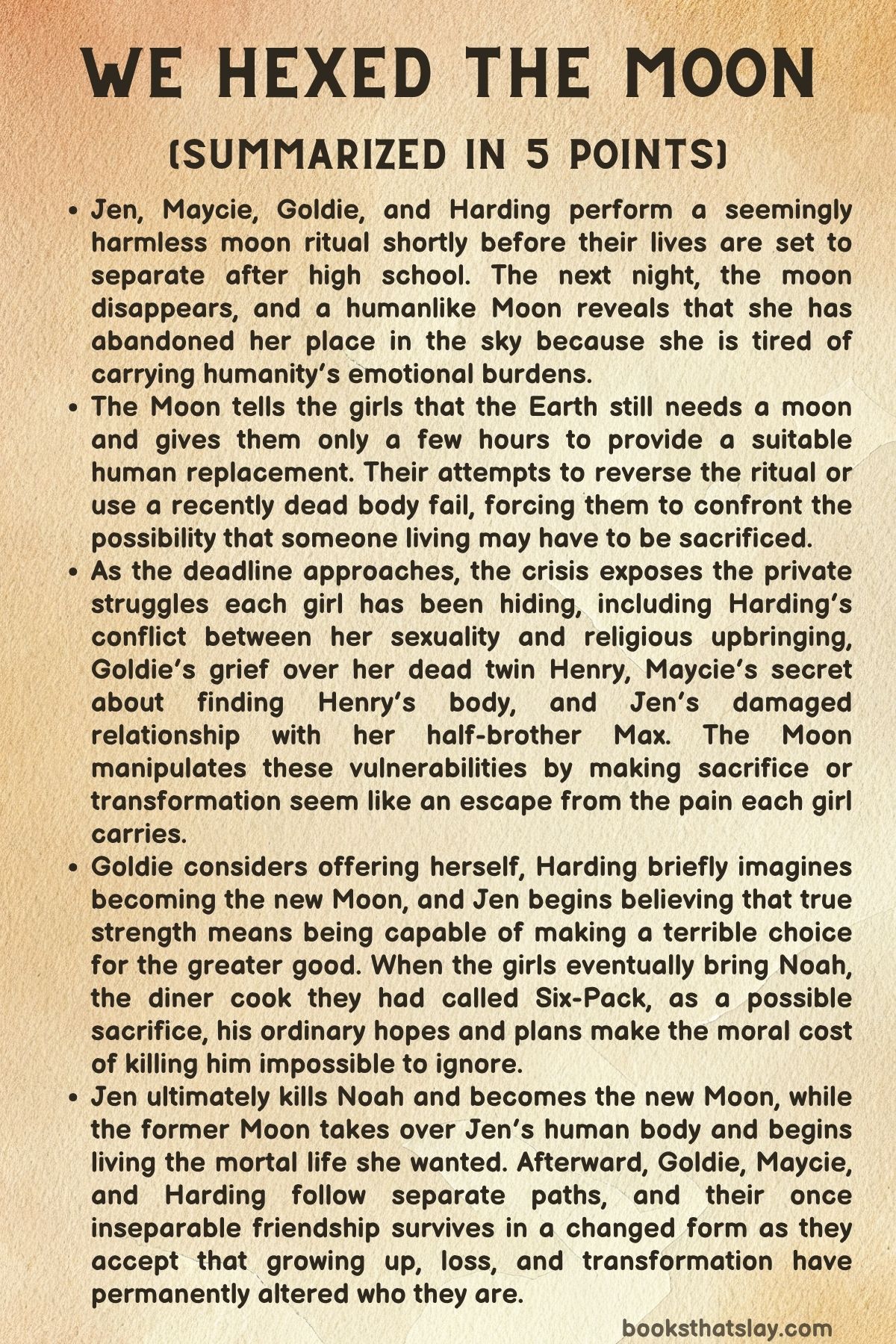
Jen is preparing to leave for Yale when Maycie climbs through her bedroom window during an intense August storm with an impossible announcement: the four friends have hexed the moon. Jen initially refuses to take her seriously because the ritual they performed the previous night had seemed ridiculous, improvised, and entirely incapable of producing anything supernatural.
Then Jen looks outside and realizes the moon is gone.
The stars surround an enormous empty space where it should be, while people across the world begin reacting with panic and confusion. For Jen, who believes strongly in reason and prides herself on understanding problems, the disappearance immediately creates a crisis that cannot be explained through anything she considers rational.
The previous day had seemed ordinary by comparison. Jen, Maycie, Goldie, and Harding had spent time together while confronting the approaching end of their shared adolescence.
Jen is headed to Yale, Goldie to the College of Charleston, Harding to Liberty University, and Maycie has rejected college for the moment and plans to travel to Buenos Aires. Their friendship remains affectionate and intimate, but every conversation carries the knowledge that their lives are about to move in different directions.
Their private tensions are already growing. Maycie and Harding have developed a romantic and sexual relationship after Harding unexpectedly kissed Maycie months earlier, though Harding remains deeply conflicted about what that relationship means.
Harding has been raised in a strict religious family that teaches obedience, sexual restraint, and fear of sin. She increasingly doubts what she has been taught, yet those teachings continue to control how she understands herself.
Goldie hides different vulnerabilities beneath confidence, humor, beauty, and sexual boldness. She likes being noticed while simultaneously resenting the attention placed on her appearance, and she often neglects eating until she becomes physically unwell.
Jen presents herself as the logical member of the group. She organizes, argues, analyzes, and mocks what she considers irrational behavior, while avoiding emotional vulnerability whenever possible.
Their joke becomes dangerous when Harding proposes testing one of the spiritual rituals associated with Maycie’s mother’s beliefs. If nothing happens, Harding reasons, perhaps some of the frightening supernatural claims she has been raised to believe are also false.
Goldie finds a ritual connected to Lilith and the waning moon. It requires blood, and Harding calmly volunteers herself when the others hesitate.
They draw a pentagram, light candles, and perform the improvised ritual. Harding cuts her palm and places blood on the pentagram while Jen experiences an unusual moment in which she seems to understand the emotional lives of her friends with extraordinary clarity.
Jen feels their grief, anger, fear, envy, and love and briefly imagines taking their pain into herself if doing so could give them peace. She quickly dismisses the experience as a strange neurological reaction caused by alcohol and emotion.
After the moon disappears, however, an impossible woman appears inside Jen’s bedroom. Jen somehow immediately understands that the woman is the Moon herself.
The Moon explains that the girls did not possess enough magical ability to remove her from the sky. Instead, their attempt to command and use her insulted her, so she deliberately abandoned her position.
Only the four girls can see her. To everyone else, including Jen’s father and half-brother Max, the moon has simply vanished without explanation.
The Moon claims she is tired of her cosmic responsibility. Humanity has projected grief, rage, longing, envy, loneliness, pain, and countless other emotions toward her for centuries, and she has been forced to absorb them before renewing herself with each lunar cycle.
She has decided that she no longer wants the responsibility.
Her proposed solution terrifies the girls. The planet still requires a moon, so somebody else must take her place.
The Moon needs a human body to inhabit on Earth, while the person who previously occupied that body will become the new moon. The girls therefore have only hours before the next lunar deadline to provide a suitable replacement.
They immediately reject the idea of murdering someone. Their first attempt is to reverse the original ritual through an online curse-removal procedure involving household ingredients, a bath, visualization, and chanting.
The Moon angrily interrupts them and makes it clear that reversing the situation will not be so simple.
Goldie then proposes using a corpse instead of killing a living person. Her suggestion grows from personal experience with death because her twin brother Henry died four years earlier after taking drugs and ending up in the water.
The girls break into a hospital morgue during the worldwide confusion and select the relatively fresh body of an unidentified young woman. They secretly remove the corpse and bring it back to Jen’s house, hoping the Moon will accept it.
For Goldie, the morgue revives memories she has never escaped. She had been forced to identify Henry’s damaged body after his death, and the physical reality of mortality has remained attached to her understanding of loss ever since.
What Goldie does not know is that Maycie found Henry’s body before anyone else.
Years earlier, Maycie discovered him near an oyster bed while walking her dog. His body was already badly swollen, and Maycie removed his combat boots because they were cutting into his ankles before an alligator dragged the corpse farther into the water.
Maycie never told Goldie what happened. She later guided Goldie toward the abandoned boots without revealing that she had been the person who removed them.
The secret has remained inside Maycie for years because she fears that revealing it would only make Goldie’s grief worse.
The Moon rejects the corpse. The person who becomes the moon must possess enough emotional strength to carry humanity’s accumulated sorrow, rage, fear, loneliness, and desire while continuing to perform the moon’s responsibilities.
A dead body cannot do that.
The rejection forces the girls toward a much darker possibility. If they cannot find a volunteer, they may eventually have to kill someone.
The Moon begins tempting each girl separately by identifying the particular weakness that could make sacrifice seem desirable.
For Harding, becoming the moon appears to offer freedom from her religious family, Liberty University, shame about loving Maycie, and the future she believes has already been chosen for her.
Her thinking begins changing after an unexpectedly honest conversation with Jen. While disposing of the rejected corpse, Harding admits that she does not actually want to attend Liberty University.
Jen urges her not to destroy her own life simply because she cannot yet imagine another path. Harding gradually recognizes that she wants to remain alive and create a future in which loving Maycie does not require abandoning herself.
Goldie’s temptation is different. She is attracted to danger and has increasingly used reckless behavior as a form of self-destruction.
That includes secretly sleeping with Max, Jen’s half-brother.
Jen and Max have a deeply damaged relationship. Max once loved Jen as his younger sister, but after discovering that Jen had been conceived during their father’s affair, he began treating her as a symbol of the family’s betrayal.
Jen later became disgusted by Max’s involvement with misogynistic online culture and disturbing sexual material. Their hostility hides the remains of a relationship that was once affectionate.
When Goldie’s involvement with Max becomes known, Jen feels profoundly betrayed. Goldie insists that her sexuality belongs to her, but Jen sees the relationship as an intrusion into one of the most painful parts of her family life.
Maycie, meanwhile, begins rejecting the identity her friends have assigned to her. They tend to see her as the sensitive and emotionally fragile member of the group, but Maycie realizes that her kindness is a choice rather than evidence of weakness.
She has repeatedly carried the pain of other people, particularly Goldie’s grief and Harding’s internal conflict. Under pressure, Maycie demonstrates that she is fully capable of anger, possessiveness, confrontation, and even violence.
Harding and Maycie finally acknowledge their love more openly. Harding cuts Maycie’s palm, joins their bleeding hands, and promises that she has found a way to avoid the life her family selected for her.
Maycie also finally tells Harding the truth about finding Henry’s body. Rather than condemning her, Harding helps her understand that witnessing Henry’s death did not make her responsible for it.
As the deadline approaches, the four girls consider practicing how to kill somebody if no alternative appears. Their conversation becomes horrifyingly practical as they discuss possible methods and use Max’s boxing dummy to understand what stabbing would require.
Goldie eventually leaves with Max for an end-of-the-world party where she hopes to find someone who could become their victim.
Her first impulse is actually to sacrifice herself. She imagines becoming the moon as a final dangerous escape, but she gradually understands that her friends love her too much to kill her.
Goldie also recognizes that sleeping with Max was partly another attempt to hurt herself. Like Henry, she has been drawn toward danger, and she has confused choosing risk with possessing control.
The Moon privately works on Jen as well. She flatters Jen’s intelligence and tells her that she is uniquely capable of confronting brutal realities.
Jen begins considering whether she could kill Max if his death saved her friends and the entire world. Although she remembers how deeply he has hurt her, she also remembers loving him before their relationship collapsed.
By accepting that she might kill him if necessary, Jen begins identifying moral ruthlessness with strength.
The final candidate, however, is not Max. Goldie brings Noah, the attractive line cook the girls had jokingly called Six-Pack.
When Noah talks about his work, motorcycle, and plans for the future, he stops being an abstract potential sacrifice. He is simply an ordinary young man with a life he expects to continue living.
Goldie again offers herself, but the others refuse. Harding briefly considers becoming the moon but realizes that she wants to remain alive, remain herself, and have a future with Maycie.
Jen becomes the person who makes the irreversible choice.
Using a broken piece of her mother’s vase, she stabs Noah in the neck. His death is frightening, painful, and morally devastating rather than heroic.
The Moon chooses Jen because Jen has demonstrated that she can commit a terrible act while continuing to carry love, guilt, anger, and responsibility at the same time. The Moon enters Jen’s human body, while Jen’s consciousness expands into the sky and assumes the moon’s place.
Afterward, Goldie, Maycie, and Harding meet again in New York, but their old unity has been permanently changed.
Goldie leaves college and becomes a model. Maycie prepares to travel to Argentina, while Harding comes out as a lesbian, leaves her family, moves to Washington, D.C., and even attends Noah’s funeral.
The being occupying Jen’s former body goes to Yale and begins experiencing human life with excitement. Meanwhile, the original Jen remains in the sky, forced to watch the world and the body that once belonged to her continue without her.
The surviving friendship is no longer the inseparable four-person identity the girls once believed would last forever. Goldie, Maycie, Harding, and Jen still love one another, but adolescence has ended through an act none of them can undo.
The former Moon, now living as Jen, begins making choices without defining herself through the expectations of the girls or the responsibilities she once carried. Above her, the new Moon continues its cycle, leaving the story with friendship, identity, grief, and transformation permanently connected to the idea that every phase eventually gives way to another.
Characters
Jen
Jen is the character most committed to rationality, structure, and intellectual control. In We Hexed the Moon, she enters the crisis believing that intelligence should allow her to understand the world, and the moon’s disappearance directly attacks that confidence by presenting her with something that cannot be organized into a logical explanation.
Her intelligence is genuine, but it is also defensive. Jen frequently converts uncomfortable emotions into arguments, facts, jokes, or theories because intellectual analysis is easier for her than admitting fear, attraction, grief, uncertainty, or affection.
This tendency can be seen in her treatment of romance and sexuality. She dismisses the importance of high-school relationships, mocks the idea of becoming involved with Noah, and speaks about virginity as an abstract social concept while remaining uncomfortable with her own vulnerability.
Jen’s relationship with Max reveals a different side of her emotional life. She hates the person he has become, particularly his misogyny and his decision to punish her for circumstances surrounding their father’s affair, yet some part of her continues to remember the older brother who once loved her.
That contradiction becomes essential to understanding Jen’s final transformation. She is capable of resentment without losing all affection, and she can imagine violence without becoming emotionally empty.
The Moon recognizes this capacity and manipulates it. By repeatedly suggesting that Jen is more mature, pragmatic, and capable than her friends, she encourages Jen to interpret moral hardness as evidence of strength.
Jen’s eventual killing of Noah therefore grows from both her best and worst qualities. She wants desperately to save her friends and the world, but she also convinces herself that being willing to perform the unbearable act proves that she alone can face reality.
Her transformation into the new Moon carries a severe irony. Earlier, during the original ritual, Jen briefly imagined absorbing the pain of everyone she loved so that they would no longer have to carry it themselves.
That compassionate impulse becomes literal, but only after she commits an act that leaves permanent guilt behind. Jen ultimately becomes responsible for carrying humanity’s emotional burden, turning her instinct to solve everyone’s problems into an endless cosmic responsibility.
Maycie
Maycie initially appears to be the most emotionally expressive member of the group. She reacts openly, loves intensely, becomes jealous easily, and seems far less controlled than Jen or Harding.
Yet the book gradually reveals that Maycie’s sensitivity is not weakness. Her emotional awareness allows her to recognize pain that the others frequently ignore, and she repeatedly chooses to care for people even when doing so requires absorbing discomfort herself.
Her relationship with Goldie demonstrates this clearly. Maycie has spent years helping Goldie through grief, disordered eating, drunkenness, and self-destructive behavior without demanding recognition for the emotional labor involved.
Her greatest secret also comes from a distorted version of that protective instinct. After finding Henry’s corpse and removing his boots, Maycie decides that telling Goldie what she witnessed would merely transfer additional horror onto someone who is already suffering.
She therefore carries the memory alone. Her silence creates guilt because Maycie confuses protecting someone from pain with assuming responsibility for that pain herself.
Her relationship with Harding allows another part of her personality to appear. Maycie is deeply loving, but she is also possessive, sexual, angry, jealous, and capable of forcefulness.
When she attacks the boxing dummy, she deliberately destroys the assumption that she is too delicate to participate in violence. She wants the others to understand that gentleness is something she chooses, not the only behavior available to her.
Maycie’s development is ultimately about recognizing the difference between kindness and self-erasure. She begins understanding that strength does not require silently swallowing every terrible experience for someone else’s benefit.
Her insight about the four friends is equally important. Maycie realizes that the sacrifice demanded by their situation is not only physical; their shared childhood identity must also end.
By accepting that Goldie, Jen, Harding, and Maycie can love one another without remaining a single inseparable unit, she becomes one of the characters most capable of understanding what growing up actually requires.
Goldie
Goldie presents herself as confident, attractive, sexually adventurous, and socially fearless. She enjoys controlling attention and often appears more comfortable with physical desire than the other girls.
Underneath that performance is a person who has never fully recovered from Henry’s death. Losing her twin leaves Goldie with grief, survivor’s guilt, anger, and a dangerous fascination with risk.
Her difficulty eating is one visible expression of this instability. She repeatedly forgets or avoids food until her body reacts, suggesting a complicated relationship with physical care and self-preservation.
Her sexual relationship with Max follows the same pattern. Goldie tells herself that sleeping with him proves independence and control, but she eventually recognizes that the relationship is partly another method of hurting herself.
This self-destructive tendency connects her strongly to Henry. Goldie understands that her brother repeatedly moved toward danger despite the people who loved him, yet she begins repeating a similar pattern in her own life.
The possibility of becoming the Moon appeals to her because it transforms self-destruction into something grand enough to resemble sacrifice. If Goldie can disappear while saving everyone else, then leaving life behind might finally appear meaningful instead of tragic.
Her friends’ refusal to kill her forces her to confront a truth she does not easily accept: she remains loved even after hurting them. Jen’s anger over Max does not erase years of friendship, and Goldie cannot make herself disposable simply by behaving badly.
Goldie’s understanding of friendship is especially intense. She sees the four girls as having created a shared identity so complete that each has borrowed habits, emotions, language, and pieces of personality from the others.
This explains why she eventually understands her relationship with Max as a special kind of betrayal. Harding and Maycie’s romance remains within the closed circle of friendship, whereas Max is someone from outside that circle whom Goldie secretly allows into it.
By the end, Goldie does not achieve complete peace with Henry’s death or her own behavior. She does, however, begin recognizing that loving someone does not give her the power to prevent them from leaving, just as punishing herself cannot reverse what has already happened.
Harding
Harding’s conflict centers on desire, religion, obedience, and self-determination. She has been raised in an environment where sexuality is tightly controlled and where violating religious expectations carries emotional and spiritual consequences.
Her love for Maycie therefore becomes frightening because it threatens the structure through which Harding has been taught to understand morality. She wants Maycie intensely while simultaneously fearing what that desire supposedly says about her.
Harding’s decision to initiate the occult ritual comes directly from this conflict. She hopes that proving one supernatural warning false might weaken the authority of the other warnings that have shaped her life.
Her willingness to bleed also reveals how comfortable she has become with sacrifice. Harding expects pain to accompany important choices because suffering, repression, and obedience have been normalized within her understanding of duty.
That makes becoming the Moon especially tempting. The transformation appears to offer an escape from Liberty University, family expectations, religious shame, heterosexual conformity, and the uncertainty of openly choosing Maycie.
The danger is that Harding initially mistakes disappearance for liberation. Becoming something other than herself would prevent her from confronting the frightening work of actually building the life she wants.
Her conversation with Jen becomes decisive because Jen forces Harding to imagine alternatives. Harding finally states plainly that she does not want to attend Liberty, turning a private resistance into an acknowledged desire.
Her interpretation of Ruth also shows how she begins rewriting inherited beliefs instead of simply rejecting everything connected to them. She discovers a model of devotion based on freely choosing whom to love rather than obediently following an assigned path.
By the final confrontation, Harding is able to refuse cosmic escape. She wants to stay alive, remain inside her own body, love Maycie, and face whatever consequences follow.
Her growth therefore comes from understanding that courage is not demonstrated by disappearing for other people. It can also mean remaining present and choosing a life that others have told her she is not permitted to have.
The Moon
The Moon functions simultaneously as a supernatural character, antagonist, tempter, and distorted reflection of the four girls. In We Hexed the Moon, she is not a passive celestial object but a conscious being exhausted by responsibility and resentful of humanity’s endless emotional demands.
Her frustration has understandable roots. She describes existing for ages while absorbing grief, rage, envy, loneliness, longing, and pain projected toward her by human beings.
Yet exhaustion does not make her harmless. The Moon is frequently cruel, manipulative, amused by suffering, and willing to create physical danger simply because she finds other people’s fear entertaining.
Her greatest power over the girls is psychological rather than physical. She identifies exactly what each girl wants and makes becoming the Moon appear capable of satisfying that desire.
For Harding, transformation means escape from religious repression. For Goldie, it offers self-destruction disguised as heroic sacrifice, while Jen is tempted through praise of her intelligence and supposed ability to make ruthless decisions.
The Moon repeatedly equates strength with the ability to absorb pain and continue functioning. There is some truth in that idea, but she uses it manipulatively by encouraging the girls to believe that suffering without limits is evidence of superiority.
Her desire for a human body reveals her own contradiction. She abandons cosmic responsibility because she wants individuality, sensation, freedom, pleasure, uncertainty, and the right to make choices that matter only to herself.
After taking Jen’s body, she embraces mortal existence with enthusiasm. Her choice demonstrates that even a being with immense power can experience responsibility as confinement.
At the same time, her liberation depends on transferring her burden to someone else. She escapes by ensuring that Jen becomes trapped in precisely the role she no longer wants.
The Moon therefore complicates any simple division between victim and villain. She has genuinely suffered, but she responds to suffering by reproducing it in another person.
Max
Max is important because he represents both the persistence of family love and the damage caused when resentment becomes identity. Jen remembers a time when she admired him and when their relationship resembled that of ordinary siblings.
That bond deteriorates after Max discovers the circumstances of Jen’s conception. Rather than directing his anger solely toward their father, he begins treating Jen as living evidence of the betrayal.
His later involvement in misogynistic online spaces further separates them. Jen becomes disgusted not only by how Max treats her but by the wider worldview he adopts.
His secret relationship with Goldie intensifies the conflict because it connects Jen’s family trauma with the private world of her closest friendships. Max’s involvement with Goldie is not presented as emotionally neutral; Jen suspects that competing with or hurting her is part of its attraction for him.
Yet Max never becomes completely abstract to Jen. Even while imagining whether she could kill him to save the world, she remains aware that he was once her brother in a much more meaningful sense.
This remaining affection matters because the story refuses to make killing him morally simple. Max may behave badly, but his flaws do not make his life automatically disposable.
Henry
Henry is dead before the central events begin, yet his presence influences Goldie and Maycie throughout the story. As Goldie’s twin, he represents a relationship so close that his death changes the structure of Goldie’s identity.
His death after taking drugs and ending up in the water creates several layers of trauma. Goldie must identify his damaged body, while Maycie secretly carries the knowledge that she found him before everyone else.
Henry also becomes a warning about the limits of love. Goldie remembers watching him move toward dangerous choices without being able to stop him.
That memory shapes her later recognition that another person’s self-destruction cannot always be prevented through sufficient devotion. Loving someone does not create complete control over whether they stay, leave, heal, or continue harming themselves.
His influence on Goldie’s behavior is equally significant. Her attraction to danger partly repeats the pattern she associates with Henry, suggesting that grief can sometimes reproduce the very behavior it mourns.
Henry therefore continues affecting the living characters not because he actively participates in events but because unresolved loss changes the decisions people make long after the person they lost is gone.
Noah
Noah initially exists at the edge of Jen’s life as the attractive line cook whom the girls jokingly call Six-Pack. Jen dismisses him intellectually because she assumes he would not meet her standards for a meaningful relationship.
His role changes completely near the end when Goldie selects him as a possible sacrifice. Suddenly, a person previously treated casually becomes the center of the story’s most difficult moral decision.
His conversation before his death is essential because it gives him ordinary human specificity. He works, likes motorcycles, makes plans, and expects a future.
Those simple details prevent the girls from pretending that they are sacrificing an anonymous object for the greater good. They are considering killing a young person whose life matters to him even if they barely know him.
Jen’s decision to kill Noah exposes the danger of utilitarian reasoning when another person’s humanity becomes reduced to numbers. Saving billions of people may provide a logical justification, but logic does not erase the terror or injustice experienced by the individual being killed.
Noah’s death follows the surviving characters afterward, particularly Harding, who later attends his funeral. His importance lies in ensuring that the cost of saving the world remains personal rather than becoming an abstract philosophical exercise.
Jen’s Father
Jen’s father remains a secondary presence, but his past choices shape much of the hostility between his children. Jen’s conception during his affair becomes the event around which Max builds years of resentment.
His reaction to the missing moon is primarily protective. He attempts to keep the family inside the house while the outside world becomes increasingly unstable.
However, he does not understand the actual conflict happening around him because he cannot see the Moon. This creates a division between the ordinary adults responding to a global emergency and the four girls who know its supernatural cause.
His limited involvement also emphasizes how alone the girls become in dealing with the consequences of their actions. The adults may control houses, universities, religious rules, and family expectations, but none of them can solve the problem that now determines the girls’ futures.
Maycie’s Mother
Maycie’s mother represents a form of parenting dramatically different from Harding’s family environment. Her interest in New Age spirituality helps create the atmosphere in which the girls can casually experiment with ritual practices.
More importantly, Maycie experiences considerable freedom within her home. She can speak openly and behave casually in ways that Harding finds almost unimaginable.
This contrast helps Harding recognize that the rules governing her own life are not universal facts. Other families operate according to entirely different assumptions about authority, sexuality, spirituality, and independence.
Maycie’s mother therefore contributes indirectly to Harding’s growing awareness that a different life is possible. Her household becomes a space where Harding can temporarily step outside the identity her own family expects her to maintain.
Harding’s Parents
Harding’s parents exert enormous influence despite appearing mainly through Harding’s memories and fears. Their religious convictions have taught Harding to connect obedience with goodness and desire with possible spiritual danger.
Their expectations extend beyond belief into the structure of her future. Liberty University represents not simply a college choice but the continuation of an entire life already designed around religious and heterosexual conformity.
Harding has absorbed their authority so deeply that physical distance alone does not free her from it. Even when she doubts their beliefs intellectually, she continues fearing that they might be right.
This makes her eventual rejection of their planned future significant. Harding does not merely disagree with her parents; she begins separating moral judgment from the fear they taught her.
By coming out, leaving her family environment, and building an independent adult life, she accepts the possibility that choosing herself may involve losing the approval she once believed she needed.
Themes
Friendship, Separation, and the End of Girlhood
The friendship among Jen, Goldie, Maycie, and Harding is built on extraordinary emotional closeness, but the story repeatedly shows that closeness cannot prevent change. Before the supernatural crisis even begins, Yale, Liberty University, Charleston, and Buenos Aires are already pulling the four girls toward separate futures.
Their fear is therefore larger than the disappearance of the moon. They are approaching the end of a period in which friendship has functioned almost like a shared identity rather than a relationship among four independent people.
Goldie’s idea of GoldieMaycieHardingJen captures this most clearly. She imagines that years of intimacy have caused them to absorb pieces of one another until distinguishing where one personality ends and another begins becomes difficult.
This unity is beautiful, but it also contains danger. When people believe closeness requires complete emotional possession, independence can begin to resemble abandonment or betrayal.
The conflicts involving Max, Harding and Maycie’s romance, Goldie’s risk-taking, and Jen’s increasing connection with Harding expose fractures that were always going to emerge as the girls matured. Each character eventually has to decide who she is outside the structure created by the group.
We Hexed the Moon ultimately treats separation as painful without presenting it as failure. The surviving relationships change because adulthood requires boundaries, private choices, different locations, and separate identities.
The girls do not stop loving one another simply because their shared girlhood ends. Instead, the story suggests that mature friendship may depend on accepting that love cannot permanently freeze people into the versions of themselves they once were.
Sacrifice, Responsibility, and Moral Choice
The demand for a replacement moon turns sacrifice from an abstract virtue into a disturbing moral problem. At first, the girls imagine sacrifice primarily as something heroic: perhaps someone can voluntarily become the Moon and save everyone else.
The situation becomes far more difficult when they discover that obtaining a replacement may require intentionally ending another person’s life. The difference between choosing to suffer oneself and deciding that someone else should suffer becomes central to the ethical conflict.
Each girl approaches responsibility differently. Harding initially sees self-sacrifice as escape, Goldie is attracted to sacrifice because it can disguise self-destruction as usefulness, Maycie repeatedly absorbs emotional burdens to protect other people, and Jen increasingly believes that responsibility means being willing to perform actions everyone else is too frightened to commit.
Jen’s final decision exposes the limits of reducing morality to arithmetic. One death against billions of lives appears straightforward when expressed as numbers, but Noah’s ordinary hopes and personality make the calculation emotionally unbearable.
His death demonstrates that choosing the outcome with the greatest benefit does not erase the moral injury required to produce it. Saving the world does not transform murder into something emotionally clean.
The novel therefore separates necessity from innocence. An action may appear necessary under impossible circumstances while still causing guilt, trauma, and permanent damage.
Responsibility is presented not as the ability to make painful decisions without emotion, but as the burden of continuing to live with what those decisions have cost.
Grief, Emotional Burdens, and Letting Go
Grief shapes nearly every major relationship in the story. Goldie lives with Henry’s death, Maycie carries the secret of finding his body, Jen mourns the earlier version of her relationship with Max, and Harding fears losing family belonging if she accepts her own identity.
The Moon expands these private forms of grief into something universal. She describes absorbing humanity’s sorrow, anger, envy, loneliness, and longing until the burden becomes unbearable.
Her exhaustion raises an important question about what happens when caring becomes endless emotional consumption. Several characters believe strength means taking pain away from other people, yet that belief repeatedly harms them.
Maycie hides the truth about Henry because she thinks protecting Goldie requires carrying the memory alone. Jen imagines taking her friends’ suffering into herself, while Goldie believes she should somehow have prevented Henry from destroying himself.
The story gradually challenges these assumptions. Love does not provide the power to control another person’s choices, remove every painful memory, or guarantee that somebody will remain unchanged.
Goldie’s reflections on tides give this idea particular force. Just as water cannot remain permanently against the shore, people cannot always be kept in the forms or relationships others want them to occupy.
Letting go is therefore not presented as emotional indifference. It means accepting that grief can remain without controlling every future decision.
The characters continue carrying loss, but survival requires allowing movement to continue around that loss rather than building an identity entirely around what can never be restored.
Identity, Freedom, and Transformation
Nearly every central character is caught between an identity assigned by others and a self that is still developing. Jen is considered rational, Maycie sensitive, Goldie beautiful and reckless, and Harding obedient and religious.
These descriptions contain truth, but each becomes restrictive when the girls begin treating one another as though a familiar characteristic represents the whole person. Growth requires each of them to violate the expectations attached to her.
Maycie proves capable of anger and violence without losing her kindness. Harding recognizes that rejecting the heterosexual future designed for her does not require rejecting her own worth.
Goldie begins understanding that sexual confidence and dangerous behavior are not necessarily evidence of control. Jen discovers that intellectual certainty cannot protect her from moral ambiguity or emotional dependence.
The Moon experiences the same problem on a cosmic scale. She has existed so completely inside a role that responsibility has consumed individuality, and becoming human offers the possibility of discovering desires unrelated to what the universe expects from her.
Yet freedom carries consequences because transformation never affects only the person changing. The Moon gains human independence by forcing Jen into the role she abandoned, while Harding’s liberation requires separation from her family and Goldie’s independence contributes to the collapse of trust with Jen.
The repeated imagery of lunar phases gives identity a useful model. A changed form does not necessarily mean that the previous self was false.
People can become different without invalidating who they used to be, and maturity emerges through accepting that identity is not a permanent state but an ongoing process of choosing, losing, changing, and continuing.