We Are Gathered Here Today Summary, Characters and Themes
We Are Gathered Here Today by Bobby Finger is a contemporary novel about marriage, friendship, family, memory, and the unsettling gap between wanting a future and being certain about it.
Set largely during an elaborate wedding weekend in central Texas, the story follows Fin Hightower as he prepares to officiate his cousin Elaine’s ceremony while secretly questioning his own recent engagement. What begins as a celebration gradually becomes an examination of several relationships at very different stages. Through comedy, arguments, old family stories, romantic uncertainty, and unexpected revelations, the book considers whether lasting commitment depends on certainty or on choosing someone despite uncertainty.
Summary
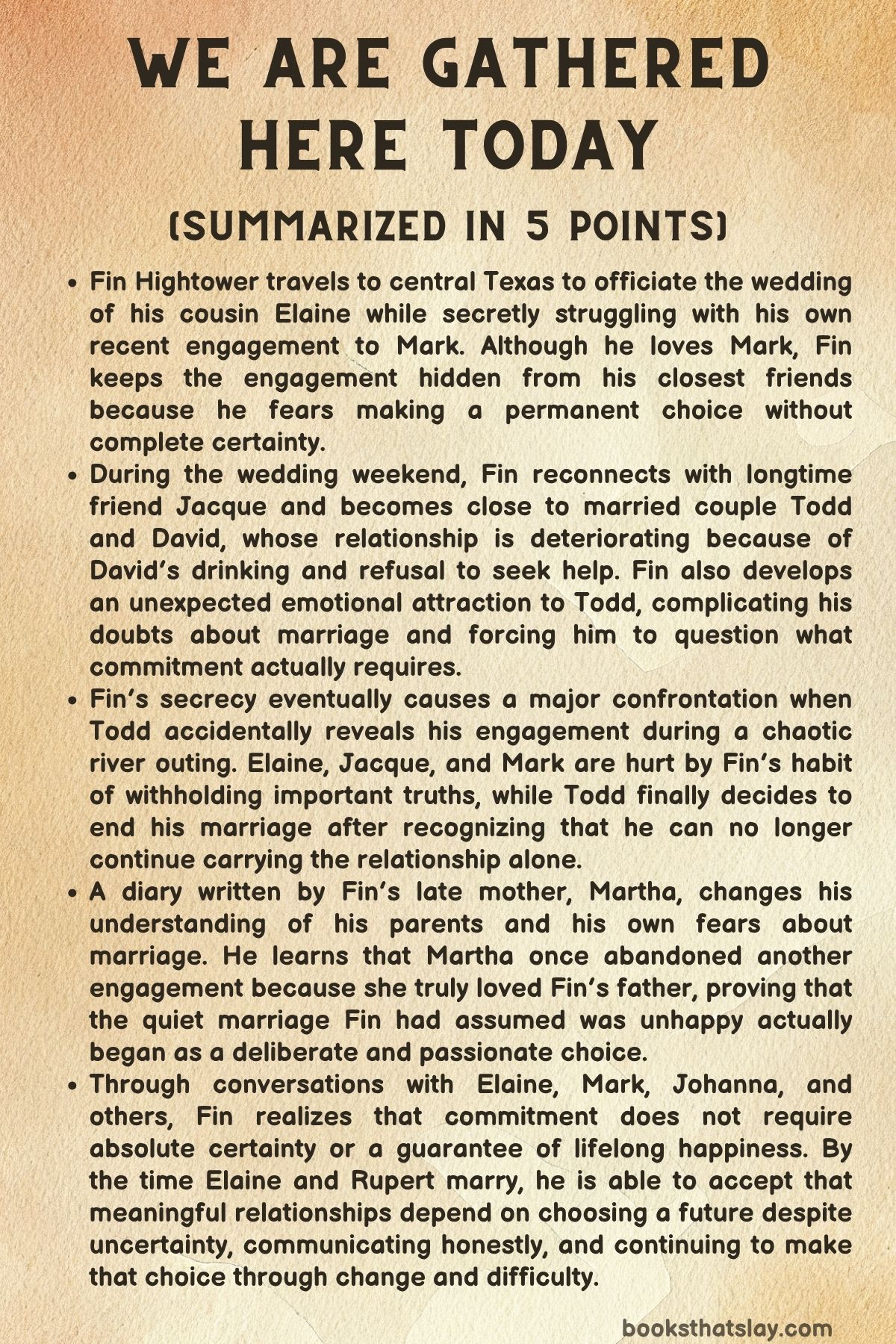
Thirty-six-year-old Finlay “Fin” Hightower travels from New York to central Texas for the wedding of his cousin Elaine, who has always felt more like a sister than a distant relative. His oldest friend, Jacque Aguilar, picks him up from the airport, and their reunion quickly restores the easy humor of a friendship that began when they were teenagers discovering their identities together.
Fin has been given an important role in the wedding: he will officiate Elaine’s ceremony. He has brought a notebook in which he intends to write his speech, but the pages remain empty because his difficulty is not merely writer’s block.
Fin is carrying a secret. His boyfriend Mark recently proposed, Fin immediately accepted, and almost as quickly he began wondering whether he had made the right decision.
Instead of telling Jacque and Elaine, the two people who should probably hear the news first, Fin keeps waiting for the ideal moment. His hesitation reflects a larger pattern in his life: he often delays difficult conversations until circumstances force them into the open.
The wedding is being held at the Hill Country Hideout, an elaborate destination venue created by wedding planner Hailey Carvajal. Hailey has constructed a highly organized four-day celebration filled with karaoke, outdoor games, river tubing, family activities, rehearsals, and carefully scheduled social events.
At the venue, Fin and Jacque meet David and Todd King, a married gay couple whose relationship immediately attracts Fin’s attention. David is loud, competitive, frequently drunk, and comfortable dominating conversations, while Todd is quieter, recently sober, and increasingly uncomfortable with his husband’s behavior.
They also meet Marina, David and Todd’s lesbian friend. Since most of the guests belong to Elaine or Rupert’s families, Fin, Jacque, Marina, David, and Todd naturally begin spending much of the weekend together.
Elaine’s arrival reconnects Fin with another important figure from his past: his elderly great-aunt Johanna. After Fin’s parents died only months apart while he was in college, Johanna became one of the strongest remaining links to the family life he had lost.
The first evening includes karaoke, an activity Fin once hated until Mark persuaded him to participate during their early dating life. When Fin unexpectedly volunteers to sing a country song associated with his childhood and invites Elaine to join him, he recognizes that Mark has helped him become more emotionally open than he once was.
Yet even while remembering Mark’s positive influence, Fin continues hiding their engagement. His uncertainty grows as he watches the couples around him and wonders what marriage actually requires from the people entering it.
Late that evening, the queer group gathers in David and Todd’s room and discusses a tradition Fin, Jacque, and Elaine created years earlier called the Hour of Disrespect. Instead of criticizing weddings while attending them, they save their complaints until afterward, spend a limited amount of time saying everything negative they noticed, and then agree to leave those criticisms behind.
The conversation gradually turns toward marriage itself. Fin talks skeptically about the institution, especially the complicated position queer people occupy after having once been excluded from legal marriage and later gaining the right to participate in it.
When he is asked whether he and Mark might marry, Fin pretends not to know. He does not reveal that he has already agreed to exactly that future.
His attention also begins moving toward Todd. Their conversations are intimate in a way neither of them openly acknowledges, and Fin becomes increasingly curious about the dissatisfaction within Todd and David’s marriage.
Meanwhile, Fin cannot write Elaine’s ceremony speech. He understands exactly what such a speech is supposed to accomplish, yet every attempt feels artificial because he cannot confidently celebrate someone else’s decision to marry while remaining uncertain about his own.
Johanna soon gives Fin something that changes the direction of the weekend: a diary written by his mother, Martha, during the summer of 1983. Fin has spent years thinking about his parents through the limited memories available to him, and Martha’s handwriting suddenly offers access to a version of his mother he never knew.
He initially cannot bring himself to read beyond the beginning. The diary feels both precious and dangerous because it may complicate the fixed story he has created about his parents and their marriage.
As the wedding activities continue, Fin repeatedly encounters questions about adulthood, children, relationships, and professional success. He remains evasive about marriage even though his engagement ring and future with Mark already exist outside these conversations.
His discomfort is intensified by the deteriorating relationship between David and Todd. Fin and Jacque overhear them arguing, and their public behavior increasingly suggests that Todd has reached the limits of what he can tolerate.
During outdoor games, Fin and Todd are paired together and celebrate a victory with an impulsive embrace that leaves both of them unsettled. Their attraction is becoming difficult to dismiss, particularly because Fin has not resolved his feelings about Mark.
Elaine is also becoming overwhelmed by the pressure surrounding her wedding. When Fin asks how she is doing, she reacts sharply, tired of being constantly observed and asked whether she is happy enough during an event that is supposedly meant to represent her happiness.
Later, Elaine organizes a family-history scavenger hunt. What initially appears to be another elaborate wedding activity becomes a reminder that families survive partly through the stories people decide to preserve.
Fin discovers a photograph of an unfamiliar relative named Thomas “Tommy” Wheeler. Johanna later explains that Tommy was an independent writer who never married and may have been one of the happiest people she knew.
The story gives Fin temporary comfort because Tommy represents a life in which being unmarried did not mean being incomplete. At this stage, Fin still treats marriage and independence as competing possibilities rather than choices that might take many different forms.
The tension between Todd and David eventually becomes impossible to ignore. Todd admits that David has a serious drinking problem and repeatedly refuses to seek meaningful help, leaving Todd trapped between love, frustration, resentment, and exhaustion.
That night, Todd comes to Fin’s room after another painful episode involving David. During their private conversation, Fin finally tells Todd that Mark proposed.
Todd then reveals an extraordinary connection between them. Years earlier, during Fin’s college days, Fin had tried to approach a man at a party and was humiliated after believing the stranger had dismissed him; Todd was that man.
Before Fin can fully process the discovery, the next morning brings another surprise. Mark arrives at the Hideout after traveling overnight to attend the wedding.
Fin is genuinely thrilled to see him. Their affectionate reunion reminds him that his uncertainty has never meant an absence of love.
The group later travels to the Medina River for tubing, where the weekend’s unresolved tensions erupt. David drinks heavily, Todd confronts him, and an argument reveals that Todd visited Fin’s room the previous night.
While defending Fin, Todd accidentally announces Fin’s engagement in front of Jacque and Elaine. Both are deeply hurt that Todd knew something so important before they did.
Elaine’s anger goes beyond the engagement itself. She accuses Fin of repeatedly withholding important parts of his life while waiting for some imaginary perfect opportunity to reveal them.
The conflict spreads across the group. Mark is hurt and suspicious, David becomes insulting, Fin loses his temper, and even the supposedly relaxing outing ends with police citations after objects are thrown into the river.
Back at the venue, Mark asks for space from Fin. Fin cannot repair their relationship immediately because Mark needs time to understand what happened between Fin and Todd and why Fin concealed the engagement from his closest friends.
Fin later talks to Hailey about marriage. Although Hailey spends her life professionally organizing weddings, she explains that seeing so many marriages has not made her cynical about commitment; it has simply made her careful about whom she would choose.
Todd, meanwhile, finally acts on the truth of his own marriage. He packs David’s belongings, arranges transportation for him, and tells him that he wants a divorce.
Todd explains that he has waited through repeated promises, refused counseling, continued drinking, and public humiliation. Leaving is not an impulsive rejection of marriage but an acceptance that commitment cannot survive indefinitely when only one person is trying to save it.
Fin also repairs his friendship with Jacque. He apologizes for hiding his engagement and for allowing their once-central friendship to weaken, while Jacque acknowledges that the distance between them was created by both of them.
Jacque and Marina also discover that their earlier assumptions about one another were wrong. Their attraction, initially hidden beneath jokes and misunderstandings, develops into a sexual and emotional connection that surprises them both.
Fin’s most important conversation with Elaine follows. After apologizing for their argument, Fin asks how certain she really is that she wants to marry Rupert.
Elaine tells him she is approximately ninety percent certain. For Fin, who has been treating uncertainty as evidence that something must be wrong, her answer is startling.
Elaine does not believe marriage requires eliminating every possible alternate future. She can imagine being happy alone or making different choices, but the future she wants most is the one in which Rupert remains beside her.
She reminds Fin of a childhood incident involving an abandoned piano. As a child, Fin had been willing to press a key simply to discover what might happen, and Elaine challenges him to recover some of that willingness to choose rather than endlessly imagine every possible consequence.
Fin finally turns seriously toward Martha’s diary. Mark begins reading it with him, and together they discover that Fin has misunderstood his parents’ marriage for most of his adult life.
Martha had once been engaged to a man named Matthew. Shortly before their wedding, however, she reconnected with James Hightower, Fin’s future father, fell deeply in love with him, canceled her planned marriage, and chose James instead.
Fin had interpreted the quietness of his parents’ relationship as evidence that they were unhappy and perhaps should have separated. Martha’s diary reveals something entirely different: she chose James deliberately even when doing so meant disrupting the future everyone expected her to accept.
The discovery forces Fin to reconsider the fear that has followed him since Mark’s proposal. He has been afraid that marrying Mark would mean repeating his parents’ supposedly unhappy life, but the model on which that fear was built was never accurate.
Mark tells Fin that studying other couples cannot tell them what their own marriage will become. Their future will be shaped by the choices the two of them make within it.
A loose page containing Martha’s wedding vows confirms the depth of her love for James. Once Fin accepts that uncertainty and imperfection do not erase genuine commitment, he is finally able to write Elaine and Rupert’s ceremony speech.
The wedding day brings quieter changes to the other characters as well. Jacque and Marina begin imagining possibilities beyond the weekend, while Todd faces the first hours of a life no longer organized around protecting David from the consequences of his drinking.
David, alone in Austin, realizes how dependent his daily existence has become on Todd. He drives back toward the wedding because he still wants to witness Rupert’s marriage, yet ultimately recognizes that appearing in the middle of his own crisis might redirect attention toward himself.
Before the ceremony, Johanna confirms what Martha’s diary has already revealed. Martha truly loved James, and the marriage Fin spent years doubting was a choice his mother knowingly made.
Johanna also makes clear that her pride in Fin does not depend on whether he marries. What matters is that he stops allowing fear to make his decisions.
When the ceremony begins, Fin finally stands before Elaine, Rupert, and their guests with something honest to say. He describes Elaine not simply as a relative but as a friend whom he continually chooses and who continues choosing him.
He comes to understand that love does not gain value from being rushed or guaranteed. A relationship can matter precisely because people keep returning to it while knowing that certainty is impossible.
Elaine and Rupert exchange vows and marry. The celebration that follows becomes meaningful not because everything went according to plan, but because almost nothing did and the people involved still arrived at the ceremony changed, connected, and willing to continue.
Later, Fin, Mark, Jacque, Marina, and Todd gather around the bonfire for the traditional Hour of Disrespect. After an entire weekend of disasters, arguments, secrets, breakups, accidents, and uncomfortable discoveries, they find that there is surprisingly little they want to criticize.
The wedding has become something larger than its itinerary. For Fin especially, it has transformed marriage from a test of absolute certainty into a choice made with incomplete knowledge, genuine love, and the courage to accept whatever future follows.
Characters
Finlay “Fin” Hightower
Fin is the emotional and intellectual center of We Are Gathered Here Today, and much of his complexity comes from the difference between what he feels and what he is willing to say. He loves Mark, values Elaine and Jacque deeply, and remains attached to his family, yet he repeatedly protects himself through delay, secrecy, analysis, and the belief that important truths should be revealed only under ideal circumstances.
His anxiety about marriage is therefore part of a much wider fear of irreversible choice. Fin can imagine alternatives so vividly that choosing one path begins to feel like killing every other possible version of his life, which explains why an engagement he initially welcomes soon becomes a source of panic.
His parents’ deaths also shape his emotional habits. Because he lost them relatively young, he has spent much of adulthood interpreting their marriage without being able to ask them whether his interpretation is correct.
Fin assumes their quiet relationship represented unhappiness, and this belief becomes an unconscious warning against his own marriage. Martha’s diary eventually shows how easily children can misunderstand their parents by mistaking limited observation for complete knowledge.
His attraction to Todd is similarly revealing. Todd does not simply represent romantic temptation; he represents an alternate life, an unresolved wound from Fin’s youth, and another possible future appearing exactly when Fin is frightened by the future he has already chosen.
Yet Fin’s growth comes from realizing that the existence of alternatives does not invalidate commitment. By the wedding ceremony, he is beginning to understand that mature choice is not the discovery of a future without risk but the willingness to choose while risk remains.
Mark
Mark functions as both Fin’s romantic partner and a challenge to Fin’s tendency to hide inside hypothetical possibilities. He is affectionate, spontaneous, attentive, and willing to act decisively, as shown when he travels overnight to Texas simply because he wants to be present for an important event in Fin’s life.
His proposal also reveals a difference between the two men. Mark can transform love into action relatively quickly, while Fin immediately begins imagining every possible way the decision could fail.
Mark is not presented as infinitely patient or unquestioningly forgiving. When he discovers that Fin concealed their engagement and had an emotionally charged private encounter with Todd, he becomes hurt, suspicious, and unwilling to resolve everything immediately.
That reaction gives the relationship greater credibility because Mark does not exist merely to reassure Fin. He expects openness and allows himself to demand space when that openness is missing.
His most important contribution is his refusal to let Fin treat other marriages as predictions of their own. Mark understands that commitment creates responsibilities, but he rejects the idea that another couple’s happiness or failure can determine what he and Fin will become.
Jacque Aguilar
Jacque is Fin’s oldest friend and one of the people who knows his habits well enough to recognize when he is avoiding the truth. Their shared history includes adolescence, coming out, college, adulthood, weddings, family difficulties, and years of emotional familiarity that have survived even as geographical distance has weakened their everyday closeness.
Her anger over Fin’s hidden engagement therefore comes from more than missing an announcement. She realizes that their friendship has gradually shifted from intimate participation in each other’s lives toward carefully edited updates.
Jacque’s personality combines sharp humor with emotional defensiveness. She often uses jokes, criticism, and skepticism about marriage to create distance from her own desire for closeness.
Her developing connection with Marina forces her to confront the possibility that some of her loneliness has been reinforced by assumptions about what other people think of her. Learning that Marina once rejected her only because she considered Jacque unattainable exposes how easily insecurity can disguise itself as certainty.
Jacque’s reconciliation with Fin also demonstrates her maturity. She allows herself to be angry without pretending that Fin alone caused the deterioration of their friendship, acknowledging that relationships can weaken through mutual neglect and can also be repaired through mutual effort.
Elaine
Elaine is both the bride around whom the weekend is organized and one of the strongest counterarguments to Fin’s belief that marriage should require total certainty. She is practical, intelligent, emotionally observant, and historically less romantic than the elaborate wedding she has arranged might suggest.
Her decision to marry Rupert is powerful precisely because she does not describe it as absolute certainty. When she tells Fin she is approximately ninety percent sure, she introduces a mature understanding of commitment in which doubt and choice can exist together.
Elaine can imagine other lives for herself, including a life without Rupert. Her confidence comes not from believing every alternative would be miserable but from knowing which future she wants enough to choose.
The pressure of the wedding also reveals her vulnerability. Constant questions about whether she is happy make her feel as though she must perform the correct emotional state for everyone around her.
Her anger at Fin during the river trip develops from years of watching him withhold information. Because Elaine considers him family as well as a friend, learning about his engagement from Todd feels like evidence that Fin has been quietly removing himself from a relationship she still considers central.
Her later conversation with Fin demonstrates why their bond survives. Elaine can apologize, accept his apology, speak openly about her own uncertainty, and use their shared childhood memories to remind Fin of the person he once was.
Within We Are Gathered Here Today, Elaine represents a form of commitment based on informed preference rather than fantasy. She knows marriage cannot guarantee a future, yet she chooses Rupert because the possibility of that shared future matters more to her than the impossibility of certainty.
Rupert
Rupert is less psychologically conflicted than many of the other major characters, but this steadiness is central to his role. His relationship with Elaine is not presented as dramatic or constantly tested by romantic crisis; instead, he offers consistency, warmth, and an ability to remain calm when circumstances become chaotic.
His first meeting with Elaine, involving the final portion of brisket, carries the charm of a romantic story, but their six-year relationship makes clear that the marriage rests on more than an amusing origin. Rupert has become someone Elaine can realistically imagine building an ordinary life beside.
His response when Elaine worries that something will go wrong at the wedding captures his approach to partnership. Rather than promising perfection, he effectively tells her that problems can be handled when they arrive.
Rupert also behaves compassionately toward David when David unexpectedly returns. Instead of treating him as an embarrassment because his marriage is collapsing, Rupert acknowledges his pain and makes it clear that he would still be welcome.
Todd King
Todd is one of the book’s most complicated examples of what happens when loyalty becomes endurance without meaningful reciprocity. Having recently become sober himself, he is trying to reconstruct his life while married to a man whose drinking continues to dominate their relationship.
His quiet personality initially makes him appear passive, but his restraint should not be mistaken for weakness. Much of the story shows a man approaching the point at which patience can no longer be distinguished from self-abandonment.
Todd’s attraction to Fin complicates his characterization because it occurs while his marriage is deteriorating. Their emotional connection gives Todd temporary access to the possibility of being seen outside the exhausting role he occupies with David.
The revelation that Todd was the stranger from Fin’s college memory adds another layer to their relationship. What Fin remembers as a defining rejection was only one incomplete encounter in Todd’s own life, reinforcing the story’s repeated concern with how people create lasting narratives from partial information.
Todd’s decision to divorce David is not presented as proof that marriage itself has failed. It reflects his recognition that remaining married cannot substitute for the work required to sustain a marriage.
His simple statement that he is “okay” after the separation marks a subtle transformation. For someone who has spent so much energy managing another person’s behavior, uncertainty begins to feel less frightening than continued entrapment.
David King
David is abrasive, funny, competitive, socially dominant, and frequently difficult to tolerate. His drinking increasingly exposes the insecurity and emotional damage beneath that aggressive exterior.
He has experienced rejection from his parents, who refused to attend his marriage to Todd. That history helps explain some of his anger toward traditional family expectations, but it does not excuse the way he treats Todd or the people around him.
David repeatedly refuses to address his alcohol use despite Todd’s concerns. His resistance to counseling and change reveals a central weakness: he expects love to continue protecting him from consequences even while he refuses to participate seriously in repairing the relationship.
After Todd sends him home, David finally experiences the emptiness created by his dependence on his husband. His decision to drive back toward the wedding suggests that the possibility of change has not completely disappeared.
His eventual restraint is equally important. When he realizes that attending could place his personal crisis in the middle of another couple’s celebration, he appears capable of choosing someone else’s needs over his own desire for comfort.
Marina
Marina enters as a sharp, confident observer whose humor fits naturally with Fin, Jacque, Todd, and David. Like Jacque, she carries skepticism about relationships and has developed emotional habits that protect her from disappointment.
Her growing attraction to Jacque becomes important because both women have misread each other. Marina’s admission that she once rejected Jacque on a dating app because she believed Jacque was beyond her reach demonstrates how insecurity can hide beneath apparent confidence.
Their connection is not immediately defined as a permanent romance. Instead, Marina represents the possibility that intimacy can begin without a complete plan for what it must eventually become.
She also brings a useful outsider’s perspective to the group. Because she is connected to David and Todd rather than Elaine’s family history, she can observe conflicts without carrying the same inherited assumptions that shape Fin, Jacque, and Elaine.
Great-Aunt Johanna
Johanna represents continuity between Fin’s present life and the family world he lost after his parents died. Her age and blunt humor prevent her from becoming a sentimental symbol of the past; she is lively, direct, curious, and deeply invested in Fin’s future.
Giving Martha’s diary to Fin becomes one of the story’s most consequential acts. Johanna understands that the object belongs to him, but she does not dictate what he must learn from it.
She later provides context that helps Fin interpret Martha’s writing correctly. By confirming that Martha genuinely chose James, Johanna overturns a story Fin has carried for years about his parents being trapped together.
Her attitude toward Fin’s engagement is also important. Although she wants another wedding to attend, her pride in Fin does not depend on marriage itself.
Johanna ultimately wants Fin to make decisions because they reflect what he wants rather than what fear tells him to avoid. Her wisdom lies not in prescribing one kind of life but in encouraging him to inhabit his own life more fully.
Hailey Carvajal
Hailey initially appears to embody the professional machinery surrounding weddings. She creates schedules, prepares backup plans, manages accidents, supervises rehearsals, and turns romantic expectations into logistical realities.
Her career could easily make her cynical about marriage, yet the opposite is true. Watching many couples has made her selective rather than dismissive.
That distinction matters when Fin asks whether she wants marriage for herself. Hailey shows him that recognizing the possibility of failure does not require rejecting commitment.
She also functions as a counterbalance to the emotional chaos of the guests. Fires, accidents, scheduling problems, anxious brides, and difficult relatives are treated as practical situations to be managed rather than evidence that everything is ruined.
Martha Hightower
Although Martha is dead before the present-day story begins, her diary makes her one of the most influential characters. For years, Fin has remembered her primarily through the perspective of a son who watched his parents from the outside.
Her writing restores her private identity. She becomes a young woman with romantic expectations, social pressures, doubts, desires, and the willingness to overturn a nearly completed wedding when she realizes she loves someone else.
Martha’s choice of James is especially significant because Fin has built much of his fear of marriage around the assumption that his parents chose badly. Her diary demonstrates that a relationship can be imperfect without having originated in resignation.
She also becomes evidence of how much disappears when family stories are not preserved. Fin knew his mother intimately in one sense and almost not at all in another.
James Hightower
James is important largely through the effect his marriage has had on Fin’s imagination. Fin remembers the quietness of his parents’ relationship and concludes that James and Martha may have remained together despite being unhappy.
The diary reveals that this interpretation was incomplete. James was not simply the man Martha ended up with; he was the man for whom she deliberately abandoned a more socially expected marriage.
His character therefore illustrates the limits of judging a relationship from its external appearance. Quietness does not necessarily mean absence of love, just as dramatic romance does not guarantee lasting compatibility.
Matthew
Matthew represents the future Martha was expected to choose before she changed the direction of her life. He appears primarily through the diary as the man she was preparing to marry when her feelings for James became impossible to ignore.
His importance lies less in his individual personality than in what the broken engagement means for Fin. Martha was once extraordinarily close to making one permanent decision and then altered course because another truth became clearer.
Matthew therefore becomes part of the evidence that changing one’s mind is not inherently cowardly, just as remaining committed is not automatically brave. What matters is whether the choice is honest.
Thomas “Tommy” Wheeler
Tommy exists largely through family memory, yet he becomes unexpectedly important to Fin. Described as an eccentric writer and lifelong bachelor, he offers Fin an example of a person who apparently built a satisfying life outside marriage.
Johanna’s claim that Tommy may have been the happiest person she knew comforts Fin because it breaks the assumption that adulthood must culminate in partnership. His example gives Fin permission to imagine that rejecting marriage would not automatically produce loneliness or failure.
At the same time, Tommy’s existence does not ultimately tell Fin what to do. He simply proves that several forms of a meaningful life are possible, leaving Fin responsible for deciding which one he personally wants.
Jeffrey
Jeffrey, Elaine’s brother, occupies a smaller role but contributes to the story’s dismantling of the fantasy that weddings can be perfectly controlled. His drunken fall during karaoke frightens Elaine and reminds everyone how quickly carefully arranged events can be disrupted.
His behavior also contributes to Elaine’s mounting exhaustion. She is trying to participate emotionally in her own celebration while simultaneously responding to the unpredictable actions of relatives and guests.
Ryan Ellerman
Ryan belongs mainly to Fin’s college memories as an intense crush associated with longing, embarrassment, and insecurity. Mentioning him opens a door to a period when Fin was far less confident about romantic possibility and far more vulnerable to perceived rejection.
The memories connected to that time also help explain why Fin left Austin for New York. His relocation was not purely professional or adventurous; it carried an element of emotional escape.
Connor and Willy
Connor and Willy serve mainly as comic agents of unpredictability during the wedding weekend. Their football and lasso accidents repeatedly disrupt the adult guests’ attempts to keep events under control.
Their presence nevertheless supports a larger idea running throughout the novel: life does not respect itineraries. People can schedule ceremonies and activities with extraordinary precision, but chance remains permanently present.
Richard
Richard appears briefly during the outdoor activities and becomes associated with the social tension produced when different groups of wedding guests are forced into temporary intimacy. His request that Jacque stop swearing reflects the minor clashes in values and behavior that emerge within large family gatherings.
His role is small, but such interactions contribute to the realistic social texture of the wedding. Not every source of discomfort needs to become a major conflict to reveal how differently people understand acceptable behavior.
Themes
Choice Without Absolute Certainty
Much of We Are Gathered Here Today challenges the assumption that people should make life-changing decisions only when every doubt has disappeared. Fin treats uncertainty almost as evidence against marriage, believing that the ability to imagine another life means there must be something wrong with the life he is considering with Mark.
Elaine offers a different understanding when she admits that she is not completely certain about marrying Rupert. Her confidence comes from accepting that other futures are possible while still knowing which future she prefers.
This distinction transforms the meaning of commitment. Choosing one person does not require proving that every alternative would have been disastrous, nor does marriage demand knowledge of everything that will happen decades later.
Martha’s history reinforces the same idea from another direction. She once planned to marry Matthew and then changed course when she recognized that she loved James, showing that honest choice can require either commitment or reversal depending on what a person truly wants.
Todd’s divorce provides another variation. He does not leave because he has discovered a perfectly guaranteed future elsewhere; he leaves because remaining in the present has become incompatible with his well-being.
By the end, Fin understands that refusing to choose is itself a choice. Uncertainty cannot be eliminated, so maturity requires deciding which risks are worth accepting.
Marriage Versus the Reality of a Relationship
Weddings repeatedly create an illusion of order that the relationships surrounding them immediately complicate. Elaine and Rupert’s celebration has schedules, rehearsals, activities, carefully designed spaces, speeches, and traditions, yet almost every part of the weekend is disrupted by accidents, arguments, secrets, drinking, jealousy, and emotional confusion.
The contrast separates the public symbol of marriage from the private work of maintaining a relationship. David and Todd are already legally married, but the existence of that marriage cannot repair David’s drinking or replace the counseling and accountability Todd has repeatedly requested.
Fin and Mark occupy the opposite position. They are not yet married, but their relationship contains affection, shared history, sexual intimacy, disappointment, argument, honesty, and the capacity for repair.
Elaine and Rupert also demonstrate that a successful relationship is not one protected from problems. Rupert’s attitude is simply that when something goes wrong, they will deal with it together.
The story therefore resists treating the wedding ceremony as the conclusion of romantic development. Marriage may formalize a choice, but it cannot perform the daily emotional labor required afterward.
The real measure of commitment lies in how people respond when expectations fail, circumstances change, resentment appears, or uncertainty returns. A ceremony can announce a promise, but only the relationship itself can determine what that promise becomes.
Memory, Family Stories, and Misinterpretation
Fin’s understanding of his family is shaped as much by missing information as by remembered facts. After losing his parents while still relatively young, he carries a fixed interpretation of their marriage into adulthood and gradually treats that interpretation as objective truth.
Martha’s diary reveals the danger of such certainty. The quiet marriage Fin interpreted as resignation began with a dramatic act of personal choice, as Martha abandoned an expected future with Matthew because she wanted James.
The discovery does not prove that Fin’s parents experienced an ideal marriage. Instead, it teaches him that he never possessed enough information to make the conclusions on which he built his own fear of commitment.
Elaine’s family-history scavenger hunt develops the same concern on a broader scale. Old photographs, forgotten relatives, private stories, and seemingly trivial memories demonstrate how quickly parts of a family disappear when nobody records or asks about them.
Tommy Wheeler becomes significant because a single remembered detail can reopen an entire possibility. Learning that an unmarried relative may have lived happily gives Fin access to a model of adulthood that his known family history had not provided.
Memory therefore functions as both inheritance and distortion. People need stories in order to understand where they come from, but those stories must remain open to correction when new voices, documents, or perspectives appear.
Friendship, Honesty, and the Work of Staying Connected
Fin’s relationships with Jacque and Elaine demonstrate that long friendship does not maintain itself automatically. Shared childhoods, college experiences, family history, and years of affection create strong foundations, but those foundations can still weaken when people stop telling one another what is actually happening in their lives.
Fin’s hidden engagement becomes painful because it exposes this gradual erosion. Jacque and Elaine are not simply offended that they learned the news late; they recognize that Fin has been making important emotional decisions without allowing them to participate in the process.
Fin often explains his silence as a search for the right moment. In practice, the desire for perfect communication becomes a method of avoiding vulnerable communication altogether.
Jacque also accepts responsibility for the growing distance between them. Their reconciliation succeeds because neither person insists on a simple story in which one friend caused the entire problem.
The Hour of Disrespect reflects another aspect of friendship. What begins as a comic ritual depends on an agreement that friends can express negativity openly without allowing it to consume the relationship.
By the final gathering, the group has endured enough conflict that criticism feels less important than connection. Friendship is shown not as uninterrupted closeness but as a repeated decision to return, apologize, listen, reveal more, and remain available to one another even after distance or disappointment.