Love You More Summary, Characters and Themes
Love You More by by Emily Giffin is a contemporary novel about love, ambition, friendship, grief, and the difficult choices that determine where a person belongs.
At its center is Billie Wright, a successful fertility doctor whose carefully built New York life is disrupted when the death of her childhood best friend, Erin, draws her back to Wisconsin. There, Billie is forced to reconsider old relationships, unfinished emotional conflicts, and her responsibility toward Erin’s young daughter, Phoebe. Moving between Billie’s youth and adulthood, the story examines how people change over time and whether love can survive distance, betrayal, competing dreams, and the consequences of choices made years earlier.
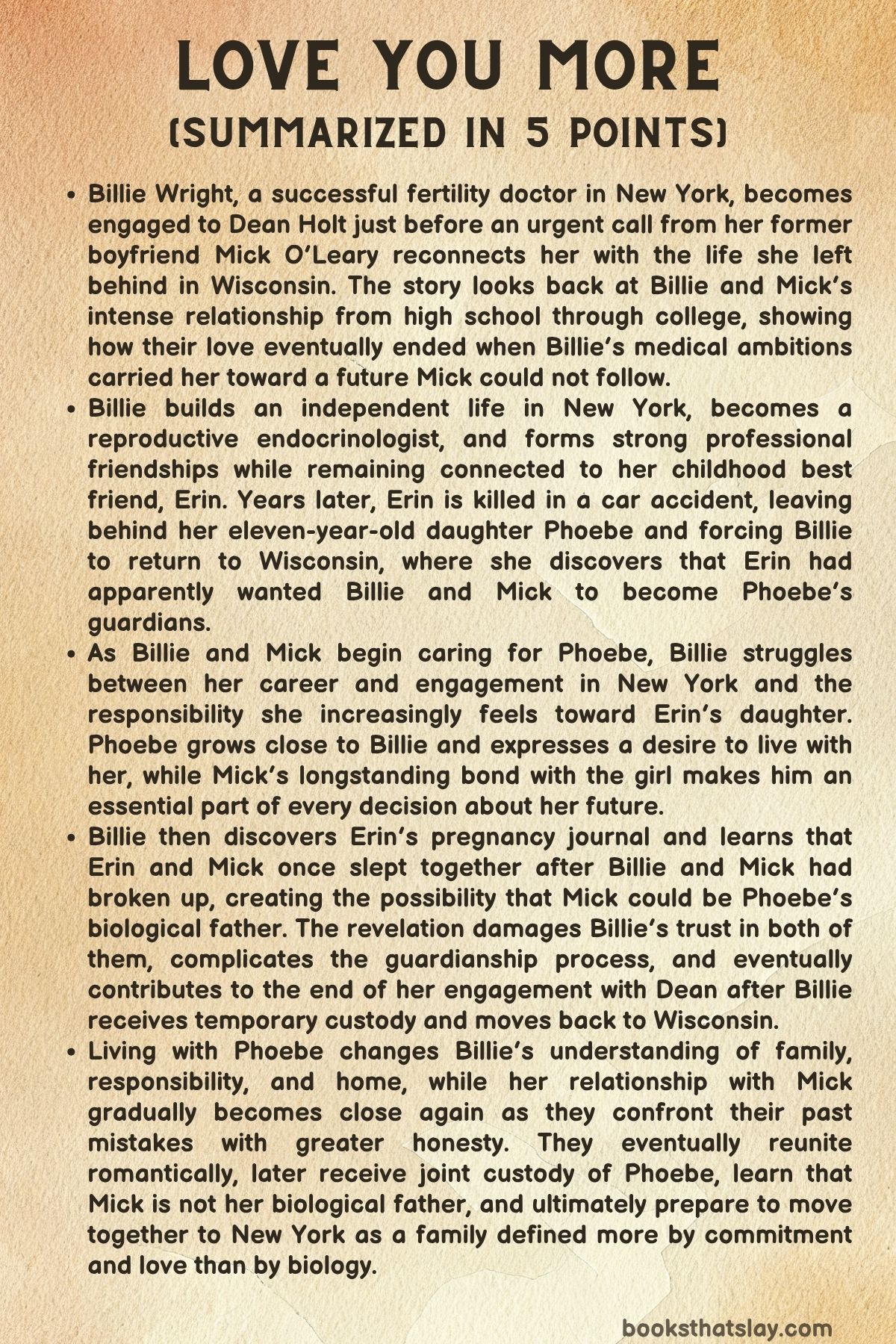
Summary
Billie Wright is a thirty-seven-year-old reproductive endocrinologist living in New York with a successful medical career and a stable relationship with trauma surgeon Dean Holt. During a visit to Dean’s wealthy family home in the Hamptons, he surprises Billie by proposing, then reveals that he has secretly invited both sets of parents to celebrate with them. Billie accepts with complete confidence, believing that after years of work and emotional uncertainty, she has finally reached the secure future she has wanted.
Soon afterward, Billie receives an unexpected phone call from Mick O’Leary, the former boyfriend who once shaped nearly every part of her young life. His appearance brings the story back to Wisconsin, where Billie first met Mick during high school. Billie was academically ambitious, disciplined, and determined to become a doctor, while Mick was popular, athletic, closely tied to his family’s orchard, and deeply protective of his younger sister Maeve, who has Down syndrome.
Billie quickly fell in love with Mick, although their relationship began as friendship. Mick trusted her with difficult truths about his mother’s alcoholism and his responsibilities at home, while Billie encouraged him to see himself as capable of attending college rather than simply accepting the future expected of him. Billie’s best friend Erin recognized Billie’s feelings almost immediately and became her closest confidante throughout the years that followed.
Mick initially dated another girl, leaving Billie heartbroken, while Billie began a relationship with the kind and intelligent Paul. Eventually Mick admitted that he had always cared for Billie romantically. Billie ended her relationship with Paul, and she and Mick finally became a couple before graduation.
Their relationship became serious enough that Billie gave up Yale and chose the University of Wisconsin so she could remain with Mick. They entered college together believing that love could hold their lives in the same direction. Their years at Wisconsin strengthened their bond, yet Billie’s growing professional ambition eventually created a challenge neither could ignore.
When Billie gained admission to medical school at Columbia, Mick encouraged her to go to New York despite knowing he could not easily follow. Billie moved east, and they attempted a long-distance relationship. At first they remained devoted, but the pressure of medical training gradually consumed Billie’s time and changed her understanding of the future she wanted.
Missed calls, cancelled visits, demanding exams, and Billie’s growing attachment to New York placed greater strain on the relationship. Mick imagined Billie returning to Wisconsin, while Billie could no longer promise that she wanted to return. They eventually ended their six-year relationship because their lives were moving toward incompatible futures, even though neither had stopped loving the other.
Billie remained in New York, completed her medical training, chose obstetrics and gynecology, and eventually specialized in reproductive medicine. She built Hope Fertility with Lesli Green and Greer, two physicians who became close friends and professional partners. Through medicine, Billie developed an identity independent of Mick and came to understand that ambition was not merely something she pursued but a fundamental part of who she had become.
Meanwhile, Erin became pregnant after what Billie believed was a drunken encounter with an unfamiliar man. Billie supported Erin throughout the pregnancy, and their friendship grew close again. Billie suggested the name Phoebe for Erin’s daughter and flew home when Erin went into labor, remaining beside her during the delivery and sharing one of the defining moments of their friendship.
More than eleven years later, Billie’s peaceful New York life is shattered when Mick finally tells her why he called: Erin has been killed in a car crash involving her partner, Russ. Billie immediately returns to Wisconsin for the funeral, consumed by grief and guilt over how distant she and Erin had again become. The larger problem quickly becomes clear because Erin has left behind eleven-year-old Phoebe, while Erin’s mother Joan has advanced Alzheimer’s disease and cannot safely raise her.
At the funeral, Billie sees Mick for the first time in years. Their reunion is restrained, but the familiar emotional connection between them remains unmistakable. Billie later learns that Erin apparently wanted Billie and Mick to become Phoebe’s guardians if something happened to her, although no formal written instructions can initially be found.
Mick already has a strong relationship with Phoebe and believes she should remain in Wisconsin among familiar people. Billie, however, has a career, fiancé, apartment, and business in New York. Dean initially responds with generosity, saying that he will adapt to whatever Billie decides, but the possibility of Billie raising Phoebe alongside Mick gradually creates tension.
Phoebe makes it clear that she would prefer Billie and Mick over other possible guardians. She also surprises Billie by expressing interest in moving to New York, where she believes she could escape being constantly identified through her mother’s death. Mick eventually agrees that Phoebe should be allowed to try living there, although Billie senses that letting Phoebe go will be painful for him.
During these weeks, Billie and Mick also reconsider their own past. Mick admits that he might have followed Billie to New York years earlier but allowed fear and insecurity to stop him. Billie begins seeing their breakup less as one person abandoning another and more as the result of two young adults who did not yet know how to make space for each other’s ambitions.
Everything changes when Billie reads Erin’s pregnancy journal. The journal refers to a mysterious man identified only as “M,” who feared that he might be Phoebe’s father. Billie immediately confronts Mick, who admits that after his breakup with Billie, he and Erin slept together once while drunk.
The revelation devastates Billie because the two people she once trusted most kept the truth from her for years. Erin believed the encounter had not resulted in pregnancy and refused Mick’s request to tell Billie. Mick admits that he has never known with certainty whether he could be Phoebe’s biological father.
Dean insists that a paternity test is necessary before any permanent guardianship decision can be made. Billie fears that if Mick is Phoebe’s father, she could lose the child she has already begun to love as family. Legal complications prevent an immediate test, so Billie applies for temporary guardianship herself and is granted custody on the condition that she live in Wisconsin for six months.
The decision places enormous strain on Billie and Dean. Dean has accepted a major career opportunity in New York, while Billie is now reorganizing her life around Phoebe and increasingly functioning as a parenting partner with Mick. Eventually Dean ends their engagement, recognizing that although they still love each other, the future they once planned no longer feels possible.
Billie moves into Joan’s former home with Phoebe and gradually develops a daily rhythm in Wisconsin. She works remotely, maintains her relationship with Hope Fertility, visits Joan, supports Phoebe through grief, and begins experiencing ordinary responsibilities of parenthood. Mick remains consistently present without using Billie’s breakup as an excuse to pressure her romantically.
As the months pass, Billie’s anger toward Mick begins to soften. She cannot erase his deception, but she sees that his devotion to Phoebe is genuine and not dependent on biological parenthood. Billie and Mick begin speaking more openly about their history, their failures, and the feelings that never completely disappeared.
Eventually Mick tells Billie that he still loves her. Unlike their youthful relationship, however, he no longer expects Billie to sacrifice her ambitions or remain in Wisconsin for him. He offers to follow her wherever the life they create together requires, including New York.
Billie realizes that loving Mick again does not require her to become the young woman who once abandoned Yale for him. Their second chance depends on meeting as adults who understand the cost of compromise, honesty, family, and personal growth. She chooses him again, and their renewed relationship grows around their shared care for Phoebe.
Three years later, Billie, Mick, and Phoebe are preparing to move to New York together. Billie and Mick have received joint custody, while the eventual paternity test has confirmed that Mick is not Phoebe’s biological father. The result matters legally, but emotionally it changes little because the family they have built rests on commitment rather than genetics.
Billie continues her medical career, Mick prepares for a new stage of his own life, and Phoebe enters adolescence surrounded by adults who have chosen to remain present for her. Even Billie’s former relationship with Dean settles into a respectful connection, showing that meaningful relationships do not always need to end in bitterness.
During their journey east, Billie, Mick, and Phoebe stop at Niagara Falls, a place Billie and Mick once visited as a young couple. With Phoebe now standing between them, Billie finally understands that she does not have to choose between the person she became in New York and the person she once was in Wisconsin. Home is no longer defined by a location but by the people with whom she is willing to build a life.
Characters
Billie Wright
Billie Wright is the emotional and psychological center of Love You More, and much of the book is concerned with the tension between the life she planned and the life circumstances eventually ask her to accept. From childhood onward, Billie is disciplined, competitive, intelligent, and deeply ambitious, but these qualities exist beside an equally powerful desire for lasting emotional security.
Her first major conflict arises because she initially treats romantic commitment as something that should justify personal sacrifice. Choosing Wisconsin over Yale demonstrates how completely she once believed that remaining close to Mick was more important than protecting every part of her individual ambition.
New York changes Billie because it forces her to discover an identity separate from her childhood relationships. Medicine becomes more than a profession for her; it provides confidence, independence, purpose, and proof that she can construct a meaningful life through her own decisions.
That independence later makes her relationship with Dean appealing because he appears to love the adult Billie without requiring her to become smaller. Yet Phoebe’s situation exposes an important truth about Billie: beneath her professional self-sufficiency, she still possesses an intense need to care for the people she considers family.
Her decision to become Phoebe’s guardian represents maturity because it differs from her youthful sacrifice for Mick. She is no longer giving something up merely to keep a romantic relationship; she is consciously accepting responsibility for a grieving child while finding ways to preserve her career.
Billie’s eventual reunion with Mick therefore does not undo her growth. She can return to him only after both understand that love cannot require one person to abandon the life that makes that person whole.
Mick O’Leary
Mick is presented first as Billie’s great youthful love, but adulthood reveals that his character is more complicated than Billie’s memories initially allow. His warmth, loyalty, and sense of responsibility are genuine, particularly in the care he gives Maeve and later Phoebe, yet he also has a strong tendency to avoid painful truths.
His attachment to Wisconsin reflects both devotion and fear. For years Mick frames his inability to follow Billie as a responsibility to Maeve and the orchard, but he eventually admits that insecurity was also involved because he feared entering Billie’s expanding world and discovering that he did not belong there.
That admission is essential to understanding his growth. Mick eventually recognizes that he once allowed Billie to carry the burden of their incompatible futures when he could have taken greater emotional risks himself.
His greatest moral failure is sleeping with Erin and then agreeing to conceal it. The betrayal becomes more serious because the possibility of Phoebe’s paternity affects not only Billie but Phoebe herself.
At the same time, Mick’s care for Phoebe is never presented as conditional upon biology. Long before the truth becomes known, he serves as a dependable adult presence in her life, and his instinct after Erin’s death is to protect Phoebe rather than protect his own comfort.
By the end of the story, Mick differs from the young man Billie once loved because he no longer asks her to fit inside his Wisconsin life. His willingness to move to New York shows that he has learned that partnership requires movement from both people.
Erin Callahan
Erin is one of the most influential characters in Love You More despite being absent from much of the present-day action. Her personality continues to affect nearly every major decision after her death because Billie, Mick, Phoebe, Joan, and their wider community all respond to different parts of the life she left behind.
As a young woman, Erin is bold, spontaneous, funny, fiercely loyal, and socially fearless. She provides an important contrast to Billie’s caution and discipline, frequently encouraging Billie to take emotional risks that Billie might otherwise avoid.
Her friendship with Billie is unusually deep but not flawless. Time, distance, relationships, careers, and motherhood repeatedly create gaps between them, yet their bond retains the emotional force of family.
Erin’s greatest contradiction lies in her decision to hide her sexual encounter with Mick. She appears to convince herself that silence protects Billie, but the secrecy also shows that Erin is capable of choosing avoidance when honesty threatens relationships she desperately wants to preserve.
Her motherhood reveals a more settled form of her loyalty. Phoebe becomes the center of Erin’s life, and everything learned about their relationship suggests genuine closeness, affection, and mutual trust.
After Erin’s death, her importance grows rather than disappears. Billie’s guardianship of Phoebe becomes, in part, an attempt to honor their friendship while also accepting that loving Erin does not require pretending that Erin never made serious mistakes.
Phoebe
Phoebe is the character around whom the adult conflicts eventually reorganize themselves. Initially she appears primarily as the child left vulnerable by Erin’s death, but she gradually emerges as perceptive, intelligent, emotionally direct, and capable of expressing preferences that the adults around her sometimes struggle to hear.
Her grief is presented through both dramatic moments and ordinary needs. She can break down because she wants her mother and then later focus intensely on dogs, spelling competitions, food, school, or daily routines, demonstrating how children often continue living even while carrying enormous loss.
Phoebe’s desire to leave Wisconsin is especially important because it prevents the adults from treating stability as purely geographical. To Mick, remaining near familiar people initially seems safest, but Phoebe explains that Wisconsin itself has become associated with pity, grief, and the identity of being the girl whose mother died.
Her attachment to Billie is connected partly to Erin. Phoebe sees something of her mother in Billie, which gives Billie a form of emotional familiarity that becomes reassuring during a period when nearly everything else has changed.
At the same time, Phoebe develops a genuine relationship with Billie that is independent of Erin’s memory. Their affection grows through shopping trips, conversations, shared routines, school events, household responsibilities, and the ordinary closeness of living together.
Phoebe also demonstrates that family need not depend upon biology. Mick is not her biological father, and Billie is not her biological mother, yet both eventually become parents through continued presence and voluntary responsibility.
Dean Holt
Dean initially represents the possibility of an emotionally mature adult relationship that differs from Billie’s history with Mick. He is accomplished, dependable, generous, attentive, and secure enough to understand Billie’s devotion to medicine.
His proposal reveals how carefully he considers Billie’s emotional needs. By including both families in the celebration, Dean demonstrates that he recognizes the importance Billie places on belonging and connection.
After Erin’s death, Dean makes serious efforts to support Billie. He offers to accompany her to Wisconsin, considers relocating, researches professional opportunities there, and approaches the possibility of raising Phoebe with more openness than Billie initially expects.
However, Dean’s limits become increasingly visible when Mick remains part of Phoebe’s life. His discomfort is understandable because he is being asked to enter a parenting structure involving his fiancée’s former great love, someone who may also be Phoebe’s biological father.
Dean’s insistence on a paternity test shows his preference for truth, legal clarity, and clearly defined responsibilities. Where Billie sometimes wants emotional certainty to matter more than biological facts, Dean refuses to construct a family around information everyone has deliberately chosen not to know.
His decision to end the engagement is painful but not cruel. Dean understands that Billie’s emotional and practical commitments have shifted, and he refuses to preserve a marriage plan that no longer reflects their actual lives.
Joan
Joan represents both family continuity and the painful effects of decline. As Erin’s mother and Phoebe’s grandmother, she belongs to the network of relationships that once made Wisconsin feel permanent and secure.
Her Alzheimer’s disease changes the practical consequences of Erin’s death because Joan cannot safely assume responsibility for Phoebe. The family is therefore forced to acknowledge that love alone cannot make someone capable of providing the care another person requires.
Joan’s moments of lucidity remain emotionally important because they provide information about Erin’s hopes for Phoebe. Her statement that Erin wanted Billie and Mick to become guardians becomes the starting point for the entire custody question.
At the same time, Joan’s unreliable memory prevents those statements from functioning as simple legal answers. Her condition creates uncertainty while also showing how quickly family structures can collapse when several generations experience loss at once.
Joan’s eventual move into memory care reflects a necessary form of love that initially feels like abandonment to Phoebe. The decision shows that responsible care sometimes requires accepting limits rather than insisting that familiar arrangements continue.
Maeve O’Leary
Maeve plays a smaller role in the direct action, but she is fundamental to understanding Mick. His love for his younger sister reveals his patience, protectiveness, loyalty, and early acceptance of responsibility.
Maeve’s Down syndrome also exposes tensions within Mick’s family, particularly through their mother’s alcoholism and the emotional pressure Mick experiences while trying to protect Maeve. These circumstances help explain why Mick associates remaining in Wisconsin with duty rather than merely preference.
As the characters grow older, Maeve’s successful life complicates Mick’s earlier assumptions about responsibility. She lives in a group home, works, develops relationships, and becomes increasingly independent.
Her progress helps reveal that some of Mick’s claimed obligations were mixed with fear about leaving the only world he knew. Maeve never asks him to sacrifice his future, and eventually he is able to imagine moving elsewhere without believing that doing so means abandoning her.
Lesli Green
Lesli begins as someone Billie connects with during the difficult adjustment to medical school in New York. Their shared Midwestern background gives Billie companionship at a time when she feels overwhelmed by both the city and the demands of her profession.
The friendship grows alongside their professional development. Lesli understands Billie not simply as a doctor but as someone whose personal identity has been shaped by sacrifice, ambition, and the fear of losing important relationships.
When the guardianship crisis develops, Lesli offers Billie emotional support without dictating what she should choose. She is more willing than Greer to imagine a flexible professional arrangement that allows Billie to remain involved with Hope Fertility while caring for Phoebe.
Her loyalty becomes especially important after Dean ends the engagement. Lesli helps demonstrate that Billie’s return to Wisconsin does not require the destruction of everything she built in New York.
Greer
Greer is confident, practical, direct, and professionally ambitious. She becomes an important part of Billie and Lesli’s adult world and contributes to the creation of Hope Fertility.
Unlike Lesli, Greer initially views Billie’s possible return to Wisconsin with considerable skepticism. She sees the professional risks clearly and questions whether Billie should reorganize her life when Mick already appears capable of caring for Phoebe.
Her perspective is valuable because it challenges the emotional momentum carrying Billie toward guardianship. Greer forces Billie to consider whether guilt, grief, and nostalgia are influencing choices that will have permanent consequences.
Despite her reservations, Greer remains loyal when Billie ultimately chooses Phoebe. She does not punish Billie professionally or treat her reduced physical presence as abandonment.
Russ
Russ is largely understood through the damage produced by his actions. His decision to drive while intoxicated causes Erin’s death and permanently changes the lives of Phoebe, Billie, Joan, Mick, and the wider community around them.
The legal proceedings against him reinforce the distinction between accountability and repair. His guilty plea and eventual prison sentence acknowledge responsibility, but punishment cannot restore Erin or recover the ordinary future Phoebe expected to share with her mother.
Billie’s victim-impact statement emphasizes this difference. Russ’s actions are not measured only through the accident itself but through every future birthday, conversation, morning, and milestone from which Erin will now be absent.
His role therefore demonstrates how one reckless decision can produce consequences far beyond the person who made it.
Cara
Cara represents another possible future for Phoebe. She is part of Erin’s later adult social world and believes that her established family household in Wisconsin could provide stability.
Her willingness to raise Phoebe is not presented as malicious competition with Billie. Cara appears to believe sincerely that remaining in a settled Wisconsin home might be better than entering Billie’s complicated life between New York and Wisconsin.
Phoebe’s discomfort with the possibility, however, demonstrates that practical stability cannot be evaluated without considering the child’s emotional relationships. Cara may offer a conventional family structure, but Phoebe does not experience that household as the place where she most strongly belongs.
Cara’s presence therefore forces Billie to move beyond vague promises of support and determine whether she is truly prepared to assume parental responsibility.
Lena
Lena is Mick’s girlfriend when Billie first returns to Wisconsin. Her presence initially appears to confirm that Mick has developed a separate romantic life and that his relationship with Billie belongs safely to the past.
Billie’s instinctive jealousy upon meeting Lena exposes feelings Billie has not yet admitted to herself. The reaction occurs before Billie consciously imagines reuniting with Mick, making it an early indication that their emotional connection has not fully disappeared.
Lena also shows that Mick has attempted to move forward rather than simply waiting for Billie. Their eventual breakup leaves Mick available romantically, but he does not immediately use that freedom to pursue Billie.
Paul Morgan
Paul is Billie’s high school boyfriend during the period when she believes Mick does not return her feelings. He is intelligent, kind, respectful, and genuinely appreciative of Billie.
His role demonstrates that emotional compatibility cannot be reduced to whether someone behaves well. Billie likes Paul and values the way he treats her, yet she eventually recognizes that gratitude and affection are not the same as being fully in love.
Ending the relationship becomes one of Billie’s early attempts to choose honesty over comfort. Although the breakup hurts Paul, staying with him while loving Mick would have been a deeper form of dishonesty.
Sophie Cohen
Sophie is one of Billie’s fertility patients and provides an important connection between Billie’s professional and personal understanding of parenthood. Facing aggressive breast cancer, Sophie must preserve her fertility before beginning treatment.
Her situation reminds Billie that medicine often involves protecting possibilities rather than guaranteeing outcomes. Billie cannot promise Sophie motherhood, but she can give her the chance to preserve that possibility.
Sophie’s eventual recovery and pregnancy reinforce the meaning Billie finds in her profession. Her story also parallels Billie’s growing recognition that parenthood can take several forms and that biological certainty is only one part of what makes a family meaningful.
Billie’s Parents
Billie’s parents provide a consistent sense of emotional security throughout the story. They support her academic ambitions, celebrate her professional achievements, welcome her relationships, and remain available when her adult life becomes uncertain.
Their attachment to Wisconsin contrasts with Billie’s movement toward New York, yet they do not treat her departure as betrayal. This makes them an important example of love that does not require geographical closeness.
When Billie becomes Phoebe’s guardian, her parents are delighted to have their daughter nearby but understand that the circumstances behind her return are painful. Their support helps Billie rebuild a temporary life in Wisconsin without feeling that returning means she has failed.
Anna and Eliot
Anna and Eliot belong to the community of longtime friends who respond practically after Erin’s death. Their assistance with sorting possessions, caring for Joan, and managing immediate responsibilities shows the value of communal support during a family crisis.
They do not replace Billie or Mick, but their presence prevents either character from carrying every responsibility alone. Through them, the story presents friendship as something that can survive long periods of ordinary distance and become immediately active when circumstances demand it.
Kristy Keller
Kristy is Mick’s high school girlfriend and initially functions as an obstacle to Billie’s hope of being with him. Her relationship with Mick becomes increasingly incompatible with his values, particularly after she uses offensive language concerning intellectual disability.
Mick’s decision to leave her is connected not only to Billie but also to his loyalty toward Maeve. Kristy therefore helps establish that Mick’s love for his sister is a defining moral boundary.
Leo
Leo is one of Billie’s adult romantic relationships after Mick. Their relationship demonstrates that Billie eventually becomes capable of dating without treating Mick as the only possible love of her life.
When Leo moves to London, Billie refuses another long-distance relationship. Her decision shows how strongly her experience with Mick has shaped her boundaries and how unwilling she has become to repeat a form of relationship that once caused enormous pain.
Themes
Love and the Difference Between Sacrifice and Partnership
Love repeatedly forces characters to distinguish between healthy compromise and losing parts of themselves for another person. In Love You More, Billie’s early decision to give up Yale for Mick reflects a youthful belief that the seriousness of love can be measured by what someone is willing to surrender.
That choice does not immediately destroy Billie’s future, but it becomes important later because she realizes that lasting partnership cannot depend upon one person continually adjusting while the other remains fixed. Her move to New York becomes the first major decision she makes in defense of her individual potential.
Billie later faces a similar question with Dean, but the circumstances have changed. Choosing Phoebe is not primarily a romantic sacrifice; it is an acceptance of responsibility toward a child who has lost her mother and needs dependable care.
Mick’s development completes this idea. When he and Billie reunite, he does not ask her to remain permanently in Wisconsin or prove her love through another major surrender.
Instead, he offers movement of his own and becomes willing to follow Billie to New York. Their second relationship therefore succeeds where the first one failed because compromise finally becomes mutual rather than one-sided.
The story ultimately presents love as something sustained not by dramatic sacrifice but by repeated willingness to adjust, communicate, remain present, and respect another person’s need to continue becoming themselves.
Family Beyond Biology
The question of who qualifies as family becomes increasingly complicated once Phoebe loses Erin. Joan is her biological grandmother but cannot safely care for her, Cara can offer a conventional household but lacks Phoebe’s preferred emotional connection, and Billie has no biological claim at all despite becoming the person Phoebe most wants beside her.
Mick’s uncertain paternity makes the issue even more complicated. For months, the possibility that he might be Phoebe’s biological father appears capable of changing custody arrangements, relationships, and even Billie’s future.
Yet Mick has already performed a parental role before anyone knows the answer. He attends Phoebe’s activities, helps with decisions, gives her stability, comforts her grief, provides a familiar home, and assumes responsibility when other adults are unavailable.
Billie becomes a parent through a similar process. Guardianship begins as something connected to Erin’s wishes but gradually becomes a relationship built through meals, school routines, medical decisions, household responsibilities, affection, boundaries, and constant presence.
When the paternity test eventually confirms that Mick is not Phoebe’s biological father, the emotional meaning of their relationship remains unchanged. The result demonstrates that genetics can establish ancestry but cannot fully define family.
Parenthood in the story is therefore presented primarily as an act of choosing responsibility. Billie and Mick become Phoebe’s parents because they remain when remaining becomes difficult.
Ambition, Identity, and the Meaning of Home
Billie spends much of her life treating geography as a symbol of identity. Wisconsin represents childhood, family, Mick, familiarity, and the version of herself who once believed love might be enough to organize an entire future, while New York represents medicine, independence, adulthood, professional ambition, and the person she becomes through choices made on her own.
Her movement between these places initially appears to require a permanent decision. Staying in Wisconsin once seems equivalent to choosing Mick, while leaving seems equivalent to choosing herself.
As Billie matures, that distinction becomes less convincing. Returning to Wisconsin for Phoebe does not erase the physician, business owner, or independent woman she became in New York.
Her professional partners adapt around her circumstances, Billie continues practicing medicine, and she refuses to interpret temporary relocation as proof that she chose the wrong career or wasted the life she built. Wisconsin, meanwhile, also changes because Billie no longer returns there as Mick’s teenage girlfriend.
The eventual move to New York with Mick and Phoebe resolves the conflict without declaring one location superior to the other. Billie can retain her Wisconsin history while choosing a New York future.
Home consequently becomes less about birthplace or residence and more about relationships in which a person can remain fully themselves.
Grief, Memory, Forgiveness, and Living with Imperfection
Erin’s death transforms memory from a source of comfort into something far more complicated. Billie initially remembers her best friend through childhood adventures, loyalty, laughter, and shared history, but the discovery of Erin’s secret forces her to reconsider whether loving someone requires preserving an idealized version of that person.
Her anger is intensified because forgiveness can no longer involve direct conversation. Erin cannot explain herself, apologize, defend her reasoning, or repair what she damaged.
Billie must therefore decide whether betrayal invalidates decades of friendship. Gradually she accepts that Erin could love her deeply and still make a selfish, frightened, damaging decision.
The same process occurs with Mick. Billie does not excuse his role in the deception, but she learns to separate one serious failure from the total meaning of his character.
Grief also changes through ordinary routines. Phoebe does not recover because the adults discover a perfect explanation for Erin’s death, and Billie receives no complete emotional resolution from Russ’s sentencing.
Healing instead occurs through breakfast, schoolwork, pets, shared memories, visits, conversations, household responsibilities, and people continuing to appear. The story treats grief not as something that disappears but as something gradually incorporated into a life that continues to grow around the absence.