Maggie and Arthur’s Magic Moment Summary, Characters and Themes
Maggie and Arthur’s Magic Moment by Leslie René is a romantic fantasy about two academics whose lives collide through magic, professional conflict, and an attraction neither is prepared to handle.
Set around Hawthorn College and the magically unstable town of Galloway, the story pairs linguist Maggie Linden with celebrated alchemist Arthur Taliesin after an anonymous Beltane encounter is followed by a dangerous magical accident. What begins as irritation between reluctant office mates develops into intellectual respect, emotional trust, and love, while both characters confront old wounds and difficult choices about their careers. The novel combines romance, academic life, magical research, family relationships, and personal change.
Summary
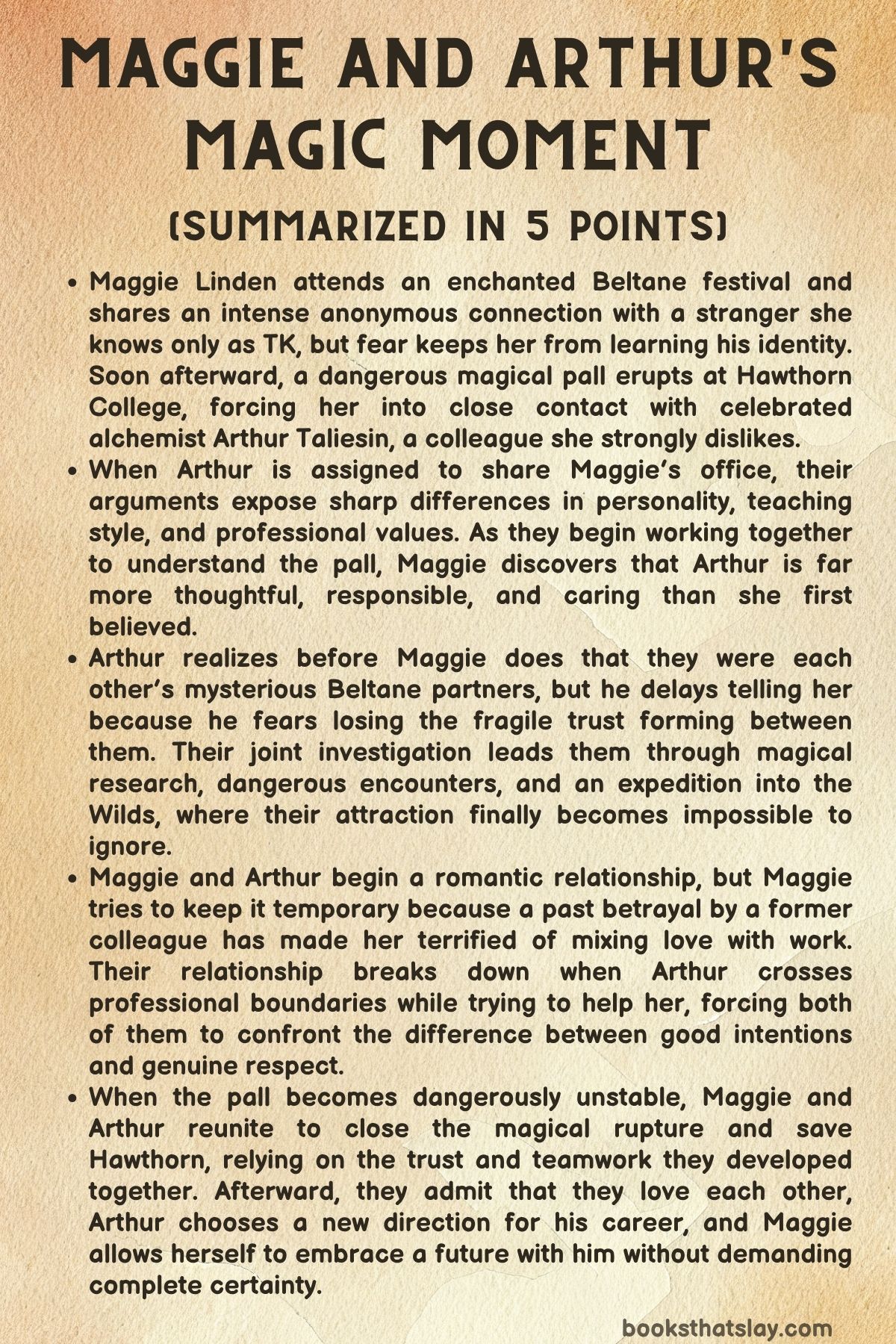
Dr. Maggie Linden attends the Beltane festival at Brig Beach with her closest friend and colleague, Dahlia Hawberry. The festival provides enchanted masks that prevent people from recognizing one another while encouraging unusual honesty, giving Maggie a rare chance to escape the cautious identity she has built after a damaging past relationship.
Calling herself Linda, Maggie meets a tall stranger who introduces himself only as TK. Their easy conversation, dancing, humor, and immediate physical attraction lead to a memorable kiss, but when TK asks Maggie to remove her mask so they can meet again, fear takes control and she leaves without discovering his identity.
Nearly two weeks later, Maggie still thinks about the stranger, although she tells herself that wondering about him is safer than actually finding him. Her attention soon shifts when a magical rupture called a pall erupts in Ilex Hall at Hawthorn College, producing violent shaking, sulfurous ether, broken glass, unnatural substances, and dangerous magical contamination.
Maggie helps evacuate the building and encounters Arthur Taliesin, a famous alchemist she already dislikes because of his distant manner and his involvement in budget decisions that damaged her department. Since Arthur’s laboratory was operating when the pall formed, Maggie assumes his arrogance or carelessness caused the disaster.
The pall proves far more serious than expected, forcing faculty members to share offices while part of Ilex Hall remains inaccessible. Maggie’s frustration increases when Arthur is assigned to her tiny basement office, but she gradually discovers details that complicate her opinion of him, including the fact that he rejected preferential accommodations because he did not want better treatment than his colleagues or students.
Their shared office initially becomes a battlefield of personalities and teaching philosophies. Maggie values flexibility, student trust, and emotional comfort, while Arthur seems stricter and more formal, yet she also notices unexpected evidence of his warmth, from family photographs to the quiet ways he adapts to her working environment.
Outside the college, the pall begins affecting Galloway by weakening magical protections and attracting dangerous supernatural creatures. When Maggie and Dahlia confront a ghoul in Rodrigo’s basement, Maggie is injured while completing the banishment spell, demonstrating both her courage and the growing seriousness of the magical emergency.
Maggie’s view of Arthur changes further when she learns that he has repeatedly entered the pall alone rather than exposing colleagues or students to its dangers. She offers her expertise in Diadhan language and magical incantations to help him destroy it, and the two strike a bargain that includes restoring funding previously lost by Maggie’s department.
Their handshake unexpectedly breaks the Beltane mask enchantment for Arthur. He realizes that Maggie is Linda, the woman he kissed, but he hides the discovery because he fears that revealing the truth while she still distrusts him will destroy their developing connection.
As they research the pall together, hostility begins giving way to friendship and attraction. Arthur sees how deeply Maggie cares about her students, while Maggie encounters the gentler versions of Arthur known by his family, friends, and students and realizes that his public reputation has concealed much of his personality.
Arthur eventually explains the accident. During an alchemical demonstration, a frightening call about his brother’s mother caused him to interrupt a spell improperly, and his unfinished Diadhan phrase contributed to the rupture; however, the extraordinary scale of the pall suggests that another magical influence amplified his mistake.
Their investigation reveals that a celestial conjunction combined with the convergence of three rivers near the Wilds greatly strengthened the failed spell. The discovery also leads Maggie and Arthur into an honest argument about the funding Arthur helped cut from her translation program, prompting him to recognize how carelessly he once treated responsibilities outside his own academic field.
Arthur apologizes and begins understanding Maggie’s resentment rather than merely defending himself. Meanwhile, his commencement speech reveals his own changing understanding of success as he publicly admits that careers, honors, and carefully designed plans matter less than the relationships that give life meaning.
When the pall begins breaking through its containment, Maggie and Arthur enter Ilex Hall together. Maggie is struck by one of the displaced souls trapped within the rupture and becomes lost inside another person’s memories until Arthur’s touch, voice, and familiar heartbeat restore her sense of self.
That heartbeat also breaks Maggie’s Beltane enchantment. She realizes Arthur was TK, although she initially assumes he still does not remember their encounter and keeps her own discovery secret while recovering from pall sickness.
Research points them toward gloaming creeper, a rare plant capable of reducing the magical amplification caused by the river convergence. Maggie and Arthur travel into the Wilds to find it, sharing stories about their childhoods, ambitions, disappointments, and families as their professional partnership becomes deeply personal.
The expedition turns dangerous when a banshee attacks Arthur while they search for the plant. Maggie refuses to abandon him and uses an enchanted bat to help defeat the creature, allowing them to escape with the gloaming creeper and strengthening the trust already developing between them.
Around their campsite, Maggie finally tells Arthur the truth about Evan, her former partner and colleague who stole her research, accused her of copying him, and seriously damaged her academic reputation. Arthur believes her without hesitation, and later, when they acknowledge that both remember Beltane, their long-suppressed attraction becomes an openly chosen romantic relationship.
Arthur then admits that he recovered his memories much earlier. Maggie is disturbed by his secrecy but also recognizes that she withheld the truth because becoming happy with him frightens her, while Arthur openly acknowledges that he wants their connection rather than pretending it means nothing.
Maggie nevertheless imposes rules intended to protect herself. Their relationship will remain private, last only through the summer, stay separate from their professional work, and end before the new academic term, even though Arthur already hopes she will eventually abandon the expiration date.
As the gloaming creeper decoction develops, they spend increasing amounts of time together. Maggie discovers that Arthur had admired her work long before Beltane, while she also recognizes that her life with him feels different from her relationship with Evan because Arthur encourages rather than diminishes her confidence, intelligence, and independence.
A visit to Arthur’s family makes the possibility of a lasting future feel dangerously real. Maggie enjoys his family’s warmth and bonds with Simon, but Lane’s quiet warning not to break Arthur’s heart forces Maggie to confront how seriously he views their relationship.
The crisis comes when Maggie discovers that Arthur personally supplied money for her translation seminar and had earlier chosen her as his office mate. Although Arthur intended the funding as restitution, Maggie feels that he has ignored boundaries she clearly established and fears that their romance has compromised her professional reputation in ways painfully reminiscent of Evan.
She ends the relationship. Arthur is devastated but eventually accepts that good intentions do not excuse his failure to listen to what Maggie actually asked of him, while Maggie discovers that removing Arthur from her life is far more painful than she expected.
Before either can resolve the breakup, the pall begins escaping its containment. The incomplete gloaming creeper decoction must be used immediately, bringing Maggie, Arthur, Dahlia, Rory, Jim, Dr. Silva, and others together for a final attempt to close the magical rupture.
Before entering Ilex Hall, Arthur gives Maggie an unconditional apology for ignoring her wishes and asks for nothing in return. Inside, they resume their old cooperation, drawing the dissipation rune and performing the revised incantation until supernatural forces influence Arthur and pull him dangerously toward the fissure.
An unsettled soul traps Arthur inside another person’s memories, leaving Maggie to protect him and complete the spell. Unable to reach him through ordinary reminders, Maggie finally says what she has been afraid to admit: she loves him and needs him to return.
Arthur awakens, and together they complete the incantation. The pall collapses back toward the fissure, the trapped souls are released, the rupture closes, and Hawthorn is finally freed from the magical disaster that brought Maggie and Arthur together.
Success, however, leaves Maggie with the private office and professional stability she originally wanted but without the person she now realizes she loves. When she learns that Arthur has resigned from Hawthorn, she confronts him and discovers that his decision is not an attempt to win her back but part of his own recognition that academic celebrity and inherited expectations have made him unhappy.
Arthur remembers enough of the magical crisis to ask about Maggie’s declaration, and both finally speak openly. He tells her he loves her, Maggie admits that she loves him as well, and they choose a future together without demanding certainty about exactly what that future must look like.
By Samhain, Arthur has left his regular faculty position while maintaining a looser connection to Hawthorn, and Maggie’s scholarship is receiving new professional recognition. They still possess their old Beltane masks, but the masks have lost their magic, reflecting how thoroughly the two have moved from anonymous safety toward being fully known by one another.
Characters
Maggie Linden
Maggie Linden is the emotional center of Maggie and Arthur’s Magic Moment, and much of her development comes from the conflict between her desire for connection and her determination to protect herself. She is intelligent, technically accomplished, compassionate toward students, and deeply committed to language, Diadhan translation, and scholarship that bridges literature with magical practice.
Her flexibility as a teacher reflects her belief that respect is expressed through trust rather than control. The same generosity she readily extends to students is much harder for Maggie to extend to herself because her experience with Evan taught her that emotional openness can become a source of professional and personal danger.
Evan’s betrayal shapes almost every romantic decision she makes. Maggie therefore prefers the anonymous Beltane encounter because desire without identity allows her to experience intimacy without accepting the possibility of a lasting relationship.
Her initial hostility toward Arthur is not simply stubbornness. He represents several things she distrusts: professional privilege, institutional power, academic celebrity, and the possibility that another colleague could gain enough importance in her personal life to hurt her career.
Maggie’s judgment of Arthur gradually changes because she is capable of revising her beliefs when confronted with new evidence. She recognizes his concern for students, loyalty to family, intellectual seriousness, vulnerability, and willingness to admit mistakes, even though accepting those qualities also forces her to confront her increasing attraction to him.
Her courage is equally important to her characterization. She completes a difficult banishment while physically attacked, enters the pall despite its dangers, saves Arthur from a banshee, helps develop the dissipation spell, and refuses to abandon him during the final magical crisis.
Her deepest development occurs when she separates Arthur from Evan. She ultimately understands that protecting herself from every possible repetition of an old betrayal has also prevented her from trusting her own judgment, and choosing Arthur becomes an act of confidence in herself as much as an act of love.
Arthur Taliesin
Arthur Taliesin is initially presented through Maggie’s frustrated perspective as privileged, arrogant, distant, and professionally powerful, but Maggie and Arthur’s Magic Moment gradually reveals a man carrying significant emotional pressure beneath an impressive reputation. His transformation depends less on becoming a different person than on recognizing the habits that his upbringing and success have taught him.
Arthur is a brilliant alchemist, an engaged teacher, and a highly capable researcher. At the same time, his confidence in his own competence sometimes becomes a weakness because he assumes that identifying a problem also gives him the right to decide how it should be solved.
His relationship with his mother, Rowena, helps explain this tendency. Raised around exceptional achievement and strict expectations, Arthur learned to associate worth with precision, accomplishment, and avoiding mistakes, leaving him poorly prepared for failure or situations that cannot be controlled through expertise.
The pall becomes a direct challenge to that identity. Arthur’s original error happens because fear for his family overwhelms his professional concentration, and his subsequent determination to enter the dangerous rupture alone reveals both genuine responsibility and his tendency to assume burdens without allowing other people to decide whether they want to share them.
His romance with Maggie exposes the same contradiction. Arthur loves her sincerely and frequently acts with generosity, but his concealment of the Beltane memory and his decision to fund her seminar show that kindness can become controlling when it ignores another person’s stated wishes.
Arthur’s eventual apology is therefore essential to his growth because he does not merely defend his intentions. He recognizes that listening matters more than deciding for Maggie what would make everything right.
His resignation completes this development. Arthur finally separates his identity from the Taliesin name, academic celebrity, and the career path he inherited, choosing a life based on teaching, family, intellectual curiosity, and relationships rather than prestige alone.
Dahlia Hawberry
Dahlia Hawberry is Maggie’s closest friend, colleague, and strongest source of emotional continuity. Her humor and enthusiasm create lighter moments, but her real importance comes from how consistently she understands Maggie without allowing Maggie’s fears to dictate every decision.
She supports Maggie’s search for the mysterious Beltane stranger while also recognizing that Maggie’s fascination with him represents a desire for connection she is reluctant to admit. Later, Dahlia notices Maggie’s attraction to Arthur long before Maggie is prepared to treat it seriously.
Dahlia is not merely a romantic adviser. As a skilled runologist, she contributes directly to the magical work, helps Maggie banish the ghoul, examines Arthur’s calculations, assists with ward strengthening, and participates in the emergency response when the pall becomes unstable.
Her friendship is especially important after Maggie’s breakup with Arthur. Dahlia refuses to let Maggie isolate herself emotionally and repeatedly challenges the assumption that Evan’s betrayal should determine what Maggie believes about every later relationship.
Unlike characters who attempt to make decisions for Maggie, Dahlia pushes her toward self-examination while still allowing her to choose. That combination makes Dahlia one of the book’s strongest examples of supportive love that respects another person’s independence.
Rory
Rory, Arthur’s younger half brother, gives readers access to a more relaxed and personal version of Arthur. Their conversations reveal a sibling relationship built on affection, teasing, trust, and an unusual ability to challenge one another honestly.
Arthur confides in Rory about recognizing Maggie from Beltane, and Rory quickly identifies the weakness in Arthur’s plan to recreate old moments rather than simply telling Maggie the truth. His advice introduces an important contrast between emotional courage and intellectual problem-solving.
Rory also contributes practical knowledge because his experience as a park ranger connects him to the Wilds and its unusual magical conditions. His suggestion that the surrounding environment may influence the pall becomes an early step toward identifying the forces strengthening it.
After Maggie and Arthur separate, Rory becomes even more important because he refuses to tell Arthur only what he wants to hear. He points out that Arthur is accustomed to people accommodating him and forces his brother to consider whether he ever tried repairing Maggie’s problem according to Maggie’s wishes rather than his own.
Rory therefore functions as both family support and moral correction. His loyalty to Arthur includes the willingness to criticize him, which helps Arthur recognize that sincere love requires listening as well as intention.
Dean Clearwater
Dean Clearwater represents Hawthorn College as an institution and demonstrates how professional environments can complicate personal relationships. He values Maggie’s work, but he is also deeply concerned with Arthur’s ability to attract students and strengthen the college’s reputation.
His decision to assign Arthur to Maggie’s office creates much of the central relationship, although his reasoning is initially pragmatic rather than romantic. Clearwater pressures Maggie to accommodate Arthur because he sees the famous alchemist as strategically important to Hawthorn.
This places Maggie in an uncomfortable professional position. Even when Clearwater does not intend direct harm, his assumption that she should keep Arthur happy establishes a power imbalance that later becomes damaging when Arthur privately funds Maggie’s seminar.
Clearwater’s suspicion that Maggie may have used her relationship with Arthur to obtain money shows how quickly institutional perceptions can threaten professional credibility. His character therefore reinforces Maggie’s fear that workplace romance can affect how others interpret her achievements.
He is not presented as purely malicious. Instead, he shows how ordinary administrative decisions, financial pressures, and reputation management can create consequences that individuals fail to anticipate.
Rodrigo
Rodrigo is one of the people who make Galloway feel like home for Maggie. His bar functions as a social refuge where Maggie can relax outside the college and speak more freely with Dahlia.
He enthusiastically helps search for Maggie’s Beltane stranger, keeping the limited clues available to them and treating the mystery with humor. His willingness to participate shows his affection for Maggie and his place within the close community she has built after leaving her earlier academic life.
Rodrigo also becomes connected to the growing magical danger when the pall weakens his basement wards and attracts a ghoul. The incident makes the wider consequences of Hawthorn’s magical disaster visible because the problem is no longer contained within the college.
Although Rodrigo has less influence on the central romance than Dahlia or Rory, his presence is important to Maggie’s emotional history. Friends such as Rodrigo helped create the stable life she values so fiercely, explaining why any relationship that threatens to alter that stability initially frightens her.
Evan
Evan never appears as a present romantic possibility, yet his influence over Maggie is enormous. He functions as the person whose betrayal created the emotional rules Maggie follows at the beginning of the novel.
Maggie once trusted him as both a romantic partner and professional collaborator during graduate school. Their relationship seemed to promise a shared academic and personal future until Evan used Maggie’s research as his own and accused her of copying him.
The betrayal was especially damaging because it attacked several parts of Maggie’s identity at once. She lost trust in someone she loved, suffered harm to her professional reputation, lost an important career opportunity, and learned that intimacy with a colleague could allow private betrayal to shape public perceptions.
Evan’s greatest continuing power lies in Maggie’s fear of repetition. She repeatedly interprets new situations through the possibility that another colleague might take control of her professional narrative.
The eventual contrast between Evan and Arthur becomes essential. Maggie learns that similarities in circumstances do not make two people morally identical, and accepting this distinction allows her to judge Arthur according to his actions rather than according to Evan’s past betrayal.
Rowena Taliesin
Rowena Taliesin, Arthur’s late mother, remains one of the strongest influences on his identity despite being absent from the present action. A celebrated alchemist, she represents achievement, intellectual discipline, professional legacy, and the pressures created by exceptional expectations.
Arthur genuinely inherited his love of alchemy from the world she introduced to him. At the same time, he remembers an upbringing in which mistakes were difficult to tolerate and excellence seemed less like an aspiration than an obligation.
Her illness and death forced Arthur to reconsider the career path he had followed for years. The experience taught him that awards and reputation cannot compensate for neglected relationships, contributing to his decision to move closer to his father, brother, and nephew.
Rowena therefore exists in Arthur’s life as both inspiration and burden. His growth depends on accepting what he genuinely loves about the intellectual world she gave him while rejecting the belief that he must reproduce her exact model of success.
His eventual departure from conventional academic life represents a significant separation from her legacy. Arthur does not abandon alchemy; instead, he claims the right to decide what place it should occupy in his own life.
Barry
Barry is Arthur and Rory’s father and represents the less demanding side of Arthur’s upbringing. His life offers an alternative to the intense academic expectations associated with Rowena.
As a former park ranger familiar with the magical geography around the Wilds, Barry provides information that helps Arthur identify gloaming creeper as a possible solution to the river convergence. His practical experience becomes as important as formal academic knowledge at a critical point in the investigation.
Barry also helps explain Arthur’s connection to outdoor life. Arthur’s childhood experiences with his father gave him skills that surprise Maggie during their expedition and show that his identity extends far beyond laboratories, lectures, and professional status.
Within the family, Barry contributes to the warmth Maggie finds so affecting. His presence helps establish the kind of affectionate, imperfect family environment that Arthur increasingly values over the isolated pursuit of achievement.
Lane
Lane is Rory’s mother and an important member of Arthur’s extended family. Her medical emergency indirectly causes the original laboratory accident because Arthur’s fear for his family interrupts his alchemical demonstration.
The incident demonstrates how strongly Arthur’s earlier experience of losing his mother affects his reactions. When he hears that Lane has collapsed, professional concentration becomes impossible because another potential family loss activates fears he has never completely escaped.
Lane later plays a crucial role in Maggie’s emotional conflict. After watching Maggie with Arthur’s family, she quietly tells Maggie that Arthur has seemed happier since knowing her and asks her not to break his heart.
Her words are meant protectively rather than cruelly, but they force Maggie to confront an implication she has avoided: Arthur does not see their relationship as an emotionally limited summer arrangement. Lane therefore becomes an unexpected catalyst for the confrontation that follows.
Simon
Simon, Arthur’s young nephew, reveals the affectionate and playful qualities Arthur usually hides in professional settings. Photographs, gifts, stories, and Arthur’s concern for him repeatedly undermine Maggie’s assumption that Arthur is naturally cold or self-important.
Arthur’s attachment to Simon also connects with his painful experience inside the pall. Memories associated with a dead child disturb him so deeply partly because the child reminds him of his nephew, demonstrating how vulnerable Arthur has become through love for his family.
When Maggie attends Simon’s baseball game, her easy bond with him makes the possibility of joining Arthur’s wider family feel real. This ordinary family experience affects Maggie more strongly than dramatic romance because it resembles the lasting life she once believed she had lost.
Simon therefore represents both Arthur’s tenderness and Maggie’s emerging desire for permanence. Through him, the story shows that love is not limited to romantic attraction but extends into the family relationships that give Arthur’s life its strongest sense of purpose.
Jim
Jim is one of Arthur’s colleagues in Alchemy and Transmutation and becomes involved in the consequences of the pall when displaced faculty members are forced to share space. Early in the story, his comments help reinforce Maggie’s assumption that Arthur caused the magical disaster.
His presence also contributes to one of Maggie’s most embarrassing encounters with Arthur when she criticizes Arthur extensively without realizing that he is standing nearby. The scene intensifies their early hostility while establishing how firmly Maggie has already formed her opinion of him.
Later, Jim’s professional value becomes more important when Arthur allows him to review revised calculations for the pall. This decision signals Arthur’s gradual movement away from trying to control every difficult problem alone.
Jim therefore occupies a modest but useful role in Arthur’s growth. Accepting another expert’s review shows that collaboration can strengthen rather than diminish Arthur’s competence.
Dr. Pearl Paige
Dr. Pearl Paige assists Maggie and Arthur during their research into Hawthorn’s historical records. Although she occupies a supporting role, her involvement allows the pair to connect the present magical crisis with older information about the land surrounding the college.
The archival research helps reveal unusual properties associated with the Wilds, the rivers, and the location of Ilex Hall. These discoveries create the conditions for Arthur’s realization that the magical convergence, rather than his mistake alone, explains the extraordinary scale of the pall.
Pearl represents the importance of historical knowledge within a problem that initially appears purely technical. Her contribution supports the broader idea that complicated problems require multiple academic perspectives rather than loyalty to a single discipline.
Dr. Kel Silva
Dr. Kel Silva is Hawthorn’s botanical expert and becomes essential once Maggie and Arthur identify gloaming creeper as a possible countermeasure to the river convergence. Silva confirms the plant’s unusual properties and explains the difficulty of locating, transporting, and preparing it.
This information sends Maggie and Arthur into the Wilds and therefore indirectly creates the circumstances in which their relationship becomes more emotionally honest. Silva’s expertise also reminds Arthur that alchemy alone cannot solve the problem he created.
The character’s role reinforces the collaborative nature of the final solution. Linguistics, runology, botany, historical research, environmental knowledge, and alchemy all contribute to closing the pall.
Silva later participates in preparing the gloaming creeper decoction and joins the emergency response when the pall escapes containment. The character therefore represents specialized knowledge applied cooperatively rather than competitively.
Dr. Stone
Dr. Stone appears briefly around Arthur’s commencement address but contributes to the novel’s examination of Arthur’s relationship with his mother’s legacy. After hearing Arthur reject conventional definitions of professional success, Stone suggests that Rowena would have appreciated the speech.
Arthur privately doubts that assumption. His reaction reveals that other academics still understand him primarily through Rowena’s reputation even when he is actively trying to establish values different from hers.
Stone’s small role is therefore useful because it demonstrates how difficult it is for Arthur to escape inherited expectations. Even well-meaning praise can return him to the identity of Rowena Taliesin’s son rather than allowing him to exist simply as Arthur.
Liv
Liv, the barista at Bean There, Done That, has a small but revealing role. She knows Arthur casually as Artie, immediately showing Maggie that people outside Hawthorn’s formal academic environment experience him differently.
For Maggie, this apparently minor discovery matters because she has almost always encountered Arthur through the professional identity of Professor Taliesin, celebrated alchemist. Hearing a familiar nickname makes him seem ordinary, approachable, and socially connected.
Liv therefore contributes to the gradual dismantling of Maggie’s original assumptions. The more Maggie encounters versions of Arthur that exist outside institutional reputation, the harder it becomes to reduce him to the arrogant public figure she believed she understood.
Themes
Vulnerability, Trust, and the Fear of Being Known
The Beltane masks establish the central conflict between wanting intimacy and fearing what intimacy requires. Maggie can approach a stranger when her identity is protected because anonymity removes many of the consequences she associates with romantic exposure, making desire temporarily safer than trust.
That contradiction continues throughout Maggie and Arthur’s Magic Moment after the masks are gone. Maggie repeatedly moves toward Arthur and then creates distance whenever their relationship begins to suggest permanence, while Arthur responds to his own fear of rejection by concealing the fact that he recognized her from Beltane.
Both therefore hide important truths even while becoming increasingly close. Their secrecy does not arise from lack of feeling; it arises precisely because the relationship matters enough to create the possibility of pain.
The story distinguishes vulnerability from simple confession. Maggie must learn to trust her ability to judge another person after Evan damaged that confidence, while Arthur must learn that openness also means allowing someone else to make decisions he cannot control.
The old masks eventually become powerful symbols because Maggie and Arthur preserve them long after their magic disappears. By Samhain, they can put them on without needing the anonymity they once provided, showing that genuine intimacy comes not from eliminating uncertainty but from allowing oneself to be known despite it.
Achievement, Reputation, and Self-Defined Success
Professional achievement is both valuable and dangerous throughout the story because neither Maggie nor Arthur can separate work completely from identity. Maggie’s scholarship helped her rebuild her life after Evan’s betrayal, while Arthur’s extraordinary academic reputation became a structure that offered prestige but also restricted his sense of who he could become.
Arthur’s conflict is particularly shaped by Rowena. Her brilliance encouraged his love of alchemy, yet her expectations taught him that mistakes were unacceptable and that professional distinction should occupy a central place in life.
The pall therefore has symbolic importance beyond magical danger. It begins with Arthur’s failure during an apparently familiar demonstration, forcing a man defined by technical excellence to live publicly with an error he cannot immediately repair.
His commencement speech marks a significant change because he openly rejects the idea that careful planning, impressive positions, or awards guarantee a meaningful life. Arthur increasingly understands that professional success becomes empty when it requires sacrificing relationships, personal freedom, or the right to change direction.
Maggie’s development creates a parallel argument. Her strongest professional achievements arrive when she pursues the literary and linguistic work that genuinely excites her instead of following the safer academic path associated with her earlier career.
Both characters ultimately redefine success as meaningful work performed without allowing institutions, reputations, or other people’s expectations to determine the entire shape of their lives.
Love, Boundaries, and Respect
Romantic love in the story is repeatedly tested by the question of whether caring about someone gives a person the right to decide what is best for them. Arthur genuinely wants to repair the harm caused by his earlier budget decision, but his decision to fund Maggie’s seminar privately becomes a serious violation because he solves the problem without respecting the conditions Maggie established.
The conflict is important precisely because Arthur’s intentions are generous. The novel refuses to treat good intentions as automatically sufficient when those intentions override another person’s independence.
Maggie’s reaction is influenced by Evan, but her anger is not simply irrational fear. Arthur did ignore boundaries she clearly communicated, and his eventual growth comes from recognizing that love requires listening instead of assuming that affection gives him superior knowledge of Maggie’s needs.
Maggie must also reconsider the boundaries she creates for herself. Some protect legitimate professional interests, while others are attempts to guarantee that she can experience intimacy without becoming emotionally vulnerable.
Their reconciliation becomes possible only after both understand this difference. Arthur apologizes without demanding forgiveness, while Maggie chooses the relationship without pretending that love can be made completely safe.
Respect therefore becomes more important than certainty. The story presents lasting partnership as a process in which two independent people continue choosing each other without claiming ownership over the other’s decisions.
Transformation, Mistakes, and the Possibility of Change
Transformation appears throughout the story as both a magical process and a human one. Arthur works professionally with transmutation, but the more significant changes involve people learning that mistakes do not have to become permanent definitions of who they are.
The pall begins with an error, yet the novel carefully distinguishes different kinds of wrongdoing. Arthur’s accident comes from fear and imperfect judgment, Evan’s betrayal is deliberate, and Arthur’s later mistakes with Maggie arise from genuine affection combined with a failure to listen.
Maggie’s growth depends partly on learning to recognize these differences. Treating every mistake as evidence of future betrayal would make emotional safety possible only through permanent isolation.
Arthur faces a related lesson. His upbringing encouraged him to believe that mistakes should be prevented through perfect preparation, but the pall teaches him that some consequences cannot be calculated away and that responsibility sometimes means admitting failure, requesting help, and changing one’s behavior.
The final solution itself reflects this philosophy. No single expert can close the rupture; alchemy requires linguistics, botany, runology, environmental knowledge, historical research, and cooperation with others.
By the end, both Maggie and Arthur have changed without abandoning the qualities that originally defined them. Maggie remains cautious but no longer lets fear make every decision, while Arthur remains ambitious and intellectually curious but releases the belief that reputation and perfect planning should control his future.