Only Spell Deep Summary, Characters and Themes
Only Spell Deep by Ava Morgyn is a dark fantasy novel about survival, inheritance, hidden power, and the cost of trying to control what should remain wild. The story follows Judeth Cole, later known as Jude Clark, a woman marked by a childhood tragedy and haunted by the ruins of her family’s past.
When a strange invitation leads her into a secret magical circle in Seattle, Jude discovers that her gifts are tied to something ancient beneath the city. Only Spell Deep explores grief, identity, family secrets, and the uneasy line between power and freedom.
Summary
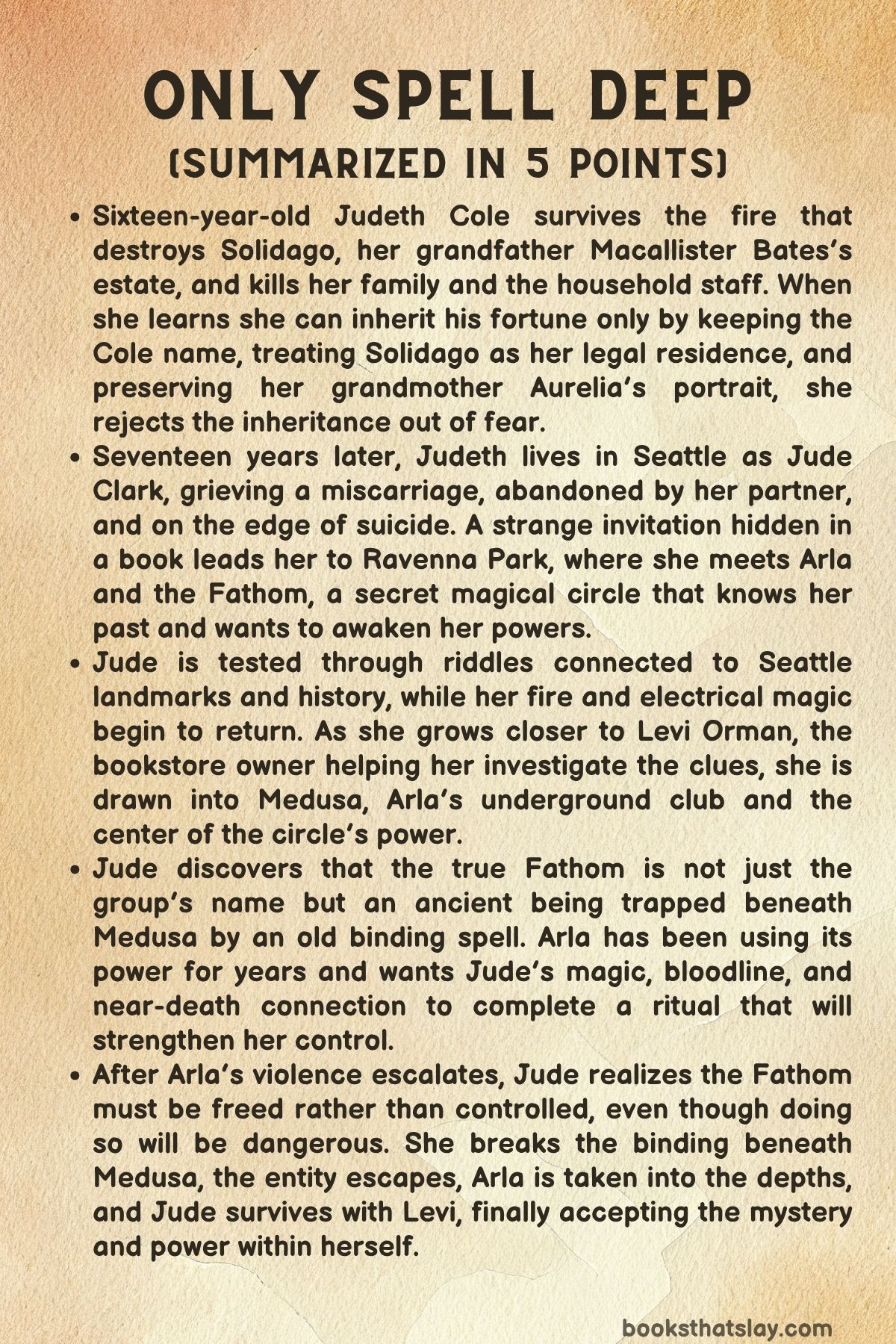
Judeth Cole’s life is shaped by fire, loss, and fear long before she understands the true nature of her inheritance. At sixteen, she survives the fire that destroys Solidago, her grandfather Macallister Bates’s grand Oregon estate.
The disaster kills her mother, her grandfather, and the household staff, leaving Judeth as the sole survivor of a family tragedy that seems impossible to explain. In the hospital, attorney James Lampitt informs her that she has inherited her grandfather’s fortune.
The inheritance, however, comes with strict conditions. She must keep the Cole name, maintain Solidago as her legal residence, and keep the portrait of her grandmother Aurelia for the rest of her life.
Judeth is terrified by the house, by the portrait, and by the dark weight of her family history. Instead of accepting a fortune tied to the place that nearly killed her, she refuses the inheritance.
She chooses distance over wealth and tries to cut herself off from the name, the estate, and the memories that follow her.
Seventeen years later, Judeth has remade herself as Jude Clark and lives in Seattle. Her life is quiet, lonely, and deeply damaged.
She is grieving a miscarriage, abandoned by her partner Roger, and unable to see a future for herself. She plans to go home and end her life with pills.
Before she can do so, a one-eyed black cat leads her into Orman Used & Rare Books, where she finds a copy of The Bell Jar. Inside the book is a black envelope addressed to her real name.
The message invites her to Ravenna Park at midnight.
The invitation interrupts her plan. Curiosity, suspicion, and perhaps the smallest trace of hope send her to the park.
There she meets Arla, a commanding woman dressed in black, along with four other strange figures who call themselves the Fathom. Arla knows things no stranger should know.
She speaks of Solidago, Jude’s lost baby, and the strange powers Jude has tried to deny since childhood. Jude learns that she has magic connected to fire and electricity, and that the inner voice she heard as a child is not gone.
Arla tells her she must pass a series of tests if she wants to join their circle.
The tests begin with riddles hidden across Seattle. Jude solves one at the Space Needle, where the pressure of the trial and the return of the inner voice force her power into the open.
She blacks out the landmark with her magic. Brennan, one of the Fathom members, appears and gives her the next clue.
Jude continues following signs linked to old Seattle history, including a cemetery marker, while trying to understand why she has been chosen. The trials grow dangerous when the cruel twins Rock and Twig attack her.
Arla steps in, but the rescue only makes it clearer that Arla controls the game and everyone inside it.
Arla brings Jude to Medusa, an exclusive underground club where the Fathom circle gathers. There Jude meets the members properly: Arla, Brennan, Cadence, Rock, and Twig.
Each of them has a role, a power, and a place in Arla’s design. Jude is drawn toward their hidden world, but she also grows close to Levi Orman, the owner of the bookstore where she found the invitation.
Levi helps her research the clues, and their connection becomes one of the few stable things in her life as the magical world around her becomes more threatening.
As Jude learns more, she discovers that the name Fathom means more than Arla’s circle. Beneath Medusa lies a sealed chamber built around an old pit-show attraction created by Edward Rudzitin.
Within it is the true Fathom: an ancient, immense being connected to deep water, darkness, magic, and many mythic forms. Rudzitin trapped it with an Aramaic binding, turning a force older than human understanding into something confined beneath the city.
Arla has spent years drawing power from it, using its captivity for her own gain.
Arla wants Jude because Jude completes what the circle needs. Her fire, her near-death connection, and her magical blood make her valuable to Arla’s plan.
Arla does not simply want to use the binding as it exists. She wants to strengthen it, change it, and make the trapped power serve her more completely.
Jude’s research leads her to a painting called Thalassa, created by a blind artist named Anneli. The painting suggests that the Fathom is not a demon, monster, or simple evil.
It is something older and wider than the myths people have used to describe it. With Levi’s help, Jude begins to understand that Arla’s view is dangerously limited.
The Fathom is not a thing to own or control. It is a primordial force, and keeping it trapped has created a terrible imbalance.
The danger around Jude grows as Arla becomes more desperate. Brennan, who once seemed loyal to the circle, begins to fear Arla.
Aaron, Jude’s coworker and friend, is pulled into the danger through Brennan, showing Jude that the consequences of Arla’s plans are spreading beyond the club and its members. Arla’s control over the group becomes harsher, and she prepares a public ritual at Medusa.
The club crowd will serve as both witnesses and a source of energy, even though they do not understand what they are being used for.
During the ritual, Arla forces Jude onto the stage and casts her in the role of a witch figure. Arla intends to use Cadence as a blood offering, turning the performance into a real sacrifice.
Jude refuses to let the ritual continue. She turns against Arla, uses her fire to burn through Cadence’s restraints, injures Rock and Twig, and escapes with Cadence and Levi.
The act breaks Jude away from Arla’s control and forces her to choose what kind of power she is willing to claim.
Jude and Levi flee Seattle and drive to Solidago. Returning to the estate means facing the place she has avoided for most of her life.
At Solidago, Jude confronts the family history she once rejected. She learns more from Mira about Aurelia and begins to understand that the past is more complicated than fear and inheritance papers made it seem.
She hangs Anneli’s Thalassa painting in Aurelia’s old room, linking the story of her family to the ancient force beneath Seattle.
In a dreamlike encounter, the Fathom reaches Jude and tells her that blood is the key to undoing the binding. This knowledge changes the meaning of Arla’s rituals.
Blood can strengthen control, but it can also break the prison. Jude realizes that she may be the only one who can stop Arla and free the being before more people die.
Jude and Levi return to Seattle and find that Arla has already taken the ritual further. She has murdered Brennan, Rock, and Twig, using their magical blood to replace Jude’s role in her plan.
Arla is now trying to complete the binding without Jude, driven by ambition and fear of losing control. In the basement beneath Medusa, Jude faces Arla and the true center of the horror hidden under the city.
Instead of helping Arla seal the Fathom again, Jude uses what she has learned to free it. The ancient being rises through the well, bringing with it the power that Arla tried to own.
Arla and the bodies are pulled down into the depths as Medusa collapses into a sinkhole. The club, the chamber, and Arla’s false kingdom are destroyed.
Jude and Levi manage to escape as the structure falls apart around them.
Six weeks later, the outside world explains the collapse as a geological event. Seattle does not know the truth about Medusa, Arla, or the force that had been trapped below the city.
Jude remains with Levi and works at the bookstore, building a quieter life from what survived. Cadence visits before leaving town and confirms that the others are gone and that the Fathom has been set free.
By the end of Only Spell Deep, Jude no longer sees magic as something she must cage, deny, or master completely. She accepts that the power inside her comes from a deep and unknowable source.
Her survival is not about controlling every part of herself or her history. It is about living with mystery, choosing freedom over domination, and understanding that some forces are not meant to belong to anyone.
Characters
Judeth Cole / Jude Clark
Judeth Cole, who later lives under the name Jude Clark, is the emotional and magical center of Only Spell Deep. Her character is shaped by survival, fear, grief, and a deep uncertainty about her own identity.
As a teenager, she survives the fire that destroys Solidago, but the event does more than take away her family and home; it leaves her with terror, guilt, and a lifelong need to distance herself from everything connected to the Cole name. By refusing her inheritance, Judeth tries to reject not only wealth but also the frightening legacy tied to her family, the portrait of Aurelia, and the estate itself.
Seventeen years later, as Jude Clark, she appears emotionally exhausted and isolated. Her miscarriage, Roger’s abandonment, and her suicidal despair show how far she has drifted from any sense of belonging or purpose.
Yet her decision to follow the black cat and the mysterious invitation reveals that some part of her still wants an answer, a sign, or a reason to stay alive.
Jude’s development in the book depends on her gradual movement from avoidance to confrontation. At first, she is frightened by her own powers, especially because fire and electricity connect her to destruction, memory, and the hidden force inside her.
The tests set by Arla and the Fathom circle awaken parts of Jude that she has tried to suppress since childhood, including the inner voice that pushes her toward magic. Her growing bond with Levi gives her an alternative to Arla’s manipulation because Levi helps her investigate rather than control, understand rather than exploit.
By the end of the story, Jude becomes someone who no longer tries to deny her past or imprison the unknown. Her return to Solidago is especially important because she faces the place that once defined her fear and begins to understand it as part of her history rather than only a site of trauma.
Jude’s final choice to free the Fathom shows her moral growth: she refuses to use power as possession and accepts that some forces are too ancient, deep, and sacred to be owned.
Arla
Arla is one of the most commanding and dangerous figures in the book. She enters Jude’s life as a woman of mystery, authority, and dark glamour, immediately positioning herself as someone who knows more than she reveals.
Her knowledge of Jude’s secrets gives her power from the beginning, and she uses that knowledge to make Jude feel chosen, exposed, and trapped all at once. Arla’s leadership over the Fathom circle is built on charisma and fear.
She presents herself as a guide into a hidden magical world, but her guidance is manipulative because she is not truly interested in Jude’s healing or freedom. She wants Jude as a tool, a missing piece in her ritual design.
Arla’s character represents the corrupting desire to dominate what should remain unknowable. She has spent years drawing power from the trapped Fathom, treating the entity as a source to be siphoned rather than a being or force to be understood.
Her underground club, Medusa, reflects her personality because it is seductive, theatrical, exclusive, and built above a secret place of imprisonment. She surrounds herself with followers and ritual performance, turning magic into spectacle and control.
As the story progresses, Arla becomes increasingly ruthless, sacrificing others when Jude resists her plan. Her murders of Brennan, Rock, and Twig reveal the full extent of her ambition: loyalty means nothing to her when power is at stake.
Arla’s downfall is fitting because the very force she tries to bind and exploit becomes the force that consumes her.
Levi Orman
Levi Orman is a stabilizing and humane presence in the story. As the owner of Orman Used & Rare Books, he is connected to knowledge, curiosity, and hidden meanings rather than domination or spectacle.
His bookstore becomes a place where Jude can pause, think, and begin following clues without being entirely swallowed by Arla’s world. Levi’s importance lies not only in his romantic connection with Jude but also in the way he respects her agency.
He helps her research the clues and the history surrounding the Fathom, but he does not try to claim authority over her experience. This makes him very different from Arla, who uses knowledge as a weapon.
Levi also gives Jude a vision of life after despair. When Jude first encounters the invitation, she is close to ending her life, and Levi’s world of books, questions, and companionship becomes one of the paths that draws her back toward living.
His courage grows as the danger becomes more direct. He follows Jude into increasingly terrifying situations, including the final confrontation beneath Medusa, not because he fully understands the ancient magic involved but because he chooses loyalty and love.
By the end of the novel, his relationship with Jude suggests healing without pretending that trauma has disappeared. He represents the possibility of staying with someone through uncertainty rather than demanding that they become simple, safe, or fully explainable.
Cadence
Cadence is a conflicted member of the Fathom circle and one of the clearest examples of how Arla’s power damages those around her. She is part of the magical group, but she does not carry the same cruelty as Rock and Twig or the same hunger for control as Arla.
Her position is vulnerable because she belongs to the circle but is also expendable within it. Arla’s plan to use Cadence as a blood offering reveals how little genuine care exists inside the group’s structure.
Cadence may seem powerful because of her connection to the circle, but her role in the ritual exposes her as another person caught inside Arla’s system of control.
Cadence becomes important because she survives and because Jude chooses to save her. When Jude burns Cadence’s restraints and helps her escape, the moment shows Jude rejecting Arla’s entire worldview.
Instead of treating another magical person as fuel, Jude treats Cadence as someone whose life matters. Cadence’s later visit after the collapse gives the story emotional closure.
She confirms the deaths of the others and the freedom of the Fathom, but she also represents the aftermath of manipulation. Her decision to leave town suggests that survival sometimes requires distance from the place where one was controlled, used, or nearly sacrificed.
Brennan
Brennan is a nervous and increasingly tragic figure in the book. At first, he appears as one of the mysterious members connected to Arla’s circle, delivering clues and helping guide Jude through the tests.
His role makes him seem like part of the system that draws Jude into danger. However, as the story develops, Brennan becomes more frightened, and that fear reveals the instability beneath Arla’s carefully controlled world.
He is not simply a loyal follower; he is someone who understands enough to be afraid but not enough to escape cleanly.
Brennan’s relationship to Aaron’s danger makes him especially significant. Through him, the magical conflict spreads beyond the central circle and begins threatening ordinary people connected to Jude’s daily life.
Brennan’s fear also helps expose Arla’s cruelty. He becomes a liability to her because he is no longer fully obedient, and his murder shows how Arla deals with weakness, hesitation, or possible betrayal.
Brennan’s death is tragic because he seems to recognize the danger too late. His character adds moral complexity to the circle by showing that not everyone under Arla’s influence is equally malicious, even if they are still involved in harmful actions.
Rock
Rock is one of the cruel twins who serve Arla and help enforce the threatening atmosphere around the Fathom circle. His character is defined by aggression, intimidation, and loyalty to a violent system.
Along with Twig, Rock attacks Jude during her trials, showing that the tests are not merely intellectual or symbolic but physically dangerous. His cruelty helps Jude understand that Arla’s world is not a glamorous invitation into hidden power; it is a place where fear and pain are used to control people.
Rock’s function in the book is to embody the brutality that supports Arla’s elegance. While Arla often manipulates through mystery, authority, and ritual, Rock represents the more direct violence beneath her leadership.
He does not appear to question the morality of what he is doing, and his closeness to Twig gives the two of them a disturbing shared identity. Their twin bond makes them feel less like independent moral agents and more like paired instruments of menace.
Rock’s eventual death at Arla’s hands also shows that even the most loyal enforcers are disposable when Arla needs blood and power.
Twig
Twig, like Rock, is part of the twin pair that brings cruelty and danger into Jude’s trials. Twig’s presence reinforces the sense that Arla’s circle is not simply strange but predatory.
The attack on Jude marks Twig as someone who participates willingly in intimidation and harm. Together with Rock, Twig creates an atmosphere of physical threat that contrasts with the more intellectual mystery of the riddles and historical clues.
This makes Jude’s initiation feel increasingly like a trap rather than a test.
Twig’s character also helps reveal the emptiness of loyalty inside Arla’s circle. Although Twig appears aligned with Arla and the group’s violent methods, that loyalty does not protect him.
When Arla murders Brennan, Rock, and Twig to use their magical blood, Twig becomes another sacrifice to the ambition he once helped serve. His death is important because it proves that Arla’s hunger for control consumes even those who enforce her will.
Twig is not portrayed as innocent, but his fate still shows the destructive logic of a world where people are valued only for the power their bodies can provide.
The Fathom
The Fathom is both a character and a vast supernatural presence that reaches beyond ordinary human categories. At first, the name seems to refer only to Arla’s circle, but Jude eventually learns that the true Fathom is an ancient being connected to deep water, darkness, magic, and mythic forms.
This makes the entity difficult to define in simple moral terms. It is not merely a monster, demon, or villain.
Instead, it represents something primordial, powerful, and older than the human attempts to name or control it. Its connection to depth is symbolic as well as literal because it reflects hidden knowledge, buried trauma, ancestral power, and the unknowable forces beneath the surface of ordinary life.
The Fathom’s imprisonment is central to the moral conflict of the story. Edward Rudzitin trapped it, and Arla continues exploiting that captivity by siphoning power from it.
Jude’s journey depends on realizing that the answer is not to replace Arla as controller or to strengthen the binding for supposedly safer purposes. The Fathom must be freed because imprisoning it has distorted the magical world around it and encouraged human ambition to become parasitic.
Its dreamlike communication with Jude suggests that it understands blood, inheritance, and power in ways that are ancient and symbolic. By freeing it, Jude accepts that magic is not something she can fully master.
The Fathom’s release is frightening but also necessary, making it one of the most important forces in Only Spell Deep.
Macallister Bates
Macallister Bates, Judeth’s grandfather, is a powerful presence even though he dies in the fire before the later events of the story unfold. As the owner of Solidago and the source of the inheritance, he represents family wealth, legacy, and the burden of ancestral expectations.
The conditions in his trust show that his influence continues after death. By requiring Judeth to keep the Cole name, preserve Solidago as her legal residence, and keep Aurelia’s portrait, he attempts to bind her to the family history she desperately wants to escape.
These conditions make his legacy feel less like a gift and more like a trap.
Macallister’s character is important because he connects personal inheritance to emotional imprisonment. The wealth he leaves behind could have given Judeth security, but the terms attached to it demand that she remain tied to the very symbols that terrify her.
His estate, his rules, and his connection to Aurelia’s portrait all suggest a family history filled with secrets and unresolved power. Even in death, Macallister shapes Jude’s choices because her refusal of the inheritance becomes one of her first acts of self-preservation.
Later, her return to Solidago forces her to face the family world he left behind.
Aurelia
Aurelia, Judeth’s grandmother, is a haunting ancestral figure whose portrait carries deep symbolic weight. Although she is not physically present in the main action, her image and history influence Jude’s fear of Solidago and of her own inheritance.
The trust’s requirement that Judeth keep Aurelia’s portrait for life makes Aurelia feel like more than a family memory. She becomes an object of obligation, mystery, and possible magical significance.
For Jude, the portrait represents the pressure of a past that refuses to stay buried.
Aurelia’s importance grows when Jude returns to Solidago and learns more about her from Mira. Through Aurelia, the story explores how women in a family line can become both hidden sources of power and figures of fear.
Jude’s relationship to Aurelia is complicated because she does not simply inherit property or a name; she inherits a magical and emotional legacy that she does not fully understand. Hanging Anneli’s painting in Aurelia’s old room becomes a meaningful act because it connects the family past to a larger, older understanding of the Fathom.
Aurelia’s character is therefore less about direct action and more about atmosphere, inheritance, and the way the dead continue shaping the living.
Anneli
Anneli is the blind artist who creates the painting Thalassa, and her character brings a visionary dimension to the story. Her blindness does not limit her insight; instead, it makes her seem able to perceive truths that others miss.
Through her painting, she understands the entity not as a simple evil but as something older, deeper, and more complex than any single mythic identity. Anneli’s art becomes a form of knowledge, offering Jude a way to think about the Fathom beyond Arla’s controlling interpretation.
Anneli’s role is important because she provides an alternative to possession and fear. Where Arla turns the Fathom into a source of power, Anneli approaches it through imagination, reverence, and symbolic understanding.
The painting helps Jude shift her perspective. It allows her to see that the force beneath Medusa is not merely something to defeat but something that has been misunderstood and confined.
Anneli’s character shows that art can reveal truths that research and ritual alone cannot. Her influence continues through the painting, which becomes a bridge between Jude’s family history, Solidago, and the ancient being at the heart of the story.
Edward Rudzitin
Edward Rudzitin is a historical figure whose actions create the central supernatural problem of the novel. He built the old pit-show attraction beneath what becomes Medusa and trapped the Fathom with an Aramaic binding.
His character represents the human impulse to capture, display, and control what is strange or powerful. The fact that the sealed chamber is tied to an attraction is significant because it suggests exploitation from the beginning.
Rudzitin does not encounter the unknown with humility; he turns it into something confined and used.
Rudzitin’s legacy is destructive because his binding does not solve danger but preserves it in a distorted form. By trapping the Fathom, he creates the conditions that later allow Arla to siphon its power.
His actions show how one generation’s attempt to control mystery can become a later generation’s source of corruption. Although he is not active in Jude’s present-day conflict, his choices shape the entire magical crisis.
Rudzitin is therefore an important example of how old violence and old arrogance continue to affect the present.
Aaron
Aaron is Jude’s coworker and friend, and his role is important because he connects Jude’s ordinary life to the supernatural danger surrounding her. He represents the everyday human world that Jude still belongs to, even as she is pulled deeper into Arla’s circle and the mystery of the Fathom.
His friendship matters because Jude begins the story isolated and emotionally devastated. Aaron’s presence suggests that she is not entirely without human connection, even if grief and despair have made her feel alone.
Aaron becomes more significant when Brennan pulls him into danger. This development shows that the conflict is expanding beyond Jude and the magical circle.
Arla’s world does not remain safely hidden; it threatens innocent or less-informed people around Jude. Aaron’s involvement raises the stakes because Jude must recognize that her choices affect more than her own survival.
His character helps keep the story grounded in human relationships and reminds readers that supernatural power becomes more frightening when it reaches into ordinary lives.
Roger
Roger is Jude’s former partner, and though he is not central to the magical plot, he is crucial to understanding Jude’s emotional state. His abandonment after the miscarriage leaves Jude in a state of grief, rejection, and loneliness.
Roger represents a painful failure of intimacy at the exact moment when Jude most needs support. His absence is therefore as meaningful as any direct action he might have taken.
By leaving, he deepens Jude’s sense that she has been discarded by both family and love.
Roger’s role in the book is tied to Jude’s despair at the beginning. He helps explain why she is so close to ending her life when the mysterious invitation interrupts her plan.
However, he also serves as a contrast to Levi. Roger’s abandonment shows love as fragile and conditional, while Levi’s later presence suggests a steadier form of care.
Roger is not developed as a villain in the supernatural sense, but emotionally, he belongs to the pattern of losses that Jude must survive before she can choose life again.
James Lampitt
James Lampitt is the attorney who informs sixteen-year-old Judeth about the terms of her inheritance after the fire. His role is formal and legal, but he appears at a deeply traumatic moment in Judeth’s life.
Through him, the trust’s conditions are revealed, and those conditions become one of the first major choices Judeth makes after losing her family. Lampitt represents the voice of law, property, and inherited obligation rather than comfort or emotional understanding.
His importance lies in the way he delivers the structure of Macallister Bates’s control. He does not need to be personally cruel for the scene to feel oppressive; the terms themselves are enough to frighten Judeth.
Lampitt’s presence shows how institutions can carry forward the will of the dead and force the living to confront family legacies before they are ready. By telling Judeth what she must do to claim the inheritance, he becomes part of the machinery that tries to bind her to Solidago, the Cole name, and Aurelia’s portrait.
Mira
Mira is important because she helps Jude understand more about Aurelia and the family past when Jude returns to Solidago. Her role is connected to memory, explanation, and the recovery of buried history.
While Jude has spent years avoiding Solidago, Mira helps make the estate readable again. Through her, Jude gains access to information that fear and trauma had kept distant.
Mira’s presence supports Jude’s movement from running away to facing what has shaped her.
Mira also functions as a grounding figure during the Solidago section of the story. The estate is loaded with terror for Jude, but Mira’s knowledge helps transform it from a place of pure nightmare into a place where meaning can be uncovered.
She does not erase the darkness of the past, but she helps Jude approach it with more understanding. In this way, Mira contributes to Jude’s healing by helping her see that inheritance is not only about property or fear; it is also about knowledge, memory, and the difficult work of interpretation.
Judeth’s Mother
Judeth’s mother is one of the victims of the fire at Solidago, and her death forms part of the traumatic foundation of Jude’s life. Although she is not deeply active in the present events, her loss is central to the emotional wound that Jude carries.
Losing her mother in such a catastrophic way leaves Jude without a primary source of protection and belonging. The fire does not simply destroy a house; it destroys the family structure that might have helped Judeth understand her history.
Her character matters because she is part of the absence that shapes Jude. Jude’s later isolation, fear of Solidago, and refusal of the inheritance are all connected to the devastation of that earlier loss.
Judeth’s mother also belongs to the larger pattern of female inheritance in the story, even if Aurelia receives more direct symbolic attention. Her death leaves Jude alone with unanswered questions, inherited power, and a family legacy that feels dangerous instead of comforting.
Themes
Survival, Trauma, and the Burden of Inheritance
Judeth’s survival is not treated as a simple second chance; it becomes a heavy psychological burden shaped by loss, fear, and refusal. After the fire destroys her family home and kills nearly everyone connected to her past, she is left with money, property, and a name that feel less like gifts than traps.
Her decision to reject the inheritance shows how trauma can make even security feel dangerous when it is tied to pain. Years later, her new identity as Jude Clark reveals that survival without healing can become a kind of hiding.
She has escaped Solidago physically, but not emotionally, because grief, guilt, and fear continue to control her choices. Her return to the past is therefore not about claiming wealth, but about facing what she has avoided.
In Only Spell Deep, inheritance becomes more than property; it represents memory, bloodline, power, and responsibility. Jude’s growth begins when she stops treating survival as merely staying alive and starts understanding it as the courage to confront what remains.
Power, Control, and the Danger of Possession
Power in the story is shown as something that becomes dangerous when people try to own it completely. Arla’s relationship with magic is based on control, extraction, and domination.
She does not respect the ancient force beneath Medusa as something beyond human command; instead, she treats it as a source to be used for status, influence, and personal strength. This hunger for control corrupts her relationships as well, because the people around her become tools rather than companions.
Jude’s power, by contrast, frightens her because it feels unpredictable and connected to parts of herself she does not understand. Her journey asks whether power must always be mastered, or whether some forces should be approached with humility.
The conflict between Jude and Arla becomes a clash between acceptance and possession. Arla wants to bind what is vast and unknowable, while Jude learns that freedom may be safer than control.
The theme suggests that power becomes destructive when it is separated from respect, restraint, and moral responsibility.
Identity, Naming, and the Search for the Self
Judeth’s change into Jude Clark reflects a deep attempt to escape the identity created by family history, trauma, and expectation. Her original name connects her to Solidago, Macallister Bates, Aurelia, and the fire, while her chosen name offers distance from everything she fears.
Yet the story shows that changing a name cannot erase the self beneath it. The black envelope addressed to her real name forces her to face the identity she has tried to bury.
This tension between Judeth and Jude is central to her emotional journey, because she must decide whether her past defines her or whether she can reclaim it on her own terms. Her identity is also shaped by magic, grief, desire, and survival, making her more complex than either name alone can express.
The theme becomes especially powerful because Jude does not simply return to who she was. Instead, she gathers the broken pieces of her past and present into a stronger self.
Identity becomes an act of recognition rather than escape.
The Unknown, the Deep, and Human Limits
The Fathom represents the parts of existence that human beings try to explain, name, fear, or control, even when they cannot fully understand them. Different characters interpret the entity through myth, magic, art, fear, and ambition, but none of these explanations can fully contain what it is.
This makes the unknown a central force in the story, not just as a source of danger but also as a source of truth. Arla’s mistake is believing that what is ancient and mysterious can be reduced to a tool.
Jude’s growth depends on accepting that some realities are too large for human certainty. The deep water imagery connected to the Fathom suggests hidden memory, buried power, and forces that exist beneath ordinary life.
Rather than offering complete answers, the story values humility before mystery. Jude’s final acceptance of her magic shows that peace does not require full understanding.
Sometimes maturity means recognizing limits, letting go of control, and living with what cannot be fully explained.