Ruinous Creatures Summary, Characters and Themes
Ruinous Creatures by Jessi Cole Jackson is a fantasy novel about magic, power, secrecy, and the cost of controlling what should belong to the world. The story follows Adela, a young keeper trained to serve magical creatures from a distance, and Kian, a Huntress novitiate carrying a hidden mission of revenge.
When two ancient phoenix skulls awaken and bind them together, both characters are forced to question the beliefs they were raised with. The book explores unfair systems, chosen loyalty, betrayal, sacrifice, and renewal through a world where magical creatures, human orders, and old lies shape every life.
Summary
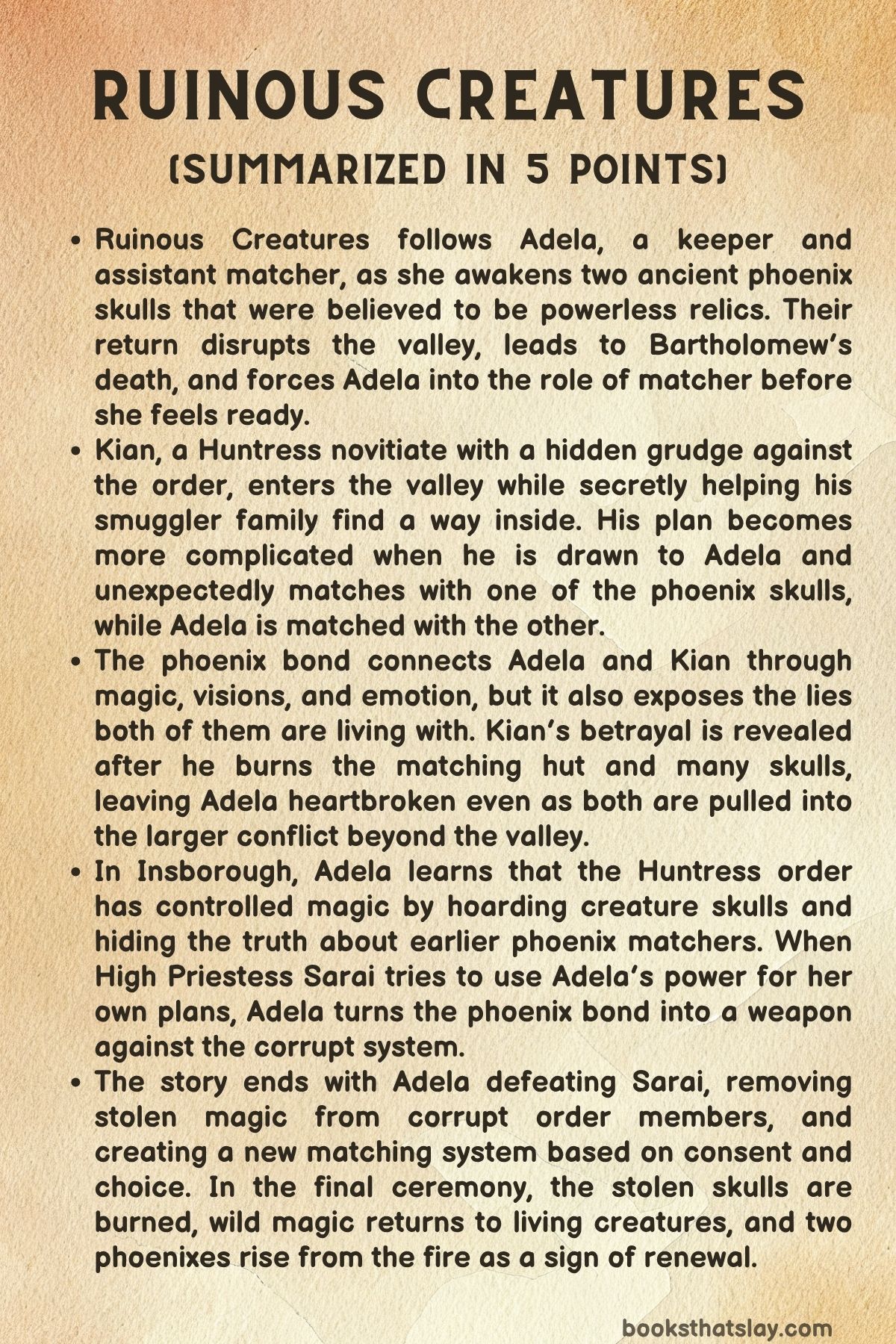
Adela works as a keeper and assistant matcher in a hidden valley where magical creature skulls are preserved and used in ceremonies. Her role is supposed to be quiet, obedient, and respectful.
She prepares skulls for the Huntress order, which uses matching ceremonies to connect chosen people with magical creatures and grant them power. Adela serves under Bartholomew, a cruel and dismissive mentor who treats her with contempt and makes her feel unworthy of real authority.
While preparing for an important Huntress matching ceremony, Adela discovers two ancient phoenix skulls hidden high on a shelf. They are unlike the other skulls she handles.
Bartholomew insists they are useless, dead decorations with no real magic left in them. Adela feels drawn to them anyway.
In secret, she touches one of the phoenix skulls to her bare cheek. That small act changes everything.
The skulls awaken in a burst of light and power that spreads across the valley, disturbing the natural and magical order.
After the phoenix skulls awaken, strange and violent events begin to unfold. Jackalopes herd Adela home as if warning her or guiding her.
A wounded kelpie arrives in terrible condition and dies despite her father Oscar’s efforts to help it. Bartholomew’s own pet dragons turn on him, attacking both him and each other.
Bartholomew is killed, and the valley is left without its official matcher. Because Adela has been trained as his assistant, she is forced into the position much sooner than anyone expected.
Beadda, who is loyal and practical, becomes her assistant.
At the same time, Kian is traveling toward the valley as part of the Huntress order. He appears to be a novitiate, but he has a hidden purpose.
Years earlier, the order killed his parents, and he joined them not out of devotion but to seek revenge from within. His plan is to lead his smuggler family into the hidden valley so they can help destroy the creature skulls.
He believes that if the skulls are destroyed, the orders will lose their control over magic and their power over others.
Before the journey, Kian’s aunt Ujvala helps him steal jewels from the skull of a dead priest. The theft is discovered, and Kian and Ulric are brutally punished.
Even so, Kian continues with his plan. As the Huntress group travels, he secretly drops red stones to mark the route into the valley for his family.
The journey becomes even more dangerous when the rogue dragon that survived Bartholomew’s death attacks the procession. Brother Thad, the last dragon-wearer, is killed, leaving the order shaken and vulnerable.
When the Huntress group arrives in the valley, Adela and Beadda make a dramatic entrance on Etana the unicorn and Lathai the pegasus. Kian notices Adela immediately and is fascinated by her.
During the welcome feast, the attraction between them grows quickly. They dance, flirt, and become physically involved, even though both are carrying secrets and fears.
Adela is trying to handle her sudden new authority, while Kian is still committed to betraying the valley and the order.
The next day, the matching ceremony does not go as expected. Kian does not match with the dragon skull prepared for him.
Instead, he matches with one of the awakened phoenix skulls. Even more shockingly, Adela herself is matched with the other phoenix skull.
This should be impossible according to everything keepers have been taught. Keepers are supposed to care for skulls and conduct matches, not become matched themselves.
Adela’s skull will not come off, making it clear that the bond is real and permanent.
The phoenix bond connects Adela and Kian in powerful ways. They begin to share emotions, visions, and magical awareness.
Adela feels frightened and guilty, unsure whether she has broken sacred rules or uncovered a truth others wanted hidden. Her new magic feels both beautiful and dangerous.
Kian is also unsettled because the phoenix bond complicates his mission. He hoped to destroy the skulls and weaken the order, but now he is tied to one of the very skulls he meant to help erase.
Kian searches for another way to carry out his plan. He realizes that his phoenix magic may not give him the fire he expected, so he turns to dragon fire instead.
During a storm, he burns the matching hut and destroys many skulls. The attack creates panic and loss in the valley.
At the same time, Etana suffers terribly after a violent encounter in the forest. Adela is forced to use her phoenix magic to end Etana’s suffering.
Etana’s foal, Tani, survives and runs into the woods.
Kian’s betrayal is exposed when the red stones he used to mark the path are discovered. Adela is devastated.
She had trusted him, desired him, and felt bound to him through magic, only to learn he had been guiding enemies toward the valley. Yet the situation is too unstable for a simple punishment or separation.
The order leaves the valley, and Adela and Kian are carried into the next stage of the conflict together, still connected by the phoenixes.
In Insborough, Adela enters temple life with Kian and begins to understand more about the structure of the orders. She sees that magic is not shared fairly.
The orders have built systems that give power to some people while denying it to others. She also learns that keepers have not always been separate from magic.
There is a hidden history of keepers once matching with phoenixes, which means Adela’s bond is not a mistake but part of a buried truth.
When Tani is found in the city, Adela and Kian secretly take her back to the valley. This return opens Adela’s awareness even further.
She hears trapped skulls calling from the Huntress temple and realizes the order has been collecting and hiding creature skulls for generations. The valley was never simply a sacred place of care and matching.
It was also part of a larger system of theft, control, and silence. Adela decides she must confront what has been hidden.
High Priestess Sarai reveals the crypt where stolen skulls have been kept. She wants Adela’s phoenix power for her own plans and pressures her by threatening the valley.
Sarai understands that Adela cares deeply about the creatures and the people connected to them, and she uses that love as a weapon. To prove Adela’s loyalty, Sarai orders her to kill Kian.
This demand is cruel, but Adela trusts the phoenix bond and believes Kian can return through its power.
Adela kills Kian, and her trust proves justified. Kian is resurrected by the phoenix magic.
This moment becomes the turning point. Adela releases the full force of her power against Sarai and the corrupt system she represents.
She destroys Sarai’s skull and strips corrupt members of the order of their stolen or misused magic. By doing so, she breaks the old structure of control and opens the way for a different future.
After Sarai’s fall, Adela begins creating a new system based on consent and choice. She matches willing people with skulls that also choose to be matched.
Keepers, servants, novitiates, and others who were once excluded or controlled are given the chance to take part in magic openly. The change does not erase the damage done, but it gives the world a fairer beginning.
Weeks later, the stolen skulls are returned to the valley. A massive farewell ceremony is held, and the skulls are burned.
As they burn, wild magic flows back into living creatures instead of remaining trapped in old bones and controlled by human institutions. Adela and Kian release their own phoenix skulls into the flames.
Rather than vanishing, the phoenixes are reborn as living creatures. Their return signals renewal for Adela, Kian, the valley, the magical creatures, and the wider world.
Characters
Adela
Adela is the central character of Ruinous Creatures, and her journey is built around fear, responsibility, discovery, and transformation. At the beginning of the book, she is positioned as someone with knowledge and skill, but not much authority.
As a keeper and assistant matcher, she understands the rituals surrounding magical creature skulls, yet she is constantly made to feel small by Bartholomew. His contempt shapes the way she sees herself, making her cautious and uncertain even when her instincts are strong.
Her decision to touch the phoenix skull shows that beneath her fear is a deep curiosity and a quiet courage. This moment changes everything, because Adela does not simply awaken ancient magic; she awakens a buried truth about herself, the valley, and the system she has been taught to obey.
Adela’s emotional complexity comes from the fact that she is not immediately powerful in a confident or heroic way. Her new position as matcher arrives suddenly after Bartholomew’s death, and she is forced into authority before she feels ready for it.
Her unexpected bond with a phoenix skull makes her even more conflicted, because it violates everything she has believed about keepers. She struggles with guilt, confusion, and fear, especially when her magic is connected to suffering and death.
Her mercy killing of Etana is one of the clearest examples of her painful growth. She does not use power for glory; she uses it because compassion demands something terrible from her.
This makes Adela a deeply humane character, because her strength develops through grief rather than certainty.
Adela’s relationship with Kian adds another layer to her character. She is drawn to him quickly, but their bond becomes much more than romance.
Through their phoenix connection, she experiences trust, betrayal, emotional exposure, and shared destiny. Kian’s betrayal hurts her because it strikes at both her heart and her beliefs.
Still, Adela’s growth is shown through her ability to see beyond personal pain and understand the larger corruption around her. By the end of the story, she becomes someone capable of making impossible choices, including killing Kian because she trusts the phoenix bond and understands that rebirth is possible.
Her final actions reveal her as a reformer rather than a conqueror. She does not replace one cruel system with another; she creates a new order based on consent, choice, and respect for magical creatures.
Kian
Kian is one of the most morally complicated characters in the book because he begins as both victim and deceiver. His hatred of the Huntress order is rooted in real trauma, since the order killed his parents and shaped his life through violence.
His decision to join as a novitiate is not an act of loyalty but an act of revenge. This makes him dangerous, but it also makes him sympathetic.
He is not plotting destruction out of simple cruelty; he is trying to strike back against an institution that took everything from him. His plan to guide his smuggler family into the hidden valley shows his intelligence, patience, and willingness to live inside the enemy’s world until the right moment comes.
Kian’s central conflict is between revenge and connection. Before meeting Adela, his purpose seems clear: destroy the skulls, weaken the orders, and avenge his family.
After he bonds with the phoenix skull and becomes emotionally tied to Adela, that clarity begins to break apart. He still hides the truth from her, and his decision to burn the matching hut causes enormous harm, but his feelings complicate his mission.
He is not able to remain only a rebel or only a lover. The phoenix bond forces him into emotional honesty even while he continues to lie in practical ways.
This contradiction makes him compelling because he is constantly torn between the justice he wants and the damage he causes while trying to achieve it.
Kian’s resurrection is important because it reflects the larger theme of renewal. He is a character built from loss, anger, and secrecy, but the phoenix bond gives him the possibility of becoming something more than his revenge.
His death at Adela’s hands is not simply a punishment or sacrifice; it becomes a test of trust between them. When he returns, the story confirms that transformation is possible, but not without pain.
Kian’s arc suggests that rebellion must eventually become something more constructive than destruction. By the end, he helps open the way for a new relationship between people, skulls, creatures, and magic.
Bartholomew
Bartholomew represents the old keeper system at its most arrogant and decayed. As Adela’s mentor, he should guide, protect, and teach her, but instead he humiliates her and dismisses her abilities.
His contempt reveals a deep insecurity in the world of keepers, where knowledge has become rigid and authority has become cruel. He treats the phoenix skulls as dead decorations, which shows how disconnected he is from the living magic he is supposed to understand.
His failure to recognize their power makes him a symbol of a tradition that has forgotten its own origins.
His death is both shocking and meaningful. Bartholomew is killed by his own pet dragons, which suggests that the forces he believed he controlled were never truly under his command.
The violence of his end reflects the danger of treating magical creatures and their remains as tools or status symbols. He does not die because of an outside enemy; he is destroyed by the consequences of the world he helped maintain.
His death also pushes Adela into power before she is ready, making him important even after he is gone. Bartholomew’s role is therefore not only to oppress Adela, but to embody the failure of the old order that she must eventually replace.
Beadda
Beadda serves as Adela’s assistant after Bartholomew’s death, and her role highlights the shift from an abusive hierarchy to a more supportive partnership. Unlike Bartholomew, Beadda does not define Adela through contempt.
Her presence gives Adela someone beside her during the early stages of sudden responsibility. This matters because Adela’s new role as matcher is frightening and isolating, especially after the awakening of the phoenix skulls.
Beadda helps show that leadership does not have to be built on cruelty or humiliation.
Beadda also represents the ordinary people affected by the larger magical and political systems of the story. She is not as central as Adela or Kian, but her movement into the assistant role shows how quickly lives in the valley change after the phoenixes awaken.
Her dramatic arrival with Adela on Etana and Lathai also gives her a place in the public transformation of Adela’s status. Through Beadda, the book shows that change does not only belong to the most powerful characters.
It also reshapes the people who stand near them, work with them, and witness the collapse of old beliefs.
Oscar
Oscar, Adela’s father, is a caring and grounded figure whose work with injured creatures reveals a gentler relationship with magic. His attempt to care for the wounded kelpie shows compassion in a world where magical creatures are often controlled, used, or reduced to skulls.
Even though the kelpie dies, Oscar’s role in that moment is important because he responds to suffering with care rather than authority. He helps establish the emotional values that Adela later carries into her own choices.
Oscar also gives Adela a connection to home and family. In a story full of orders, temples, rituals, and hidden systems, he represents a more personal form of loyalty.
His presence reminds readers that Adela’s strength does not come only from phoenix magic. It also comes from the compassion she has learned in the valley and from the people who treat creatures as living beings rather than objects.
Oscar may not drive the political conflict directly, but he helps shape the moral foundation of Adela’s character.
Ujvala
Ujvala is important because she connects Kian to his smuggler family and to the life he had before and beyond the Huntress order. Her help in stealing jewels from a dead priest’s skull shows that she is practical, daring, and willing to participate in dangerous acts for the sake of the family’s larger plan.
She is not presented as innocent, but her actions are shaped by resistance to a corrupt magical system. Through her, the story shows that rebellion often exists in morally gray spaces.
Her relationship with Kian also reveals the strength of family loyalty in his life. Kian is not acting alone; he is part of a wider network of people who have been harmed by the orders and are willing to fight back.
Ujvala’s role helps explain why Kian is so committed to his plan. He carries not only personal grief but also the hopes and anger of his family.
She therefore expands the conflict beyond one young man’s revenge and makes it part of a broader struggle against institutional control.
Ulric
Ulric is connected to Kian through the theft of jewels and the brutal punishment that follows. His presence shows the danger faced by those who resist the orders from within or near their control.
Like Kian, he suffers because of the rigid and violent discipline of the system. The punishment he receives is significant because it exposes the cruelty beneath the order’s sacred appearance.
The institution claims authority over magic, but its methods are built on fear and pain.
Ulric’s role also strengthens the reader’s understanding of Kian’s world. He helps show that Kian’s hatred of the order is not abstract or exaggerated.
The brutality is visible, immediate, and personal. Even if Ulric is not as deeply developed as Kian, his suffering gives weight to the atmosphere of oppression surrounding the novitiates.
He becomes part of the evidence that the system Adela later challenges is not merely flawed but actively harmful.
Brother Thad
Brother Thad is significant because he is the last dragon-wearer, which gives his death symbolic weight. When the rogue dragon attacks the procession and kills him, it marks the end of a particular form of magical authority.
The dragon-wearer role suggests a connection between humans and dragon magic, but Brother Thad’s death shows how unstable and dangerous that connection has become. The old structures cannot protect even their own representatives.
His death also intensifies the disorder spreading after the phoenix skulls awaken. The procession to the valley is supposed to be controlled and ceremonial, yet it becomes vulnerable to chaos and violence.
Brother Thad’s death helps establish that the magical world is no longer functioning according to the rules people believe in. His end foreshadows the collapse of the larger system of control, especially the belief that the orders can safely manage magic while hiding the truth.
High Priestess Sarai
High Priestess Sarai is the clearest embodiment of institutional corruption in the book. She is powerful, calculating, and willing to use fear to maintain control.
Her revelation of the hidden crypt of stolen skulls exposes the depth of the order’s deception. The skulls have not simply been preserved or honored; they have been hoarded.
Sarai’s power depends on secrecy, theft, and the unequal distribution of magic. She presents herself as a religious or political authority, but her actions reveal that she values control more than justice.
Sarai’s treatment of Adela shows how manipulative she is. Rather than simply attacking Adela, she tries to force her into obedience by threatening the valley.
This makes Sarai dangerous because she understands what people love and uses it against them. Her command that Adela kill Kian is designed to break Adela emotionally and prove her loyalty.
However, Sarai misunderstands the phoenix bond and underestimates Adela’s courage. Her downfall comes because she cannot imagine a kind of magic based on trust, consent, and renewal rather than possession.
When Adela destroys Sarai’s skull and strips corrupt members of their magic, Sarai’s defeat becomes more than the fall of one villain. It becomes the collapse of the system she represents.
Sarai is important because she gives the story a human face for corruption. The injustice of the orders is not vague; it is concentrated in her choices, threats, and ambition.
Her defeat allows the book to move from exposure to transformation.
Etana
Etana, the unicorn, is one of the most emotionally important magical creatures in the story. Her dramatic arrival with Adela and Beadda gives her an image of beauty, strength, and wonder, but her later suffering shows the vulnerability of magical creatures in this world.
Etana is not merely a symbol of elegance. She is a living being whose pain matters.
Her violent encounter in the forest and the birth of her foal place her at the center of one of Adela’s most painful moral decisions.
Adela’s use of phoenix magic to end Etana’s suffering is devastating because it joins mercy with death. Etana’s role therefore helps define what Adela’s power means.
Phoenix magic is not only about rebirth and spectacle; it is also about endings, compassion, and the courage to act when no choice is pure. Etana’s death also leads to Tani’s survival, making her part of the story’s pattern of loss followed by renewal.
Through Etana, the book asks readers to see magical creatures as beings with dignity, not as ornaments, tools, or sources of power.
Lathai
Lathai, the pegasus, contributes to the sense of wonder and living magic in the valley. Alongside Etana, Lathai helps create the dramatic image of Adela and Beadda arriving at the welcome ceremony.
This moment matters because it publicly marks Adela’s changed position. She is no longer only Bartholomew’s belittled assistant; she has become someone visibly connected to the magical life of the valley.
Lathai helps frame that transformation.
Although Lathai is not developed as deeply as Etana, the pegasus still represents the beauty and vitality of creatures that exist beyond the orders’ control. In a story where so much magic has been trapped in skulls, living creatures like Lathai remind readers what has been endangered.
Lathai’s presence strengthens the contrast between wild, living magic and the institutional habit of collecting, matching, and controlling magical remains.
Tani
Tani, Etana’s foal, is a symbol of survival and renewal. Born from violence and grief, Tani represents life continuing after terrible loss.
Her escape into the woods makes her seem fragile but also free, and her later appearance in the city reminds Adela and Kian that the consequences of their choices are not confined to the valley. Tani connects the private pain of Etana’s death with the larger question of where magical creatures belong.
When Adela and Kian secretly return Tani to the valley, the act becomes a gesture of protection and repair. Tani’s importance lies in what she represents: a future for living creatures outside systems of ownership and control.
She is not a weapon, a skull, or a source of power to be assigned. She is a young living creature who deserves safety.
Through Tani, the story gives emotional shape to the new world Adela wants to create.
The Phoenixes
The phoenixes are central to the meaning of Ruinous Creatures because they represent memory, rebellion, death, rebirth, and consent. At first, they appear only as ancient skulls hidden away and dismissed as lifeless objects.
Their awakening proves that the old understanding of magic is incomplete. They are not dead decorations, and they are not passive tools.
Their bond with Adela and Kian reveals a deeper form of magical relationship, one based on connection rather than command.
The phoenixes also uncover the hidden history of keepers and the truth that the orders have suppressed. Through them, Adela learns that the system she inherited was built on lies.
Their magic forces both Adela and Kian to confront death differently. Kian’s resurrection shows the phoenix power of return, while Adela’s transformation shows the phoenix power of renewal after destruction.
At the end, when the skulls are released into the flames and living phoenixes emerge, the story completes its movement from captivity to freedom. The phoenixes are not simply magical beings; they are the living proof that a broken world can burn and still begin again.
The Dragons
The dragons represent uncontrolled violence, broken bonds, and the danger of treating magical creatures as possessions. Bartholomew’s pet dragons turn against him and each other, which reveals the instability beneath his supposed mastery.
Their attack is not random in meaning; it shows that domination creates destruction. Bartholomew believes he has authority over magical beings, but the dragons expose the weakness of that belief.
The surviving rogue dragon also plays a major role in spreading chaos beyond Bartholomew’s death. Its attack on the procession and killing of Brother Thad show that the old magical order is losing control.
Dragon fire later becomes part of Kian’s destructive plan, connecting dragons with rebellion as well as danger. The dragons therefore occupy a morally complex place in the book.
They are frightening and destructive, but their violence also reflects the damage caused by systems that have misunderstood and exploited magic.
The Kelpie
The wounded kelpie is a brief but meaningful presence in the story. Its death in Oscar’s care helps establish the atmosphere of magical disturbance after the phoenix skulls awaken.
The kelpie’s suffering shows that the awakening of old magic has consequences for living creatures, not just for human institutions. Its death adds sadness and urgency to the early part of the book.
The kelpie also helps reveal Oscar’s compassion and, indirectly, Adela’s moral inheritance. The creature is not treated as an inconvenience or a curiosity; it is treated as a patient whose pain matters.
This small moment supports one of the story’s larger ideas: magical creatures are living beings deserving care, grief, and respect. Even though the kelpie does not remain in the plot for long, its death helps prepare the reader for the deeper creature-centered conflicts that follow.
The Jackalopes
The jackalopes bring a strange and memorable form of magical disruption into Adela’s life. Their act of herding her home suggests that the creatures of the valley are responding to the awakened phoenix magic in ways humans do not fully understand.
They create a sense that nature and magic are communicating, even when people are confused by what is happening. Their behavior is unusual, but it is not meaningless.
As creatures, the jackalopes help show that the valley is alive with more awareness than the orders recognize. They are part of the widening ripple caused by Adela’s contact with the phoenix skull.
Their role is small, but it contributes to the story’s sense of a magical ecosystem reacting to buried power. They remind readers that the valley is not just a setting; it is a living world filled with creatures whose instincts may understand change before humans do.
Themes
Power, Control, and the Ownership of Magic
In Ruinous Creatures, magic is not treated as a shared wonder but as something controlled by institutions that decide who deserves access to it. The orders build their authority by keeping creature skulls, controlling matches, and hiding the truth about where much of their power comes from.
This control creates inequality, because some people are given magical status while others are kept obedient, ignorant, or powerless. Adela’s discovery of the stolen skulls exposes how deeply this system depends on secrecy.
Sarai’s actions show the danger of leaders who protect power for themselves while claiming to serve a sacred purpose. The theme becomes even stronger when Adela begins matching people and skulls through consent rather than rank or tradition.
Magic shifts from being a tool of domination to a force connected with choice, fairness, and responsibility. The ending suggests that power becomes less destructive when it is returned to its rightful source and shared with respect.
Betrayal, Trust, and Moral Complexity
Kian’s betrayal is not presented as simple cruelty, because his actions come from grief, anger, and a desire to fight an unjust system. He lies to Adela, marks the route into the valley, and helps destroy skulls, yet his motives are tied to the murder of his parents and the damage caused by the orders.
This makes the theme of betrayal emotionally complicated. Adela’s pain is real because she trusts him and forms a deep magical and personal bond with him, but Kian is also trapped between revenge and growing love.
Their relationship forces both characters to question whether trust can survive serious harm. The phoenix bond becomes important because it allows them to understand each other beyond spoken explanations, but it does not erase the consequences of his choices.
By the time Adela kills Kian under Sarai’s command, trust has become an act of great risk. Their connection shows that forgiveness is not easy, but it can exist when both people face the truth.
Transformation Through Grief and Responsibility
Adela begins as someone treated with contempt and kept in a limited role, but the awakening of the phoenix skulls forces her into a position of responsibility before she feels ready. Her growth is shaped by loss, fear, and painful decisions rather than by simple ambition.
Bartholomew’s death, the destruction of the matching hut, Etana’s suffering, and the discovery of the stolen skulls all push Adela to understand that avoiding power is no longer possible. The moment she uses phoenix magic to end Etana’s pain shows how responsibility can involve mercy as well as strength.
Her later confrontation with Sarai proves that she has moved beyond obedience to tradition. She learns that being a true matcher is not about preserving old rules but about listening, judging fairly, and protecting both people and magical creatures.
Her transformation is powerful because she does not become fearless; instead, she acts despite fear. Grief teaches her that power must be guided by compassion, not control.
Renewal, Consent, and the Restoration of Balance
The phoenixes represent renewal, but the story connects renewal to ethical change rather than mere survival. Resurrection alone is not enough; the world must also change the systems that caused harm.
The stolen skulls, hidden crypt, and forced use of magic reveal a broken relationship between humans and magical creatures. Adela’s new way of matching is based on consent, which becomes one of the clearest signs of restoration.
Skulls are no longer objects to be claimed, assigned, or exploited. They become beings whose willingness matters.
This shift changes the meaning of magic from ownership to partnership. The farewell ceremony also deepens the theme, because burning the skulls is not destruction in a cruel sense but a release.
Wild magic returns to living creatures, suggesting that balance can only be restored when imprisoned power is set free. The emergence of living phoenixes from the fire gives the ending hope, showing that true renewal comes after truth, sacrifice, and the courage to create a fairer order.