Once and Again Summary, Characters and Themes
Once and Again by Rebecca Serle is a novel about love, regret, family secrets, and the difficult wish to change what has already happened. The story follows Lauren Novak, a married woman whose life is shaped by a strange family inheritance: each woman in her family receives one silver ticket that can undo the past.
As Lauren faces a strained marriage, the return of a first love, and a crisis involving her father, she begins to question what should be fixed, what must be accepted, and whether saving one moment is worth altering an entire life.
Summary
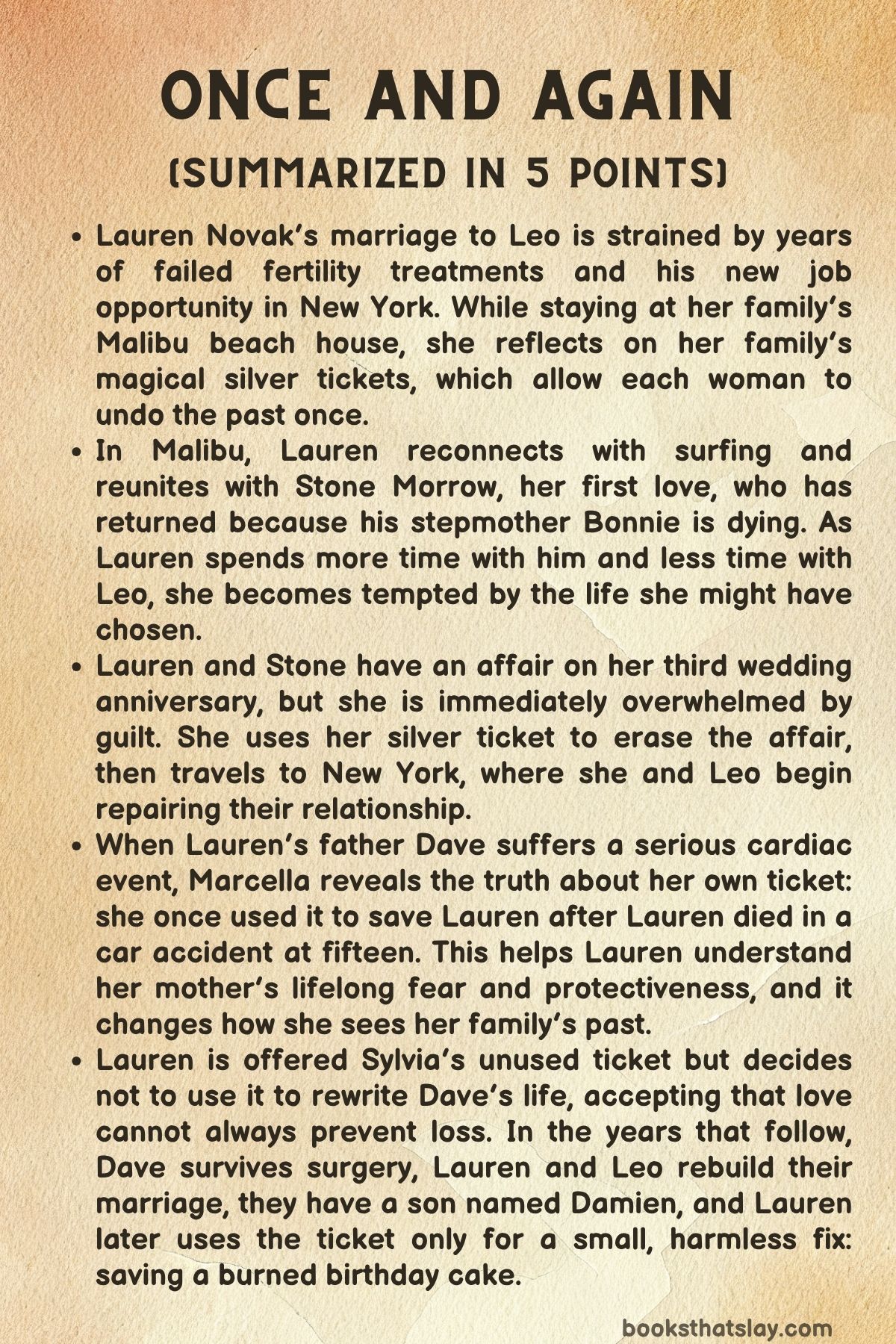
Once and Again follows Lauren Novak, a woman living in West Hollywood with her husband, Leo. Their life together looks steady from the outside, but their marriage is under deep pressure.
Leo works as a director of photography and is preparing to travel to New York for an interview that could lead to a major television job. Lauren supports him, yet his absence brings up old fears.
She has always been anxious when someone she loves is far away or in danger, partly because of a family story she grew up believing.
Lauren was told that her father, Dave, once died in a car crash and was saved by her mother, Marcella, through the use of a magical silver ticket. In Lauren’s family, every woman receives one ticket, and each ticket has the power to undo the past one time.
The tradition goes back to Lauren’s great-grandmother Irina, who used the first ticket as a child in Odessa to save her father from being taken away. For Lauren, the story has always been part of her family’s history, but she does not fully understand how closely it is tied to her own life.
While Leo is away, Lauren visits the old family beach house in Malibu. Her father Dave, her mother Marcella, and her grandmother Sylvia all live there.
Lauren is especially close to Dave and Sylvia. Dave gives her warmth and steadiness, while Sylvia carries a quiet strength and a sense of mystery.
Lauren’s relationship with Marcella is much harder. Marcella’s love often appears as fear, control, and caution, and Lauren has spent years feeling judged or restricted by her mother.
Leo gets the job in New York, which is good news for his career but also creates distance between him and Lauren. He suggests that she spend the summer in Malibu while they rent out their West Hollywood bungalow to bring in extra money.
Lauren agrees and moves into the beach house with her cat, Pea. The move gives her a chance to return to the ocean, to her family, and to a part of herself she has not touched in years.
Lauren and Leo’s marriage has been strained by fertility struggles. They have gone through years of treatments without success.
Leo is exhausted and wants to stop trying, but Lauren cannot easily give up the dream of having a child. Their different ways of handling disappointment have created silence between them.
Leo’s work in New York gives them space, but it also leaves Lauren alone with her fears, memories, and unresolved desires.
In Malibu, Lauren begins surfing again. The ocean becomes a place where she feels strong, free, and connected to her younger self.
During one surf session, she runs into Stone Morrow, her first love. Stone has returned to Malibu because his stepmother, Bonnie, is dying of cancer.
Lauren and Stone have a long history. They dated from the time Lauren was fifteen until she was twenty-five, and their relationship ended when Stone moved to Boulder to start a surf school.
His return awakens old feelings and reminds Lauren of the life she might have had if their paths had stayed together.
As Lauren spends more time in Malibu, she and Stone begin seeing each other often. They surf together, share meals, and visit Bonnie.
Stone knows parts of Lauren that Leo does not, or at least parts that Lauren has not shown Leo in a long time. With him, she feels remembered.
Their connection is familiar and easy, but it is also dangerous because Lauren is still married and Leo is still trying to build a future with her.
The summer becomes a season of comparison. Lauren thinks about her life with Leo and the life she almost had with Stone.
She also watches Bonnie face death, which makes questions of time, loss, and second chances feel more urgent. On Lauren and Leo’s third wedding anniversary, Leo is away in New York.
Lauren spends the day with Stone, and the emotional weight of Bonnie’s illness brings them closer. That night, Lauren and Stone have sex in a parking lot.
The moment is brief, but its effect on Lauren is immediate and painful. She is overwhelmed by guilt and understands that she has crossed a line she cannot live with.
Because she has her family’s silver ticket, she has a way to undo what happened. Lauren uses the ticket and goes back to erase the affair from reality.
In the new version of events, the parking lot encounter never occurs.
After using the ticket, Lauren makes a different choice. She flies to New York to be with Leo.
Their time together there becomes gentle and healing. Away from the pressure of their old routines, they reconnect.
They stop centering every conversation on fertility treatments and allow themselves to imagine a future that may not look exactly as Lauren once planned. Their marriage begins to feel possible again.
Then Lauren receives frightening news. Dave has suffered a serious cardiac event, and she rushes back to Los Angeles to be with her family at Cedars-Sinai.
At the hospital, Marcella finally tells Lauren the truth about the story she has always believed. Dave was not the one Marcella saved with her ticket.
Lauren was.
When Lauren was fifteen, she and Dave were in a terrible car accident after one of Lauren’s volleyball games. In that original timeline, Lauren died.
Marcella used her silver ticket to return to a moment before the accident and save her daughter’s life. Afterward, she changed the story, telling Lauren that Dave had died and been saved instead.
Marcella could not bear to tell Lauren that she had once lost her.
This truth changes the way Lauren sees her mother. Marcella’s fear, protectiveness, and emotional distance suddenly make sense in a new way.
She was not simply controlling Lauren; she was a mother who had already experienced the worst loss imaginable and had spent years terrified it might happen again. Lauren’s anger toward Marcella does not vanish at once, but it becomes complicated by understanding.
As Dave’s condition worsens, Lauren wants to use another ticket to save him. Sylvia reveals that she never used her own ticket and gives it to Lauren.
The possibility of saving Dave is now real. Lauren believes she can prevent his illness or change the event that led to the crisis.
But Dave refuses. To save him, Lauren would need to go back far enough to erase major parts of her life, including her marriage to Leo and the person she has become.
Dave does not want his survival to come at that cost.
Marcella also begins to accept that some things should not be undone. The tickets can change a moment, but they cannot remove the pain and meaning of a whole life without consequences.
Lauren is forced to face the hardest lesson of the book: love does not always mean reversing loss. Sometimes love means honoring what has happened and choosing how to live afterward.
Lauren then goes to Stone and says goodbye. Their connection was real, but it belongs to the past.
She understands that returning to Stone would not solve the deeper questions in her life. It would only let her escape them.
Letting him go becomes part of Lauren’s decision to return to the life she has chosen, even with all its flaws.
Back in West Hollywood, Lauren tells Leo the truth about the affair, even though she erased it from reality. Leo has no memory of it because, in the current timeline, it never happened.
Still, Lauren knows that honesty is necessary if their marriage is going to survive. Leo is hurt by her confession, but he does not walk away completely.
He wants to try to forgive her, though forgiveness does not come easily.
Over the next few years, Lauren and Leo move through pain, separation, and repair. Dave has surgery and survives, which allows the family to keep living without rewriting the past.
Lauren and Leo eventually reconcile after a long period of distance. Their path to parenthood also changes.
With Sylvia’s help, they use donor eggs, and Lauren gives birth to a son named Damien.
At Damien’s first birthday party, life has settled into something imperfect but full. Lauren has a family, her father is alive, and her marriage has survived hard truths.
During the party, she burns the cake. In the old cookie jar, she finds Sylvia’s unused silver ticket.
Holding it in her palm, Lauren chooses to go back once more, not to change a death, erase a betrayal, or remake her life, but simply to fix the cake.
The ending shows how Lauren’s understanding of time and regret has changed. She no longer sees the ticket as a way to escape pain or rebuild her life from the ground up.
Instead, she uses it for something small and ordinary. After all she has learned, the smallest correction becomes the safest one.
Once and Again closes with Lauren accepting that a life does not need to be perfect to be worth keeping.
Characters
Once and Again presents its characters through love, regret, memory, family inheritance, and the painful temptation to rewrite the past. Each character in the book is connected to the central question of whether a person should undo suffering if doing so also changes the life that grew from it.
The emotional force of the story comes from the way these characters are not simply divided into right and wrong choices; they are shaped by fear, grief, longing, loyalty, and the deep human wish to protect the people they love.
Lauren Novak
Lauren Novak is the emotional center of Once and Again, and her character is defined by a constant struggle between love and fear. She is a woman who deeply values connection, but she also lives with the anxiety of loss.
Her fear that danger may strike the people she loves is not ordinary worry; it is rooted in the strange family belief that death and disaster can be reversed, but only once. This makes Lauren unusually aware of how fragile life is.
She loves her husband Leo, but their marriage has become strained by failed fertility treatments, disappointment, and the exhaustion of wanting something they cannot easily have. Her desire for a child is not shown as selfish, but it does become consuming, making it difficult for her to accept a future different from the one she imagined.
Lauren’s summer in Malibu reveals another side of her character. Away from Leo and back near the ocean, she reconnects with the person she used to be.
Surfing becomes more than a hobby for her; it becomes a way of remembering freedom, youth, and a version of herself that existed before marriage, infertility, and adult disappointment narrowed her world. Her reunion with Stone intensifies this emotional return to the past.
Lauren is not simply tempted by another man; she is tempted by another life. Stone represents first love, unfinished possibility, and the version of Lauren who once believed her future could unfold naturally and joyfully.
Her affair with him exposes her weakness, but it also exposes her grief. She acts out of longing, confusion, and emotional hunger, not cruelty.
The use of the silver ticket becomes one of Lauren’s most revealing choices. When she erases the affair, she is not only trying to protect Leo from pain; she is also trying to protect herself from the consequences of what she has done.
This shows her moral complexity. She wants to be good, but she also wants escape.
Later, when she chooses to tell Leo the truth even though the event has been erased, she finally accepts that love cannot be built on a hidden reality. This confession marks a major stage in her growth because she stops using magic as a way to avoid responsibility.
By the end of the story, Lauren becomes someone who understands that a life cannot be made perfect by removing every mistake. Her final choice to use the ticket only to fix a burnt cake is meaningful because it shows both tenderness and restraint.
She is no longer trying to undo an entire life; she is trying to preserve a small moment of happiness.
Leo
Leo is Lauren’s husband, and his character represents steadiness, patience, and the painful limits of devotion. He loves Lauren, but he is also worn down by the repeated disappointment of fertility treatments and the emotional pressure their marriage has carried for years.
His wish to stop trying is not a sign that he loves Lauren less; rather, it shows that he is trying to protect both of them from being destroyed by a dream that has become painful. Leo’s character is important because he offers a contrast to Lauren’s inability to let go.
While Lauren clings to possibility, Leo begins to see acceptance as a form of survival.
His move toward the New York job creates physical distance between him and Lauren, but it also reveals the emotional distance already present in their marriage. Leo is not portrayed as uncaring or absent in a simple way.
He is busy, ambitious, and trying to move forward, while Lauren is caught between the marriage she has and the past she has never fully released. When Lauren joins him in New York after using the ticket, their relationship briefly becomes lighter and more hopeful.
This shows that Leo is capable of rebuilding intimacy when the weight of fertility and disappointment is lifted. He is not the obstacle to Lauren’s happiness; he is one possible form of it.
Leo’s reaction to Lauren’s confession is one of the strongest signs of his complexity. He is deeply hurt, and the pain is real, even though the affair no longer exists in the altered timeline.
His hurt comes from the emotional truth of Lauren’s choice, not simply from the physical act. Still, he does not respond with immediate rejection.
His willingness to try to forgive her shows maturity and emotional depth. Leo’s love is not naïve; it has to pass through anger, separation, grief, and time.
By eventually reconciling with Lauren and building a family with her, Leo becomes a symbol of love that survives not because it is untouched by betrayal, but because it is rebuilt honestly after damage.
Stone Morrow
Stone Morrow is Lauren’s first love, and his role in the story is tied to memory, temptation, and the life Lauren did not choose. He returns to Malibu because his stepmother Bonnie is dying, which immediately places him in a state of grief and vulnerability.
This makes his reunion with Lauren emotionally charged. He is not simply a romantic rival to Leo; he is a reminder of Lauren’s younger self, her history with the ocean, and the years before adult responsibilities reshaped her life.
Stone carries the atmosphere of the past with him, and because of that, he becomes both comforting and dangerous.
Stone’s connection with Lauren is powerful because it is built on long familiarity. They loved each other for ten years, from adolescence into young adulthood, and their bond still has a natural ease.
Their surfing together, shared meals, and visits to Bonnie make their renewed closeness feel intimate before it becomes physical. Stone understands a version of Lauren that Leo does not fully know, and this gives him emotional power in her life.
However, he also represents escape. With Stone, Lauren can imagine a path untouched by fertility treatments, marital strain, and the disappointments of adulthood.
That imagined path is seductive, but it is also incomplete because it is built more on longing than on present reality.
Stone is not written as a villain. He is grieving, lonely, and drawn to someone who once meant everything to him.
At the same time, his presence forces Lauren to confront the difference between remembering love and returning to it. Their affair is not presented as a grand solution; it is a moment of weakness that leaves Lauren filled with guilt.
When Lauren later says goodbye to Stone for good, it confirms that he belongs to a chapter of her life that cannot become her future. His character shows that first love may remain meaningful without being the love one is meant to choose forever.
Marcella
Marcella, Lauren’s mother, is one of the most emotionally complex figures in the book. At first, she appears distant, strained, and overprotective, especially in Lauren’s eyes.
Lauren does not understand why their relationship feels so burdened or why Marcella carries such intense fear. The truth about the silver ticket completely changes the way Marcella must be understood.
She did not use her ticket to save Dave, as Lauren had always believed. She used it to save Lauren after Lauren died in the car accident at fifteen.
This revelation transforms Marcella from a difficult mother into a woman shaped by unbearable trauma.
Marcella’s lie is morally complicated. She hides the truth from Lauren for years, allowing her daughter to believe a false version of the family’s past.
This deception damages their relationship because Lauren grows up without understanding the real source of Marcella’s fear. Yet Marcella’s lie also comes from love and terror.
She cannot bear to tell Lauren that she once died, and she cannot bear to relive the experience openly. Her protectiveness is not simply controlling behavior; it is the reaction of a mother who has already lost her child once and knows exactly how fragile survival can be.
The tragedy of Marcella is that the very act that saved Lauren also created emotional distance between them.
By the end of the story, Marcella begins to accept that love cannot mean controlling every possible outcome. Her realization that the ticket should not be used to erase an entire life shows growth.
She understands, perhaps better than anyone, the cost of changing the past. Marcella’s character represents maternal love at its most fierce and wounded.
She is not perfect, but her choices come from a place of profound devotion. Her relationship with Lauren becomes more understandable once the truth is revealed, and the emotional distance between them begins to soften because Lauren can finally see the grief behind her mother’s fear.
Dave
Dave is Lauren’s father, and he represents warmth, stability, and the kind of love that feels safe and dependable. Lauren is close to him, and her bond with him is one of the emotional anchors of the story.
For much of her life, Lauren believes that Dave once died in a car crash and was saved by Marcella’s silver ticket. This false belief gives Dave an almost miraculous place in Lauren’s imagination, as someone whose life was restored by love.
When the truth is revealed, his role shifts, but his importance does not lessen. Instead, he becomes part of the hidden trauma that shaped the whole family.
Dave’s cardiac event brings the family’s deepest questions into the present. Lauren’s instinct is to use Sylvia’s unused ticket to save him, which shows how much he means to her.
Yet Dave refuses because he understands the cost of such an action. To save him by going far enough back would risk erasing Lauren’s life with Leo and everything that came from it.
His refusal reveals his selflessness. Dave does not want his daughter to sacrifice the life she has built in order to preserve him.
This makes him one of the clearest voices of acceptance in the story.
Dave’s character is not defined by dramatic speeches or selfish demands. He is defined by love that releases rather than clings.
His willingness to face death without asking Lauren to undo her life shows emotional courage. He becomes a moral counterweight to the temptation of the ticket.
Through Dave, the story suggests that loving someone sometimes means allowing life to continue naturally, even when that continuation includes pain. His eventual survival after surgery offers hope, but the significance of his character lies even more in his refusal to let love become possession.
Sylvia
Sylvia, Lauren’s grandmother, is a quiet but powerful figure in the story. She carries the family history of the silver tickets and represents memory, inheritance, and wisdom.
Unlike the other women in the family who are defined by the use or potential use of their tickets, Sylvia’s significance lies in the fact that she never used hers. This restraint gives her a special moral authority.
She understands the temptation to change the past, but she has lived with the discipline of leaving life untouched. Her unused ticket becomes one of the most important objects in the story because it represents possibility, restraint, and the burden of choice.
Sylvia’s relationship with Lauren is affectionate and supportive. She is part of the Malibu home that gives Lauren a sense of belonging and continuity.
Her presence connects Lauren not only to her immediate family but also to generations of women before her. When Sylvia gives Lauren the unused ticket, she gives her more than a magical object; she gives her trust.
She allows Lauren to face the responsibility of deciding what should and should not be changed. This action shows Sylvia’s faith in Lauren’s growth, even though the decision could have enormous consequences.
Sylvia also plays an important role in Lauren and Leo’s eventual family. Her financial help with donor eggs makes Damien’s birth possible, which shows that Sylvia’s love is practical as well as emotional.
She helps create the future without rewriting the past. This is central to her character.
Sylvia’s wisdom lies in understanding that love does not always need magic. Sometimes it needs patience, money, support, honesty, and the courage to accept imperfect solutions.
Her hidden ticket at the end reminds the reader that temptation never fully disappears, but Sylvia’s life has already shown the value of restraint.
Irina
Irina, Lauren’s great-grandmother, is the origin of the family’s magical inheritance. As a child in Odessa, she uses the first silver ticket to save her father from being taken.
Her action begins the pattern that shapes the women who come after her. Irina’s choice is rooted in fear, love, and survival.
Because her use of the ticket happens in a dangerous historical context, it carries a different weight from Lauren’s later choices. For Irina, the ticket is not about romantic regret or personal dissatisfaction; it is about protecting her family from immediate loss.
Although Irina does not occupy as much space in the present action of the story, her influence is enormous. She establishes the emotional and moral inheritance that Lauren, Marcella, and Sylvia must live with.
The ticket becomes a family legacy, but it is also a family burden. Irina’s act proves that the past can be changed, and that knowledge alters how each generation thinks about grief and responsibility.
Once such power exists, every crisis becomes a question: should it be undone, or should it be endured?
Irina’s character also adds depth to the story’s treatment of ancestry. The women in the family inherit not only a magical object but also the emotional consequences of earlier acts of protection.
Irina’s love for her father echoes through Marcella’s love for Lauren and Lauren’s love for Dave, Leo, and Damien. Her brief but crucial role shows how one desperate act of love can shape generations.
She represents the beginning of a family pattern in which women are asked to decide how much of life should be controlled and how much must be allowed to unfold.
Bonnie
Bonnie is Stone’s stepmother, and her illness gives emotional urgency to Stone’s return to Malibu. She is important because her dying body brings mortality into the foreground of the story.
Her cancer is not a distant idea; it is immediate, painful, and unavoidable. Through Bonnie, Lauren and Stone are forced to confront the reality that some losses cannot easily be escaped.
Her condition also helps create the atmosphere in which Lauren becomes more emotionally vulnerable. Being near Bonnie’s illness reminds Lauren of death, regret, and the limited time people have with one another.
Bonnie’s role is also connected to Stone’s humanity. Because he returns to care for or be near her, the reader sees him not only as Lauren’s first love but as a man dealing with grief.
Bonnie’s illness softens Stone and makes his connection with Lauren feel rooted in shared sadness rather than simple nostalgia. The time Lauren spends visiting Bonnie also draws her deeper into Stone’s world, making the emotional boundary between past and present harder for her to maintain.
Bonnie may not drive the main decisions directly, but her presence influences the emotional climate of the story. She reminds the characters that life is temporary and that the desire to seize happiness can become stronger when death is nearby.
At the same time, her illness also contrasts with the magical possibility of the tickets. Not every suffering is undone.
Not every approaching loss is stopped. Bonnie’s character helps the story ask whether accepting mortality is part of truly living.
Damien
Damien, Lauren and Leo’s son, represents the future that becomes possible when Lauren and Leo stop trying to force life to match their original plan. His birth through donor eggs is deeply meaningful because it shows that parenthood arrives through acceptance rather than control.
For years, Lauren’s longing for a child is tied to grief, failure, and the pain of fertility treatments. Damien’s arrival does not erase that pain, but it transforms it.
He becomes proof that a different future can still be full of love.
Damien’s first birthday party is especially important because it places the story in a world of ordinary domestic joy. After all the emotional turmoil involving marriage, betrayal, illness, family secrets, and magical choices, the burnt cake becomes a small but tender problem.
Lauren’s decision to use the ticket to fix the cake shows how much her understanding of power has changed. Damien is at the center of this change.
Because of him, Lauren is no longer trying to reclaim the past; she is trying to protect the sweetness of the present.
As a character, Damien is less psychologically developed than the adults because he is still a child, but symbolically he is essential. He represents reconciliation, new beginnings, and the life that exists because Lauren did not erase everything in an attempt to save Dave.
His presence confirms the importance of Dave’s refusal and Lauren’s eventual acceptance. Damien is the living result of a future that could have disappeared if Lauren had used the ticket differently.
Pea
Pea, Lauren’s cat, plays a smaller role, but even this minor presence adds warmth and texture to Lauren’s life. Pea accompanies Lauren to Malibu, which makes the move feel less like an escape into emptiness and more like a temporary relocation of her real life.
The cat’s presence gives Lauren a sense of companionship during a summer when she is emotionally divided between her husband, her family, and her past with Stone.
Pea also helps humanize Lauren. In stories centered on major emotional decisions, small domestic details can reveal the ordinary rhythms of a character’s life.
Lauren is not only a wife, daughter, former lover, and potential mother; she is also someone who packs up with her cat, settles into familiar spaces, and tries to make a home wherever she is. Pea quietly reinforces the theme that life is made not only of dramatic turning points but also of small attachments and routines.
Although Pea does not affect the plot in the same way as the human characters, the cat contributes to the emotional atmosphere of the book. Pea’s presence makes Lauren’s solitude more visible and more tender.
During a season when Lauren is questioning who she is and what life she wants, Pea remains a small sign of continuity.
Themes
The Burden of Choice and the Desire to Undo the Past
Lauren’s silver ticket represents the tempting belief that pain can be corrected if a person is given one perfect chance to return to the past. In Once and Again, this power seems like a gift, but it slowly becomes a moral burden because every changed moment carries hidden consequences.
Lauren first uses the ticket to erase her betrayal of Leo, believing that removing the event will remove the guilt. Yet the emotional truth remains inside her, proving that the past cannot be fully escaped just because reality has been altered.
Marcella’s earlier choice to save Lauren also shows that undoing loss can create new forms of fear, secrecy, and emotional distance. The ticket does not simply fix tragedy; it forces each woman to decide what kind of pain she can live with.
By the end, Lauren understands that life cannot be controlled through constant correction. The final use of the ticket for something small suggests a healthier acceptance of imperfection rather than a desperate attempt to rewrite an entire life.
Love, Loyalty, and Emotional Honesty
Lauren’s relationships with Leo and Stone show the difference between longing for an imagined life and committing to the difficult reality of love. Stone represents memory, youth, freedom, and the version of Lauren that existed before marriage, infertility, and disappointment changed her sense of self.
Her attraction to him is not only romantic; it is also a desire to return to a time when life seemed simpler and her choices felt wider. Leo, on the other hand, represents the love that has endured pressure, silence, grief, and unmet expectations.
Their marriage is strained because both of them are hurting in different ways, and neither knows how to fully reach the other. Lauren’s confession to Leo becomes important because it values truth over comfort.
Even though the affair has been erased, she chooses honesty because emotional loyalty requires more than technical innocence. The relationship survives not because it is untouched by failure, but because both Lauren and Leo slowly choose repair over denial.
Motherhood, Protection, and Generational Fear
Marcella’s protectiveness appears harsh and suffocating until Lauren learns the truth about the accident. Once it is revealed that Marcella had already lost her daughter once, her fear becomes deeply human rather than merely controlling.
Her lie about Dave being the one saved creates years of distance between mother and daughter, but it also comes from trauma that Marcella never fully processed. The women in the family inherit more than silver tickets; they inherit the fear that love can be taken away without warning.
Irina saves her father, Marcella saves Lauren, Sylvia preserves her chance, and Lauren must decide whether saving someone is always the same as loving them well. The theme of motherhood also extends to Lauren’s struggle with fertility, where her desire for a child becomes tied to grief, hope, and identity.
Through donor eggs and Damien’s birth, the story broadens the idea of motherhood. It is not defined only by biology, but by care, sacrifice, truth, and the courage to let life unfold.
Acceptance, Mortality, and Letting Go
Dave’s illness forces Lauren to face the limits of love, even in a family where time can be changed. Her first instinct is to use Sylvia’s unused ticket to save him, which reflects her lifelong terror of losing the people she loves.
Dave’s refusal becomes one of the clearest expressions of acceptance in the story. He understands that saving his life by going too far back would erase years of Lauren’s own existence, including her marriage, healing, and future child.
His choice teaches Lauren that love cannot always mean rescue. Sometimes it means respecting another person’s life, suffering, and decisions.
Bonnie’s illness also prepares Lauren for this truth, because her approaching death shows that not every ending can or should be avoided. The story treats mortality not as something easily defeated, but as a reality that gives relationships urgency and meaning.
Lauren’s final growth comes from accepting that a full life includes loss, regret, forgiveness, and ordinary mistakes that do not always need to be undone.