Make Nice by Ryan Effgen Summary, Characters and Themes
Make Nice by Ryan Effgen is a family novel about three adult siblings returning to the Michigan vacation island where they spent their childhood summers, only to discover that memory, grief, and family loyalty are far less stable than they seem.
Their reunion follows the recent death of their mother, Lydia, but each sibling arrives carrying a private crisis: Viv faces the end of her marriage, Pete questions the value of a lifetime spent being agreeable, and Corey is hiding a reckless criminal scheme. Through their conflicts, the book examines identity, family myths, honesty, adulthood, and the uncertain difference between being kind and merely being “nice.”
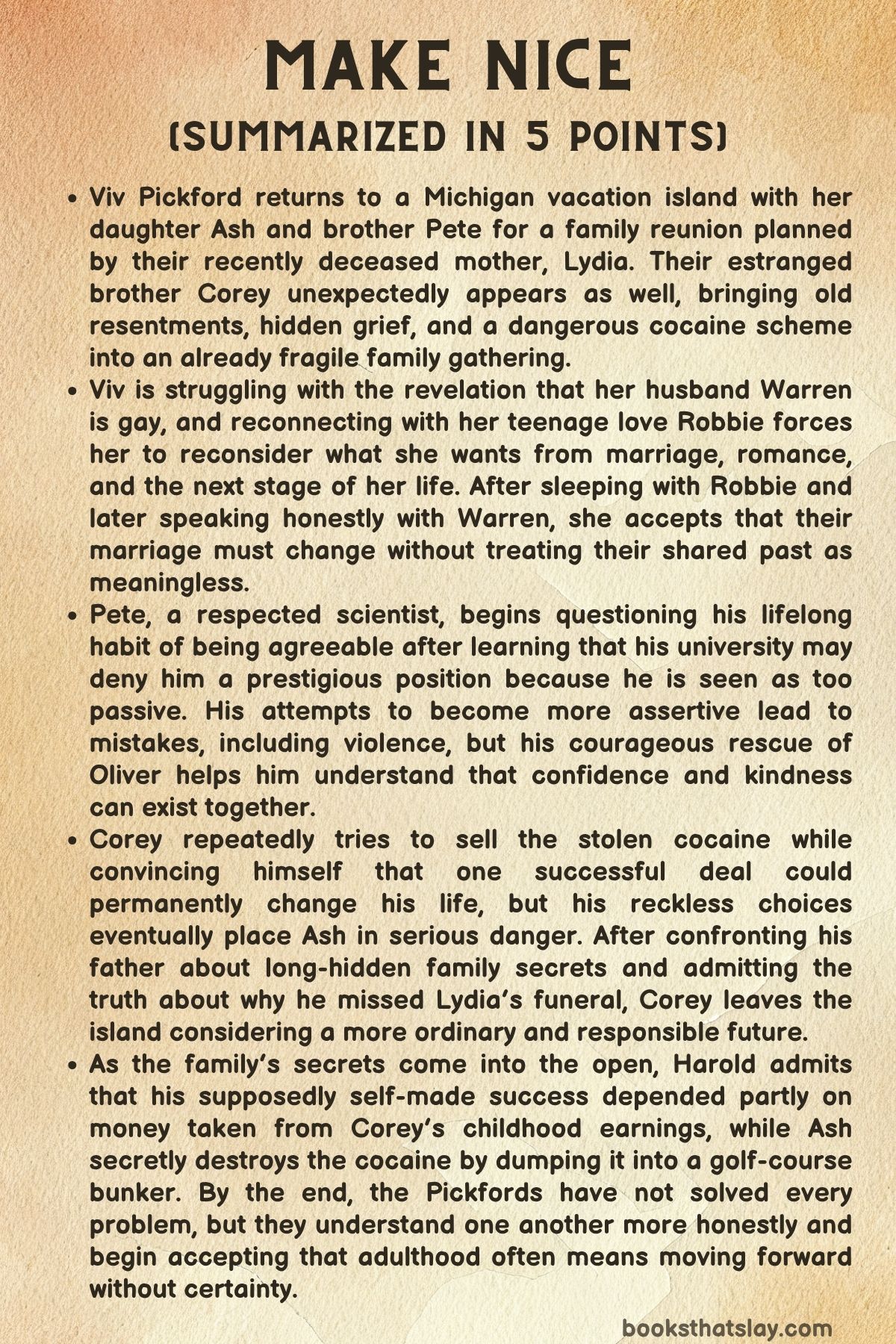
Summary
Viv Pickford arrives on a Michigan vacation island with her teenage daughter, Ash, and her younger brother Pete. The family once spent every summer there until their parents abruptly sold their cottage, and their mother Lydia had planned this reunion before dying unexpectedly three months earlier.
Viv is already emotionally overwhelmed. Her husband Warren has recently told her that he is gay, leaving her uncertain whether their marriage has a future, but she has not yet explained the situation to the rest of the family.
The reunion becomes more difficult when Viv and Pete discover that their estranged brother Corey has also arrived. Corey has spent years borrowing money, pursuing failed schemes, disappearing for long periods, and disappointing his family, and he even failed to attend Lydia’s funeral.
Corey tells his siblings that he missed the funeral because he was in jail for financial crimes. He claims incarceration changed him and says he wants to become a functional adult, but this apparent confession is another lie.
In reality, Corey has brought a large quantity of cocaine to the island. He and his roommate Andrew stole the drugs after finding them in a messenger bag taken from another man, and Corey then took the package from Andrew and fled, hoping to sell it to wealthy tourists at the Grand Hotel.
Pete, meanwhile, is dealing with a quieter crisis. A respected scientist specializing in gastropods, he believes he is close to receiving a prestigious endowed university chair, an achievement he hopes will finally earn the admiration of his father, Harold.
Pete has also discovered a new freshwater snail species and named it after Lydia. He carries a preserved specimen in a glass orb, intending it as a memorial gift for Harold, but his father’s reaction is far less meaningful than Pete had hoped.
Pete soon learns that the university is considering a famous science documentarian for the position he expected to receive. Even worse, an administrator who had encouraged Pete to apply is actively supporting the celebrity candidate, partly because colleagues see Pete as too accommodating and unassertive to be a leader.
For the first time, Pete begins to resent the personality he has spent his life building. Being considerate, helpful, and agreeable once seemed virtuous, but he starts wondering whether his constant desire to avoid displeasing others has made him invisible.
While researching an unusual theory about invasive snails entering the United States through imported marble, Pete meets Oliver, an eight-year-old boy living in the house built on the site of the Pickfords’ former cottage. Oliver has become attached to an invasive snail, and Pete initially insists on taking and killing it despite the boy’s distress.
Oliver’s mother, Rebecca, challenges Pete’s rigid insistence on being scientifically correct. When Pete later returns, he treats Oliver with greater patience and invites him to help collect specimens, creating an unexpected friendship between them.
Pete also becomes close to Rebecca, whose husband Curtis is largely absent. Rebecca recognizes Pete’s unusual ability to communicate with Oliver and sees qualities in him that his professional world has treated as weaknesses.
Their connection becomes romantic, and Pete eventually sleeps with Rebecca. The next morning Curtis unexpectedly arrives, attacks Pete, and triggers a violent fight in which Pete goes far beyond defending himself.
Oliver witnesses Pete beating his father and becomes terrified. Pete leaves ashamed, realizing that rejecting passivity does not mean surrendering to aggression.
Viv is undergoing a transformation of her own. During a yoga class, grief over Lydia finally overwhelms her, and soon afterward she encounters Robbie Coleman, the boy with whom she had her first sexual experience during the family’s final summer on the island.
Robbie represents a part of Viv’s life that never had a proper ending. He tells her that after she suddenly disappeared from the island, he wrote her letters that never reached her because the Pickfords had already sold their cottage.
Their renewed attraction grows quickly. Viv tells Warren that he should explore his sexuality rather than remain trapped in uncertainty, removes her wedding ring, and eventually sleeps with Robbie.
The encounter is important to her, but it does not provide a simple new future. Viv later learns that Robbie has dated or slept with other women around the hotel, forcing her to recognize that she had turned their reunion into a romantic destiny that Robbie never promised.
Warren eventually comes to the island. Viv tells him about Robbie, and although he is hurt, they both acknowledge that their marriage cannot continue in its previous form.
Their conversation also confirms that their years together were not false simply because Warren now understands his sexuality differently. Their marriage contained real companionship and love, even if its romantic structure must end.
Ash observes far more than the adults realize. She already knows about Warren’s sexuality after finding evidence in the family internet history, and rather than feeling destroyed by the discovery, she finds some comfort in knowing that adults can remain uncertain about themselves.
Ash also becomes close to Corey after he treats her opinions seriously and defends her during an argument with Harold. Corey tells her that they are alike because both are outsiders, and Ash begins seeing him less as the irresponsible uncle described by her mother and more as someone who understands her.
That trust becomes dangerous when Ash notices Andrew secretly watching Corey. Corey asks her to keep the matter private without telling her the truth about the drugs.
Later, Ash accidentally enters Corey’s hotel room and overhears Corey and Andrew discussing the cocaine, police, prison, and a potential buyer. She finally understands that Corey has involved the family in something genuinely dangerous.
Corey repeatedly attempts to sell the drugs, but his plans fail because the enormous quantity frightens potential buyers. Even when he receives a serious offer, he rejects it because he wants a spectacular profit rather than a smaller escape.
At the same time, Corey briefly begins imagining a more ordinary future. The Grand Hotel’s culture of hospitality appeals to his natural ability to talk to people, and he considers finding steady work instead of depending on schemes.
The family’s old stories also begin collapsing. Harold has always portrayed himself as a self-made businessman who succeeded through discipline and hard work, but Viv learns that he sold the family cottage because he needed money to launch his company.
Pete later discovers something worse. Harold had faced a legal dispute involving intellectual property, suggesting that the foundation of his success was far less clean than his moral lectures implied.
Corey uncovers the deepest part of the secret. Money he earned as a child actor had been used by Harold during the creation of the business, and Lydia’s later financial support of Corey was partly her attempt to repay what had been taken from him.
Corey confronts Harold and refuses renewed payments. Instead, he demands that his father admit the truth to Viv and Pete and stop presenting Lydia as the parent responsible for Corey’s failures.
Meanwhile, Andrew discovers that the cocaine has disappeared and assumes Ash took it after seeing her in Corey’s room. He forces her back into the hotel room and prevents her from calling for help.
Viv and Warren hear part of Ash’s cry on voicemail, track her phone, and rush to the room. Warren breaks through the door and overpowers Andrew, while Viv learns that Corey was never imprisoned at all.
At nearly the same time, Pete learns that Oliver has disappeared. Although Rebecca warns him that Curtis has reported the earlier fight to police, Pete immediately goes to help.
Pete finds Oliver drifting away from shore in a rowboat. He swims into the cold, rough lake and reaches the child, but Oliver refuses to return because he is still frightened by what he saw Pete do to Curtis.
Instead of commanding him, Pete admits the truth. He explains that he defended himself but also acknowledges that the violence went too far, and he patiently persuades Oliver to help guide the boat back.
The rescue changes Pete’s understanding of courage. Being decisive does not require domination, anger, or recognition; it can mean acting without hesitation because another person genuinely needs help.
Viv later forces Corey to tell her everything. Corey finally admits that he skipped Lydia’s funeral not because he was in jail but because he could not emotionally face losing the person he believed cared about him most.
Viv does not excuse the danger he created, especially after Ash was threatened, but she sees his grief more clearly. Corey then disappears from the island before the final family dinner.
At dinner, Harold admits that he took Corey’s money and allowed Lydia to shoulder the blame for supporting him. His confession damages the family myth of absolute self-reliance but also allows him to become more human in the eyes of his children.
The missing cocaine has one final surprise attached to it. Ash secretly removed the package and emptied it into the white sand of the island golf course, taking direct action after becoming tired of adults assuming she did not understand what was happening.
Corey leaves the island on a bus without a clear destination. For once, he no longer believes that a brilliant shortcut will save him, and he begins considering the possibility that adulthood may simply require finding ordinary work and continuing to show up.
Pete also remains behind briefly. He intends to throw the glass orb containing the snail named after Lydia into the lake, abandoning both the memorial and his need for Harold’s approval.
Before he can do so, Rebecca finds him. She tells Pete that he is a good man and responds with genuine fascination when he explains the scientific importance of the specimen.
Instead of watching Pete discard it, Rebecca asks if she can keep it. The gesture gives the object a new meaning: Pete no longer needs recognition from the person who failed to provide it, because someone else genuinely understands its value.
Characters
Viv Pickford
Viv is one of the central emotional figures in Make Nice, and her conflict comes from discovering that a life can be both genuine and no longer sustainable. Warren’s revelation about his sexuality does not simply threaten her marriage; it forces her to reconsider years of intimacy, motherhood, habit, loyalty, and the assumptions she once treated as permanent.
Her return to the island intensifies that instability because the place represents a version of herself that existed before marriage and adult responsibility. Robbie therefore appeals to more than desire: he represents an unfinished possibility, and reconnecting with him allows Viv to imagine that another version of her life might still exist.
Her mistake is not sleeping with Robbie so much as briefly expecting the encounter to provide a complete answer. When she realizes that Robbie has lived an independent romantic life and cannot tell her what their reunion is supposed to become, Viv has to accept that freedom does not arrive with instructions.
Viv also has a complicated relationship with Corey. Her anger toward him is justified by years of dishonesty, yet her insistence that he face consequences sometimes hides the grief she feels over having effectively lost a brother long before Lydia died.
By the end, Viv becomes more comfortable with uncertainty. Her marriage is ending, Corey may disappear again, and her family history has been altered by new truths, but she no longer treats the absence of certainty as proof that everything has failed.
Pete Pickford
Pete’s central struggle concerns the difference between kindness and submission. He has built his identity around being useful, agreeable, patient, and nonthreatening, but losing the university chair makes him suspect that other people value him precisely because he rarely demands anything from them.
His professional disappointment exposes how much approval matters to him. The chair is not merely a promotion; it represents recognition from colleagues and, at a deeper level, the paternal approval he has sought since childhood.
Pete initially responds to this crisis badly. He destroys the Carthusian snail in anger, pursues a relationship with a married woman, and fights Curtis with a level of violence that reveals how much resentment he has suppressed.
Yet the novel does not argue that Pete must become harder or crueler. His finest qualities emerge when he listens to Oliver, respects the boy’s unusual way of communicating, and risks himself to rescue him from the lake.
Pete’s development therefore moves toward integration rather than rejection. He does not need to stop being gentle; he needs to stop confusing gentleness with fear, and he must learn that confidence can exist alongside compassion.
Corey Pickford
Corey is perhaps the most contradictory character in Make Nice. He is dishonest, impulsive, manipulative, funny, perceptive, affectionate, reckless, emotionally observant, and capable of understanding other people far better than he understands the consequences of his own choices.
His cocaine scheme reflects his lifelong attraction to shortcuts. Corey does not simply want money; he wants a dramatic transformation that will erase his failures and allow him to become someone impressive without enduring the slow process of rebuilding his life.
His charm is both a gift and a defense mechanism. He can read strangers quickly, create identities on command, and make people feel interesting, but those same talents allow him to avoid accountability whenever honesty becomes uncomfortable.
His relationship with Lydia complicates the family’s view of him. Although he benefited from her money, their bond was not merely financial, because Corey recognized loneliness and restlessness in his mother that the others often missed.
His treatment of Ash reveals the ethical weakness inside his affection. Corey genuinely likes and respects her, but he also asks a teenager to protect his secrets, allowing his desire for loyalty to place her directly in danger.
The confrontation with Harold is one of Corey’s strongest moments because he refuses money and asks only for truth. His final departure suggests a small but meaningful change: for perhaps the first time, he considers building a life through ordinary persistence rather than waiting for a spectacular escape.
Ash Pickford
Ash is observant, sarcastic, politically aware, emotionally guarded, and much less naive than the adults around her assume. Her childhood injury, which left her watching other children play while she remained physically separated from them, shaped her lasting sense of being outside ordinary social life.
She has converted that old loneliness into a belief that she prefers isolation. Her detachment protects her from rejection, but it also prevents her from admitting when she wants connection or needs help.
Ash is attracted to Corey because he treats her as intellectually significant. When he tells her that they are similar outsiders, he provides a form of recognition that she rarely receives from adults.
Her anger after discovering the cocaine therefore comes partly from betrayal. Corey has not only lied to her; he has used the intimacy of their connection to secure her silence.
Her decision to destroy the cocaine is reckless but revealing. It is an attempt to take control in a family where adults constantly conceal information while assuming children cannot understand serious problems.
By the end, Ash remains uncertain about her parents’ separation and her family’s future. Her growth lies less in achieving clarity than in accepting that she can respond actively to uncertainty instead of observing everything from an emotional distance.
Harold Pickford
Harold presents himself as the guardian of discipline, hard work, and self-reliance. His pride in the family’s immigrant history and his criticism of Corey depend on the belief that responsible adults succeed by controlling themselves and accepting consequences.
The revelations about his business undermine that identity. Harold used Corey’s childhood earnings, concealed the circumstances surrounding his company’s creation, and allowed Lydia to appear solely responsible for financially supporting their troubled son.
His flaw is therefore not simply hypocrisy but self-deception. Harold has spent years reducing complicated family events into a moral story in which he represents discipline and other people represent weakness.
His eventual confession matters because he stops protecting that story. Admitting that he lacked control, made questionable decisions, and failed Lydia and Corey allows him to become a father rather than a symbol of judgment.
Lydia Pickford
Although Lydia dies before the present-day action begins, her presence shapes nearly every major relationship in the story. The reunion exists because she planned it, and the siblings’ understanding of themselves is inseparable from their memories of her.
Lydia appears to have recognized emotional needs that Harold often interpreted as weakness. Her relationship with Corey was especially complicated because she gave him money but also shared with him a sense of internal restlessness and loneliness.
The later revelation that her financial support was partly an attempt to repay money taken from Corey changes her moral position within the family. What Harold called enabling becomes connected to guilt, loyalty, restitution, and maternal responsibility.
Her influence on Pete is quieter but equally important. She reassured him that he would be fine, though even that reassurance carried the implication that his unusual personality required special concern.
Lydia ultimately represents the limits of family knowledge. Each person remembers a different version of her, and none possesses the complete truth of who she was.
Warren
Warren is important because his revelation changes Viv’s life without turning him into a villain. His sexuality forces both of them to confront a truth that neither fully understood when they married.
The memories of their first meeting make clear that their relationship contained authentic affection. Their marriage cannot simply be dismissed as deception because companionship, attraction, shared humor, and family life were genuinely meaningful to both of them.
Warren also demonstrates his commitment as a father when Ash is threatened. His immediate response to her danger strips away his usually controlled manner and confirms that whatever happens between him and Viv, his relationship with Ash remains central.
His future remains uncertain, which suits the larger argument of the story. Understanding something true about himself does not instantly tell him what kind of life he should build next.
Robbie Coleman
Robbie initially functions as Viv’s connection to an idealized past. Because their youthful relationship ended suddenly rather than deteriorating naturally, Viv has preserved him as a symbol of emotional intensity and unrealized possibility.
As an adult, Robbie complicates that fantasy. He genuinely remembers Viv, values their history, and still desires her, but he has also lived a full life that did not stop when she left the island.
His refusal to accept Viv’s assumptions is important. Robbie does not promise destiny, and he challenges her to acknowledge what she actually wants instead of allowing nostalgia to make decisions for her.
Rebecca
Rebecca is initially introduced through Pete’s conflict with Oliver, but she quickly becomes a significant challenge to Pete’s understanding of himself. She sees his patience and scientific curiosity not as signs of weakness but as qualities that allow him to connect with her son.
Her marriage to Curtis appears strained before Pete enters her life. Her attraction to Pete grows partly from the relief of encountering an adult who understands Oliver without treating him as a burden.
Rebecca is also morally complicated. Her relationship with Pete begins before her marriage has formally ended, and the consequences of that choice become painful for everyone, especially Oliver.
Still, she plays an important role in Pete’s development because she values precisely the qualities he has begun to despise in himself. Her final request for Lydia’s preserved snail offers recognition without Pete having to demand it.
Oliver
Oliver is one of the characters through whom Pete learns the most about honesty. Unlike Pete, Oliver does not hide distress to make other people comfortable; his emotions appear immediately and intensely.
His attachment to the snail initially exposes Pete’s excessive commitment to correctness. Pete has sound ecological reasons for removing the invasive animal, but Oliver forces him to confront the human cost of treating every situation as a technical problem.
Oliver later becomes a mirror for Pete’s younger self. Both are unusual, intensely interested in specific subjects, and at risk of feeling excluded from ordinary social life.
The lake rescue becomes meaningful because Pete does not simply save Oliver physically. He tells him that a lonely, strange child can grow into an adult life filled with purpose, effectively speaking to both Oliver and his younger self.
Andrew
Andrew is both Corey’s accomplice and a warning about the consequences Corey prefers not to see. He participates in the original theft, yet he understands more clearly than Corey that the missing cocaine could result in serious violence.
His fear gradually becomes desperation. When the package disappears, Andrew becomes convinced that Ash stole it and allows panic to justify threatening a teenager.
He is therefore not merely an innocent victim of Corey’s schemes. Andrew makes his own criminal choices, but unlike Corey, he lacks the charisma and imaginative confidence that allow danger to look temporarily manageable.
Curtis
Curtis is defined largely through absence before becoming physically present. His failure to arrive for Oliver’s birthday contributes to the child’s distress and increases Rebecca’s exhaustion and resentment.
When he finally appears and discovers Pete in Rebecca’s bed, his anger is understandable even though his immediate violence escalates the situation. His attack gives Pete an opportunity to defend himself, but Pete’s excessive response shifts the moral balance.
Curtis ultimately helps reveal one of Pete’s hardest lessons: a person can be wronged and still behave wrongly in response.
Rachel
Rachel functions as Pete’s connection to the professional world he temporarily leaves behind. She is the person who informs him that the prestigious university position he expected is no longer secure.
Her role is important because she communicates the institutional judgment Pete fears most: his colleagues respect his intelligence but do not necessarily see him as someone with authority. Through Rachel, professional disappointment becomes personal self-doubt.
Dave Campbell
Dave Campbell represents institutional approval and its instability. His early encouragement leads Pete to believe that the endowed chair is almost his, which makes Campbell’s later support for the celebrity candidate especially painful.
Pete interprets the reversal as evidence that professional institutions can praise reliability while rewarding visibility, prestige, and force of personality. Campbell therefore becomes associated with the gap between being valued as a worker and being recognized as a leader.
Dixon
Dixon is a relatively minor character, but his encounter with Corey provides an important reality check. Corey sees a marijuana joint and immediately constructs an elaborate theory that Dixon might become his connection to the cocaine market.
Dixon’s response exposes the absurdity of that assumption. His refusal reminds Corey that other people do not automatically share his willingness to turn every coincidence into a risky opportunity.
Jane
Jane, the yoga instructor, contributes to Viv’s emotional reassessment of Robbie. Her comments reveal that Robbie has been involved with other women and destroy Viv’s temporary belief that their reunion exists outside ordinary adult romantic history.
Jane therefore serves as a corrective to nostalgia. Through her, Viv is forced to distinguish what actually happened with Robbie from the larger romantic meaning she created around it.
Mr. Depcik
Mr. Depcik appears in Pete’s childhood memories as the science teacher who helps redirect his search for meaning. When Pete struggles with religious ideas about forgiveness and certainty, Mr. Depcik encourages curiosity rather than providing easy answers.
His influence helps explain why science becomes central to Pete’s identity. He teaches Pete that imperfect observation can still be valuable if approached carefully, establishing an intellectual ethic that Pete carries into adulthood.
Cindy
Cindy has a limited role, appearing mainly in Viv’s memories of adolescence. Her presence helps place Viv’s youthful attraction to Robbie within the ordinary social world of teenage friendship, curiosity, and romantic excitement.
Because Cindy belongs almost entirely to memory, she also contributes to the contrast between the island as Viv remembers it and the far more complicated place she encounters as an adult.
Themes
Kindness, Niceness, and the Need for Self-Respect
The distinction between genuine kindness and compulsive agreeableness gives Make Nice much of its moral structure. Pete has spent his life assuming that a good person minimizes conflict, makes other people comfortable, works hard, accepts disappointment politely, and avoids imposing his own needs.
His professional crisis forces him to see the cost of that approach. Colleagues appreciate his reliability but interpret his hesitancy as a lack of leadership, leaving Pete furious that the behavior he believed made him admirable may also have prevented others from taking him seriously.
His first response is to reject niceness almost completely. He destroys a snail in anger, enters a morally uncertain relationship, and turns a defensive fight into an eruption of long-suppressed rage.
None of these acts gives him the self-respect he wants. Instead, they demonstrate that the opposite of passivity is not cruelty, recklessness, or violence.
Pete’s rescue of Oliver offers a healthier model. He acts decisively, takes enormous physical risk, speaks honestly, and refuses to wait for praise or permission, yet his actions remain rooted in care for another person.
The story therefore separates kindness from fear. Pete does not need to stop being good to become stronger; he needs to understand that consideration has value only when it is chosen freely rather than used as a strategy for earning approval.
Family Myths, Secrecy, and Partial Truth
The Pickford family survives partly through stories its members have repeated until those stories appear to be facts. Harold is the disciplined self-made businessman, Lydia is the overly indulgent mother, Corey is the irresponsible failure, Pete is the harmless good son, and Viv is the competent adult whose family life appears stable.
One by one, those identities become less secure. Harold’s company was built under morally questionable circumstances, Corey’s childhood money helped finance it, and Lydia’s support of Corey was connected to restitution rather than simple indulgence.
Viv and Warren’s marriage contains another form of concealed truth. Ash knows more about Warren’s sexuality than her parents realize, demonstrating that withholding information does not necessarily protect children from reality.
Corey’s invented jail story creates an even more direct example. He offers the family what appears to be a confession, but even his performance of honesty is constructed from another lie.
The book does not suggest that families can or should communicate every private thought. Instead, it shows how dangerous secrecy becomes when it hardens into a false moral structure.
Truth changes relationships because it changes the stories through which people judge one another. Harold’s confession matters not because it repairs every injury, but because it removes the false position from which he has spent years condemning others.
Identity, Reinvention, and the Limits of Starting Over
Nearly every major character arrives on the island wanting some form of reinvention. Viv imagines a life beyond her marriage, Pete experiments with becoming more forceful, Corey wants one profitable scheme to transform him into a successful adult, and Ash tests an identity built around independence and detachment.
The island initially seems suited to reinvention because it belongs to the family’s past. Returning allows the characters to compare who they once were with the adults they have become.
Yet none of them can simply choose a new identity and discard the old one. Viv’s encounter with Robbie cannot recreate adolescence, Pete cannot become confident merely by rejecting kindness, and Corey cannot turn himself into a responsible adult through one dramatic financial success.
Even Ash discovers that being the clever outsider does not make her invulnerable. When Andrew traps her, the self-sufficient identity she has cultivated reaches its limit and she has to call for help.
Change becomes possible only when the characters stop treating reinvention as replacement. Warren’s sexuality does not erase the reality of his marriage, Pete’s assertiveness need not erase his gentleness, and Corey’s future does not require him to stop being charismatic or imaginative.
Maturity comes from building differently with the person one already is rather than waiting to become someone entirely new.
Grief, Memory, and Letting the Past Change
Lydia’s death brings the family back to the island, but grief is not limited to mourning her. Each character is also grieving an earlier version of family life, a vanished landscape, an old relationship, or an identity that no longer fits.
The physical island constantly challenges memory. The Pickford cottage is gone, Corey’s childhood landmarks have disappeared, and places that once seemed private or magical have been replaced, renovated, or absorbed into a wealthier environment.
Viv’s relationship with Robbie demonstrates how memory can preserve an experience by preventing it from developing. Because their teenage romance ended abruptly, Viv has been able to remember it without the ordinary disappointments that might have followed.
Pete’s preserved snail performs a similar function in relation to Lydia. He turns scientific discovery into a permanent memorial, hoping the object will contain both his love for his mother and the recognition he wants from Harold.
The ending changes the meaning of that memorial. Pete is prepared to throw it into the lake because he believes letting go requires destruction, but Rebecca’s interest offers another possibility.
The past does not have to be discarded or preserved unchanged. Memory can acquire new meaning when it is carried into relationships where it is genuinely understood, allowing grief to remain part of life without becoming a demand to return to what no longer exists.