Sight Unseen Summary, Characters and Themes
Sight Unseen by Alexis Marie is a fantasy mystery about survival, cursed magic, buried guilt, and the hard work of rebuilding trust after trauma. The story follows Veda Thorne, a Mage at Weston Academy who is slowly being killed by a blood curse tied to an old murder.
When a silent young Seer named Antaris arrives at the school after his mother’s death, Veda is drawn back into the case of the Botanist, a killer who targets Seers through forbidden magic. As Veda, Antaris, and his father Hiram uncover the truth, they face a threat rooted in revenge, stolen identity, and a past that refuses to stay hidden.
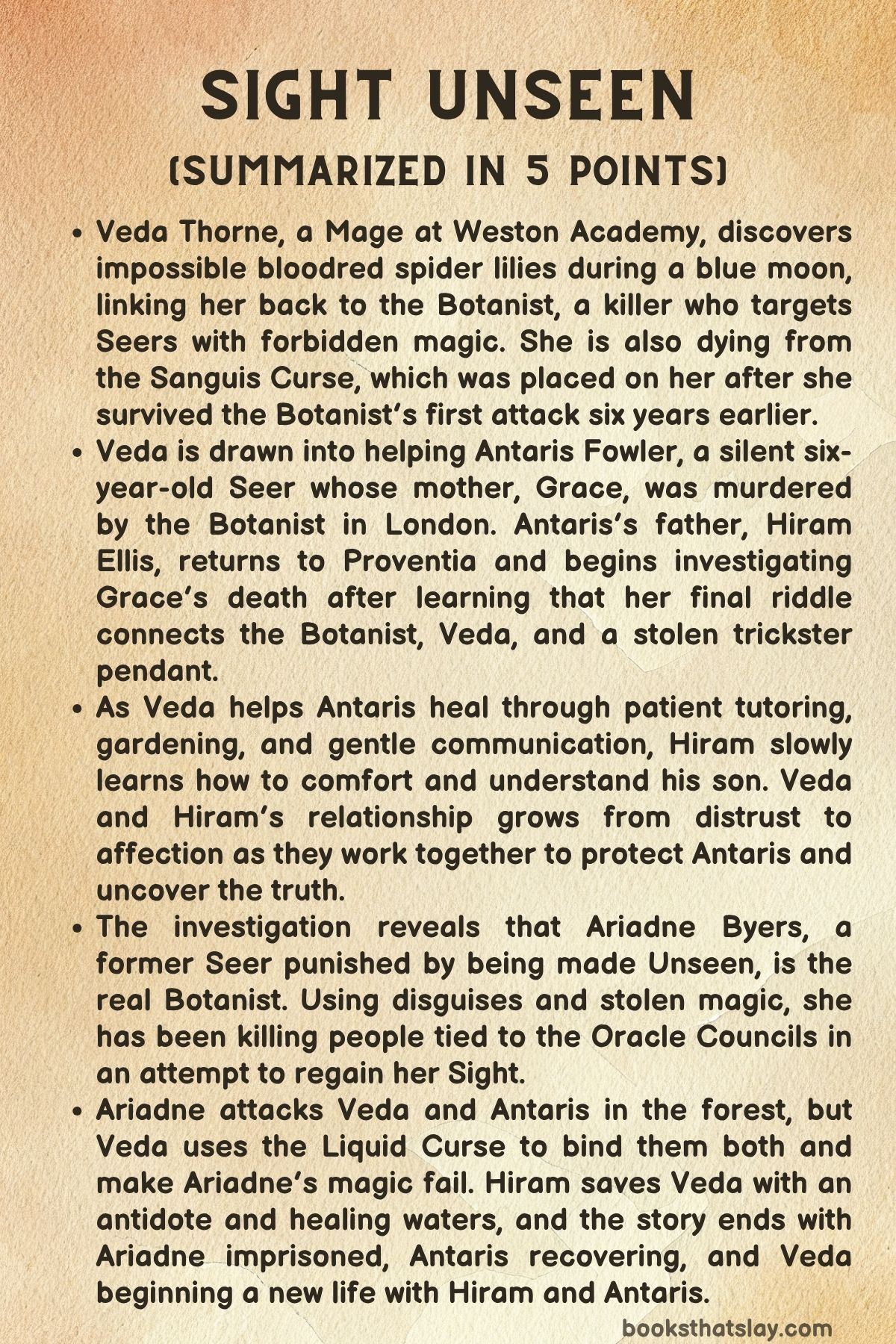
Summary
Veda Thorne is a Mage working at Weston Academy, a school built to educate Seers and Mages together in a world still shaped by old fears and prejudices. Her life is already marked by pain and secrecy.
Six years earlier, she survived an attack connected to the Botanist, a serial killer who murders Seers using forbidden Omnipotent magic. Surviving did not mean escaping.
Veda was left with the Sanguis Curse, a deadly blood curse that has been eating away at her body ever since. She lives with the knowledge that time is running out, even as she tries to keep doing her work and avoid becoming too attached to anyone.
The past returns when Veda discovers bloodred spider lilies blooming in the Washington forest during a blue moon. The flowers should not be there, and their appearance signals something deeply wrong.
They are tied to the Botanist’s killings, and their return suggests the murderer is active again. Peter Weston, Veda’s friend and the head of the academy, soon asks her to help with a new student named Antaris Fowler.
Antaris is six years old, a Seer, and has stopped speaking after the death of his mother, Grace Fowler, in London.
Antaris is now living with his father, Hiram Ellis, a powerful lawyer from a Mage family known for its prejudice against Seers. Hiram has returned to Proventia with several hopes at once: to raise his son, buy a home, and repair his strained relationship with his parents, Barrett and Simran.
He is still grieving Grace and trying to understand how to be present for a child who has lost so much. At first, he believes Grace died during a burglary, but investigators Gabriel Sallant and Francisco Padillo tell him the truth is worse.
Grace was killed by the Botanist.
Before her death, Grace left behind a strange riddle. It refers to a dying star, the sun, the moon, the earth, and a lost trickster pendant that can disguise whoever wears it.
Hiram does not want the investigators questioning Antaris, fearing it will harm his son further. Still, he cannot ignore the clues.
As he looks deeper, he realizes Grace’s murder, Veda’s curse, and the Botanist case are connected.
Veda begins working with Antaris at the academy. Their bond grows slowly and quietly.
She does not force him to speak or behave as others expect. Instead, she meets him where he is.
Their tutoring sessions include gardening, simple routines, food lists, and patient forms of communication. Antaris responds to her steadiness.
Hiram also begins to reach his son through notes, sign language, and comfort during the magical nightmares that disturb Antaris at night. Father and son are both learning how to live with grief, and Veda becomes part of that fragile healing process.
Veda and Hiram cross paths more often as the investigation develops. Their early interactions carry suspicion and tension, especially because both are protective of Antaris and both have reasons to distrust others.
One important meeting happens at Nénuphar, a healing cave with powerful waters. There, Hiram has Veda’s unique amulet tattooed on his arm after a Seer’s vision points him toward it.
The tattoo links him more closely to the mystery and to Veda herself. Over time, distrust gives way to respect, then affection.
Hiram sees Veda’s courage and gentleness with Antaris, while Veda begins to see Hiram as more than a privileged lawyer from a difficult family.
The clues surrounding the Botanist become more dangerous. Dr. Everett Simpson reveals that he knows about Veda’s Sanguis Curse.
He is also under a curse that drives him toward madness if he speaks certain truths. Before he disappears, he gives cryptic warnings: the sheep is a wolf, and the trickster flies.
Gabriel and Francisco discover that the Botanist’s victims were connected to Oracle Councils, suggesting the killings are not random. Hiram finds an old rare book about Sanguis magic and begins uncovering a hidden link to a woman named Ariadne Byers.
Ruth eventually explains Ariadne’s history. Ariadne was a Seer rescued from an abusive school, but the damage done to her shaped her choices.
She became obsessed with forbidden magic and caused the Great Vanishing, a terrible event that changed many lives. As punishment, she was made Unseen, stripped of the Sight that defined her.
But Ariadne survived. She stole the trickster pendant and used it to disguise herself as other people, including Seren, Marlene, and Everett.
Under these borrowed faces, she moved through the lives of her victims, killing members of the Oracle Councils in an attempt to regain Sight.
Ariadne’s danger lies not only in her magic but in her ability to hide in plain view. She has spent years manipulating people, wearing trusted faces, and turning the past into a weapon.
As her stolen magic begins to fail, she becomes more desperate. She attacks people tied to her history, threatens Hiram’s family, and keeps pushing toward the power she believes was taken from her.
Veda learns that her own curse may be the key to stopping Ariadne. Ariadne’s blood is inside her because of the Sanguis Curse, and that connection can be used against the killer.
The group forms a plan to trap Ariadne using the trickster pendant. Khadijah disguises herself as Veda in the hope of drawing Ariadne out.
But Ariadne is too cunning and stays ahead of them. She attacks Veda’s cottage, steals Khadijah’s Sight, and forces Veda and Antaris to flee into the forest.
Veda’s first thought is Antaris’s safety. She hides him and prepares to face Ariadne, knowing that her weakened body may not survive the fight.
In the forest, Veda confronts the killer who has shaped so much of her suffering. She uses the Liquid Curse to bind herself and Ariadne together, forcing Ariadne’s magic to fail.
The act is dangerous and nearly fatal. The Sanguis Curse erupts from Veda’s body, tearing through her and leaving her close to death.
Ariadne is stopped, but Veda pays a severe price.
Hiram, Gabriel, and Francisco find Antaris first, then search for Veda. Hiram tracks her through one of his enchanted notes, a small sign of the bond they have built.
When he finds her, he gives her an antidote and carries her to Nénuphar. The healing waters draw the curse from her body and save her life.
Veda wakes three weeks later in the hospital. The immediate danger has passed, though not without loss.
Ariadne has survived, but she is imprisoned and cursed, waiting for the end of her block. Khadijah is alive, but she has been made Unseen, leaving the group with another wound to face.
Veda reunites with Hiram and Antaris, no longer bound to the ruined cottage or the curse that had defined her future.
In the months that follow, life begins to change. Hiram opens his own practice and continues building a better home for Antaris.
Simran, his mother, starts trying to change after years of prejudice and distance. Antaris continues healing, supported by the adults who have chosen patience over pressure.
Veda also begins again, not as someone waiting to die, but as someone learning to live.
The story ends with Veda and Antaris releasing a lantern together. The act becomes a quiet farewell to the fear, grief, and pain they have carried.
It does not erase what happened, but it marks a choice to keep going. Sight Unseen closes on survival, family, and the possibility of peace after years of being hunted by the past.
Characters
Veda Thorne
Veda Thorne is the emotional center of the book because her personal suffering is directly tied to the larger mystery surrounding the Botanist. She is a Mage working at Weston Academy, but her role extends far beyond teaching or helping students.
She carries the Sanguis Curse, which makes her life feel fragile and limited, yet she continues to act with patience, courage, and compassion. Her illness gives her character a quiet sadness, but it does not make her passive.
Instead, Veda becomes someone who understands fear deeply and still chooses to protect others, especially Antaris.
Veda’s bond with Antaris reveals one of the most tender sides of her character. She does not force him to speak or heal quickly; instead, she reaches him through small, careful acts of trust.
Gardening, food lists, tutoring, and patient communication become ways for her to give Antaris safety after trauma. This shows that Veda’s strength is not only magical or physical, but emotional.
She knows what it means to survive something terrible, so she instinctively understands that healing must happen slowly.
Her relationship with Hiram develops through suspicion, shared danger, and emotional recognition. At first, she is guarded, partly because of her curse and partly because the Botanist case has made trust dangerous.
Over time, however, Hiram’s devotion to Antaris and his willingness to face painful truths allow Veda to see him differently. Their affection feels meaningful because it is not built on instant romance, but on mutual protection, vulnerability, and shared responsibility.
By the end of the book, Veda becomes a figure of sacrifice and rebirth. Her confrontation with Ariadne is not only a battle against the killer but also a battle against the curse that has shaped her life for six years.
When she uses the Liquid Curse to bind herself to Ariadne, she accepts extreme danger in order to save Antaris and stop the murders. Her survival at Nénuphar allows her to move beyond the identity of someone who is dying.
She begins a new life not because her pain disappears, but because she finally has the chance to live without being ruled by fear.
Hiram Ellis
Hiram Ellis is one of the most layered characters in the story because he is both powerful and emotionally fractured. As a lawyer from a prejudiced Mage family, he carries the weight of privilege, family expectation, and personal regret.
His return to Proventia is not simply a change of location; it is an attempt to become the father Antaris needs and to confront the family wounds he has avoided. Hiram’s character is shaped by tension between the world he comes from and the person he wants to become.
His relationship with Antaris is central to his development. At the beginning, Hiram is grieving Grace’s death while also trying to understand a silent, traumatized child who has lost his mother.
His early protectiveness can make him resistant, especially when investigators want to question Antaris, but this resistance comes from fear rather than cruelty. As the story progresses, Hiram learns to meet Antaris where he is.
Notes, sign language, and nightly comfort during magical nightmares show Hiram becoming more patient, emotionally available, and responsible.
Hiram’s investigation into Grace’s death also reveals his intelligence and determination. He refuses to accept easy explanations once he understands that Grace’s murder connects to Veda, the Botanist, and forbidden magic.
His legal mind helps him follow clues, but his emotional involvement makes the case personal. He is not simply seeking justice for Grace; he is trying to protect his son, understand the truth of his past, and prevent further harm.
His romance with Veda brings out his vulnerability. Hiram is drawn to her strength, but he also sees her fear, pain, and loneliness.
The tattoo of Veda’s amulet becomes a symbol of the strange magical connection between them, but the deeper connection grows through trust and action. By saving Veda with the antidote and carrying her to Nénuphar, Hiram proves that his love is not passive.
His ending, with his own practice and a more stable family life, shows that he has moved toward independence, healing, and emotional maturity.
Antaris Fowler
Antaris Fowler is one of the most vulnerable and important characters in the book. As a six-year-old who has recently lost his mother, he represents the emotional cost of the Botanist’s violence.
His silence is not treated as a simple mystery to solve, but as a response to grief, trauma, and fear. Through Antaris, the story explores how children process loss in ways adults may not immediately understand.
Antaris’s relationship with Veda is deeply significant because she gives him patience without pressure. She does not define him only by what he cannot say.
Instead, she notices his needs, interests, and fears. Their quiet routines allow him to feel seen, and this makes Veda’s protection of him during Ariadne’s attack especially powerful.
Antaris is not merely a child caught in danger; he becomes someone whose trust must be earned and whose safety motivates the choices of the adults around him.
His bond with Hiram is equally important. Hiram’s efforts to communicate through notes and sign language show that Antaris helps transform his father.
Their relationship begins under the shadow of Grace’s death, but it slowly becomes warmer and more secure. Antaris’s magical nightmares reveal the depth of his trauma, while Hiram’s nightly comfort shows the creation of a more stable father-son bond.
By the epilogue, Antaris’s healing is not shown as sudden or complete, which makes it feel more believable. He has survived terror, grief, and magical danger, but he is also surrounded by people who are committed to helping him recover.
The lantern scene with Veda suggests that Antaris is beginning to release some of the fear that has followed him. His character represents innocence wounded by violence, but also the possibility of recovery through love, patience, and safety.
Ariadne Byers / the Botanist
Ariadne Byers is the central antagonist and one of the most tragic figures in the book. Her crimes are horrifying, but her backstory gives her villainy a painful origin.
As a Seer rescued from an abusive school, Ariadne begins as someone who has suffered deeply. However, her obsession with forbidden magic and her role in causing the Great Vanishing transform her from victim into perpetrator.
Her punishment of being made Unseen becomes the wound that drives her later violence.
As the Botanist, Ariadne represents corruption, obsession, and revenge. Her murders of Seers using forbidden Omnipotent magic are not random acts of cruelty; they are part of her desperate attempt to regain Sight and power.
The bloodred spider lilies connect her crimes to beauty, death, and unnatural magic. This contrast makes her terrifying because she turns something natural and delicate into a sign of murder.
Ariadne’s use of the trickster pendant reveals her manipulative intelligence. By disguising herself as Seren, Marlene, Everett, and others, she becomes a threat that can hide inside familiar faces.
This makes her especially dangerous because she attacks not only bodies but trust itself. Her disguises force the other characters to question what they see, who they know, and whether truth can be recognized before it is too late.
Despite her power, Ariadne is also a character in decline. Her stolen magic begins to fail, and her desperation grows more reckless.
Her connection to Veda through blood makes Veda both a victim and the key to her downfall. In the final confrontation, Ariadne’s obsession collapses against Veda’s willingness to sacrifice herself for Antaris.
Ariadne survives, but imprisonment and curse leave her stripped of the control she spent so long trying to regain.
Grace Fowler
Grace Fowler is absent for most of the story, yet her presence shapes nearly everything that happens. Her death is the event that brings Hiram and Antaris back into the center of the Botanist case.
Although she is no longer alive, Grace remains important through the riddle she leaves behind, the secrets connected to her murder, and the grief carried by her son and Hiram.
Grace’s final riddle shows that she was intelligent, aware, and brave. Her references to the “dying star,” the sun, the moon, the earth, and the trickster pendant suggest that she understood more about the danger around her than others initially realized.
Even in death, she leaves clues that help expose Ariadne’s identity and motives. This makes Grace more than a victim; she becomes a guide whose last act helps the living move toward the truth.
Her role as Antaris’s mother gives her character emotional weight. Antaris’s silence and nightmares show how deeply her loss has affected him.
Hiram’s grief is also tied to unresolved emotions, responsibility, and the difficulty of becoming a single parent after tragedy. Grace’s death therefore serves both the mystery and the emotional development of the characters left behind.
Grace represents love interrupted by violence. The fact that the truth of her death was hidden behind the idea of a burglary makes her murder even more disturbing.
Once the Botanist connection is revealed, Grace becomes part of a much larger pattern of injustice. Her memory motivates Hiram’s investigation and helps push the story toward the final confrontation with Ariadne.
Peter Weston
Peter Weston is an important supporting character because he connects Veda to Weston Academy and to Antaris. As a Seer and the head of the integrated academy, Peter represents a more inclusive vision of magical society.
His school is a place where different magical identities can exist together, which contrasts with the prejudice associated with families like Hiram’s.
Peter’s decision to involve Veda in helping Antaris shows that he understands her compassion and skill. He sees that Antaris needs someone patient and emotionally perceptive, not merely someone powerful.
This trust in Veda helps set much of the emotional plot in motion. Peter’s role is not loud or dramatic, but it is structurally important because he brings together people who need one another.
As a Seer, Peter also belongs to the group targeted by the Botanist, which gives his position a sense of danger. His leadership at the academy places him at the intersection of education, magical politics, and the threat facing Seers.
He helps create a community around Veda and Antaris at a time when isolation would make them more vulnerable.
Peter’s character functions as a stabilizing presence. He is not the central hero, but he helps make heroism possible by recognizing needs, connecting people, and supporting the academy’s values.
Through him, the book shows that institutions can either harm vulnerable people or protect them, depending on who leads them and what values they defend.
Gabriel Sallant
Gabriel Sallant is one of the investigators working to uncover the truth behind Grace Fowler’s death and the Botanist murders. His role gives the mystery a sense of official urgency.
By telling Hiram that Grace was not killed in a burglary, Gabriel helps shift the story from private grief into a larger investigation involving forbidden magic, murdered Seers, and old secrets.
Gabriel’s partnership with Francisco Padillo is important because together they represent persistence and rational inquiry in a world full of disguises and magical deception. They follow connections between victims and Oracle Councils, gradually uncovering the scale of Ariadne’s revenge.
Gabriel’s investigative work helps balance the emotional plot by grounding the danger in evidence and pattern.
Gabriel also becomes important in the final rescue. Alongside Hiram and Francisco, he searches for Antaris and Veda after Ariadne’s attack.
His presence in these moments shows that he is not only an investigator from a distance, but someone willing to enter danger directly. This makes him part of the protective network surrounding the main characters.
As a character, Gabriel represents duty and clarity. In a story where appearances are unreliable and identities can be stolen, his commitment to uncovering the truth matters.
He helps expose the hidden structure beneath the murders and supports the final effort to save Veda and Antaris.
Francisco Padillo
Francisco Padillo works alongside Gabriel Sallant and plays a key role in the investigation into the Botanist. Like Gabriel, he helps reveal that Grace Fowler’s death is part of a wider pattern rather than an isolated crime.
His presence strengthens the sense that the murders are being pursued seriously, even when the truth is difficult to understand.
Francisco’s role is especially important in connecting the victims to Oracle Councils. This discovery shifts the investigation away from individual murders and toward Ariadne’s larger motive.
Through Francisco’s work, the book reveals that the Botanist’s crimes are rooted in history, punishment, and revenge. He helps turn scattered clues into a clearer picture.
His partnership with Gabriel also gives the investigative side of the story stability. While Veda and Hiram are emotionally tied to the case, Francisco and Gabriel provide a more procedural perspective.
This contrast helps the story move between personal stakes and broader magical consequences.
Francisco’s involvement in finding Antaris and Veda near the end shows his loyalty and courage. He is not only a collector of facts; he is part of the rescue effort when the danger becomes immediate.
His character represents persistence, teamwork, and the importance of following the truth even when magic is designed to hide it.
Khadijah
Khadijah is a brave and important supporting character whose role becomes especially significant during the plan to trap Ariadne. By disguising herself as Veda with the trickster pendant, she willingly places herself in danger.
This shows courage and loyalty, because the plan depends on her accepting a dangerous role in order to protect Veda and expose Ariadne.
Her character also reveals the cost of fighting someone as ruthless as Ariadne. The plan does not unfold as intended, and Khadijah pays a terrible price when Ariadne steals her Sight.
This loss is devastating because Sight is not only a magical ability but part of identity, perception, and power. Khadijah’s fate shows that even careful plans can fail when facing someone who thrives on deception.
Khadijah’s survival matters because it prevents her from becoming only another casualty. However, being left Unseen connects her directly to the punishment and suffering that shaped Ariadne’s own transformation.
This parallel is painful because Khadijah becomes marked by the very kind of loss Ariadne once endured, though Khadijah does not respond with the same corruption or cruelty.
Through Khadijah, the book emphasizes sacrifice and consequence. Her courage helps the group, but her suffering reminds the reader that victory does not come without damage.
She stands as a symbol of loyalty under pressure and of the lasting wounds left by forbidden magic.
Ruth
Ruth is a crucial keeper of history in the story. Her explanation of Ariadne’s past gives the characters the context they need to understand the Botanist’s identity and motive.
Without Ruth’s knowledge, Ariadne’s crimes might appear only as monstrous acts, but Ruth reveals the older story of abuse, forbidden magic, the Great Vanishing, and punishment.
Ruth’s role is important because she connects personal memory to public history. She understands that the past has not stayed buried; it has returned through Ariadne’s violence.
By explaining how Ariadne was rescued, corrupted, and eventually made Unseen, Ruth helps the other characters see that the present danger is rooted in earlier failures.
Her character also represents the burden of truth. The information she carries is painful and dangerous, but it is necessary.
Ruth does not merely provide exposition; she helps expose the moral complexity of the conflict. Ariadne was harmed, but she also chose to harm others.
Ruth’s account allows the book to hold both truths at once.
As a supporting character, Ruth gives depth to the magical world. She shows that institutions, punishments, and hidden histories have long consequences.
Her knowledge becomes a weapon against secrecy, helping the characters understand what they are fighting and why Ariadne has become so dangerous.
Dr. Everett Simpson
Dr. Everett Simpson is a mysterious and tragic figure because he knows important truths but is prevented from speaking them freely. His curse, which drives him toward madness if he reveals certain information, makes him a character trapped between knowledge and silence.
This creates tension around him because his warnings are fragmented, urgent, and difficult to interpret.
His statements that “the sheep is a wolf” and “the trickster flies” are important clues. They suggest hidden danger, disguise, and the trickster pendant, but Everett cannot explain everything directly.
His role therefore reflects one of the book’s major themes: truth exists, but magic, fear, and manipulation can make it almost impossible to communicate clearly.
Everett’s disappearance adds to the sense of danger surrounding anyone who knows too much. He is not simply a source of information; he is another person damaged by Ariadne’s influence and by the web of curses surrounding the case.
His suffering shows how forbidden magic harms not only its direct targets but also those forced to carry pieces of the truth.
Because Ariadne disguises herself as Everett, his character also becomes tied to the story’s exploration of identity. The use of his appearance as a mask deepens the violation surrounding him.
Everett is both a victim of silence and a symbol of how Ariadne turns people into tools for deception.
Barrett Ellis
Barrett Ellis is part of the family history that Hiram must confront. As Hiram’s father and a member of a prejudiced Mage family, Barrett represents the older attitudes and inherited biases that have shaped Hiram’s life.
His presence helps explain why Hiram’s return to Proventia is emotionally complicated.
Barrett’s relationship with Hiram is fractured, suggesting a history of distance, conflict, or disappointment. Hiram’s attempt to repair the relationship shows that he is not only dealing with Grace’s murder and Antaris’s trauma, but also with unresolved family pain.
Barrett’s character therefore adds another layer to Hiram’s struggle to become a better father and a more independent man.
As a grandparent to Antaris, Barrett also becomes part of the question of whether families can change. The prejudice associated with the Ellis family creates uncertainty around whether Antaris will be fully accepted and protected.
Barrett’s significance lies in the pressure he places on Hiram’s identity and choices.
Although Barrett is not central to the mystery, he is important to the emotional structure of the book. He represents the past Hiram comes from, while Hiram’s choices show the possibility of breaking away from inherited prejudice.
Barrett helps make Hiram’s growth more visible by standing as part of what Hiram must face and overcome.
Simran Ellis
Simran Ellis is Hiram’s mother and another important figure in the family conflict surrounding him. Like Barrett, she is connected to the prejudiced Mage background that has shaped Hiram’s life, but her later attempts to change give her character a more hopeful direction.
She represents the possibility that even deeply rooted attitudes can be challenged.
Her relationship with Hiram is damaged, and his return to Proventia forces old wounds back into the open. Simran’s presence matters because Hiram is not only building a future with Antaris; he is also deciding what kind of relationship, if any, his son should have with the family that hurt him.
This makes Simran part of the book’s wider interest in inheritance, accountability, and change.
By the epilogue, Simran is trying to change, which is significant because the story does not present transformation as easy or complete. Her effort suggests remorse or at least recognition, but it does not erase the harm connected to her past.
This makes her more believable than a character who is instantly redeemed.
Simran’s character adds emotional complexity to Hiram’s family arc. She shows that healing within a family requires more than reunion; it requires active change.
Her attempt to become better contrasts with Ariadne’s refusal to move beyond pain without causing more harm.
Seren
Seren is important less as an independent presence and more as one of the identities Ariadne uses through the trickster pendant. Because Ariadne disguises herself as Seren, the character becomes part of the story’s larger concern with deception and stolen trust.
A familiar or believable face becomes a weapon.
The use of Seren’s identity shows how dangerous the trickster pendant truly is. It does not merely hide Ariadne; it allows her to move through the world by borrowing the credibility of others.
This makes every interaction uncertain and increases the fear that anyone could be false.
Seren’s connection to Ariadne’s disguises also emphasizes the violation involved in magical impersonation. To use someone’s face is to turn that person’s identity into camouflage.
Even if Seren is not deeply explored, the use of the name contributes to the atmosphere of suspicion and instability.
Through Seren, the book shows how Ariadne attacks the social fabric around her victims. She does not rely only on force.
She survives by making people doubt perception, memory, and recognition.
Marlene
Marlene, like Seren, is significant because Ariadne uses her identity as part of her deception. This makes Marlene connected to the theme of disguise and the danger of appearances.
The fact that Ariadne can become Marlene shows how easily trust can be manipulated when magic interferes with identity.
Marlene’s role also helps reveal Ariadne’s method. Ariadne does not simply hide in shadows; she steps into the lives and faces of others.
This makes her crimes more intimate and disturbing, because she turns ordinary recognition into a trap.
Even without a large independent arc, Marlene matters because the use of her identity expands the reach of Ariadne’s harm. Ariadne’s victims are not only those she kills or curses, but also those whose names and faces she exploits.
Marlene becomes part of the pattern of stolen agency.
Her presence in the story strengthens the mystery by making the truth harder to reach. Every disguise Ariadne uses delays recognition and increases danger.
Marlene’s identity, like the others Ariadne borrows, becomes evidence of how thoroughly the Botanist corrupts trust.
Themes
Healing Through Trust and Patient Care
In Sight Unseen, healing is shown as a slow emotional process rather than a sudden recovery. Veda, Antaris, and Hiram are all carrying wounds that cannot be solved through magic alone.
Veda is physically dying from the Sanguis Curse, but her deeper struggle is the fear of attachment when she believes her life is already ending. Antaris has lost his mother and responds to grief through silence, nightmares, and withdrawal.
Hiram, meanwhile, is learning how to be a father while carrying guilt, family conflict, and uncertainty. Their healing begins through small acts of care: quiet lessons, written notes, food lists, sign language, gardening, and nightly comfort.
These simple gestures matter because they give each character safety without forcing them to speak before they are ready. The theme suggests that recovery depends on patience, consistency, and emotional presence.
Love becomes powerful not because it removes pain instantly, but because it gives the wounded characters a reason to keep choosing life.
Prejudice, Family, and the Possibility of Change
The story examines how prejudice can damage families across generations, especially through Hiram’s relationship with his parents and their views about Mages and Seers. Hiram comes from a powerful Mage family shaped by social pride and inherited bias, and this affects how his parents respond to his choices, his son, and the world around them.
His return to Proventia forces old conflicts into the open. Rather than treating prejudice as a simple personal flaw, the narrative shows it as something taught, protected, and normalized inside families and institutions.
At the same time, the story allows space for change. Hiram refuses to pass this damage on to Antaris, and Simran’s later attempts to improve suggest that transformation is possible, though not immediate or easy.
This theme is important because it connects personal healing with social healing. A family cannot become whole by ignoring its past; it must face the harm it has caused and choose a different future.
The Corruption of Power and the Cost of Obsession
Ariadne’s story shows how pain, ambition, and forbidden magic can turn a victim into a source of terror. Her past explains the roots of her rage, but it does not excuse the murders, disguises, manipulation, and theft of Sight that follow.
Once she becomes obsessed with regaining what she lost, every person around her becomes a tool or obstacle. Her use of the trickster pendant and Omnipotent magic reflects the danger of power without moral restraint.
She does not seek justice; she seeks control. This theme becomes stronger because her crimes are connected to institutions that once failed or punished her, creating a complex picture of damage spreading outward.
Ariadne’s downfall also shows that stolen power is unstable. The more she takes from others, the more desperate and vulnerable she becomes.
The story warns that obsession can consume the original wound until nothing remains except the hunger to dominate, punish, and survive at any cost.
Letting Go of Fear and Choosing a New Life
Veda’s journey centers on moving from survival to renewal. For years, the curse has shaped how she sees herself and her future, making her life feel temporary and fragile.
Her ruined cottage, her isolation, and her fear of loving others all reflect the belief that death is always near. Yet her bond with Antaris and Hiram slowly challenges that belief.
She begins to act not only as someone trying to endure, but as someone who wants to protect, love, and belong. Her final confrontation with Ariadne becomes more than a magical battle; it is a moment where Veda refuses to let fear decide the ending of her life.
After she is saved, the release of the lantern becomes a symbol of emotional freedom. She is not forgetting what happened, but she is no longer trapped by it.
The theme shows that new beginnings are possible after trauma when a person allows grief to be acknowledged, released, and transformed.