Sisters in Yellow Summary, Characters and Themes
Sisters in Yellow by Mieko Kawakami is a novel about memory, loyalty, poverty, and the dangerous hunger for belonging. It follows Hana Ito, a woman in her forties, who is forced to face a hidden part of her youth after learning that Kimiko Yoshikawa, someone she once loved and trusted, has been arrested for violent crimes.
Through Hana’s memories, the book traces how four young women formed a fragile chosen family around a small Tokyo bar, only to be pulled into crime, fear, and betrayal. Sisters in Yellow is a story about how love can shelter people, mislead them, and leave marks that last for decades.
Summary
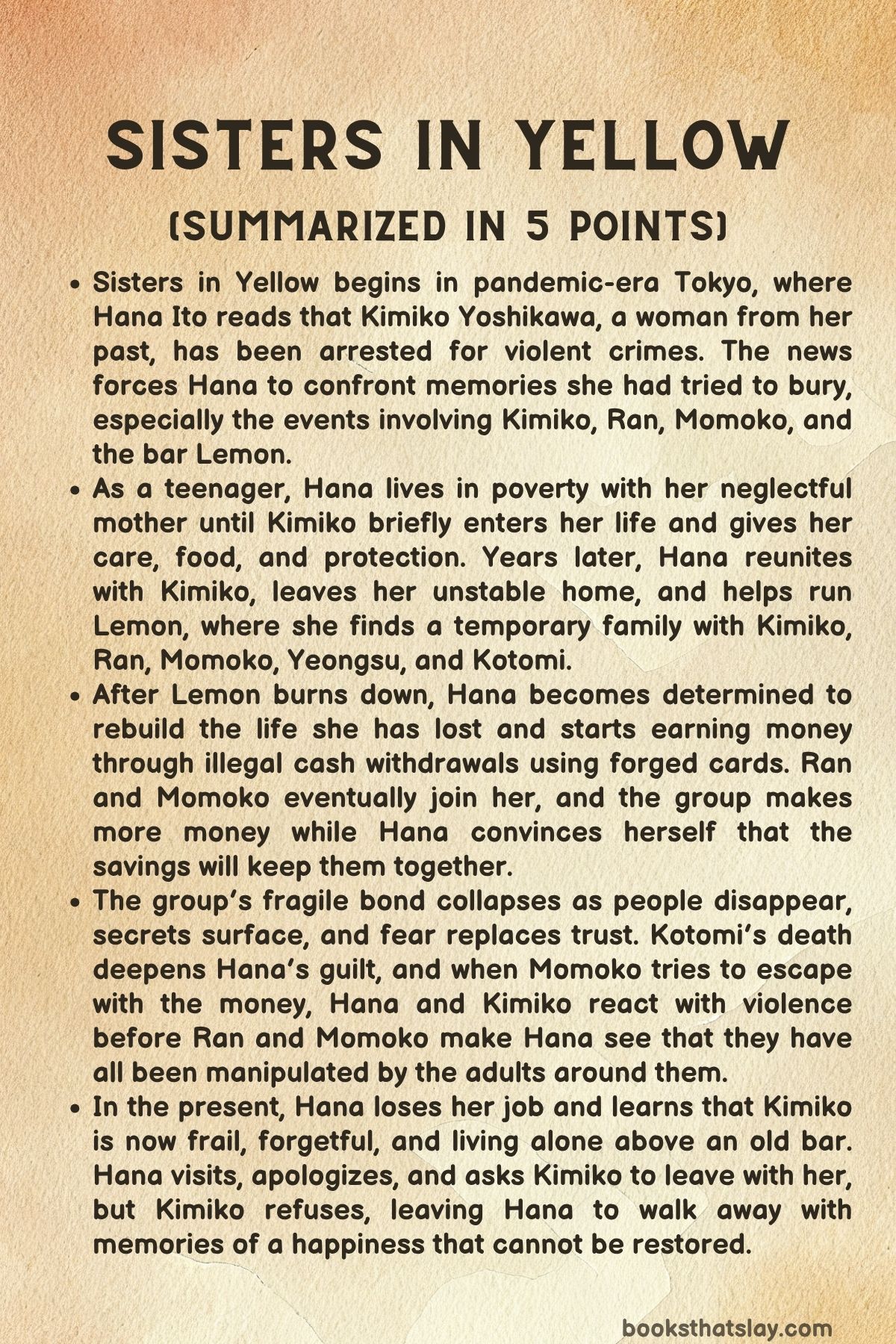
Sisters in Yellow begins in Tokyo during the early days of the COVID-19 emergency. Hana Ito is forty years old and working at a deli when she reads an online news article that stops her cold.
The article reports that Kimiko Yoshikawa, a woman Hana once lived with, has been arrested for blackmail, abduction, and battery. Kimiko is accused of confining and abusing a young woman.
For most readers, the article would be another disturbing crime story. For Hana, it opens a sealed room in her mind.
Kimiko is not just a name from Hana’s past. She is someone who once cared for her, protected her, and gave her a home when Hana had almost nothing.
The news frightens Hana because it suggests that the past she has spent years trying to bury may return in a public and dangerous way. She worries that Kimiko’s arrest might expose what happened twenty years earlier, when Hana, Kimiko, Ran, and Momoko were living together and committing crimes.
In panic, Hana searches through an old shoebox and finds phone numbers from that time. She calls Ran Kato, another woman who was part of the old life.
Ran agrees to meet, but she warns Hana not to go to the police.
From there, Sisters in Yellow moves back to Hana’s adolescence. At fifteen, Hana lives in Higashimurayama with her mother, Ai, in a poor tenement house.
Ai is unreliable, self-absorbed, and often absent. She leaves Hana alone while she spends time with men, including a boyfriend whose presence makes the household even more unstable.
Hana’s life is marked by neglect, loneliness, and the quiet shame of poverty. She has no steady adult looking after her and no real sense of safety.
One summer, Kimiko appears at Hana’s home. She knows Ai, and she begins staying with them while Ai disappears for long periods.
Kimiko quickly becomes the most stable person in Hana’s life. She cleans the house, cooks meals, speaks to Hana with attention, and shields her from local bullies.
For Hana, Kimiko’s presence feels like rescue. Kimiko does not treat her as a burden or an afterthought.
She gives Hana food, order, conversation, and the feeling of being seen.
That summer becomes one of the first times Hana understands what warmth might mean. Kimiko is not presented as perfect, but to Hana she is almost magical.
She fills the role that Ai has abandoned. Then, without warning, Kimiko leaves.
Before going, she fills the refrigerator with food, a small act that stays with Hana as proof that someone had cared whether she survived.
Two years later, Hana’s situation has not improved. Her savings are stolen by Snoozy, one of her mother’s former boyfriends, leaving her desperate and directionless.
By chance, she meets Kimiko again. This reunion comes at exactly the moment when Hana feels she has nowhere to go.
Kimiko asks if Hana wants to come with her. Hana says yes, and that decision changes the course of her life.
Kimiko takes Hana to Sangenjaya, where she opens a small bar called Lemon. Hana helps run the bar, and Lemon soon becomes her entire world.
It is more than a workplace. It is a home, a refuge, and a symbol of a life that seems chosen rather than endured.
Through Lemon, Hana meets people connected to Kimiko’s past and present. Yeongsu is a quiet man involved in illegal work, and Kotomi is a beautiful Ginza hostess with her own complicated history.
These adults move through the bar with secrets around them, but Hana is too hungry for belonging to see the danger clearly.
Ran Kato eventually joins Lemon. Ran works at a cabaret club and is struggling in her own way.
Later, Momoko enters their circle. She is a lonely rich girl, different from Hana and Ran in background but similarly starved for connection.
In time, Hana, Ran, Momoko, and Kimiko begin living together in a house. Their household becomes a makeshift family built from need, affection, and shared isolation.
Each woman has been failed by ordinary forms of care. Together, they create something that feels like safety.
For Hana, this period is intoxicating. She believes she has found the life she was meant to have.
Kimiko is still the center of that life, part protector and part authority figure. Ran and Momoko become like sisters.
The bar gives them purpose and rhythm. Even when the world around them is unstable, Lemon seems to hold them together.
That fragile stability ends when Lemon burns down. The fire destroys their income and the place that had given shape to their lives.
Without the bar, the group begins to drift toward desperation. Hana, terrified of losing the only family she has ever wanted, becomes fixated on recreating what they had.
She believes that if they can gather enough money, they can reopen Lemon and restore their happiness.
This need leads Hana into crime. She accepts work from Viv, an underworld contact, withdrawing cash from ATMs with forged cards.
At first, Hana does the work alone. She is afraid, but she also feels useful.
The money gives her a sense of control she has rarely had. Soon Ran and Momoko become involved too.
The crimes become more organized, and the group carries out repeated cash withdrawals known as attack runs. Later, they also use a club connected to Kotomi to skim credit-card information.
As the money grows, so does Hana’s obsession with protecting it. She saves carefully, convinced that every bundle brings them closer to reopening Lemon and returning to the life they lost.
Yet the more money they earn, the more their relationships change. What began as a desperate plan becomes a trap.
The girls are no longer simply surviving together. They are being drawn deeper into an adult criminal world they do not fully understand.
The adults around them are unreliable and dangerous. Yeongsu disappears.
Viv becomes difficult to contact. Kotomi’s life also moves toward tragedy.
Hana learns that Kotomi has died, most likely killed by her unstable boyfriend, Oikawa. Kotomi had been trying to reach Osaka to find Jihun, a man from her past.
Hana feels responsible because she had told Kotomi that Jihun was alive, even though Yeongsu had warned her not to share that information. This guilt weighs heavily on Hana.
It adds to her fear, confusion, and growing emotional collapse.
Inside the household, trust begins to fail. The bond between Hana, Ran, Momoko, and Kimiko is no longer enough to protect them from what they have done.
Hana becomes increasingly controlling about the saved cash, seeing it as the only path back to happiness. When Momoko tries to run away with the money, Hana attacks her.
The violence marks a turning point. Hana, once a neglected girl seeking protection, has become someone willing to harm another person to preserve an impossible dream.
Kimiko’s response makes the situation worse. Believing Momoko cannot be allowed to leave, she violently restrains her.
The family Hana once cherished now resembles a prison. Ran and Momoko finally make Hana face what has happened: the adults have used them, and the dream of restoring Lemon has become destructive.
The girls decide to split the money, deny everything if questioned, and leave. Hana takes only one bundle and walks away from Kimiko.
This abandonment becomes the central wound of Hana’s adult life. She leaves behind the woman who once saved her, but also the woman who helped lead them into danger.
Hana survives, grows older, and builds an ordinary life, but she never fully escapes that past. She has tried to erase it, yet the news of Kimiko’s arrest proves that memory can return without warning.
Back in the present, the pandemic disrupts Hana’s already fragile life. She loses her deli job and feels unmoored.
She contacts Yeongsu and learns that Kimiko has received a suspended sentence. Kimiko is now living alone above Mama Junko’s old bar in Higashimurayama.
This information pulls Hana back to the place where her story with Kimiko began.
Hana visits Kimiko and finds her frail, forgetful, and almost unrecognizable. The powerful woman from Hana’s memory has faded.
Kimiko is no longer the figure who could fill a room, command loyalty, or make Hana feel protected. She is old, diminished, and living among ghosts.
Hana apologizes and asks Kimiko to come with her, perhaps hoping to repair what was broken or repay the care she once received.
Kimiko refuses. She says she will stay because she can see her mother, Kotomi, and Yeongsu there.
Her words suggest that she is living partly in memory, surrounded by people who are gone or unreachable. Hana cannot rescue her.
The past cannot be restored, and the family they once created cannot be made whole again.
Hana promises to visit again and leaves. She walks through town, boards a train, and falls asleep while remembering a happiness that once felt real but can no longer be fully recovered.
Sisters in Yellow ends not with clean redemption, but with the ache of recognition. Hana understands that the love she received from Kimiko was real, but so was the harm.
The family she found saved her from one kind of loneliness while leading her into another kind of damage. What remains is memory: uncertain, painful, and still bright in places.
Characters
The characters in Sisters in Yellow are shaped by poverty, loneliness, fear, dependence, and the desperate human need to belong somewhere. Their relationships form a fragile substitute family, but that family is built on secrecy, crime, emotional hunger, and unequal power.
Each character carries wounds that affect the way they love, betray, protect, and survive.
Hana Ito
Hana Ito is the emotional center of the book, and her character is defined by abandonment, longing, guilt, and survival. As a teenager, she grows up in poverty with a neglectful mother, which leaves her emotionally starved and deeply vulnerable to anyone who offers warmth.
When Kimiko enters her life, Hana does not simply see her as an adult helper; she sees her as safety, family, and proof that she can be cared for. This makes Hana’s attachment to Kimiko intense and dangerous because she begins to build her entire identity around the world Kimiko creates.
Hana’s greatest desire is not money itself but the security and belonging she believes money can protect. When Lemon burns down, Hana becomes obsessed with earning and saving because she thinks the lost happiness of the bar can be rebuilt if she works hard enough and gathers enough cash.
This reveals how trauma distorts her judgment. She convinces herself that crime is acceptable because it serves a larger emotional purpose: keeping the group together.
Her careful saving, planning, and secrecy show that she is intelligent and disciplined, but those same qualities become destructive when they are driven by fear.
Hana is also morally complex because she is both victim and participant. She is manipulated by adults and trapped by circumstances, yet she also makes choices that harm others.
Her attack on Momoko shows how possessiveness, panic, and desperation have overtaken her. At that moment, Hana becomes capable of the same kind of violence and control that once frightened her.
This does not make her purely cruel; rather, it shows how deeply she has internalized the fear of being abandoned again. Her later guilt over Kotomi and Momoko reveals that she understands the damage she caused, even if she could not stop herself at the time.
In the present, Hana is a woman who has survived but not healed. Her ordinary life as a deli worker suggests that she has tried to bury her past under routine, but Kimiko’s arrest forces her to confront the memories she avoided.
Her visit to Kimiko is an act of remorse, but it is also an attempt to recover the lost version of herself that once believed in family. Hana’s final state is quiet and unresolved.
She cannot fully repair the past, but she can finally look at it honestly. Her character shows how the need for love can save a person for a while, but when mixed with fear and dependence, it can also lead to ruin.
Kimiko Yoshikawa
Kimiko Yoshikawa is one of the most powerful and troubling figures in the book. At first, she appears as a rescuer.
She enters Hana’s neglected home, cooks, cleans, protects her, and gives her the tenderness that Hana’s mother fails to provide. To young Hana, Kimiko seems almost magical because she brings order, food, attention, and emotional warmth into a life defined by instability.
This early image makes Kimiko deeply compelling because she is not introduced as a villain. She is introduced as someone capable of care.
However, Kimiko’s care is complicated by control. She gives people shelter and affection, but she also creates emotional dependence.
Her relationships with Hana, Ran, and Momoko are built like a family, yet Kimiko remains the central authority within that family. She is loving, charismatic, and protective, but she is also secretive and tied to dangerous people and illegal work.
Her presence gives the girls a sense of belonging, but it also pulls them into a world where boundaries between protection and exploitation become blurred.
Kimiko’s later violence toward Momoko reveals the darker side of her character. She believes she is preserving the group, but her idea of preservation becomes imprisonment.
Her inability to let Momoko leave shows that Kimiko’s love can become possessive and abusive. She seems to fear abandonment as much as the girls do, and instead of facing that fear, she tries to control the people around her.
This makes her tragic because her longing for family is real, but her methods destroy the very family she wants to keep.
In the present, Kimiko is frail, forgetful, and almost unrecognizable, which changes how the reader sees her. She is no longer the strong, mysterious figure of Hana’s youth but a lonely woman surrounded by ghosts of the past.
Her refusal to leave the old place suggests that she lives more in memory than reality. She remains attached to the dead, the missing, and the lost.
Kimiko’s character represents both rescue and danger, showing how a person can be loving and harmful at the same time.
Ran Kato
Ran Kato is a sharp, wounded, and practical character who understands danger more clearly than Hana does. When she appears in the present, her warning to Hana not to go to the police shows that she has not forgotten the seriousness of what happened.
Unlike Hana, who is still overwhelmed by guilt and memory, Ran seems more guarded and realistic. She knows that the past cannot be safely reopened without consequences.
In the earlier part of the story, Ran enters the group as a struggling cabaret club worker, which already places her in a vulnerable position. She is not protected by wealth or family stability, and this makes the makeshift home around Kimiko and Lemon attractive to her.
Ran, like Hana, is searching for a place to belong. However, Ran is less innocent in her understanding of the world.
She recognizes exploitation, danger, and adult manipulation more quickly than Hana does.
Ran’s importance grows when the criminal work expands. She joins Hana in the ATM schemes, but she does not fully lose herself in the dream of rebuilding Lemon.
This difference makes her a necessary contrast to Hana. While Hana clings to the fantasy that money can restore happiness, Ran becomes one of the voices that helps expose the truth: the girls have been used by the adults around them.
Her role in persuading Hana to split the money and leave shows her strength and clarity.
Ran’s character represents survival through awareness. She is damaged, but she is not entirely blinded by attachment.
She sees that the family they built has become dangerous and that staying loyal to it would destroy them. Her decision to leave is not simple betrayal; it is self-preservation.
Ran shows that escaping a harmful bond often requires accepting a painful truth: the place that once felt like home may no longer be safe.
Momoko
Momoko is a lonely rich girl whose presence complicates the group’s idea of family. Unlike Hana and Ran, she does not appear to come from obvious material poverty, yet she is emotionally deprived.
Her loneliness makes her vulnerable in a different way. She is drawn to Kimiko, Hana, and Ran because they offer a kind of closeness and shared life that money cannot provide.
This makes Momoko important because the book shows that emotional hunger can exist even in comfort.
At first, Momoko seems like someone who has found excitement and belonging through the group. She becomes part of the household and participates in the illegal work, suggesting that she wants to prove herself and be accepted.
However, her position is always uneasy. Because she has money and a different background, she does not experience the group’s desperation in exactly the same way as Hana.
This difference eventually creates tension, especially when the saved cash becomes the symbol of everyone’s hopes and fears.
Momoko’s attempt to run away with the money is a turning point in the book because it exposes the collapse of trust. To Hana, Momoko’s act feels like betrayal, but it can also be understood as a desperate attempt to escape a situation that has become frightening and unstable.
Momoko recognizes that the group is no longer simply a chosen family; it has become a trap. Her attempted escape reveals both her fear and her will to survive.
The violence Momoko suffers shows how quickly love can turn into control when people are terrified of loss. She becomes the person on whom the group’s hidden brutality is forced into the open.
Yet Momoko is not only a victim. By helping Ran persuade Hana that they have been used, she becomes part of the movement toward escape.
Her character shows the painful cost of belonging to a family built on need, secrecy, and fear.
Ai
Ai, Hana’s mother, is a neglectful and unreliable presence whose absence shapes Hana more powerfully than her presence does. She leaves Hana alone for long stretches, prioritizes her boyfriend, and fails to provide the emotional and practical care a child needs.
Because of Ai’s failures, Hana grows up without a stable model of protection, which makes Kimiko’s care feel overwhelming and precious when it arrives.
Ai is important because she creates the emotional emptiness at the center of Hana’s life. Hana’s hunger for family does not appear suddenly; it is born from years of being ignored, abandoned, and forced to survive too early.
Ai’s neglect makes Hana vulnerable to attaching herself completely to someone like Kimiko. In this way, Ai’s character helps explain why Hana later confuses dependence with love and danger with belonging.
Although Ai is not developed as deeply as some of the other characters, her role is essential. She represents the ordinary cruelty of neglect rather than dramatic villainy.
She does not need to be constantly violent or openly malicious to damage Hana. Her irresponsibility is enough.
Through Ai, the story shows that abandonment can become the first wound from which many later choices grow.
Snoozy
Snoozy is a minor but significant character because his theft of Hana’s savings pushes her toward Kimiko and the life that follows. As Ai’s ex-boyfriend, he belongs to the unstable adult world that surrounds Hana’s childhood.
His act of stealing from Hana is especially cruel because the money represents her effort to create some security for herself. By taking it, he destroys one of the few things Hana has managed to control.
Snoozy’s importance lies less in his personality and more in what he represents. He is part of a pattern of adults who exploit the young and vulnerable.
Hana is already poor, neglected, and emotionally isolated, and Snoozy’s theft confirms that the world around her cannot be trusted. His action helps make Kimiko’s offer feel like rescue.
When Hana chooses to go with Kimiko, it is not only because she loves Kimiko; it is also because her existing life has become unbearable.
Through Snoozy, the book shows how a single act of exploitation can change the direction of a young person’s life. He does not need to appear for long to matter.
His selfishness becomes one of the forces that pushes Hana into a new world of attachment, crime, and eventual guilt.
Yeongsu
Yeongsu is a quiet and mysterious figure connected to illegal work, and his character carries an atmosphere of secrecy. He is part of Kimiko’s world before Hana fully understands what that world means.
Because he is restrained and not openly expressive, he often seems to know more than he says. This makes him both intriguing and unsettling.
Yeongsu’s relationship to the group is complicated because he is not simply a protector or a criminal contact. He appears to have knowledge of dangerous networks and past relationships, especially involving Kotomi and Jihun.
His warning to Hana not to tell Kotomi that Jihun is alive shows that he understands the risks hidden beneath the surface of their lives. Hana’s decision to ignore or misunderstand that warning contributes to her later guilt over Kotomi’s death.
Yeongsu’s disappearance deepens the sense that the group’s world is collapsing. As long as he is present, he seems like a link to information, order, or protection, even if that protection is uncertain.
When he vanishes, the girls are left more exposed. In the present, Hana’s contact with him becomes part of her attempt to piece together what happened and what remains.
Yeongsu represents the hidden machinery behind the visible events of the story. He is connected to crime, survival, and memory, but he is also connected to silence.
His character shows that not every person involved in harm acts loudly or directly. Some remain on the edges, carrying knowledge that could save others but does not always arrive in time.
Kotomi
Kotomi is one of the most tragic characters in the book, and her beauty hides a life marked by danger, longing, and vulnerability. As a Ginza hostess, she appears glamorous and experienced, but her personal life is unstable and painful.
She is connected to Kimiko’s old world and to men whose presence brings risk rather than safety. Her story reveals how beauty and charm can become forms of exposure rather than protection.
Kotomi’s longing for Jihun gives her character emotional depth. The possibility that he is alive awakens hope in her, and that hope pushes her toward a dangerous decision.
Hana’s role in telling Kotomi about Jihun becomes one of Hana’s deepest sources of guilt because she believes her words helped lead Kotomi toward death. This makes Kotomi central to Hana’s moral awakening.
Through Kotomi, Hana learns that even a small choice can have devastating consequences when people are trapped in violent circumstances.
Kotomi’s likely death at the hands of Oikawa shows the brutal reality beneath the group’s dream of freedom. While Hana, Ran, and Momoko imagine rebuilding Lemon and preserving their chosen family, Kotomi’s fate reminds the reader that the adult world around them is filled with possessiveness, jealousy, and violence.
Kotomi is not just a victim of one man; she is a victim of a wider world where women’s desires and attempts to leave can become dangerous.
Her character remains haunting because she is remembered through absence. After her death, she becomes part of the emotional weight that Hana carries into adulthood.
Kotomi represents lost possibility: the possibility of love, escape, and a different future that is destroyed before it can be reached.
Viv
Viv is an underworld contact who draws Hana deeper into criminal activity. Viv’s role is important because she turns Hana’s desperation into a practical system for making money.
Through Viv, Hana begins withdrawing cash from ATMs using forged cards, and what first appears as a way to survive becomes a repeated pattern of crime. Viv gives Hana access to money, but that access comes at the cost of safety and innocence.
Viv is not emotionally central to Hana in the way Kimiko is, but Viv is crucial to the plot because she connects the girls to a larger criminal network. Her presence shows that the group’s illegal work is not a small private rebellion but part of something organized and dangerous.
As Viv becomes harder to reach, the instability of that world becomes clearer. The girls are not in control, even when they think they are earning and planning for themselves.
Viv represents exploitation through opportunity. She does not need to force Hana directly; she simply offers a path that matches Hana’s desperation.
This makes her dangerous in a subtle way. She provides the means for Hana to chase the dream of rebuilding Lemon, while also pulling her into a system that will eventually worsen the group’s fear and distrust.
Oikawa
Oikawa is an unstable and violent figure whose connection to Kotomi reveals the danger of possessive relationships. Although he is not one of the central emotional figures, his impact is severe.
He represents the kind of male violence that exists around the edges of the women’s lives, threatening any attempt they make to move freely or choose differently.
His likely role in Kotomi’s death makes him one of the darkest figures in the story. Kotomi’s attempt to go to Osaka and search for Jihun suggests a desire to reclaim part of her life, but Oikawa’s violence appears to destroy that possibility.
He is therefore associated with control, jealousy, and punishment. His character shows how dangerous it can be for a woman in the story to seek escape from a man who believes he has power over her.
Oikawa also affects Hana indirectly. Because Hana believes she contributed to Kotomi’s decision by telling her Jihun was alive, Oikawa’s violence becomes tied to Hana’s guilt.
He is the immediate threat, but Hana feels implicated in the chain of events. This makes Oikawa important not only as a violent character but as part of the moral burden that follows Hana into adulthood.
Jihun
Jihun is more important as an absence than as an active presence. He exists in the story largely through Kotomi’s longing and Yeongsu’s warning.
Because Kotomi believes in the possibility of finding him, Jihun becomes a symbol of hope, memory, and unfinished love. His possible survival opens a door in Kotomi’s mind, making her imagine that her life might still change.
However, Jihun also represents the danger of hope when it is placed inside a violent and unstable world. The news that he may be alive does not simply comfort Kotomi; it sets events in motion that lead toward tragedy.
This does not make Jihun responsible in a direct sense, but it makes his presence powerful. He becomes the figure around whom desire, secrecy, and danger gather.
For Hana, Jihun becomes part of her guilt because she told Kotomi he was alive despite being warned not to. In this way, Jihun’s character is tied to the book’s larger concern with knowledge and consequence.
Knowing something, or believing one knows something, can change lives. Jihun represents the kind of past that refuses to stay buried.
Mama Junko
Mama Junko is a minor character, but her old bar becomes meaningful in the present because it is where Kimiko lives after her sentence. The space above Mama Junko’s bar functions almost like a storage place for memory.
It holds traces of people and events that have disappeared, and Kimiko’s decision to remain there shows how deeply she is trapped in the past.
Mama Junko herself is not developed as extensively as Hana, Kimiko, Ran, or Momoko, but her presence is connected to the older world of bars, nightlife, survival, and informal communities. Her bar belongs to the social environment from which Kimiko and others emerged.
It is not just a location; it is part of the atmosphere of women living on the margins, forming connections in places that are both comforting and unsafe.
Through Mama Junko’s old bar, the story brings Hana back to the physical world of her memories. It becomes the place where past and present meet.
Kimiko’s claim that she can see her mother, Kotomi, and Yeongsu there suggests that the bar has become a haunted emotional space. Mama Junko’s role may be small, but the place associated with her helps show how memory can attach itself to rooms, streets, and old lives.
Themes
Abandonment and the Hunger for Belonging
Hana’s life is shaped by emotional neglect long before she understands it as abandonment. Her mother’s repeated disappearances leave Hana without security, routine, or protection, making even small gestures of care feel life-changing.
Kimiko’s arrival matters so deeply because she offers what Hana has been denied: food, attention, conversation, and the feeling that someone is watching over her. This need for belonging later explains why Hana attaches herself so strongly to Lemon and the women around Kimiko.
The bar is not simply a workplace; it becomes a substitute home where Hana can imagine herself wanted. Yet this longing also makes her vulnerable.
She confuses dependence with love and survival with loyalty. Her desire to keep the group together becomes stronger than her ability to judge danger clearly.
In Sisters in Yellow, belonging is shown as both healing and risky, especially when it grows out of loneliness rather than trust.
Poverty, Desperation, and Moral Compromise
Poverty in Hana’s world is not presented as a background condition but as a force that shapes choices, relationships, and self-worth. As a teenager, Hana learns that money means safety, food, freedom, and the possibility of not being abandoned.
When her savings are stolen, the loss is more than financial; it confirms how little control she has over her own life. Later, after Lemon burns down, the group’s illegal work begins to appear almost practical because ordinary survival already feels impossible.
Hana’s crimes do not begin from greed alone. They begin from fear, attachment, and the belief that money can rebuild the only life that ever gave her comfort.
As the amount of cash grows, so does Hana’s moral confusion. She starts measuring hope through money and treating danger as acceptable if it protects the group.
The story shows how desperation can slowly weaken judgment until harmful actions feel necessary.
Female Bonds, Power, and Control
The relationships among Hana, Kimiko, Ran, Momoko, and Kotomi are built on care, need, admiration, jealousy, and control. These women are drawn together because each of them is isolated in some way, and their closeness gives them temporary strength against a harsh world.
Kimiko becomes a protector and mother figure for Hana, but her protection is never free from power. She decides who belongs, who is trusted, and what must be hidden.
Hana later repeats this pattern when she tries to control Momoko in the name of keeping the group safe. The emotional intensity of their bond makes betrayal feel unbearable, which is why leaving becomes so difficult.
Ran and Momoko’s eventual resistance is important because they recognize what Hana cannot: care has become confinement. The story presents female connection as deeply necessary, but it also shows how love can become possessive when it is shaped by fear, dependency, and unresolved pain.
Memory, Guilt, and the Past’s Return
Hana’s present life is quiet and ordinary on the surface, but the news of Kimiko’s arrest forces the past back into view. Her shock reveals that forgetting has never truly freed her; it has only allowed her to keep moving.
The memories that return are not simple. They contain warmth, shame, loyalty, fear, and grief at once.
Hana remembers moments of happiness with the same people who became part of violence and crime, which makes her guilt harder to resolve. Her visit to Kimiko is not only an attempt to apologize but also an attempt to face the person she once loved, depended on, and abandoned.
Kimiko’s frailty makes the past feel both distant and painfully alive. Hana cannot recover what was lost, and she cannot fully repair what was broken.
The ending leaves her suspended between memory and acceptance, carrying the knowledge that some forms of happiness cannot be restored without also remembering the harm attached to them.