Tortured Souls Summary, Characters and Themes
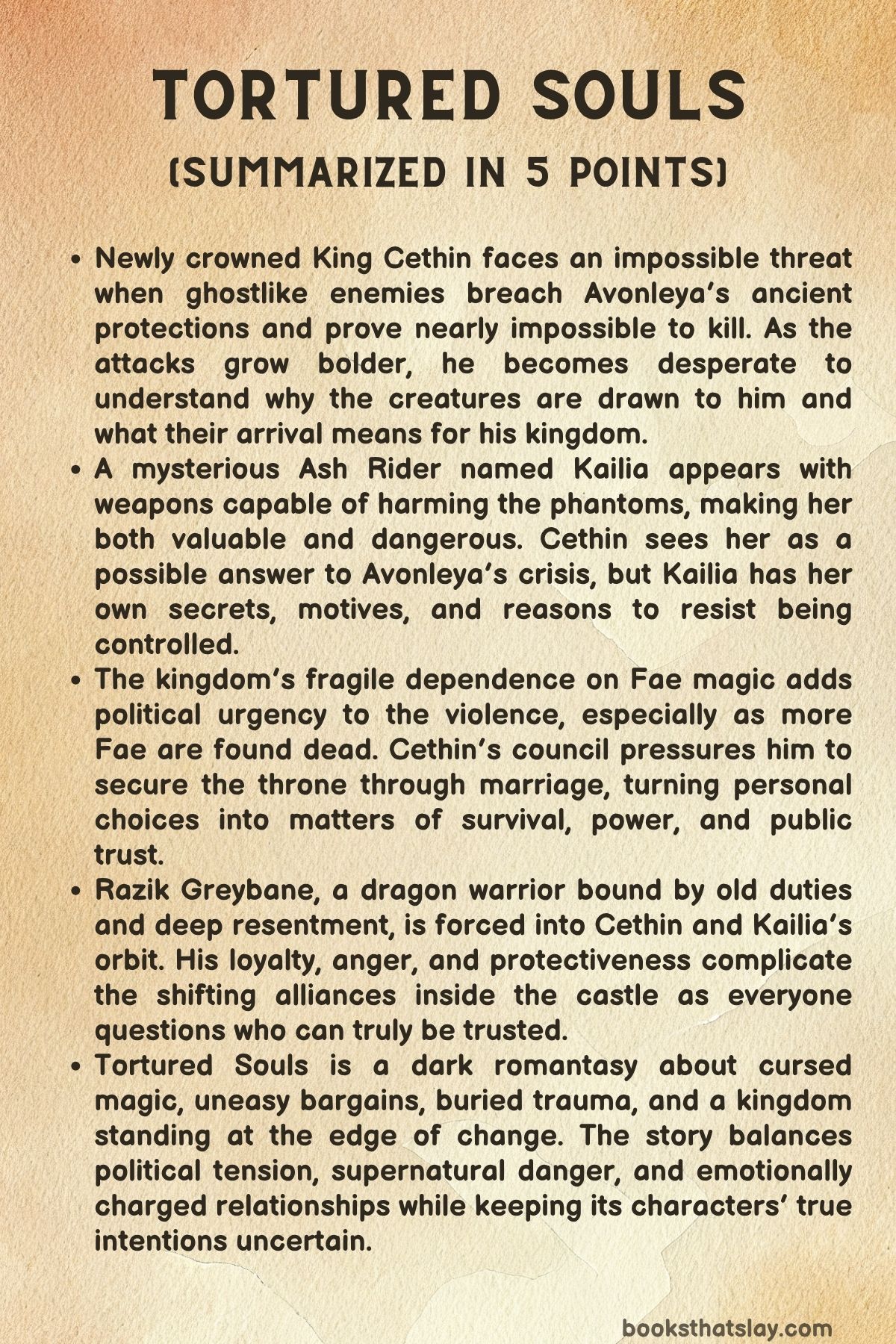
Tortured Souls by Melissa K Roehrich is a dark fantasy about power, captivity, blood magic, and the cost of survival. Set in the sealed kingdom of Avonleya, the story follows Cethin, a newly crowned king whose hidden choices have weakened ancient protections, and Kailia, an Ash Rider with a dangerous past and a mission of her own.
As phantom enemies invade the kingdom and Fae begin dying, alliances form under pressure, lies become weapons, and marriage becomes another kind of battlefield. The book builds its conflict around trust, control, revenge, and the uneasy line between protection and possession. It’s the first book of the Avonleya series.
Summary
Cethin has only recently taken the throne of Avonleya when the impossible happens: a ship arrives from across the Edria Sea. For centuries, the kingdom has been sealed behind cursed Wards, cut off from the outside world.
No ship should be able to pass through. Cethin knows more than he admits.
He has weakened whatever kept the ships out, but he keeps that truth hidden, even as the consequences begin to reach his kingdom.
Three seasons later, Avonleya faces a terrifying new threat near Shira Forest. Strange translucent beings attack the king’s forces.
They have pale skin, white hair, pupil-less eyes, and weapons that appear without warning. Normal blades pass through them, and ordinary magic fails against them or is snuffed out entirely.
Only dragon fire can destroy them. Razik Greybane and his uncle Tybalt fight alongside the warriors, but the battle is costly.
Valric, one of the Cadre, is killed. When Cethin arrives, the creatures immediately focus on him, calling him “blood of death.” His own magic is useless, and Razik is ordered to protect him despite the bitter hatred between them.
Razik and Tybalt use up their dragon fire destroying most of the beings, but one remains and nearly kills Cethin. At that moment, a mysterious female appears through smoke and ashes.
She kills the creature with a special arrow, then disappears barefoot, leaving only ashy footprints behind. Cethin becomes convinced she is an Ash Rider, a rare being able to move through smoke and ash.
He keeps the arrow she left behind and begins searching for her.
The danger soon reaches the castle. Another phantom appears inside the heavily warded stronghold after murdering Lady Nessira, a member of Cethin’s council.
It attacks Cethin, but he kills it using the Ash Rider’s arrow. He secretly keeps the arrowhead and lies to Razik and Tybalt, claiming nothing remained.
The attack proves that the creatures can enter protected places, and it makes Cethin even more determined to find the Ash Rider.
At the same time, Fae are being found dead throughout Avonleya. Their deaths create a crisis because Avonleyans depend on Fae power to refill their own magic quickly.
Cethin had helped ships cross the Wards partly because he hoped to bring more Fae into the kingdom, but many of those newcomers are now being killed. His council presses him to marry, preferably to a Fae wife, to secure an heir and show political commitment to protecting the Fae.
They suggest using the Spring Esbat Festival to gather the Fae and give him a chance to choose a bride. Cethin reacts with anger and loses enough control of his darkness to scar the council table.
At the festival, the Ash Rider, Kailia, disguises herself in the crowd to get close to Cethin and recover her arrow. She hates crowds, unwanted touch, boots, and pretending to fit in.
When someone grabs her arm to steady her, she reacts by stabbing him, only to realize the man is Cethin. He hides the incident from the crowd and later refuses to return her arrow.
Instead, he tricks her into coming to the castle, where he reveals what he wants: more of her arrows, and a wife in name only.
Kailia refuses to help him. Cethin presses her for information and learns that her magic is tied to her arrows.
Without the full set, she cannot create more, and one missing arrow is already weakening her power. He uses this knowledge to trap her in a blood bargain.
The next time their paths cross, she must either accept his proposal or stab him. Kailia leaves the castle and returns to Aimonway, where she meets Wren, Jarek, Bram, and Marissa.
Marissa gives her a blue crystal necklace, claiming the Fates intend her to have it. Kailia also thinks about an Oracle she once encountered, one who appeared in Razik’s form, making her believe Razik will matter to her future.
Her magic suddenly drags her to Lake Noctus, where Cethin, Razik, and Avonleyan warriors are fighting more phantoms. Kailia joins the battle, using her arrows and lending arrowheads to others so they can kill the creatures too.
Razik shifts fully into dragon form and protects the forces with black dragon fire. After the battle, Cethin makes a jealous comment about Kailia’s necklace, and she stabs him in the thigh with his own dagger.
Razik grabs her, but she panics violently, tearing at him with ash magic until Niara puts her to sleep.
Cethin places Kailia in the cells, then comes to her with clothing, pastries, and a threat. If she refuses to negotiate, she could face trial and execution.
Kailia agrees to become his wife and queen in title, in exchange for protection, a pardon, and the return of her arrow once the union is binding. Their blood bargain produces strange silver and dark green light.
Tybalt asks Razik to become Kailia’s guard, and Razik begins questioning whether she is being forced.
Cethin and Kailia complete a private union ceremony at Lunae Falls under Niara’s guidance. Rather than a normal blood-based union, Niara binds their hands with a braided cord tied to their bloodlines and magic.
Beneath the moon, they call their powers and speak binding vows. Kailia receives a silvery Moon Mark on her palm, visible only at night.
Cethin later tells her they have entered a Lunar Marriage, a sacred rite from his bloodline that cannot be dissolved. Kailia realizes the bond is far more permanent than she expected.
Cethin returns her arrowhead, but she privately knows the missing arrow was not the only problem. Something is wrong with her power, especially her failure to travel through smoke and ash.
Tybalt confronts Cethin about the Lunar Marriage, furious that he performed such a serious rite without fully explaining it. He also reports that the attackers from the hunt were Avonleyan and may be connected to the Elder Clan, an ancient group tied to old prophecies and sacred places.
Razik is ordered to stay with Kailia at all times. He tries to help her adjust to her role as queen and takes her to the docks, where they collect a mysterious bowl from sailors.
When a man grabs Kailia, she stabs his hand to a table and threatens him, setting off a tavern brawl. Razik gets them out and warns her she must learn how to behave publicly.
Cethin announces to the council that the union has already happened and that the public celebration will occur on the next full moon. The council is shocked when they learn it was a Lunar Marriage.
Kailia is questioned about her past but reveals little. She also meets Lord Corveth Astor of Everfall and shows interest in visiting his territory.
Later, she and Cethin discuss her hatred of touch. Kailia admits that touch has mostly meant violence, control, and bruises.
Cethin tells her it can also mean safety and desire, but he does not force her.
Kailia asks to visit Shadowfen, the town she has falsely claimed as her birthplace. Cethin insists on going with her, and Razik joins them.
Shadowfen is foggy, secretive, and nearly empty. In a tavern, Kailia reveals small pieces of her true past across the Edria Sea, but she becomes overwhelmed when questioned.
Outside, phantoms attack, and Kailia again fails to move properly through her ashes. Later, at Tenebrae Halls, a phantom appears in Cethin and Kailia’s rooms and wounds Cethin with one of Kailia’s arrows before she kills it.
They begin to suspect the phantoms may be targeting Cethin specifically.
Kailia slowly tests closeness with Cethin. She asks him to sleep in the same bed as a small step toward tolerating another person near her.
In dreams, her power briefly works but pulls her against her will. A dream version of Cethin appears, and she admits her only sexual experience lacked tenderness or a kiss.
When she wakes, she is left questioning both her power and Cethin’s strange ability to survive her magical weapons. In a quiet moment while she is bathing, she allows Cethin to touch her arm and then touches his face, seeing that he craves contact as strongly as she fears it.
Razik begins to suspect something is wrong. During training, Kailia reveals extraordinary skill, using ashes on the ground to sense vibrations and anticipate attacks.
Razik notices a hidden thread of Cethin’s dark magic in her hair and realizes Cethin has been entering her dreams. He confronts Cethin, accusing him of manipulating Kailia and hiding the truth.
He also realizes Cethin may be the reason her magic has been failing.
Cethin summons Kailia to the beach through her ashes. She forces him to explain.
He admits he entered her dreams after placing magic in her hair. He also enchanted the blue kyanite necklace so her ashes would always bring her back to him.
He arranged for the necklace to reach her through Marissa and used Wren to make sure she wore it. Kailia attacks him and demands he remove the enchantment, but he refuses.
She sees his actions as another cage and tells him she hates him.
Afterward, Kailia decides to act. She sends a message to Corveth, revealing that she is ready.
Razik learns that Cethin has removed him as Kailia’s guard and that Kailia agreed. Hurt and angry, he isolates himself.
After ten days, he begins to suspect Kailia may have wanted the crown all along and may be planning to kill Cethin. He remembers that in a Lunar Marriage, if one partner dies, their power passes to the other unless one directly kills the other.
Cethin and Kailia travel to Everfall, where the stryx have awakened. Cethin subdues one creature, but members of the Elder Clan attack.
Kailia reveals the truth: she knows Cethin’s blood magic may be connected to the Fae deaths, and Corveth is her brother. Corveth kills Draven.
Kailia announces that she came to Avonleya to infiltrate the kingdom, find her brother, avenge the Cliffs, and take everything from the cursed king. Razik arrives in dragon form, but Kailia shoots Cethin in the chest with the phantom arrow.
As Cethin weakens, Corveth uses his blood to break the enchanted necklace and free Kailia. She destroys Cethin’s crown, claims her own circlet, and leaves as queen.
Elsewhere, the goddess Saylah learns her son is in danger and prepares to cross the Wards in fury.
Characters
Cethin
Cethin is the central figure of political power, secrecy, and moral instability in Tortured Souls. He has only recently become king of Avonleya, yet he is already burdened by a truth he refuses to share: he is responsible for weakening the Wards that have kept the kingdom sealed for centuries.
This hidden guilt shapes much of his behavior. Outwardly, he performs the role of a ruler who must protect his people, investigate strange enemies, calm the Fae, and satisfy the demands of his advisory council.
Inwardly, however, he is defensive, controlling, and deeply afraid of the consequences of his own choices. His secrecy is not passive; it becomes an active pattern of manipulation, especially when he keeps the Ash Rider’s arrowhead, lies about it, and later uses Kailia’s need for her arrow to trap her into negotiation.
Cethin’s relationship with power is one of the most important parts of his character. He does not merely possess authority; he uses it instinctively, often before considering the emotional or moral cost.
His decision to bind Kailia through a Lunar Marriage shows how far he is willing to go when he believes something or someone is necessary to his survival. He presents the marriage as political strategy, a way to secure a queen and gain access to weapons that can kill the phantom enemies, but the act is also personal.
He wants Kailia near him, wants control over her movements, and eventually wants access to her emotionally and physically. His methods reveal a man who confuses protection with possession.
Even when he seems capable of tenderness, that tenderness is compromised by deception.
At the same time, Cethin is not written as a simple villain. He is dangerous, manipulative, jealous, and often cruel, but he also carries loneliness, desire, fear, and genuine vulnerability.
His conversations with Kailia about touch reveal that he understands longing and deprivation. He does not force her in that moment, which shows that some part of him is capable of restraint and care.
Yet this possible softness is repeatedly undercut by his need to control outcomes. He enters her dreams without her understanding, places magic in her hair, enchants the necklace so her ashes will bring her back to him, and arranges for others to help put that necklace on her.
These choices make his intimacy invasive rather than safe.
Cethin’s tragedy lies in the gap between what he wants to be and what he actually does. He wants to be seen as a protector, a king, and perhaps even a man worthy of trust, but his decisions create the very hatred he fears.
Kailia begins to imagine that Avonleya could become home and that Cethin’s care might be real, but his betrayal confirms her deepest fear: that she has once again been caged by someone who values her power more than her freedom. By the end, Cethin stands as a ruler whose blood, magic, and crown are all under judgment.
His enemies call him “blood of death,” and the phrase becomes more than an insult; it reflects the destructive legacy attached to him, the deaths connected to his magic, and the danger of a king who believes necessity excuses violation.
Kailia
Kailia is one of the most compelling and wounded figures in the book. She enters the story as a mysterious Ash Rider, appearing through smoke and ashes to save Cethin from a phantom creature before vanishing barefoot and leaving only ashy footprints behind.
Her first impression is one of power, secrecy, and sharp survival instinct. She is not eager to be known, touched, studied, or claimed.
Her discomfort with crowds, boots, physical contact, and courtly performance immediately marks her as someone shaped by a life of danger rather than comfort. She does not move through the world like a noblewoman; she moves like someone who has had to defend every inch of herself.
Her violence is often instinctive, but it is not mindless. When grabbed, she stabs.
When trapped, she bargains. When threatened, she calculates.
This makes her frightening to others, yet understandable within the emotional logic of the story. Kailia’s aversion to touch comes from a past in which touch meant force, bruising, control, and violation.
Because of this, her gradual attempts to tolerate closeness with Cethin carry emotional weight. Asking him to sleep in the same bed is not a romantic gesture alone; it is an act of testing whether contact can exist without harm.
Her dream confession that her only sexual experience lacked gentleness or a kiss deepens the sense that she has been denied tenderness and is struggling to understand whether desire can be separated from fear.
Kailia’s magic is inseparable from her identity. Her arrows are not just weapons; they are extensions of her power.
When one disintegrates and her ability to move through smoke and ashes weakens, she is not merely losing a useful skill but losing part of herself. This makes Cethin’s decision to keep her arrowhead especially cruel because he exploits both her practical need and her magical vulnerability.
Later, when it is revealed that the necklace has been enchanted to pull her back to him, the violation becomes even deeper. Kailia’s ashes, which should symbolize freedom, movement, and escape, are turned into a leash.
Her arc is also driven by hidden purpose. Kailia is not only a frightened survivor or reluctant queen; she is an infiltrator with a mission.
Her connection to Corveth, her desire to avenge the Cliffs, and her plan to take everything from Cethin reveal a long game beneath her apparent resistance. This does not erase her pain or the reality of Cethin’s manipulation, but it complicates her.
She can be victim, weapon, strategist, sister, queen, and avenger all at once. By the end, when she shoots Cethin, breaks from the enchanted necklace, destroys his crown, and claims her own circlet, she transforms from a woman being negotiated over into someone who seizes authorship of her own fate.
Her victory is not gentle; it is born from betrayal, rage, and years of survival.
Razik Greybane
Razik Greybane is one of the most conflicted characters in Tortured Souls, defined by loyalty, resentment, protectiveness, and a deep frustration with the duties imposed on him. He begins as a warrior of immense power, capable of using dragon fire against enemies that ordinary weapons and magic cannot touch.
His strength is practical and immediate on the battlefield, but his emotional life is much more complicated. He hates Cethin, yet he is ordered to protect him.
He serves within a system he despises, yet he continues to act because Avonleya’s survival, his uncle’s plans, and his own obligations leave him little room to abandon the struggle.
Razik’s bond with Wren reveals both his tenderness and his possessiveness. As his Fae Source, Wren restores his magic through her blood, which places her in an intimate and vulnerable role.
He depends on her, and he clearly cares for her, but his protectiveness can become controlling. His confrontation with Bram shows this clearly.
Razik worries that Wren will be hurt, abandoned, or treated as temporary by someone who does not understand her life among warriors. His concern is sincere, but it also exposes how difficult it is for him to accept Wren’s independence.
He says she is grown and can choose, yet he struggles to emotionally believe it.
His relationship with Kailia becomes one of the richest parts of his characterization. At first, he sees her through the lens of strategy and suspicion, wondering whether she can be used to get closer to Cethin.
As he spends more time with her, however, he becomes attentive to her habits and needs. He notices her barefoot fighting style, understands that she uses ashes to read vibrations, and regrets not recognizing her methods sooner.
Unlike Cethin, Razik often responds to Kailia by trying to understand how she works rather than simply how she can be possessed. This does not make him perfect, but it gives him a moral contrast against Cethin’s controlling behavior.
Razik’s anger is fierce and sometimes destructive, yet it often comes from a place of insight. He is the one who recognizes that Cethin has likely been dream-walking without Kailia’s knowledge.
He confronts the king for manipulation, for hiding truth, and for interfering with Kailia’s power. His rage is not only jealousy or hatred; it is a response to violation.
Still, Razik is not immune to cruelty himself. When hurt by Kailia’s decision to remove him as guard and by Wren’s possible move toward Bram, he lashes out at Wren.
This shows that his emotional wounds can make him unfair to the people he loves. Razik is therefore a character caught between nobility and bitterness, capable of fierce protection but also capable of causing pain when he feels abandoned.
Wren
Wren is a Fae Source whose importance lies in both magical function and emotional grounding. She restores Razik’s power through her blood, which makes her essential to his survival and effectiveness as a warrior.
In a kingdom where the Fae population is declining and Fae deaths are becoming a crisis, Wren represents more than one person; she embodies the dangerous dependence Avonleyans have on Fae power. Her existence exposes the imbalance between those who use magic and those whose bodies help replenish it.
Wren’s relationship with Razik is intimate but not simple. She is his Source, not his bound partner, and that distinction matters because it keeps her from being reduced entirely to Razik’s possession.
She has her own desires, her own social connections, and eventually her own possible future with Bram. Razik’s concern for her shows that she is deeply valued, but his resistance to Bram also suggests that Wren has had to live under the weight of other people’s protectiveness.
Her quiet strength comes from continuing to make choices even while powerful figures around her debate what is best for her.
Her kindness toward Kailia also helps reveal her character. Wren offers to help Kailia find a dress and becomes part of the chain of events that brings Kailia more deeply into Avonleya’s political and magical web.
However, the later revelation that Cethin used Wren to make sure Kailia wore the enchanted necklace complicates Wren’s role. Whether knowingly or unknowingly, she becomes part of Cethin’s manipulation.
This makes her position painful: she is caring, but she exists in a world where even acts of help can be exploited by someone more powerful.
Wren’s importance is also emotional. She gives the story a softer human center amid battles, bargains, and betrayals.
Through her, the book explores care, dependence, freedom, and the difficulty of being loved by someone who is afraid of losing control. Her connection with Bram suggests the possibility of a gentler life, one chosen for affection rather than duty.
That possibility threatens Razik because it would force him to accept that Wren’s life cannot revolve around his needs forever.
Tybalt
Tybalt is a seasoned, strategic figure whose calm often contrasts with the volatility of Cethin and Razik. As Razik’s uncle, he carries the weight of age, experience, and long planning.
He understands the broader stakes of Avonleya’s imprisonment behind the Wards and repeatedly reminds Razik that Cethin may be their only way out. This makes Tybalt pragmatic in a way that can feel cold.
He is willing to tolerate Cethin not because he trusts him, but because he sees him as necessary.
His conversations with Razik reveal that Tybalt has been working toward freedom for a long time. He is patient where Razik is reactive, and this patience gives him authority.
He does not deny the pain of their duties, but he frames those duties within a larger historical struggle. For Razik, bloodline obligations feel like chains; for Tybalt, they are part of a plan that must be endured until the right moment arrives.
This difference creates tension between them but also shows why Tybalt remains influential.
Tybalt is also one of the few characters willing to challenge Cethin directly. His anger over the Lunar Marriage shows that he understands the seriousness of sacred rites and old bloodline traditions.
He recognizes that Cethin has acted recklessly by entering a permanent bond without fully explaining its implications to Kailia or to those responsible for the kingdom’s stability. Tybalt’s concern is not sentimental; it is political, magical, and prophetic.
He sees danger forming before others are willing to name it.
His suspicion of Kailia’s arrival and his interest in the Elder Clan connect him to the deeper mysteries of the story. Tybalt understands that the attacks, the sacred places, the prophecies, and Cethin’s bloodline are not separate problems.
He functions as a watcher of patterns, someone who sees the older forces moving beneath immediate events. While he is not always warm, he is necessary because he brings memory, caution, and strategic clarity to a kingdom increasingly driven by panic and desire.
Corveth Astor
Corveth Astor first appears as Lord Corveth of Everfall, but his true significance is revealed through his connection to Kailia. He is not merely a nobleman or political contact; he is Kailia’s brother and a key part of her hidden mission.
His presence reframes her actions, showing that her interest in Everfall and her willingness to move within Avonleya’s court are not random. She is searching, planning, and waiting for the moment when personal loyalty and revenge can converge.
Corveth’s character is closely associated with secrecy and vengeance. He understands more about Cethin’s blood magic and its possible connection to Fae deaths than many others do.
His alliance with Kailia suggests shared history, shared trauma, and a shared desire to punish the cursed king. When he kills Draven and helps break the enchanted necklace using Cethin’s blood, he becomes an active force in dismantling Cethin’s control.
His actions are violent, but they are also liberating for Kailia because they restore her freedom from the magical bond Cethin placed around her.
As Lord of Everfall, Corveth also connects the political world of Avonleya to older, darker forces. The awakening of the stryx and the Elder Clan attack around Everfall suggest that his territory is not merely a setting but a place where buried powers are resurfacing.
Corveth stands at the intersection of noble identity, family loyalty, and rebellion. His composed exterior hides a much sharper purpose.
His bond with Kailia gives emotional depth to both characters. Kailia’s mission is not only about abstract vengeance; it is about finding her brother and reclaiming something stolen from her past.
Corveth’s appearance confirms that Kailia has roots beyond the identity she performs for Cethin’s court. He helps expose the false foundation of Cethin and Kailia’s marriage by revealing that Kailia has never truly belonged to the role Cethin forced upon her.
She came with her own blood, her own loyalties, and her own crown waiting beneath the lie.
Bram
Bram is important because he offers Wren the possibility of affection outside the intense, duty-bound world surrounding Razik. His interest in her creates conflict not because he behaves cruelly, but because Razik fears what that interest might cost her.
Bram insists that his feelings are real and that he understands the life Wren already lives among warriors. This insistence gives him quiet strength.
He does not treat Wren as fragile, temporary, or strange; he appears willing to accept the reality of her world.
His role is subtle but meaningful. Through Bram, the story explores whether love can exist without possession.
Razik’s bond with Wren is layered with dependence, protectiveness, and fear, while Bram represents a different possibility: chosen companionship. That possibility unsettles Razik because it threatens the emotional arrangement he has relied on.
Bram therefore becomes less a rival in a simple romantic sense and more a test of whether Wren will be allowed to choose a life beyond serving as someone else’s source of strength.
Bram also helps reveal Wren’s agency. His desire for her matters because it gives her a path that belongs to her rather than to Razik’s needs or Avonleya’s magical systems.
He is not one of the most dominant figures in the plot, but his presence affects the emotional balance around Razik and Wren. In a story filled with bargains, bloodlines, and forced bonds, Bram’s importance lies in his apparent willingness to want Wren without trying to own her.
Jarek
Jarek is a warrior figure who contributes to the martial culture surrounding Razik, Kailia, and the Cadre. His interactions at the training arenas show the expectations and boundaries of Avonleyan combat society.
When Kailia asks to spar, Jarek refuses to fight the queen, revealing that even among warriors, political rank alters behavior. His refusal is not cowardice; it reflects the discomfort of treating the newly bound queen as an ordinary fighter.
Jarek also helps expose Kailia’s exceptional skill. His presence in the training scene allows the contrast between Razik’s brutal sparring and Kailia’s surprising technique to emerge.
While Razik fights him with intensity, Kailia proves herself against Fallon nearby, forcing the warriors to reconsider whatever assumptions they may have had about her. Jarek’s role, then, is partly structural: he belongs to the world of trained fighters whose standards Kailia disrupts.
His hints that he knows Kailia stabbed Cethin also suggest that he is observant and not easily fooled. He may not occupy the emotional center of the story, but he helps create the sense that the people around Cethin and Kailia are watching, interpreting, and quietly judging events.
In a court full of secrets, even secondary warriors like Jarek matter because they notice more than the rulers may want them to.
Fallon
Fallon stands out as a capable warrior who becomes one of the first people to directly engage Kailia’s fighting ability in a controlled setting. When Jarek refuses to spar with the queen, Fallon agrees, and that choice places her in a position of practical openness.
She is willing to test Kailia rather than merely be intimidated by her title. Their sparring reveals not only Kailia’s skill but also Fallon’s own courage and flexibility.
During the battle near Lake Noctus, Kailia lends arrowheads to Fallon and Ariadne so they can kill the phantom enemies. This moment is important because it shows Fallon as someone who can adapt quickly under supernatural threat.
Ordinary weapons and magic are useless against the phantoms, so survival depends on accepting unfamiliar methods. Fallon’s ability to use Kailia’s weaponry makes her part of the larger shift in Avonleya’s defense, where old assumptions about power are no longer enough.
Fallon also helps highlight the difference between title and ability. Kailia may be queen in name, but in the arena and on the battlefield she is first a fighter.
Fallon’s willingness to meet her in combat gives Kailia space to be recognized as dangerous on her own terms. In this way, Fallon serves as both a warrior and a witness to Kailia’s true nature.
Ariadne
Ariadne is another warrior who becomes significant during the fight against the phantoms. Like Fallon, she receives one of Kailia’s arrowheads and is able to help destroy enemies that normal Avonleyan force cannot harm.
This places Ariadne among the characters who bridge traditional Avonleyan combat and the strange, specialized power Kailia brings from beyond the familiar boundaries of the kingdom.
Her role emphasizes the urgency of adaptation. Avonleya’s fighters are powerful, but the phantom enemies reveal the limits of their magic and weapons.
Ariadne’s use of Kailia’s arrowhead shows that survival requires cooperation with the unknown. Even if Ariadne is not deeply explored emotionally, her presence in battle reinforces the collective nature of the kingdom’s crisis.
No single character, not even Cethin, Razik, or Kailia, can face the threat alone.
Ariadne also contributes to the credibility of Kailia’s value. Cethin wants her arrows because they are useful, but the battlefield proves that usefulness in action.
When warriors like Ariadne can kill phantoms only through Kailia’s weapons, the political pressure around Kailia intensifies. She is not simply a mysterious outsider; she is a necessary military asset, which makes Cethin’s desire to bind her both strategic and exploitative.
Niara
Niara is associated with healing, ritual, and sacred knowledge. She first becomes important when she magically puts Kailia to sleep after Kailia panics violently under Razik’s restraint.
In that moment, Niara functions as a stabilizing force, preventing further harm when physical control has only intensified Kailia’s terror. Her power is not presented as battlefield dominance but as intervention, containment, and care.
Her role in Cethin and Kailia’s private union ceremony is even more significant. Niara guides the rite at Lunae Falls and uses a braided cord representing bloodlines and magic instead of a standard blood-based union.
This positions her as someone who understands old rites and the spiritual weight of binding vows. Through her, the Lunar Marriage becomes more than a political arrangement.
It becomes sacred, ancestral, and permanent.
Yet Niara’s role also raises questions. She facilitates a rite whose full implications Kailia does not understand.
Even though Kailia says she knows what she is doing when questioned later, the permanence of the Lunar Marriage shocks her afterward. Niara therefore occupies a complicated place: she is not malicious, but her ritual knowledge serves a union shaped by Cethin’s manipulation.
Her presence gives the marriage legitimacy, even while the emotional truth beneath it remains unstable.
Zayan
Zayan, the Hand of the King, represents royal administration and the formal machinery of Cethin’s rule. His interruption during Cethin and Kailia’s tense negotiation helps place their private conflict back into the public world of court politics.
When Cethin introduces Kailia by name and implies she will be seen around the castle more often, Zayan becomes a witness to the king’s attempt to fold her into palace life.
Although Zayan is not heavily developed, his title indicates trust and proximity to power. As Hand of the King, he likely acts as an extension of Cethin’s authority, which makes his presence important in scenes where private decisions begin becoming official reality.
He belongs to the structure that allows Cethin’s will to move through the castle and kingdom.
Zayan’s significance lies less in emotional complexity and more in function. He helps remind the reader that Cethin’s choices are not isolated romantic or magical acts.
Once Cethin decides to keep Kailia near him, people like Zayan help transform that decision into court fact. In a story where personal obsession and political authority constantly overlap, Zayan represents the administrative side of that overlap.
Valric
Valric’s death is one of the first major signs that the phantom enemies are a genuine threat to Avonleya’s strongest defenders. As a member of the Cadre, he is not an ordinary casualty.
His death proves that the kingdom’s elite warriors are vulnerable, and it creates a vacancy that must later be filled by Draven. This gives his loss political and military consequences beyond grief.
Valric also helps establish the stakes of the new enemy. The phantoms cannot be fought with normal blades or ordinary magic, which makes Valric’s death a warning that the old systems of protection are failing.
His fall marks the beginning of a crisis in which Avonleya must rethink what power means. Dragon fire and Kailia’s arrows become essential because warriors like Valric can no longer rely on familiar methods.
Although Valric does not receive extended personal development, his role is structurally important. He is the first major absence created by the phantoms, and that absence reshapes the Cadre.
His death creates room for Draven’s appointment, which later becomes significant when Draven is killed by Corveth. Through Valric, the book begins a pattern of warrior losses that expose the fragility beneath Avonleya’s apparent strength.
Draven
Draven enters greater importance when he is appointed to replace Valric in the Cadre. His promotion shows how quickly Avonleya must respond to loss and maintain the appearance of strength.
The Cadre cannot remain incomplete while the kingdom is under attack, so Draven becomes part of the effort to preserve military order in a rapidly destabilizing world.
His later death at Corveth’s hands gives his character a sharper function. Draven becomes a casualty not of the phantom enemies but of the hidden conflict involving Kailia, Corveth, and Cethin.
This shift matters because it shows that Avonleya is threatened from multiple directions. The danger is not only supernatural invasion; it is also internal betrayal, revenge, and the consequences of old blood magic.
Draven’s arc is brief but pointed. He replaces a fallen warrior and then falls himself, emphasizing the instability of the Cadre and the failure of Avonleya’s institutions to protect their own.
His death also marks the moment when Kailia’s hidden purpose fully emerges. Once Corveth kills him and Kailia reveals her mission, the courtly and marital tensions explode into open rebellion.
Lady Nessira
Lady Nessira is a member of Cethin’s advisory council whose murder inside the castle demonstrates that no place in Avonleya is truly secure. Her death is especially alarming because it happens in a heavily warded location.
Until then, the phantoms are terrifying battlefield enemies; after Nessira’s murder, they become infiltrators capable of violating the heart of royal power.
As a council member, Nessira represents the political class that pressures Cethin, advises him, and expects him to act in ways that preserve confidence in the crown. Her murder weakens that structure and forces Cethin to confront the fact that his kingdom’s protections are failing.
It also gives him the opportunity to use Kailia’s arrow to kill the phantom, which reinforces his dependence on the very weapon he has stolen and hidden.
Nessira’s character is more important in death than in life. Her murder reveals the phantoms’ golden blade, confirms the testimony of Paesha, and intensifies the urgency of finding the Ash Rider.
She becomes one of the first victims whose death links palace politics, supernatural violence, and Cethin’s growing secrecy.
Paesha
Paesha is the servant who witnesses Lady Nessira’s murder, and her testimony gives crucial information about the phantom attack inside the castle. Her role may be small, but it is important because she confirms that the creature killed Nessira with a golden blade.
This detail helps distinguish the phantoms from ordinary enemies and contributes to the growing understanding of their weapons and methods.
Paesha’s presence also highlights the vulnerability of people outside the warrior and noble classes. The crisis in Avonleya is not limited to kings, Cadre members, and council lords.
Servants witness horrors, carry traumatic knowledge, and become part of the chain of evidence that shapes royal decisions. Paesha survives, but what she sees places her close to the kingdom’s deepest danger.
Her character reminds the reader that castles are not only occupied by rulers and advisors. They are full of people whose lives are disrupted by the consequences of royal secrecy and magical war.
Paesha’s fear and testimony ground the supernatural threat in an ordinary human reaction: someone saw a murder, survived it, and told the truth.
Marissa
Marissa is a jeweler Kailia meets at the festival, and her gift of the blue crystal necklace appears meaningful long before its true purpose is revealed. She claims the Fates mean for Kailia to have it, giving the necklace an aura of destiny.
At first, this makes Marissa seem like a minor mystical helper, someone who recognizes significance around Kailia and offers a token that may guide her.
The later revelation that Cethin arranged for the necklace changes the meaning of Marissa’s role. Whether she understands the full enchantment or simply participates in a larger plan, the gift becomes part of Cethin’s control over Kailia.
The necklace is not a harmless symbol; it is a magical device that ensures Kailia’s ashes bring her back to Cethin. This makes Marissa part of one of the deepest betrayals in the story.
Marissa’s character therefore shows how manipulation can disguise itself as fate. Her language about the Fates gives spiritual beauty to an object that is actually a leash.
This is especially painful for Kailia because she is already suspicious of being touched, trapped, and used. Marissa’s brief appearance has lasting consequences because the necklace becomes one of the main symbols of Cethin’s violation of Kailia’s freedom.
Lord Corveth Astor of Everfall
Lord Corveth Astor’s public identity as a nobleman of Everfall allows him to move within Avonleya’s political world while hiding his deeper connection to Kailia. As a lord, he appears to be part of the kingdom’s aristocratic structure.
Kailia’s interest in visiting Everfall initially seems like curiosity or strategy, but it later becomes clear that Corveth’s importance is personal and revolutionary.
His territory is tied to the awakening of the stryx and the Elder Clan’s violence, which gives Everfall a charged atmosphere. Corveth is not simply a courtly figure; he is connected to places where old forces are stirring.
His presence suggests that the kingdom’s noble houses may contain secrets that Cethin does not fully control.
Because Corveth is also Kailia’s brother, his formal identity and private identity collide. He uses the access and authority of a lord while serving a mission rooted in blood loyalty and vengeance.
This duality makes him dangerous. He can stand inside the political order while helping Kailia destroy Cethin’s claim to power from within.
Saylah
Saylah appears near the end as a goddess and as Cethin’s mother, which dramatically expands the scale of the conflict. Until her involvement, Cethin’s danger feels political, marital, magical, and personal.
When Saylah receives news of her son’s danger and prepares to cross the Wards in wrath, the story’s stakes rise into the divine. Cethin is not only a king with cursed blood; he is also the child of a goddess whose anger may reshape the conflict.
Her maternal identity is crucial. Saylah’s reaction is not distant divine judgment but wrath awakened by danger to her son.
This makes her potentially terrifying because her power is tied to emotion. If Cethin’s choices have already brought death and instability, Saylah’s arrival may bring consequences on an even larger scale.
She represents the idea that bloodlines in this world are not symbolic; they carry real supernatural force.
Saylah also complicates how Cethin should be understood. His darkness, his bloodline rites, his hidden marks, and the sacred Lunar Marriage all suggest that his identity is tied to forces older and greater than the throne.
Saylah’s existence confirms that his story is not merely royal but mythic. Her coming wrath promises that Kailia’s seizure of power and Cethin’s injury will not remain a private victory for long.
Themes
Power, Control, and the Fear of Vulnerability
Power in Tortured Souls is rarely shown as simple strength; it is often a response to fear. Cethin’s rule begins under pressure, with a weakened kingdom, broken defenses, dead Fae, hostile councils, and enemies that can bypass magic.
His need to control Kailia grows from political desperation, but it also exposes his deeper inability to trust anyone without binding, tracking, or manipulating them. Kailia’s reaction to control is shaped by past violence, so every attempt to contain her feels like another cage.
Her stabbing, fleeing, silence, and refusal to explain herself are not just aggression; they are survival habits. Razik, too, is trapped by duty, bloodline expectations, and his role as protector.
The conflict between these characters shows that power becomes destructive when it replaces honesty. Cethin may want safety for Avonleya, Kailia may want freedom, and Razik may want release from old obligations, but all three often use force before trust.
The theme becomes most painful when protection and possession begin to look almost the same.
Freedom Against Obligation
Freedom carries enormous emotional weight because nearly every major character is bound by something they did not fully choose. Avonleya itself is sealed behind Wards, turning an entire kingdom into a beautiful prison.
Cethin weakens those Wards because he wants a future beyond confinement, yet that choice brings danger into the kingdom and forces him into further secrecy. Razik’s life is shaped by ancient plans, loyalty to Tybalt, responsibility toward Wren, and resentment toward the king he is ordered to protect.
Kailia’s freedom is the most personal and urgent: she has crossed into Avonleya with hidden motives, but she is quickly trapped by bargains, marriage, court politics, enchanted objects, and Cethin’s dream magic. Her hatred of boots, crowds, touch, and restraint all reflects a body and mind that reject control.
The search for freedom in Tortured Souls is not only about leaving a place; it is about reclaiming choice. The tragedy is that characters who want freedom often steal it from others in order to secure their own.
Trust, Betrayal, and Hidden Truths
Trust is fragile because nearly every relationship is built around withheld information. Cethin hides his role in weakening the Wards, keeps the arrowhead, lies about what remains of the phantom weapon, and later conceals the full meaning of the Lunar Marriage.
His choices may be tied to duty, but they teach Kailia that tenderness from him cannot be separated from manipulation. Kailia also hides her true identity, her connection to Corveth, her mission, and her plan to strike against Cethin.
Her secrecy is defensive, yet it still turns intimacy into strategy. Razik stands between these two, suspicious of both, and his anger often comes from seeing truths before others are willing to name them.
The repeated betrayals do not work as sudden twists alone; they reveal how badly damaged these characters are. Each person wants loyalty but offers only partial truth.
The result is a world where love, alliance, and political necessity are constantly unstable, because trust cannot grow where survival depends on deception.
Identity, Survival, and Reclaiming the Self
Kailia’s journey strongly centers on identity after trauma. She enters Avonleya disguised, barefoot, guarded, and unwilling to be touched, using sharpness as a shield against anyone who might claim authority over her.
Her Ash Rider abilities, arrows, and connection to smoke and ashes are not just weapons; they are part of how she understands herself. When her magic weakens and Cethin’s enchantment redirects her movements, the loss is more than practical.
It feels like an attack on her selfhood. Cethin also struggles with identity, split between king, cursed bloodline, protector, manipulator, and target of the phantom beings.
Razik’s identity is shaped by dragon power, family duty, and the painful gap between what he wants and what he is expected to do. Across the story, survival is not presented as clean healing.
It is messy, defensive, and sometimes cruel. Characters reclaim themselves through anger, refusal, truth, and violence as much as through tenderness, showing that identity can become a battlefield when others try to define or possess it.