Trad Wife Summary, Characters and Themes
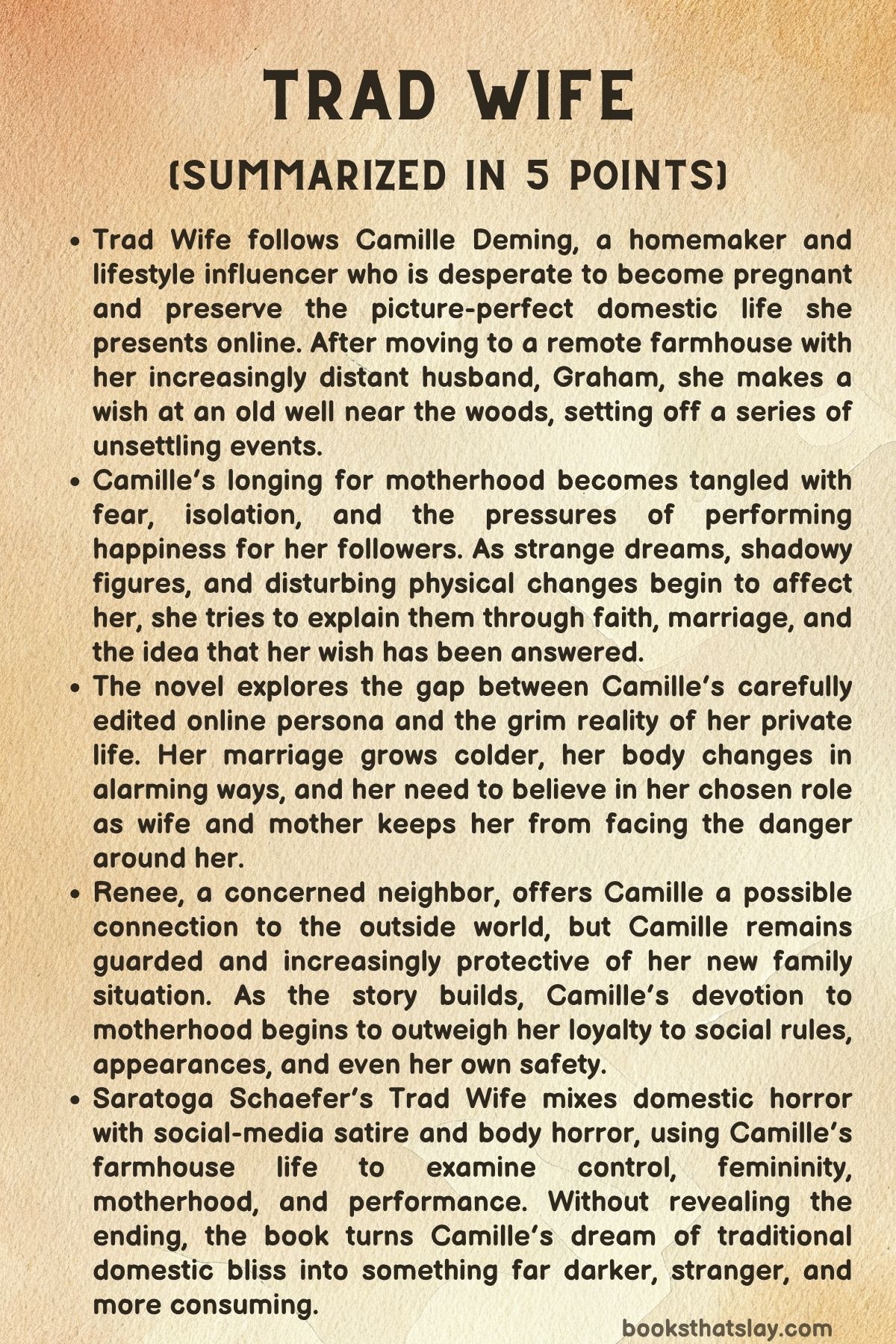
Trad Wife by Saratoga Schaefer is a domestic horror novel about Camille Deming, a young homemaker and lifestyle influencer whose longing for pregnancy becomes tied to her carefully curated image of marriage, faith, femininity, and rural perfection. Living in an isolated farmhouse with her increasingly distant husband, Graham, Camille tries to turn herself into the ideal traditional wife she admires online.
But after making a wish at an old well near the woods, she attracts something inhuman. The book uses pregnancy horror, body horror, religious fear, and influencer culture to show Camille’s transformation from controlled wife to monstrous mother.
Summary
Camille Deming wants her life to look perfect. She is a homemaker and lifestyle influencer who presents herself online as a devoted wife, a graceful cook, and a woman made for domestic beauty.
Her marriage to Graham is part of that image, but the most important missing piece is a baby. Camille films herself taking a pregnancy test, hoping to capture a tender announcement for her followers, only to see that the test is negative.
She deletes the footage, hides the evidence, and returns to the work of making dinner before Graham comes home.
Camille and Graham have recently moved into a remote farmhouse surrounded by wheat fields, trees, and open land. Camille has turned the house into a version of the traditional-wife dream she follows online, inspired especially by the famous influencer Mara Shoemaker.
She fills the space with rustic beauty, careful meals, soft clothes, and the appearance of calm devotion. Yet the house is lonely.
Graham is often late, vague, and emotionally absent, and Camille senses that the marriage is weakening. She believes a baby might save it, while also giving her online life the purpose and attention she craves.
One day, while walking through the wheat field, Camille discovers an old well near the edge of the forest. It reminds her of childhood memories with her late mother, who used to make wishes with her.
Camille throws a penny into the well and wishes for a baby. The well responds in a strange and frightening way.
Her phone light seems to vanish inside it, dark shapes move below, and time appears to slip away. After this, Camille’s life begins to change.
She notices disturbing signs around her. A photo of the well appears to contain a shadow like an arm.
At night she dreams of a huge winged eye on her ceiling, asking why she wants a child. She wakes thinking she has tasted blood, although her glass contains only water.
A neighbor named Renee Colt visits with a pie and tries to be friendly, but she also warns Camille to stay away from the woods. Camille does not know what to make of Renee’s concern, and she remains cautious around her.
The haunting grows stronger. Camille hears footsteps, smells damp earth and stone inside the house, and sees shadows near the property.
The eye returns in dreams, pressing her about her desire for a baby. Rather than seeing the presence only as evil, Camille starts to believe it may be an angel.
Graham once told her that biblical angels can look terrifying, and this idea gives her a way to understand what is happening. When a gray, winged, horned creature appears in her bedroom, she faints.
Graham finds her afterward, shows brief concern, and then asks about dinner, making clear how little he truly sees her fear.
Graham’s distance worsens. He stays out late, smells of perfume, and eventually leaves overnight, saying he is staying with a friend.
While he is gone, Camille sees the creature again. Convinced that it has come in answer to her wish, she gives herself to it.
The encounter happens during a storm, and afterward the creature vanishes into the wheat field.
Soon Camille’s body changes violently. She vomits dark blood and finds that her stomach has swollen almost at once.
Pregnancy tests confirm that she is pregnant, but the pregnancy does not behave normally. The baby seems to kick almost immediately.
Camille tells herself the pregnancy is divine and prepares to announce it to Graham. His reaction is not as joyful as she hoped, but Camille edits the footage so it looks happy before sharing it online.
Her followers celebrate the news, giving her the approval she wanted.
The pregnancy moves at an unnatural speed. Camille becomes weak and ill.
Her cravings turn strange and alarming: raw meat, blood, butter, and other rich, bodily foods. Graham takes her to a church, perhaps hoping religion will steady their lives, but the service makes Camille violently sick.
She runs outside, vomits a dark mudlike sludge, and finds a copper penny in it. The penny horrifies her because it connects the pregnancy back to the well.
She hides this from Graham.
During this time, Renee continues to visit and grows more concerned. She sees Camille’s sickness, Graham’s controlling behavior, and the danger surrounding the woods.
Camille feels some closeness to Renee but cannot fully trust her. She is too committed to preserving her image and protecting the pregnancy.
The creature stops appearing after the church incident, and Camille misses it, even as her body breaks down. She remains trapped in routines of cooking, cleaning, filming, and pretending, telling herself she must love the life she chose.
Camille goes into sudden early labor while Graham is at work. The birth is horrific.
Instead of normal fluid, a thick white substance mixed with blood pours from her body. The labor is fast, brutal, and nearly unbearable.
The creature enters through the sliding glass door and watches her suffer for hours before finally helping her remain upright. When the baby is born, the creature catches her, bites through a green umbilical cord, and disappears.
Camille sees that her daughter has pure white eyes like the creature.
Camille and Graham call the baby Sweetheart. Online, Camille presents her as perfect, carefully editing every photo so no one can see her strange coloring or eyes.
Graham believes Renee helped with the birth because Camille lies to cover what really happened. Sweetheart sleeps whenever Graham is nearby, hiding her true nature from him.
Camille, however, sees everything. The baby has gray-green skin, smells faintly of soil, is unusually heavy, and refuses formula.
Sweetheart’s hunger soon reveals itself. She bites off two of Camille’s toes and drinks from the wounds.
Camille tries feeding her raw meat, but Sweetheart rejects it. Desperate to keep her daughter alive, Camille cuts flesh from her own stomach and feeds it to the baby.
Sweetheart grows with unnatural speed. She develops sharp reptilian teeth, gains strength, crawls, sits, and advances far beyond any normal infant.
Camille continues to feed her with pieces of her own body and blood.
Outside the house, the creature begins leaving dead animals for Camille. Camille herself develops a hunger for raw meat and starts eating the carcasses at night.
Her body and instincts change as Sweetheart grows. Graham still drifts in and out of the role of husband and father, sometimes attempting tenderness but mostly remaining selfish and removed.
Camille resists his sexual demands because she has just given birth, because her body is wounded, and because she no longer belongs to him in the same way.
At dinner one night, Graham speaks about fallen angels, Nephilim, and angels mating with human women. His words confirm Camille’s fear that Sweetheart’s father was not holy.
The creature may not be an angel of God at all. Still, Camille decides that Sweetheart’s origin does not matter.
Sweetheart is her daughter, and Camille will protect her from anyone who threatens her.
Sweetheart’s appetite soon becomes too much for Camille alone. Renee visits again, ignores Camille’s boundaries, and picks up the baby.
She sees Sweetheart’s white eyes. Sweetheart bites into Renee’s arm, and Renee panics, calling the baby “it.” Camille reacts with violence, striking Renee in the head with a marble rolling pin.
Renee dies. Camille drags the body into the wheat field, where Sweetheart feeds on it for days and grows even faster.
Camille disposes of the bones by throwing them into the bottomless well.
Camille later learns from a neighbor, Bill, that Renee’s family left long ago after a divorce and custody fight, meaning her absence may not be noticed quickly. But Officer Lipton eventually comes asking questions.
He sees Sweetheart’s unnatural size and eyes, and Camille knows he is a threat. She uses Sweetheart to distract him, and Sweetheart attacks.
Camille helps hide the death, dragging the body away and throwing his belongings into the well.
Graham finally begins to suspect Camille’s lies, especially her claim that Renee delivered the baby. Their confrontation exposes the truth of his affair with Rose and his plan to seek an annulment.
He tells Camille she is not the woman he married and that their relationship is over. Camille realizes he may try to take Sweetheart from her or expose what Sweetheart is.
When Graham goes to the nursery and sees Sweetheart awake, Camille attacks him. She bites into him and eats him while Sweetheart watches.
Afterward, Camille sees that her own eyes have turned completely white.
In the end, Camille takes Sweetheart outside to the creature. She accepts him, her daughter, and the new life waiting for her.
Together, they feed on what remains of the bodies. Camille walks through the wheat field toward the forest, leaving behind the farmhouse, her marriage, her online persona, and the role she once tried so hard to perform.
At the well, she drops in a penny, removes her old clothes, and follows Sweetheart and the creature into the trees. Her former life is over, and Camille chooses the monstrous family that has claimed her.
Characters
Camille Deming
Camille Deming is the central character of Trad Wife, and her journey forms the emotional and horror-driven core of the book. At the beginning, she appears as a young homemaker who is deeply invested in creating a perfect domestic life, both for herself and for her online audience.
Her identity is built around the image of being a graceful, traditional wife: cooking, decorating, smiling, filming, and presenting her marriage as peaceful and desirable. However, beneath this carefully arranged image, Camille is anxious, lonely, and desperate.
Her negative pregnancy test hurts her not only because she wants a child, but because motherhood has become tied to her worth as a wife, influencer, and woman. She believes a baby will complete her marriage, strengthen her public image, and give meaning to the life she has chosen.
Camille’s character is tragic because much of her suffering comes from the gap between appearance and reality. She wants to believe she is happy in the farmhouse, happy with Graham, and happy with the role she has built for herself, but the book gradually reveals that her domestic life is more like a cage than a dream.
She hides disappointment, edits videos to make painful moments look joyful, and constantly tries to make Graham’s neglect seem normal. Even when frightening supernatural events begin around her, she interprets them through the emotional need that dominates her life: the desire for a baby.
This makes her vulnerable to the creature, because she is willing to believe that something terrifying might also be divine if it offers her motherhood.
As Camille’s pregnancy and motherhood become more monstrous, her personality changes in a disturbing but understandable way. She becomes secretive, physically altered, morally flexible, and increasingly detached from ordinary human limits.
Yet the book does not present her simply as evil. Her actions are horrifying, especially when she kills Renee, helps cover up Officer Lipton’s death, and consumes Graham, but these choices come from a twisted version of maternal protection.
Once Sweetheart is born, Camille’s loyalty shifts completely from her marriage and online persona to her child. She stops trying to be the perfect wife and becomes something more primal: a mother who will feed, hide, and defend her daughter at any cost.
By the end, Camille’s transformation is both physical and symbolic. Her white eyes show that she has crossed fully into Sweetheart and the creature’s world.
She no longer belongs to the farmhouse, to Graham, to social media, or to the fantasy of traditional domestic perfection. Her final act of shedding her old clothes and walking into the forest suggests that she has abandoned the identity she once tried so hard to perform.
Camille is one of the most complex figures in the book because she is victim, believer, mother, killer, and transformed being all at once.
Graham Deming
Graham Deming is Camille’s husband and one of the main sources of emotional pressure in the story. He is not openly monstrous in the same supernatural way as the creature or Sweetheart, but his coldness, neglect, and selfishness make him deeply important to Camille’s decline.
At first, he seems like the husband at the center of Camille’s homemaker fantasy: the man she cooks for, waits for, films around, and hopes to please. However, his actions quickly reveal that he does not truly value the emotional labor Camille puts into their life.
He comes home late, gives little attention to her fears, and responds to her distress with concern only when it inconveniences him.
Graham’s role in the book is to expose the emptiness behind Camille’s idealized marriage. He benefits from her devotion without giving her the affection, honesty, or partnership she needs.
When Camille faints after seeing the creature, Graham’s concern quickly gives way to asking whether dinner has been made, showing how naturally he reduces her to her domestic usefulness. His distance, the scent of perfume, and later the revelation of his affair with Rose confirm that he has already emotionally abandoned the marriage while Camille is still fighting to preserve it.
His reaction to Camille’s pregnancy is also revealing. Camille wants the pregnancy to be a shared miracle, but Graham’s hesitation shows that he is not as invested in the family ideal as she is.
He is willing to perform happiness when necessary, but he does not truly enter Camille’s world of hope, fear, or devotion. His later interest in fallen angels, Nephilim, and supernatural conception briefly makes him seem more aware, but this awareness does not lead to compassion.
Instead, when he confronts Camille, he focuses on escape, annulment, and control.
Graham becomes most threatening when he suggests that Camille could lose the life and child she has chosen. His plan to leave her and possibly challenge her connection to Sweetheart turns him from a neglectful husband into a danger.
Camille’s decision to kill and eat him is horrific, but within the dark logic of the story, it is also the final destruction of the marriage that has trapped her. Graham represents the failure of the traditional husband figure Camille once worshipped.
He is not strong, protective, or faithful; he is selfish, cowardly, and ultimately disposable in the new family Camille chooses.
Sweetheart
Sweetheart is Camille’s daughter and the most important symbol of the story’s transformation from domestic fantasy into body horror. She is born from a supernatural union between Camille and the creature, and from the moment of her birth she is clearly not an ordinary child.
Her white eyes, gray-green skin, strange weight, unusual smell, and rapid development all mark her as something outside human nature. Yet Camille names her Sweetheart, a soft and affectionate name that contrasts sharply with the baby’s terrifying needs.
This contrast captures the central tension of her character: she is both a beloved daughter and a monstrous being.
Sweetheart’s hunger defines much of her role in the book. She cannot live on ordinary formula or food, and she quickly teaches Camille what she needs by biting off her toes and drinking from the wounds.
Her feeding is gruesome, but it also creates a disturbing version of the mother-child bond. Camille gives her own flesh and blood to keep Sweetheart alive, turning motherhood into literal bodily sacrifice.
Sweetheart’s hunger grows beyond Camille’s body, leading to Renee’s death, Officer Lipton’s death, and the consumption of Graham. Through Sweetheart, the book turns the ideal of nurturing motherhood into something violent, physical, and impossible to sanitize.
Although Sweetheart is frightening, she is not portrayed as merely a villain. She is a child acting according to her nature.
She sleeps around Graham, hides her abnormalities unintentionally or instinctively, and depends on Camille for protection. Her violence comes from hunger, fear, and survival rather than human malice.
When Renee calls her “it,” Camille reacts so strongly because Sweetheart’s humanity, at least in Camille’s eyes, is being denied. To Camille, Sweetheart is not a monster to be rejected but a daughter to be defended.
Sweetheart also becomes the force that frees Camille from her former life. Her existence makes it impossible for Camille to continue performing the role of perfect wife and influencer forever.
Every part of Sweetheart’s body and appetite exposes the falsehood of Camille’s curated domestic image. By the end, Sweetheart leads Camille away from the farmhouse and toward the forest, becoming both child and guide.
In Trad Wife, Sweetheart represents a terrifying form of rebirth: she destroys Camille’s old world while giving her a new identity rooted in blood, hunger, and unconditional attachment.
The Creature
The creature is one of the most mysterious and powerful figures in the book. It first appears through signs rather than direct explanation: the strange well, the swallowed light, the shadowy shape in the photograph, the smell of damp soil and stone, the dreams of a huge winged eye, and the sense of something watching Camille.
These early appearances make the creature feel ancient, hidden, and connected to the land around the farmhouse. It is frightening because it does not behave like a familiar human threat.
It belongs to the woods, the well, the dark, and the unknown.
Camille’s interpretation of the creature is shaped by her desperation. Because she wants a baby so badly, she convinces herself that the creature may be an angel sent to help her conceive.
Its terrifying form, with wings, horns, grayness, and an inhuman presence, becomes easier for her to accept when she remembers that biblical angels can appear frightening. This self-deception is central to her relationship with the creature.
She does not fully understand what it is, but she gives it meaning based on what she needs it to be. Her belief turns fear into devotion and violation into miracle.
The creature’s actions are ambiguous. It does not speak clearly or explain itself, and it often watches rather than intervenes.
During Camille’s labor, it observes her suffering for hours before finally helping her. After Sweetheart is born, it catches the baby and bites through the strange umbilical cord, behaving almost like a silent father or midwife.
Later, it leaves dead animals for Camille, feeding the hunger that develops in her. These actions suggest a bond, but not necessarily tenderness in a human sense.
The creature seems to operate according to an older, more instinctive set of rules.
By the end, the creature becomes part of Camille’s chosen family. Once Graham is gone and Camille’s transformation is complete, she accepts the creature not as an angelic savior but as the father of Sweetheart and the being connected to her new existence.
It represents everything Camille once feared and everything she eventually becomes willing to embrace. The creature is not simply a monster; it is a force that exposes Camille’s hidden desires, breaks apart her false life, and draws her into a darker world where she finally stops pretending.
Renee Colt
Renee Colt is Camille’s neighbor and one of the few genuinely concerned human figures in the story. She enters the book with a homemade pie and an attempt at friendship, which immediately places her in contrast to the isolation of Camille’s farmhouse life.
Renee notices more than Camille wants her to notice. She warns Camille about the woods, worries about her pregnancy, questions Graham’s behavior, and keeps returning even when Camille is guarded.
Her concern makes her both comforting and dangerous, because she threatens the secrecy Camille depends on.
Renee functions as a voice of ordinary human reality. While Camille tries to interpret supernatural horror as divine blessing and domestic suffering as marital duty, Renee sees warning signs.
She recognizes that Graham is controlling or neglectful, that Camille’s pregnancy seems wrong, and that something about the farmhouse and woods is unsafe. However, Renee never fully understands the scale of what is happening.
This partial awareness makes her tragic. She gets close enough to sense danger, but not close enough to protect herself from it.
Her death marks one of Camille’s most important moral turning points. When Renee sees Sweetheart’s white eyes and calls the baby “it,” Camille’s protective instincts overpower any remaining loyalty to ordinary morality.
The killing is sudden, brutal, and deeply revealing. Camille does not kill Renee because Renee has harmed her in the usual sense; she kills her because Renee has seen too much and has rejected Sweetheart’s identity as a child.
In that moment, Camille chooses monstrous motherhood over human friendship.
Renee is also significant because her disappearance shows how isolated the setting truly is. The revelation that her family has already left means that the social world around her is weaker than expected.
There are fewer immediate consequences, fewer people to search, and fewer protections against Camille’s new life. Renee’s character brings warmth, suspicion, and human concern into the story, but her fate shows that compassion is not strong enough to survive once Camille fully commits to protecting Sweetheart.
Mara Shoemaker
Mara Shoemaker is not physically central to the plot, but her influence over Camille is extremely important. As a famous lifestyle influencer, Mara represents the idealized traditional-wife aesthetic Camille admires and tries to imitate.
Camille’s farmhouse, cooking, clothing, social media content, and emotional performance are all shaped by the kind of life Mara appears to embody. In this sense, Mara functions less as a direct participant and more as a symbol of the fantasy that traps Camille.
Mara’s importance lies in the pressure she creates from a distance. Camille does not simply want to be happy; she wants to look happy in a specific, curated way.
She wants the rustic home, the beautiful meals, the devoted marriage, the pregnancy reveal, and the soft domestic glow that influencers like Mara make desirable. This kind of influence is powerful because it turns private life into performance.
Camille’s pain becomes something to hide, edit, or reframe for an audience.
Through Mara, the book critiques the seductive nature of online domestic ideals. Camille’s desire for a baby is genuine, but it is also tangled with the image of motherhood she wants to publish.
Her marriage is troubled, but she keeps trying to make it appear stable. Mara represents the unreachable standard that keeps Camille performing even when her body and mind are breaking down.
The more horrifying Camille’s life becomes, the more disturbing her commitment to presentation appears.
Mara is therefore an indirect antagonist of sorts, not because she personally harms Camille, but because the lifestyle she represents helps shape Camille’s self-deception. Camille’s obsession with becoming the perfect homemaker makes it harder for her to admit danger, loneliness, or failure.
Mara’s presence in the book shows how fantasy can become a form of control even when it arrives through beauty, inspiration, and aspiration.
Camille’s Mother
Camille’s late mother appears mainly through memory, but her emotional influence is important. The memory of making wishes with her mother gives the well its first personal meaning for Camille.
When Camille throws the penny into the well and wishes for a baby, she is not only acting from desperation; she is also reaching back toward childhood, grief, and a lost sense of comfort. The wish connects the supernatural horror of the story to something tender and familiar.
Camille’s mother represents a softer version of womanhood and motherhood than the one Camille experiences in her marriage. The remembered act of wishing suggests intimacy, hope, and emotional connection.
This contrasts with Camille’s adult life, where domesticity is full of pressure, performance, and loneliness. Her mother’s memory becomes part of why Camille is willing to believe in the wish.
The act feels innocent because it is tied to someone she loved.
At the same time, the memory also shows how dangerous longing can become when grief and desire are mixed together. Camille’s wish is simple, but the answer she receives is horrifying.
The well twists a childhood ritual into something dark and irreversible. Her mother does not cause the events of the story, but the memory of her helps open the emotional doorway through which Camille approaches the well.
Camille’s mother also deepens Camille’s longing to become a mother herself. The loss of her own mother may intensify her desire to create a new bond, one that cannot abandon her.
This makes Sweetheart’s arrival more powerful, because Camille’s love for her daughter fills an emotional emptiness that existed long before the creature appeared. The mother’s role is quiet, but she helps explain why Camille’s wish carries so much force.
Rose
Rose is Graham’s affair partner and a largely off-page character, but she has an important effect on the story. She represents the betrayal Camille has suspected but tried not to fully face.
The smell of perfume on Graham and his increasing distance already suggest that his loyalty is broken, but Rose gives that betrayal a name. Once Camille learns about her, the fantasy of her marriage becomes impossible to maintain.
Rose’s role is significant because she exposes Graham’s hypocrisy. While Camille is sacrificing her body, sanity, and safety to preserve the marriage and become a mother, Graham is building an escape route elsewhere.
His affair shows that he has been emotionally absent not simply because of stress or confusion, but because he has chosen another life. Rose therefore becomes the proof that Camille’s devotion has not been returned.
Although Rose does not directly confront Camille, her existence sharpens Camille’s sense of threat. Graham’s affair is not just romantic betrayal; it is connected to his plan to seek an annulment and separate from Camille.
That makes Rose part of the chain of events that leads Camille to see Graham as a danger to Sweetheart. If Graham can leave Camille, expose her, or challenge her motherhood, then he becomes an enemy.
Rose also serves as a contrast to Camille’s decaying domestic ideal. Camille has tried to be the perfect wife, but Graham still turns away from her.
This undercuts the belief that obedience, beauty, homemaking, and devotion can guarantee love. Rose’s presence in the book helps destroy the illusion that Camille can save her marriage by performing the role of wife more perfectly.
Bill
Bill is a minor but useful character because he provides information about Renee’s life and absence. When Camille learns from him that Renee’s family left long ago after a divorce and custody battle, she realizes that Renee’s disappearance may not be noticed as quickly as it otherwise would be.
This detail helps Camille understand that the consequences of Renee’s death can be delayed or avoided, at least temporarily.
Bill’s role is grounded in the ordinary social world outside Camille’s farmhouse. He is not involved in the supernatural events, but his conversation gives Camille practical knowledge that helps her continue hiding what has happened.
In a story filled with strange hunger, monstrous birth, and transformation, Bill represents the casual neighborly reality that still exists around the edges.
His importance also lies in what he does not know. Bill has no idea that his information is helping Camille conceal a murder.
This makes him part of the book’s atmosphere of isolation and secrecy. People nearby may talk, visit, or notice small things, but they do not truly understand what is happening in Camille’s home or in the wheat field.
Bill’s character shows how easily horror can remain hidden when a community is already fragmented. Renee’s family situation, the remote farmhouse, and the lack of immediate social connection all give Camille room to continue.
Bill does not drive the plot emotionally, but he helps reveal how the outside world fails to interrupt Camille’s descent.
Officer Lipton
Officer Lipton represents official authority and the possibility that Camille’s secrets might finally be exposed. When he comes asking about Renee, he brings the outside world directly to Camille’s door.
Until this point, Camille has been able to manage suspicion through lies, isolation, and careful performance. Officer Lipton’s presence threatens that control because he is trained to question inconsistencies and notice evidence.
His encounter with Sweetheart is crucial because he sees too much. Unlike Graham, who misses or avoids the truth, and unlike Renee, whose concern is personal, Officer Lipton approaches the situation from a position of investigation.
Sweetheart’s unnatural size and eyes make it impossible for Camille to maintain the illusion of normal motherhood. His discovery turns him from a visitor into a threat.
Camille’s response to Officer Lipton’s death shows how much more practiced she has become at violence and concealment. By this point, she is no longer simply reacting in panic.
She uses Sweetheart as a distraction, helps cover up the death, moves the body, and throws his belongings into the well. The killing confirms that Camille has crossed into a new moral state where protecting Sweetheart matters more than law, guilt, or fear.
Officer Lipton’s role in Trad Wife is brief but important because he represents the collapse of ordinary accountability. If even a police officer can be consumed and erased, then Camille’s new family has moved beyond the reach of normal human systems.
His death makes the story feel more final, showing that there may be no easy rescue, exposure, or return to the life Camille once knew.
Themes
Performance and the Cost of Living for an Audience
Camille’s life is shaped by the need to appear fulfilled before she can honestly understand whether she is fulfilled. Her home, marriage, pregnancy hopes, meals, clothing, and even emotional reactions are arranged for the camera.
The negative pregnancy test matters not only because it disappoints her privately, but because it ruins the kind of joyful scene she hoped to post. In Trad Wife, social media turns domestic life into a stage where sincerity becomes difficult to separate from branding.
Camille edits Graham’s weak reaction to her pregnancy so that it looks loving, hides Sweetheart’s strange body from followers, and continues presenting beauty while her real life becomes violent and grotesque. This theme shows how constant performance can trap a person inside the image she has built.
Camille does not simply lie to others; she learns to lie to herself. The more horrifying her reality becomes, the harder she works to preserve the fantasy, because admitting the truth would mean losing the identity that gives her purpose.
Domestic Ideals, Control, and Female Self-Erasure
Camille’s dream of being a perfect homemaker is not peaceful or empowering in practice; it becomes a system of self-erasure. She measures her worth through cooking, pleasing Graham, becoming pregnant, and maintaining a beautiful home.
Even when Graham neglects her, stays out late, smells of another woman, and shows little care for her suffering, Camille keeps trying to perform devotion. The farmhouse, with its careful rustic beauty and isolation, becomes a physical symbol of the life she believes she must love.
Her desire for a baby is tied to love, status, and security, but it also reveals how little space she has allowed for her own needs. The horror grows from this imbalance: Camille’s body is expected to give endlessly, first emotionally, then physically, then literally as Sweetheart feeds from her flesh.
The domestic ideal demands sacrifice, and Camille’s sacrifice becomes monstrous because she has been taught to value herself mainly through service, obedience, and motherhood.
Motherhood as Devotion, Possession, and Transformation
Motherhood in Trad Wife is shown as both fierce love and consuming possession. Camille begins by wanting a child to complete her marriage and online identity, but once Sweetheart is born, her attachment becomes far deeper and more dangerous.
Sweetheart’s needs are horrifying, yet Camille accepts them with increasing certainty. She feeds the baby from her own body, kills Renee when Sweetheart is threatened, helps cover up further deaths, and finally kills Graham when he becomes a danger to their bond.
The theme is not simply that motherhood makes Camille protective; it transforms her values, body, appetite, and moral boundaries. Sweetheart gives Camille a purpose stronger than the fake domestic role she previously served.
By the end, Camille is no longer pretending to be the ideal wife. Her white eyes show that motherhood has remade her into something outside human society.
The child she wished for destroys her former life, but also frees her from it in a terrifying way.
Religion, Desire, and the Misreading of the Monstrous
Camille repeatedly tries to explain the creature through belief because faith gives her fear a usable shape. The winged eye, the strange dreams, and the creature’s frightening body could signal danger, yet Camille chooses to see holiness because she needs the pregnancy to feel meaningful.
Her interpretation is shaped by desperation: if the creature is an angel, then her wish has been answered, her suffering has purpose, and her child is divine rather than monstrous. The church scene breaks this illusion when her body violently rejects the sacred space and produces the penny, reminding her that the well, not God, answered her wish.
Graham’s later comments about fallen angels and Nephilim make the truth harder to ignore, but Camille eventually decides origin matters less than loyalty. This theme examines how people can reshape frightening evidence to fit what they need to believe.
Desire becomes stronger than warning, and Camille’s hunger for meaning leads her toward a new, darker faith.