Humboldt Cut Summary, Characters and Themes
Humboldt Cut by Allison Mick is a folk-horror thriller rooted in Northern California’s redwood country, where old logging violence, family secrets, and a living forest collide. The story moves between a deadly mid-century timber operation and a present-day return to Humboldt for a funeral that turns into a search-and-survival nightmare.
At its center is Jasmine Bay, a hospital nurse carrying deep grief and anger, pulled back into the place that raised her and scarred her. What begins as a tense homecoming becomes a confrontation with a local legend, a hidden ecology of power, and the brutal cost of what the forest is owed.
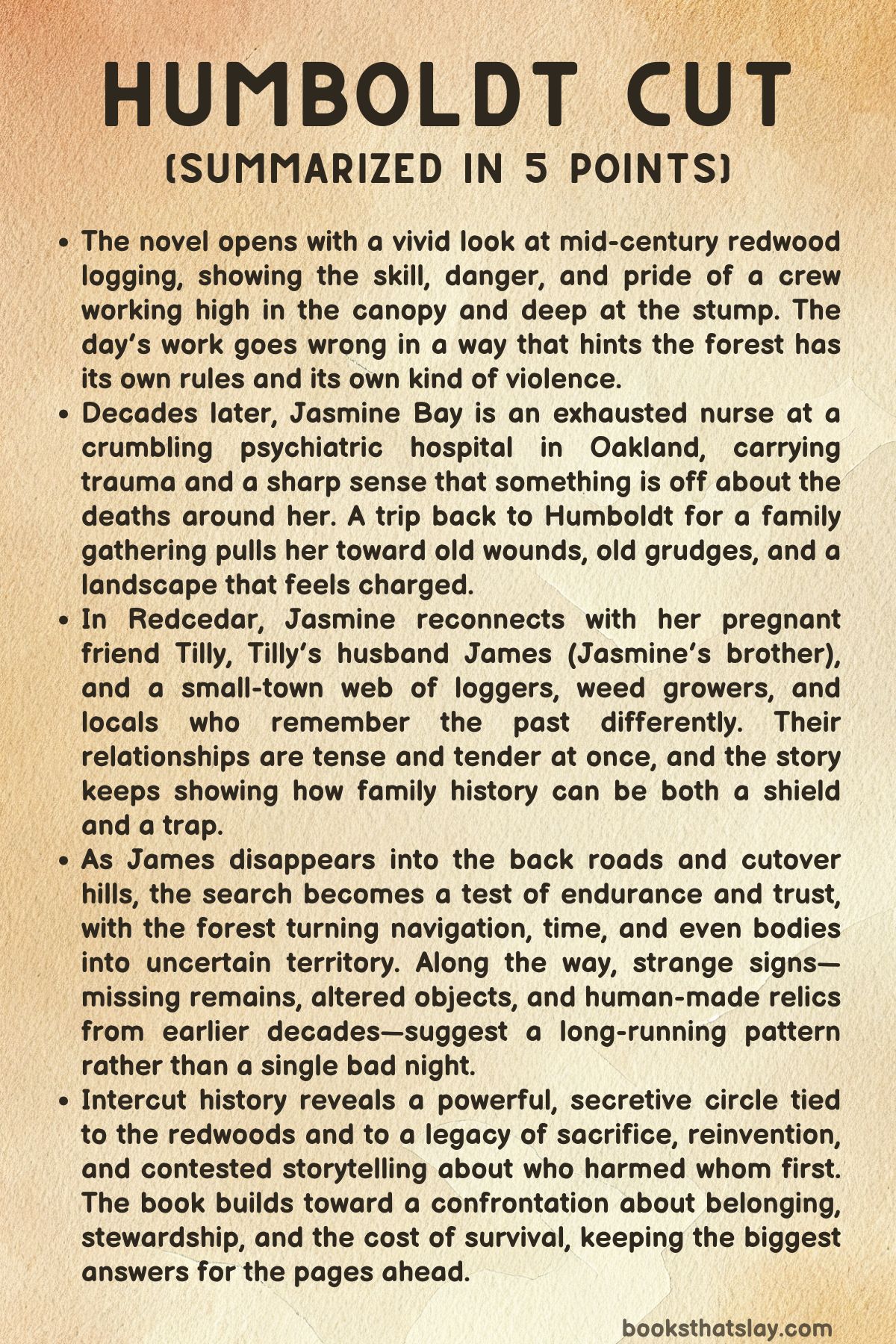
Summary
In 1951, a logging crew works deep in a redwood grove to bring down a massive, ancient tree. The foreman treats the site with a kind of reverence, but the job is still hard, dangerous labor.
Two young fallers carve a wedge cut while a high rigger sets cables overhead. A fifteen-year-old new kid is shown the basics, including how to build a bed of smaller trees to soften the redwood’s fall.
The crew even takes a photo inside the enormous cut, smiling like tourists inside something sacred and dead. The tree drops cleanly, and they begin slicing the trunk into sections to haul down the mountain.
The day turns into slaughter. The greenhorn steps beside the foreman and is abruptly crushed by a huge falling branch.
Then more branches start dropping in rapid succession, like the canopy itself has decided to fire. Men are killed and impaled across the work site.
In the silence that follows, the foreman hears a strange coughing bark and glimpses hairless, rust-speckled humanoids moving through the trees with impossible speed. He hides, terrified, until the high rigger, Whipple, pulls him away and forces him into a cave shaped by roots.
The foreman, shaken and panicking, runs out. A creature drops down and kills him instantly.
Whipple covers the body and finds one injured man—one of the Toms—and drags him into the root cave. Whipple retrieves the foreman’s camera, leaves in the foreman’s truck, and drives deeper into the forest rather than toward help.
In the cave, the injured Tom’s screams shift into the same rough barking. His skin begins to change.
Decades later, Jasmine Bay works as a nurse in Oakland at a crumbling psychiatric facility. She is used to death, neglect, and the uneasy feeling that the place is built to let people disappear.
One day she finds a sedated patient who has hanged himself using exposed pipes. The cleanup is routine in the worst way.
Another patient, Freddie, insists the institution is trying to kill them, and he accuses Jasmine of being part of it. She is then belittled by a doctor who misreads her role and talks down to her.
Jasmine carries her anger like a tool.
Jasmine heads north to Humboldt for the funeral wake of Aunt Gin, the woman who raised her and her brother James. An orderly from her hospital, Henry, drives her.
He is awkwardly devoted to her and wants closeness she doesn’t offer. On the way they stop at a roadside attraction where redwood kitsch and a staged “tree accident” unsettle Henry.
Nearby, a drifter who has been living between farms and forests is refused a ride, wanders into the attraction, and is killed by a camouflaged, burl-like predator. His body is reduced into soil as if the ground is hungry.
In Redcedar, Tilly—pregnant—and her husband James attend Gin’s funeral and fend off Gin’s strange friends, older women who talk about the forest like a church and behave like they have a claim on the house. Tilly tries to keep control of the home and the day.
James, meanwhile, works at a lumber company yard and endures racist and sexual taunts from coworkers. The tension between James and Jasmine runs deep, and it doesn’t take much for old arguments to surface: family history, resentment, and the way they survived childhood differently.
Jasmine meets James and Tilly, but the reunion quickly turns sharp. During an argument in the car, Henry mentions Jasmine’s mother, and Jasmine reacts with sudden fury and pain, bailing out of the car near a clear-cut.
Henry follows her into the stump-filled hillside where ATV riders circle like guards. The riders look threatening—skull masks, rifles—but the leader is Buck, a big Native man who treats Jasmine like family.
The men are protecting a marijuana grow. Jasmine mocks their performance and moves on with Henry.
That night they gather at the Skyliner, the only bar in town, a dive filled with logging memorabilia and old news clippings. The bartender, Aunt Charlyne, knows Jasmine from her teen years.
In the back room, drinking loosens everyone’s restraint. Henry notices a headline about a local saboteur and learns about Jasmine and James’s white grandfather, William “Grampdaddy” Whipple.
According to town lore, he was a logger who turned against logging, committed acts of sabotage, and may have caused deaths. The siblings argue over whether Whipple was a monster, a martyr, or both.
The argument cracks open a childhood memory: their mother, Marian, suffering a terrifying breakdown in a restaurant, believing something in the world was coming for her and her children. She set herself on fire, and Jasmine had to drag James away as he tried to go back and save her, burning his arm in the process.
At the wake, Gin’s friends arrive drunk or high and try to run the evening, decorating the stage with cheery nonsense that feels wrong. When Jasmine speaks about Gin’s role in raising them, local men heckle and insult Gin, then throw racist slurs at Jasmine and James, calling their family a curse on Humboldt.
Jasmine snaps. Outside, the confrontation becomes a brutal fight, and Jasmine is frighteningly effective, using an axe head as a weapon.
Henry gets hit, then retaliates. In a rush of adrenaline and confusion, Jasmine kisses Henry hard, then recoils from what she’s done and runs back inside.
Later, James disappears. Tilly receives a call from him—he sounds hurt and lost in the woods—then the call drops.
When they reach Gin’s property, they discover the grave has been disturbed. The body is gone.
In its place is a human-shaped outline made of carefully laid pine needles. Inside the house, Jasmine finds a sketch of the same outline in Gin’s medication log.
Buck arrives with supplies, and the group decides to search immediately, knowing law enforcement won’t move fast enough.
James’s path into the woods is a sequence of dread: a near collision with a white pickup, a glimpse of a huge-eyed human-shaped figure, a crash, and then a desperate stumble deeper among old logging roads and cables. He is injured by a shifting stump and stabbed by roots, then chased by something that moves too fast to be only human.
While searching, Jasmine notices a disturbing change in herself. Her constant aches and sadness fade.
The forest air makes her feel strong, hungry, and wired. Her thoughts narrow into sensation and impulse.
She throws herself at Henry, trying to force intimacy. Henry tells her to stop and pushes her away.
Shame hits hard, and Jasmine runs, moving with shocking speed. Moments later Henry falls into a hidden hole, and Jasmine slips in after him as a figure watches from above.
They are rescued by Buck and by Doug, one of the ATV men from earlier. Doug claims he has found James’s truck, but the vehicle looks impossibly old and overgrown, as if decades passed in hours.
They camp nearby. Henry finds old newspapers and Polaroids showing dead and injured loggers, linked to Whipple.
During the night, a cable snaps overhead and Doug is killed violently. Bark-skinned humanoids attack.
The survivors fight with rope, axe heads, and fury. When the chaos ends, they notice something worse: a severed creature arm bears a tattoo.
These things were people.
At dawn the bodies are gone, absorbed by the forest, leaving only pine-needle outlines. Buck is missing too, marked by a larger outline that suggests he died.
Jasmine and Tilly argue, each blaming the other, but they keep moving. They steal Doug’s ATV and race along logging roads while creatures shadow them through the trees and along the skyline of ridges.
They reach a small cabin with a plastic water tank and barricade themselves inside. To their horror, they find James hiding under the sink—alive, but visibly altered: pale, cracked skin, distended eyes, long nails, and a dried-out body that still insists it feels “great.” James admits he drank from the tank and sensed something inside the water.
He believes the forest is repairing him. Jasmine sees the truth: it is remaking him.
Inside the cabin they find paperwork and photos connecting the place to their family. A photograph shows a white man, a pregnant Black woman, and their daughter on the porch—evidence that the family story Jasmine and James grew up with is incomplete or deliberately false.
James claims Whipple was never the hero Jasmine wants him to be. The past is full of planted myths.
The narrative then reveals the deeper history. Jeanne Whipple—who later becomes known as Gin—survived a fall in 1960 by drawing strength from an underground network of life.
She met Charlyne as a child and later drew other women into her circle, including Victoria and Nancy. Over years they formed a secret congregation.
Jeanne was tied to a vast forest power that demanded feeding. The women offered it blood and bodies: runaways, hitchhikers, loggers, and even children.
Jeanne wanted companionship more than worship, but she accepted their devotion as her needs and grief hardened.
Jeanne loved William Whipple and gave him a daughter, Marian. The child changed William’s loyalties, and Jeanne’s jealousy became fury.
When William died in 1980—hanged by loggers after escalating conflicts and sabotage—Jeanne tried to bring him back, but the forest refused. Grief curdled into hatred of Marian, who fled and built a life in Oakland.
Jeanne’s network watched Marian from afar through animals and insects, waiting.
When Marian’s life collapsed after her husband’s death and her own terror spiraled into self-immolation, Jeanne seized the chance. Because Jeanne was “dead” on paper, the women crafted a new identity for her: Virginia “Gin” Jones.
She took custody of Jasmine and James as a godmother and raised them in Humboldt under the forest’s shadow. The siblings survived, but adolescence fractured them, especially as Tilly and James became entangled and Jasmine’s despair turned inward.
Back in the present crisis, the survivors attempt to escape beneath the cabin and along gullies, but the forest tightens around them. In the final confrontation, fire spreads near a root cave as the women from Gin’s circle try to recruit Tilly back into the tradition of sacrifice.
Tilly refuses. Jasmine dies in the flames—then is immediately remade.
The forest resurrects her as its new vessel, and her rage turns outward. She confronts Jeanne/Gin for hoarding power and for failing to truly protect what she claimed to serve.
Jasmine triggers a massive wildfire and channels the forest’s force into violent regrowth, pushing roots and green across California, toppling human infrastructure and turning cities into overrun wilderness. She kills key members of the old circle, spares Nancy, and then absorbs Henry and Tilly into herself, stripping them of autonomy.
In the end, Jasmine frames her transformation as salvation, keeping Marian alive and trapped in a hospital while forcing a twisted “reunion” through invasive fungal growth. She declares she is saving the world, even as the boundary between protection and domination disappears.
Characters
The Foreman (1951)
The older foreman is introduced as a man who treats the redwood grove like a cathedral and his work like a craft, which immediately frames him as someone who carries reverence alongside ruthlessness. His cherished Kodak camera matters because it reveals the way he wants to fix meaning in place—proof of competence, proof of beauty, proof that what they do is historic—yet the photograph inside the redwood’s “mouth” also becomes an omen, a souvenir of arrogance at the exact moment the forest is being opened and wounded.
He is paternal and practical with the fifteen-year-old greenhorn, coaching him through the unglamorous labor that makes the spectacle possible, and his attempt to reassure the boy about blistered hands shows a kind of rough care that cannot protect anyone from the larger system they’re inside. When the branch-fall massacre begins, the foreman’s instincts shift from mastery to animal survival, and his flight into hiding strips him of authority; the forest turns him from overseer into prey.
His death—sudden, brutal, and almost clinical—underscores a core theme of Humboldt Cut: human competence and tradition mean nothing when the land decides to answer back.
Tom (Faller, 1951) and Tom (Faller, 1951)
The two young fallers being identically named “Tom” makes them feel interchangeable, like workforce units rather than distinct lives, and that’s exactly how the logging operation treats them—skilled bodies on springboards cutting a notch that will decide the direction of a giant’s fall. Their presence embodies the pride and camaraderie of dangerous labor, especially during the photo moment where the crew smiles inside the wedge, but their individuality is intentionally blurred, suggesting how industrial extraction flattens personal identity.
The later horror—where one badly injured Tom is dragged to the root cave and begins transforming—turns that “interchangeability” into something grotesque: the forest does not just kill workers, it repurposes them. By making the Toms nearly indistinguishable at the start, the story prepares the reader for the most horrifying version of anonymity at the end—humans becoming bark-skinned figures who can no longer be recognized as themselves.
The Greenhorn (fifteen-year-old boy, 1951)
The greenhorn arrives as polite, eager, and fundamentally out of place, which makes him the emotional entry point into the logging world’s brutality. His willingness to take the photo so the foreman can be included reads as basic courtesy, but it also positions him as someone who wants belonging, approval, and a spot in the group memory—he’s literally trying to make room for others in the frame.
His blistered hands at the water tank are a quiet rite-of-passage moment that the crew treats as entertainment, exposing the culture of toughness that normalizes harm as initiation. His death is especially cruel because it is instantaneous and undeserved in the logic of work: he hasn’t “earned” the consequences yet, and the forest does not care.
The greenhorn’s vanishing mid-step is also a narrative pivot—his body becomes the first clear sign that the danger isn’t only human error or logging physics; something predatory and intelligent has entered the story.
Whipple (High rigger, 1951)
Whipple is initially a technical presence—high in the canopy, running cables, representing the unseen infrastructure that makes the fall possible—but he gradually becomes the story’s most chilling kind of survivor: the one who adapts. When the massacre begins, he appears not just competent but calibrated, pulling the foreman away, directing him into concealment, and behaving as if he understands more than he says.
After the foreman dies, Whipple’s decision to cover the body with debris, retrieve the camera, and drive away is not simple panic; it feels like the practiced concealment of someone who knows how disappearances get managed in these woods. His final turn—driving deeper into the forest toward home rather than toward town—recasts him as a man whose loyalties are not to the crew or the law but to whatever life he has carved out within the forest’s rules.
He becomes a bridge character between human industry and the forest’s counter-industry: extraction on one side, assimilation and secrecy on the other.
The Bark-Skinned Humanoids (“barkers”)
The barkers are not presented as a separate species so much as an outcome, a condition, and a warning. Their hairless, rust-speckled bodies and inhuman agility make them feel like evolved predators, but the most disturbing detail is their proximity to humanity: hoarse cough-barks, mottled skin changes, and later the inked tattoo on a severed arm that confirms they were once people.
They operate like an immune response of the forest, dropping branches “like gunfire,” using skylines and rigging as if the logging machinery itself has been turned against its operators. They are also carriers of contamination, because transformation spreads through water, proximity, and time distortion; the horror is not merely that they can kill you, but that they can make you into them.
When one touches Jasmine and coughs out “Marian,” the barkers become more than monsters—they become messengers, indicating that the forest remembers lineage, debts, and names, and that it can weaponize recognition.
Jasmine Bay
Jasmine begins as a nurse in a collapsing psychiatric institution, which places her at the intersection of care and systemic neglect; she cleans up Victor’s death and navigates condescension from authority, suggesting she is accustomed to holding grief while being dismissed. Her defining trait is an abrasive honesty that reads as self-protection—she talks about death too easily, needles James reflexively, and uses confrontation as a way to control emotional distance.
Yet her loyalty is real and immediate: she drives north for Aunt Gin’s wake, throws herself into the search for James, and repeatedly chooses to stay when leaving would be safer. The forest intensifies what already exists in her—pain becomes strength, shame becomes hunger, desire becomes compulsion—so her attempted intimacy with Henry reads less like romance and more like the land rewriting her body’s rules.
Her violence at the bar parking lot is similarly double-edged: it is protective rage and also a glimpse of how easily she can become an instrument of force. By the end of Humboldt Cut, Jasmine’s arc turns tragic and terrifying: she dies, is remade, and returns not as a healed version of herself but as an avatar capable of “saving” the world through domination, absorbing others, and redefining salvation as total control.
Henry
Henry is introduced as an orderly with a crush, which could make him seem like comic relief or a tagalong, but the narrative steadily makes him the moral pressure gauge of the group. He follows Jasmine north out of affection and curiosity, yet he also keeps encountering the limits of what he can tolerate: her death-talk, her volatility, and especially her loss of consent when the forest’s energy floods her.
His repeated insistence that she stop is one of the story’s clearest human boundary lines, and it matters because so much of the forest’s power operates through violation—of bodies, of agency, of time, of identity. Henry’s fear is practical and escalating; he wants to flee after Doug’s death, he inventories supplies, and he tries to impose structure on chaos, which makes him the closest thing the group has to a stabilizer.
At the same time, his bursts of violence—crushing a creature with a truck door, smashing a framed clipping over a man’s head—show how quickly “ordinary” people can be pulled into brutality when survival and adrenaline take over. His end-state is especially bleak: being forcibly absorbed into Jasmine’s new form implies that even his decency becomes raw material for a larger will.
James
James is shaped by two forces that never reconcile: the trauma of his mother’s death and the suffocating inheritance of Humboldt’s forest mythos. As an adult, he presents as defensive and combative, especially toward Jasmine; he resents being poked at and resents the family story that paints their lineage as either heroic or cursed depending on who is talking.
His solo night in the woods exposes the core of him: he is still the child who runs back toward danger, gets hurt, and can’t stop chasing the signal—his ringing phone becomes a symbol of connection that leads him deeper into terror. His transformation is the most intimate example of the forest’s seduction, because he interprets it as healing: he insists he feels great while his body becomes pale, cracked, and distended, showing how the forest can make corruption feel like restoration.
His insistence that their family history is full of lies is not just plot information; it’s his attempt to reclaim agency by rewriting the story before it rewrites him. When he later appears at a key moment to save Jasmine by destroying a barker, that act reads as a last flare of brotherhood and humanity—immediately swallowed by the swarm—reinforcing the story’s cruel pattern: in this landscape, love can still exist, but it is rarely allowed to last.
Tilly
Tilly is defined by protectiveness and a fierce refusal to be managed, whether it’s Aunt Gin’s circle trying to take over the funeral space or Jasmine trying to dominate family dynamics. Her pregnancy amplifies the stakes of the forest’s appetite, because in this story reproduction and sacrifice are entangled, and bodies are resources to be claimed.
She is often the one who insists on action—search now, don’t wait for police, stay until James is found—and that stubbornness reads both as courage and as the fatal trait that keeps the group in the kill zone. Her relationship with Jasmine is combustible because they mirror each other: both are convinced they’re the one who truly cares, and both weaponize blame to survive guilt.
In the later confrontation, Tilly’s refusal to be recruited by the Witches becomes her defining moral decision; she rejects the logic that survival requires offering bodies, especially babies, to the forest. The loss of her fetus transforms her from someone fighting for a future into someone fighting with nothing left to bargain, and her continued resistance makes her one of the few characters who never romanticizes the forest’s power—even when it would be easier to call it destiny.
Aunt Gin (Virginia “Gin” Jones / Jeanne Whipple)
Gin is the story’s most complex human mask: a constructed identity designed to move through society while serving something older and hungrier. As Gin, she is caregiver and guardian, raising Jasmine and James after Marian’s collapse, offering stability while quietly tethering them to Humboldt; her care is real, but it is never clean, because it exists alongside manipulation and long-term planning.
As Jeanne, she is a resurrecting figure bound to a vast underground network, capable of knitting broken legs and returning from death, yet unable to reclaim what she wants most—William—because the forest decides what can be restored and what must be redistributed. Her deepest wound is emotional rather than physical: she gives William a daughter, Marian, and watches love shift away from her, turning jealousy into decades-long hatred that becomes strategy.
Jeanne wants companionship, not worship, but she accepts worship when it becomes useful, and that compromise is what turns her circle from friends into priestesses and the forest into a church with a ledger of offerings. Her final conflict with Jasmine is not simply generational; it is ideological, a battle over whether power should be hoarded in rituals of sacrifice or unleashed as ecological conquest, and Gin’s tragedy is that the child she tried to reclaim becomes something far more absolute than she ever was.
Marian
Marian is a character who exists like a haunting across timelines: daughter, survivor, whistleblower, and ultimately captive. In 1980, she is the frightened young woman who understands that the logging world is soaked in corruption and death contracts, and her desperate attempt to tell Smitty what she knows shows both courage and naivety—she is trying to use ordinary truth-telling against a system that runs on silence.
Her later life in Oakland is defined by being hunted from the inside out; animals and insects relaying news suggests that the forest never stops tracking her, and her paranoia about turning to wood becomes a form of bodily horror that is also metaphorically accurate. The restaurant self-immolation is the purest expression of her terror: she chooses fire as a wall between her children and the forest, turning motherhood into a final act of violent protection.
Yet the story refuses to let that protection stand; Gin uses Marian’s collapse as an opening to seize the children, and later Jasmine keeps Marian alive and imprisoned, turning reunion into invasion. Marian’s role is to show that escape is not freedom when the land itself has a memory, and that even the fiercest attempt to protect your children can be repurposed by the forces you’re fleeing.
William “Grampdaddy” Whipple
William Whipple is a shifting legend whose contradictions are the point: he is remembered as eco-saboteur and murderer by some, victimized activist by others, and company foreman by the evidence that surfaces later. This instability is not just family drama; it is how Humboldt itself functions, with stories used as weapons in labor wars and in moral arguments about what violence is justified.
The acts attributed to him—spiking water with LSD, cutting cables, sabotaging equipment—paint a portrait of someone willing to endanger bodies for a cause, which forces the reader to sit in the uncomfortable overlap between righteous anger and reckless harm. His lynching by loggers is both revenge and warning, a public ritual meant to restore dominance, and the fact that his camera is used to photograph his hanging body turns documentation into desecration.
William’s bond with Jeanne is central because it reveals the human scale inside the supernatural: he is the love that cannot be resurrected, the one loss the forest will not undo, and that refusal becomes the engine of Jeanne’s long fury.
Charlyne (Aunt Charlyne)
Charlyne functions as the town’s social anchor and quiet historian, the one who holds the Skyliner together as a living archive of clippings, stories, and grudges. Her introduction carries warmth and sharpness—she knows Jasmine from her teen years and doesn’t perform politeness for strangers—so her bar feels like a refuge that still contains danger.
Her childhood encounter with Jeanne matters because it frames Charlyne as someone who recognizes outsiders and understands what it means to be vulnerable in Humboldt; she offers help because she sees herself in Jeanne’s injuries, and that empathy becomes the seed of a lifelong connection. As Buck’s mother, she also bridges generations, showing how community networks persist even as the forest and industry churn people up.
Charlyne’s role is not to wield power directly but to legitimize what’s happening as part of local reality; when the supernatural erupts, it does so in a place she runs, implying that no one in this town is fully outside the forest’s story.
Buck
Buck presents as intimidating at first—skull-masked ATV guard with a rifle—but quickly reveals himself as family-coded protection for Jasmine, someone whose toughness is rooted in responsibility rather than posturing. His work guarding a weed farm places him in Humboldt’s contemporary economy, a successor industry that still depends on secrecy, territory, and the land’s isolation, which makes him a modern echo of the logging crew’s territorial instincts.
In the search, Buck becomes logistical muscle and emotional ballast, bringing supplies, a truck, and a willingness to move toward danger without theatricality. His death—implied through the pine-needle outline where his body should be—hits hard because it shows the forest does not respect “good guys,” strength, or community role; it consumes what it wants, and then it tidies the evidence.
Buck also carries one of the story’s most horrifying revelations through observation: the tattoo on the severed creature arm makes the monsters personal, and his presence in that moment grounds the supernatural in human consequence.
Doug
Doug is performative confidence with a deadly expiration date, a flirt and swaggerer who uses bravado to claim space around Jasmine. He is also competent in the ways Humboldt rewards—able to build fires quickly, move through the woods, and speak as if he knows the terrain—which makes his sudden death a deliberate shock to the reader’s assumptions about survival skills.
The cable that kills him links his end directly to the logging world’s machinery, as if the landscape is weaponizing the old infrastructure against anyone who enters its domain. Doug’s short arc works like a warning label: charisma and capability do not matter here, and people who treat the forest like a stage for their persona are especially expendable.
Victor
Victor’s presence is brief but crucial because his suicide at Hewes Hutton Hospital establishes the modern world’s parallel horror: institutions where people are supposed to be safe are instead decaying machines that quietly facilitate death. The exposed pipes and the sedation suggest negligence and abandonment rather than a purely private tragedy, mirroring how the logging operation’s “accidents” are embedded in systems that accept casualties as normal.
Victor’s death also affects Jasmine’s psychological baseline; she begins the journey already steeped in mortality, already aware that places can be structured to kill. In that way, Victor is less an individual character and more a tonal door into the story’s worldview, where death is both personal and infrastructural.
Freddie
Freddie is the story’s early truth-teller in plain sight: volatile, frightened, and therefore easy to dismiss, yet insistently naming the violence baked into the hospital. When he tells Jasmine the place is trying to kill them and later accuses her of being part of it, he functions like a pressure-release valve for paranoia that the narrative later validates in the forest, where the environment really does feel like a coordinated adversary.
His confrontation triggers paperwork, scrutiny, and institutional discipline, demonstrating how systems respond to fear by punishing the messenger. Freddie matters because he establishes a pattern Jasmine repeats with her own family: when people speak terror out loud, the first response is often social control, not help.
Tilly’s Husband’s Coworkers and the Lumberyard Men (including Ratty Matty)
The men around the timber economy and weed economy operate as a chorus of local cruelty, enforcing social hierarchies through taunts, sexism, and racial slurs. Ratty Matty, in particular, embodies how prejudice becomes a way to explain complex ecological and economic collapse: instead of admitting shared culpability, he frames Jasmine and James as a “curse,” turning history into scapegoat mythology.
Their heckling at Gin’s memorial is an invasion of grief space that mirrors the larger invasion of the forest, and Jasmine’s violent response shows how humiliation and menace can flip instantly into bloodshed. These men are not supernatural, but they are part of the same ecosystem of harm; the story treats them as another kind of predator that thrives when law, community trust, and empathy have eroded.
Victoria Mooney
Victoria begins as a wealthy teenager playing at ownership, treating the mountain farm and marijuana operation like an accessory to rebellion, which makes her initial negligence a form of entitlement—she wants the romance of the land without the responsibility. Her transformation begins when she is violently confronted with the land’s real economy of bodies: guards, guns, and disappearances, culminating in her being swallowed by soil and returned alive.
That near-death rebirth makes her susceptible to Jeanne’s orbit, and over time Victoria becomes one of the key priestesses who translates Jeanne’s needs into organized sacrifice. What makes her especially unsettling is that she blends privilege with fanaticism; she has the resources to avoid consequences and the appetite to keep feeding the system once she believes it grants her belonging.
Her eventual destruction at Jasmine’s hands reads like the end of an old regime—the fall of a woman who learned to treat people as offerings and called it devotion.
Ellen Zeller
Ellen functions as an administrator of belief, one of the women who helps turn Jeanne’s loneliness and power into a structured practice of recruitment and sacrifice. Where Victoria carries glamour and entitlement, Ellen reads as procedural commitment: the person who keeps the Sunday congregation coherent and keeps the logic of “projects” alive even when it requires escalating cruelty.
Her presence in the later attempt to recruit Tilly shows how the Witches operate like a cult with a script—promises of meaning, pressure to submit, and insistence that sacrifice is service. Ellen’s destruction alongside Victoria signals not just personal comeuppance but the collapse of the priestess model itself when Jasmine redefines power as direct ecological domination.
Nancy Hsu
Nancy is the Witch who complicates the group’s moral silhouette, because she participates in the congregation but is ultimately spared, suggesting she retains some capacity for doubt, restraint, or simple survival instinct. In a story where most alliances are totalizing, Nancy’s survival reads like a refusal to flatten all followers into identical monsters; she becomes evidence that even within harmful systems, individuals can occupy different degrees of complicity.
Being sent away by Jasmine positions her as a living witness to what happened and as a carrier of memory, which matters because memory is currency: the forest uses it, families fight over it, and communities rewrite it. Nancy’s continued existence also implies unfinished consequences, the idea that the story’s violence does not end cleanly with one purge.
Jeanne “Smitty” (the logger-town man in 1980)
Smitty is a man shaped by the logging town’s mix of fear, loyalty, and opportunism, and his role reveals how violence gets socially laundered. He drinks, waits for news about missing workers, and senses that something is wrong, yet he operates within the culture’s default tools—booze, rumor, bravado—until Marian forces him to look closer.
His suspicion about corrupt company practices and insurance policies suggests he can see the machinery behind “accidents,” but his later behavior during Whipple’s lynching shows how quickly that awareness can become complicity when the crowd wants blood. By calling the lynching self-defense and ordering Marian’s family brought out to be silenced, he becomes an agent of narrative control: he doesn’t just participate in violence, he tries to control its meaning after the fact.
In the moral universe of the story, Smitty represents the human side of the forest’s concealment—the way communities bury bodies with stories.
Kevon Bay
Kevon appears through Marian’s life as a gentle stabilizing force, representing a possible alternate trajectory where love and ordinary family life might dilute the forest’s pursuit. His death in the 1989 earthquake functions like a cruel hinge: it removes the person most capable of grounding Marian in reality, and his absence accelerates her collapse into fear and instability.
Kevon is important precisely because he is not tied to Humboldt’s mythos; he is an outsider to the forest’s generational claim, which makes his loss feel like the snapping of the last tether to normalcy. In the larger structure of the story, Kevon is a reminder that catastrophe does not have to be supernatural to be decisive—sometimes the world breaks you in ways that make you vulnerable to older horrors.
Aunt Gin’s “Witches” as a Collective (Jeanne’s Congregation)
As a collective force, the Witches operate like a social machine that turns Jeanne’s personal grief and power into an institution. They create ritual, normalize sacrifice, and treat horror as community bonding, which allows them to recruit, justify, and escalate without ever fully naming what they are doing as monstrous.
Their intrusiveness at the funeral and their forest-church language show how they blur boundaries between mourning and recruitment, between friendship and indoctrination. They also embody the most frightening version of devotion: devotion that no longer serves the beloved but serves the system devotion has built.
When they attempt to recruit Tilly by framing sacrifice as duty, they reveal their core logic—love expressed as consumption—and their eventual downfall signals that the forest’s power does not guarantee the survival of those who manage its rituals.
The Forest Presence (the underground network, mycelium, time distortion)
Though not a “character” in the human sense, the forest functions with enough agency, memory, and appetite that it behaves like the book’s largest personality. It heals Jeanne’s broken legs, swallows bodies into soil, erases corpses into pine-needle outlines, and distorts time so that vehicles rust and overgrow in hours, creating an environment where reality is negotiable.
It also communicates through animals and insects, and it uses water as an infection vector, implying a slow, systemic method rather than random haunting. The forest does not simply punish; it assimilates, transforming people into barkers and turning human infrastructure—skylines, cables, clear-cuts—into tools of predation.
When Jasmine becomes its new avatar, the forest’s “character” becomes terrifyingly legible: its idea of restoration is not coexistence but takeover, and its idea of salvation is growth without consent.
Themes
Industry, extraction, and the cost of treating living places as inventory
The opening logging sequence establishes a world where awe and violence exist in the same breath: the foreman looks at the grove “like a cathedral,” yet his job is to make that cathedral collapse on command. That tension carries forward as the story shows how an extractive mindset trains people to translate living complexity into measurements, marks, and “clean falls.” The work is portrayed as skillful and communal, but also as a machine that normalizes risk, turns injury into a rite of passage, and expects the youngest and weakest bodies to absorb the worst of it.
The greenhorn’s bloodied hands are not just an initiation detail; they show how pain becomes a credential in systems that reward endurance over care. When the catastrophe hits—branches dropping with sudden, indiscriminate force—the novel refuses the comforting idea that mastery protects you.
It frames the forest not as a passive backdrop but as a place that can answer back, and it pushes the reader to ask whether the crew’s sense of control was ever real.
The later modern scenes extend the same logic into different forms of “institutional extraction.” At the hospital, Jasmine works inside an understaffed, degrading facility where human beings become cases to manage and liabilities to contain. The exposed pipes used for suicide mirror the exposed cables in the woods: infrastructure meant to organize life becomes the means of death when neglect is built into the system.
In the timber town, corporate paperwork, insurance forms, and deadlines give extraction an administrative face, suggesting that the most damaging violence is often legalized, documented, and signed. Even Whipple’s transformation from logger to saboteur does not cleanly exit that economy; it shows how people shaped by extraction may reproduce its harm even when they believe they are resisting it.
The novel’s insistence is blunt: when a place is treated as raw material, the damage does not stay contained within tree rings or county lines. It spreads into labor culture, family mythmaking, public institutions, and finally into a landscape where the boundary between “worksite” and “ecosystem” collapses, leaving everyone to pay for choices they did not individually author but collectively inherit.
The forest as an active power and the terror of being remade
From early on, the forest is presented as something that observes and acts rather than simply “contains.” The creatures that appear after the logging accident are not introduced as a separate monster problem; they are linked to the worksite itself through timing, proximity, and later revelations about tattoos and human origins. That connection makes the horror personal.
The fear is not only that something is hunting people, but that the forest can convert people into something else, erasing the line between victim and threat. The pine-needle outlines left after bodies vanish function like negative photographs, an image of absence that feels ritualistic and organized rather than random.
The novel keeps returning to the idea that disappearance is not the end state; it is processing. Bodies become loam.
A truck becomes a rusted relic in hours, covered in growth that suggests time distortion or accelerated decay. The forest does not merely kill; it metabolizes.
This theme becomes more unsettling when transformation begins to read like relief. Jasmine’s experience of sudden strength, energy, and heightened sensation in the woods is written as seductive, even before it becomes frightening.
Her body’s responses do not behave like her mind’s intentions, and that mismatch creates a specific kind of horror: losing ownership over your own impulses. James’s condition intensifies that dread, because he insists he feels “great” while looking visibly less human, as if the forest’s influence includes rewriting what “wellness” means.
The story also turns resurrection into a moral and psychological trap. Jeanne can heal by drawing from an underground network of life, but the price is dependence on that network’s demands.
When Jasmine later becomes the forest’s new avatar, the power to regrow and restore is inseparable from domination: saving becomes controlling, nurturing becomes consuming. Humboldt Cut treats “being remade” as both miracle and violation, asking what it means for nature to reclaim what was taken when that reclaiming happens through the body.
The result is a horror rooted in intimacy: the most frightening force is not outside the skin but inside it, altering sensation, desire, memory, and identity until the self becomes a resource to be harvested.
Inherited history, family mythmaking, and the way trauma travels through generations
The novel repeatedly shows people living inside stories that were curated for them, and it uses those distortions to explain how families survive unbearable truths while also passing damage forward. Jasmine and James inherit a legend about Whipple as an eco-saboteur, and their argument in the bar exposes how identity can harden around competing versions of the same past.
One sibling needs the story to mean resistance; the other needs it to mean recklessness. Neither version fully protects them, because both are missing the deeper reality of what the forest demanded and what the town’s violence enforced.
The photographs and paperwork operate as an alternate archive that contradicts the spoken family narrative. When the characters discover these artifacts, the past stops being an argument and becomes evidence, forcing them to confront how carefully their history was edited.
Marian’s life demonstrates how trauma does not remain contained within a single dramatic event. Her childhood proximity to logging deaths, her later instability, and her final act of self-immolation form a chain of attempts to escape a threat she experiences as contagious.
The restaurant fire is especially important because it shows a mother choosing an extreme act not out of cruelty but out of terror that she will harm her children by existing near them. That is what makes the scene so brutal: love becomes indistinguishable from danger.
When Jeanne and the Witches seize custody under a new identity, care becomes another kind of capture. Gin raises the siblings with devotion, yet she is also an agent of a broader plan, meaning nurture arrives braided with coercion and surveillance.
Adolescence then repeats the pattern: friendship, romance, and jealousy are not just personal dramas; they are the ways older forces replay themselves in younger bodies.
By the time Jasmine returns north, her work as a nurse places her in daily contact with death and institutional failure, suggesting she has learned to live close to collapse because collapse is familiar. The forest’s return is not a random supernatural escalation; it is the resurfacing of a lineage problem that was never resolved, only renamed.
The novel argues that inherited trauma is not simply memory passed down; it is a structure that shapes what people believe is normal, what they expect from love, what they will tolerate, and what they think they deserve. The family’s struggle is not only to survive the woods but to survive the stories they were given about the woods, and to recognize that their bloodline has been used as a conduit for older bargains they never consented to.
Care, control, and the thin line between protection and possession
Jasmine’s identity as a caregiver is tested in multiple arenas, and the book uses those tests to question whether care can remain ethical when resources are scarce and fear is constant. At the hospital, she is asked to keep patients alive in a facility that seems designed to fail them.
When Victor dies, the aftermath is procedural—incident reports, blame, hierarchy—rather than humane. The doctor’s condescension, misnaming her role, and disciplining her tone show how care work is often stripped of authority even as it carries the most responsibility.
Jasmine’s bond with Freddie is similarly complicated: she tells him she knows the place is trying to kill them, which reads as honesty and empathy, yet it also places her in a precarious position where truth becomes punishable. The institution pushes her toward emotional hardening, and that hardening follows her into the woods where decisions must be immediate and unforgiving.
The theme sharpens through interpersonal boundaries. Henry’s attraction to Jasmine and his desire to be “useful” create a dynamic where protection can slide into entitlement.
Jasmine’s sudden sexual aggression in the forest, paired with Henry’s repeated refusal, forces the story to confront consent without softening it into misunderstanding. Her shame afterward does not erase harm; it emphasizes how the forest’s influence can hijack behavior and how a person can become frightening to themselves.
In that moment, “care” for James becomes entangled with Jasmine’s inability to trust her own body, and Henry’s concern becomes entangled with his fear of being pulled into someone else’s crisis. Tilly’s pregnancy adds another layer because care becomes future-oriented: everything is weighed against what will happen to a child.
When that pregnancy is later violated and taken, the novel frames it as the ultimate corruption of care, a theft of possibility.
Jeanne’s long relationship with her companions offers the most chilling version of this theme. She wants friendship, yet the women around her turn devotion into a system of offerings, and the forest’s demands turn community into a supply chain of sacrifices.
This culminates in Jasmine’s final transformation into an avatar who claims she is saving the world while overriding other people’s autonomy, absorbing Henry and Tilly, and imprisoning Marian under the logic of “reunion.” The story does not treat this as hypocrisy so much as escalation: the same impulse that makes a person want to protect can become a justification for possession when power is unequal. The novel insists that care without consent is not care, even when it is motivated by real fear and real love.
It also suggests that in collapsing systems—whether hospitals, towns, or ecosystems—people may reach for control because it feels like the only form of safety left, even as that control becomes the next form of violence.