How to Lose a Goblin in Ten Days Summary, Characters and Themes
How to Lose a Goblin in Ten Days by Jessie Sylva is a cozy fantasy romance set on the edge of a halfling village and a goblin forest. Pansy Underburrow is practical, stubborn, and tired of being treated like she’s too small for big choices.
When she inherits her late grandmother’s cottage, she expects solitude and a fresh start—until she discovers Ren, a goblin caretaker, already living there. What begins as a tense standoff turns into shared meals, petty household battles, unexpected kindness, and a growing connection that challenges old fears on both sides. At its heart, the story is about belonging, community, and choosing love over inherited suspicion.
Summary
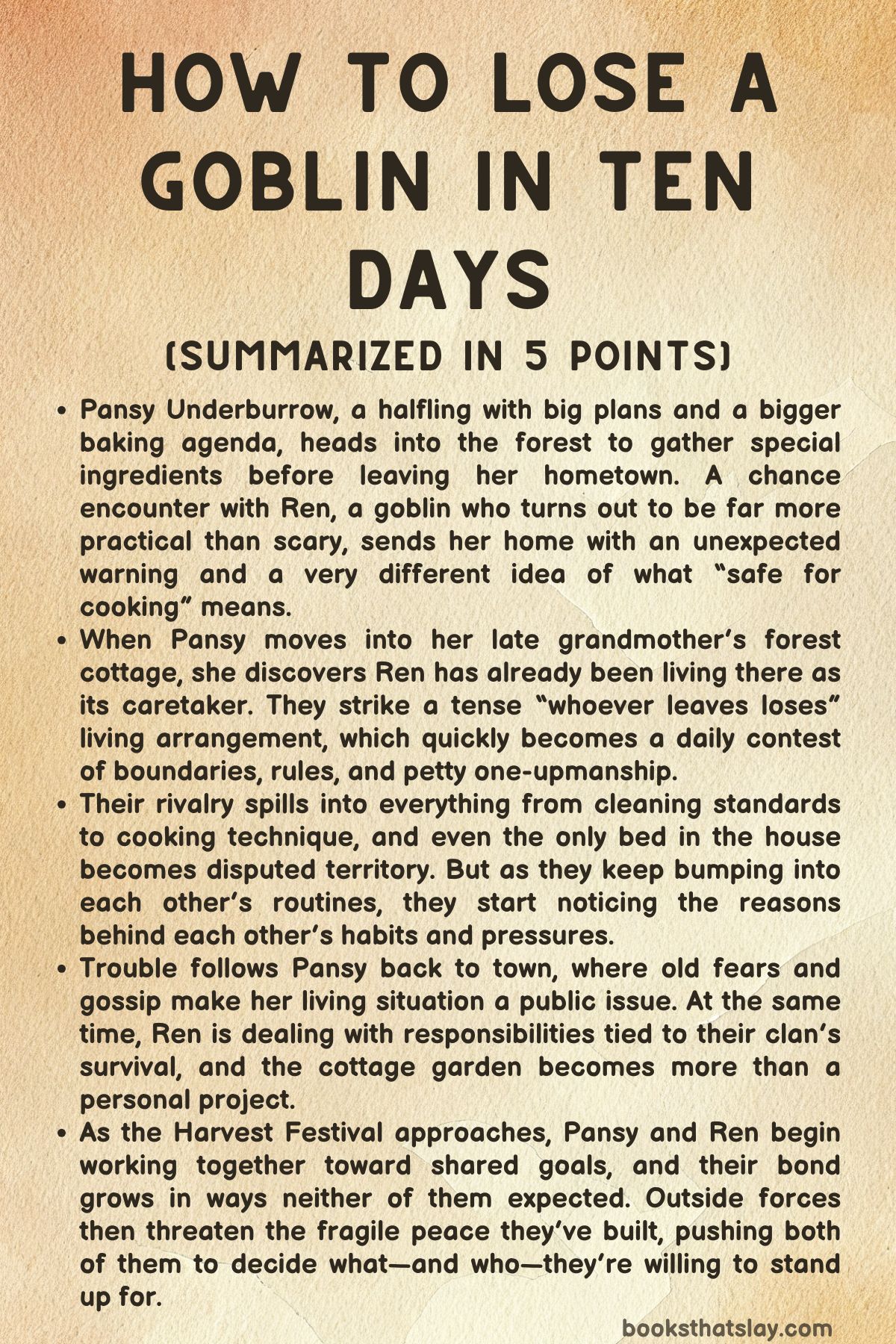
Pansy Underburrow spends her last day in her childhood home with dirt under her nails and a basket that’s supposed to hold something special. She wants to forage rare Phoenix Tail mushrooms so she can bake a farewell quiche before moving away.
But the forest doesn’t reward her effort. Unsure of what she’s gathered, she cuts a handful of orange fungi anyway, determined not to return empty-handed.
Then she spots something even better: a large white truffle, perfect for truffle butter as a parting gift for her parents. Before she can grab it, a fat pink pig snatches it and runs.
Pansy bolts after the pig, chasing it through the undergrowth until the truffle drops. She dives for it—and collides with a goblin reaching for the same prize.
Pansy freezes, expecting danger, but the goblin isn’t armed and seems more annoyed at the pig than interested in her. The goblin calmly tells her the mushrooms in her basket are poisonous Bloodletter Shrooms that could kill anyone who eats them.
Humiliated, Pansy tries to save face with a flimsy lie about decorations, but the goblin doesn’t buy it. Still, they place the truffle in her basket anyway, not wanting “dead halflings” weighing on their conscience, and tell her to get home before dark—also pointing out she has dirt smeared across her face.
Back in Haverow, Pansy returns to her parents’ burrow to find her mother already cooking. Pansy reminds them that she’s leaving the next day to move into her late grandmother Angelica’s forest cottage, which was left to her.
Her parents react with alarm, especially her mother, whose fear of goblins is tied to old war stories and a massacre that still haunts local memory. Pansy insists she’ll be fine, promises to visit, and swears she’ll come home if anything goes wrong.
The next day, Pansy arrives at the cottage—only to discover she isn’t alone. Ren, the goblin from the forest, has been living there as its caretaker.
From Ren’s point of view, the cottage isn’t abandoned at all; it’s a living place their clan has maintained, filled with cultivated moss, plant systems, and carefully managed spaces. When Pansy enters with her key, Ren attempts to scare her away with a dramatic roar.
Pansy panics, slams into the wall, and shakes loose ceiling moss that Ren’s clan has tended with care. Ren scrambles to save it while snapping at her for wrecking things.
Pansy insists the cottage is hers by inheritance. Ren argues that her grandmother left it behind decades ago, and the goblins are the reason it hasn’t rotted into nothing.
The fight spirals into accusations: theft, disrespect, entitlement. Neither will back down, so Pansy proposes a binding arrangement—both of them will live in the cottage, and if either leaves, that person forfeits their claim.
They add rules: don’t break each other’s belongings, don’t make major changes without agreement, and only repair when both consent. They shake hands, trade names, and instantly start thinking of ways to outlast the other.
Pansy explores her new home and finds it strange, half cozy and half wild. Many rooms are sparse or overtaken by plants.
A lower level feels more like a cavern than a cellar, with dirt floors and glowing growth along the walls. She stumbles across a stone circle carved with runes, sketches the symbols into her notebook, and then hides the stone under a rug when the pig starts pawing at it.
Even in a place she’s just claimed, something feels older than her family’s stories.
Ren escalates the household war in petty ways. They deliberately track dirt through the cottage and smugly claim it’s allowed because they’re “adding” soil, not destroying anything.
Pansy tries to clean, and Ren blocks her by declaring the dirt is their “stuff.” The two trade barbs until the argument shifts into the kitchen, where Ren prepares a chestnut and mushroom salad using goblin ingredients and painfully slow techniques. Pansy can’t help stepping in.
Ren complains she chops “ugly,” and Pansy counters by challenging them to a bet: if she can make a truly good salad using Ren’s ingredients, the kitchen becomes her domain and Ren has to stop the dirt nonsense. If she fails, she’ll leave Ren alone while they cook.
Ren supervises with suspicious intensity, explaining unfamiliar items like oilflute oil and sugarfern vinegar. Pansy cooks with confidence and care, and the final dish surprises them both.
Ren grudgingly admits it’s good. Pansy wins the kitchen, claiming the space not just as a cooking area, but as her first real foothold in the cottage.
That night, the battle moves to the bedroom. Pansy makes the only bed her territory by covering it with her own sheets and blankets.
When she returns from bathing, she finds Ren trying to spread moss on the bed and settle in. Pansy refuses to share and insults Ren.
Ren threatens retaliation with dirt, and the argument ends in a tense compromise: a wall of pillows and blankets divides the mattress into two zones. They lie awake, hyperaware of each other’s breathing and movement.
Morning brings more bickering. Ren wakes tangled in Pansy’s blanket on the floor, accusing her of shoving them off the bed.
Pansy insists it was only a “nudge,” and Ren calls it a kick. Accusations fly about stolen blankets and cold feet.
When Pansy snaps that Ren “stole” her blanket, Ren flinches at the word in a way that makes Pansy realize she hit something sensitive. She apologizes, and the tension shifts from pure hostility into something more complicated—hurt, pride, and an uncomfortable awareness that the other person’s feelings can actually matter.
Pansy walks back to Haverow to shop and immediately runs into Councilor Dorothy Millwood, who is pushing to host the annual Harvest Festival. Mrs. Millwood needles Pansy about living alone, pressures her toward marriage, and warns her to avoid any scandal that could ruin the village’s chances.
She also brings up Pansy’s grandmother’s past festival trouble, hinting that the family has a reputation for embarrassment. Pansy swallows her anger and offers to bake classic shortbread for the festival committee, using politeness like armor.
She vents to her friend Blossom at Blossom’s flower shop, admitting the truth: a goblin lives in her cottage, and they’ve made a deal to cohabitate until one of them gives up. Blossom jokes about property law, then offers what she believes is a simple solution—cats, because goblins supposedly hate them.
Blossom sends Pansy home with a tiny black kitten. Pansy names him Mushroom, fully aware she’s also bringing a weapon into her household war.
On her way out, Pansy runs into Agvaldir, the village’s long-present wizard. He speaks with unsettling cheer about a necromancer in the south and tries to coax her into joining his next “campaign.” Pansy refuses.
Instead, she asks about the runes from the cottage’s lower level, showing him her sketches. Agvaldir’s interest sharpens.
He claims he doesn’t recognize them and can’t help, but his questions leave Pansy uneasy.
Ren, meanwhile, is under pressure of a different kind. As caretaker, they harvest food and deliver crates to their clan’s caves.
The goblins celebrate Ren’s arrival, children swarming them, and Ren’s cousin Thorn teases them relentlessly. But the mood shifts when Nana, the clan leader, shows Ren a section of dead crops.
Ren identifies the cause: dwarven refinery runoff has poisoned the soil. Rage spreads through the clan.
Some want sabotage, but Nana forbids any move that could invite a massacre. Ren proposes planting above ground near the cottage instead, and Nana approves.
Thorn supplies “toad juice” for plant mixtures and tells Ren to be as obnoxiously goblin as possible to drive the halfling out.
When Pansy returns to the cottage with Mushroom, Ren recoils. The kitten wreaks immediate havoc, clawing at plants and launching into chaos.
Pansy uses the moment to push Ren into cleaning their beloved dirt trail, suggesting the cat might decide the floor is a toilet. Furious, Ren gives in and sweeps.
The victory feels childish, but it also marks a shift: both of them are learning how to influence the other, and both are starting to care more than they want to admit.
Pansy bakes shortbread for the festival committee and realizes she forgot sugar. Ren offers sugarfern instead and explains how it crystallizes.
They share the space in a new way—less combat, more reluctant teamwork. In a small, startling gesture, Ren brushes sugarfern off Pansy’s face and then bolts as if embarrassed by their own tenderness.
Pansy leaves food out anyway. The next morning, she finds the dishes cleaned and the cookies gone.
Ren ate everything.
Trouble in Haverow grows worse. Pansy is discovered using goblin ingredients, and Councilor Millwood throws her out of town, calling her selfish and dangerous.
Even Pansy’s parents side with the fear, begging her to come home. Pansy breaks down on the forest path, feeling like she’s never fit the shape Haverow wants from her.
Ren, who has been waiting with a lantern because they don’t want her walking alone at night, apologizes for scolding her earlier and admits they were worried. Pansy tells them she wants to win the Harvest Festival Crop Competition, not just for pride, but to prove she isn’t a failure of a halfling.
Ren agrees to help and suggests using an existing pumpkin patch near the cottage.
The pumpkin plot is a mess—smothered by fast-running beans. Ren admits they planted the beans partly to annoy Pansy, just as Mushroom was meant to annoy Ren, and both plans have backfired into something like attachment.
While working the garden, Pansy realizes she’s been eating from Ren’s pantry and garden without understanding how much of it is meant to feed the goblin clan through winter. Mortified, she offers to contribute and to buy her own supplies despite her ban.
She grows unwell during the work and later collapses into sleep in Ren’s potion room. Ren finds her and makes a fast remedy using Cold Flower tea, which turns cold instantly and numbs pain.
Feeling better, Pansy confesses another ugly truth: after her earlier blowup, she blamed Blossom for exposing the sugarfern and stole seed packets from Blossom’s shop. Ren, instead of condemning her, explains a goblin custom about taking what would otherwise be wasted or misused, reframing the act in a way that eases Pansy’s shame without excusing it.
Pansy wants Cold Flower to apologize properly, and Ren offers to take her to the Goblin Market when it appears.
As the festival nears, the cottage changes from battlefield to shared home. Ren admits they can’t read.
Pansy reads aloud to them, doing silly voices until Ren laughs. Ren tries to “read” back by retelling the story from memory, but mixes in goblin legends about a trickster hero named Aconite.
Pansy notices the differences and realizes the cultures share similar stories told in different shapes. Ren gives her a polished bird skull as a gift.
Pansy makes a careless joke about dead things, sees Ren’s reaction, and apologizes quickly. She accepts the gift sincerely, planning to wear it.
The night before the Harvest Festival, Pansy wakes to find Ren’s arm around her and Mushroom sprawled on top of them both. Ren admits they didn’t want to disturb the kitten.
Pansy asks Ren to come to the festival with her, and Ren agrees, hiding beneath a hood. Before facing the crowd, Pansy goes to her parents’ burrow.
The introduction is tense, but her parents choose kindness over panic. They share tea and biscuits, and Ren openly enjoys the food, which helps.
Pansy’s mother offers Ren an old dagger believed to be goblin-made. Ren accepts it as a serious gift and explains goblins avoid violence unless forced.
Pansy and her mother reconcile, admitting fear drove earlier choices, and Pansy admits she’s happy with Ren. Ren says they’re happy too.
Then everything collapses. Returning to the cottage, Pansy and Ren find the door smashed, the garden destroyed, and the home ransacked.
Blossom appears and explains that Agvaldir arrived with armed men and a dwarf, claiming he was “freeing” Pansy from goblin magic. Halflings—including Pansy’s parents—are downstairs, uncertain and frightened.
In the wreckage, Agvaldir reveals he used the runes Pansy once showed him, calling them a lock. He claims the cottage is Wolf Banefoot’s tomb and implies Pansy wanted Ren removed.
Ren realizes Pansy did ask Agvaldir about the runes and feels betrayed. They argue brutally, and Ren storms away into the tunnels, tossing the flower crown aside.
Pansy refuses to run home. She defends Ren and the goblins, telling the crowd the garden was meant to feed Ren’s clan through winter.
She turns the accusation back on Agvaldir, arguing he treats halflings as disposable tools for his glory. When Agvaldir tries to force the lock open, Pansy blocks him.
He shoves her aside and begins to escalate the violence.
Ren returns, furious at themselves for blaming her and determined to protect her. They confront Agvaldir with the dagger.
Agvaldir orders a human henchman—the tall figure Pansy thought she saw in the forest—to attack. Ren is outmatched and stabbed with a hidden second blade, collapsing in blood.
Pansy grabs the dagger, trying to shield Ren, but Agvaldir decides to use her blood to open the lock. The henchman carries her away—until Pansy’s mother picks up the dagger and rallies the halflings, condemning Agvaldir and exposing the damage his adventures leave behind.
The crowd’s loyalty shifts. The henchman quits on the spot, drops Pansy, and leaves.
Reinforcements arrive in the form of Thorn and armed goblins, summoned by Ren’s raven message. Thorn explains goblin tradition required an engagement celebration, and they came anyway—now ready for a fight.
Outnumbered and unable to safely use magic, Agvaldir retreats with his men.
Ren is saved through quick action. Blossom and Thorn rush to the herb room, brew a healing potion, and pour it over Ren’s wound until it knits shut.
In the aftermath, halflings and goblins begin repairing the cottage together, replanting the garden so no one goes hungry. Even Councilor Millwood, confronted by the reality of community effort, agrees to help.
As Pansy speaks of halflings and goblins as friends, the runes glow on their own and the sealed stone wall slides open, revealing a vast hidden chamber. An inscription describes the wish of “a child of two worlds” for both halves to become whole again.
Pansy and Ren understand the message: the space was always meant to be shared, not claimed by one side. Mushroom and Pig emerge from a hidden tunnel, safe.
Over the following month, the two communities rebuild more than a house—they build trust. Trade routes form between Haverow and the goblin clan.
A new statue of Aconite is raised. And with the cottage finally becoming what it was meant to be, Pansy and Ren look forward to their wedding and a future that belongs to both of them.
Characters
Pansy Underburrow
In How to Lose a Goblin in Ten Days, Pansy begins as someone earnest, stubborn, and quietly insecure, and much of the story’s humor and warmth comes from watching those traits collide with a world that refuses to stay tidy. Her first forest outing shows both her competence and her pride: she wants to leave home with something meaningful to offer, but when she misidentifies poisonous mushrooms, she doubles down with a lie rather than admit she’s wrong.
That impulse to protect her self-image becomes one of her core engines. She is brave enough to chase a pig through the woods and bold enough to move into a cottage alone, yet she is also deeply sensitive to being judged as foolish or “a terrible halfling.” Pansy’s determination is not just about winning arguments with Ren or proving she can live independently; it is about claiming the right to define herself outside the narrow expectations of Haverow, especially the suffocating pressure to behave properly, marry conveniently, and never cause embarrassment.
Her relationship with tradition is complicated and personal. She loves her parents, but she refuses to let their fear become her future, and she carries her grandmother Angelica’s legacy like both a shield and a bruise.
Pansy is compared to Angelica by the village in the most unfair way—through gossip, suspicion, and the idea that unconventional women “invite trouble”—and that comparison becomes a pressure cooker inside her. When the town bans her for goblin ingredients, it doesn’t just threaten her plans; it confirms her worst fear that she never fully belonged.
That rejection reveals how much of Pansy’s confidence is built on performing acceptability. Once she can’t earn safety through politeness, she has to find another center of gravity: actual integrity, chosen community, and the courage to be disliked.
Pansy’s growth is most visible in how she learns to see consequences beyond her own hurt. Early on, she treats the cottage as inheritance and the garden as scenery, not yet grasping that Ren’s caretaker work is literally life-support for an entire clan.
When she realizes she has been eating from supplies meant for winter survival, her shame is immediate and sincere, and she tries to correct it even when it costs her, including attempting to buy her own groceries despite being pushed out of town. That shift matters because it is the moment she stops treating conflict as a game she must win and starts treating it as a shared problem that can harm real people.
The same evolution shows in how she admits wrongdoing: she confesses stealing seed packets in a burst of guilt, not because she is caught, but because she wants to be honest with Ren.
At the same time, Pansy remains distinctly herself—clever, dramatic, and a little chaotic. She uses baking as both comfort and defiance, offering food as apology, as proof of competence, and as a bridge between worlds.
She also uses mischief strategically, like adopting Mushroom to unsettle Ren and then leveraging the kitten’s presence to push Ren toward cleaning. What changes is that her mischief becomes less about scoring points and more about building intimacy.
The bedroom “territory war,” the blanket wall, and the arguments over dirt and “stuff” evolve into trust, tenderness, and eventually open love, as Pansy learns that being close to someone does not require constant control.
Pansy’s moral spine becomes unmistakable in the confrontation with Agvaldir. Even while devastated by Ren’s anger and her own past choice to ask the wizard for help, she refuses to let that guilt be weaponized into complicity.
She stands between Agvaldir and the sealed archway, confronts him publicly, and reframes the entire conflict as exploitation rather than “rescue.” In that moment, Pansy stops trying to win approval from Haverow and starts demanding accountability from it. By the end, she is no longer the halfling who lies to save face over mushrooms; she is someone who can be wrong, admit it, fight for others, and still insist she deserves joy—especially with Ren.
Ren
Ren is introduced as calm and observant, the kind of person who can tell a stranger’s basket is full of lethal mushrooms and still deliver the warning without cruelty. In How to Lose a Goblin in Ten Days, Ren’s defining tension is that they are both caretaker and troublemaker: someone carrying heavy responsibility for their clan’s survival while also taking enormous satisfaction in petty, brilliant provocation.
Their instinct when threatened is to perform “goblin” in the way others expect—roaring, scaring, smearing dirt, claiming territory—because that performance has historically worked as protection. Yet underneath the theatrics is a deeply conscientious person who worries about safety, food shortages, and the consequences of conflict with dwarves or halflings.
Ren’s identity is inseparable from the caretaker role, which is less a job than a vow. They take it seriously enough to skip breakfast, rush through chores, and calculate winter provisions with anxiety that borders on grief, especially with their aunt ill and the memory of floods still shaping scarcity.
When the clan’s crops die from poisoned runoff, Ren’s anger is fierce, but it is disciplined anger, shaped by Nana’s warning that retaliation could invite slaughter. This is a crucial element of Ren’s character: they are not naïve about violence, but they are not eager for it either.
Their ethics are pragmatic and communal—protect the clan, avoid catastrophic escalation, and do what must be done quietly if possible.
Ren’s conflicts with Pansy start as a territorial war but reveal an emotional vulnerability Ren tries to hide even from themselves. The word “steal” hits them like an old wound, suggesting a history of being accused, othered, or treated as inherently criminal.
Their reaction is not just hurt pride; it is the ache of a stereotype that has followed them long before Pansy arrived. This is why Ren clings so hard to rules and “deals.” The agreement to cohabitate is Ren’s attempt to create safety through structure: if the world is unfair, at least the terms can be clear.
Ironically, Ren then tries to exploit those very terms by “adding” dirt and moss, revealing both their humor and their fear that straightforward honesty won’t protect what they love.
Ren’s relationship with food mirrors their relationship with intimacy: cautious at first, then wholehearted. They use strange ingredients not to be strange, but because their world has its own pantry and its own logic.
When Pansy respects that logic—learning sugarfern, appreciating moss paste, listening to ingredient explanations—Ren’s defensiveness softens into curiosity and pleasure. Their pride when Pansy likes the moss paste is telling; they want to be understood more than they want to win.
Even their “plotting to make Pansy miserable” becomes less a genuine campaign and more a mask that slips whenever Pansy responds with warmth instead of disgust.
Ren is also shaped by what they lack: literacy, conventional social acceptance, and the ability to move freely without being seen as a threat. When Ren admits they cannot read, it exposes a quiet shame they try to cover with swagger.
Pansy reading aloud becomes a turning point because it offers Ren inclusion without condescension. Ren’s storytelling tradition—ravens, oral tales, illusion-aided narratives—also reveals a mind that values memory, performance, and communal experience over written authority.
That matters later when the story links Aconite and Wolf Banefoot; Ren is comfortable holding multiple truths at once, while others demand a single sanctioned version.
Romantically, Ren moves from guarded fascination to unmistakable devotion. They are physically responsive to Pansy’s presence in a way that surprises them, and emotionally they oscillate between wanting to drive her out and wanting to keep her safe.
The scene where Ren waits with a lantern at the forest’s edge captures their truest instinct: protect first, complain second. When Pansy breaks down, Ren’s apology is immediate and real, and they name the actual fear underneath their irritation.
Later, when Pansy gives the union crown without understanding, Ren’s response is not cautious—it is absolute. They claim her publicly, then seek privacy not to retreat from commitment but to confirm consent and meaning.
The later betrayal fracture—when Ren learns Pansy once asked Agvaldir for help—is equally revealing: Ren’s pain comes from trust, not ego, and their storming away shows how deeply they had already begun to imagine a shared future.
In the climax, Ren proves they are not the monster Haverow fears. They return to help Pansy up, admit they were wrong, and stand between her and the aggressors even when outmatched.
Their willingness to fight is not a love of violence; it is a willingness to be hurt if it keeps Pansy alive. By the end, Ren becomes a bridge not because they stop being goblin, but because the story insists goblinhood includes tenderness, responsibility, humor, and honor.
Blossom
Blossom functions as the story’s emotional triage nurse: she recognizes distress quickly, creates safety without fanfare, and offers solutions that are both practical and slightly ridiculous in the best way. Her most defining trait is her steady acceptance of complexity.
When Pansy shows up furious and overwhelmed, Blossom doesn’t lecture her into calm; she closes the shop, brings her upstairs, makes tea, and lets her unravel. That response signals a friend who understands that shame and anger often come from the same place, and that comfort is sometimes more useful than advice.
Blossom is also one of the few halflings who treats goblins as people rather than as folklore. Her suggestion to use cats to drive goblins away is comedic and reveals she still carries some community myths, but the larger point is that Blossom engages the problem without moral panic.
She doesn’t treat Pansy as tainted for living with Ren; she treats it as a messy roommate situation with real stakes, and she helps in the way she can. Giving Pansy Mushroom is an act of trust and generosity, and it also shows Blossom’s belief that small companionship can change the emotional temperature of a home.
Later, Blossom’s role expands from confidante to active protector. When the cottage is attacked and Ren is wounded, Blossom’s competence becomes life-saving.
She brews a healing potion and applies it decisively, acting without hesitation in a moment where many would freeze or choose a side based on prejudice. That moment also reframes Blossom’s kindness as courage: she is not simply “nice,” she is willing to defy local power structures when they become violent.
Blossom’s presence also highlights Pansy’s internal conflict about blame. When Pansy lashes out and blames Blossom for the cookie incident, it reveals how Pansy’s fear of condemnation can spill onto the person safest to accuse.
Blossom doesn’t become less important because of that; she becomes more important, because the friendship survives Pansy’s worst day. Blossom represents the possibility that community can be built through loyalty rather than conformity.
Councilor Dorothy Millwood
Councilor Millwood embodies social power that dresses itself up as concern. She is not a villain because she twirls a mustache; she is a villain because she believes she has the right to police other people’s lives.
Her fixation on marriage, propriety, and public image reveals a worldview where individuals exist as symbols for the village’s reputation. Pansy living alone is not simply unusual to her; it is a public embarrassment that must be corrected, preferably by steering Pansy toward a nephew like a tidy solution to an untidy woman.
Millwood’s political motivation—bringing the Harvest Festival to Haverow—makes her prejudice more strategic. She treats goblins as a threat not only to safety but to branding, as if the village’s worth depends on appearing pure and predictable to outsiders.
That is why she reacts so harshly to goblin ingredients and rumors: Pansy’s choices risk “funny business,” meaning anything that can’t be controlled, explained, or spun into respectability. Millwood uses fear as leverage, invoking the Great War and old massacres to justify present-day exclusion.
Whether or not her fear is sincere, she channels it into punishment, and punishment is her preferred tool.
Importantly, Millwood is also a measure of change. Near the end, when she agrees to help repair and rebuild, it signals that even entrenched prejudice can bend under the weight of truth, collective action, and undeniable evidence of shared humanity.
Her shift does not erase the harm she caused, but it does suggest that the story’s vision of reconciliation is not limited to the already-kind; it challenges even the controlling gatekeepers to become part of something better.
Agvaldir
Agvaldir represents predation disguised as heroism. He is introduced with an unnerving smile and grand talk of a necromancer threat and campaigns, immediately positioning himself as the central figure in an epic narrative.
What makes him dangerous is not just his magic but his desire to recruit others into a story where he is the protagonist and everyone else is a tool. Pansy senses that coercion and refuses, and his interest in her becomes sharper once he realizes she is connected to a mystery he can exploit.
Agvaldir’s interaction with the runes is a masterclass in manipulative withholding. When Pansy asks for help, he pretends ignorance, keeping her dependent and uninformed.
Later, he reveals he knew enough to use the runes as a lock mechanism, and he weaponizes that reveal to poison Ren and Pansy’s trust. He frames himself as a liberator “freeing” Pansy from goblin magic, which is the language of control masquerading as rescue.
His disgust at the idea of mixed heritage, and his contempt for halflings as disposable, expose the ideology under the performance: a hierarchy where some lives are resources to be spent for his goals.
Agvaldir’s cruelty is direct when challenged. He escalates from smugness to physical violence quickly, shoving Pansy aside and attempting to use her blood as a key.
That choice shows his real moral center: consent is irrelevant, bodies are instruments, and righteousness is a costume he can put on or take off depending on the audience. Even his retreat is not a moral defeat but a tactical one—he withdraws when outnumbered and unable to safely wield power.
He is the story’s clearest warning about charismatic authority: the most dangerous oppressors often sound like saviors until you refuse to play your assigned role.
Pansy’s Mother
Pansy’s mother is shaped by fear that has roots deeper than simple prejudice. She initially appears as the protective parent who resists Pansy leaving, and her resistance is intensified by stories of goblin attacks during the Great War and the lingering trauma tied to Angelica’s past.
She is not portrayed as malicious; she is portrayed as someone whose love has fused with anxiety so tightly that she mistakes control for care. Her insistence that Pansy return home “if anything goes wrong” is sincere, but it also assumes that independence is inherently unsafe, especially for a daughter who reminds her of a woman who caused pain by refusing to fit in.
Her character deepens when she is confronted with reality rather than rumor. Meeting Ren triggers fear, but she actively chooses kindness once she sees that Pansy’s happiness is real and Ren’s behavior is respectful.
Removing the grandmother’s dagger from display is a small but meaningful act: she recognizes what might read as a threat and tries to make the space safer. Later, she becomes a leader in the crisis, picking up a dagger, denouncing Agvaldir, and rallying other halflings.
That shift marks her transformation from someone who responds to fear by retreating into tradition to someone who responds to injustice by standing up.
Her reconciliation with Pansy in the kitchen is one of the story’s most grounded moments of healing. She admits fear shaped her earlier reaction and connects it to painful memories, which matters because it stops being an argument about who is right and becomes an honest admission of why she was wrong.
When she asks whether Ren makes Pansy happy, she is choosing her daughter’s lived experience over her own inherited dread. By the end, she represents a kind of generational change: not perfect, not instantly enlightened, but willing to grow when love demands it.
Pansy’s Father
Pansy’s father is quieter in the narrative than her mother, but his steadiness forms part of the emotional foundation Pansy keeps returning to. He shares the household’s worry and initially aligns with the village’s caution, yet he is also capable of showing up with concern rather than condemnation.
When Pansy introduces Ren, his fear is present, but he participates in the effort to be kind, which signals a willingness to follow his daughter into unfamiliar territory if it means staying connected to her.
He also serves as a bridge between the extremes represented by Millwood and Agvaldir. He is not a political enforcer and not a crusader; he is a parent trying to reconcile what he has been taught with what his daughter is living.
That matters because it shows how prejudice sustains itself not only through loud hostility, but through ordinary people choosing the safe opinion. His gradual softening, especially in the domestic scene with tea and biscuits and Ren openly enjoying food, illustrates how intimacy can dissolve fear faster than debate.
Thorn
Thorn is a force of nature with the instincts of a prankster and the presence of a battlefield. He functions as both comedic disruption and clan muscle, embodying the goblin community’s exuberance, protectiveness, and unapologetic social pressure.
His first major appearance is affectionate and overwhelming: he hugs Ren, teases them, and gives advice that boils down to “be more goblin,” which is funny but also revealing. Thorn understands that goblins survive by leaning into the identity others assign them, turning stereotype into armor and sometimes into entertainment.
At the Goblin Market, Thorn becomes a symbol of goblin confidence and communal chaos. His “toad juice” stall suggests a slightly disreputable entrepreneurial streak, and his shameless teasing of Ren and Pansy as an old married couple is both accurate and deliberately embarrassing.
He flirts with Pansy, not in a way that undermines her bond with Ren, but in a way that tests boundaries and asserts his own dominance in the social arena. Underneath the jokes, Thorn is intensely loyal.
When the engagement tradition demands celebration, he shows up with armed goblins, not because he wants a fight, but because goblin love is not private and passive—it is communal, demonstrated, and defended.
In the climax, Thorn’s physicality becomes decisive. He protects vulnerable people when others try to use them as shields, and he helps turn the tide simply by arriving with numbers and intent.
Yet he never fully drops the humor, which keeps him from becoming a generic warrior. Thorn is the story’s reminder that tenderness and intimidation can coexist, and that sometimes the loudest person in the room is also the one most willing to show up when it matters.
Nana
Nana is authority with a long memory, the kind of leader who has survived enough to know that pride can get people killed. She is the stabilizing center of the goblin clan.
When the crops die, she refuses sabotage not because she lacks anger but because she understands the power imbalance with dwarves and the cost of provoking them. Her leadership is defined by restraint, strategy, and the ability to hold the clan’s rage without letting it become self-destruction.
This makes her a counterpoint to the outsiders’ image of goblins as impulsive and violent; Nana is calculating in the way that keeps a community alive.
Her interaction with Pansy is also a test of character. Nana’s initial reaction to halfling ears is guarded, and she does not pretend otherwise, but she listens when Pansy speaks honestly about helping with Ren’s garden.
Nana’s blunt wisdom—she can’t make everyone like her—functions as both comfort and challenge. It invites Pansy to stop begging for approval and instead focus on building real bonds.
Nana’s most influential move is the union crown, given freely rather than sold. Whether or not she intends to push events forward, she recognizes love as a political force: a bond between Pansy and Ren can reshape trade, trust, and the future more effectively than any argument.
Nana’s approval is not sentimental; it is purposeful, rooted in the belief that unity can become infrastructure.
Bramble
Bramble appears as a voice of economic survival logic within the clan. Their suggestion to earn coin in the south reflects a pragmatic willingness to look outward when resources collapse.
Bramble represents the pressure that scarcity creates: when the ground is poisoned and winter looms, ideals about staying safe in the shadows clash with the need to find money, supplies, and options. Even though Ren shuts the idea down, the suggestion matters because it shows the clan is not monolithic.
Different goblins imagine different futures, and Bramble’s willingness to risk the outside world highlights how desperate the situation is.
Briar
Briar embodies the immediate, visceral response to injustice. They want sabotage when dwarven runoff poisons the soil, and that impulse is understandable because the harm is both direct and humiliating.
Briar’s presence emphasizes how violence becomes tempting when diplomacy has never protected you. Nana’s refusal of Briar’s plan doesn’t make Briar foolish; it shows the tragic arithmetic oppressed communities are forced to do, where righteous anger must be weighed against potential massacre.
Briar is the story’s reminder that restraint is not the absence of rage—it is the management of it.
Ren’s Aunt
Ren’s aunt is mostly offstage, but her illness shapes everything. She represents the lineage of caretaker labor that kept the cottage alive while Angelica was gone.
Her condition is the reason Ren steps into the caretaker role, and that transition explains both Ren’s exhaustion and their desperation to protect the cottage as a living system rather than a sentimental heirloom. The aunt’s illness also symbolizes how fragile the clan’s stability is: when one person who holds knowledge and routine becomes unable to work, the ripple touches food stores, maintenance, and emotional morale.
Even unseen, she is a quiet gravity pulling Ren’s choices toward responsibility.
Angelica
Angelica, Pansy’s late grandmother, haunts the story as legacy more than presence. She is the source of the cottage inheritance and the village’s lingering gossip, especially the infamous festival incident tied to fireworks.
To Haverow, Angelica becomes a cautionary tale about what happens when women are too adventurous, too strange, too willing to cross boundaries. To Pansy, she is both inspiration and burden: proof that a halfling life can be larger than the burrow, but also proof that the village punishes those who refuse to be small.
Angelica’s most important narrative function is that she created a space meant to be shared, even if that intention only becomes clear at the end. The hidden chamber’s inscription about “a child of two worlds” reframes Angelica’s story as something more compassionate than scandal.
She becomes part of the bridge between communities, not just the source of conflict. Through Angelica, the story argues that inheritance is not only property—it is unfinished work, unresolved history, and the chance to repair what older generations could not.
Pig
Pig begins as comic catalyst and becomes a steady presence of domestic life. Pig’s theft of the truffle literally crashes Pansy and Ren into each other, setting the entire relationship in motion.
Beyond that, Pig functions as a practical partner in the caretaker economy, pulling wagons and helping transport crops. The fact that Pig serves Ren’s clan work also reinforces the story’s theme that what looks quaint or funny from the outside is often part of survival.
Pig’s calm usefulness contrasts with the humans and halflings who bring chaos and violence into the cottage; the animal is consistent when people are not.
Mushroom
Mushroom, the black kitten, arrives as a tactical annoyance and becomes an emotional anchor. He is Pansy’s attempt to claim power in the cottage conflict by introducing something Ren dislikes.
The plan backfires in the best way: the kitten becomes a shared point of attachment, a small living creature both of them end up protecting and accommodating. Mushroom’s chaos forces cooperation, and his presence softens the house’s tension by creating moments of laughter and caretaking that aren’t about winning.
Mushroom also symbolizes domestic future. When he sprawls across them in bed and becomes the reason Ren doesn’t move their arm from around Pansy, the kitten turns into an excuse for tenderness that neither of them has to name yet.
Later, when he emerges from the hidden tunnel at the end, he becomes part of the story’s visual proof that the cottage was always bigger than either side’s claim. He is not just a pet; he is a small, purring argument for shared home.
Wolf Banefoot and Aconite
Wolf Banefoot and Aconite function as mythic characters inside the story, but their importance is practical because their legend becomes the key to understanding the cottage, the lock, and the hidden chamber. The dual legends suggest that history is not neutral; it is shaped by who survives to tell it and who benefits from the telling.
The idea that Wolf Banefoot and Aconite might be the same person reframes the past as blended rather than divided, hinting at a heritage that crosses halfling and goblin lines and threatens purists like Agvaldir. These figures symbolize the possibility that division is learned and maintained, while connection is older, deeper, and repeatedly buried.
When the hidden inscription speaks of “a child of two worlds,” it turns the legend into a blueprint for reconciliation, implying that the world becomes whole not by erasing difference but by making room for it to belong together.
Themes
Home, Ownership, and the Meaning of Belonging
Pansy arrives at her grandmother’s cottage carrying a key and a lifetime of assumptions about what inheritance should guarantee. The key gives her legal access, but it doesn’t give her emotional security, local approval, or practical knowledge of what the cottage has become.
Ren’s claim is rooted in labor and continuity: their clan kept the place functioning, seeded it with living systems, and treated it as a responsibility rather than a trophy. The conflict between them forces a deeper question than “Who owns this building?” because the cottage is not a static object.
It is a working environment shaped by care, daily maintenance, and choices about what should be preserved or changed. Pansy’s first instinct is to map the cottage into territories—kitchen, bed, rooms—because claiming space feels like the fastest route to feeling safe.
Ren mirrors that instinct with their own territorial habits, using dirt trails and moss as a way to assert presence.
What changes over time is that both learn ownership is not only about rights; it is also about obligations. Pansy’s initial harvesting and cooking are framed as personal projects, but she gradually understands that Ren’s garden is tied to winter survival for an entire clan.
Ren, meanwhile, learns that Pansy’s desire to live there isn’t a selfish performance of independence; it is a way to step out of the narrow role Haverow expects her to accept. The cottage becomes a testing ground for what “home” means when two people carry different histories into the same doorway.
The breakthrough is not a courtroom decision or a single apology; it is the growing recognition that a home can be built by shared rules, shared work, and shared vulnerability. By the end, the hidden chamber’s message about a “child of two worlds” gives the idea of belonging a physical form: the space was designed with the expectation that wholeness comes from sharing rather than winning.
The cottage stops being a prize that one person must secure and becomes proof that home is something made together, even when everyone around them insists it should be divided.
Prejudice, Community Fear, and the Cost of Old Stories
Haverow’s fear of goblins is not presented as random dislike; it is maintained through selective memory, authority pressure, and social punishment. Pansy’s mother carries fear shaped by war stories and community trauma, and Councilor Millwood weaponizes that fear to police behavior in the present.
The banishment Pansy experiences is not only about Ren living in the cottage; it is about a village deciding what kind of person Pansy is allowed to be. The moment goblin ingredients enter the conversation, the village treats Pansy as a contamination risk rather than a neighbor.
That reaction reveals how prejudice often hides behind “safety” language: people claim they are protecting the community, while actually protecting their own comfort and control.
Ren faces the same structure from the other side. Their clan has practical reasons to distrust outsiders—scarcity, threats, and the danger of provoking dwarves or humans—but that caution can harden into reflexive hostility.
When Pansy is stopped at the Goblin Market and told halflings aren’t allowed, she runs into a boundary that feels personal even if it is framed as policy. Nana’s blunt advice—that Pansy can’t make everyone like her—captures the unfairness of trying to earn basic acceptance while others are free to judge without consequences.
The story also shows how prejudice reproduces itself through jokes, warnings, and “common sense” rules. Millwood’s public needling about marriage, propriety, and “funny business” is social training disguised as concern.
Thorn’s teasing about Pansy and Ren arguing like an old married couple plays differently because it is affectionate rather than policing; it suggests that humor can either enforce exclusion or normalize connection, depending on who is speaking and why.
The clearest cost of prejudice appears when Agvaldir uses it as a tool. He arrives claiming to “free” Pansy from goblin magic, knowing that this language will activate the crowd’s fear and justify violence.
His strategy works because the community already has a ready-made story: goblins are dangerous, halflings are vulnerable, and outsiders need to be controlled “for their own good.” That story nearly gets Ren killed and turns a home into wreckage. The healing in the aftermath is not portrayed as instant enlightenment; it comes through action.
People rebuild together, share labor, and see with their own eyes what was at stake—food security, shelter, and the truth of who Ren and Pansy are when no one is performing for propaganda. The theme argues that prejudice is not defeated by a single speech; it is weakened when communities are forced to confront the real consequences of their fear and then choose repair over repetition.
Intimacy Through Conflict and the Shift from Rivalry to Partnership
Pansy and Ren’s relationship starts with suspicion and escalates into a competition that is almost bureaucratic: rules about what counts as “adding,” agreements about repairs, and constant attempts to make the other surrender. Their early fights about dirt, moss, chopping, blankets, and bed space are not trivial in context.
These arguments are how they negotiate boundaries when neither knows how to trust the other yet. The cottage becomes a pressure cooker where small habits carry symbolic weight.
Dirt on the floor is not just mess; it is Ren asserting that the cottage operates on goblin logic. Pansy’s insistence on clean sheets is not just fussiness; it is her attempt to protect a piece of comfort in a life that is changing too fast.
Even their cooking bet has emotional stakes: whoever controls the kitchen controls daily life, and daily life is where power quietly settles.
What makes their intimacy believable is that it grows from repeated moments of reluctant care rather than grand declarations. Ren warns Pansy about poisonous mushrooms without demanding anything in return.
Pansy leaves food out even after Ren acts hostile, and later notices the evidence of gratitude in cleaned dishes and eaten cookies. Ren waits with a lantern at the forest’s edge when Pansy walks home late, then apologizes when their concern lands as criticism.
These are the moments where rivalry begins to lose its usefulness. Both characters keep discovering that their attempts to irritate the other often backfire into attachment: the kitten intended as a goblin-repellent becomes a shared chaos magnet; the running beans planted partly to annoy Pansy end up forcing them to work side by side.
Their emotional turning points also include missteps that could have ended everything. Pansy’s earlier contact with Agvaldir, and Ren’s immediate assumption of betrayal, show how fragile trust is when both have learned to expect rejection.
The story doesn’t resolve this by pretending trust is automatic; it shows trust as a choice made again after anger. Even the “accidental proposal” at the Goblin Market carries this pattern: a mistake becomes a moment of truth because both decide to interpret it as a chance to be honest rather than an excuse to retreat.
Their affection is not a sudden personality change; it is the result of learning each other’s triggers, learning how apologies must be specific, and learning that partnership means taking risks together—walking into town under a hood, facing parents, facing a crowd, and still choosing “with you” instead of “without you.” By the end, their bond is not defined by how often they argue, but by how quickly arguments turn into repair, and how consistently they prioritize each other’s safety over pride.
Power, Exploitation, and the Ethics of “Protection”
Agvaldir represents a kind of power that survives by disguising itself as guidance. He approaches Pansy with talk of a necromancer threat and a coming campaign, implying that young people should become part of his project.
When she refuses, he pivots to information control: he asks pointed questions about the runes, then claims ignorance. That choice matters because it suggests he recognizes the runes’ purpose but prefers to keep Pansy dependent and uninformed.
His eventual assault on the cottage reveals the logic behind his earlier behavior. He doesn’t see Pansy as a person with agency; he sees her as a lever—someone whose fear, guilt, and social vulnerability can be used to open locks, trigger conflict, and justify violence.
The theme becomes sharper because Agvaldir’s power is not only magical; it is social and institutional. He arrives with armed support and a dwarf, and he relies on the crowd’s readiness to believe that goblins must be controlling Pansy.
He uses the language of rescue to disguise theft and invasion. Calling his attack “freeing” Pansy turns brutality into a moral performance.
This is how exploitation often operates in communities: a leader frames coercion as care, then punishes anyone who questions the framing. Pansy’s guilt about asking him for help earlier shows how manipulation works even when the victim recognizes something is wrong.
She feels responsible for his actions because she once sought his authority, and that guilt makes her easier to isolate.
Against this, the story offers an alternative model of power rooted in accountability and mutual defense. Nana forbids reckless retaliation against dwarves not because she is passive, but because she understands the real cost of provoking a massacre.
Thorn shows another form of power: loud, forceful, but ultimately protective of Ren and responsive to community needs. Pansy’s mother finally speaks as someone who has endured the collateral damage of “adventures,” exposing how leaders like Agvaldir treat families as acceptable losses.
That moment is crucial because it flips the moral frame: the community begins to see that the true danger is not goblin presence, but a man who treats people as tools.
The final opening of the hidden chamber reinforces the ethical contrast. Agvaldir wants the locked space as a conquest and a story he can claim.
The inscription reframes it as a wish for wholeness between worlds, which undercuts the idea that power should be used to separate, purify, or control. The rebuilding that follows—halflings and goblins repairing the cottage, restoring the garden, setting up routes and shared plans—shows power as something that can be distributed through cooperation rather than hoarded through fear.
In How to Lose a Goblin in Ten Days, the most dangerous force is not magic itself; it is the willingness to treat domination as protection, and the relief that comes when a community learns to recognize that trick before it costs another life.