If I Ruled the World Summary, Characters and Themes
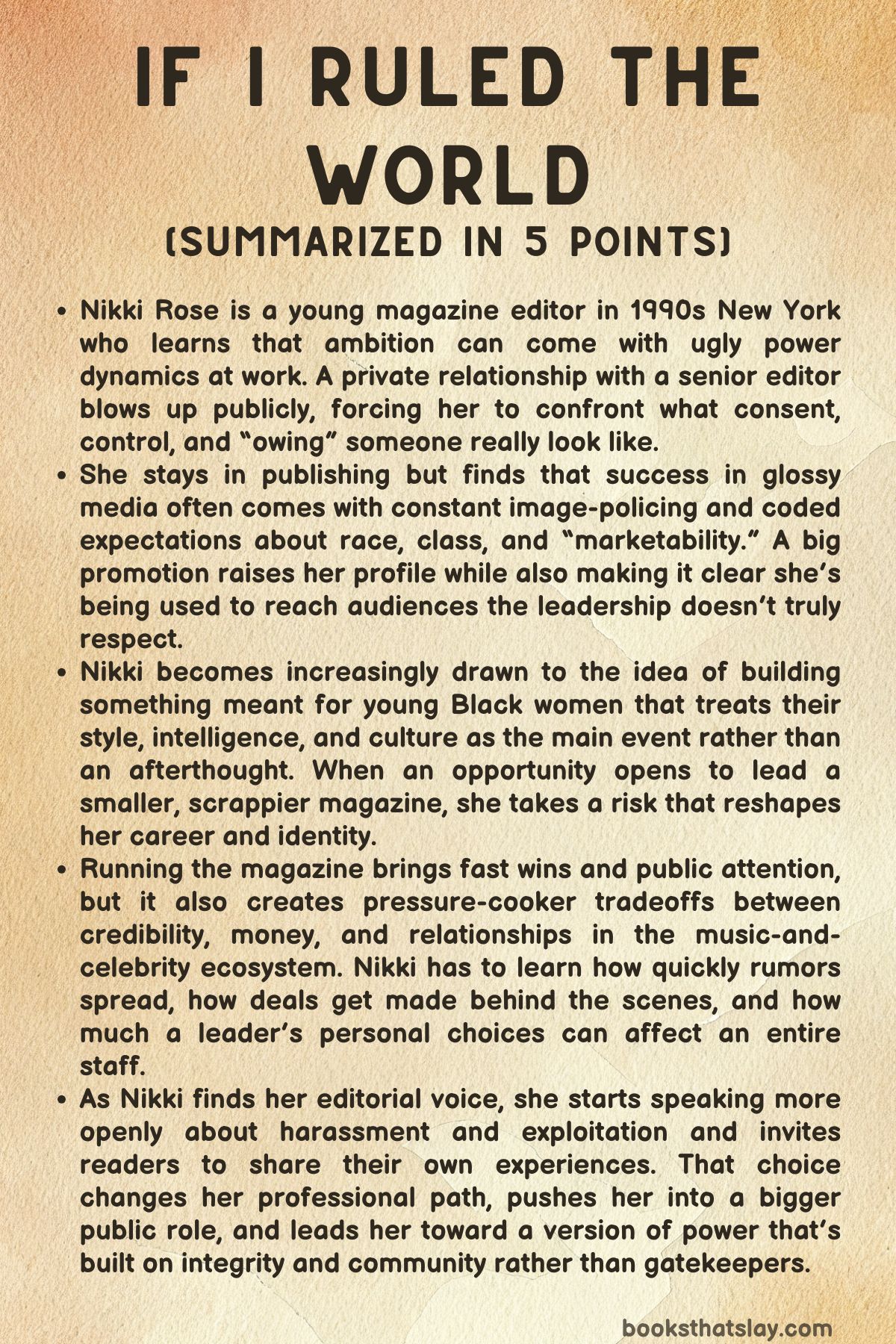
If I Ruled the World by Amy DuBois Barnett is a sharp, insider look at late-1990s New York magazine culture through the eyes of Nicole “Nikki” Rose, a young editor trying to build a real career while navigating power, race, and desire in an image-obsessed industry. Starting with a damaging relationship with her married boss, Nikki learns how easily ambition can be manipulated—and how hard it is to reclaim your voice once a powerful man decides you belong to him.
As she rises from assistant to editor in chief, she’s forced to choose between fitting in and telling the truth, even when honesty threatens her job, her reputation, and her future.
Summary
Nicole “Nikki” Rose arrives in New York in the spring of 1996 with a clear goal: to become a serious magazine editor. She wants a life built on ideas, taste, and authority—something she can claim as her own.
But her entry into the industry is distorted from the start. During her interview process at Revolutions, a major music magazine owned by Park Avenue Publishing, her mother reaches out to an old friend from Chicago, Alonzo Griffin, to help Nikki get an opportunity.
Alonzo is influential, wealthy, and married. He also quickly makes it clear that his help comes with expectations.
At first, Nikki tries to treat the connection as professional, but Alonzo turns it personal and then controlling. He decides how she should look, what she should wear, and how she should present herself.
He encourages her to spend money she doesn’t have on clothes and grooming, promising he will cover the bills. Their meetings happen in hotels and behind closed doors, framed as part of Nikki’s “future” in the business.
Nikki feels uneasy but also trapped by ambition and the pressure to succeed in a world that seems to run on access. She tells herself she can manage it.
Then the secret becomes public in the worst possible way. One rainy night, Nikki is at a Krispy Kreme on Twenty-Third Street with Alonzo when her parents unexpectedly walk in and see them in an intimate moment.
Her father’s anger erupts immediately. Her mother, Ann, is stunned for a different reason—she recognizes Alonzo as a childhood friend.
The confrontation is humiliating and painful, and Nikki cannot explain herself in the moment. Her parents leave devastated, and the relationship with them cracks open into silence and judgment.
Alonzo, instead of feeling remorse, reacts with excitement. He treats the incident like a thrill.
In his Range Rover after the encounter, he pushes Nikki into sex even though she is crying and trying to stop him. The imbalance of power becomes unmistakable.
Nikki is left shaken, ashamed, and frightened, while Alonzo behaves as if the chaos only proves how intense their connection is.
Back at work, Nikki tries to regain control. She goes to Alonzo’s office and tells him she wants the relationship to end and for them to remain strictly professional.
Alonzo refuses. He tells her she cannot leave until he is ready, and he implies that her job exists because he allowed it.
When she presses, he escalates into threats: she can resign or be fired, and she should not tell anyone because she has “no idea” what he is capable of.
Terrified, Nikki turns to human resources and speaks privately with Marie Hyacinthe, her friend and the only Black person in HR. Marie confirms what Nikki suspects: Alonzo has a reputation, complaints exist, and the company protects him because he is profitable.
Nikki doesn’t want to file an official report—she wants distance and safety without becoming a target. Marie advises her to keep her head down, take time off, and look for another internal role.
Soon Nikki is moved to StyleList, the company’s prestigious fashion magazine, as an editorial assistant. It is a downgrade in status compared to her work at Revolutions, but it gets her away from Alonzo.
A couple months later, Alonzo abruptly leaves the company. Rumors circulate, including claims of racism, but Nikki learns the real reason is more blunt: Alonzo slept with the niece of a powerful editor in chief, and the complaint went directly to the CEO.
Alonzo calls Nikki, convinced she ruined him. During the conversation Nikki accidentally reveals too much about HR and other complaints, and Alonzo ends with a warning that makes it clear he still sees her as someone he can threaten from afar.
Three years pass. In fall 1999, Nikki is now a senior associate editor at StyleList.
She has learned how the place works: the image rules, the culture is overwhelmingly white, and every moment feels like an audition. In a high-pressure editorial meeting, the editor in chief, Lucinda, abruptly rejects months of planning and demands a new January issue theme that is “hot” and “sexy.” Nikki offers “the ageless issue,” pairing fashion across generations with a major sex-and-relationships package anchored by a survey.
Lucinda loves it and puts Nikki in charge of the sex content. Nikki also proposes an AIDS story, but Lucinda shuts it down as not fitting the magazine’s idea of “sexy.” When Nikki suggests a Black model for the cover, Lucinda is blunt: “Black girls don’t sell magazines.”
Nikki’s personal life is also shaped by performance. She is dating Joseph Burke III, a successful Wall Street banker from a prominent Black family.
Joseph is polished, ambitious, and proud of appearances. He gifts Nikki expensive jewelry and tells her he wants her to “look expensive.” Nikki feels the pressure beneath his compliments—the suggestion that she should be molded to fit a certain idea of success.
At a dinner Joseph arranges with Nikki’s parents without warning her, Nikki’s mother criticizes Nikki’s work assignment as vulgar, while Joseph takes up space with stories about his career. Nikki ends the night feeling judged from every direction.
Seeking change, Nikki straightens and highlights her hair for the first time in years. At the salon she finds a chaotic but exciting magazine called Sugar, aimed at Black women, and she’s struck by the gap between its energy and its execution.
She learns Sugar is published by NuVoices Media, run by Barbara Porter, a powerful publisher with ties to the music world—including a past partnership with Alonzo. Nikki feels alarm but also fascination.
She can’t stop thinking about what Sugar could be if it were edited with real rigor and style.
At a lavish Lucinda-hosted party, Nikki experiences how quickly the office responds to her makeover. She is treated as more acceptable, more visible, more worthy of attention.
At the event she meets Kiara Matsumoro, a Black PR executive who runs the room with ease and offers Nikki guidance and access. Nikki also meets Barbara Porter through Kiara’s introduction.
Fueled by champagne and frustration, Nikki bluntly tells Barbara that Sugar has potential but needs major improvement, arguing that young Black women deserve a magazine that is chic, smart, and culturally serious. Barbara challenges Nikki’s credibility, but she gives Nikki her card and invites her to follow up.
Soon after, Lucinda calls Nikki into a private meeting. Lucinda praises Nikki’s contributions, including a package that won an Ellie Award and a sex survey that boosted sales and earned Lucinda an Oprah appearance.
Then Lucinda reveals StyleList’s growth is stalling and says they need stories that bring in new audiences—especially audiences Nikki supposedly “understands.” She offers Nikki a promotion to special projects editor with a major raise, framing it as opportunity but also as a debt Nikki must repay. Lucinda even mentions that Alonzo once tried to block Nikki’s hiring, and that Lucinda ignored him due to his misconduct.
Nikki leaves with the promotion, but also with the sense that the job comes with a price.
With the promotion, Nikki gains access to strategy meetings and learns how StyleList engineers success through cover planning, cultural timing, and sales metrics. But the office atmosphere turns colder.
Coworkers resent her, whisper, and withhold support. Nikki becomes both visible and isolated.
Still, she performs. With Kiara feeding her contacts, Nikki delivers the kind of “urban” stories Lucinda wants.
One major success is a package profiling influential African women and fashion scenes in Cape Town, Lagos, and Accra, which brings media attention and a sales spike. Lucinda rewards Nikki with luxury gifts.
Nikki’s friends celebrate her, yet Nikki feels increasingly disconnected from herself, especially as Joseph praises her more when she looks and acts like the version of Nikki the industry rewards.
Nikki confesses to her friend Teresa that she feels unsettled. She shows Teresa her private archive: clippings, annotated issues, and notes—especially magazines featuring Black women on covers.
Nikki admits she can’t stop thinking about Sugar and believes she could build something better. Teresa challenges her to act.
Nikki meets Barbara Porter at a cigar bar where Barbara tests her bluntly, warns her about reputation, and brings up Alonzo’s history without naming him as harmless. Nikki argues that young Black women drive culture yet lack a magazine that reflects ambitious women of color who love fashion, nightlife, and power.
Barbara orders Nikki to email a vision document. Nikki writes a detailed proposal, mixing research and editorial concepts.
On Nikki’s thirtieth birthday, Barbara calls and offers her the editor in chief job at Sugar on a six-month trial, demanding an answer almost immediately.
When Nikki tells Joseph, he reacts with fear and judgment. He calls NuVoices sketchy, worries about her status, and suggests she’s risking everything.
Nikki’s friends, by contrast, are energized and supportive. Nikki decides to leave StyleList.
When she informs Lucinda, Lucinda explodes, threatens Nikki’s career, and has security escort her out while coworkers watch. Even Marie is furious Nikki didn’t warn her.
Nikki walks out of Park Avenue Publishing with her belongings and no safety net.
At NuVoices, Nikki steps into a new world driven by music publicity, celebrity access, and speed. Kiara introduces her to opportunities, including an emerging R&B singer, Betty Brown.
Nikki pushes for a fast, exclusive cover deal to beat competitors. She also begins writing a more personal editor’s letter, “Nikki’s Notes,” choosing honesty as Sugar’s signature voice.
Nikki’s social circle shifts as she becomes linked to JJ, a powerful music figure who courts her with gifts, attention, and access. Their relationship escalates quickly and becomes difficult to hide.
Rumors begin, and Barbara confronts Nikki, furious that Nikki is risking Sugar’s credibility. Nikki tries to keep control, but the pressures multiply: public scrutiny, workplace politics, and her own need for intimacy and protection.
A major cover party becomes chaotic, and Nikki makes choices that strain her friendships. Soon after, she learns Betty’s label has delayed the release that would have boosted Sugar’s sales—an act of retaliation orchestrated by Alonzo using industry leverage.
Nikki realizes Alonzo is still capable of reaching into her life and breaking what she builds.
As Nikki fights to protect her editorial vision, she also refuses to tolerate disrespect from advertisers, even when it costs the company money. Barbara responds by warning Nikki she is on thin ice.
Nikki, however, leans harder into honesty with readers, using “Nikki’s Notes” to explain why she won’t compromise what Sugar represents.
Conflict erupts again when Nikki and JJ argue about a rape accusation involving a music figure and Nikki’s decision to publish a damaging story. JJ dismisses the accuser and implies Nikki’s credibility is compromised because of her past.
Nikki realizes she cannot trust him or rely on him, and she ends the relationship.
Then tragedy hits: Bobbie Washington, a beloved star, dies. Sugar must rebuild an entire issue in a week as a tribute.
Nikki mobilizes writers, staff, and a new editorial structure that honors Bobbie’s perspective. But Groove owns the strongest photos.
Nikki negotiates with Luna at Groove, trading a major feature for the cover image Sugar needs. In the process, Nikki learns more about how JJ, Alonzo, and Groove exchange favors and silence to control narratives.
Nikki completes the tribute issue successfully. It sells out, and Nikki sees what real influence looks like when readers respond with passion and recognition.
Riding that momentum, Nikki writes an editor’s letter announcing a series on sexual harassment and assault in the music industry. She discloses that early in her career she was pressured into sex by a powerful man, inviting readers to share their stories.
The response is immediate and intense. Nikki becomes a public figure to her audience—recognized on the street, flooded with letters, and positioned as someone willing to say what others hide.
Barbara, focused on business survival and legal risk, decides Nikki is too dangerous. She demands a retraction and apology related to a lawsuit threat.
Nikki refuses. Barbara fires her on the spot, and Nikki is escorted out with ten minutes to pack.
Nikki spirals afterward, isolated and furious, while Alonzo calls to mock her and imply her disclosure was aimed at him.
Over time, Nikki begins rebuilding from the outside. She reconnects with Derek, a public defender she met through Teresa.
Derek suggests Nikki start a blog—an expanded version of “Nikki’s Notes”—where she can speak freely about style, culture, and industry abuse. With Derek’s legal guidance and sourcing support, Nikki publishes a harassment exposé that gains traction fast.
The blog grows rapidly, and Nikki appears on CNN, proving she doesn’t need a gatekeeper to reach an audience.
Behind the scenes, NuVoices begins collapsing due to financial misconduct tied to Barbara’s lover. The board moves to force Barbara out.
Nikki learns Alonzo is trying to buy NuVoices. Working with Kiara and Kiara’s husband Ricky Matsumoro, Nikki helps orchestrate a deal that outbids Alonzo.
Ricky also buys Groove Media and fires Alonzo, cutting off his platform and power.
Alonzo confronts Nikki in person and tries to pressure her into helping him get reinstated. Nikki refuses and tells him directly that he is the problem.
Not long after, Marie reaches out with an offer: Nikki can return to Sugar, but with real ownership. Nikki insists that equity should extend to the staff too, not just leadership.
Before stepping back in, Nikki cuts her hair into a pixie—choosing a visible reset that reflects a deeper one.
Nikki and Derek finally cross the line from friendship into intimacy, and Nikki allows herself to accept a relationship that doesn’t demand she shrink. At brunch with friends and family, Nikki celebrates her return and holds Derek’s hand publicly, preparing to introduce him to her parents as part of her life, not a secret.
On Nikki’s first day back at NuVoices, the staff applauds her. Her office has been kept for her, and she meets with her team to reset the mission with clearer boundaries and stronger purpose.
As she begins drafting her first editor’s letter as returning editor in chief and part owner, Nikki steps into a new kind of power—one rooted not in permission, but in authorship.
Characters
Nicole “Nikki” Rose
In If I Ruled the World, Nikki is defined by the collision between ambition and the way institutions exploit that ambition, especially when she is young, Black, and trying to “make it” inside white, image-driven media spaces. She starts as an aspiring editor who believes proximity to power will equal opportunity, but her early relationship with Alonzo turns that belief into a wound that shapes how she reads danger, loyalty, and leverage for years.
Nikki’s inner life is full of double-vision: she can critique a magazine’s shallow standards while still feeling pressured to meet them, she can recognize manipulation while also craving validation, and she can want independence while still being pulled toward controlling men who promise access. Her arc is not a simple climb; it’s a series of costly awakenings in which professional advancement often arrives wrapped in compromise, isolation, or shame.
What finally stabilizes her is not “winning” approval in elite rooms but building an editorial voice that is unmistakably hers—first through “Nikki’s Notes,” then through a platform that merges integrity with business power, culminating in her return with equity and a rewritten set of rules.
Alonzo Griffin
Alonzo functions as the story’s central predator and long-range antagonist, but he is more frightening because he is also ordinary within his ecosystem: a man whose reputation is known, whose abuse is documented in whispers and complaints, and who is still protected because he generates profit. In Nikki’s early career he uses mentorship language and career access as camouflage for coercion, turning “help” into ownership and making her feel both indebted and replaceable.
His control is not only sexual; it’s economic and psychological, expressed through demands about her appearance, money, secrecy, and the implied threat of professional ruin. Even after he is fired, Alonzo’s influence lingers as a kind of shadow infrastructure—he knows people, trades favors, interferes with releases, and weaponizes gossip and corporate fear.
He represents how abusers often survive consequences by shifting arenas, reframing themselves as victims of racism or misunderstanding, and re-entering the system through new partnerships. Nikki’s final refusal to rehabilitate him, and her clarity in telling him he is the problem, is a turning point where she stops negotiating with the logic of predation.
Ann Rose
Ann is initially positioned as a mother whose love arrives through control, propriety, and fear, but her complexity deepens as the story reveals how much she understands about power and its dangers. She recognizes Alonzo immediately as someone from her past, and her reaction is not only maternal disgust but the alarm of someone who knows what certain men become when given proximity to money and influence.
Ann’s coldness after the Krispy Kreme incident reads as judgment, yet it is also grief and terror—she can’t easily reconcile her daughter’s vulnerability with the harsh truths she already suspects about how “help” from powerful men can turn into harm. Over time, her relationship with Nikki shifts into a more practical, supportive partnership, especially when Nikki leaves Park Avenue Publishing and needs grounding rather than scolding.
Ann’s apology and her willingness to reframe Sugar as a fresh start mark her growth: she stops demanding that Nikki be “respectable” in the eyes of others and starts prioritizing Nikki’s safety, competence, and future. She becomes a quiet symbol of intergenerational negotiation—how mothers and daughters may clash on tone and strategy while sharing the same underlying desire for dignity and protection.
Nikki’s Father
Nikki’s father is defined by rage, disappointment, and a protective instinct that has limited emotional vocabulary, especially in the public humiliation of the Krispy Kreme discovery. His anger is immediate and explosive because he sees the situation in stark moral terms—his daughter with a married boss—and because he recognizes the imbalance of power even if he cannot name it as coercion.
Unlike Ann, who can confront Alonzo with social knowledge and history, Nikki’s father reacts as a parent who feels he failed to shield his child from harm, and he temporarily withdraws behind distance rather than conversation. His role in the story is less about plot mechanics and more about what silence does inside families: Nikki’s shame grows in the space where support is withheld, and her sense of isolation intensifies when her home becomes emotionally unsafe.
Even so, his presence at the later brunch suggests repair without melodrama; he becomes part of Nikki’s reclaimed life, standing as evidence that the family rupture was not permanent and that Nikki’s adult self can re-enter family space without surrendering her autonomy.
Marie Hyacinthe
Marie is one of If I Ruled the World’s most morally demanding characters because she embodies what it costs to survive inside institutions that claim to protect employees while routinely protecting revenue. As Nikki’s friend and the only Black person in HR, Marie carries both empathy and realism; she knows Alonzo’s history, knows the company pattern, and understands exactly how complaints disappear.
Her advice to lie low and maneuver internally is not cowardice but strategic harm reduction in a workplace where formal justice is often performative. Yet Marie also becomes a point of tension later, because her loyalty to systems and her insistence on protocol can collide with Nikki’s need for agency and transparency.
When Nikki leaves without telling her, Marie’s fury is partly personal betrayal and partly fear—she knows how unforgiving powerful networks are when someone breaks the script. By the end, Marie’s arc sharpens into constructive power: she joins as COO, offers Nikki a return with equity, and becomes the executive counterpart to Nikki’s editorial vision, signaling a rebalancing where Black women are no longer merely surviving corporate structures but directing them.
Lucinda
Lucinda is a polished embodiment of editorial authority that uses praise and cruelty interchangeably, making her both mentor-shaped and predatory in a way that differs from Alonzo but echoes him. She can recognize Nikki’s talent and exploit it at the same time, awarding responsibility not purely as reward but as extraction—assigning Nikki to deliver “buzzy” stories aimed at demographics Lucinda treats as market segments rather than communities.
Her comment that “Black girls don’t sell magazines” reveals not just bias but a business philosophy that hides prejudice behind presumed audience behavior, absolving leadership of responsibility for shaping culture. Lucinda’s offer of promotion is transactional and laced with debt: she frames Nikki as someone who must “pay her back,” and later reacts to Nikki’s departure with a level of fury that exposes how much Lucinda sees staff as possessions and brand instruments.
Even her later note praising the Bobbie tribute carries appropriation, positioning Nikki’s success as something learned under Lucinda, as if Nikki’s excellence must be traced back to Lucinda’s gatekeeping. Lucinda represents a kind of power that is socially acceptable in elite spaces precisely because it is packaged as taste, standards, and strategy, even when it is deeply dehumanizing.
Natasha
Natasha functions as both an enforcer of StyleList’s aesthetic regime and a pragmatic professional who understands the magazine as a machine built to sell desire. Her treatment of Nikki reflects the office’s conditional acceptance: once Nikki changes her hair, Natasha and others behave as if Nikki has become more “right” for the brand, which exposes how beauty norms are used as workplace currency.
Natasha’s value to the narrative is instructional; she teaches Nikki the real mechanics behind cover strategy—timing, cultural hooks, cover lines, and visual requirements—showing Nikki that editorial influence is inseparable from commerce. She is not depicted as a cartoon villain so much as a participant in a system that rewards conformity and punishes difference, which is why her coldness after Nikki’s promotion reads as status anxiety rather than pure malice.
Natasha’s presence helps Nikki understand that power at a glossy magazine is rarely about pure creativity; it’s about controlling perception, manufacturing urgency, and deciding whose image becomes the face of aspiration.
Tara
Tara’s hostility toward Nikki after the promotion illustrates the social policing that often follows when someone from a marginalized position rises inside a hierarchy built on exclusivity. She is less developed as an individual and more meaningful as a climate: the silence, refusal, and resentment Nikki faces are not just personal dislike but a signal to “know your place.” Tara represents how workplaces can punish upward mobility when it disrupts an unspoken order, especially when race and class are part of that disruption.
Her refusal to acknowledge Nikki becomes a subtle form of violence—denying Nikki’s belonging and trying to make the promotion feel illegitimate. In Nikki’s arc, Tara matters because she forces Nikki to confront a truth she would rather avoid: success in that environment does not guarantee inclusion, and sometimes achievement increases vulnerability by making you more visible.
Joseph Burke III
Joseph is written as a “respectable” version of control, which makes him dangerous in a quieter way than the overt menace of Alonzo. He comes from status, money, and a polished Black elite lineage, and he offers Nikki a relationship that looks like stability and social ascent.
But his love is conditional on presentation: he wants her to “look expensive,” critiques her hair, manages social situations without consent, and frames her choices through how they will reflect on him and his circle. Joseph’s discomfort with Sugar reveals his deeper worldview—he trusts institutions that already validate him and distrusts moves that center Black women’s voices outside white approval structures.
His public confrontation with JJ exposes how much of his identity is tied to dominance and image; he would rather humiliate Nikki than tolerate uncertainty or competition. The breakup is crucial because it’s Nikki rejecting the idea that partnership requires shrinking her ambitions, and Joseph’s cold note afterward crystallizes what the relationship always was: a negotiation for control, not a mutual project of growth.
Denyse
Denyse operates as one strand of Nikki’s support network, representing the kind of friendship that celebrates wins while also noticing emotional costs. Her presence during the office celebration and later conflicts shows how friends can be both cheerleaders and witnesses, excited for Nikki’s promotion but not fully able to protect her from the grind and the politics that come with it.
Denyse is significant because she is part of Nikki’s chosen family—people who show up physically, bring joy into sterile office spaces, and remind Nikki that her life is larger than status rooms and editors in chief. When Denyse and the others walk out after the party conflict, it is not petty drama but an ethical line: they are refusing to normalize Nikki’s compromise and self-erasure for access.
Denyse’s role underscores the story’s insistence that ambition without community becomes a trap.
Sofie
Sofie helps anchor the narrative’s social world, especially the intersection of friendship, nightlife, and the cultural scene Nikki moves through. She provides space—literally and emotionally—where Nikki can be celebrated, such as the birthday party at Sofie’s Café, and she symbolizes the warmth of an environment that does not require Nikki to audition for belonging.
Her romantic link to MC WhiteHot also places her at the center of the party conflict, turning the night into a test of Nikki’s loyalty: whether Nikki will protect a friend’s partner or prioritize a volatile celebrity relationship for the magazine’s benefit. Sofie’s departure in disgust is a moment of boundary-setting that forces Nikki to see how the industry pressures her to treat people as expendable pieces.
In that sense, Sofie’s importance lies in how she makes the personal consequences of professional choices impossible to ignore.
Teresa
Teresa is Nikki’s clearest mirror and conscience, the friend who can celebrate Nikki while still naming the costs without envy or cruelty. She has her own history of high-status misery and understands the specific fatigue of being praised for a version of yourself that feels hollow.
Teresa’s confrontations are loving but firm; she notices the hair changes, the unease, and the way Nikki is drifting toward a life that looks impressive but feels wrong. Her challenge—pushing Nikki to act on her obsession with Sugar—becomes catalytic, helping Nikki convert vague longing into a concrete professional leap.
Later, Teresa’s anger at the party moment is not just about etiquette; it is grief over watching Nikki choose access over people, and fear that Nikki is repeating a pattern of being consumed by powerful men and powerful rooms. Teresa’s steadiness makes her one of the story’s most stabilizing forces, and her birthday planning scene with Derek also quietly positions her as a bridge to Nikki’s next, healthier chapter.
Barbara Porter
Barbara is a complicated power figure: skeptical, blunt, strategically ruthless, and also one of the few characters who holds real ownership-level influence in media. She tests Nikki because she has seen many ambitious people confuse taste with leadership, and she understands that a magazine for Black women will be judged more harshly, funded more precariously, and punished faster.
Barbara’s mentorship is not gentle; it is conditional and often cruel, especially when she believes Nikki endangers the brand through visible romance or risky editorial decisions. Yet Barbara also provides the doorway Nikki needs, offering the editor in chief role and forcing Nikki to articulate a vision strong enough to withstand scrutiny.
Over time, Barbara’s leadership reveals structural weakness: the business is vulnerable, ad dollars are fragile, and personal entanglements inside ownership can corrode the company. Her firing of Nikki is both a power move and an admission of fear—fear of lawsuits, fear of lost revenue, fear of losing control of the narrative.
Barbara ultimately represents the harsh reality that representation alone is not liberation; without ethical leadership and stable governance, even Black-led media can replicate the same exploitative dynamics it was meant to resist.
Kiara Matsumoro
Kiara is the story’s connector, the woman who understands that influence is built through relationships, timing, and controlled visibility. As a PR executive, she is fluent in the language of access, and she uses that fluency to help Nikki navigate elite spaces without pretending those spaces are fair.
Kiara’s alliance with Nikki is rooted partly in shared knowledge of Alonzo and the broader pattern of men “running game,” which gives their bond a layer of mutual protection. She feeds Nikki tips, introduces her to key people, and later connects her to housing and story opportunities, effectively acting as a strategic partner in Nikki’s ascent at NuVoices.
At the same time, Kiara is careful about reputation management; she warns Nikki about rumors and understands exactly how quickly women in media get reduced to insinuations. Kiara’s marriage-linked surname and connection to Ricky also show how women often have to navigate networks that were not designed for them, using every available linkage to create leverage.
She represents a pragmatic feminism—less about speeches and more about surviving, building, and outmaneuvering gatekeepers.
Ricky Matsumoro
Ricky appears as a power broker whose importance lies in the structural shift he enables rather than in emotional intimacy. He is a famed developer with the capital and appetite for acquisition, and he becomes the decisive force that prevents Alonzo from buying NuVoices and consolidating control again.
Ricky’s role highlights a key theme of the story: moral outcomes in media often hinge on ownership and finance, not just editorial ideals. By outbidding Alonzo and later buying Groove Media and firing him, Ricky effectively changes the ecosystem Nikki has been trapped inside, removing an abuser’s access to institutional platforms.
He is not portrayed as a savior in a romantic sense; instead, he functions as the mechanism through which Nikki and her allies can reconfigure the board-level reality that previously made people like Alonzo untouchable.
JJ
JJ is charisma, access, and danger braided together—someone who can be attentive and “respectful” in moments while still treating Nikki as a symbol he can display. He speaks the language of hip hop marketing and understands “heat,” which fascinates Nikki because it aligns with her editorial instincts about culture and timing.
Yet JJ’s behavior also replicates patterns Nikki is trying to escape: he orders for her, floods her space with gifts, uses grand gestures to create obligation, and makes possessive remarks that reveal entitlement. Their relationship becomes combustible because it blurs personal and professional boundaries in an industry where women are constantly accused of trading sex for access.
When Nikki challenges him over the rape accusation and his minimization of the teenage accuser, JJ’s moral center collapses into self-protection and brand management, and he pivots to blaming Nikki’s proximity to men like Bishopp. He ultimately represents a seductive trap: the feeling of being chosen by power, paired with the realization that power rarely chooses you without a price.
Betty Brown
Betty is less a fully rendered interior character and more a cultural catalyst whose talent briefly becomes the engine of Sugar’s commercial strategy. Her acoustic performance electrifies the staff and reminds Nikki why culture matters beyond glossy poses: the voice, the feeling, the moment of collective attention.
Betty’s planned cover is designed as a fast, decisive move—proof that Sugar can move quicker and smarter than competitors—and her presence signals Nikki’s editorial ambition to blend fashion with real cultural impact. When her label delays the release, Betty becomes the site of betrayal and retaliation, showing how easily women artists’ careers can be manipulated by executives and rival outlets.
The tragedy is that Betty herself becomes collateral damage in a war of egos and leverage, reinforcing the book’s critique of an industry that markets women while routinely undermining them.
Von
Von functions as loyalty in motion inside NuVoices, the kind of colleague who shows up when the institution turns cold. During Nikki’s firing, Von frantically helps her pack, which is a small act with huge emotional weight: it says Nikki mattered as a person even if leadership reduces her to risk and cost.
Von also reflects the staff’s hunger for Nikki’s vision; when Nikki’s Notes and bolder editorial choices spark reader response, characters like Von represent the internal morale that grows when a magazine feels honest. Von’s invitation to go out for a drink after the Reine disaster suggests a team trying to hold Nikki up when she is breaking, emphasizing that workplaces can also become communities, not only hierarchies.
In a story crowded with power plays, Von stands for basic human solidarity.
Imani
Imani is the emotional barometer of Sugar’s newsroom and a carrier of collective grief and urgency, especially when Bobbie Washington dies. Her distraught arrival forces the team into crisis mode, and that crisis reveals Nikki’s ability to lead with empathy rather than ego.
Imani’s later revelations about the company’s finances and the embezzlement scandal place her as a truth-teller who sees beyond the glossy surface into the operational reality. She also embodies how staff members in precarious media companies often know the real story long before it becomes public, absorbing instability while still producing culture.
Imani’s presence reinforces a central contrast in the narrative: the magazine world sells fantasy, but the people making it are living with grief, betrayal, and uncertainty in real time.
Derek
Derek is positioned as a counterweight to the men who use Nikki for status, sex, or control; he is drawn with steadier ethics and a professional identity built around defending people rather than extracting from them. As a public defender, he brings a different relationship to power—he understands institutions as systems that criminalize and distort narratives, which makes him uniquely aligned with Nikki’s growing desire to tell the truth and protect vulnerable voices.
Their bond forms through music and conversation, but it deepens through collaboration when Nikki helps with the case involving rap lyrics as evidence; Derek values her insight rather than policing her choices. His suggestion that Nikki start a blog is not a grand gesture meant to claim her, but a practical invitation to build something durable, and his offer of legal review support reflects care expressed through protection rather than possession.
When they finally become physically involved, it reads as the culmination of trust built over time, and Derek’s presence at the brunch signals Nikki stepping into a public life where intimacy no longer requires concealment or self-betrayal.
Sondra
Sondra often appears at moments where reality punctures Nikki’s momentum, acting as the bearer of bad news and the voice of operational consequence. She is the one who delivers the devastating update about the label push that guts Nikki’s sales strategy, making her a conduit for how quickly plans collapse in media when external stakeholders change priorities.
Sondra’s role underscores that editorial brilliance cannot control distribution schedules, label politics, or executive vendettas; it can only respond. While she is not explored deeply as a person, her narrative function is important: she grounds the story in the unglamorous mechanics that determine whether a magazine survives.
Serge of Reine
Serge is a personification of advertiser entitlement and misogynistic body policing, showing how commerce tries to dictate editorial values. His contempt for plus-size women and his casual cruelty reveal the kind of “respectability” the fashion economy often demands: that women be marketed only when they fit narrow, profitable ideals.
Nikki’s decision to throw him out is a defining ethical choice because it prioritizes readers and staff dignity over revenue, but it also exposes the brutal math of media—how quickly one man can pull ads and trigger a financial crisis. Serge matters because he forces the story’s central question: what does leadership mean when integrity has immediate costs, and survival depends on money controlled by people who despise your audience?
Luna
Luna is a rival, a gatekeeper, and eventually a complicated ally, making her one of the more textured secondary characters. As someone at Groove, she is embedded in the same culture machine Nikki is trying to reshape, and she understands the transactional deals that keep exclusives flowing.
Her taunting at the party and ominous hints show that she can weaponize insider knowledge, yet her grief over Bobbie Washington reveals a genuine emotional core and a history rooted in shared neighborhood realities. Luna’s decision to help Nikki obtain the cover photo, while insisting on protective spin and first choice, demonstrates how even in solidarity there are negotiations, reputational calculations, and power games.
Her confession about Alonzo cornering her in his Range Rover expands the story’s map of harm, showing that Alonzo’s behavior is patterned and widely distributed, not an isolated incident with Nikki. Luna ultimately represents the uneasy truth that women in competitive industries can be both obstacles and lifelines, sometimes within the same conversation.
Bobbie Washington
Bobbie’s presence is largely felt through memory, influence, and the collective response to her death, which makes her a symbol of legacy and authenticity in a world obsessed with the next party and the next cover. She is portrayed as an artist who carried weight in the culture and as someone connected to characters like Luna on a personal level, not only as a celebrity asset.
The tribute issue reframes Bobbie as more than content; she becomes a lens through which the staff reveals vulnerability, love, and history. Bobbie also functions as a moral catalyst: her death forces Nikki to lead under pressure, to barter and strategize without losing reverence, and to write an editor’s letter that pivots the magazine toward confronting harassment and assault.
The fact that the issue sells out suggests Bobbie’s “power” is different from celebrity hype—she commands real devotion—and that Nikki’s most meaningful editorial success comes when she aligns cultural respect with editorial bravery.
Sliq Bishopp
Sliq is depicted as the embodiment of celebrity impunity and the intimidation machinery that can be activated when journalism threatens powerful men. The rape accusation and the subsequent threat of a lawsuit place Nikki in direct conflict with a figure who expects the usual protections: public doubt, private payoffs, and media complicity.
His presence exposes the moral fault lines between Nikki and JJ, and it reveals how entertainment ecosystems can incentivize silence through access deals and fear of retaliation. Sliq’s role is less about personal complexity and more about structural critique: he is the kind of man around whom entire business arrangements are built, and confronting him risks not only Nikki’s job but the survival of a fragile publication.
MC RedHot
RedHot represents celebrity volatility as currency—how a famous person’s presence can instantly transform an event’s value while also threatening to destroy it. His arrival at the cover party turns a slow night into a scene, proving the addictive logic of proximity: one star can validate a brand in the eyes of cameras and gossip.
But he also brings instability, including the potential for violence when he spots MC WhiteHot, and his influence forces Nikki and Barbara into humiliating choices about who must be sacrificed to keep him happy. RedHot matters because he dramatizes the bargain at the heart of the magazine’s nightlife strategy: attention is attainable, but it often arrives with chaos, compromised friendships, and a constant fear of losing the very access you’re chasing.
MC WhiteHot
WhiteHot’s significance comes from how he is treated as disposable despite being tied to Nikki’s real community through Sofie. When the party conflict erupts, he becomes the test case for Nikki’s leadership under pressure: will she protect her friend’s world or appease RedHot’s celebrity power for the magazine’s benefit?
Nikki telling him to leave is a moment where she chooses industry logic over personal loyalty, and the fallout with her friends makes the cost immediate and painful. WhiteHot’s role shows how quickly people become props in the culture machine, valued or discarded based on what keeps the spotlight brightest.
Nelson George
Nelson George appears as a symbol of cultural authority and credibility, someone whose byline can function like a high-value asset in negotiations. Nikki’s willingness to pay for his Bobbie feature and trade it for photos shows her learning to operate at a sharper strategic level, where relationships and resources are deployed like chess pieces under deadline pressure.
His presence also signals that Nikki is building a magazine that can stand in conversation with serious cultural commentary, not only nightlife and fashion gloss. Even in a limited role, he represents the kind of intergenerational cultural legitimacy that Nikki wants Sugar to earn.
Themes
Power, coercion, and the cost of silence
Nicole’s early relationship with Alonzo shows how power works when it hides behind mentorship, access, and career opportunity. What begins as “help” during an interview process becomes a private system of control: he uses money, status, and proximity to the gatekeepers of publishing to shape her choices and narrow her options.
The relationship is not framed as mutual risk; it is framed as her dependence. Alonzo’s demands about her appearance and spending are not random preferences—they are a way to train her to treat his approval as a requirement for professional survival.
The Krispy Kreme incident exposes the arrangement publicly, and his reaction to the chaos shows his mindset: the danger is exciting to him because he is insulated from consequences, while she is the one whose family ties, reputation, and emotional safety collapse in real time. The most revealing moment is not the exposure itself, but what follows: when Nicole tries to end things, he refuses the idea that she can choose.
He tells her she can’t leave until he is ready and implies her job is owed to him, turning employment into leverage and intimacy into debt.
The workplace response reinforces how institutional silence protects people like him. Human resources does not treat her experience as a crisis requiring immediate protection; it treats it as a known problem managed through quiet containment.
Complaints already exist, but profitability overrides accountability, and the “solution” is to move her rather than confront him. That transfer is presented as safety, yet it is also a demotion that reshapes her trajectory.
Even when Alonzo is eventually removed, it is not because of what he did to Nicole; it is because he offended a more powerful person’s family. That outcome underlines the hierarchy: harm to a young employee is tolerated, but harm that threatens senior power networks is punished.
The theme continues later when Bishopp’s lawsuit threat is used to pressure Nicole into retracting reporting. In both cases, the system tries to convert truth into risk management and morality into liability.
Nicole’s eventual decision to publish her editor’s letter about harassment, and later to build the book’s version of “Nikki’s Notes” into a platform, becomes a direct refusal of that structure. It is not just personal catharsis; it is an attempt to remove the secrecy that lets powerful men operate with impunity and to replace whisper networks with public record.
Respectability politics and the policing of identity
Nicole’s rise inside StyleList shows how identity can be treated as a tool for branding while also being treated as a problem that must be controlled. Her daily anxiety about visibility—being watched, judged, and measured in a mostly white, status-obsessed office—creates a constant pressure to manage how she speaks, dresses, and even moves through hallways.
The comments she receives are rarely framed as racism in obvious terms; instead they appear as “market logic,” aesthetic standards, and business decisions that are presented as neutral. Lucinda dismisses an AIDS story as not “sexy,” then later declares “Black girls don’t sell magazines,” reducing both public health realities and Black womanhood to sales risk.
Nicole’s promotion is offered as praise, but it is tied to a transactional expectation: she is being elevated to help the magazine reach “demographics” she supposedly “understands.” That framing turns her into a bridge to an audience while denying her full creative authority. It also isolates her socially, because coworkers can interpret her advancement as favoritism, tokenism, or threat, which is why the office climate shifts into resentment and quiet hostility after her promotion.
The changes in how people treat her after she straightens and highlights her hair make the theme impossible to ignore. She is not suddenly more talented; she is simply closer to the office’s preferred version of “polished.” Lucinda publicly celebrates the makeover and labels her former self as “mousy,” which is not just rude—it is a message that her earlier presentation was unacceptable and that acceptance is conditional.
Joseph’s desire for her to “look expensive” mirrors this dynamic in her personal life. His gifts are not purely affectionate; they come with expectations about how she should be seen, and his critiques of her hair underline how beauty standards become relationship standards.
Nicole’s discomfort is not vanity; it is the creeping sense that she is being rewarded for performing an identity that drains her. That internal conflict becomes sharper once she begins leading Sugar, where her credibility is questioned from the opposite direction: Barbara challenges whether she can authentically represent a Black women’s brand, and gossip quickly frames her success as the result of proximity to powerful men.
Nicole is boxed in from both sides—too Black for StyleList’s idea of mass-market glamour, and not “right” enough for some people’s idea of who gets to speak for Black women. The eventual haircut into a pixie is meaningful here because it reads as a personal boundary: a decision to stop negotiating her selfhood through other people’s comfort.
In If I Ruled the World, identity is not a static label; it is something constantly assessed by institutions, partners, and audiences, with approval granted when she fits a profitable image and withdrawn when she does not.
Ambition versus integrity in industries built on access
Nicole’s career moves show the tension between doing work that matters and doing work that sells, especially in media spaces where access and relationships are currency. StyleList trains her to think in metrics: cover lines timed to cultural events, photo requirements designed for newsstand performance, packages engineered for buzz.
She learns the machinery of influence, and she becomes good at it—her sex survey boosts sales and visibility, and her special projects succeed when they are aligned with what Lucinda wants. The reward system is clear: stories about “hot” social scenes, celebrity adjacency, and sexual intrigue receive attention and praise, while other stories are minimized as boring, risky, or off-brand.
When Nicole tries to pitch an AIDS story, she runs into an editorial philosophy that treats seriousness as incompatible with desirability. That isn’t just taste; it’s a business worldview that shapes which realities are allowed into the glossy frame.
When she shifts to Sugar, the tension changes form but stays intense. She wants to build a magazine that reflects smart young Black women who love fashion and nightlife without being reduced to stereotypes.
Her fifteen-page proposal shows she is thinking like an editor and like a strategist, using research and cultural analysis to argue that the audience exists and is culturally central. Yet her first big win—Betty Brown’s cover—is built on speed, exclusivity, and label timing, which means Sugar’s success is still tethered to industry power games.
When Alonzo manipulates the label’s release schedule to sabotage the issue, the story becomes an illustration of how fragile editorial plans are when they rely on people who can punish you behind the scenes. It’s not simply personal revenge; it is a reminder that gatekeepers can move the market around you.
Integrity becomes most visible when it costs money. Nicole throws Serge out after he insults plus-size women, choosing her readers and her team’s dignity over ad revenue.
The consequence is immediate: lost ads, Barbara’s anger, and Nicole’s job security collapsing. Later, Barbara demands a retraction and apology to protect the company from Bishopp’s legal threat, and Nicole refuses again.
What’s striking is that Nicole’s “good” choices are not celebrated as leadership; they are treated as recklessness because they threaten revenue and relationships. The theme argues that “professionalism” in this world often means obedience to the business interests of people above you, not ethical consistency.
Nicole’s evolution is the gradual realization that ambition without control will always be leased, not owned. Her blog growth and CNN appearance show an alternative path where influence comes from audience trust rather than party access.
By the time she negotiates equity and insists employees should share ownership, she is no longer chasing success as approval; she is building power that cannot be taken away by a single angry publisher or threatened advertiser. The story treats integrity as expensive in the short term, but also as the only stable foundation for long-term authority.
Reputation, public gaze, and gendered double standards
Nicole’s experience shows how reputation functions like a second job—constant maintenance, constant threat, and rarely applied equally. From the beginning, the risk is not only what happens behind closed doors, but what people will assume if they find out.
After the Krispy Kreme incident, her family reacts with devastation, and the shame lands heavily on her body and choices even though Alonzo is the married boss with structural power. In the workplace, the solution is to keep things quiet and move her away, which reinforces the idea that the scandal would damage her more than him.
Years later, the same pattern repeats in a different key when Lucinda publicly praises her makeover at a penthouse party. Nicole’s body becomes a symbol for the brand’s story of success, and that public framing reduces her interior life into a spectacle others can interpret however they want.
At Sugar, the public gaze intensifies because celebrity culture is built on rumor. Once Nicole is seen kissing JJ, the narrative takes off immediately: she is accused of using him for clout, using sex for covers, and compromising the magazine’s credibility.
The important detail is that none of these accusations require evidence; they only require an audience ready to believe them. JJ, meanwhile, moves through the same space with far less reputational risk because masculinity and power absorb scandal differently.
Even Barbara’s anger is focused less on JJ’s choices and more on Nicole’s “judgment,” as though the burden of propriety belongs to her alone. The cover party disaster amplifies this theme: Nicole is pressured to manage unpredictable men, protect alliances, smooth egos, and keep the night profitable for the magazine.
When conflict erupts, she is forced into a no-win decision—prioritizing RedHot’s goodwill means alienating friends, but refusing could hurt Sugar’s access and future coverage. The aftermath becomes shame, gossip, and isolation, showing how women in leadership can be punished not only for mistakes but for circumstances they are expected to control without real authority to enforce behavior.
The theme also addresses how reputation becomes weaponized by men who want to escape accountability. JJ questions Nicole’s credibility by implying she mixes work and personal life, then references her past with Alonzo to destabilize her moral standing.
Bishopp threatens lawsuits to intimidate her into silence. Alonzo mocks her firing and frames her editor’s letter as an attack, trying to make her truth-telling look like malice.
These moments show a consistent strategy: when a woman challenges power, the response is often to attack her character, not her facts. Nicole’s answer is to shift the battleground.
By writing directly to readers, inviting women to share stories, and building an audience that responds with letters and engagement, she creates a reputational base that doesn’t depend on executives, party invitations, or male validation. When she returns to NuVoices with equity and insists on broader employee ownership, reputation is no longer just a fragile image; it becomes connected to governance and shared stakes.
The public gaze is dangerous, but it can also be redirected into accountability when someone is willing to accept short-term backlash for long-term credibility.