Heir by Sabaa Tahir Summary, Characters and Themes
Heir by Sabaa Tahir is a fantasy novel set in the world of the Martial Empire, following a new generation caught between inherited power, old wounds, and dangerous magic. The story centers on Aiz, an orphan from Kegar who rises from oppression into leadership; Quil, a reluctant crown prince facing war and duty; and Sirsha, a banished tracker searching for a killer.
Their paths cross as ancient stories, living metal, political betrayal, and a hungry spirit reshape their lives. Heir is about ambition, survival, love, revenge, and the terrible cost of believing that suffering justifies any sacrifice.
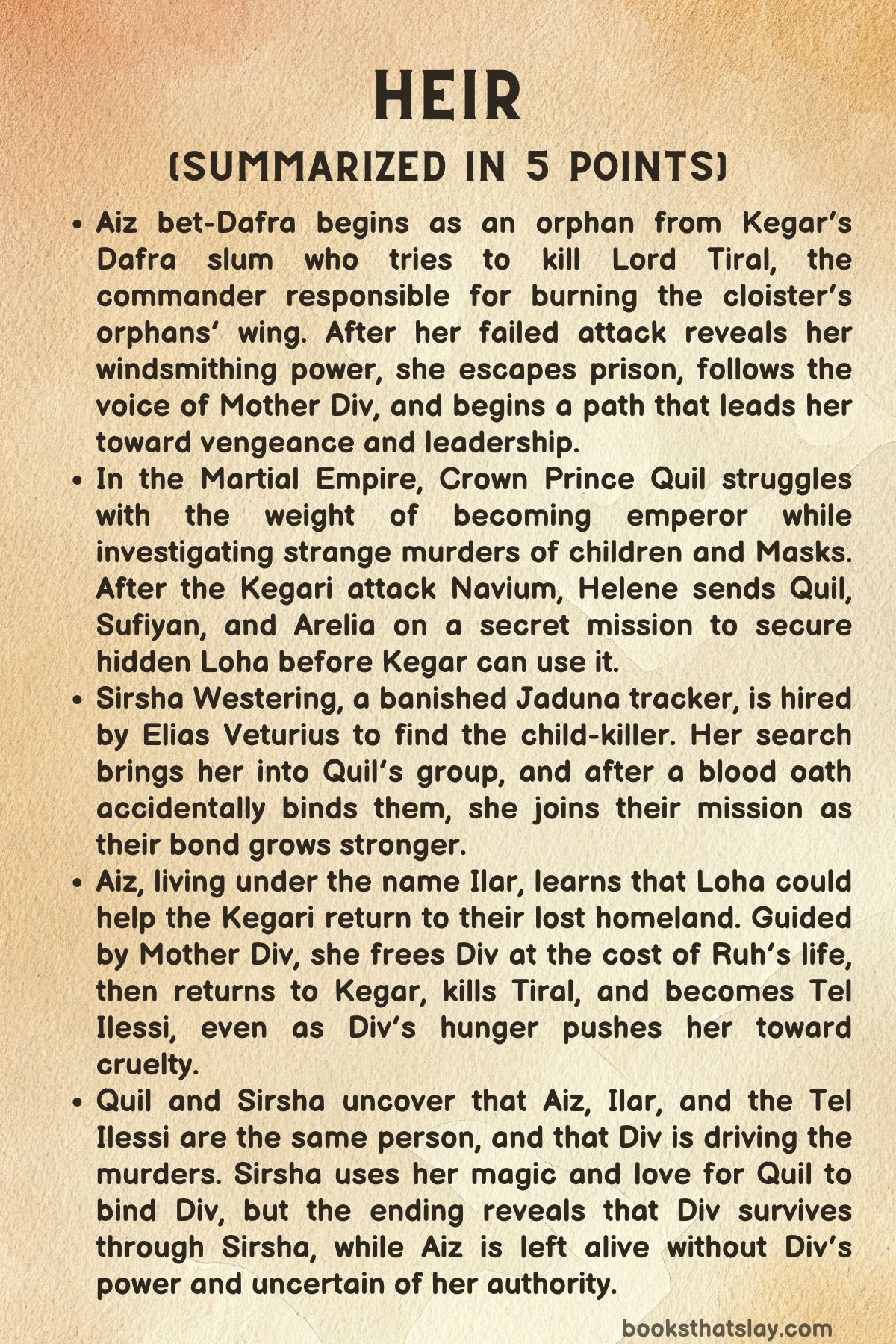
Summary
Aiz bet-Dafra grows up in the Dafra slum of Kegar, shaped by poverty, loss, and anger. She is an orphan who remembers the cruelty of Lord Tiral, a highborn commander responsible for burning the orphans’ wing of the cloister years before.
That old crime becomes the center of her rage, and she decides to kill him. Her assassination attempt is bold but reckless.
She gets close enough to strike, yet the plan fails. In the chaos, she reveals a hidden power: windsmithing.
A sudden burst of force helps her escape, but not before she steals a strange book from Tiral.
The failed attack brings disaster to the cloister. Tiral responds with punishment.
Aiz and the clerics are arrested, and the orphans are taken away for conscription. Aiz is sent to the Tohr prison, where misery and fear rule the inmates’ lives.
Even there, she holds on to stories. She tells the Sacred Tales to the prisoners, giving them something to believe in when everything around them has been stripped away.
Her storytelling marks her as someone unusual, and she is eventually taken to the Hollows. There, she hears the voice of Mother Div, a figure from belief and legend who claims to be returning.
Aiz escapes with help from Cero, a loyal friend who cares deeply for her, and she is sent away from Kegar with Ankanese seers to search for the truth behind Tiral’s book and Mother Div’s voice.
Far from Kegar, the Martial Empire faces its own fear. Crown Prince Quil is uneasy with the future waiting for him.
He is expected to become emperor, but he does not feel ready for the role or certain that he wants it. At the same time, a series of horrifying murders begins to shake the Empire.
Children and Masks are found dead with their hearts burned out. The Bani al-Mauth warns Quil that more children have died than he realizes, making it clear that the danger is larger than anyone has admitted.
During a festival in Navium, the threat from Kegar becomes impossible to ignore. Kegari forces attack using Sails, bringing destruction to the city and exposing the Empire’s weakness.
Empress Helene acts quickly. She sends Quil, Sufiyan, and Arelia away on a secret mission to recover hidden Loha, the living metal used to create Masks, before Kegar can claim it.
Quil is already burdened by murder, war, and the expectation of leadership, and he is unsettled further when he learns that his aunt has arranged his marriage without telling him.
Sirsha Westering enters the story as a banished Jaduna tracker. She has been cast out from her own people, but her skill makes her valuable.
Elias Veturius hires her to find the child-killer, and Sirsha begins following the trail. After fleeing Raider’s Roost, she tracks the killer south and discovers an important detail: the killer is female.
This discovery connects her search to the larger danger rising around the Empire.
After the Kegari attack, Sirsha crosses paths with Quil, Sufiyan, and Arelia. At first, they do not fully trust one another, but clues begin to connect their missions.
Sufiyan recognizes a ring Elias gave Sirsha, and the group realizes that the murders, Kegar’s aggression, and the search for Loha may be part of the same crisis. Sirsha’s own past catches up with her when her sister R’zwana and other Jaduna capture them.
In order to protect Sirsha, Quil claims her as his betrothed through a blood oath. The act is meant as a quick defense, but it accidentally binds them through an Adah oath coin.
Sirsha becomes part of Quil’s group, and as they travel together, the bond between her and Quil grows from necessity into real feeling.
While Quil and Sirsha search for the killer, Aiz travels under the name Ilar with Tribe Saif. In this new identity, she has a chance to observe the world beyond Kegar.
She befriends Ruh, whose kindness and loyalty matter deeply to her. She also grows close to Quil, though he does not know who she truly is.
Through her travels, Aiz learns more about the Martial Masks and understands that the metal used in them is Loha. To Aiz, this discovery is not just political or military.
Loha may be the key to carrying the Kegari back to the homeland they lost long ago. The dream of Return becomes central to her purpose.
Guided by Mother Div’s voice, Aiz seeks the hidden Ninth Tale. Her faith in Div grows stronger because Div seems to offer both truth and justice.
Aiz eventually finds the place where Div’s spirit is imprisoned. Freeing Div appears to be a sacred act, but the cost is terrible.
Ruh is killed, and the identity of Ilar is believed dead. Div is released, but she is not the savior Aiz imagined.
She is hungry, dangerous, and dependent on young hearts to regain her strength.
Aiz returns to Kegar transformed by grief, faith, and ambition. She confronts Tiral, overthrows him, and kills him.
In doing so, she becomes the Tel Ilessi, a leader who promises the Kegari that she will bring about their Return. To the oppressed people of Kegar, Aiz appears to be the answer to years of suffering.
She speaks to their longing and rage. Yet Div’s hunger keeps growing, and Aiz begins to sacrifice others in the name of a greater cause.
She tells herself that each cruel choice is necessary, that the future of her people matters more than the lives lost along the way. As her power rises, her moral certainty becomes more dangerous.
Quil and Sirsha continue investigating the murders and discover that the killer serves the Tel Ilessi. This leads them to the truth that Aiz, Ilar, and the new Kegari leader are the same person.
The revelation is painful, especially because Quil once knew Ilar as someone close to him. The person he trusted is now leading an invasion and working with a spirit that feeds on children’s hearts.
Quil, Sirsha, Sufiyan, and Arelia infiltrate Kegari camps and uncover more about Div. They realize that stopping Aiz also means understanding the ancient force behind her.
Aiz’s campaign grows more dangerous when she captures Helene and learns where the hidden Loha is kept. With that knowledge, her plan for the Kegari Return moves closer to reality.
Cero, who once helped Aiz escape and loved her deeply, begins to see that the girl he knew is disappearing. Div’s influence and Aiz’s own choices have changed her.
She still believes she is saving her people, but she has become willing to destroy anyone who stands in her way.
Quil, Sirsha, Sufiyan, Arelia, and Tas regroup in Ankana, hoping to stop the invasion and expose the truth. Instead, political betrayal leads to their arrest.
Their enemies are not only on the battlefield; they also face treachery from those who should be allies. When Aiz arrives, the conflict becomes personal.
Quil attacks her, but Div uses his pain against him by appearing as Marcus, Quil’s dead father. This vision torments Quil and forces him to face old fear and grief.
Sirsha realizes that Div was once bound by the First Durani. This knowledge gives her a way to fight back.
Her magic, her understanding of old power, and her love for Quil become the key to binding Div again. Sirsha acts even though the cost may be her own life.
She binds and destroys Div, or at least believes she has. The resulting blast scatters everyone and leaves the survivors uncertain of what has truly happened.
Quil survives and returns home, carrying grief for Sirsha. He believes he has lost her, and the victory feels incomplete.
Laia reveals that she once released the forbidden story that began this tragedy, showing that the present disaster was shaped by choices made long before. Aiz also wakes alive, but without Div’s power.
Her claim as Tel Ilessi now seems uncertain, perhaps even empty. The promise she made to her people remains, but the force that helped her rise is gone.
The ending leaves one final shock. Sirsha has survived, but Div is not fully destroyed.
Instead, Div appears in Sirsha’s own form, revealing that the binding has joined them together. The spirit’s defeat is not clean or final.
The battle has changed Sirsha, and the threat may continue in a new shape. Heir closes with its characters alive but marked by loss, power, and unfinished consequences.
Characters
The characters in Heir are shaped by grief, power, memory, loyalty, and the dangerous difference between justice and revenge. Each major figure carries a personal wound that influences the choices they make, and the story uses these characters to show how pain can either deepen a person’s compassion or harden into destruction.
The book presents its characters not simply as heroes or villains, but as people caught between private suffering and public responsibility.
Aiz bet-Dafra
Aiz bet-Dafra is one of the most tragic and morally complex figures in the book. She begins as an orphan from the Dafra slum of Kegar, someone who has grown up surrounded by loss, poverty, cruelty, and the memory of violence.
Her hatred of Lord Tiral is deeply personal because he represents the highborn brutality that destroyed the orphans’ wing and shattered the lives of children who already had very little protection. At first, Aiz’s desire to kill him feels like an act of justice, because it comes from years of grief and anger.
However, her journey gradually shows how easily justice can become revenge when suffering is left unchecked. Her windsmithing power makes her extraordinary, but it is her pain, not her magic, that truly drives her.
As Aiz grows closer to Mother Div, her character becomes increasingly dangerous. She convinces herself that every sacrifice is necessary for the survival and return of the Kegari people.
This makes her a powerful leader, but also a frightening one, because she begins to value her mission more than individual human lives. Her transformation into the Tel Ilessi shows how oppression can produce a leader who speaks the language of liberation while repeating the violence of oppressors.
Aiz is not evil in a simple way; she is someone whose love for her people becomes twisted by trauma, divine manipulation, and the hunger for revenge. By the end, when she is stripped of Div’s power and forced to confront the hollowness of her title, she becomes a symbol of ambition emptied of certainty.
Her tragedy lies in the fact that she wanted freedom, but lost herself while pursuing it.
Crown Prince Quil
Crown Prince Quil is a character burdened by inheritance. As the future emperor, he is expected to accept power, duty, marriage, and political responsibility, yet he begins the book deeply uneasy about all of it.
His discomfort makes him sympathetic because he is not hungry for the throne in the way many rulers might be. Instead, he fears what leadership will demand of him and whether he can live up to the people who came before him.
His connection to the mysterious murders of children and Masks places him in a world where political danger and supernatural horror are deeply connected, forcing him to mature quickly.
Quil’s character develops through his growing sense of responsibility. When Navium is attacked and he is sent away on a secret mission to recover the hidden Loha, he is no longer just a prince questioning his future.
He becomes someone who must act even when he is frightened, uncertain, and emotionally overwhelmed. His relationship with Sirsha also reveals his tenderness and courage.
By claiming her as his betrothed to protect her, he makes a sudden choice that carries magical and emotional consequences. Quil’s love is not presented as weakness; it becomes one of the sources of his strength.
His confrontation with Div, especially when Div uses the image of Marcus to torment him, exposes his deepest wounds. Quil survives the story as someone marked by grief, but also strengthened by love, loyalty, and the painful knowledge that leadership requires sacrifice.
Sirsha Westering
Sirsha Westering is one of the most compelling characters in the story because she is defined by exile, skill, and emotional guardedness. As a banished Jaduna tracker, she lives with the pain of being cut off from her own people.
Her work as a tracker gives her purpose, but it also shows how much she has had to rely on herself. When Elias hires her to find the child-killer, Sirsha enters the story as someone practical, sharp, and independent.
She follows evidence rather than emotion, and her discovery that the killer is female shows her intelligence and discipline.
Sirsha’s deeper character emerges through her relationship with Quil and her confrontation with her own past. She is not simply a tracker pursuing a killer; she is someone learning whether she can trust others after being rejected by her own community.
Her bond with Quil grows because both of them understand what it means to carry responsibilities they did not fully choose. The Adah oath coin binding them together gives their relationship a magical form, but the emotional bond between them is built through shared danger and loyalty.
Sirsha’s final act against Div is one of the most important moments in the book. By using her magic and her love for Quil to bind and destroy Div, she proves that love can be a force of resistance rather than vulnerability.
Yet her survival with Div appearing in her own form complicates her victory. Sirsha does not simply defeat darkness; she becomes bound to it, making her ending both hopeful and deeply unsettling.
Mother Div
Mother Div is the most dangerous supernatural presence in Heir, and her character represents the seductive power of forbidden stories, old wounds, and divine hunger. At first, Div appears to Aiz as a voice of guidance and hope.
She seems to offer answers, purpose, and a path toward restoring the Kegari people. This makes her especially dangerous because she does not enter the story only as a monster.
She presents herself as a savior, a motherly force, and a keeper of hidden truth. For someone like Aiz, who has lost so much and longs for justice, Div’s voice becomes almost irresistible.
As the story reveals more of Div’s nature, she becomes a figure of corruption and consumption. Her need to feed on young hearts shows that her return is built on innocence destroyed.
She manipulates Aiz by tying personal grief to national salvation, making cruelty seem necessary. Div’s power lies not only in magic but in persuasion.
She understands how to use longing, rage, and historical suffering to bend people toward her will. Her appearance as Marcus to torment Quil also shows her ability to weaponize memory and grief.
Even when Sirsha binds her, Div is not fully erased. Her survival in Sirsha’s form suggests that evil in the story is not easily destroyed; it mutates, attaches itself to the living, and survives through hidden bonds.
Lord Tiral
Lord Tiral is a cruel and oppressive figure whose actions shape much of Aiz’s life. He represents the highborn violence that has crushed the poor and powerless people of Kegar.
His burning of the orphans’ wing is not just a past crime; it is the wound that drives Aiz’s desire for revenge. Tiral’s cruelty is institutional as well as personal.
He has power, status, soldiers, and authority, and he uses all of them to punish those beneath him. His retaliation after Aiz’s failed assassination attempt shows his willingness to harm entire communities in order to maintain control.
Tiral’s role in the story is important because he helps explain why Aiz becomes so radicalized. He is the kind of villain whose brutality creates the conditions for rebellion.
However, his death does not solve the deeper problem. When Aiz kills him and takes power, the story shows that destroying one tyrant does not automatically create justice.
Tiral is a symbol of obvious oppression, but his presence also prepares the reader to see a more complicated danger: the possibility that the oppressed, once empowered by rage and divine manipulation, can become destructive themselves. His character is therefore essential to understanding Aiz’s fall.
Cero
Cero is a deeply important character because he represents loyalty, love, and the painful experience of watching someone change into a person almost unrecognizable. He rescues Aiz after her failed attempt to kill Tiral and helps her flee Kegar, which immediately establishes him as someone willing to risk himself for her.
His devotion is not abstract; it is shown through action. He protects Aiz when she is vulnerable and supports her when she is hunted.
As Aiz rises to power, Cero’s role becomes more emotionally complicated. He loves her, but he slowly realizes that the Aiz he knew is disappearing under Div’s influence and under the weight of her own choices.
This makes Cero one of the story’s quieter tragic figures. He is close enough to Aiz to understand her pain, but also close enough to see the moral cost of what she is becoming.
His character shows the helplessness of loving someone who is being consumed by power, trauma, and certainty. Cero’s importance lies in the fact that he humanizes Aiz.
Through him, the reader can see that before she became the Tel Ilessi, she was a person capable of being loved.
Empress Helene
Empress Helene is a character defined by command, sacrifice, and political responsibility. As empress, she must think beyond her own fears and emotions, even when the empire is under attack.
Her decision to send Quil, Sufiyan, and Arelia away on a secret mission after the devastation of Navium shows her strategic mind. She understands that the struggle against Kegar is not only about surviving one battle, but about preventing the enemy from gaining access to Loha and increasing their power.
Helene’s relationship with Quil also reveals the tension between love and rule. She cares for him, but she also makes decisions that affect his life without fully including him, such as arranging his marriage.
This does not make her careless; rather, it shows how rulers often treat personal lives as political tools. Helene’s capture by Aiz raises the stakes because she becomes both a political prisoner and a source of vital information.
Her character represents the burden of leadership in a world where every decision has consequences. She is strong because she can act under pressure, but her strength also creates emotional distance between her and those she is trying to protect.
Sufiyan
Sufiyan is a loyal and observant member of Quil’s party. His recognition of the ring Elias gave Sirsha helps connect separate parts of the story, making him important to the unfolding mystery.
He is not merely a companion in the background; he is someone whose knowledge and attention help the group understand that the dangers they are facing are linked. His presence gives Quil support during a time when the prince is being forced into dangerous responsibility.
Sufiyan’s character also reflects steadiness. In a story filled with supernatural terror, political betrayal, and emotional upheaval, he provides a grounded kind of loyalty.
He helps Quil move through situations that would be overwhelming alone. His value comes from his reliability and his ability to act with clarity when the group is surrounded by confusion.
Sufiyan may not be the most central figure, but he strengthens the bonds among the characters and helps the mission survive.
Arelia
Arelia is another important member of Quil’s group, and her presence adds intelligence, loyalty, and emotional balance to the journey. She is sent away with Quil and Sufiyan on Helene’s secret mission, which shows that she is trusted in matters of great importance.
Arelia exists within the political and military urgency of the story, but she also helps build the sense that Quil is not facing his burdens alone.
Her character is important because she is part of the circle that keeps Quil connected to duty, friendship, and survival. In dangerous situations, characters like Arelia reveal the importance of chosen companions.
She is not driven by the same consuming rage as Aiz or the same exile as Sirsha, but she still plays a meaningful role in resisting the forces threatening the empire. Her loyalty gives the group cohesion, and her presence helps show that the fight against Div and Aiz is not the work of one hero but of many people acting together.
Elias Veturius
Elias Veturius plays a significant role as the person who hires Sirsha to find the child-killer. His decision shows that he understands the danger is serious enough to require someone with Sirsha’s rare tracking abilities.
Elias acts as a bridge between past conflicts and the current crisis, connecting Sirsha to a larger world of danger, responsibility, and hidden truths. His trust in Sirsha is important because she is banished and isolated, yet he recognizes her value.
Elias’s presence also gives the story a sense of inherited consequence. The younger characters are not acting in a vacuum; they are living in a world shaped by earlier struggles, older powers, and past decisions.
By sending Sirsha after the killer, Elias helps set in motion one of the central investigations of the book. His role may not dominate the action, but it is crucial because he helps bring the right person into the heart of the conflict.
R’zwana
R’zwana, Sirsha’s sister, represents the painful bond between family and judgment. Her capture of Sirsha and the others shows the power the Jaduna still hold over Sirsha’s life.
As Sirsha’s sister, R’zwana is not simply an enemy; she is part of the community and family structure from which Sirsha has been banished. This makes her role emotionally sharp because she embodies the rejection Sirsha carries with her.
R’zwana’s character helps reveal the cost of exile. Through her, the reader sees that Sirsha’s banishment is not just a political or magical condition, but a personal wound tied to family and belonging.
R’zwana forces Sirsha to confront the world she has lost and the people who still have power over her identity. Her presence deepens Sirsha’s character by showing that the tracker’s independence was shaped by rejection, not freedom alone.
Ruh
Ruh is a gentle and important figure in Aiz’s journey during her time with Tribe Saif. His friendship with Aiz, while she is living under the name Ilar, gives her a glimpse of connection outside her pain and mission.
Ruh represents innocence, trust, and the possibility of a softer life. Through him, Aiz is briefly connected to warmth and companionship rather than revenge and survival.
Ruh’s death is one of the major turning points in Aiz’s transformation. It marks the terrible cost of freeing Div and shows that the pursuit of hidden truth can demand innocent blood.
His loss is not only tragic on its own; it also pushes Aiz further toward the path that leads her back to Kegar as the Tel Ilessi. Ruh’s importance lies in what he represents before he dies.
He is proof that Aiz could have belonged to something gentler, but his death helps close that door. In that sense, Ruh becomes a symbol of the life Aiz loses as she becomes more consumed by Div and by her cause.
Tas
Tas is part of the group that regroups with Quil, Sirsha, Sufiyan, and Arelia in Ankana. His role places him within the resistance against Aiz’s invasion and the growing threat of Div.
Although he is not described as centrally as Quil, Sirsha, or Aiz, his presence still matters because he is part of the wider network of people trying to survive political betrayal and supernatural danger.
Tas helps show that the crisis affects more than the main characters. The struggle against Aiz and Div requires alliances, regrouping, and collective endurance.
Characters like Tas broaden the story’s world by showing that many people are drawn into the consequences of Aiz’s choices. His role reinforces the idea that survival depends not only on powerful individuals, but also on the people who stand with them when events begin to collapse.
Laia
Laia is a character connected to the deeper origin of the tragedy. Her revelation that she once released the forbidden story that began the disaster gives her a heavy symbolic role.
She represents the unintended consequences of choices made with incomplete understanding. Her action is not presented as simple villainy, but as a mistake or decision whose effects spread far beyond what she could have foreseen.
Laia’s importance lies in the way she connects story, memory, and catastrophe. The forbidden story is not just a piece of information; it becomes a force that changes lives, awakens danger, and helps set the larger tragedy in motion.
Through Laia, the book suggests that stories have power, and that releasing hidden knowledge can be both liberating and destructive. Her character carries guilt and responsibility, reminding the reader that even well-intentioned actions can open the door to suffering.
Marcus
Marcus appears most powerfully through Div’s manipulation of Quil. As Quil’s dead father, Marcus represents inherited trauma, fear, and emotional torment.
Div’s choice to manifest as Marcus is cruel because it uses Quil’s personal grief against him. This moment reveals how deeply Marcus still affects Quil, even in death.
He is not simply a remembered parent; he is part of the emotional weight Quil must carry as he moves toward leadership.
Marcus’s role is important because he shows that the dead continue to shape the living. For Quil, his father is tied to pain, memory, and the fear of becoming trapped by the past.
When Div takes Marcus’s form, she turns that memory into a weapon. This makes Marcus less of an active character and more of a haunting presence, but that presence is powerful.
He helps expose Quil’s vulnerability and makes Quil’s survival more meaningful.
The Bani al-Mauth
The Bani al-Mauth is a mysterious and unsettling figure who warns Quil that more children have died than he realizes. This warning expands the danger beyond what Quil initially understands and helps establish the murders as part of a larger supernatural crisis.
The character’s role is brief but significant because it pushes Quil toward awareness. The Bani al-Mauth brings knowledge that others do not have or are not ready to face.
This figure also adds a sense of fate and darkness to the story. The warning is not casual; it feels like a message from a deeper, more ominous layer of the world.
Through the Bani al-Mauth, Quil is forced to recognize that the violence around him is not isolated. The character functions as a messenger of hidden truth, making the danger feel larger, older, and more terrifying.
The First Durani
The First Durani is important because of the ancient connection to Div’s binding. Although not present in the same way as the central characters, this figure represents old power, old resistance, and forgotten knowledge.
Sirsha’s realization that Div was once bound by the First Durani gives her the key to fighting Div in the present. This makes the First Durani essential to the story’s magical history.
The First Durani also shows that the battle against Div is not new. The present conflict is part of a much older struggle between destructive power and those who try to contain it.
Through this figure, the book suggests that history leaves behind both danger and tools for survival. The First Durani’s importance lies in legacy.
Even from the past, this character’s actions shape the possibility of Div’s defeat.
The Ankanese Seers
The Ankanese seers play an important guiding role in Aiz’s journey after she escapes Kegar. They send her away to pursue the truth behind Tiral’s strange book and Mother Div’s return.
Their presence gives Aiz’s mission a sense of destiny and spiritual importance. They are connected to hidden knowledge, prophecy, and the search for truths that ordinary people cannot easily access.
However, their role also shows the danger of seeking truth without fully understanding its cost. Aiz’s path toward Div begins partly through this search for answers, and those answers eventually lead to destruction.
The seers help move Aiz toward knowledge, but the knowledge she finds becomes corrupted by grief and manipulation. Their character function is therefore complex.
They are guides, but the path they help open leads Aiz toward both revelation and ruin.
The Clerics
The clerics are important because they represent the fragile moral and spiritual structure surrounding Aiz’s early life. When Tiral retaliates by arresting Aiz and the clerics, their suffering shows how the powerful punish entire communities rather than only individuals.
They become victims of collective cruelty, caught in the consequences of Aiz’s failed assassination attempt and Tiral’s need to reassert control.
Their presence also emphasizes the vulnerability of the cloister and its orphans. The clerics are connected to care, teaching, and spiritual life, but they are powerless against the machinery of highborn violence.
Their arrest and imprisonment help explain the scale of injustice in Kegar. They show that Aiz’s anger is rooted in a real system of oppression, even if her later choices become morally corrupted.
The Kegari Orphans
The Kegari orphans are not one single character, but they are deeply important as a collective presence in the story. They represent the innocence destroyed by Tiral’s violence and by the larger cruelty of Kegar’s social order.
The burning of the orphans’ wing is one of the wounds that shapes Aiz, and the later conscription of the orphans shows that children in this world are repeatedly treated as expendable.
The orphans also give emotional force to Aiz’s mission. Her desire to fight for the Kegari is tied to children like them, people who have been abandoned, harmed, and used by those in power.
However, their suffering also makes Aiz’s later actions more tragic. She begins by wanting justice for the vulnerable, but under Div’s influence, she becomes connected to the deaths of children herself.
The orphans therefore help reveal the painful irony of Aiz’s journey: she rises in response to harm done to children, yet her cause becomes entangled with a power that feeds on young hearts.
The Jaduna
The Jaduna are important as Sirsha’s people and as a magical community with its own rules, judgments, and traditions. Their treatment of Sirsha reveals a society that values order and belonging, but also one capable of exclusion.
Because Sirsha is banished, the Jaduna represent both her origin and her wound. They are the people who shaped her, but also the people who cast her out.
Their capture of Sirsha, Quil, and the others shows that they are powerful and organized, not merely a background group. The Jaduna also deepen the story’s exploration of loyalty and identity.
Sirsha must navigate her connection to them while also building a future beyond their judgment. Through the Jaduna, the book explores how communities can protect tradition while also causing deep harm to those who do not fit within their expectations.
The Kegari People
The Kegari people are central to the emotional and political conflict of the story. They are a displaced and suffering people longing for a Return to their lost homeland.
Their pain gives Aiz’s rise meaning, because she becomes the Tel Ilessi by promising them restoration, dignity, and a future. Their longing is understandable, and the story treats their suffering seriously rather than dismissing it.
At the same time, the Kegari people are vulnerable to being led by someone whose vision is increasingly shaped by Div. Their hope becomes a source of power for Aiz, but also a tool that can be used to justify violence.
This makes them one of the most tragic collective forces in the story. They want freedom and home, but their cause becomes tied to sacrifice, invasion, and manipulation.
Through them, the book shows how oppressed people can be drawn toward dangerous leaders when hope is mixed with desperation.
The Martial Masks
The Martial Masks are significant both as warriors and as symbols of empire. Their connection to Loha makes them central to the conflict, because the living metal within them becomes something Aiz believes can help carry the Kegari back to their homeland.
The burned-out hearts of murdered Masks also connect them to Div’s hunger and the larger mystery Sirsha and Quil are trying to solve.
As a group, the Masks represent discipline, power, and the machinery of the Martial Empire. Yet the murders make them vulnerable, showing that even the empire’s strongest figures can be reduced to victims by the supernatural force at work.
Their role helps connect political power to magical danger. They are not only soldiers; they are bodies marked by the very resource everyone is trying to control.
The Kegari Sail Fighters
The Kegari who attack Navium with Sails represent the military force of Aiz’s people and the destructive side of their campaign. Their attack devastates the city and changes the direction of Quil’s life.
Through them, the Kegari cause becomes visible not only as a dream of return, but as an organized and violent movement capable of mass destruction.
These fighters are important because they complicate the reader’s view of the Kegari struggle. Their people have suffered, but their method of fighting brings suffering to others.
The attack on Navium forces the Martial Empire to respond and pushes Helene to send Quil on the mission to recover the hidden Loha. The Sail fighters therefore act as the military expression of a deeper political and spiritual crisis.
They show how a wounded people’s longing for home can become a force that wounds others.
The Inmates of Tohr Prison
The inmates of Tohr prison are important because they become the audience for Aiz’s storytelling. When Aiz tells the Sacred Tales to them, she gains a kind of power that is different from windsmithing.
She becomes a voice, a keeper of memory, and a figure who can move people through story. This moment helps show why Aiz is capable of becoming a leader later.
She understands the emotional power of narrative.
The inmates also represent the broken and forgotten people of Kegar’s system. Their presence shows that oppression is not limited to Aiz or the orphans.
Many people are trapped, silenced, and discarded. Aiz’s connection with them in prison deepens her role as someone who speaks to the suffering.
However, this gift for storytelling later becomes dangerous when combined with Div’s influence. The same ability that allows Aiz to inspire the imprisoned also helps her persuade a nation to follow her into darkness.
Themes
Power and Moral Corruption
Aiz begins with a cause that feels rooted in justice: she wants revenge for the suffering of the orphans and freedom for the Kegari people. Her anger comes from real cruelty, poverty, and loss, which makes her early choices understandable even when they are dangerous.
However, as she gains influence, her sense of justice begins to shift into a hunger for control. She starts believing that any sacrifice is acceptable if it serves the Return, and this belief slowly separates her from compassion.
Her leadership becomes defined not only by courage but also by the willingness to use others as tools. The tragedy lies in how easily righteous pain can become cruelty when it is joined with unchecked power.
Aiz does not see herself as evil; she sees herself as necessary. That makes her fall more disturbing, because the story shows that corruption often grows from certainty rather than doubt.
Identity and the Burden of Inheritance
Quil’s struggle is shaped by the weight of the throne, his family history, and the fear that he may repeat the violence connected to his bloodline. He is not simply preparing to rule; he is trying to understand what kind of ruler he can be when his inheritance carries both duty and darkness.
The pressure placed on him is political, emotional, and deeply personal. His arranged marriage, his aunt’s expectations, and the memory of his father all remind him that his life is not entirely his own.
Yet his choices show a desire to define leadership through mercy rather than domination. In Heir, inheritance is not treated as a simple gift or curse.
It is a force that characters must confront, question, and reshape. Quil’s journey suggests that identity is not decided only by ancestry, but by the choices made when power, fear, and responsibility collide.
Faith, Manipulation, and Dangerous Devotion
Aiz’s devotion to Mother Div gives her purpose during moments of loneliness, suffering, and uncertainty. The voice she follows seems to offer comfort and direction, especially when the world has denied her safety and justice.
Yet that devotion becomes dangerous because it demands obedience without moral questioning. Aiz mistakes guidance for truth and sacrifice for holiness, allowing Div’s hunger to hide behind the language of destiny.
The story examines how faith can become destructive when pain makes a person desperate for meaning. Aiz wants to believe that every loss has a purpose and that every brutal act serves something sacred.
This makes her easier to manipulate, because Div does not need to force her completely; she only needs to feed the beliefs Aiz already wants to hold. The theme shows that devotion without conscience can become a weapon, especially when it promises healing while asking for blood.
Love, Loyalty, and Sacrifice
The relationships in the story reveal how love can both protect and wound. Quil and Sirsha’s bond grows in the middle of fear, pursuit, and political danger, making their connection feel fragile but powerful.
Their love is not separate from the larger conflict; it becomes one of the forces that helps Sirsha resist Div and act with courage. Cero’s loyalty to Aiz is more painful because he sees the person he loves changing into someone harder and colder.
His grief shows that loyalty becomes complicated when love demands honesty instead of blind support. The story also presents sacrifice as more than dramatic loss.
It is the willingness to protect others even when survival, pride, or desire pulls in the opposite direction. Sirsha’s final act shows love as a form of resistance, not weakness.
Through these relationships, the narrative suggests that loyalty matters most when it is guided by truth.