Saltwater by Katy Hays Summary, Characters and Themes
Saltwater by Katy Hays is a moody, dangerous literary thriller about inherited money, family silence, and the stories powerful people build around their crimes. The book follows Helen Lingate, the daughter of a famous playwright who died on Capri thirty years earlier under suspicious circumstances.
When Helen returns to the island with her wealthy family, her assistant and confidante Lorna disappears, creating a second mystery that mirrors the first. As old evidence resurfaces, the glamour of villas, yachts, and private islands gives way to betrayal, staged innocence, and the truth about what really happened to Sarah Lingate.
Summary
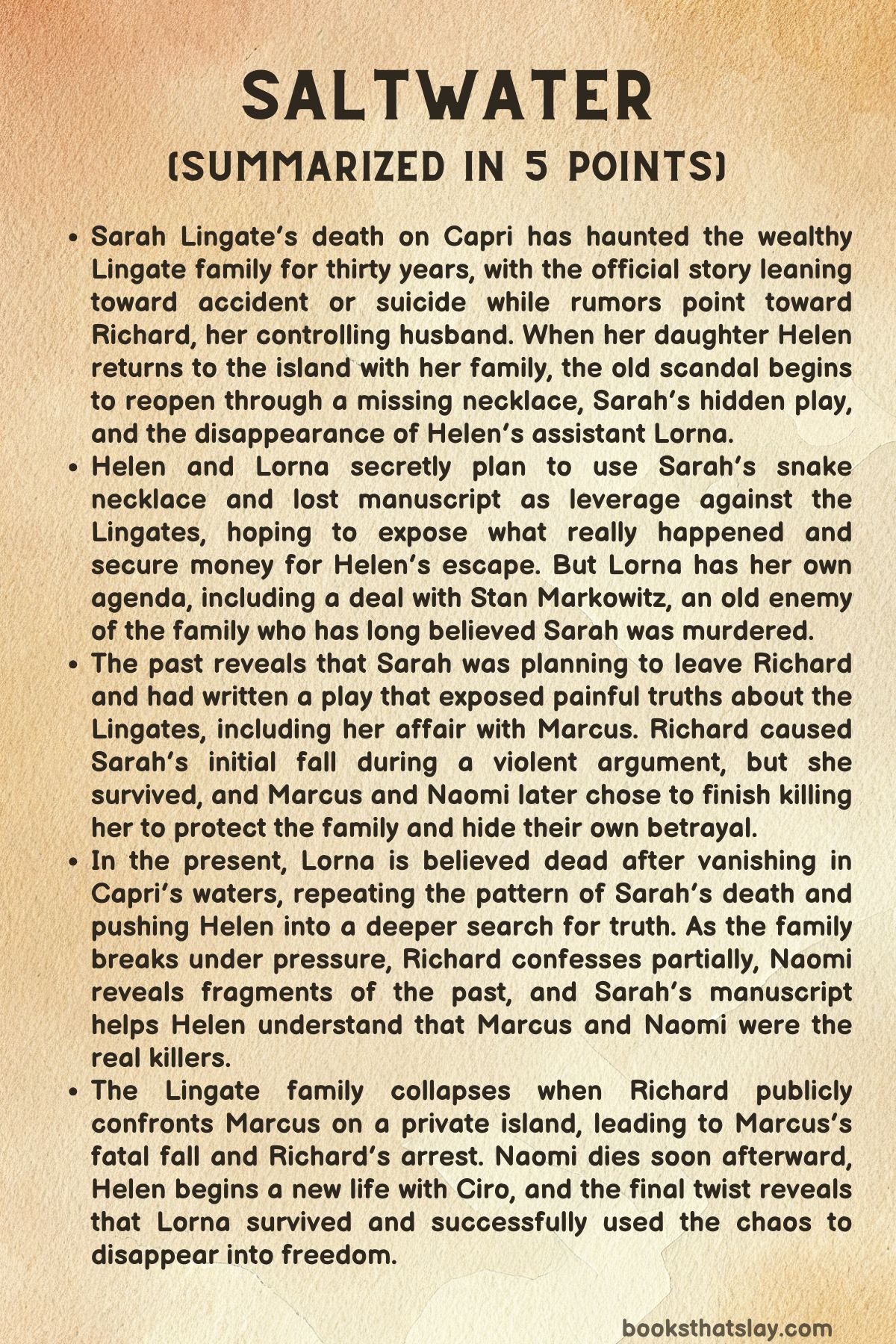
Sarah Lingate’s disappearance on Capri begins as a public scandal and becomes a private family curse. She is a Pulitzer-nominated playwright, married to Richard Lingate, whose family controls a powerful energy fortune.
During a vacation with Richard, his brother Marcus, and Marcus’s wife Naomi, Sarah vanishes after a night out. Richard returns to the villa alone, and Sarah is reported missing the next day.
When her body is later found near the Faraglioni, authorities lean toward accident or suicide, but suspicion immediately gathers around the Lingates.
Thirty years later, Sarah’s daughter Helen returns to Capri with the same family whose silence shaped her life. Helen is no longer a child, but she still lives under the weight of her father’s rules, her uncle’s control, and the family’s money.
She has grown up hearing that outsiders cannot be trusted, and every detail of Sarah’s life has been filtered through Richard and Marcus.
Helen’s assistant and friend Lorna joins the trip, though her role is far more complicated than that of a normal employee. Lorna has arranged the travel, villa, dinners, boats, and comforts the Lingates take for granted, but she also watches them with resentment and calculation.
She is fascinated by their wealth, yet repelled by the casual cruelty that comes with it. When a boat captain’s hand is crushed during their arrival, the Lingates leave money behind and move on, while Lorna remains shaken by how little the injury matters to them.
Lorna has her own history with the family. She works for Marcus, has grown close to Helen, and is hiding secrets connected to Freddy, Helen’s boyfriend.
Years earlier, Lorna and Freddy knew each other through drugs, drinking, and sex, a connection Freddy wants buried. Lorna also has a separate plan involving Stan Markowitz, an old enemy of the Lingates who has spent years trying to prove that Richard killed Sarah.
The return to Capri is not only a family ritual. Helen and Lorna have come with a plan.
Before the trip, they discovered Sarah’s snake necklace at Marcus’s office, a piece believed to have disappeared after her death. Helen recognized it from records and understood its power immediately.
Rather than turn it over to police, she and Lorna arranged for the necklace to be sent to the villa with a threatening message, hoping to destabilize the family and force hidden truths into the open.
Helen’s motives are personal and financial. She has learned that Sarah created a trust for her using money from her work, but Richard liquidated it while Helen was still young.
The trust could have given Helen independence, but the family concealed the truth and pushed her into signing papers that protected them. Helen wants to escape the Lingates, but escape requires money, evidence, and leverage.
The necklace arrives at the villa like a curse returning home. Richard and Marcus recognize it, and their controlled reactions show that the object carries more history than they are willing to admit.
Helen refuses to hand it over, using the fact that it was addressed to her as a form of power. Lorna watches closely, knowing the plan is becoming more dangerous.
As the family moves through dinners, drinks, beach clubs, and boat trips, the old story of Sarah’s death keeps resurfacing. Naomi drinks too much and makes unsettling comments about Sarah, Ciro, and the past.
Island locals still recognize the Lingates and call them killers. Stan keeps pressing Lorna for the item she promised him, and Lorna continues hiding a manila envelope she stole from Marcus’s office.
Inside are pages of Sarah’s lost play, Saltwater, the work that may have threatened the family before her death.
The narrative returns to Sarah in 1992, revealing the collapse of her marriage. Richard has become controlling, isolating her and trying to block her new play because he recognizes the Lingates in it.
Sarah is preparing to leave him. She no longer believes she can live inside his family’s money, surveillance, and legal threats.
Her work is not just art; it is evidence of emotional abuse, family corruption, and perhaps something even more dangerous.
Sarah’s relationship with Marcus also becomes central. Before the fatal night, she meets Marcus and tries to reassure him that she will not attack the family financially in the divorce.
Yet their conversation carries the charge of an affair. Marcus asks her to promise that Richard will never know the truth, and Sarah agrees.
This secret means Sarah is dangerous not only because of her play or her planned divorce, but because she may expose Marcus’s betrayal and the possibility that Helen is his daughter.
In the present, Helen and Lorna’s plan begins to fracture. Lorna is secretly negotiating with Stan and may intend to sell him Sarah’s manuscript.
Helen still believes they are working together, but Lorna’s loyalty is uncertain. Ciro, Renata’s son and Helen’s former lover, reappears as well.
He and Helen share a long history that began in childhood on Capri and became romantic when they were older. Their bond represents a life Helen once wanted, but could never fully choose.
During a swim near the cliffs, Lorna panics in open water and nearly drags Helen down with her. The setting is loaded with dread because Sarah died below the same island landscape.
Ciro rescues Lorna, but the episode exposes how vulnerable Lorna is and how little control she really has. She came to Capri believing she could profit from the Lingates’ secrets, but she is surrounded by people who know the island, the water, and the rules of power better than she does.
Lorna later meets Stan on his yacht, intending to trade information for money. Stan presents himself as a crusader for justice, but Lorna sees that he is also vain, obsessive, and corrupt in his own way.
He hates the Lingates, yet belongs to their world of luxury and entitlement. Lorna understands that Sarah’s death was not only the result of one bad marriage; it came from an entire social circle built on silence, performance, and control.
That night at Anema e Core, Lorna remains sober while everyone around her drinks and performs happiness. She is close to completing her exchange and possibly escaping with money.
But as she leaves the club, she becomes isolated in the streets. The sense of pursuit grows until her disappearance becomes inevitable.
In the morning, Helen realizes Lorna has not returned. The family responds with calm excuses rather than panic, suggesting that they have learned how to manage disappearance as a public-relations problem.
Helen knows Lorna had a task after leaving the club and should have contacted her. As the hours pass, fear hardens into certainty.
Lorna is missing in a way that mirrors Sarah.
Helen searches Lorna’s room and finds the hidden envelope containing pages of Sarah’s play. The discovery changes everything.
Helen has spent her life trying to know her mother through fragments, but now she holds Sarah’s own words. The manuscript suggests that the truth about Sarah’s death may be tied to the play, the affair, and the family’s fear of exposure.
Authorities also begin circling the old case again. Articles reveal that Sarah’s death has been reopened, based on new evidence and possible written material.
Witnesses from the past claim Sarah was seen injured with a man, and that Richard may have said Sarah tried to kill him. The old official explanation no longer holds easily.
Then Lorna’s body is found in the water. Helen sees the terrible repetition: another woman close to the Lingates has ended up dead on Capri.
Stan wants to push the case from outside, but Helen knows the family can survive outside pressure. Any real destruction must come from within.
Richard soon cracks. Helen finds him near the Salto di Tiberio, unstable and haunted, and he confesses that he killed Sarah.
He remembers the sound of her body hitting stone. Helen is horrified, but the confession is incomplete.
Richard caused Sarah’s fall during a violent argument, but the later truth is darker. Sarah did not die immediately.
Naomi begins revealing pieces of the hidden story. She tells Helen that Richard is wrong: he did not kill Sarah.
Her statement forces Helen to reconsider everything. Richard may be guilty, but not in the way he believes.
His guilt comes from the fall, while the actual killing may have happened afterward.
The past finally becomes clear through Marcus and Naomi. After Sarah falls, Marcus finds her alive, injured, and terrified.
Instead of calling for help, he recognizes the danger she represents. If Sarah survives, she can expose Richard’s violence, her planned divorce, the play, and the affair with Marcus.
Naomi appears as well, driven by jealousy, resentment, and the belief that Sarah took both her husband and the child she never had. Naomi and Marcus silence Sarah and push her over the edge, ensuring that the sea will finish what the fall did not.
Renata, Sarah’s friend and Ciro’s mother, also witnessed part of the truth. Naomi attacked her and pushed her over a wall to eliminate another witness.
Renata survived, carrying the truth outside the family’s control for decades. She is later revealed to have sent the snake necklace back into the story, using it as a tool to reopen the past.
On the private island of Gallo Lungo, Helen shows Sarah’s play to Richard. As he reads, he begins to understand what he missed: the manuscript exposes Sarah’s affair and points toward Marcus’s motive.
Richard confronts Marcus in public. Their fight ends with Marcus falling over a wall onto the rocks below, echoing Sarah’s death.
This time, there are witnesses. The family’s old pattern of secrecy becomes impossible to repeat.
Richard is detained, and Naomi begins to unravel. Helen helps Naomi leave the party, but the next morning Naomi is found dead from an apparent overdose.
Helen asks for an autopsy, refusing the convenient closure that Sarah never received. Richard plans to plead guilty, Marcus is dead, Naomi is dead, and the Lingate family’s old machinery has collapsed.
Two years later, Helen is living in Milan with Ciro and their baby. She sees a woman who looks like Lorna and follows her through the streets.
The encounter seems impossible, because Lorna was believed dead. A later sign from Capri suggests that Lorna may still be alive.
The epilogue confirms that Lorna survived. She used the chaos around the Lingates, Stan, and the sea to disappear into a new identity.
To the world, she is dead, but that death gives her freedom. Helen sees her briefly, and Lorna allows herself a moment of recognition before vanishing again.
The final turn leaves the book with one last act of self-invention: the woman everyone mourned has escaped the story others tried to write for her.
Characters
Helen Lingate
Helen Lingate is the unstable center of Saltwater, a woman raised inside wealth but emotionally starved by the same family that claims to protect her. Her life has been shaped by absence: the death of her mother Sarah, the loss of the trust Sarah created for her, and the constant withholding of truth by Richard, Marcus, and Naomi.
Helen’s greatest wound is not only that Sarah died when she was young, but that she was denied a full relationship with her mother’s memory. Richard controlled her access to Sarah’s work, her friendships, her education, and even the stories she was allowed to believe.
This control leaves Helen both sheltered and deeply suspicious, trained to obey but also quietly gathering evidence against the people who raised her.
Her friendship with Lorna reveals Helen’s hunger for alliance outside the Lingate system. Yet Helen is not innocent in that friendship.
She uses Lorna as a partner in the necklace plan and, at times, fails to see how vulnerable Lorna is. Helen wants freedom, but she has learned strategy from her family, which means her attempts at escape often resemble manipulation.
By the end of the book, Helen has become both survivor and inheritor. She refuses easy closure after Naomi’s death and demands the kind of scrutiny Sarah never received.
Still, she is not presented as purified by truth. She carries the Lingate talent for silence, timing, and selective confession, but she begins using those tools to loosen the family’s hold rather than preserve it.
Lorna
Lorna is one of the most slippery and self-made figures in the novel. She enters the Lingates’ world as an employee, but she is never only an assistant.
She is a watcher, planner, liar, survivor, and opportunist who understands that rich people often mistake service for loyalty.
Her resentment toward the Lingates comes from close observation. She arranges their comforts, sees the labor behind their ease, and understands how money lets them move past injury, scandal, and responsibility.
The boat captain’s accident affects her because it exposes the family’s moral reflex: payment replaces care, and inconvenience matters more than harm.
Lorna’s bond with Helen is real enough to matter, but not pure enough to be safe. She sympathizes with Helen’s imprisonment, helps with the necklace scheme, and understands the emotional power of Sarah’s lost objects.
At the same time, she hides the manuscript, negotiates with Stan, and keeps her past with Freddy secret. Her loyalty is always mixed with the question of what she can gain.
Her survival at the end reframes her entire role. Lorna becomes the one character who fully escapes by accepting social death.
While the Lingates use false stories to preserve status, Lorna uses disappearance to create freedom. Her final choice to remain gone makes her both morally ambiguous and strangely victorious.
Sarah Lingate
Sarah Lingate is the dead woman at the center of the story, but the book gradually restores her from symbol to person. At first, she exists as a famous playwright, a scandal, a beautiful lost wife, and a mother Helen barely remembers.
Later, her own perspective reveals a woman trapped inside a controlling marriage and a dangerous family structure.
Sarah’s art is one of her strongest forms of resistance. Her play Saltwater threatens the Lingates because it turns private cruelty into language.
Richard fears it because he recognizes himself and his family in it, while Marcus fears it because it may expose the affair and the deeper betrayal beneath his polished control.
Her relationship with Richard is marked by exhaustion and containment. He uses money, privacy, legal threats, and emotional pressure to narrow her life.
Sarah understands that leaving him will not be simple, because divorce from a Lingate is not just a marital decision but an attack on a dynasty.
Sarah’s affair with Marcus complicates her position without reducing the violence done to her. She has secrets of her own, but those secrets do not justify what happens.
Her death becomes the result of male possession, family panic, and Naomi’s jealousy. Her later ghostly presence gives her a final voice, allowing the story to treat her not as a mystery object but as a mother, artist, and witness.
Richard Lingate
Richard Lingate is defined by weakness wrapped in entitlement. He presents himself at times as spiritual, wounded, or misunderstood, but his actions show a man who uses vulnerability as another form of control.
His marriage to Sarah deteriorates because he cannot tolerate her independence, her work, or the possibility that she might define herself outside his name.
Richard’s guilt is real, but it is incomplete. He believes he killed Sarah because his violence caused her fall.
That belief haunts him for decades, especially the memory of her body striking stone. Yet his confession does not contain the whole truth, and this gap reveals something essential about him: even his remorse is centered on his own suffering.
As a father, Richard turns Helen’s life into a guarded enclosure. He teaches her that only family can be trusted, but what he really means is that family must never be exposed.
His theft or misuse of Sarah’s trust for Helen is another betrayal, depriving his daughter of the financial independence Sarah wanted her to have.
Richard’s final confrontation with Marcus is both delayed justice and another repetition of old violence. He may not intend to kill Marcus in a clean, deliberate way, but anger and the landscape combine again.
His life becomes a cycle of falls, confessions, and failures to act rightly when it matters.
Marcus Lingate
Marcus Lingate is the family’s chief manager of damage. He is calmer than Richard, smoother in public, and more capable of thinking strategically under pressure.
That calm makes him more dangerous, because he treats moral crisis as a logistical problem.
His relationship with Sarah exposes his hypocrisy. He is emotionally and likely sexually involved with her, yet when her survival threatens the family, he chooses preservation over love.
Whatever feeling he had for Sarah collapses under the pressure of reputation, money, and power.
Marcus’s crime is especially chilling because he finds Sarah alive. The crucial moral choice comes after the fall, when rescue is still possible.
Instead of saving her, he calculates what her survival would cost. That decision turns panic into murder.
As Helen’s uncle and possible biological father, Marcus carries another layer of betrayal. If Helen is his child, then his role in Sarah’s death and Helen’s lifelong confinement becomes even more monstrous.
He does not merely hide the truth; he helps destroy the woman who could have told it.
Naomi Lingate
Naomi begins as a figure who seems ornamental, unstable, and often drunk, but the book gradually reveals her as one of the most important keepers of the truth. Her looseness with alcohol makes her appear unreliable, yet she has been watching and remembering for decades.
Her jealousy of Sarah is central to the crime. Naomi knows about Sarah and Marcus, and she believes Helen may be the child Marcus never gave her.
Sarah becomes, in Naomi’s mind, the woman who stole her husband, motherhood, and emotional place within the family. This resentment curdles into violence.
Naomi’s role in Sarah’s death is not passive. She helps silence Sarah and later participates in pushing her into the sea.
She also attacks Renata, showing that her instinct is not merely to protect Marcus but to eliminate witnesses. Her cruelty comes from wounded pride, but the result is calculated and lethal.
In the present, Naomi’s attempts to tell Helen pieces of the truth are shaped by guilt, bitterness, and self-preservation. Her death from an apparent overdose closes her life without full accountability, but Helen’s demand for an autopsy refuses to let Naomi receive the easy ending the family once arranged for Sarah.
Freddy
Freddy represents safety as arranged by the family, but that safety is hollow. He is Helen’s boyfriend and possible fiancé, a man who fits the world Richard and Marcus want Helen to inhabit.
His presence suggests normalcy, marriage, and continuation of the same class system.
His past with Lorna complicates his image. He wants their history of drugs, sex, and chaos to remain hidden because it threatens the version of himself he presents to Helen.
This makes him another character invested in controlled storytelling, even if his secrets are smaller than the Lingates’ crimes.
Freddy often responds to crisis with denial or inappropriate cheer. While Helen is terrified over Lorna, Sarah, and her father’s confession, Freddy moves toward ring shopping and social plans.
His emotional distance shows how poorly he understands Helen and how much their relationship depends on surface compatibility.
He is not the central villain, but he belongs to the system that keeps Helen contained. His role is to make a controlled future look attractive enough that Helen might stop asking questions.
By the end, she has outgrown the life he represents.
Ciro
Ciro is Helen’s connection to a life outside the Lingate family, but he is not a simple rescue figure. He grew up near Helen through his mother Renata, and their childhood bond grows into adult romance.
For Helen, he represents Capri as something more intimate than luxury: memory, desire, and a possible escape.
His relationship with Helen is shaped by class difference. He shows her Naples and a less polished life, but Helen’s money, surveillance, and fear keep her from choosing him fully when they are younger.
Their bond carries longing, but also mistrust.
In the present, Ciro often knows more than he says. His calm after Lorna’s death and his evasiveness about the night before make Helen question his honesty.
He helps her, protects her, and later builds a life with her, but he is also part of the island’s network of secrets.
Ciro’s importance lies in the fact that he connects Helen to Renata’s truth. Through him, Helen is pulled toward a history the Lingates tried to bury.
He is love, temptation, witness, and risk all at once.
Renata
Renata is one of the quiet moral anchors of the story. She is not part of the wealthy family, yet she preserves the truth more faithfully than anyone inside it.
Her friendship with Sarah gives Sarah a connection beyond the Lingates’ control, and her care for Helen creates an emotional link between past and present.
Her backstory shows her as a vulnerable woman who came to Capri while pregnant after escaping violence. Sarah treats her with dignity, which helps explain Renata’s lasting loyalty.
Their bond is built not on power but on recognition.
Renata’s witness to Sarah’s death is crucial. She sees enough to understand that Sarah survived the initial fall and that Marcus and Naomi were involved.
Naomi’s attack on Renata proves how far the family would go to protect itself.
By sending the snake necklace back into the world, Renata becomes the hidden force that restarts the truth. She does not have the money or legal machinery of the Lingates, but she has memory, patience, and purpose.
Her survival keeps Sarah’s story alive.
Stan Markowitz
Stan Markowitz is an outsider to the Lingate family but not to their world. He has spent years insisting that Sarah did not die by suicide or accident, and his obsession helps keep the case alive.
He sees himself as someone pursuing justice when everyone else has been bought or silenced.
Yet Stan is not morally clean. His yacht, his young companions, and his self-importance reveal that he shares the same entitlement and vanity he condemns in the Lingates.
He may hate them, but he understands their language of money and influence because he speaks it too.
His interest in Lorna is transactional. He wants what she has, and she wants his money.
Their alliance is based less on trust than on mutual use. This makes him useful to the plot but unreliable as a moral guide.
Stan matters because he pressures the family from the outside, but Helen understands that outside pressure has limits. He can expose, accuse, and fund inquiry, but he cannot break the family’s deepest habits.
That must come from within.
Bud Smidge
Bud Smidge represents the legal machinery that protects wealth from consequence. He appears whenever the family needs procedure, language, delay, or containment.
His work is not emotional truth but damage management.
In the earlier case, he helps the Lingates regain control of Sarah’s body and public narrative. The possibility of cremation, delayed evidence, and official uncertainty all show how legal strategy can shape what later generations are allowed to know.
In the present, Bud continues to speak in terms of “we,” assuming Helen remains part of the family defense system. His language reveals how deeply the Lingates treat crisis as a collective brand problem rather than a moral reckoning.
He is not as personally central as Richard, Marcus, or Naomi, but his role is vital. Families like the Lingates survive because people like Bud know how to turn guilt into process, grief into statements, and suspicion into delay.
Themes
Wealth as Protection, Imprisonment, and Violence
Money in the book is never just comfort. It is a shield, a weapon, and a cage.
The Lingates use wealth to move through the world with extraordinary ease: yachts, villas, private islands, luxury stores, lawyers, controlled press, and access to places where ordinary accountability struggles to enter.
For Lorna, wealth is something she studies from the outside. She sees how it softens life for the Lingates while hardening them toward others.
The injured boat captain is a perfect example. They can leave cash behind and continue their vacation, treating money as a substitute for moral response.
For Helen, wealth is more complicated because it both protects and imprisons her. She is born into privilege, but her access to money is controlled by the same people who control her history.
Sarah’s trust could have given her freedom, but Richard’s actions turn inheritance into another form of theft.
Saltwater presents wealth as especially dangerous when combined with family loyalty. The Lingates do not simply hide crimes because they are rich; they are rich enough to make hiding feel normal.
Their money buys time, silence, lawyers, plausible stories, and beautiful settings in which terrible things can be made to look accidental.
Family Myths and the Manufacture of Truth
The Lingates survive by controlling stories. Their family legend begins with a romantic tale of oil wealth, but Helen knows the real origin involves exploitation and theft.
This early contrast teaches the reader how the family works: shameful acts are rewritten until they become heritage.
Sarah’s death is managed in the same way. The family allows accident, suicide, and uncertainty to cloud the public record because confusion protects them.
They do not need everyone to believe one perfect lie. They only need enough competing versions to keep the truth from taking legal or emotional shape.
Helen grows up inside this manufactured reality. Her mother becomes a controlled subject, her friendships are monitored, and even her attempts to speak about Sarah are punished.
The family’s version of love depends on silence, and its version of loyalty requires surrendering independent memory.
The return of Sarah’s necklace and manuscript breaks that system because objects and words survive where official stories fail. The play, the necklace, Renata’s memory, and Lorna’s disappearance all challenge the family’s control.
Truth does not arrive cleanly, but it gathers through fragments that refuse to stay buried.
Women Who Are Erased and Women Who Return
Sarah, Lorna, Renata, Naomi, and Helen are all shaped by erasure in different ways. Sarah is killed and then converted into a public mystery, a beautiful dead playwright whose actual fear, anger, art, and motherhood are buried beneath speculation.
Her voice survives through her play and later through the ghostly presence that restores her emotional truth.
Lorna appears to become another woman swallowed by the same waters. Her presumed death repeats Sarah’s story so closely that it seems like history has claimed a second victim.
Yet Lorna’s final revelation changes the pattern. She turns disappearance into escape, taking the death assigned to her and using it as cover for self-invention.
Renata is also nearly erased when Naomi tries to kill her as a witness. Her survival is quieter than Lorna’s but just as important.
She carries the truth for decades and returns it through the necklace, proving that people dismissed as peripheral may hold the strongest evidence.
Helen’s arc is the movement from managed daughter to active witness. She does not bring Sarah back to life, and she cannot undo Lorna’s choices, but she refuses the old habit of convenient endings.
Her demand for an autopsy after Naomi’s death shows that she has learned the cost of letting women disappear too easily.
Performance, Guilt, and Public Collapse
Nearly every major character performs. Richard performs spiritual regret, Marcus performs calm authority, Naomi performs decorative drunkenness, Freddy performs suitable devotion, Stan performs righteous crusading, and the Lingates as a group perform innocence through their annual return to Capri.
Their lives depend on appearing controlled, even when the truth beneath them is rotting.
The settings intensify this performance. Capri, the villa, luxury restaurants, beach clubs, jewelry stores, yachts, and Gallo Lungo all create a stage where beauty distracts from violence.
The family knows how to use glamour as cover. If the scene looks elegant enough, people may hesitate to name the brutality inside it.
Guilt, however, keeps breaking through the performance. Richard’s confession, Naomi’s collapse, Marcus’s defensiveness, and Helen’s growing suspicion all show that buried crimes do not remain still.
Even when legal consequences are delayed, emotional consequences continue to spread through the family.
The public confrontation on Gallo Lungo destroys the old method. Sarah’s death happened in secrecy, then was managed through silence.
Marcus’s death happens before witnesses, in the middle of a party, with no easy way to seal the story. The family’s private violence finally becomes public spectacle, and the performance can no longer hold.