A Family Matter Summary, Characters and Themes
A Family Matter by Claire Lynch is a family drama about illness, secrecy, lost time, and the damage caused when fear is given legal power. The novel follows Heron Barnes, an elderly man facing cancer, and his daughter Maggie, who has spent her life believing that her mother chose to leave her.
As Heron’s illness brings old papers and buried decisions back into view, Maggie begins to uncover the truth about her mother Dawn, her relationship with Hazel, and the custody battle that reshaped all their lives. A Family Matter is a quiet, emotional story about love, injustice, memory, and the possibility of reunion.
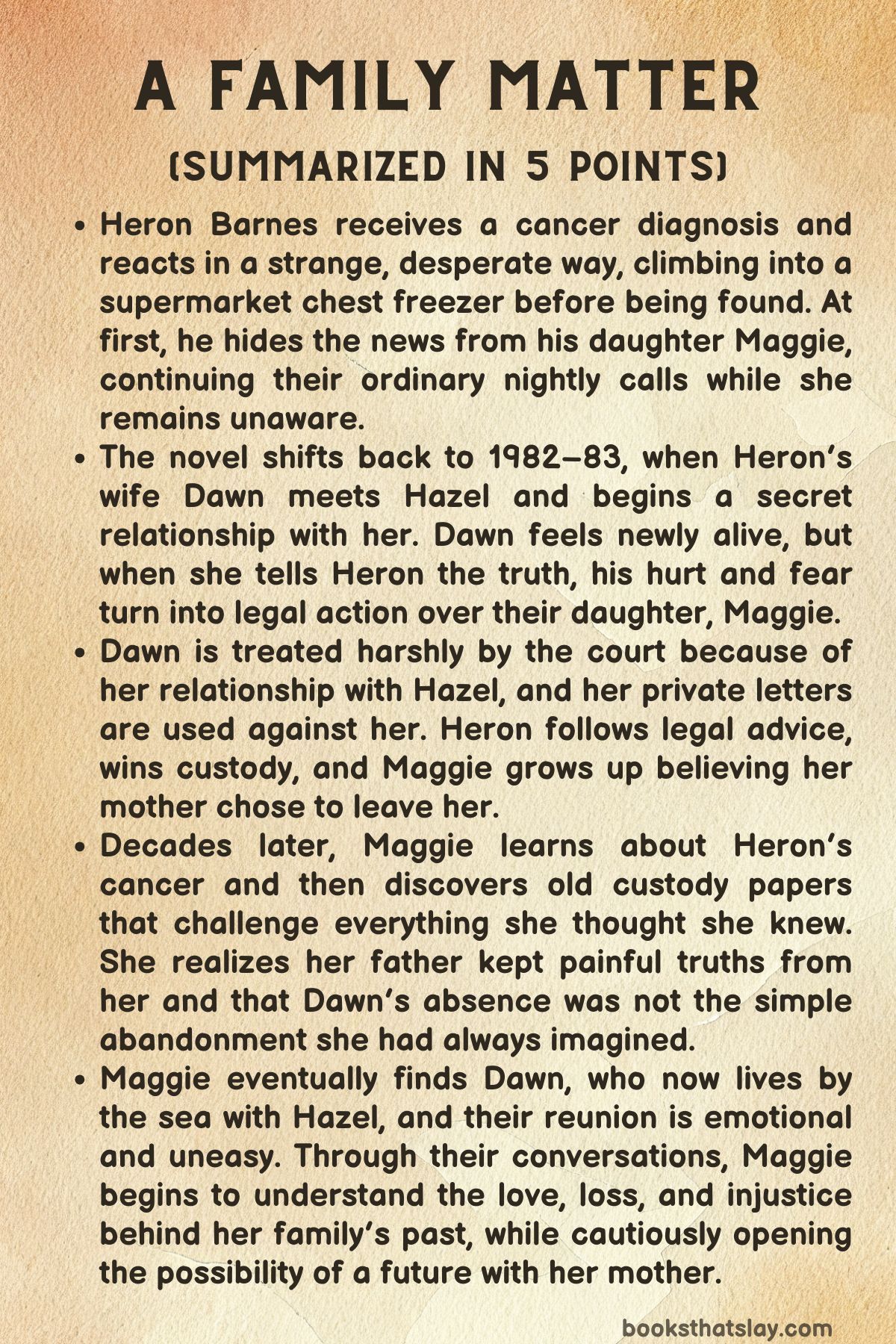
Summary
A Family Matter begins with Heron Barnes receiving life-changing news from his doctor. He has cancer, and although he is not told that death is immediate, he understands that his remaining years are limited.
The diagnosis leaves him stunned. After the appointment, he tries to continue with his normal Thursday routine, going to the supermarket as he usually does.
But the ordinary world suddenly feels strange and unbearable. Instead of shopping, he climbs into a chest freezer and lies there until a customer discovers him.
It is a small, strange act of panic, showing how deeply the news has disturbed him.
At first, Heron does not tell his daughter, Maggie, about his illness. Their relationship is close but built on habit and restraint.
He calls her every night, as he always has, and they talk about daily matters. Maggie, who is busy with her husband Conor and their children, Tom and Olivia, does not suspect that anything serious has changed.
Heron keeps up the shape of normal life, even though fear and mortality have entered it.
The novel also returns to the early 1980s, when Heron was a young husband and Dawn was his wife. Dawn is Maggie’s mother, and at that time she is caring for their young daughter while living a life that feels narrow and fixed.
She married young, became a mother young, and has tried to fit herself into the role expected of her. Her meeting with Hazel at a jumble sale begins casually, but it soon changes everything.
Hazel is confident, interesting, and different from the world Dawn knows. What starts as conversation becomes friendship, then love.
Dawn and Hazel begin seeing each other in secret. They meet in pubs, at aerobics, at the cinema, and later at Hazel’s flat during lunch hours.
With Hazel, Dawn feels seen and alive. She experiences a kind of freedom and desire that has been missing from her marriage.
Yet her happiness is mixed with fear, because she knows the world around her will not accept what she has found. She hides Hazel’s letters at home and tries to carry on with her family life, but secrecy becomes impossible.
Dawn decides she must tell Heron the truth.
Heron reacts with shock, anger, and humiliation. Dawn’s confession breaks the image he had of their marriage and their future.
Their home becomes tense and hostile. Dawn sleeps on the landing after the truth comes out, and after another quiet fight, she leaves for the night.
When she returns, she finds that Heron has changed the locks. This moment marks a turning point.
Dawn is no longer simply a wife who has confessed to loving someone else; she is now a mother being pushed out of her own child’s life.
Heron’s fear grows, and he allows himself to be guided by his mother and his solicitor. They tell him that Dawn’s relationship with Hazel can be used against her and that he must protect Maggie.
The legal advice he receives turns Dawn’s sexuality into evidence of danger. Heron begins custody proceedings, and the private breakdown of a marriage becomes a public judgment on Dawn’s character.
Dawn tries to remain part of Maggie’s life, but Heron restricts her access. She seeks help from a lesbian mothers’ group in London and learns that women like her are treated harshly by the courts.
The law does not simply question her parenting; it treats her love for Hazel as proof that she is morally unfit. Dawn prepares for the custody fight, but the odds are against her from the beginning.
In court, Dawn is exposed and shamed. Her private letters are read aloud, and she is questioned cruelly about her relationship with Hazel.
The language used against her turns ordinary love into something suspect. Social workers and legal experts describe her as a risk to Maggie, not because she has harmed her child, but because she is a woman in love with another woman.
Heron has opportunities to soften the fight or choose some form of compromise, but he follows his lawyers’ advice and continues.
Dawn loses the case. She is separated from Maggie and eventually told that staying away will be better for her daughter.
This advice deepens the damage. Dawn sends cards and gifts, and later tries again to gain access, but Heron blocks or delays her efforts.
Maggie grows up believing that her mother left by choice. Her understanding of her childhood is shaped by silence and by the version of events Heron allows her to know.
In the present day, Heron begins cancer treatment. He walks, goes to the gym, and tries to keep his life organized.
His routines become a way to hold fear at a distance. Eventually, he tells Maggie about his diagnosis while they are sorting through old paperwork together.
Maggie is shaken by the news and begins preparing herself for the reality of caring for him. But the papers also open another door.
Among Heron’s documents, Maggie finds records from the custody case. They reveal that the story she has believed all her life is incomplete.
The discovery changes Maggie’s view of her family. She realizes that Dawn did not simply abandon her and that Heron has hidden painful truths for decades.
This knowledge is deeply unsettling. Her father is ill and vulnerable, yet he is also the person who kept her from her mother.
Maggie must hold both truths at once: Heron has loved and cared for her, but he also made choices that caused lasting harm.
Maggie searches online for Dawn and eventually finds Hazel, who gives her Dawn’s address. Maggie drives to Dawn’s seaside cottage, unsure what kind of welcome she will receive.
Dawn, now older and still living with Hazel, welcomes her. Their reunion is awkward, painful, and full of emotion.
They walk by the sea, eat fish and chips, and spend the evening talking. Maggie sees the ordinary life that Dawn and Hazel built together, a life that once became the reason Dawn was judged and punished.
Dawn explains that she never wanted to leave Maggie. She tells her about the custody battle, the letters, the cards, the gifts, and the years of grief.
Losing Maggie was the worst thing that ever happened to her. Maggie admits that she never received the cards.
This confirms what both women have suffered: Dawn kept trying, and Maggie was kept from knowing.
Their reunion does not erase the past. Maggie is angry, confused, and grieving the years that were taken from them.
She must reconsider her childhood, her father, and the mother she thought she understood. At the same time, she begins to see Dawn not as a woman who walked away, but as a young mother crushed by prejudice, law, fear, and Heron’s choices.
As the night goes on, Maggie and Dawn begin to imagine a future, cautiously and without pretending that healing will be simple. Maggie considers bringing Tom and Olivia to meet their grandmother.
The idea suggests that what was broken may not be fully repaired, but it can be faced. Maggie stays overnight in Dawn and Hazel’s home.
Before she sleeps, she hears them closing up the house. Dawn quietly opens the bedroom door to look in on her daughter, finally able to watch Maggie breathing again after decades of absence.
The moment is tender and restrained, closing the story with sorrow, recognition, and the fragile beginning of a restored bond.
Characters
Heron Barnes
Heron Barnes is one of the central and most morally complicated characters in A Family Matter. At the beginning of the story, he appears as an ageing father facing the frightening reality of cancer, but as the book moves between the present and the past, he becomes much more than a vulnerable old man.
His illness forces him to confront not only death, but also the choices he made decades earlier. Heron is a man who has tried to preserve order in his life, keeping routines, making nightly phone calls to Maggie, and presenting himself as dependable and ordinary.
However, beneath this ordinary surface lies a history of fear, bitterness, and concealment. His decision to hide the truth about Dawn from Maggie shapes the emotional damage at the heart of the story.
In the past, Heron’s reaction to Dawn’s confession reveals how deeply wounded and frightened he is. Dawn’s love for Hazel feels to him like a personal betrayal, but his response goes beyond heartbreak.
Instead of allowing Dawn to remain part of Maggie’s life, he lets anger, social prejudice, family pressure, and legal advice guide him. By changing the locks, restricting Dawn’s access, and pursuing custody in a hostile legal system, Heron becomes an active participant in separating mother and daughter.
He may believe he is protecting Maggie, but the book shows how protection can become control when it is shaped by fear and prejudice.
Heron is not presented as a simple villain. His later illness makes him fragile, lonely, and human, and his relationship with Maggie shows that he does love his daughter.
Yet his love is deeply flawed because it depends on silence. He builds Maggie’s childhood on a false version of the past, allowing her to believe that Dawn left by choice.
This makes Heron tragic as well as blameworthy. He is a man who wanted to keep his family together, but in trying to control the damage, he caused a deeper wound.
His character represents the painful consequences of cowardice, social pressure, and the refusal to tell the truth.
Maggie
Maggie is the emotional centre of the book because she carries the consequences of decisions made when she was too young to understand them. In the present, she is a daughter, wife, and mother who believes she knows the basic truth of her life: that her mother left her and that her father stayed.
Her daily world with Conor, Tom, and Olivia appears settled, but Heron’s cancer and the discovery of old custody papers disturb this sense of certainty. Maggie’s character is shaped by the painful process of learning that the story she inherited was incomplete.
Maggie’s journey is not only about finding Dawn; it is about rethinking her own identity. For most of her life, she has understood herself as an abandoned child.
This belief affects how she sees her mother, her father, and perhaps even her own role as a parent. When she discovers that Dawn tried to stay in touch and that Heron blocked or distorted the truth, Maggie is forced to grieve two losses at once.
She grieves the mother she thought had rejected her, and she grieves the years that were taken from both of them. Her anger is therefore layered and believable, because it is directed not only at Heron’s deception but also at the injustice that shaped her childhood.
Maggie’s reunion with Dawn shows her courage and emotional openness. She does not instantly forgive, nor does she fully understand everything at once.
Instead, she listens, observes, and slowly allows a new version of the past to enter her life. Her visit to Dawn and Hazel’s seaside home is important because Maggie sees that the relationship once treated as dangerous was, in reality, loving and ordinary.
As a character, Maggie represents the painful work of recovering truth after years of silence. She also represents the possibility of repair, even when repair cannot restore what was lost.
Dawn
Dawn is one of the most tragic and deeply sympathetic figures in the book. In the 1980s storyline, she is a young wife and mother who has married early and settled into a life of domestic responsibility.
Her love for Maggie is never in doubt, but her meeting with Hazel awakens a part of herself that has been suppressed. Dawn’s relationship with Hazel is not shown as reckless or shallow; it is shown as a discovery of emotional honesty, desire, and selfhood.
Through Hazel, Dawn begins to understand that the life expected of her is not the same as the life that feels true to her.
Dawn’s tragedy comes from the fact that her honesty is punished. When she tells Heron the truth, she is not simply facing the end of a marriage; she is entering a world that treats her sexuality as evidence of moral failure.
The court’s treatment of her is cruel and invasive. Her private letters are exposed, her love is treated as a threat, and her motherhood is judged through prejudice rather than care.
Dawn’s character reveals how social and legal systems can turn a mother’s identity against her. She does not lose Maggie because she does not love her; she loses Maggie because the world around her refuses to see her love as legitimate.
In the present, older Dawn carries the grief of those lost years with quiet dignity. Her home with Hazel is peaceful, loving, and ordinary, which makes the past injustice even more painful.
She has built a life, but that life contains a permanent absence. Her reunion with Maggie is tender because Dawn does not demand instant forgiveness or try to erase the past.
She explains, remembers, and allows Maggie to feel anger and confusion. Dawn’s quiet act of looking in on Maggie before sleep is especially moving because it restores, for a brief moment, the maternal closeness that was denied to her for decades.
Dawn represents love that survives separation, and motherhood that remains real even when it is legally and socially attacked.
Hazel
Hazel is a crucial character because she gives Dawn the possibility of a life built on truth. At first, she enters the story through a casual meeting, but her presence gradually changes everything for Dawn.
Hazel offers companionship, attraction, confidence, and a sense of recognition that Dawn has not experienced in her marriage. Their relationship allows Dawn to feel alive, not because Hazel rescues her, but because Hazel helps her see herself more clearly.
Hazel therefore represents freedom, but also the risks that came with claiming that freedom in a hostile society.
Hazel’s importance also lies in her steadiness. In the past, she is part of a secret world of meetings, letters, pubs, cinema trips, and lunch-hour visits, but in the present, she is part of the stable home Dawn has built.
This contrast is powerful. What was once treated as scandalous is shown years later as domestic, loving, and calm.
Hazel’s life with Dawn challenges the cruel assumptions used against Dawn in court. She is not a corrupting influence or a danger; she is Dawn’s partner, companion, and emotional anchor.
Hazel also becomes a bridge between Maggie and Dawn. When Maggie searches for her mother, Hazel is the person who helps make the reunion possible by giving Maggie Dawn’s address.
Her role in the later part of the book is quiet but significant because she does not stand between mother and daughter. Instead, she allows space for their difficult reconnection.
Hazel’s character represents loyal love and the ordinary dignity of a relationship that society once tried to shame.
Conor
Conor is Maggie’s husband and part of the family life she has built in the present. Although he is not as central as Maggie, Heron, Dawn, or Hazel, his presence helps show the contrast between Maggie’s adult stability and the instability hidden in her past.
Through Conor, the reader sees Maggie not only as Heron and Dawn’s daughter, but also as a partner and mother with responsibilities of her own. This matters because Maggie’s discovery about Dawn does not happen in isolation; it enters an already existing family life.
Conor’s character functions as part of Maggie’s present-day world, the life that appears ordinary before the past begins to intrude. His role also helps show how family stories continue across generations.
The truth about Dawn is not only Maggie’s personal history; it has implications for the family she has created with Conor and their children. As Maggie begins to imagine bringing Tom and Olivia to meet Dawn, Conor’s family unit becomes connected to the older wound.
He represents the present life that Maggie must carry with her as she decides how to respond to the past.
Tom
Tom is Maggie and Conor’s child, and his role is important because he represents the next generation of the family. He does not carry the same emotional weight as the adults, but his presence deepens the meaning of Maggie’s reunion with Dawn.
When Maggie imagines Tom meeting his grandmother, the possibility of repair expands beyond mother and daughter. It becomes a chance for Dawn to be known within the family from which she was removed.
Tom also helps highlight what was stolen from Dawn. Dawn did not only lose the chance to raise Maggie; she also lost years of ordinary family continuity.
She missed Maggie’s childhood, adulthood, marriage, and motherhood. Tom’s existence makes that absence visible.
Through him, the book suggests that family history does not stop with one generation. Secrets and losses travel forward, but so can truth, recognition, and reconnection.
Olivia
Olivia, like Tom, represents the future of the family and the possibility of a different kind of inheritance. Her presence in Maggie’s life shows that Maggie is not only a daughter seeking answers, but also a mother deciding what truths her own children will know.
Olivia’s possible future meeting with Dawn carries emotional significance because it suggests that Dawn may finally be allowed to exist openly as a grandmother.
Olivia also helps emphasize the cruelty of the separation between Dawn and Maggie. Dawn was denied the daily experiences of motherhood, and through Olivia, the reader can sense the depth of what Dawn missed.
The thought of Dawn meeting Maggie’s children does not erase the past, but it offers a small form of restoration. Olivia’s character therefore contributes to the book’s larger concern with family, memory, and the possibility of healing after silence.
Heron’s Mother
Heron’s mother is an important secondary figure because she represents the older social attitudes that help shape Heron’s decisions. Her influence over him after Dawn’s confession strengthens his fear and anger.
Rather than encouraging understanding or compromise, she appears to support the view that Dawn’s relationship with Hazel threatens the family. Through her, the book shows how prejudice is often reinforced within families before it is acted out through institutions.
Heron’s mother matters because Heron does not make his choices in a vacuum. His decision to fight Dawn for custody is influenced by the people around him, including family and legal advisers.
She represents the pressure to preserve respectability at any cost. Her role helps explain how Heron’s personal hurt becomes part of a larger system of exclusion.
She is not the only cause of the damage, but she contributes to the atmosphere in which separating Dawn from Maggie seems acceptable.
Themes
Silence, Secrecy, and Emotional Avoidance
In A Family Matter, silence becomes one of the strongest forces shaping the characters’ lives. Heron’s first response to his cancer diagnosis is not confession but concealment, as he continues ordinary phone calls with Maggie while carrying a life-changing truth alone.
This pattern reflects a deeper habit that began decades earlier, when he hid the full story of Dawn’s separation from their daughter. His silence is not neutral; it protects him from shame, guilt, and conflict, but it also traps Maggie inside a false version of her own childhood.
Dawn’s silence is different because it is forced upon her. She is pushed out of Maggie’s life and then made to appear absent by choice.
The novel shows how silence can become a form of control when one person has the power to decide which truths survive. By the time Maggie discovers the documents, the damage has lasted for years, proving that hidden truths do not disappear; they wait until someone is ready to face them.
Parenthood, Possession, and Protection
Parenthood is presented as both love and danger when it becomes tied to control. Heron believes he is protecting Maggie, especially after Dawn’s relationship with Hazel is treated as a threat by lawyers, social workers, and his family.
Yet his protection slowly turns into possession. Instead of asking what Maggie needs from both parents, he allows fear and public judgment to decide her future.
Dawn’s motherhood is questioned not because she lacks love, but because she does not fit the moral expectations of the time. The custody battle exposes how easily a parent can be declared unfit when society refuses to accept their identity.
Maggie becomes the centre of the conflict, but her own emotional needs are not truly heard. The tragedy lies in the fact that both parents love her, yet only one is given the authority to define that love.
The novel asks whether care is still care when it depends on hiding another parent’s truth.
Law, Prejudice, and Social Judgment
The legal system in the novel does not appear as a place of fairness but as a space where prejudice is given official language. Dawn’s relationship with Hazel is turned into evidence against her, while her private letters are exposed and judged in public.
The courtroom does not simply decide custody; it humiliates her and transforms love into moral danger. This shows how law can reflect the fears of its time rather than justice.
Heron is not the only person responsible for Dawn’s loss, because solicitors, social workers, and family voices all help build a case against her. Still, he benefits from that system and chooses to keep using it even when compromise is possible.
The novel makes clear that social judgment becomes most harmful when institutions support it. Dawn loses access to her daughter not because she fails as a mother, but because the world around her refuses to separate sexuality from parental worth.
Memory, Truth, and Repair
Maggie’s adult life is shaped by a memory she did not create for herself. She grows up believing Dawn left willingly, and that belief affects how she understands her mother, her father, and her own past.
When she finds the custody papers, memory becomes unstable. What once seemed certain begins to look incomplete, and she must rebuild her personal history from painful evidence and Dawn’s account.
Her reunion with Dawn does not magically restore the lost years, but it gives both women a chance to speak honestly. The seaside visit is important because it replaces legal records and family myths with direct human presence.
Maggie sees Dawn not as an absence, but as a woman who grieved, waited, and survived. Repair in the novel is cautious rather than simple.
The past cannot be undone, and anger remains justified, but truth creates the first real possibility of connection after years of separation.