Next In Line Summary, Characters and Themes
Next In Line by Amy Daws is a contemporary romance set in wintery Boulder, Colorado, where a chance run-in at a bait shop turns into something neither lead expects. Sam O’Connor is steady, private, and happiest on frozen lakes.
Maggie—newly single, determined to reinvent herself, and wildly unprepared for the cold—storms into his world with big plans and zero gear. What begins as Sam rescuing a stranger from a humiliating scene becomes a string of outdoor “adventures,” a secret connection with messy stakes, and a slow shift from trying to prove something to choosing what feels real. It’s the 2nd book in the Wait With Me series.
Summary
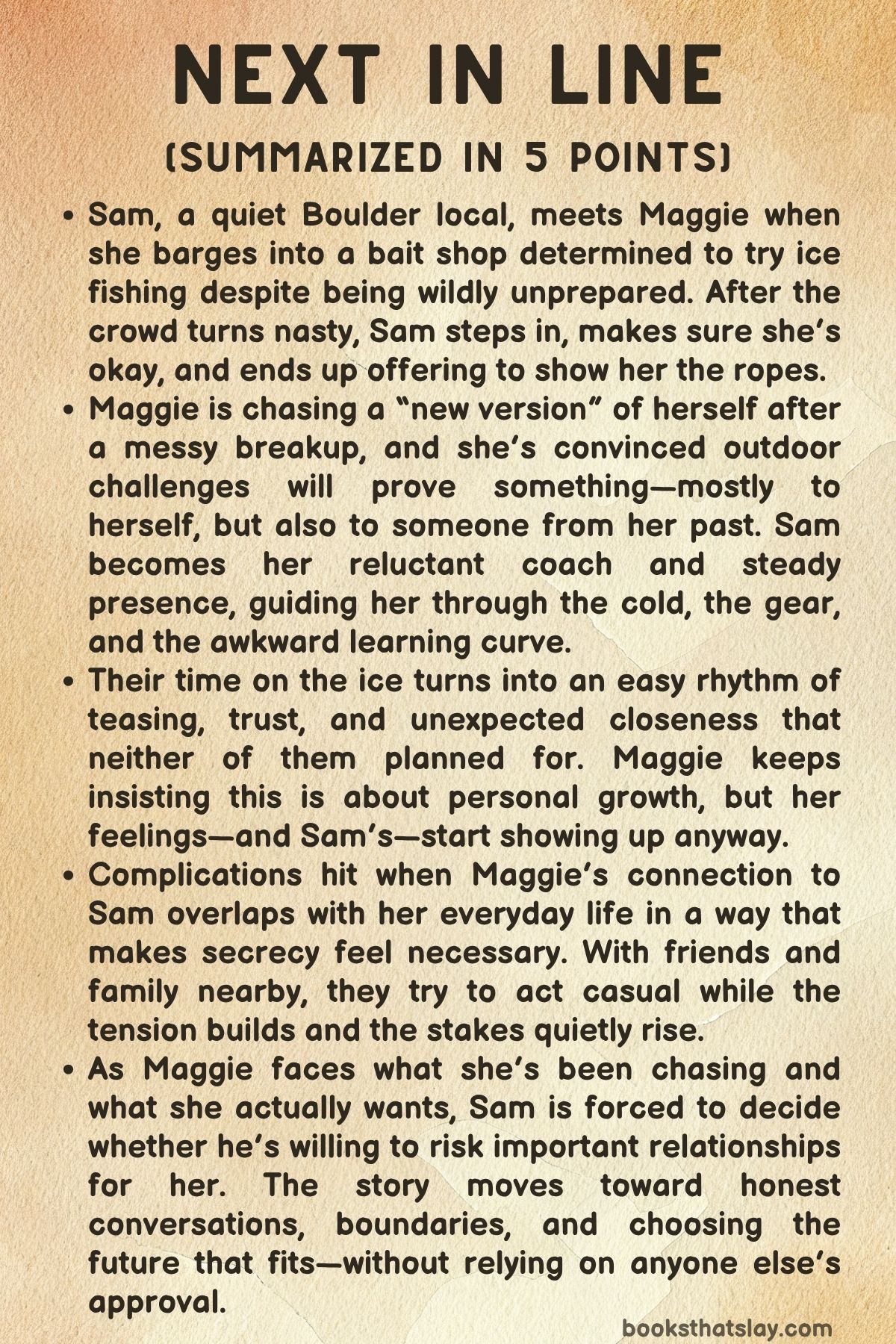
Sam is waiting his turn at Marv’s Bait and Tackle on the first safe weekend of the ice-fishing season when a tall young woman barges in, declaring she’s “next in line” because she “needs the fish.” She’s dressed for a city stroll, not subzero weather, and demands a full list of supplies: bait, a pole, a hook, and something to break the ice. Marv refuses to sell to her, warning she could freeze.
The men in the shop laugh at her, then escalate into crude comments. The woman fires back until one remark crosses a line and her anger cracks into distress.
Sam steps in. When the worst offender keeps going, Sam punches him and pulls the shaken woman away from the crowd and into the attached diner.
In a booth, he checks on her, surprised by how quickly she steadies herself once the noise is gone. She introduces herself as Maggie, a twenty-two-year-old college graduate on a self-assigned road trip.
She insists she’s not reckless—just committed to doing something quiet and “deep thinking,” like the glowing ice shacks she saw on the lake. She wants a reset away from constant screens and expectations, and she believes outdoor challenges will help her become a “better version” of herself.
Sam can’t pretend her plan makes sense without proper clothing, so he offers a compromise: he’ll take her ice fishing that afternoon if she buys the right gear. Maggie agrees, and at Marv’s she tries on so many layers she can barely move, proud of the bulky snowsuit that finally makes her look prepared.
Sam turns out to be her guide in every way she didn’t expect—calm, matter-of-fact, and quietly funny. Instead of a truck, he arrives with a snowmobile.
He buys her a helmet, refuses to let her drive, and she wraps her arms around him for the ride, surprised by how safe she feels holding on to a stranger.
Sam takes her to a secluded lake rather than the crowded spots. On the ice, he shows her how to set up a pop-up shelter, seal it against wind, drill holes, and rig lines.
Inside, he warms the space with a propane heater and checks a fish locator with the ease of someone who has done this a thousand times. Maggie struggles with the stillness.
She fills the silence with chatter until a fish appears on the monitor, and the moment turns frantic. She doesn’t understand what “set the hook” means, so Sam wraps around her, guides her hands, and helps her snap the rod just right.
Maggie fights the fish up, grabs it barehanded as instructed, and glows with the shock of doing something she didn’t think she could do. She chooses to release it, watching it disappear back into the dark water—and something in her breaks open.
She kisses Sam hard, then immediately panics and insists she didn’t come out here to find a guy. Sam teases her for being a “hot mess,” but he can’t stop thinking about her afterward.
Back at his day job at Tire Depot, Sam tries to focus on the future his uncle Terry wants for him: taking over the shop and expanding it with big plans Sam has organized into a binder. His best friend and employee, Miles, notices he’s distracted.
So does Miles’s girlfriend, Kate, who writes romance novels while hanging around the shop. Sam admits he kissed someone at Marv’s and hates how much he hopes it wasn’t a one-time thing—especially because he insists he doesn’t do serious relationships.
Maggie, meanwhile, is hiding out at the Briar Rose Bed and Breakfast. Her Christmas fell apart, and she’s been avoiding her brother in Boulder by throwing herself into “Adventure Maggie” goals.
At breakfast she meets a group of men from Backwoods Magazine researching ice climbing on iced grain silos. One of them, Ezekiel, flirts and invites her to come watch or try it.
The idea sounds extreme enough to prove she’s changing—and it also gives her another excuse not to face her family.
On a frigid Saturday that happens to be Sam’s thirty-first birthday, he returns to Marv’s and finds Maggie outside, furious beside a collapsed fishing hut she bought and can’t figure out. She admits she avoided him because of the kiss, but she’s also clearly lonely and stubbornly determined.
Sam doesn’t lecture her. He simply asks if she wants to go ice fishing.
Back on the lake, the two of them fall into a rhythm that feels easy and private, and Sam finally asks what’s driving her so hard.
Maggie admits the truth: this all started because of Sterling, a quarterback headed for the NFL draft. Their relationship moved fast, with talk of marriage and a future before she’d even made her own career plans.
On Christmas morning, Sterling dumped her and called her “too basic,” saying he wanted someone more adventurous. Maggie has been trying to become that person—partly for herself, but mostly so Sterling will want her back.
She’s been sending him proof, like pictures of her struggles with the hut. Sam calls Sterling an asshole and tells her she’s already impressive, but Maggie isn’t ready to let go of her old plan.
That night Sam is pulled into a noisy family birthday celebration with his mom and sisters, where they tease him for being a loner. Later, Miles drags him out to a surprise party at Pearl Street Pub.
There, Sam gets hit with a twist he can’t prepare for: Miles introduces his visiting baby sister—Megan, who goes by Maggie. Maggie is the same woman from the bait shop and the frozen lake.
Both of them freeze, then cooperate in a tense, awkward performance, pretending they’re meeting for the first time so Miles won’t explode.
After the party, Kate insists Maggie drive Sam home. In the car, an accidental touch turns flirty, and the conversation turns serious.
Maggie admits she’s been staying at the bed-and-breakfast because she was supposed to be with Sterling out of state, and she’s hiding the breakup from her family. She insists Sterling’s final kiss made her believe he regrets dumping her, and her mission is to win him back by becoming “adventurous.” Maggie announces her next challenge: the iced-silo climb.
Sam objects immediately and insists on coming with her unless she tells Miles, which she refuses to do. She agrees to let Sam join, partly to keep her secret safe.
Kate quickly figures out Maggie is sneaking out to meet Sam and, after Maggie admits Sterling dumped her, Kate agrees to cover for her with Miles. At the farm, the iced silos loom like frozen towers.
Ezekiel treats it like a competition and challenges Sam to a race; the prize is getting to belay Maggie, plus a free chalet weekend if they allow filming. Sam wins easily and ends up belaying Maggie.
Maggie climbs slowly, terrified but stubborn, refusing to quit until she reaches the top and rings the bell, crying with relief. Sam is proud of her in a way that feels personal, not performative, but Maggie’s excitement is still tangled up in sending proof to Sterling—something that lands like a punch to Sam’s mood.
The free chalet weekend becomes a snowboarding trip for Sam and Maggie. The cabin has one bedroom, and Sam tries to be honorable about space, but their chemistry keeps pushing past rules.
In a natural hot spring under snow and lantern light, they talk about Sam’s goals: building Tire Depot into something bigger and helping his mom retire early. Maggie teases him, but she also sees how steady he is—how he shows up for people without making speeches about it.
A memory from Maggie’s past surfaces and changes everything. She recalls a party where she tried to impress Sterling sexually, only for him to force a rough, humiliating moment while ignoring her distress.
In the present, sitting with Sam, the fear that sex will come with expectations makes her panic. She flees the hot spring early, leaving Sam confused.
The next morning she admits the truth: she didn’t run because of Sam, but because she’s scared of being pushed into something that hurts. Sam’s reaction is immediate and fierce—anger on her behalf, not at her.
He tells her she deserves better and makes it clear he isn’t interested in using her or demanding anything. He also names what he actually likes about her: her brain, her humor, her stubborn courage.
Maggie tells him to buy condoms.
Snowboarding is a disaster at first. Maggie falls constantly and gets targeted by teenage boys who spray her with snow.
After taking enough hits, she and Sam retaliate with an ambush of hard-packed snowballs, laughing like kids when the teens retreat. That night, playful rule-breaking turns into real heat—until the teens steal their clothes while they’re in the hot tub.
Maggie and Sam sprint naked through the snow back to the cabin, half furious and half delirious with laughter. In front of the fire, the tension finally breaks.
They have sex, and afterward Maggie feels something deeper than a weekend thrill when Sam carries her to bed and—despite claiming he doesn’t sleep with women—stays with her.
The connection continues after they return. They text constantly.
Sam’s uncle Terry, impressed by Sam’s business plan, decides to invest as a silent partner and effectively hands the shop over to Sam. Sam’s life is opening up, and Maggie is part of that shift.
But the secrecy is a ticking bomb, especially because she’s Miles’s sister. When Maggie surprises Sam at Tire Depot with lunch, they almost get caught kissing.
She plays it off, but the pressure builds.
On another ice-fishing day, Sam opens up about his past: a father with bipolar disorder who went off medication, caused chaos, and eventually abandoned the family. Sam carries old anger and a fear of being left again.
Maggie listens, comforts him, and promises not to repeat it to Miles. Sam admits she’s the only person he’s fished with since his father left, and that he needed her the day they met.
Their intimacy is no longer just physical, but Maggie still flinches whenever Sterling pulls at her attention.
The tension snaps when Sam decides Miles deserves the truth. Maggie panics at the idea of being exposed—not only for sleeping with Sam, but for lying about Sterling dumping her.
She lashes out, calling them “fuck buddies,” and storms away, terrified that letting go of her Sterling plan means admitting she was wrong about everything.
Then Sterling shows up in Boulder unexpectedly and walks into Miles’s house, acting possessive and pushing for closeness that makes Maggie uncomfortable. Miles and Kate are thrilled to see him, unaware of the real timeline.
A group dinner becomes a pressure cooker. Sterling is dismissive about Colorado, physical with Maggie under the table, and careless in ways Maggie can’t ignore anymore.
Sam shows up, unable to stay away, and needles Sterling with pointed questions about “adventure” and what he actually loves about Maggie. In the alley behind the restaurant, Sam confronts Maggie about taking Sterling back and blurts the truth he’s been holding: he wants her completely, not as a secret, and he loves her.
Maggie asks for time—time to process and to end things with Sterling properly. Sam refuses to be her backup plan.
Sterling follows them outside, sees them too close, and a fight breaks out. Sam punches Sterling, who falls and hits his head, bleeding.
An ambulance is called. Sam runs.
At the hospital, Sterling is fine and only needs stitches. Maggie finally tells Kate she’s been sleeping with Sam, and Miles overhears.
Furious, Miles feels betrayed by both of them—and hurt by Maggie’s lies about the breakup. Maggie ends things with Sterling for real, saying there is no “us,” no more waiting for him to decide her value.
Sterling leaves.
Miles goes to Sam’s cabin and explodes, the argument nearly turning into another fight until Sam says the one thing Miles can’t ignore: he’s in love with Maggie and wants a future with her. Miles shifts from rage into conflicted acceptance, still raw but unable to deny what he sees between them.
Needing space, Sam goes night ice fishing. Maggie tracks him down with Marv’s help and arrives on a snowmobile.
She tells him a “fishing story” that mirrors their relationship: waiting, hoping, getting hooked on the wrong thing, and finally choosing what’s in front of you instead of chasing what won’t hold. She tells Sam she’s done trying to earn Sterling’s approval and admits she loves Sam.
They reunite on the ice, no longer hiding from what they want.
Months later, Maggie has moved to Boulder and works at Marv’s. She fits into Sam’s life with relentless puns and big dreams, and Sam meets her energy with a steadiness that feels like home.
When Maggie considers renting her own place, Sam bluntly suggests she move in with him. Maggie tries to protest because she wants romance, not logistics.
Sam responds in his own style—simple, direct, and full of conviction—offering her his key and asking her to move in because he’s in love with her and starting to believe in the kind of ending Maggie always hoped she’d get.
Characters
Sam O’Connor
In Next In Line, Sam comes across as the kind of man who’s quietly competent in a way that makes chaos feel smaller. He’s introduced as calm and observant—someone who can read a room in Marv’s Bait and Tackle and instantly tell who’s harmless, who’s cruel, and who’s about to get hurt.
That steadiness isn’t passive, though; it’s paired with a protective streak that turns physical the moment Maggie is publicly humiliated, and the fact that he throws the punch when the line-crossing gets truly ugly shows a moral line he won’t negotiate. Underneath the capable “Boulder guy who fishes and fixes things” exterior, Sam carries old wounds—his father’s bipolar disorder, the instability of a parent who repeatedly blew up the family’s sense of safety, and the abandonment that left Sam with a deep distrust of letting people matter too much.
His insistence that he doesn’t do serious relationships reads less like bravado and more like an emotional safety policy he’s lived by for years. What changes him is that Maggie doesn’t just disrupt his routine; she gives him a reason to be emotionally present again, and he realizes his solitude isn’t the same thing as peace.
His arc is a move from controlled isolation to chosen vulnerability—he stops treating love like a risk to manage and starts treating it like a life to build, which is why his “I won’t wait in line” moment lands as both romantic and revealing: Sam’s love is decisive, direct, and finally willing to be seen.
Maggie “Megan” O’Connor
Maggie is written as a bundle of contradictions that make perfect sense once you see the bruise underneath them. She storms into the bait shop with bold, almost comedic confidence—declaring she’s “next in line,” demanding gear she doesn’t understand, dressed like she’s headed to brunch instead of a frozen lake—yet that bravado is clearly a mask that slips the moment the men’s mocking turns sexual and predatory.
Maggie’s central drive is identity panic: she’s been told she’s “too basic,” and instead of rejecting that cruelty, she tries to audition for a new self that will finally be “enough” in someone else’s eyes. Her “Adventure Maggie” persona is both funny and heartbreaking because it’s fueled by a breakup she refuses to accept, and she keeps mistaking performative change for healing.
What makes her character more than a rom-com archetype is how the story lets her be messy without making her shallow—she lies to her family, clings to Sterling, and uses photos like proof-of-worth, but you can see the fear underneath: if she stops chasing his approval, she has to face that she centered her future on someone who didn’t value her. Maggie’s sexual history with Sterling also adds an important layer: she’s not simply “confused about love,” she has a real bodily memory of being ignored and pushed past consent, and that rewires how she interprets intimacy, expectations, and safety.
With Sam, Maggie doesn’t just fall for a man; she gradually relearns what it feels like to be listened to and protected without being controlled. Her growth isn’t becoming “more adventurous” to impress anyone—it’s becoming brave enough to stop bargaining for love, tell the truth, and choose the person who sees her clearly, even when she’s a hot mess in a snowsuit.
Sterling
Sterling functions as both antagonist and mirror for Maggie’s insecurity, and he’s defined less by overt villainy and more by selfishness packaged as charisma. He sweeps Maggie up fast, speaks in future-fantasy, and encourages her to delay practical plans, which positions him as someone who enjoys the feeling of being central to her life without committing to the responsibilities that come with it.
His Christmas breakup—cold, image-based, and centered on labeling her “basic”—is cruelty disguised as preference, and the lingering kiss afterward becomes his most manipulative tool because it leaves her clinging to ambiguity. Sterling’s relationship to intimacy is another key reveal: he’s comfortable taking, escalating, and prioritizing his gratification even when Maggie is physically struggling, and his apology afterward doesn’t erase the fact that he ignored her experience in the moment.
Later, when he reappears at Miles’s house, his possessive pet names and quick push toward sex reinforce a pattern of entitlement. He’s also dismissive of Colorado and subtly condescending in social settings, which highlights how he treats environments and people as accessories to his own trajectory.
Sterling is important because he represents the version of love Maggie thought she had to earn—conditional, image-driven, and unstable—and the story uses him to clarify what Sam becomes by contrast: not perfect, but present, accountable, and genuinely interested in who Maggie is rather than how she performs.
Miles O’Connor
Miles is the emotional hinge between friendship, family, and fallout in Next In Line, and he’s written as a man who loves hard and expects loyalty as a form of oxygen. As Sam’s best friend and employee, he trusts Sam completely—so much that he’s comfortable calling himself “ride or die”—and that level of devotion makes the eventual betrayal feel catastrophic rather than merely awkward.
As Maggie’s older brother, Miles is protective in an instinctive, almost automatic way; he wants her safe, happy, and settled, and he also wants to believe the romantic narrative she’s been selling the family about Sterling because it keeps the world orderly. His anger when the truth comes out isn’t just possessiveness over his sister’s dating life; it’s grief over being lied to, over realizing he celebrated a relationship that was already dead, and over discovering that two of the people he trusts most built a secret behind his back.
What makes Miles compelling is how quickly he shifts once Sam says the quiet part out loud—that he’s in love with Maggie and wants a future. Miles still has to process the breach, but love reroutes him, and the speed of that pivot suggests he isn’t actually upset about Maggie choosing Sam; he’s upset about being excluded from the truth and made into the last person to know his own sister’s life.
In the end, Miles represents the messy reality of found-family romance plots: love isn’t just about the couple, it’s about the community around them, and his eventual conflicted support shows how repair can happen when the motivation is genuine.
Kate
Kate plays the role of perceptive catalyst, functioning like the person in the room who notices the real story before anyone else admits it exists. As Miles’s girlfriend and a romance novelist, she has both emotional literacy and narrative instincts, and she uses them to cut through Maggie’s denial with a mix of teasing and directness.
Kate is the first to clock that Maggie is sneaking around with Sam, and instead of treating it as scandal, she treats it as information—then chooses the most helpful path by covering for Maggie with Miles, not because lying is good, but because she recognizes Maggie is in a fragile, transitional state and needs space to tell the truth on her own terms. She also provides an important contrast to Maggie’s flailing: Kate’s relationship with Miles is stable enough that she can advocate for honesty and still be kind, and her willingness to call out “obvious chemistry” pushes Maggie to confront the difference between what she’s performing for Sterling and what she feels with Sam.
When everything explodes at the hospital, Kate becomes the practical center—she calls for help, manages the moment, and later becomes the safe person Maggie can confess to. Her character matters because she shows what supportive truth-telling looks like: she doesn’t shame Maggie, but she also doesn’t romanticize self-deception.
Marv
Marv is the gruff gatekeeper of competence, and his first big action—refusing to sell gear to an underdressed stranger—immediately frames him as someone whose moral code is rooted in reality, not politeness. He might seem like the stereotypical small-town shop owner at first, but his refusal is protective rather than dismissive; he’s not judging Maggie for being inexperienced, he’s judging the weather for being lethal.
Marv also represents a kind of community authority: his bait shop is a social hub where norms get enforced, sometimes cruelly by the regulars, but also corrected when someone like Sam steps in. As the story progresses, Marv becomes a quiet pillar in Maggie’s new life, and the fact that she ends up working at the bait shop signals that she’s not only found romance—she’s found belonging, routine, and a self that isn’t built to impress anyone.
Marv’s place in the narrative is subtle but essential because he’s the bridge between Maggie’s “outsider trying on an identity” phase and Maggie’s “I live here now, I contribute here now” reality.
Terry
Terry, Sam’s uncle, is the stabilizing adult influence, and he’s also the proof that Sam’s competence didn’t appear out of nowhere. He gives Sam a path that doesn’t require Sam to become his father or repeat his father’s chaos, and by trusting Sam with the future of Tire Depot, Terry communicates something Sam rarely allows himself to feel: belief.
His investment as a silent partner isn’t just financial; it’s emotional validation that Sam’s long-term thinking and discipline matter. Terry’s earlier role—helping teen Sam channel anger—suggests he was the consistent presence when Sam’s home life was shaped by unpredictability.
In a romance story, that kind of character often exists as background, but here Terry’s importance is structural: he’s part of why Sam can offer Maggie safety without it turning into control, because Sam learned steadiness from someone who modeled it.
Debrah
Debrah, Sam’s mom, represents the quiet backbone of the O’Connor family. She’s the person Sam still fixes things for, not because she can’t, but because caregiving is how he expresses love and how he proves he’s reliable.
Debrah’s presence also sharpens Sam’s internal conflict: she wants him to have fun, to not carry the whole family on his shoulders, and her gentle pressure reveals that Sam’s “I’m fine alone” narrative is something the people who know him best don’t fully buy. When she challenges him about Maggie potentially being “the one who got away,” it shows Debrah as emotionally attuned—she sees the shift in him before he’s ready to name it.
She’s also a reminder that Sam’s fear of commitment isn’t abstract; it’s rooted in watching his mother survive a painful marriage and abandonment, which makes his eventual willingness to love Maggie feel like a genuine act of courage rather than a trope.
Tracey, the sisters, and Kinsley
Sam’s sisters—especially Tracey, who pulls him into family maintenance tasks like fixing the water softener—function as a chorus that reflects Sam back to himself. Their teasing about him being a loner is affectionate but pointed, and it exposes how his isolation has become a defining trait within the family story.
They also create stakes around disclosure: Sam knows that if his family gets even a whiff of something real, they’ll make it real out loud, which is exactly what he’s terrified of. Kinsley, with her true-crime “murder” chatter, adds humor but also reinforces the sense of this being a lived-in family where everyone spills into everyone else’s space.
These characters aren’t deeply individuated in the summary, but their narrative purpose is clear: they show Sam’s life is not empty, it’s simply guarded, and they make it obvious that love won’t just change his private world—it will ripple through a whole family system.
Ezekiel
Ezekiel is the shiny embodiment of Maggie’s performative “Adventure” storyline, and that’s exactly why he matters even without becoming a true romantic rival. He offers her the next adrenaline fix at the exact moment she’s trying to delay emotional reckoning, and his flirtation makes “Adventure Maggie” feel socially rewarded.
The climbing challenge and the race between Ezekiel and Sam externalize the core tension of the book: is Maggie chasing a version of herself for the camera, or building something real with a man who sees her off-camera? Ezekiel also highlights Sam’s instincts—Sam doesn’t win by being flashier, he wins by being competent and focused, which fits the story’s larger argument that steadiness can be more attractive than spectacle.
In that way, Ezekiel isn’t a villain; he’s a temptation toward distraction, a symbol of the life Maggie thought she had to manufacture to be lovable.
Themes
Identity built for yourself, not for someone else
Maggie’s “Adventure Maggie” persona begins as a reaction to being judged, and that origin matters because it shapes how she measures her worth. After Sterling labels her “too basic,” she starts treating identity like a performance review: collect proof, send photos, and convert discomfort into a résumé that might earn his approval.
The story shows how quickly self-improvement can get poisoned when it’s driven by an audience instead of an inner need. Maggie isn’t simply trying new things; she’s trying to become un-rejectable, which is a different goal entirely.
That pressure makes her lie to her family, hide in a bed-and-breakfast, and cling to a relationship that already harmed her sense of safety. Even when she succeeds—ringing the bell at the top of the silo, surviving the day on a snowboard, managing ice fishing—her first instinct is still to translate the moment into a message for Sterling, as if the experience only becomes real once it changes his opinion.
What shifts her is not a motivational speech about self-love, but repeated experiences of being treated as a full person in ordinary moments. With Sam, she gets feedback that isn’t dependent on how impressive she looks.
He notices her stubbornness, humor, intelligence, and courage, and he says those qualities matter more than appearance. That reframes identity from “prove you can be exciting” to “notice what you already are.” It also changes how she approaches risk: at first she seeks danger because it might buy validation; later she takes on challenges because she wants to feel capable and present.
By the end, her growth looks less like reinvention and more like recovery—returning to her own preferences, her own pace, and her own definition of what makes her life meaningful. The romantic ending lands because Maggie’s biggest decision is not choosing Sam over Sterling; it’s choosing herself over the version of herself that begged to be chosen.
Safety, consent, and the cost of being sexualized
From the opening scene in Marv’s shop, the story establishes how quickly a woman’s presence in a male-dominated space can turn hostile. Maggie walks in asking for fishing gear and immediately becomes entertainment: mocked for her clothes, challenged for her competence, and targeted with crude remarks.
The escalation is fast, but it feels believable because the men treat her not as a customer but as a spectacle. Her anger isn’t only about rudeness; it’s about being reduced to an object in a room where her needs stop mattering.
Sam’s intervention—pulling her back, then punching the man who crossed the line—functions as a dramatic gesture, but the emotional point is that someone finally treats the situation as serious and humiliating rather than “just jokes.” Maggie’s distress after the vulgar comment shows how sexual aggression can flip a person from fiery to shaken in seconds, because it threatens more than pride; it threatens bodily autonomy.
That foundation makes the later sexual trauma memory hit with extra weight. Maggie’s past experience with Sterling isn’t framed as “bad sex” or awkwardness; it’s an episode where her signals and physical limits are ignored, and where she pays the price in humiliation.
The aftermath is not only fear of repeating the act, but fear of being pressured, judged, or treated as an accessory to someone else’s gratification again. The story tracks how trauma can live in the body: the hot spring moment should be romantic, yet her nervous system reads danger and pulls her out of the situation.
What matters is that Sam doesn’t punish her for the sudden shift or treat it as rejection. When she explains, he reacts with anger on her behalf and makes clear that sex should not be a transaction where someone “demands” acts as proof of affection.
That response gives Maggie something Sterling never did: emotional safety around sex, including the right to stop, the right to set terms, and the right to be believed without having to provide a perfect explanation.
By showing both public harassment and private coercion, Next In Line argues that consent isn’t a technicality; it’s a culture. Maggie learns to trust her voice again, and she takes control not by becoming tougher, but by being supported while she tells the truth.
The romance becomes a space where sexuality can be playful and mutual rather than performative or fear-based, and that change is portrayed as healing rather than merely exciting.
Loyalty, secrecy, and the messy ethics of protecting people you love
The tension with Miles isn’t just a “friend’s sister” complication; it’s a study of how loyalty can turn into secrecy, and how secrecy turns into collateral damage. Maggie’s first big lie—pretending Sterling didn’t dump her—starts as a defensive move.
She doesn’t want her family to hate him because she still hopes the relationship can be saved, and she doesn’t want to face the embarrassment of being rejected after dreaming out loud about a future. That lie expands because it has to: once she hides the breakup, she also has to hide her grief, her confusion, and her loneliness.
Sam’s secret grows from a different place: he doesn’t want to lose his best friend, and he knows Miles can be protective, so he agrees to keep the connection quiet. Both decisions look understandable in isolation, but together they build a structure where everyone is forced to act a part—Maggie as the devoted girlfriend, Sam as the uninvolved friend, and Miles as the cheerleader for a relationship that isn’t real.
The story shows the emotional tax of that arrangement. Maggie becomes jumpy and reactive whenever Sterling comes up because she’s managing two realities at once.
Sam becomes irritable and jealous because he has real feelings but no legitimate place to express them. Miles, meanwhile, is being unknowingly manipulated into bonding with someone who hurt his sister, and that’s why the eventual reveal feels like betrayal rather than mere surprise.
When Miles overhears the truth at the hospital, his anger isn’t only about sex; it’s about being denied consent to his own reality. People often talk about lies as personal, but this story treats lies as social—they reorder how everyone makes decisions and what everyone believes they’re participating in.
What resolves the conflict is not a clean moral lesson, but a messy emotional reckoning. Maggie finally ends things with Sterling directly, not through hints or hopes or curated photos.
Sam finally chooses honesty even when it risks his friendship. Miles’s reaction is loud and physical, but the pivot is important: once Sam admits he is in love, Miles can reframe the situation from “you used my sister” to “you want a life with her.” That doesn’t excuse the secrecy, but it makes room for repair.
The story suggests that loyalty without truth becomes control, while loyalty with truth becomes a risk you take on behalf of real intimacy. The characters don’t become perfect; they become more honest, and that honesty becomes the only route to lasting family-level bonds.
Stability versus risk, and what “adventure” actually means
Maggie and Sam begin with opposite relationships to risk. Maggie runs toward extreme experiences because she equates adrenaline with transformation.
Ice fishing, ice climbing, snowboarding—each challenge is a bid to become someone new fast, because she believes her current self is what got rejected. Sam, on the other hand, is anchored to routine: Tire Depot, his cabin, ice fishing as quiet, predictable comfort.
He doesn’t present stability as boring; he presents it as earned. He’s carrying responsibility for a family business, helping his mother, and managing the scars left by a father who was unreliable and ultimately absent.
For Sam, steadiness is not the absence of ambition; it’s a strategy for survival. That’s why he is cautious about relationships and suspicious of chaos.
Emotional risk, for him, is the dangerous sport.
The story makes “adventure” a contested idea rather than a simple virtue. Sterling treats adventure like a brand requirement—an aesthetic that upgrades his life and makes him feel impressive.
Under that logic, Maggie is “basic” because she doesn’t perform excitement on command. Sam rejects that framing by treating adventure as context-dependent.
Taking Maggie ice fishing isn’t about chasing thrills; it’s about sharing a quiet space where she can breathe and learn. His pop-up shelter, his careful instructions, his insistence on proper gear—these details show a different definition of daring: the courage to slow down, be present, and take responsibility for someone else’s safety.
Even the playful moments, like their snowball ambush and the chaotic sprint back to the cabin, underline that excitement is best when it’s mutual and respectful, not when it’s demanded or used as leverage.
Over time, both characters adjust. Maggie learns that pushing herself can be meaningful, but only when the goal is internal—confidence, peace, competence—not external approval.
Sam learns that a controlled life can still leave him lonely, and that opening his heart is not a distraction from his plans but part of becoming fully alive. His business ambitions show this clearly: he isn’t stagnant, he is building something; the missing piece is allowing someone to build alongside him.
The ending doesn’t suggest that stability is superior to adventure or that adventure is superior to stability. It suggests that the healthiest version of both happens when you aren’t auditioning.
Real adventure is choosing honesty when it could cost you, choosing love when it could hurt, and choosing a future that reflects what you want—not what you’re trying to prove.