Nine Goblins Summary, Characters and Themes
Nine Goblins by T Kingfisher is a short, funny fantasy tale that follows a battered goblin infantry squad that would rather complain than conquer. The Whinin’ Niners are hungry, undermanned, and stuck fighting a war that has dragged on too long.
When a human wizard’s escape spell goes wrong, a chunk of the unit is thrown deep into enemy territory. What starts as a survival march turns into an uneasy alliance with an elf healer who wants nothing to do with the war, and a mystery where something unnatural is emptying farms and killing whole villages. The result is a brisk adventure with sharp humor, odd tenderness, and a lot of goblin stubbornness.
Summary
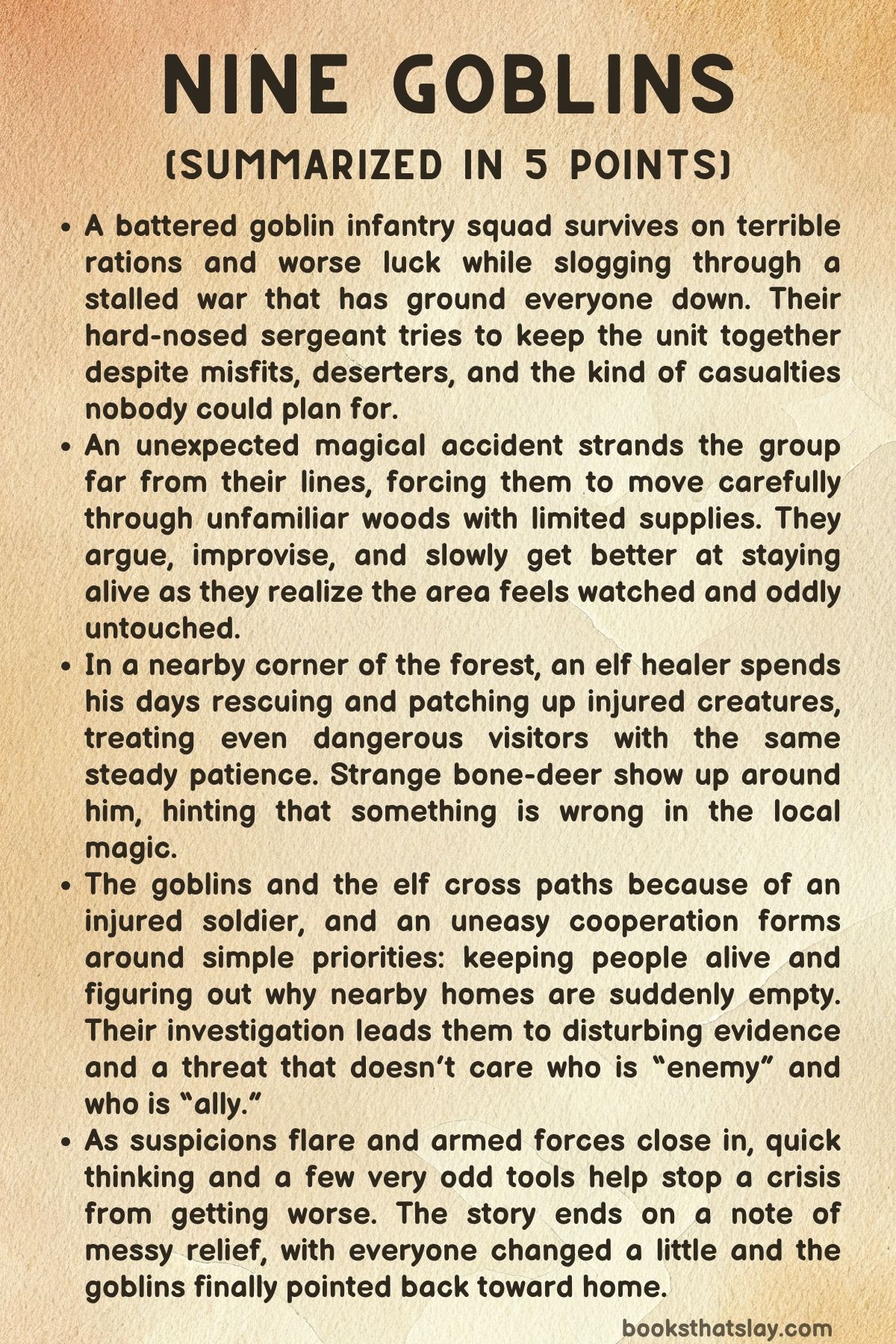
The Whinin’ Niners of the Goblin Army’s Nineteenth Infantry wake to another miserable day in a bleak landscape, eating the same grey gruel they always eat and trying to ignore the fact that their numbers keep shrinking. Their recent dead include Blockhammer, who was killed in a freak supply accident involving a roc and an elephant, leaving the surviving goblins to bury what they can and move on.
Sergeant Nessilka, blunt and practical, keeps the unit moving despite their constant grumbling. Her squad is a strange set: Corporal Algol, who is responsible and easily distracted by anything living; Murray, a clever goblin who used to be in a more technical corps before being demoted; and Weatherby, a deserter by instinct who announces his own escapes as if he expects applause and has to be watched constantly.
As they march toward yet another planned attack, the broader war sits in the background like a bad smell. Humans have expanded into goblin lands for years, taking territory bit by bit until goblins are boxed into the edge of the continent.
Goblin leaders eventually try formal demands, but the human response is smug and dismissive. After that, the fighting becomes a long, grinding conflict that pulls in other peoples, including elves, and turns into the kind of war where nobody remembers what victory would even look like.
The Whinin’ Niners reach a temporary camp close to the battlefield and try to rest before dawn. Nessilka assigns watches, checks their ragged supplies, and focuses on keeping the unit intact.
Among her troops is Blanchett, a goblin who carries a battered teddy-bear and consults it as if it gives orders. Nobody is entirely sure whether it’s superstition, madness, or simply Blanchett being Blanchett, but the bear has become part of the unit’s routine.
Elsewhere, far from the front line, an elf called Sings-to-Trees lives on the edge of elven territory. He spends his days caring for injured animals and dealing with whatever chaos arrives at his door.
One night he helps a pregnant unicorn deliver a foal, getting kicked and scraped and covered in filth for his trouble. He still gets up afterward to feed his odd household of recovering creatures, including a raccoon cub and a gargoyle that lives on the roof.
While tending the unicorn’s stall, he encounters something that shouldn’t exist: a skeletal stag and a skeletal doe with a broken leg. The stag behaves like a wary guardian, but the doe is clearly injured.
Sings-to-Trees approaches carefully and realizes the doe’s bones are held together by a dark webbing and are warm to the touch. He splints the leg and later identifies the creatures as cervidian—bone-deer drawn toward magical disturbances, which suggests something nearby is dangerously wrong.
Back at the goblin camp, the dawn battle begins on a hill dotted with flowers, a detail that only makes the slaughter feel stranger. In the confusion, Nessilka spots a human wizard on a rise, killing goblins with blue bolts that blast from his mouth.
She charges, and the Whinin’ Niners follow her without much thought beyond “that one is killing us.” When Nessilka closes in, the wizard panics and tears open the air itself, forming a dark, green-tinged rift. Nessilka is slammed forward by her own troops, crashes into him, and both are shoved through the opening just before it snaps shut.
Nessilka wakes in a forest clearing with only part of her unit. Several goblins are missing, and the landscape is completely unfamiliar.
Murray uses a makeshift spyglass—his “looky-tube”—to orient himself and realizes the truth: they are nowhere near the battlefield. Worse, they appear to be on the human side of Goblinhome, deep in enemy territory.
The wizard lies nearby, unconscious and grey. The goblins know he is dangerous, and it would be easy to kill him where he lies, but Nessilka refuses to do it.
She doesn’t want to become the kind of soldier who kills a helpless enemy. With no good way to restrain him, she covers him with her cloak and orders her troop to move fast and quietly, putting distance between themselves and the moment he wakes.
The goblins are not built for stealth, at least not as a disciplined group. They stumble, crash through underbrush, and suffer from poison oak until they learn, slowly and painfully, to move with more care.
Weasel, a shy goblin who isn’t loud like the others, turns out to be a capable hunter with a sling. She brings down birds and small game, which keeps the group alive.
They take shelter for a night in a dirt cave by a mostly dry riverbed, listening to unsettling “swooshing” sounds overhead and finding strange hoofprints with claw marks in the mud. The forest feels wrong in ways they can’t explain.
Murray, always noticing details, points out another clue: near a human town, a forest like this should have logging trails and chopped stumps, yet the woods are untouched. He suspects elven control.
The next day, Nessilka sends Murray and Algol with another goblin to scout a farmhouse and see if they can steal supplies. They return shaken, reporting that the place feels empty in a way that raises the hairs on their necks.
Nessilka goes herself. The farmhouse is intact, but it looks abandoned mid-life: furniture left in place, food rotting on a plate, dust gathering in corners.
The pens and stalls are empty—no chickens, pigs, or horses—yet there is no obvious sign of a struggle. In the cellar, instead of corpses, they find preserved jars lined neatly on shelves.
Nessilka decides they will take what they can carry: preserves, blankets, cookware, salt, flour. While they work, Algol disappears from his post, causing panic.
When he returns, he is muddy but pleased with himself, holding a kitten he has rescued from a drainage pipe. Nessilka is furious about the lapse in discipline, but the kitten is alive and helpless, and eventually she allows Algol to keep it.
He names it Wiggles, and it becomes an unexpected spark of comfort for a unit that hasn’t had much reason to feel gentle.
When they get back to their camp, the fragile calm breaks again. Weasel arrives terrified and breathless: Thumper has been injured, and an elf has taken him.
Weasel explains that she and Thumper were hunting when Thumper chased a deer, fell into a hole, and struck his head hard enough to knock himself unconscious. An elf appeared, bandaged Thumper, and carried him away.
Weasel followed at a distance and watched the elf take Thumper to a cabin in a meadow. Nessilka gathers a group and marches out to retrieve her goblin, ready for trouble.
They find the elf in his garden, calm and unarmed. Murray attempts diplomacy in Elvish but only knows how to ask for the bathroom, which does not help.
The elf surprises them by speaking Goblin, introduces himself as Sings-to-Trees, and invites them inside. Thumper is alive but concussed.
Sings-to-Trees explains he treats injuries, not armies. He has no interest in turning them in, because the war is far away from his cabin and because an injured creature is an injured creature.
He feeds the goblins and offers the barn as a place to sleep, while keeping Thumper inside so he can monitor him through the night.
During this uneasy truce, Nessilka mentions the abandoned farmhouse and the missing animals. Sings-to-Trees grows concerned.
He realizes no one from the nearby village has brought him food for almost a week, which is not normal. The next morning, Nessilka, Murray, Blanchett, and Sings-to-Trees go to investigate.
In the forest, they hear something like a distant conversation, half-audible yet strangely compelling. Without noticing the shift in their own minds, they begin moving toward it faster and faster, as if their bodies have decided for them.
A skeletal stag blocks their way, and a bone doe appears behind them. The moment the “voice” stops, the group snaps back to themselves, shocked at how close they came to running blindly into danger.
They decide the sound is magical and likely connected to the emptiness spreading across the farms. To protect themselves, they plan to use earplugs when approaching the village.
As they near the farmland, the truth is worse than abandonment. They find bodies: dead livestock, dead dogs, dead horses, and humans scattered along paths and fields, with signs that animals stampeded and people tried to crawl toward town before collapsing.
At the edge of the village, they find an old man barely alive. They give him water and move him into shade, confirming that at least one person survived for now.
In the village square, they see something that makes no sense: a human girl, young but old enough to carry herself confidently, stepping around corpses as if they are furniture. She carries groceries into the church as though this is an ordinary morning.
Nessilka and Murray enter the church to confront her, while Blanchett stays outside. Inside, the girl is frying pancakes among the dead.
She speaks with an eerie calm, as if she expected visitors and is irritated that the wrong ones showed up. She complains that she expected elves, not goblins, and hints at a plan involving someone named John.
When Nessilka presses her, the girl blocks the exit and unleashes the same compelling voice, now far stronger at close range. Nessilka and Murray find themselves forced forward, their bodies moving against their will.
Blanchett rushes in at the last moment and knocks the girl unconscious with a club, breaking the spell.
Elven rangers arrive immediately afterward, weapons drawn. They bind the goblins and assume they are responsible for the slaughter.
Their captain, Finchbones, interrogates Nessilka’s group and doubts their claims. At the same time, Sings-to-Trees has his own encounter with the deeper cause of the disaster.
Guided by the cervidian, he finds the human wizard from the battlefield—John—alive and hiding by a campfire. John admits he can tear openings in the air and ran from the battle.
He also recognizes the voice. It belongs to his sister, Lisabet.
That night, Lisabet strikes again, projecting the voice into the ranger camp. Elves collapse or stagger forward, dragged by compulsion toward the command tent.
Chaos erupts as everyone fights their own bodies. Sings-to-Trees arrives with help—trolls he knows—bringing John with him.
When Lisabet sees John, she stops the voice long enough to argue with him. Her reasoning is sick and simple: she killed the village and called everything to its death to force her brother to come back.
Finchbones tries to act, but Lisabet resumes the voice, tightening control.
In the confusion, Blanchett—who seems less affected than others—charges forward. He pulls the teddy-bear from his helmet and hurls it into Lisabet’s face.
The unexpected hit disrupts her focus just enough for the trolls to seize her. John opens a portal and takes Lisabet through it, leaving everyone else behind despite the rangers’ anger and fear.
His choice ends the immediate threat, even if it doesn’t offer anyone the neat justice they want.
Three days later, the aftermath settles into an uneasy calm at Sings-to-Trees’ cabin. Thumper recovers fully.
Finchbones accepts that the goblins did not cause the massacre and grants them an escort back toward their own lines. The elves even give medals to Nessilka, Murray, and Blanchett—and, in a gesture that feels half ceremonial and half baffled respect, they also award Blanchett’s teddy-bear, adding stripes as if it has been promoted.
The goblins piece together what happened: Lisabet, an orphan with growing magical power, used her voice to lure people and animals to their deaths and to pull her brother back to her, no matter the cost.
When it is time to leave, the Whinin’ Niners return to their usual state: arguing, complaining, and half-obeying orders, but still together. Algol keeps Wiggles.
Nessilka restores discipline as best she can. They march back toward the war they never wanted, carrying supplies, medals, and one more story that proves how strange and dangerous the world can be—especially when magic and desperation are allowed to run loose.
Characters
Sergeant Nessilka
Sergeant Nessilka is the exhausted spine of the Whinin’ Niners, a leader who never wanted the job but refuses to let the job go undone. In Nine Goblins, her toughness isn’t theatrical heroism so much as a daily discipline: she keeps order among goblins who are hungry, frightened, bored, and half-trained, and she does it with blunt practicality rather than inspiration.
What defines her most is her moral stubbornness in a world that rewards cruelty—when the unconscious human wizard lies helpless after the rift jump, she won’t let her unit kill him “just because they can,” and that restraint becomes the first step that keeps later violence from spiraling further. Nessilka’s leadership style is also deeply communal; she sees her soldiers’ oddities not as nuisances to erase but as realities to manage, whether that means physically preventing Weatherby from deserting, tolerating Blanchett’s teddy-bear “chain of command,” or letting Algol keep a rescued kitten even after scolding him for abandoning his post.
Over the course of the story she shifts from survival-leadership to bridge-building leadership, learning to negotiate with an elf healer and later enduring elven suspicion without collapsing into hatred, which makes her the emotional hinge between armies that have been taught to see each other as less than people.
Corporal Murray
Murray is the unit’s reluctant brain: a goblin who is visibly out of place among infantry because he thinks too clearly, asks the wrong questions, and notices patterns that others miss. Demoted from the Mechanics Corps, he carries the bruised pride and sharpened competence of someone who has been punished for being capable in the “wrong” way, and that contradiction becomes a survival tool.
His “looky-tube” and his habit of reasoning from details—like the absence of logging near a human town—let him infer they’ve crossed into elven-controlled territory long before anyone else can name what feels off. Murray’s intelligence is not polished or glamorous; it’s stubbornly practical, expressed through bitter jokes, improvised “tea,” and a readiness to engage with the enemy’s language even when his Elvish is disastrously limited.
He also acts as Nessilka’s conscience-with-teeth: he will argue, question, and complain, but when the compulsion voice hits or when the goblins are bound and accused, he keeps pushing for explanations instead of giving in to panic. His arc is less about becoming braver than about becoming useful on his own terms, discovering that the same mind that got him demoted is the mind that keeps his squad alive.
Corporal Algol
Algol embodies the goblin infantry’s odd tenderness: a competent soldier who still can’t stop himself from rescuing something small and helpless even when it’s dangerous or inconvenient. As the corporal managing practical burdens like the supply goat, he represents the unglamorous logistics that actually keep a unit moving.
His disappearance at the farmhouse crystallizes who he is: he fails at the strict definition of duty, but succeeds at a deeper, character-level loyalty to life, emerging muddy and triumphant with Wiggles the kitten. That choice complicates the unit’s discipline—Nessilka has to reaffirm authority without crushing the part of her soldiers that still cares—and it also mirrors Sings-to-Trees’ worldview, quietly aligning goblin and elf values long before either side admits they have anything in common.
Algol’s softness isn’t weakness; it’s a stubborn insistence that even in a meat-grinder war, not everything has to be reduced to utility.
Weatherby
Weatherby is chaos with legs, a goblin deserter who performs his own unreliability like a ritual—announcing escapes loudly, stripping naked to dance, and turning the very idea of military order into a joke. He functions as both comic pressure valve and a genuine leadership problem: Nessilka can’t afford to let one soldier’s panic or thrill-seeking get the rest killed, so he becomes a test of how far authority can stretch without snapping.
Weatherby’s antics also point to a psychological truth the story keeps returning to: constant fear and deprivation make people weird, and sometimes “weird” is just the shape that survival takes. He is not developed as a strategic actor in the central mystery, but he enriches the unit’s texture by showing what happens when a person refuses to metabolize trauma quietly.
Even when he’s being ridiculous, he’s a reminder that soldiering is as much about managing breaking points as it is about fighting.
Blanchett
Blanchett is the most unsettlingly funny figure in the company: a goblin who consults a battered teddy-bear as if it were an officer, granting the unit a mock hierarchy that’s ridiculous until it becomes strangely functional. His bear is a coping mechanism made visible—an external “voice of authority” that replaces the absent, inaudible speeches of real officers and turns fear into a ritual the squad can share.
What makes Blanchett truly pivotal is that he is not merely comic relief; at crucial moments he becomes action. He is the one who ends Lisabet’s compulsion inside the church by knocking her unconscious, and later he appears unusually resistant when the voice incapacitates others, charging forward to use the teddy-bear itself as a disruptive weapon.
That combination—fragile coping on the surface, stubborn effectiveness underneath—casts Blanchett as a symbol of how the powerless survive: by inventing structure, believing in it just enough, and then weaponizing that belief when reality turns supernatural.
The Teddy-Bear
The teddy-bear is not treated as a literal character with agency, but the story gives it narrative weight like one. It acts as a portable command structure, a morale object, and an emotional talisman that turns Blanchett’s fear into something the unit can understand and even obey.
The bear’s “promotions” and medals underline the story’s satirical angle on military honor: symbols matter, but not always for the reasons armies claim. At the same time, the bear’s key role in disrupting Lisabet’s power transforms it from mere comfort object into an accidental tool against coercion, as if the story is saying that ridiculous, handmade forms of meaning can sometimes resist a magic that feeds on helplessness.
By the end, when the bear receives elven recognition alongside Nessilka and Murray, the bear becomes a bridge-object, an emblem that both sides can acknowledge without surrendering pride.
Thumper
Thumper is a straightforward soldier whose main narrative purpose is to become vulnerable in a way that forces contact between enemies. His concussion is the event that pushes Nessilka’s squad into Sings-to-Trees’ orbit, and his injury reframes the goblins from “invaders” into “patients,” at least long enough for a conversation to happen.
Thumper’s personality is less foregrounded than others, but that simplicity is part of his function: he represents the ordinary body of the army, the one that bleeds, falls, and needs care no matter whose banner he serves. His recovery also becomes a quiet measure of safety; as long as Thumper is healing, there is time for negotiations, discoveries, and the slow de-escalation that would be impossible on an active battlefield.
Weasel
Weasel begins as shy and easily overlooked, and the story uses that quietness to reveal competence that louder characters miss. Her skill with a sling and her effectiveness as a hunter become essential once the unit is stranded without supply lines, making her a reminder that survival often depends on the people the hierarchy undervalues.
She also carries an emotional bravery that contrasts with her timidity: she panics when Thumper is taken, but she follows secretly, gathers information, and returns with a coherent report, which is exactly the kind of courage that doesn’t look like charging a hill. Weasel’s arc isn’t about transforming into a different person; it’s about being taken seriously as the person she already is, and her usefulness helps hold the group together when fear could easily splinter them.
Gloober
Gloober appears primarily as part of the small scouting team, and his role shows how quickly confidence dissolves when the familiar rules of war stop applying. His shaken return from the silent farmhouse area highlights the story’s creeping shift from battlefield logic to mystery logic: the danger is no longer “enemy soldiers,” but absence, wrongness, and unanswered questions.
While he is not given the same deep spotlight as Nessilka or Murray, Gloober contributes to the unit’s realism as one of the many soldiers whose personalities are defined less by speeches and more by how they react when the world stops making sense.
Blockhammer
Blockhammer is dead before the main plot properly begins, yet he still shapes the unit’s mood because his death is both horrifying and absurd: crushed by an elephant dropped by a supply roc, leaving the goblins unable to separate goblin from elephant well enough to recover his sword. He stands for the random cruelty of war and the way bureaucracy and distance turn lives into logistics problems.
The fact that he is remembered with grim humor shows how the Whinin’ Niners process loss—by joking, complaining, and moving forward because stopping would mean feeling everything at once. Blockhammer’s presence is brief but meaningful: he sets the tone that in this world, death is not always heroic, and grief often comes packaged as a punchline.
Sings-to-Trees
Sings-to-Trees is the story’s moral counterweight: an elf who lives at the margin of his own people’s war machine, devoting his life to mending rather than winning. In Nine Goblins, his days are filled with unromantic caretaking—pulling a unicorn foal into the world, stitching wounds, cleaning filth, feeding odd creatures—work that makes him both gentle and unflinchingly practical.
His compassion is not naive; he recognizes danger, reads a Bestiary, understands magical ecology, and approaches threats with careful ritual rather than panic. When goblins arrive at his cabin, he chooses to treat them as injured beings first and enemies second, which immediately complicates the simplistic categories that fuel the war.
Sings-to-Trees also becomes the investigator who can name the supernatural: he identifies the cervidian as drawn to magical disturbance and senses that the silence around the farms is not normal abandonment but something predatory. His role is to open a third path between “kill” and “be killed,” proving that restraint and curiosity can be forms of power as real as swords.
Frogsnoggler
Frogsnoggler, the daylight troll who brings a trapped fox, is a figure of surprising gentleness wrapped in monstrous strength. He demonstrates that compassion crosses species lines in unexpected ways: he hates cruelty enough to carry an injured animal to someone who can help, and he is willing to endure treatment even while dramatizing his fear of it.
His ability to twist the trap into scrap shows how trolls interact with human-made harm—not just by avoiding it, but by destroying the instrument so it can’t bite again. Frogsnoggler also anchors the social world around Sings-to-Trees, indicating that the elf is not a lone saint but part of a loose community of outsiders who help, bicker, and show up when needed.
The Cervidian
The cervidian—skeletal stag and doe—operate like characters in the sense that they have presence, intention, and a relationship with the unfolding mystery. They are living signs of disturbance, pulled toward the wrongness that has emptied farms and killed a village, and their bone-and-webbing bodies make visible what the story keeps hinting at: magic here is not clean, it’s hungry and ecological.
The stag’s warning-rattle and their ability to block paths give them an almost guardian-like function, steering the living away from compulsion and toward understanding. They also guide Sings-to-Trees to John, functioning as a bridge between the natural world Sings cares for and the human-made catastrophe Lisabet unleashes.
They are eerie, not evil—creatures responding to imbalance, trying in their limited way to contain it.
John
John is the human wizard who tears open the air and accidentally drags goblins into enemy territory, and the story treats him less as a villain than as a frightened man whose power outpaces his courage. His defining trait is flight: he panics on the hill, opens the rift, and later is found near a campfire, having run from battle and from the consequences of his own magic.
Yet he is not simply cowardly; he is also bound by family, guilt, and a sense of responsibility that he cannot fully meet. His knowledge is crucial—he recognizes the compulsion voice as Lisabet’s—and that recognition reframes the crisis from “enemy action” to “personal catastrophe.” When he finally acts decisively, he does it in a morally complicated way: opening a portal to take Lisabet away solves the immediate danger but denies the elven rangers their justice and leaves everyone else with unresolved anger.
John embodies a recurring theme: immense power does not guarantee moral clarity, and sometimes the person who can fix the problem chooses a fix that protects what they love rather than what is fair.
Lisabet
Lisabet is the story’s concentrated horror: a young human whose power expresses itself as a voice that overrides will, turning living creatures into obedient bodies that walk to their deaths. Her menace is amplified by her ordinariness; she can stand in a church making pancakes amid corpses, not because she is detached from reality, but because she has reshaped reality into a stage for her need.
Her motivation is brutally intimate: she kills a village and its animals to force John back, weaponizing mass death as a message to one person. That blend of childish entitlement and catastrophic capability makes her frightening in a way armies aren’t prepared for, because she isn’t trying to win a war—she’s trying to win a relationship.
Lisabet also functions as a mirror of wartime dehumanization taken to an extreme: where nations compel soldiers through propaganda and discipline, she compels bodies directly, stripping away the last illusion of choice. Her capture is possible only through disruption—Blanchett’s blow and the teddy-bear’s interference—suggesting that control like hers is less about strength than about uninterrupted attention, and that even small absurdities can break a tyrant’s rhythm.
Captain Finchbones
Captain Finchbones represents institutional suspicion: an elven officer trained to interpret chaos as enemy action and to treat unexpected survivors as likely perpetrators. His skepticism is understandable—he arrives to a massacre scene and finds armed goblins nearby—and his interrogation of Nessilka’s group reflects the war’s logic of blame.
At the same time, Finchbones is not written as a simple antagonist; he is capable of recalibrating when the truth becomes undeniable, and later he acknowledges what happened and grants the goblins an escort home. His arc shows the slow movement from certainty to nuance, from “they must have done it” to “this situation is stranger than doctrine,” and that shift matters because it hints at how peace becomes possible: not through sudden friendship, but through grudging recognition of facts and shared threats.
Finchbones stands for the part of authority that can learn, even if learning arrives late and carries the embarrassment of having been wrong.
Themes
War as routine, hunger, and the shrinking of what feels normal
The opening stretch of Nine Goblins treats war less like a sequence of grand clashes and more like an exhausting maintenance job where the same problems return every day, only with worse food and fewer people. The Whinin’ Niners are introduced through the monotony of gruel and the grim comedy of Blockhammer’s death, and that comedy does not soften the reality so much as show what prolonged conflict does to the mind: it forces everything, even loss, into the category of “another thing that happened.” Daily survival tasks—packing the goat, setting watches, finding somewhere barely dry to sleep—take up as much narrative space as tactics or ideology, which makes the war feel like a system that consumes attention until there is little left for reflection.
Hunger is not a background detail but a shaping pressure: it affects mood, discipline, and moral choices. A soldier who is constantly underfed becomes obsessed with small wins—a rabbit, a jar of preserves, a pinch of salt—and the story uses those wins to measure how narrowed their world has become.
Even leadership gets reframed as resource management under stress. Nessilka’s toughness reads less like heroism and more like a learned posture for keeping a fragile group functioning when everything around them encourages collapse—desertion, despair, stupid accidents, and boredom so deep it turns dangerous.
The cause of the war—humans expanding until goblins are cornered—adds a political layer, but the lived experience is the slow grind that follows once leaders have already chosen the path. By keeping the soldiers ordinary, hungry, and distracted, the book suggests that large conflicts are sustained not only by ideology but by the way routine numbs people into accepting conditions they would once have called impossible.
Leadership as reluctant care and the ethics of restraint
Nessilka’s authority is defined most clearly by the moments where she chooses restraint, even when restraint is inconvenient or risky. Her refusal to kill the unconscious wizard is the sharpest example: in enemy territory, with limited supplies and exhausted troops, she still treats “dangerous” as different from “deserves to die right now.” That decision matters because it is not presented as sentimental; it is framed as a practical moral line she will not cross, and that line becomes part of how her unit understands itself.
The same pattern repeats in smaller situations: she controls Weatherby not with cruelty but with constant vigilance, because she recognizes that keeping a unit intact sometimes means managing the person most likely to blow everything up. She scolds Algol for abandoning duty, but she also allows him to keep Wiggles, because she recognizes the value of morale and the odd ways attachment keeps people moving forward.
Her leadership is not clean or inspirational; it is made of compromises that keep everyone alive without surrendering their humanity. The narrative also contrasts her approach with institutional authority.
Orders come from distant officers giving speeches no one can hear, while the real work of command happens at ground level: deciding watches, balancing risk, preventing panic, and making choices when no rulebook fits the situation. When the goblins meet Sings-to-Trees and later the elven rangers, leadership appears again as a question of responsibility toward vulnerable bodies—injured soldiers, trapped animals, civilians caught in magical violence.
Even Finchbones, initially rigid and suspicious, is pushed into the uncomfortable position of admitting uncertainty and adjusting judgment once the truth becomes visible. The theme here is that leadership is less about dominance than about stewardship under pressure, and that the ability to hold back—to avoid an execution, to hear an explanation, to grant an escort home—can be as consequential as any aggressive act.
In a world where fear makes every stranger an enemy, the book treats restraint as a form of courage with real costs.
Communication, language, and power that overrides choice
The story places ordinary language and supernatural compulsion on the same spectrum: both shape what people can do, but one does it through mutual effort while the other does it by force. The goblins’ attempt to speak with Sings-to-Trees is comic—Murray’s Elvish is basically useless—yet the scene still lands as a meaningful encounter because Sings-to-Trees meets them in Glibber.
That choice to speak the other side’s language is an act of respect, and it immediately changes what becomes possible: medical care, shelter, cooperation, and shared investigation. The book makes it clear that misunderstanding is not just about vocabulary; it is about assumptions.
The mayor who dismisses goblin demands with patronizing beer is not “confused,” he is choosing not to listen, and that refusal helps turn political tension into war. Against that backdrop, the magical “voice” becomes the darkest version of failed communication: it is persuasion without consent, a command that hijacks the body and drags it toward destruction.
When Nessilka and Murray feel themselves compelled to run toward the sound, the horror comes from how quickly judgment disappears. The victims in the village show what happens when this power is used at scale: humans and animals moving as if pulled by a hook, abandoning safety, collapsing in the streets.
Lisabet’s ability is communication reduced to control, and her calm behavior in the church—making pancakes among corpses—shows how power can normalize atrocity for the person wielding it. The response to that power is telling.
The group survives not through superior magic but through improvised barriers—earplugs, caution, staying back—and through the one character who is oddly unaffected, Blanchett, whose relationship with the teddy-bear becomes a practical countermeasure. That is funny on the surface, but it also underlines the theme: the most terrifying power in the book is not fire or portals but the capacity to remove choice.
By setting genuine cross-cultural conversation beside coercive supernatural influence, the story argues that the line between peace and catastrophe often depends on whether “being heard” is treated as a shared process or a weapon.
Mercy, healing, and the fragile work of rebuilding trust across enemies
Healing is not limited to bandages; it is also the slow repair of trust between groups trained to see each other as threats. Sings-to-Trees embodies this theme through his daily care for injured animals and his refusal to categorize suffering by species or side.
His work with the fox trap, the unicorn birth, and the cervidian with the broken leg establishes a moral baseline: pain is pain, and the correct response is attention, patience, and skill. When he extends that approach to Thumper and then to the goblins themselves, the story tests whether care can exist inside a war without being naïve.
It can, but it is fragile and constantly challenged. Nessilka’s group walks into elven space expecting hostility, and the rangers later bind them expecting guilt.
Suspicion is not portrayed as irrational; it is an understandable survival habit in a landscape where massacres happen and evidence is confusing. What changes the situation is not a dramatic speech but a sequence of care-based actions that accumulate into credibility: Thumper’s treatment, the shared investigation of the empty farms, the rescue of the old man, the willingness to face danger rather than run.
Even when the goblins are disarmed and doubted, the narrative keeps returning to the same question: who is actually trying to reduce harm right now? The trolls’ arrival reinforces it, because they bring blunt physical help without joining the rangers’ moral panic, and they become part of the practical solution—restraining Lisabet and preventing more deaths.
Mercy also appears in the ending, where Finchbones grants an escort home and medals are given in a way that is half sincere, half awkward, but still meaningful. It signals a shift from pure hostility toward recognition that enemies can act with decency.
The decision to let Wiggles stay with Algol is a small echo of the same idea: protecting a powerless creature becomes a way of reclaiming normal values after living too long inside disaster. Importantly, the book does not pretend that healing erases the war or solves the political problem of stolen land.
It shows something narrower and more believable: individuals can choose care in specific moments, and those moments can prevent violence from spreading further. Trust is rebuilt not through declarations but through repeated proof that someone will treat the wounded, refuse unnecessary killing, and accept cooperation even when fear would be easier.