Room 706 Summary, Characters and Themes
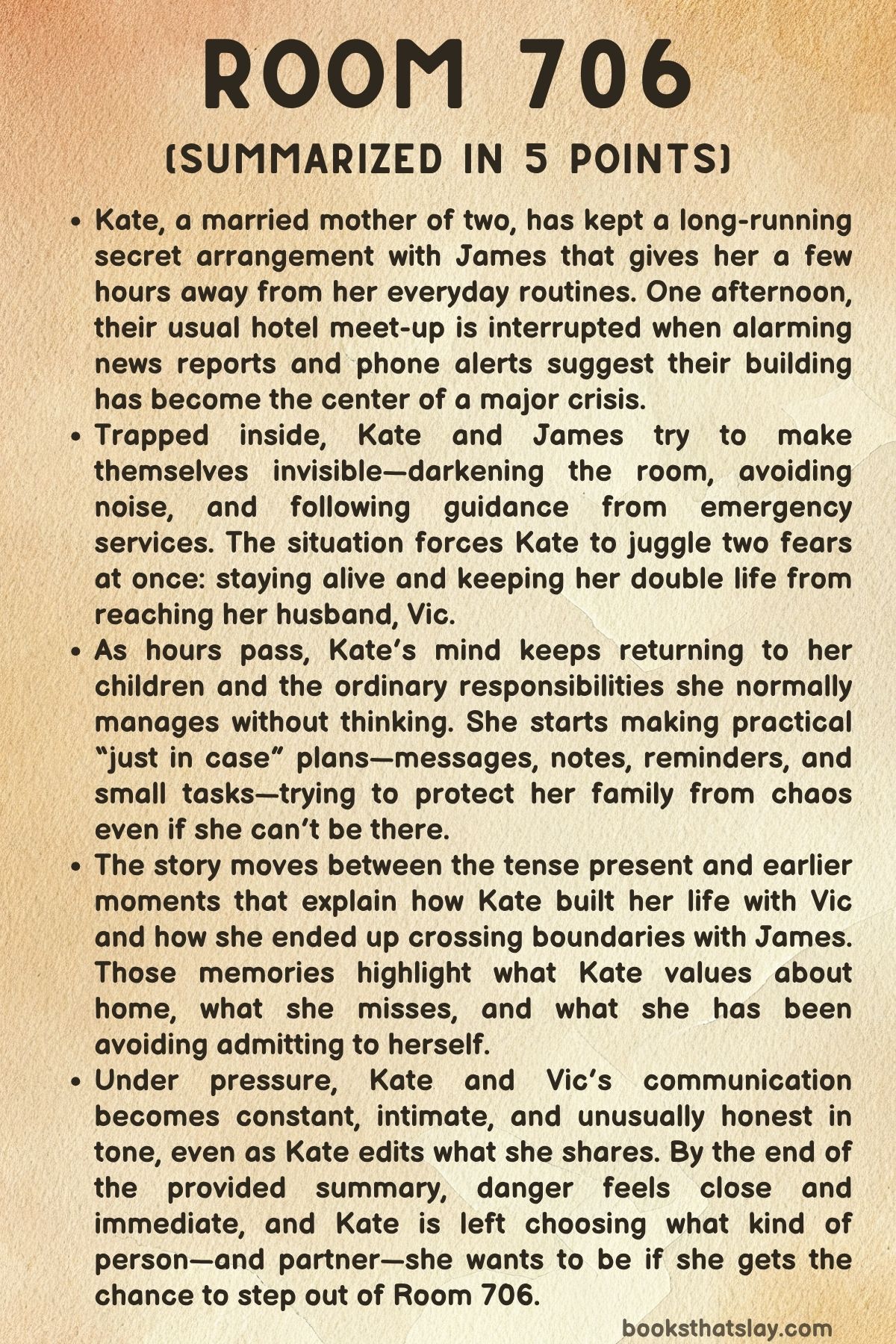
Room 706 by Ellie Levenson is a tense, intimate novel about an ordinary afternoon that turns into a long fight to stay alive—and to keep a carefully managed life from collapsing. Kate is a mother, a wife, and a journalist who has been meeting a married man, James, in hotels for years.
Their arrangement is private, controlled, and meant to leave no trace. Then a terrorist attack locks them inside the very hotel where they are hiding. Trapped in one room, Kate must weigh truth against survival, guilt against love, and the future of her family against the secret she’s built her escape around.
Summary
Kate’s day begins like countless others: a rapid series of small tasks that keep her household running. She wakes early, moves through the practiced routine of getting her children—Lenny and Annie—fed, dressed, and ready for school, while exchanging normal, affectionate chatter with her husband, Vic.
Kate is careful to sound casual as she lies about her plans. She tells Vic she has a magazine interview with a psychologist about sleep and mental health.
The interview exists, but it’s scheduled for another day. Today’s destination is different, and the lie has become part of a pattern.
After the school drop-off, Kate heads into central London, restless with anticipation. The details of the morning don’t cooperate—she can’t find the right bread rolls for Annie’s lunch, she feels strangely flustered buying condoms and lubricant, and she ends up killing time in a coffee shop while watching the entrance to a hotel near the Thames.
James, the man she has been meeting in secret for six years, texts that he’s late and then sends the room number: 706.
By early afternoon, Kate is in that room, post-sex, comfortable in the familiar anonymity of a hotel. She likes the small luxuries: the toiletries, the softness of towels, the feeling of being temporarily unaccountable.
James showers. Kate eats a chocolate truffle from the welcome box and half-watches a news channel with the sound low, thinking mostly about timing—how long she can linger and still be home for the school run.
Then the broadcast changes her body before it changes her mind. She catches words like “London” and “hotel,” looks up properly, and recognizes the entrance she watched from the coffee shop.
The hotel on screen is the hotel she is in. An alert flashes on her phone.
A major incident has been declared. Armed gunmen have taken control of the building.
People are trapped inside. Casualties are already being reported.
James comes out of the bathroom and sees Kate’s face. They both stare at the TV and at the escalating notifications.
Panic hits them in different ways. Kate’s first instinct is to escape; James’s is to calculate risk.
They consider leaving by a back exit but realize they don’t know where the attackers are, how far their control reaches, or which routes are safe. The hotel’s fire-escape plan offers options that all require stepping into corridors, stairwells, or lifts—spaces that could be watched.
They shift into hiding mode fast. The TV is muted and then switched off.
Kate turns off running bathwater. They listen for sounds beyond the door.
When the hotel’s name appears on the news, any remaining doubt is gone. They notice a flag hanging from a lower-floor window, a symbol that suggests ideology rather than robbery.
Kate remembers she hung a “Do not disturb” sign outside—something that now feels like a beacon. James cracks the door open, removes the sign, locks and chains the door, and drags furniture against it in a barrier that offers more comfort than protection.
Kate’s phone alarm goes off—an ordinary reminder to leave on time for school pickup. The noise slices through their attempt at silence, and they scramble to stop it, furious at the way normal life keeps insisting on itself.
Almost immediately, Vic messages her. He’s seen the news.
He’s asking if she’s okay. Kate is trapped between two disasters: the attack itself, and the possibility of her husband realizing she’s inside the hotel for a reason she can’t admit.
Kate chooses to call emergency services anyway. She wants the authorities to know she’s there, to mark room 706 as occupied by a living person, not a blank space.
James argues that the call could expose them, that the questions will lead to explanations neither of them can give. Kate gives her full name, room number, and personal details, but when asked if she’s alone, she lies and says yes.
The operator tells her the attackers control the lobby and first floors and that hostages are being held in meeting rooms. Kate is instructed to stay hidden, keep silent, avoid lights, avoid running water, avoid flushing, ignore knocks and alarms, and not post anything online.
She gives Vic’s number so police can inform him she is inside.
The room becomes a sealed world. Kate scrolls news and social media, watching speculation harden into fear.
James looks up information about the group suggested by the flag and reads about previous attacks: places taken over, hostages threatened, rescues that ended in deaths, and a long siege elsewhere that lasted for days. The possibility of being stuck for forty-eight hours—or longer—lands heavily.
Kate looks at photos of her children, trying to treat breathing like a task she can complete.
As the hours drag, the narrative keeps opening into Kate’s past, showing what she risks losing. Years earlier, she is young and newly with Vic in Italy, learning what it feels like to be cared for steadily.
Vic is affectionate, curious, and a little amazed by her. Kate tells him about Eve, her closest friend since childhood, and about a summer they spent traveling in Spain, talking through their lives with a ritual that made space for honesty.
When Kate’s mother died, Eve was unreachable at an off-grid camp in America, and Kate tried to protect her by writing late and discouraging her from coming back. The absence left a bruise that never really healed.
Another strand of the past shows how Kate’s connection with James began. She meets him as a journalist interviewing a CEO, and the professional attention shifts into personal intensity.
James is candid about his life in a way that feels like trust. He admits he will never leave his wife, Bea.
Kate insists she can want someone without wanting to build a life with them. They toast to the idea of “not falling in love,” and the agreement becomes their excuse and their shield.
The affair grows into a repeating escape: meetings in hotels, sex that feels separate from marriage, and the comfort of being desired without being fully known.
In room 706, that separation starts to fail. Kate keeps thinking about school pickup and how to manage it without revealing where she is.
She sends Vic practical instructions, and he reacts with calm competence—rearranging plans, collecting the children, and telling her to focus only on getting home. His steadiness makes her guilt sharper.
Kate drafts cover stories and deletes them. She sends messages that are too emotional to be ordinary, including an “I love you” threaded with apology, and then panics about what it implies.
The danger outside is not abstract. At one point, Kate and James hear a family in the corridor—a child’s voice, parents heading toward the lift as if it’s a normal day.
Kate tries to move, to warn them, but James stops her, convinced it would expose them and change nothing. The lift dings.
A scream follows. Then a gunshot.
The sound leaves Kate shaken and sick with the thought that silence might have been complicity.
As night comes, Kate’s mind turns practical in a desperate, almost automatic way. She writes notes: to Vic, to Lenny, to Annie.
She tries to leave behind something unmistakably hers, even adding a sentence that contains every letter of the alphabet so her handwriting can be recognized. She saves documents to the cloud so they will appear on the computer at home.
She schedules emails with holiday payment details and where the children’s gifts are hidden. She orders a Viking costume for a school event, buys an outrageously expensive doll Annie wants, and completes a grocery order so food will still arrive if she doesn’t.
In the room, James remains half-outside the moment, still thinking about work, still guarding emotional distance. Kate realizes how uneven the risk has been.
James’s wife is abroad and unlikely to connect him to the hotel. Kate’s life, by contrast, is right there in London: her husband, her children, the routines that will expose the gap if she doesn’t return.
She pushes James about whether he’ll tell Bea if they survive; he says there’s no point. Kate sees, with sudden clarity, that the affair ends here either way—by death, by truth, or by the simple fact that she can no longer pretend it costs nothing.
News updates worsen. Two bodies are pushed out through the revolving door.
Kate refuses to hunt for clearer images. Vic keeps texting, trying to anchor her with memories: Italy, their early promises, small private jokes.
He keeps her talking through imagination games, asking her to picture herself at different ages, pulling her attention away from the corridor and back into a life that still exists for him.
In the early hours, the hotel’s electricity cuts out. The fridge hum stops.
The Wi-Fi fails. Kate scrambles onto a public signal from a nearby building.
Then new sounds begin: dull thuds below, muffled shouts, and a repeated command—“Clear”—moving upward floor by floor, like doors being breached. It could be rescue teams.
It could be attackers searching room by room. James arms himself with a glass ashtray and crouches beside her.
Kate watches Vic’s last playful message waiting for her reply, and with the word “Clear” now close enough to feel like a hand on the door, she answers his game anyway—imagining them old, safe, still together—because she needs to believe there is a version of the world where she gets out of room 706 and goes home.
Characters
Kate
In Room 706, Kate is the gravitational center of the story: a woman who has built a life on competence and care, then secretly carved out a private annex of desire that she tries to keep airtight. On the surface she is a highly functional mother and partner, running a household through routines, reminders, and contingency planning, but the siege exposes how much of her stability is performance under pressure.
Her affair with James is not framed as a romantic alternative life so much as a controlled room she steps into every few months, a space where she can be wanted, anonymous, and briefly unburdened by family logistics; the hotel setting matters because she fetishizes its order, cleanliness, and rules, as if they can contain chaos. When violence erupts, Kate’s mind does what it always does: it manages—lists, emails, purchases, instructions, school pickup arrangements—yet the same managerial instinct becomes its own torment because every practical step carries moral weight.
She is both intensely self-protective and intensely self-exposing: she calls emergency services and gives her full identity, yet lies about being alone; she fears death, yet fears discovery almost as much. The narrative repeatedly shows that Kate’s deepest conflict is not sex versus fidelity, but control versus truth: she wants to curate what everyone knows about her, while the siege threatens to turn her into evidence.
Her memories—Eve’s friendship game, Vic’s tenderness, Italy’s beginnings—aren’t nostalgic decoration; they are the internal jury she faces when she can no longer distract herself with normal life. By the end, Kate’s voice becomes starkly essential, shedding cleverness and cover stories until what remains is love, fear, and the desperate wish to leave her children something usable: food, passwords, gifts, handwriting, reassurance.
James
James functions as both catalyst and mirror for Kate, embodying the kind of compartmentalization Kate aspires to but cannot fully sustain. He is older, powerful, and practiced at managing narratives—his corporate life, his marriage, his reputation—and that practiced control carries into the affair, where he prefers rules, minimal disclosure, and emotional containment.
In the room during the siege, his instinct is calculation: he studies escape plans, he worries about police questions, he researches the terrorist group, and even in crisis he returns to board responsibilities, which makes him feel chillingly intact compared to Kate’s unraveling. That intactness is not simple strength; it reveals a moral asymmetry.
James can imagine surviving with fewer consequences because his wife is away, his identity is less entangled with childcare logistics, and he is more confident he can outlast scrutiny, while Kate’s entire life is booby-trapped with small domestic facts that can expose her. He also represents the story’s critique of “clean” adultery: Kate tells herself this is sex without love, but the siege forces her to look at what she actually knows about him, and it turns out to be frighteningly little—so little that even the basic intimacy of a favourite colour becomes unreachable.
James’s refusal to imagine confession or transformation underscores that for him the affair was always a sealed channel, never a crossroads, and when Kate declares it ends here, he agrees with a resigned practicality that reads as both honesty and hollowness. In crisis he can be protective in small ways, yet his primary loyalty is to containment, and that makes him the story’s embodiment of secrecy as a lifestyle rather than a mistake.
Vic
Vic is the emotional counterweight of Room 706, a character built from steadiness, memory, and patient attention rather than spectacle, and that steadiness becomes heroic precisely because it is unglamorous. He enters the narrative through domestic routine and gentle intimacy, and over time we see that his love language is caretaking that does not demand applause: washing up, buying rolls, managing school pickups, smoothing panic with games and stories.
When the siege begins, Vic becomes Kate’s lifeline not through grand declarations but through relentless presence; he texts, reassures, takes control of logistics, and offers her a mental place to stand when the outside world is collapsing. Importantly, he is not written as naïve; his question about how she ended up in the hotel shows suspicion or at least awareness, and Kate’s scrambled lie lands between them like a new kind of damage.
Yet even with that crack, Vic chooses the role of anchor in real time, prioritizing her survival over his need for answers. His history—family distance, the tight bond with Tom, the way he treasures Kate as his closest friendship—explains why stability matters so much to him: he has learned to build family deliberately, not assume it will be there.
Vic’s imagination games, the “V and K always” refrain, and the remembered scratch in asphalt reveal a man who fights terror with continuity, trying to keep Kate tethered to a future self who gets to come home. If Kate is split between selves, Vic is the person who insists she is still one person worth saving, even when she no longer feels morally coherent.
Eve
Eve is less a presence in scenes than a shaping absence, the lost friend whose way of being becomes Kate’s inner refuge and inner wound. Their friendship is depicted as unusually structured and intimate: the travel ritual where they speak uninterrupted about people in their lives suggests a bond built on deep witnessing, not casual companionship.
That ritual becomes crucial later when Kate, trapped and terrified, reconstructs Eve as an imagined listener; Eve’s “voice” provides Kate something she cannot risk giving anyone else—full confession without immediate consequence. Eve’s death creates a long-term emotional fault line that the marriage and the affair both partially cover: Vic comforts Kate, yes, but Eve represented a kind of truth-telling that didn’t require Kate to be a “good wife” or a “good mother,” just a whole person.
The moment when Kate writes Eve a letter after her mother’s death, telling her not to come back, reveals Kate’s complicated caretaking impulse: she tries to protect people from pain, even if it isolates her, and even if it robs her of the support she needs. Eve’s function in the story is therefore moral and psychological rather than plot-driven: she represents the standard of intimacy Kate once had, the intimacy she misses, and the intimacy she tries to replace with sex that supposedly asks for nothing.
In the siege, Eve becomes a silent benchmark—what Kate would say if she were brave enough to be fully known.
Lenny
Lenny, Kate and Vic’s son, is portrayed through the texture of everyday parenting rather than through direct action, which makes him feel real and also painfully vulnerable when Kate is trapped. He exists in permission slips, playdates, costume plans, and Christmas present calculations—precisely the kinds of details that suddenly become sacred when time might be short.
Kate’s panic about “Invader Day” and the Viking costume is not trivial; it shows how motherhood is experienced as a chain of promises, and how the threat of death turns even a silly school theme day into proof of whether she has failed him. Lenny also becomes part of Kate’s moral reckoning because he embodies the life that depends on her reliability; when she ticks off tasks or schedules emails, she is trying to keep his world continuous even if she disappears.
In that way, Lenny functions as a future-facing character: he represents the older child who will eventually understand more, ask more, and feel the ripples of what happened in a way that is both emotional and interpretive.
Annie
Annie is the younger child whose needs are immediate, specific, and emotionally disarming, and the story uses those specifics—her pickiness about bread rolls, her attachment to her toy Fluffy, the expensive American doll—to show how love often expresses itself through tiny, material acts. Annie’s presence heightens Kate’s urgency because Annie is at the age where comfort is concrete: a familiar toy, a kiss, a parent at the school gate.
Kate’s thoughts about Annie are less about future explanations and more about protection and reassurance, which is why Kate writes affirmations and instructions meant to be found later, as if she can still mother Annie through paper and scheduled emails. The doll purchase is especially telling: in the middle of terror, Kate makes a financially irrational choice because it feels like a tangible way to keep a promise and leave delight behind, a substitute for presence if presence is taken away.
Annie’s function is therefore emotional leverage, but not in a cheap way; she makes the stakes domestic and intimate, forcing the siege to be experienced not as an abstract headline but as a threat to bedtime, school runs, and the small rituals that form a child’s sense of safety.
Tom
Tom, Vic’s brother, enters the story as a protective outsider who sees Vic with both affection and sober clarity. His early interrogation of Kate—about the age gap, her background, her intentions—isn’t villainy; it’s a kind of brotherly due diligence born from knowing Vic’s softness and wanting it safeguarded.
Tom’s warning that Vic won’t be “exciting” but will be loyal frames an enduring tension in Kate’s life: the gap between steadiness and thrill, between safety and appetite, and how easy it is to mistake intensity for aliveness. Later, when the crisis unfolds, Tom becomes part of the survival net, present with Vic and receiving Kate’s practical “just in case” information, which underscores his role as family infrastructure rather than drama.
He is a character who embodies accountability—someone who will remember what was promised, who will notice what doesn’t add up, and who will likely be there after the crisis to help rebuild whatever is left.
Bea
Bea, James’s wife, is mostly offstage, but her absence is meaningful because it reveals how James benefits from distance and how Kate is exposed by proximity. The fragments we learn—her work as a food stylist, her time in America, the suggestion of a temporary break and attempted relocation—create the outline of a life that is real but withheld, much like Kate’s own marriage is real but partially withheld from James.
Bea functions as the unchosen witness: the person James refuses to let the truth reach, not because truth would help anyone, but because truth would disturb the architecture of his life. For Kate, Bea becomes a symbol of inequity; realizing Bea is away and unlikely to connect James to the hotel forces Kate to see that the affair’s risk was never evenly distributed.
Bea’s character, then, operates as moral pressure: she is the person whose existence makes “no one is getting hurt” impossible to believe.
Nicole
Nicole represents the social world Kate keeps at arm’s length, the realm of gossip, apps, blunt talk, and external observation that threatens secrets simply by existing. Her message about a dating app sighting lands like a flare in the dark—proof that the private can become public through random digital overlap.
Nicole’s earlier presence in conversations about childbirth, sex, and affairs also shows how Kate’s environment contains candid discussions that Kate absorbs while still trying to remain exceptional, as if rules apply to other people’s mess but not her carefully managed transgression. Nicole isn’t portrayed as malicious; she is portrayed as connected, curious, and unfiltered, which is exactly why she is dangerous to Kate’s hidden life.
In that sense, Nicole functions as a reminder that secrecy is never just about what you do, but about how many other humans and systems can accidentally triangulate it.
Cheryl
Cheryl appears as part of the social backdrop during Kate’s pregnancy and grief, contributing to the chorus of blunt female realism around birth, sex, and fidelity. Her role is brief but pointed: she helps situate Kate in a community where taboo topics are spoken aloud, highlighting the contrast between what can be said in public conversation and what Kate still cannot say about her own interior life.
Cheryl’s presence reinforces one of the book’s recurring tensions: knowledge does not equal permission. Kate can hear talk about affairs and still feel uniquely trapped by the possibility of her own being known.
Nonna
Nonna, though not central in the siege timeline, anchors the Italy chapters with a sense of family texture and origin, offering a setting where intimacy is domestic and intergenerational rather than illicit and hidden. The apartment scenes and the early days of Kate and Vic’s relationship carry the warmth and ordinariness that later become precious in memory: dishes, teasing jokes, shared routines, and the feeling of being folded into someone’s world.
Nonna’s presence also quietly frames what Kate has built since then—an entire adult life that began in those rooms and that now, in a different room number, is under threat. She represents the kind of belonging that doesn’t need passwords or cover stories, which makes her an emotional counterpoint to the hotel’s anonymity.
Michael
Michael, the older man on the flight, is a small but telling character because he shows Kate receiving care from a stranger in a moment of vulnerability, and that care is calm, practical, and non-demanding. His breathing guidance during turbulence and his quiet marriage advice in the immigration queue briefly place Kate in a world where anxiety is shared openly and help arrives without cost.
The slip where she almost says she is married to James exposes how thoroughly the affair has invaded her unconscious, and Michael’s presence sharpens that contrast: he offers steadiness without secrecy, while Kate is living inside a steadiness that requires lies to maintain. In narrative terms, Michael is a foil to James and a faint echo of Vic’s groundedness, reminding the reader that comfort can come from honesty and ordinary human kindness, not only from adrenaline or escape.
Sandra
Sandra, Eve’s mother, appears as a deferred responsibility, someone Kate keeps meaning to check in with but cannot face. That avoidance reveals how grief and guilt can fossilize into procrastination: Kate can handle bins, school forms, and online orders under siege, but she struggles with the emotional labour of revisiting Eve through her mother.
Sandra’s role is therefore quietly devastating—she is a living link to the friendship Kate lost, and Kate’s inability to contact her mirrors the book’s larger theme of avoidance: what Kate can’t bear to confront gets postponed, compartmentalized, and turned into a reminder set for “later,” even when later may never come.
Themes
Secrecy, Exposure, and the Cost of Double Lives
In Room 706, Kate’s day is built out of small, deliberate acts of concealment that feel ordinary to her until the hotel siege turns them into liabilities. The lie to Vic about a psychologist interview is not a dramatic invention but a practiced habit, and that is what makes it dangerous: the cover story has been rehearsed enough to fit neatly into a school-run morning.
The secret relationship with James is treated as something Kate “contains” through routines—timed departures, hotel baths, a return to normality before pickup—so she can keep the affair separate from the life where she is a mother and wife. When the crisis begins, that separation collapses.
The same phone that helps her manage lunch rolls and reminders becomes a device that can betray her location and her timeline. The “Do not disturb” sign is suddenly not a convenience but a marker that says someone is inside.
Her alarm at 3.15 p.m. is not just an annoying beep; it is an announcement to the corridor that a person is present, and it forces Kate to confront how fragile her privacy has always been.
The most punishing aspect of secrecy here is that it doesn’t only hide pleasure; it also blocks help. Kate’s first instinct is not simply survival but survival without being known.
Even while trapped, she is thinking about the school gate and about Vic discovering the affair, and those thoughts compete with decisions that could protect others. The moment with the family in the corridor makes this cruelly clear: Kate’s desire to warn them runs straight into James’s insistence on silence, and underneath that argument sits a shared understanding that being found together would expose everything.
The siege magnifies what secrecy already does in quieter circumstances: it trains people to prioritize containment over truth, and it rewards fear-based decisions. Kate calls emergency services, but even then she lies and says she is alone, choosing the safety of her marriage’s image over the safety that might come from full information.
The theme isn’t merely that secrets exist; it is that maintaining them becomes a way of thinking that persists even when the stakes shift to life and death, and the emotional bill arrives all at once—panic, shame, anger at James, and the sudden awareness that the story she has been protecting may not even be worth the harm it causes.
Marriage as Caretaking, Labor, and a Long Practice of Loyalty
Kate’s marriage to Vic is shown less through grand statements and more through logistics, attention, and the slow accumulation of shared language. The domestic routine at the start—lunches, shoes, slow-cooker dinner, messages about bread rolls—can look banal, but it establishes a pattern: this is a partnership that runs on constant, mostly invisible work.
Vic’s care shows up in his willingness to cover practical gaps without drama, and later, when the siege begins, that same steadiness becomes a lifeline. His texting isn’t just reassurance; it is active regulation of Kate’s panic.
He provides structure, takes over coordination of the children, calls the police when she asks, and keeps her tethered to a world that still has dinner, biscuits, and soft toys. The relationship becomes a kind of emergency infrastructure, with Vic serving as a calm external nervous system when Kate’s mind is spiraling.
At the same time, the story is honest about how caretaking can create resentment and imbalance. Kate’s Minnesota trip reveals a jagged feeling: when Vic solo-parents, it can seem like a break for him, while for her, “time away” carries guilt and planning.
In the siege, Kate continues to mother from a locked hotel room: she buys costumes, schedules emails, places a grocery order, writes down passwords, thinks about Christmas presents, and tries to leave written traces of herself for her children. Her instinct under threat is not self-centered pleasure, but management—making sure the household machine can keep moving if she is removed from it.
That is a form of love, but it is also evidence of how much responsibility sits in her head.
The marriage theme gains complexity because Vic’s loyalty is not naïve; it is chosen and repeated. The early memories in Italy show him wanting not just romance but intimacy in the form of knowledge—wanting to know everything about her, wanting to be her best friend.
That desire is tender, but it also creates pressure, because being fully known is exactly what Kate has trouble tolerating. The siege forces a harsh comparison: James offers intensity and escape, but he protects himself first—he argues against calling the police, keeps his wife out of the loop, and holds distance even when Kate asks basic questions like a favourite colour.
Vic, in contrast, is emotionally exposed and practically present, and that contrast pushes the theme beyond “good husband versus affair partner.” It becomes about what loyalty looks like when it is not glamorous: it looks like school pickups, phone calls, invented imagination games at 2 a.m., and a steady refusal to abandon someone even when their story makes no sense. Kate’s fear is that the marriage cannot survive truth; the narrative’s pressure point is whether love built on years of care can hold when the hidden parts finally press against the surface.
Crisis as a Mirror That Forces Moral Accounting
The hostage situation does more than create suspense; it strips away Kate’s usual methods of emotional control and forces her to watch herself making choices in real time. In ordinary life, she can keep the affair in a sealed compartment, rationalize it as “me time,” and return home scrubbed clean.
In the hotel, there is no clean reset. Every sound becomes a moral problem—an alarm, a toilet flush, the ring of a phone—because noise can kill.
The emergency operator’s instructions are practical, but they also carry a blunt ethical message: your actions ripple outward, and you are responsible for minimizing risk to yourself and others. Kate tries to follow the rules, but stress reveals how easily instinct overrides intention, like flushing the toilet and immediately understanding she may have endangered them.
The most devastating moral moment is the corridor family. Kate’s impulse to warn them is immediate and human, and James’s restraint is also rational in the most chilling way: if you open the door, you invite death into the room.
The lift ding, the scream, the gunshot—this sequence becomes a permanent injury in Kate’s mind because it leaves no space for comforting narratives. She cannot tell herself that doing nothing was harmless.
She cannot confirm what happened. She is left with responsibility without proof, which is exactly the kind of burden that grows in the imagination and does not resolve.
The siege turns Kate’s private moral compromises into something she can’t avoid measuring. Her affair has always involved risk—emotional risk to Vic, risk to her children’s stability—but the danger was abstract and managed through secrecy.
Now risk is physical and immediate, and she experiences what it is like to be trapped with the consequences of hesitation.
This theme also shows how crisis compresses identity. Kate moves rapidly between roles—lover, mother, journalist, frightened civilian—without the usual transitions.
Her to-do list becomes a confession of what she values when time might be short: forms, bins, holiday payments, costumes, gifts, grocery orders, passwords, handwriting samples for her children. These tasks are not trivial in her mind; they are evidence that she existed in specific, useful ways.
The scheduled emails are especially revealing because they are an attempt to reach into the future and keep shaping it, even if she cannot be there. Under threat, Kate becomes intensely practical, almost bureaucratic, because it is the only kind of control she can still exert.
The moral accounting is not only about the affair; it is about whether she has been present enough, honest enough, and brave enough when presence, honesty, and bravery suddenly have consequences that cannot be postponed.
Grief, Memory, and the Need for a Witness Who Knows the Whole Story
Eve’s absence functions like a missing organ in Kate’s emotional life: everything still works, but with strain and compensations. The friendship with Eve is remembered as a structured kind of listening, a ritual where each could speak uninterrupted about the people shaping their life.
That ritual matters because it models what Kate doesn’t have in her adult world: a witness who can hold complexity without demanding a simplified version. After Eve’s death, Kate loses not only companionship but a specific kind of truth-telling space.
In the siege, when she “hears” Eve’s voice and imagines playing the old travel game, it isn’t a quirky coping mechanism; it is Kate recreating the only format that ever let her speak freely. She confesses the affair to an imagined Eve before she can confess anything real to Vic, which shows how grief doesn’t just hurt—it reroutes communication.
Eve becomes the person Kate can be honest with precisely because she is gone and cannot impose consequences.
Memory in the story is not a nostalgic escape; it is an active survival tool. Vic uses shared memories as anchors—“V and K always,” the scratched asphalt, Nonna, the cinema meeting—and these details are effective because they are concrete.
They pull Kate out of catastrophic thinking and back into specific scenes where she has felt safe. The imagination game they play late at night is a deliberate strategy: it forces Kate’s mind to build images that are not the hotel corridor.
Even when the game turns toward old age, it is not sentimental; it is a way to keep her present and breathing while danger approaches floor by floor. Kate’s reply about them as the happiest old couple is heartbreaking not because it is poetic, but because it is an act of will—choosing a future picture at the moment the door might break.
Grief also shapes Kate’s relationship to control and abandonment. Her mother’s death happened while Eve was unreachable, and Kate’s decision to write a letter telling Eve not to come back reveals a pattern: Kate tries to manage loss by pre-empting it, by making herself the one who chooses separation so she won’t feel left behind.
The affair can be read through that lens too, as an arrangement where attachment is limited and exit is scripted, which feels safer than needing someone fully. But the siege wrecks scripted distance.
Facing possible death, Kate reaches for connection in the most basic form—messages, love yous, practical information, the urge to leave words behind. She becomes desperate not merely to survive, but to be understood if she doesn’t.
The handwritten pages, the file that syncs to the home computer, the tiny note tucked into her bra are all attempts to ensure that if the worst happens, someone will still be able to reconstruct her intentions and her love. In that sense, grief and memory are not background elements; they are the forces shaping how Kate speaks, what she hides, and what she cannot bear to leave unsaid when there may be no later.