The Grandest Game Summary, Characters and Themes
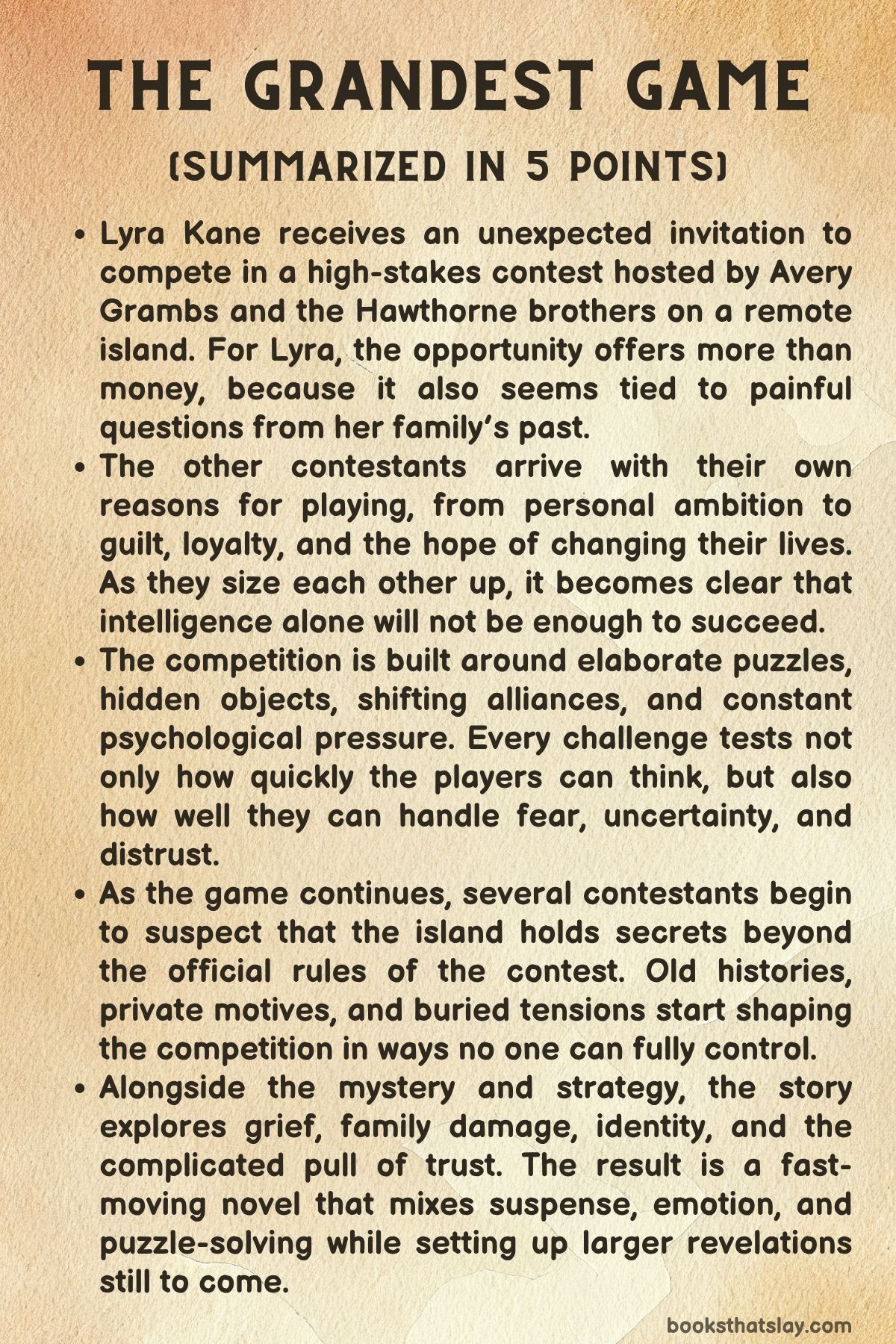
The Grandest Game by Jennifer Lynn Barnes is a high-stakes young adult mystery built around puzzles, buried history, private grief, and dangerous ambition. Set in the world of the Hawthorne family (The Inheritance Games), the novel follows a group of contestants invited to compete for life-changing wealth on a remote island designed for strategy, deception, and spectacle.
At the center are Lyra Kane, who is haunted by her father’s death and a mystery tied to the Hawthornes, Gigi Grayson, who wants to do something good with the prize, and Rohan, who enters with a secret agenda of his own. The result is a tense, clever story about survival, trust, and the price of winning.
Summary
A year before the main action begins, Rohan is given a challenge that defines his future. Raised in the shadow of an influential underground figure in London, he is told that if he wants a place in that world’s highest ranks, he must leave, earn a vast amount of money, and prove himself worthy.
He chooses the Grandest Game as his path forward, committing himself to preparation, observation, and strategy long before the contest officially begins.
In the present, Lyra Kane is struggling through college while carrying emotional wounds she has tried to bury. A recurring nightmare forces her to relive the day her father died by suicide when she was very young.
In the dream, he says a Hawthorne was responsible and leaves behind a cryptic riddle. Lyra has pushed those memories away for years, but the Hawthorne name keeps bringing them back.
At the same time, her family is under financial strain. Her mother is trying to hold things together, but unpaid tuition threatens Lyra’s future, and the possible sale of their family home deeply unsettles her.
When Lyra receives an invitation to the Grandest Game with a note telling her that she deserves it, the offer feels both like an opportunity and a threat.
Another contestant, Gigi Grayson, is drawn into the competition from a very different place. She comes from the Hawthorne orbit and is the half-sister of Grayson Hawthorne.
Though she has access to privilege, she wants to prove herself without depending on it. She also carries a private burden connected to her father’s actions, and she wants to use any winnings to help others.
Her twin sister Savannah shadows her life as both rival and mirror, pushing Gigi’s insecurities to the surface. While Savannah seems naturally formidable, Gigi worries that she is always the lesser twin, the one who falls short.
As the contestants arrive on Hawthorne Island, the novel introduces a charged mix of personalities and motives. Lyra’s first encounter with Jameson and Grayson Hawthorne shakes her, because the family name is inseparable from her father’s last words.
Rohan arrives already in control of himself, studying the others and deciding who may be useful. Gigi comes by boat with Savannah and Brady Daniels, another contestant whose guarded manner hides deeper complications.
The island itself becomes part of the game immediately. Contestants are told to search for useful hidden objects before sunset, and every discovery feels like both a clue and a test.
During this first phase, several important threads emerge. Lyra finds notes bearing different versions of her father’s name, convincing her that someone on the island knows exactly who she is and what wounds to press.
Gigi discovers suspicious equipment including scuba gear, a knife, and a necklace that later proves to hold a listening device. Rohan quietly manipulates the field, having already gathered information and even ensured that certain invitations reached specific players.
By the time everyone reaches the main house and dresses for an elaborate masked ball, the contest has already become personal.
At the ball, Avery Grambs and the Hawthorne brothers frame the event as a chance at reinvention. The contestants are not only competing for money but being invited into a larger legacy of games and transformation.
Yet for Lyra, the glamour is overshadowed by what she learns from Grayson. He had once looked into her father’s past and found a file connected to a man known as Thomas Thomas, someone apparently on Tobias Hawthorne’s enemies list.
But the file was packed with false information. This deepens the mystery rather than resolving it, and Lyra grows even more certain that her father’s death is tied to the Hawthorne family in a way no one has fully explained.
The first major game begins after the contestants are split into teams and locked into rooms overnight. Each team must solve layered puzzles before dawn or face elimination.
Lyra is grouped with Grayson and Odette, an elderly contestant who knows more than she initially admits. Gigi is paired with Brady and Knox, whose hostile, emotionally loaded relationship points to a shared past and the disappearance of a girl named Calla.
Rohan is teamed with Savannah, and their alliance becomes a battle of attraction, mistrust, and competing agendas.
These puzzle sequences reveal character as much as intelligence. Lyra, Grayson, and Odette gradually learn to work together, identifying word patterns, hidden compartments, and coded messages.
Lyra and Grayson, initially tense and defensive around each other, begin to form a stronger bond as they recognize each other’s pain and determination. Odette, meanwhile, keeps delaying answers about how she knows the Hawthornes, making it clear that her history with the family runs deep.
Gigi’s team is more unstable. Brady and Knox are tied together by years of history, loyalty, betrayal, and grief linked to Calla.
Gigi becomes the emotional center of the group, defusing conflict, spotting patterns others miss, and refusing to let the older contestants dismiss her. Her optimism is not naive; it is active, observant, and often brave.
As she notices hidden surveillance and possible outside interference in the game, she becomes one of the first contestants to understand that something is wrong beyond the designed competition.
Rohan and Savannah spend their challenge testing each other. Both are sharp, guarded, and unwilling to surrender ground.
Their scenes are full of negotiation and exposure. When they are forced into a truth-or-dare style trial to earn a hint, pieces of their inner lives come to light.
Rohan reveals fragments of a brutal childhood marked by abuse and fear. Savannah reveals that money alone is not her true reason for competing.
Their rivalry becomes more dangerous because it is built on genuine understanding as well as manipulation.
As the teams progress through deeper levels of the challenge, the novel increases both emotional and physical pressure. Lyra experiences a flashback triggered by disturbing imagery in one of the puzzles and recalls more about her father’s death, including a symbol drawn in blood.
Grayson helps pull her back to the present, and together with Odette they realize that her father’s final riddle pointed toward omega, the last letter of the Greek alphabet. This discovery links the game’s puzzle design to Lyra’s private trauma in a way that cannot be accidental.
The contest takes a darker turn when the island’s power goes out unexpectedly. This does not feel like part of the planned game.
Doors become dangerous, movement is restricted, and the contestants realize that an unknown person may be operating on the island. Gigi hears a voice through the bugged necklace from a man she has encountered before, someone dangerous who knows secrets about her family.
This confirms that the competition has been infiltrated. The carefully controlled environment is no longer closed, and the contestants are no longer dealing only with the hosts’ designs.
By dawn, the teams race toward the dock. Gigi falls and is injured, causing her team to miss the deadline.
The emotional cost is immediate. Brady, who had earned some of Gigi’s trust and sympathy, confesses that he lied about needing money for his mother’s cancer treatment.
His real motives connect back to Calla and to larger hidden interests. The lie cuts Gigi deeply, especially because she had sincerely wanted to help him.
After the round ends, more truths surface. Odette voluntarily gives up her place in the game, and in a private conversation with Lyra and Grayson she finally explains that she once worked for the law firm tied to Tobias Hawthorne and had a romantic relationship with him.
She reveals that Lyra’s father’s dying words may not have pointed to Tobias at all, but to Anne Hawthorne, Tobias’s wife, who had returned from the dead under shocking circumstances. This revelation shifts the entire mystery surrounding Lyra’s father and suggests that the past is far more tangled than Lyra imagined.
Meanwhile, Rohan uncovers Savannah’s real motive. She is not playing for simple victory or wealth.
She wants public revenge. On the livestream that will crown the winner, she plans to accuse Avery Grambs of killing her father.
This raises the stakes of the contest beyond personal survival or money and turns the final stages into a possible public reckoning.
Lyra, finally understanding that someone other than Avery arranged for her to be in the game, grows closer to Grayson. He admits he cared about her from the start but was too overwhelmed by his own life to respond well when she first reached out.
Their reconciliation leads to a kiss, giving Lyra a moment of connection in the middle of mounting uncertainty.
The novel ends on a sharp note of danger rather than resolution. Gigi, still suspicious and determined, goes alone into the woods to draw out the hidden watcher.
Instead, she is overpowered and kidnapped. In the final pages, an unknown observer considers whether watching events unfold is enough, or whether more direct action is needed.
The ending leaves the competition unresolved and makes it clear that the game was never only a game. It is a stage for old crimes, hidden loyalties, revenge, and truths that are only beginning to surface.
Characters
Lyra Kane
Lyra is the emotional and investigative center of The Grandest Game. She enters the story carrying trauma that has never been fully processed, and that unresolved pain shapes nearly every part of her behavior.
Her recurring nightmare about her father’s death is not just a memory returning to the surface; it is the force that makes her question the truth of her childhood, her family history, and the Hawthorne name itself. What makes her especially compelling is that she is not written as fragile in a simple or predictable way.
She is wounded, but she is also disciplined, highly intelligent, and capable of intense focus. Her talent for solving puzzles reflects more than cleverness.
It shows a mind that has learned to survive by observing patterns, making connections quickly, and refusing to be overwhelmed even when the emotional stakes are high.
Her financial situation adds another important layer to her character. Lyra’s struggle is not symbolic or abstract.
She is worried about tuition, her family home, and the burden her mother is carrying. That reality gives her a practical motivation for entering the competition, but the deeper reason is personal.
She wants answers. The game becomes the place where money, identity, grief, and truth collide for her.
She is constantly forced to choose between emotional self-protection and the need to keep moving toward painful revelations. That conflict gives the character depth.
She does not merely want to win. She wants to understand the meaning of her father’s last words and the role the Hawthornes may have played in destroying her family.
Her relationship with Grayson is built on tension, suspicion, and gradual recognition. At first, he represents everything she distrusts: wealth, control, distance, and a family history that may be tied to her father’s death.
Over time, however, she begins to see that he is carrying his own damage. Their connection works because it is rooted in restraint rather than easy romance.
Lyra does not suddenly soften without reason. She watches, tests, resists, and only then allows herself to believe that Grayson may actually understand her.
That slow shift makes her emotional arc persuasive. By the end, she has not found peace, but she has moved from confusion and repression toward action and self-knowledge.
She becomes someone willing to face the truth, however destabilizing it may be.
Gigi Grayson
Gigi brings warmth, motion, and moral clarity to the novel, but reducing her to comic relief or optimism would miss what makes her so effective. She is written as bright, talkative, and relentlessly energetic, yet beneath that surface is a young woman carrying guilt, loneliness, and a fierce need to prove that she can do good on her own terms.
Her motivation for entering the game is deeply tied to her father’s wrongdoing, and this gives her generosity a serious emotional foundation. She is not trying to seem kind.
She is trying to repair damage she feels connected to, even if she was not the one who caused it. That creates a character whose cheerfulness is active rather than shallow.
She chooses openness even when secrecy and betrayal surround her.
Her relationship with Savannah is one of the most revealing elements of her characterization. Gigi loves her sister, admires her, competes with her, and feels diminished by her all at once.
This mixture of affection and insecurity is believable because it never turns into a simple rivalry. Gigi’s pain comes less from jealousy alone and more from feeling that Savannah occupies the role of the stronger, sharper, more impressive twin.
That dynamic helps explain why Gigi wants to succeed without family help. She wants a victory that belongs fully to her.
At the same time, she is hiding a family secret from Savannah out of a desire to protect her, which shows that even when their relationship is strained, Gigi is still acting from love.
As a player in the competition, Gigi is underestimated again and again, and the novel uses that underestimation to her advantage. She notices details others miss, adapts quickly, and solves problems through observation and lateral thinking rather than force.
Her intelligence is practical, physical, and intuitive. She maps the island on her skin, hides clues on her body, studies objects carefully, and responds creatively under pressure.
These choices establish her as someone whose mind is always moving. She may not project menace or authority, but she is one of the sharpest people in the game.
Her interactions with Brady and Knox also reveal her emotional courage. She repeatedly tries to create peace between them, not because she is naive about their danger but because she believes people can still choose decency.
Even after learning that Brady lied to manipulate her, and even after sensing that Knox is far more dangerous than he lets on, she continues trying to understand the pain behind their behavior. This does not make her weak.
It shows that she refuses to let cynicism define her. By the end, Gigi has become one of the novel’s most morally significant figures because she keeps choosing compassion in a setting designed to reward suspicion.
Rohan
Rohan is one of the most controlled and strategic characters in the story, and much of his power comes from the fact that he treats social interaction as performance. He enters the game after a year of planning, already armed with information, contingency thinking, and a willingness to shape events before they happen.
He does not simply react to the competition; he tries to position himself above it. This makes him feel dangerous from the start.
He studies people in terms of usefulness, anticipating how they might help or hinder him. His intelligence is not just logical but theatrical.
He can alter tone, persona, and energy depending on what a moment requires, which makes him difficult for others to read.
That outward control is complicated by the glimpses the novel gives into his past. His memories suggest a childhood marked by abuse, fear, and severe emotional damage.
The image of near-drowning, his recollection of a woman who harmed him, and the hardening effect of his upbringing all point to someone who learned very early that vulnerability invited pain. This history explains why he keeps people at a distance emotionally, even while reading them with precision.
It also explains why winning matters to him on a level beyond money. The contest represents legitimacy, power, and escape from dependence.
He wants to rise high enough that no one can control him again.
His dynamic with Savannah is one of the strongest tests of his usual methods. He begins by trying to classify and manipulate her, but she resists becoming predictable.
Their attraction is real, but so is their hostility. They recognize each other as equally ambitious, equally guarded, and equally capable of cruelty when needed.
Rohan’s interest in her therefore becomes more than flirtation. He wants to understand the source of her intensity because he senses that her motivation is larger than the stated prize.
That curiosity shifts him from detached strategist to someone personally invested in another player, and the tension between those two positions gives his character complexity.
Rohan also represents the novel’s interest in ambition stripped of comforting language. He is not there to become a better person.
He is there to win, to secure a future, and to prove his worth to a world that trained him through brutality. Yet the story does not flatten him into a cold machine.
His reactions to memory, his fascination with Savannah, and his constant effort to maintain control suggest a person who has never had the luxury of softness. He is formidable because he understands fear so well.
Even when he is manipulative, the reader can see the survival instinct underneath that behavior.
Grayson Hawthorne
Grayson begins as a figure of reserve, discipline, and emotional repression, but his character becomes richer as the story exposes the cost of living that way. He has been shaped by a family culture that values control, precision, and strategic thinking, and he has internalized those values so completely that he often appears almost inhuman to those around him.
Lyra initially sees him as cold and merciless, and that first impression makes sense. He speaks carefully, hides vulnerability, and reacts to pressure by narrowing himself into efficiency.
Yet the novel steadily reveals that this is not emotional emptiness. It is emotional containment.
One of Grayson’s strongest qualities is his seriousness. He takes responsibility quickly and carries the burden of his family name whether he wants to or not.
Even his initial refusal to engage fully in the game comes from principle rather than apathy. He does not like being manipulated, even by his own family, and he recognizes that his presence in the competition puts other contestants at a disadvantage.
Once he understands that refusing to play would harm Lyra and Odette, he commits himself completely. That shift matters because it shows that he is not ruled by pride.
He can change course when conscience demands it.
His connection to Lyra reveals the emotional world he tries so hard to hide. He had investigated her father in the past and failed to help her, a failure that clearly stayed with him.
When he admits that he cared about her from the moment she first reached out, the confession feels earned because the novel has already shown the quieter signs: his attention, his concern, and his inability to fully detach from her. What makes this dynamic compelling is that Grayson does not rescue her in any simplistic sense.
Instead, he meets her as someone who also knows what it means to survive by pretending to be fine. Their growing trust allows him to become more honest, not just more affectionate.
Grayson’s role in the puzzle sequences also reinforces his character. He is brilliant, but not infallible.
He is accustomed to being right, and one of his more important moments comes when he admits that he has been thinking about a puzzle the wrong way. That admission is a sign of growth because it moves him away from inherited Hawthorne arrogance and toward collaboration.
He remains controlled, but the control is no longer absolute. By the end, he stands as a character trying to become more human than the system that shaped him.
Savannah Grayson
Savannah is one of the most intimidating figures in the competition because she projects certainty, physical confidence, and emotional hardness. She appears to move through the game without hesitation, and that steadiness makes other characters, especially Gigi, feel smaller in comparison.
Yet the novel gradually shows that Savannah’s confidence is not simple self-assurance. It is armor.
She is playing with a level of anger and purpose that sets her apart from contestants motivated mainly by money or pride. Her determination is focused, almost severe, because she is carrying a private mission.
Her relationship with Gigi is central to understanding her. She is the twin who seems more accomplished, more capable, more difficult to shake, but that role also isolates her.
Gigi experiences Savannah as a standard she cannot meet, while Savannah often appears emotionally distant. That distance becomes more meaningful once the reader understands how much she is withholding.
She is not merely aloof; she is operating under pressure, secrecy, and a long-nursed grievance. The emotional gap between the sisters is painful because it is built not on lack of love but on concealment and obsession.
Savannah’s scenes with Rohan expose the sharpest aspects of her character. She refuses charm when she sees it being used as a tactic, and she is quick to call out performance, vanity, or manipulation.
That makes her one of the few people who can meet Rohan on equal terms. Their exchanges show that Savannah is not interested in surrendering narrative control to anyone else.
Even when attraction enters the picture, she remains combative, strategic, and suspicious. This insistence on control suggests a person who has learned that trust is costly.
The revelation that she wants public revenge against Avery transforms her character from an impressive competitor into a destabilizing force within the larger story. She is not just playing to win; she is playing to accuse, expose, and shatter a public image.
That motive changes the meaning of her discipline. It is not simply ambition.
It is preparation for an act of reckoning. Savannah becomes, in effect, a character fueled by grievance and certainty, someone who has built herself around a single purpose.
That gives her strength, but it also suggests danger, because people driven by revenge rarely remain untouched by it.
Odette Morales
Odette is one of the most surprising characters because she initially appears to occupy the role of the eccentric older contestant, only to emerge as a figure with deep ties to the family history at the center of the mystery. Her age sets her apart from the younger players, but the novel never treats her as ornamental.
She is observant, controlled, and selective about what she reveals. Even when she appears to be commenting lightly or watching from the edges, she is processing much more than she says.
This makes her presence quietly powerful. She often knows that a room contains more than the obvious puzzle and that a person is hiding more than the obvious motive.
Her history with Tobias and the legal world around the family reframes much of her earlier behavior. She is not on the island by chance or for thrill alone.
She is there because the past is unfinished, and because that past still has the power to injure the next generation. Her relationship to Tobias is especially important because it prevents the story from simplifying him into either genius or villain.
Through Odette, he becomes a man capable of both love and exploitation, and she becomes the person who carries the emotional and moral aftermath of that contradiction.
Odette also functions as a bridge between generations of women damaged by Hawthorne history. Her interactions with Lyra are marked by caution at first, then increasing recognition.
When she realizes that Lyra’s questions may connect to old wounds she herself understands, Odette’s role changes from competitor to witness. She begins to see that continuing in the game may matter less than interrupting a destructive legacy.
Her decision to leave the competition, despite earlier statements about wanting to leave something behind for her family, shows a character capable of moral reconsideration. She does not cling to pride when conscience tells her that stepping aside is the better act.
Her physical fragility, including her pain and seizure, adds further dimension. The novel does not present her as symbolically wise in some effortless way.
She is a body under strain, a person nearing death, someone for whom time is not theoretical. That urgency shapes her choices.
She knows what secrets cost across a lifetime, and that knowledge gives weight to her words. Odette becomes one of the story’s most important carriers of memory, regret, and hard-earned clarity.
Knox Landry
Knox is introduced as threatening, abrasive, and opportunistic, and for much of the novel he continues to justify that impression. He intimidates Gigi, seizes advantages where he can, and seems comfortable operating close to violence.
Yet the character gains depth because his hardness is tied to a past of deprivation, attachment, and unresolved grief. He is not dangerous in a decorative sense.
He has learned to survive through aggression, and that lesson is still present in the way he moves through the world. He expects betrayal, assumes scarcity, and reacts badly when cornered physically or emotionally.
His history with Brady is the key to understanding him. Their relationship is built out of childhood dependence, rescue, loyalty, resentment, and the disappearance of Calla.
Knox appears to have spent years carrying pain he does not know how to express except through hostility or withdrawal. Brady’s family gave him food and care, but that does not translate into ease or trust.
Instead, Knox seems to feel trapped between gratitude and defensiveness. He cannot fully reject connection, but he cannot inhabit it calmly either.
This gives him a jagged emotional life that spills into the competition.
Knox’s behavior during the locked-room stage shows both his strengths and his dangers. He is capable, physically brave, and often perceptive, but the confined space and rising pressure expose how unstable he can become.
His refusal to take a hint, his explosive reaction to conflict, and the fight with Brady all show how badly he handles situations where vulnerability is forced to the surface. Yet even in these moments, the novel suggests pain rather than pure malice.
The revelation of what Brady’s family once meant to him, and the tenderness hidden under his roughness, complicate the harsher version of him seen earlier.
His scenes with Gigi are especially effective because they show her trying to read past the mask he presents. He warns her not to trust him, which is both threat and confession.
He seems aware that whatever damage shaped him is still active. That self-awareness does not absolve him, but it prevents him from becoming one-note.
Knox stands as a portrait of someone whose roughness is inseparable from abandonment, loyalty, and old hurt that never healed cleanly.
Brady Daniels
Brady initially appears quieter and softer than Knox, and the novel uses that impression to build both sympathy and suspicion around him. He is attentive, capable of gentleness, and often positioned as the more emotionally open half of the partnership.
Gigi responds to that openness, and readers are encouraged to do the same. Yet Brady is also deeply strategic.
He understands the value of emotional presentation and uses it well, which makes him one of the more unsettling characters once his lies begin to surface. He is not simply deceitful for pleasure.
He lies because he believes the stakes justify it.
Calla defines much of Brady’s inner life. His commitment to finding her is intense enough that it reshapes his relationships, his ethics, and his participation in the game.
He carries the past as unfinished business, and unlike Knox, whose grief often turns inward or volatile, Brady directs his grief outward into pursuit. That makes him seem steadier, but it also makes him capable of manipulation.
He can tell himself that dishonesty is acceptable if it serves a larger rescue mission. This is exactly what happens when he lies about his mother’s illness.
The lie is cruel because it exploits compassion, especially Gigi’s, but the novel frames it as the act of someone who has narrowed his moral world around one obsessive goal.
His relationship with Knox is full of old loyalty and fresh bitterness. He wants Knox to return to the moral bond they once shared, but he also believes Knox failed him and Calla.
This combination of attachment and disappointment makes Brady emotionally intense even when he appears calm. He remembers, he measures, and he judges.
The force of that judgment becomes especially clear during their arguments, where years of resentment break through the surface.
Brady’s connection with Gigi is one of the more painful examples of the novel’s concern with trust. He gives her attention, encouragement, and moments of tenderness, but because strategy is always present underneath, those moments cannot remain innocent.
He may not be entirely insincere, but sincerity alone is not enough when manipulation is also involved. Brady becomes a character who shows how easily care and calculation can exist side by side, especially in a setting built on competition and hidden sponsors.
Avery Grambs
Avery occupies a fascinating position because she is both host and former outsider. Her public role is that of benefactor, architect, and proof that a life can be transformed through a game.
She presents the competition as opportunity, almost as inheritance redistributed to those bold enough to claim it. That framing gives her an aura of confidence and myth.
She knows what it means to have nothing and then to be pulled into a world of wealth, danger, and puzzles, so she speaks with the authority of someone who survived the process and now wishes to recreate it for others.
Yet the novel also keeps questioning her role. Avery may genuinely believe in offering contestants a chance, but she is still operating inside the Hawthorne tradition of manipulation, secrecy, and selective revelation.
She is not a neutral organizer. She chooses players, controls information, and shapes the emotional conditions of the game.
Several contestants suspect that she knows more than she admits, especially when old family histories and private wounds begin surfacing in ways that feel far too precise to be accidental. Her composure under pressure only increases that suspicion.
What makes Avery interesting is that she embodies both change and continuity. She once stood outside this world, which should make her more sympathetic than the family she joined, but she now helps sustain its methods.
In that sense, she is evidence that power does not merely liberate; it can also absorb people into its habits. At the same time, there are moments when her concern appears real, especially in response to Gigi’s injury and the emotional strain on the contestants.
These moments prevent her from becoming a simple puppet master. She is neither pure benefactor nor pure manipulator.
She is someone who believes in the value of the game even as the game reveals its capacity for harm.
Savannah’s plan to accuse her publicly of murder gives Avery’s character another layer of instability. Whether the accusation is true or false, its existence means that Avery’s curated image is vulnerable.
She stands as a public symbol of reinvention and fortune, but beneath that image are histories and allegations that could destroy the entire structure around her.
Jameson Hawthorne
Jameson functions as one of the main engines of the competition’s energy. He brings charisma, theatricality, and an obvious love of games, making him feel almost perfectly matched to the contest environment.
He enjoys pressure, performance, and the art of making people think around corners. In another kind of story, he might simply be the charming architect of chaos, but here his role also reveals something important about the Hawthorne inheritance.
For Jameson, games are not hobbies. They are language, relationship, and worldview.
He understands emotion through challenge, and he gives shape to the competition by making intellect feel dramatic and alive.
At the same time, there is an impersonal edge to his brilliance. He knows how to build conditions that test people severely, and he appears to trust the structure of the game more than he trusts conventional forms of care.
This does not mean he is cruel in a direct sense, but it does mean he is willing to let contestants experience fear, tension, and emotional exposure if those things are part of the design. That quality connects him strongly to the family legacy.
He may be more charming than Tobias, but he still believes revelation can be engineered through stress.
Jameson’s function in the story is also symbolic. He represents the seduction of the Hawthorne world at its most exhilarating.
He makes danger look exciting and complexity look glamorous. That is important because the novel is constantly balancing attraction and critique.
Through Jameson, readers can see why people are drawn into this universe so easily. It promises intelligence, intensity, and transformation.
But because the story also shows the harm such structures can produce, his character becomes part of the novel’s larger argument about the cost of turning life into a game.
Xander Hawthorne
Xander brings levity and movement into scenes that might otherwise become too emotionally heavy, but his function is more important than comic release. He acts as a reminder that charm, playfulness, and kindness can exist inside the Hawthorne orbit without fully dissolving its darker patterns.
His interactions with contestants, especially Gigi, often have a lighter quality, and that makes him seem more accessible than some of his brothers. Yet he is still part of the machinery of the competition.
He participates in constructing mood, spectacle, and pressure.
His significance lies partly in contrast. Against Grayson’s restraint and Jameson’s intensity, Xander reads as open and improvisational.
That difference helps show that the Hawthorne identity does not produce one fixed personality type. At the same time, even his warmth exists inside a family system built on secrets and tests.
That means his lightness never entirely removes the sense of control surrounding the contest. He is personable, but he is not outside the game.
Xander also helps maintain the strange emotional tone of the island, where danger and entertainment sit close together. His presence makes the setting feel socially alive rather than grimly mechanical.
This matters because the novel depends on contrast. The brighter some moments feel, the sharper the later betrayals and revelations become.
Nash Hawthorne
Nash has less page presence than some of the other Hawthornes, but his appearances are useful because they reinforce the wider family atmosphere. He is perceptive, grounded, and capable of cutting through performance quickly, as seen in his early recognition of Rohan’s type.
Unlike the brothers more deeply involved in staging the competition, Nash often feels slightly removed from the theatrical center, and that distance gives his observations weight. He does not seem interested in spectacle for its own sake.
His importance is less about transformation and more about framing. He helps establish that the Hawthorne family contains multiple modes of intelligence and power.
Where others are more decorative or visibly strategic, Nash reads as direct and intuitively perceptive. That makes him effective in smaller scenes.
He can assess character quickly and speak with a blunt confidence that cuts through illusion. Even limited appearances are enough to suggest a stable core that contrasts with the volatility elsewhere in the family.
Themes
Trauma, Memory, and the Fight to Control the Past
Memory in The Grandest Game is unstable, involuntary, and often physically disruptive. The story treats trauma not as backstory decoration but as an active force shaping perception, behavior, and identity in the present.
Lyra’s recurring nightmare is the clearest example. What she remembers about her father’s death does not arrive as a complete, orderly truth.
It emerges in fragments, symbols, sensations, and phrases that resist easy interpretation. This matters because the novel is interested in how damaged memory can still contain truth, even when that truth is difficult to decode.
Lyra’s trauma does not make her less reliable in a simplistic sense. Instead, it means that reality reaches her in pieces, and she must do the painful work of putting those pieces together.
Rohan offers a second version of this theme. His childhood abuse is not narrated as a fully explained history but as flashes that interrupt his carefully controlled present.
The memory of near-drowning and maternal cruelty gives depth to his fixation on control. He is not merely ambitious.
He is someone trying to ensure that no one can ever reduce him to helplessness again. Savannah, too, is governed by the past, but in her case memory hardens into accusation and revenge.
She has transformed whatever she believes happened to her father into a mission that structures her present choices. Gigi is also shaped by inherited wrongdoing, carrying guilt for actions she did not commit but cannot ignore.
What makes the theme especially strong is that the game itself mirrors traumatic memory. It is full of fragments, coded clues, missing context, repetition, and emotional triggers.
Contestants are not just solving puzzles; they are being forced into contact with what they have buried or avoided. The structure of the competition turns private pain into active pressure.
The novel suggests that the past does not remain past simply because someone refuses to name it. It returns through symbols, through family histories, through institutional secrecy, and through the body itself.
At the same time, the story does not suggest that remembering automatically heals. Memory can destabilize as easily as it clarifies.
What matters is the choice to face it rather than live under its hidden rule. In that sense, the book treats truth not as comfort but as a necessary disruption.
Power, Wealth, and the Illusion of Opportunity
The competition is presented as a life-changing opportunity, and on the surface that promise seems generous. A billionaire and the Hawthorne heirs are offering ordinary or struggling people a chance to win money, visibility, and entry into an elite world.
Yet the story repeatedly questions the moral structure beneath that offer. The contest may provide possibility, but it is still built by people with immense power, and that imbalance shapes everything.
The contestants are not entering a neutral arena. They are stepping into a space designed by those who can control access, information, and even the emotional terms of participation.
Lyra’s financial pressure is essential to this theme. She needs money in a way that is immediate and concrete.
Her education, her family home, and her future are all vulnerable. That makes the competition hard to refuse.
Gigi, by contrast, comes from proximity to wealth but still wants independence from it. Her desire to earn rather than inherit reveals that money is not just currency in the novel; it is moral positioning.
Rohan sees the prize as a route to status and power after a life shaped by dependence and danger. Brady claims a medical emergency as his reason, weaponizing the emotional credibility of need even when the claim is false.
Across these storylines, money is never simple. It can represent survival, freedom, redemption, manipulation, or public legitimacy depending on who is pursuing it.
The novel also pays close attention to the spectacle surrounding wealth. The gowns, masks, jewels, island setting, and theatrical puzzle design all turn privilege into performance.
Contestants are meant to be dazzled even as they are being tested. This is important because glamour becomes one of the mechanisms through which power justifies itself.
If the game looks exciting and transformative, its coercive aspects become easier to overlook. But the story keeps exposing those aspects.
Players can be emotionally cornered, physically endangered, psychologically manipulated, and forced to confront private suffering for the entertainment value and symbolic goals of people richer than they are.
Rather than offering a simple anti-wealth message, the novel examines how power hides inside narratives of merit and opportunity. The contest claims to reward intelligence and bravery, but hidden invitations, outside sponsors, secret histories, and unequal access complicate that ideal.
Not everyone begins on equal ground, and not every move is visible. The result is a sharp commentary on systems that call themselves fair while remaining shaped by invisible influence.
Opportunity exists, but it comes packaged with surveillance, manipulation, and the values of those already in control.
Trust, Performance, and the Instability of Human Connection
Nearly every important relationship in the novel is shaped by uncertainty over what is genuine and what is strategic. The competition creates a setting where contestants must cooperate to survive while also preparing to outlast one another.
That tension turns trust into one of the story’s most fragile and revealing subjects. People are constantly reading one another for weakness, motive, sincerity, and threat.
The result is a world where even kindness may be tactical and even attraction may carry hidden intent.
Rohan embodies this theme through his talent for performance. He can become what a situation requires, shifting tone and persona with ease.
For him, social behavior is often calculated, and this makes genuine connection difficult because it is always entangled with utility. Savannah recognizes this quickly and refuses to be taken in by charm alone.
Their connection therefore becomes one of the most interesting in the story, because both characters are trying to assess how much of the other is real. They are attracted to one another, but attraction does not cancel strategy.
It exists beside it.
Gigi’s storyline gives the theme a more emotional register. She wants to believe in people, to make peace between them, and to create bonds even inside competition.
Her openness makes her vulnerable, especially with Brady, whose warmth and encouragement are mixed with deception. The pain of his lie matters not only because he lied, but because he exploited the kind of compassion she offers naturally.
Knox complicates this further by being someone who warns Gigi against trust even while behaving in ways that suggest buried loyalty and care. The novel refuses easy categories.
The person who lies may still feel genuine attachment, and the person who seems cruel may still protect others.
Lyra and Grayson provide a slower, more careful version of the same theme. Their growing closeness works because it is not built on instant confidence.
Both have reasons to hold back, and both understand emotional self-protection as a survival habit. As they begin to trust each other, the process feels difficult and earned.
The novel suggests that trust is valuable precisely because it is risky. It cannot be meaningful if nothing is at stake.
This theme also extends beyond romance and friendship into the structure of the game itself. Hidden sponsors, planted clues, surveillance devices, and outside interference make it impossible to fully know the terms of engagement.
Contestants are not just asking whether another person is lying. They are asking whether the entire environment is telling the truth.
The story therefore presents trust as both necessary and dangerous. People need one another to survive, but every bond is formed under conditions that encourage doubt.
Legacy, Inheritance, and the Burden Passed Between Generations
The novel is deeply concerned with what families leave behind, and not just in terms of money or property. Inheritance here includes trauma, secrecy, guilt, social power, enemies, unfinished relationships, and stories that distort the lives of those who come later.
The younger characters are not free agents moving through a fresh contest. They are walking into structures built by previous generations, and those structures continue to shape what they know, fear, and desire.
Lyra’s story is driven by a legacy she did not choose. Her father’s death left behind a mystery that shaped her childhood even before she consciously remembered it.
Once that memory returns, she discovers that what she inherited was not simply grief but a question. Gigi inherits shame by association.
Her father’s actions cast a shadow over how she sees herself, and part of her need to do good comes from wanting to resist the idea that blood determines moral worth. Grayson inherits the Hawthorne code of control, excellence, and emotional restraint.
He spends much of the story trying to decide whether he can remain part of that legacy without reproducing its damage.
Odette’s role broadens the theme by showing how legacy functions over decades. She has lived long enough to understand that some inheritances are not blessings at all.
Her statement about certain legacies not being worth passing down captures one of the novel’s core moral ideas. Families often preserve stories that protect power rather than truth, and the cost of that preservation is paid by children and grandchildren who did not choose the silence.
Anne Hawthorne’s return, Tobias’s manipulation, and the legal and romantic history surrounding them all suggest a past carefully managed for appearance rather than justice.
The competition itself is an inheritance machine. It extends Tobias Hawthorne’s worldview into a new generation, packaging old patterns as opportunity and brilliance.
Avery, in hosting the contest, becomes both inheritor and transmitter of that legacy. She may have once disrupted the family system by entering it as an outsider, but she now helps sustain its methods.
That tension makes inheritance feel dynamic rather than static. People do not merely receive a legacy; they decide, knowingly or not, whether to continue it, revise it, or resist it.
What gives this theme force is the novel’s refusal to treat inheritance as destiny. Characters are shaped by what comes before them, but they are not fully imprisoned by it.
The struggle lies in recognizing what has been passed down and choosing what to do with it. Some respond with revenge, some with secrecy, some with generosity, and some with control.
The story asks whether a person can separate identity from family history without pretending that history never mattered. That question remains one of the strongest currents running through the entire book.