At Swim-Two-Birds Summary, Characters and Themes
At Swim-Two-Birds by Flann O’Brien is a comic, experimental Irish novel about stories that refuse to stay obedient. Its unnamed student-narrator lives in Dublin, drinks, avoids work, argues about literature, and writes a novel whose characters begin to resist their author.
The book mocks literary tradition, Irish legend, moral seriousness, student laziness, and the idea that an author has full control over what he creates. Its world contains university life, folk heroes, cowboys, fairies, saints, poets, and fictional people who become more practical than their makers. It is playful, strange, and sharply intelligent.
Summary
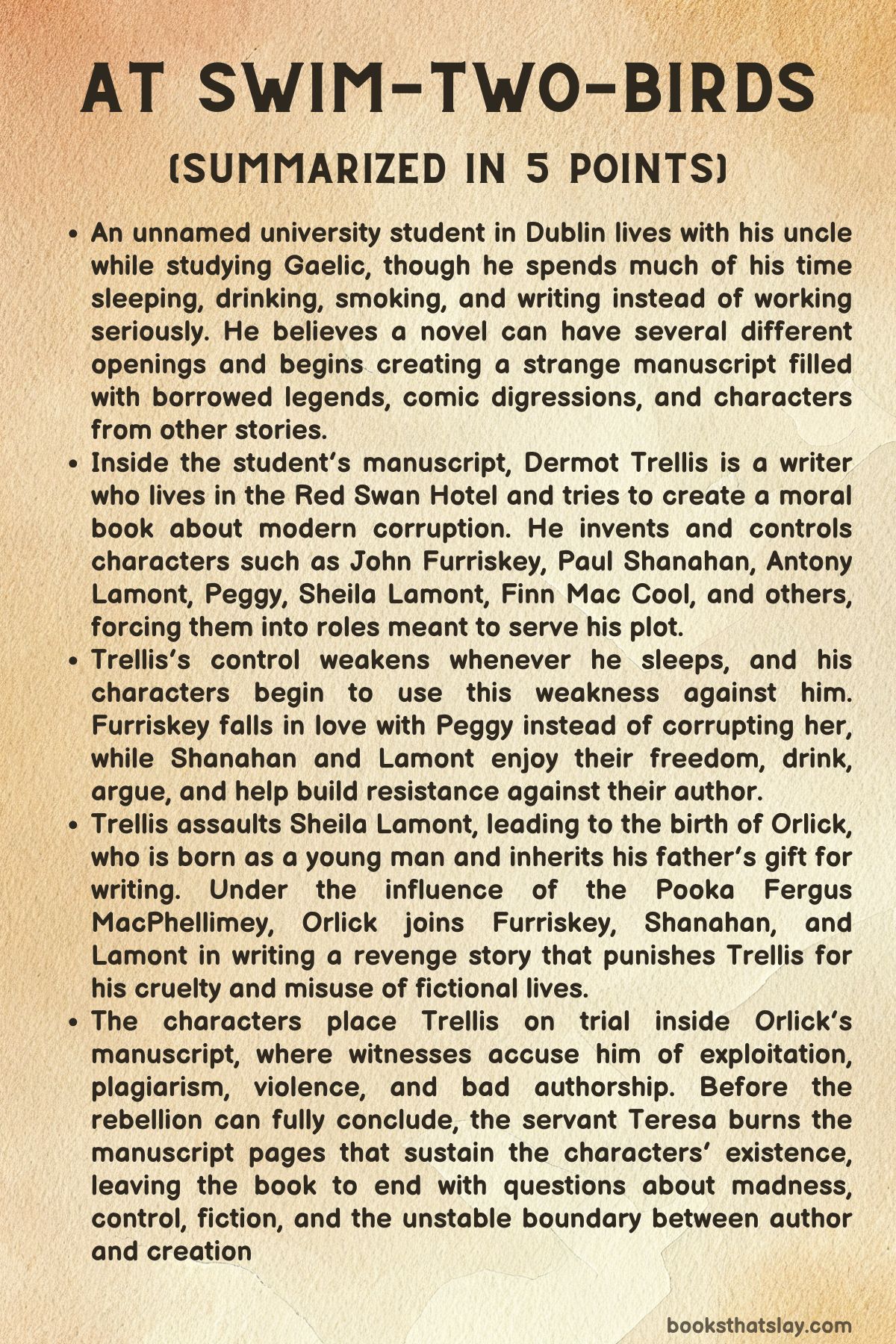
An unnamed university student lives with his uncle in Dublin while studying Gaelic. His ordinary life is small and domestic, but his imagination is crowded with theories about fiction, half-finished manuscripts, borrowed legends, and characters who seem more alive than the people around him.
At the beginning, he reflects on how a good book need not have a single opening. It may have several openings that are different from one another yet somehow connected.
To prove this, he offers three possible beginnings: one about a supernatural Pooka named MacPhellimey thinking about mathematics, another about John Furriskey being born as a fully grown man, and a third about the Irish hero Finn Mac Cool.
The student’s life with his uncle is tense. The uncle sees him as lazy, untidy, idle, and morally suspect.
The student prefers to stay in his room, smoke, think, sleep, and write. He claims to value a contemplative life, but his behavior often looks like avoidance.
His uncle wants discipline, religion, study, and respectable habits. The student wants privacy and freedom from interference.
Even when he asks for money to buy a German book for his studies, he uses the money for betting and drinking rather than scholarship. This contrast between claimed intellectual seriousness and actual irresponsibility becomes one of the book’s main comic patterns.
The student spends much of his time with friends such as Brinsley, Kelly, Donaghy, and others. They drink porter, discuss literature, recite poetry, visit pubs, go to the cinema, and wander through Dublin.
These student scenes are casual, talkative, and comic, but they also frame the strange fiction the narrator is writing. Brinsley becomes the main listener to the student’s manuscript.
He sometimes praises it, sometimes challenges it, and sometimes becomes confused by the many characters and nested stories. The student has bold ideas about fiction: he argues that characters should be reusable across books and that modern novels should openly acknowledge earlier literature.
Inside the student’s manuscript is Dermot Trellis, a writer who lives in the Red Swan Hotel. Trellis is unattractive, controlling, and morally self-important.
He spends most of his time in bed and plans to write a book exposing the corruption of modern society. Yet his moral mission is false from the start because he intends to include indecent material to attract readers.
Trellis creates characters and forces them to serve his designs. He keeps them in the hotel so that he can supervise them, especially because he only has power over them while awake.
When he sleeps, his control weakens, and the characters gain freedom.
One of Trellis’s creations is John Furriskey, who is born fully grown, with a body, clothes, memories, and a role already assigned to him. He is supposed to be a wicked seducer.
A supernatural voice tells him that his purpose is to behave badly and corrupt women. But Furriskey soon meets Paul Shanahan and Antony Lamont, who explain the strange condition of being fictional characters.
They know that authors use and misuse them, that they may be borrowed from one story to another, and that they are expected to obey roles they did not choose. Furriskey’s assigned nature does not match his developing desires, and he soon becomes one of the rebels against Trellis.
Trellis also brings in figures from Irish legend and popular fiction. Finn Mac Cool appears not as a solemn national hero but as a talkative, huge, somewhat foolish figure who recites long stories.
He tells the tale of Mad Sweeny, the cursed king who wanders Ireland after being punished by a priest. Sweeny’s story brings an older Irish literary world into the novel, full of poems, exile, sorrow, birds, trees, and religious punishment.
But even this ancient material is interrupted by Shanahan, Lamont, and Furriskey, who prefer jokes, beer, practical matters, and working-class poetry. Finn’s grandeur is constantly undercut by the impatience and bluntness of the other characters.
Trellis’s plan for Furriskey involves Peggy, a servant girl, whom Furriskey is meant to betray. Instead, Peggy tells him that Trellis loses power when asleep.
She has already suffered because of Trellis’s cruel plotting and the actions of other characters under his control. During their conversation, Furriskey and Peggy fall in love.
They decide to pretend obedience while secretly seeking freedom. Their relationship becomes part of the characters’ quiet revolt.
Rather than accept the immoral story Trellis has written for them, they try to build a life outside his control, even opening a confectionery shop during the long periods when Trellis is drugged into sleep.
Trellis then creates Sheila Lamont, Antony Lamont’s sister. He intends her to be a pure woman whose reputation Furriskey will destroy, but Trellis himself becomes attracted to her and assaults her.
Sheila becomes pregnant. This event exposes Trellis as a hypocrite: he claims to condemn sin while committing the very acts he attributes to his fictional villains.
His abuse of Sheila also leads to the birth of Orlick, a child who is both Trellis’s son and one of his fictional creations. The birth is attended by a strange group including the Pooka Fergus MacPhellimey, the Good Fairy, cowboys Slug Willard and Shorty Andrews, the poet Jem Casey, and Mad Sweeny.
Before Orlick’s birth, Fergus and the Good Fairy compete for influence over the child. Their rivalry is comic rather than noble.
Fergus wins the right to shape Orlick’s future through superior card-play, tricking the Good Fairy into giving up his claim. Orlick is born not as an infant but as a stocky young man.
He immediately speaks politely and understands more than a newborn should. Under Fergus’s influence, Orlick develops a spirit of rebellion.
Because he has inherited Trellis’s literary ability, Shanahan, Lamont, and Furriskey realize that he can be used as a weapon against his father. If Trellis can create and control characters through writing, perhaps his own son can write back against him.
While Trellis sleeps under the influence of drugs given by his characters, Furriskey and Peggy enjoy married life, Shanahan and Lamont drink and talk, and Orlick begins composing a new story in which Trellis is punished. The act of writing becomes a form of revenge.
At first, Orlick struggles to decide how best to attack Trellis through fiction. He tries grand religious scenes and moral accusations, but Shanahan and the others complain that he is taking too long or writing too fancily.
They want direct action. Their debates over style are comic but also meaningful: the characters are not merely rebelling against Trellis’s power; they are arguing over what kind of story should replace his.
Orlick’s revenge story grows increasingly violent and absurd. Trellis is given painful boils, attacked by the Pooka, thrown from windows, injured by falling ceilings, beaten, transformed, chased, and humiliated.
When Orlick temporarily leaves, the other characters continue the narration in cruder, faster styles, showing that authorship itself can be seized, shared, and damaged. Yet Orlick eventually decides that simple torture is not enough.
To raise the matter into a more serious literary form, he stages a trial in which Trellis must answer for his crimes against his characters.
At the trial, Trellis is placed before a court made up of fictional figures who have suffered under his control. The witnesses expose him as a plagiarist, exploiter, hypocrite, and careless maker.
Slug speaks of the distress of being forced into Trellis’s fiction. William Tracy, a writer of Westerns, accuses Trellis of borrowing characters and returning them damaged, even pregnant, thereby harming the artistic structure of his own work.
Shanahan complains of being misused and punished. A cow is granted speech and testifies about professional dissatisfaction.
Lamont speaks of Trellis’s assault on Sheila and the damage caused to his family. The trial becomes a comic fantasy of literary justice, where characters judge their author.
Meanwhile, the student’s real life continues. He fails in some duties, drinks too much, neglects his studies, and suffers minor humiliations.
His uncle criticizes him often, yet their relationship is not purely hostile. After the student passes his final examination with creditable success, the uncle congratulates him and gives him a secondhand watch as a gift.
The moment surprises the student because it reveals affection beneath the uncle’s lectures. This real-world scene contrasts with the violent rebellion inside the manuscript.
The uncle may be fussy and moralizing, but he is not simply a villain. He is human, limited, and capable of kindness.
The rebellion against Trellis ends unexpectedly. Teresa, a servant at the Red Swan Hotel, enters Trellis’s room to tidy it.
Finding loose papers scattered on the floor, she uses them to light the fire. These papers are the manuscript pages that sustain the existence of Furriskey and his companions.
As they burn, the fictional world that depended on them collapses. Trellis returns, weak and disordered, but alive.
The characters’ planned judgment is cut short not by moral resolution but by accident, domestic routine, and fire. The destruction of the manuscript suggests that fictional existence is fragile, dependent on paper, authors, readers, and chance.
The book closes by questioning sanity, madness, order, and invention. Trellis may be mad, or he may simply be one more figure trapped by the logic of stories.
Sweeny, Hamlet, Trellis, and others suggest that the line between sense and madness is unstable. People may be driven into obsession by small things, strange ideas, numbers, cloth, bicycles, literary theories, or private grievances.
The student’s own book remains unfinished, fractured, and comic, yet that incompleteness is part of its design. At Swim-Two-Birds ends as a novel about writing, rebellion, laziness, control, and the unruly life of invented people.
Characters
The Unnamed Student
The unnamed student is the book’s central consciousness and the maker of the nested fiction. He lives in Dublin with his uncle while studying Gaelic, but his academic life is marked by delay, drinking, sleep, and elaborate self-justification.
He likes to present himself as a thinker, a writer, and a man suited to contemplation, but the book repeatedly exposes the gap between his intellectual theories and his daily habits. His claim that fiction can have several openings and that characters can move between books shows genuine inventiveness, yet his personal discipline is poor.
He loses papers, avoids responsibilities, spends study money on gambling, and lets drink take over his schedule. Still, he is not merely idle.
His imagination is energetic, comic, and radical. Through him, the book questions what a novel can be and whether an author has any right to dominate fictional lives.
The Student’s Uncle
The student’s uncle represents domestic authority, Catholic respectability, discipline, and conventional morality. He is often comic because of his long lectures, suspicious questions, and obsession with his nephew’s laziness.
He disapproves of the student’s room-bound habits and doubts that smoking, sleeping, and private thinking count as study. Yet he is more than a flat scold.
His interest in religion, music, public meetings, and proper behavior makes him a recognizable figure of Dublin middle-class life. His relationship with the student is strained, but not loveless.
When the student passes his examination, the uncle congratulates him and gives him a secondhand watch, revealing pride and affection beneath his constant criticism. In the book, he functions as both an obstacle to the student’s freedom and a reminder that ordinary family life has its own emotional force.
Brinsley
Brinsley is the student’s friend, literary listener, drinking companion, and occasional critic. He hears sections of the student’s manuscript and responds with a mixture of admiration, confusion, and challenge.
His praise encourages the student, but his disagreements also show that the student’s theories about fiction are not universally accepted. Brinsley is practical enough to be distracted by horse racing and social pleasures, yet interested enough in literature to debate structure, character, and style.
His inability to keep Furriskey, Shanahan, and Lamont clearly separated later becomes comic evidence of how crowded and unstable the student’s fictional world has become. Brinsley also interacts with the uncle, who hopes he may consider a religious future, making him a bridge between student life, literary talk, and respectable expectation.
Kelly
Kelly is one of the student’s drinking companions and part of the social world that competes with academic discipline. He appears in memories of pub visits and later in nighttime walks through Dublin.
His presence helps establish the student’s habits: drinking porter, staying out, talking, drifting through the city, and shaping life around companionship rather than duty. Kelly is not explored as deeply as Brinsley, but he matters because he belongs to the student’s informal education.
Through people like Kelly, the student learns the rhythms of pubs, streets, talk, and urban idleness. He also helps show how the student’s life outside the house is freer, messier, and more attractive than the disciplined future imagined by the uncle.
Donaghy
Donaghy appears as a friend of Brinsley and another member of the student’s Dublin circle. He talks with the student about literature, joins him in drinking, and offers physical observations that puncture the student’s self-image.
When he comments on the student’s stale smell, and when Brinsley notes the student’s growing paunch, the book turns the student’s supposed contemplative lifestyle into something bodily and comic. Donaghy’s role is small but useful: he belongs to the world of frank male friendship, where literary talk exists beside insult, alcohol, and ordinary social judgment.
He helps expose the cost of the student’s habits without turning the scene into moral instruction.
Kerrigan
Kerrigan is a minor acquaintance who leads the student toward Michael Byrne’s house, where talk and debate continue in another social setting. He represents the wider network of students and intellectual companions surrounding the narrator.
Though not given extended development, Kerrigan helps move the student from private writing and domestic conflict into a communal world of discussion. His presence shows that the student’s mind is shaped not only by books but also by talk among peers.
In the book’s structure, such minor companions are important because conversation often replaces action, and social movement through Dublin becomes part of the rhythm of narration.
Michael Byrne
Michael Byrne is associated with a house where scholarly and other debates take place. His home gives the student a setting in which he can discuss sleep and introduce Trellis’s addiction to bed.
Byrne’s role is not large, but his house matters as a site of talk, performance, and intellectual display. In the book, characters often exist through the conversations they host or provoke, and Byrne belongs to that pattern.
His environment allows the student to read aloud, test his ideas, and move his manuscript into public hearing. He is less a psychological portrait than a social function: he provides a room where the student’s fiction can become an event among listeners.
Mr. Corcoran
Mr. Corcoran is an elderly acquaintance of the uncle and a comic figure of respectable adult society. He arrives with the uncle, speaks about his own studious son Tom, and brings a gramophone that leads to a domestic scene of music, fuss, sneezing, and physical embarrassment.
Corcoran mirrors the uncle’s world of adult concerns, social visits, and polite conversation, but he also makes that world absurd. His presence helps drive the student back toward his room and then out into the streets.
Later, Corcoran is present when the student’s uncle congratulates him on passing his exams. As a result, he becomes part of the social ritual through which the student is briefly accepted by the older generation.
Tom Corcoran
Tom Corcoran is mentioned rather than fully dramatized, but he is important as a contrast to the student. Mr. Corcoran complains that Tom is fussy and studious, which places him at the opposite end of the behavioral scale from the narrator.
Where the student avoids work and hides behind literary theory, Tom appears as excessively dutiful or academically absorbed. His function is comic comparison.
The older men measure young people through habits of study, religion, and respectability, yet neither the lazy student nor the overly studious Tom fully satisfies them. Tom’s brief presence by reference helps broaden the social field of the book beyond the narrator’s own household.
Verney
Verney is the horse-racing tipster who sends the student advice by letter. He represents false expertise, gambling culture, and the student’s willingness to divert money from study into chance.
His letter apologizes for bad advice while encouraging clients to send more money, which makes him both comic and faintly predatory. Verney never needs to appear in person because his influence works through text, just as many characters in the book exist through documents, manuscripts, letters, and quotations.
He helps connect the student’s literary irresponsibility with financial irresponsibility. The German book money becomes betting money, and Verney’s tips help turn scholarly purpose into pub-centered adventure.
Dermot Trellis
Dermot Trellis is one of the book’s most important figures because he is both a character and an author within the student’s manuscript. He lives in the Red Swan Hotel, spends much of his life in bed, and attempts to write a moral book about the corruption of modern society.
His moralism is dishonest. He wants to condemn indecency while using it to attract readers, and he forces his characters into degrading roles while imagining himself righteous.
Trellis’s greatest flaw is control. He creates people, confines them, assigns them identities, and expects obedience.
Yet his dependence on sleep makes him vulnerable. When he sleeps, his characters gain freedom, drug him, build lives of their own, and eventually use his son Orlick’s writing against him.
Trellis is comic, grotesque, tyrannical, and pathetic. In At Swim-Two-Birds, he becomes a satirical image of the author as bully.
John Furriskey
John Furriskey is born as an adult and given a corrupt role before he has any real experience. Trellis intends him to be a seducer and villain, but Furriskey does not simply obey.
His first problem is existential: he must understand hunger, identity, memory, and purpose despite having just come into being. After meeting Shanahan and Lamont, he learns that fictional characters can be trapped by authors and forced into roles.
His love for Peggy marks his departure from Trellis’s design. Instead of betraying her, he marries her and joins the revolt against their maker.
Furriskey is comic because of the absurdity of his birth, but he also raises serious questions about freedom. He shows that a character written for vice may desire decency, companionship, and self-direction.
Peggy
Peggy is a servant girl created or used within Trellis’s fiction, and she becomes central to the characters’ resistance. Trellis intends her to be a victim in Furriskey’s assigned story, but she possesses knowledge and agency.
She understands Trellis’s weakness: he loses power when asleep. By sharing this with Furriskey, she helps transform him from obedient villain into partner and rebel.
Her relationship with Furriskey offers one of the book’s clearest alternatives to authorial cruelty. Together they create a practical life, even running a confectionery business while Trellis remains drugged.
Peggy’s role also shows how female characters are often endangered by the plots male authors impose on them. Her survival and marriage to Furriskey resist that imposed pattern.
Paul Shanahan
Paul Shanahan is one of the liveliest fictional characters in the book. He is talkative, practical, comic, and skeptical of high literary style.
He enjoys drink, working-class poetry, anecdote, and blunt expression. Shanahan often interrupts grand or ancient material, especially Finn’s long recitations, with more modern and earthy preferences.
His admiration for Jem Casey shows his preference for poetry rooted in labor, porter, and ordinary speech. During Orlick’s writing campaign against Trellis, Shanahan repeatedly pushes for speed, clarity, and direct punishment rather than elaborate prose.
He is also eager to present himself as talented and important, even when his claims are absurd. Shanahan’s comic energy makes him a major force in the rebellion against Trellis and a strong voice for popular taste.
Antony Lamont
Antony Lamont is a fictional character and the brother of Sheila Lamont. He is closely associated with Shanahan and Furriskey, often participating in their conversations, complaints, drinking, and plans.
Lamont can be confused with the others by outside listeners, but the book gives him a distinct emotional stake through Sheila. Trellis’s assault on his sister gives Lamont a personal reason to hate him and to support the trial.
In the revenge manuscript, Lamont contributes to the shared authorship that punishes Trellis, even taking over narration briefly when Orlick is absent. He is less dominant than Shanahan but important as part of the collective voice of the mistreated characters.
His presence emphasizes that Trellis’s crimes affect not isolated individuals but a whole network of fictional lives.
Sheila Lamont
Sheila Lamont is created by Trellis as a beautiful and refined woman meant to serve his plot, but she becomes the victim of his hypocrisy. Trellis intends her purity to be endangered by Furriskey, yet he himself assaults her.
Her pregnancy and the birth of Orlick are central to the later rebellion. Sheila exposes the violence hidden inside Trellis’s moral project: he creates women not as free beings but as instruments for male plots, then violates the very purity he claims to defend.
Though she does not speak as extensively as the male characters, her importance is enormous. Through Sheila, the book turns authorial control into bodily harm and makes Trellis answerable not only for bad art but for cruelty.
Orlick
Orlick is the son of Trellis and Sheila, born as a young man rather than an infant. His birth is comic and strange, but his role becomes structurally crucial.
He inherits Trellis’s power of literary composition, yet he is shaped by Fergus MacPhellimey’s influence toward rebellion. This makes him the perfect instrument against his father: he can write Trellis into suffering just as Trellis wrote others into suffering.
Orlick is thoughtful about style and structure, sometimes too much so for Shanahan’s taste. He believes a writer must prepare a fall by first lifting the victim, which shows his concern for literary form.
In At Swim-Two-Birds, Orlick turns authorship into inherited power, revenge, and moral counterattack.
Finn Mac Cool
Finn Mac Cool is the legendary Irish hero brought into the student’s manuscript, but he is not treated with simple reverence. He is physically grand, connected to ancient Irish tradition, and capable of long poetic recitations, especially concerning Sweeny.
At the same time, he is comic, slow, and often interrupted by more modern characters who lack patience for his heroic style. Finn represents inherited national literature, oral tradition, and mythic authority.
The book both honors and mocks him. His speech carries the weight of old Ireland, but his listeners are often more interested in porter, jokes, and plain talk.
This tension makes Finn a central figure in the book’s treatment of literary inheritance.
Sweeny
Sweeny, or Mad Sweeny, is the cursed king whose story is told through Finn’s recitations and who later joins the strange procession to the Red Swan Hotel. He is punished by a priest, forced into wandering, associated with birds, trees, exile, and sorrow.
His lyrical suffering contrasts with the comic interruptions around him. When he appears in person, disheveled, wounded, and partly feathered, the tragic dignity of his legend is lowered into the practical comic world of the other characters.
Yet he retains a real aura of loneliness. Sweeny represents the old literary theme of madness, exile, and spiritual punishment, while also becoming one more displaced figure wandering through a chaotic modern fiction.
Fergus MacPhellimey, the Pooka
Fergus MacPhellimey is a supernatural Pooka and one of the book’s most memorable comic spirits. He begins as a strange being thinking about mathematics, later becomes involved in Sheila’s childbirth, and wins influence over Orlick through card-play.
Fergus is mischievous, argumentative, practical, and capable of magical torment. His rivalry with the Good Fairy is comic because matters of spiritual influence are settled through gambling and bargaining.
Once Orlick comes under his influence, Fergus helps shape the revolt against Trellis. In Orlick’s revenge story, the Pooka becomes the agent of physical punishment, inflicting pain, humiliation, and disorder.
He represents supernatural misrule, comic evil, and the pleasure of turning authority upside down.
The Good Fairy
The Good Fairy is a tiny supernatural figure who visits Fergus to discuss Sheila’s unborn child. Though supposedly aligned with goodness, he is fussy, argumentative, class-conscious, and easily drawn into absurd debate.
His conversations with Fergus cover spirits, kangaroos, odd and even numbers, tails, politics, and practical inconveniences. He loses his claim over Orlick through debt after a card game, showing that moral influence in the book can be decided by petty bargaining rather than noble principle.
His fear for his reputation makes him comic. The Good Fairy’s role is to parody simple moral categories: goodness here is not majestic or pure, but anxious, talkative, and vulnerable to manipulation.
Jem Casey
Jem Casey is the working-class poet praised by Shanahan as a poet of the people. His verse celebrates labor, porter, and the everyday life of working men.
He stands in contrast to Finn’s ancient poetic tradition and Sweeny’s sorrowful lyricism. Casey’s poetry is comic, direct, and social rather than grand or mythic.
His political opinions also bring class tension into the book, especially in his argument with the Good Fairy about workers and social change. Casey is important because he expands the book’s idea of literature.
Poetry is not only ancient heroic speech or refined art; it can come from labor, pubs, and ordinary speech. Through Casey, the book gives popular culture a loud and confident voice.
Slug Willard
Slug Willard is one of the cowboy figures who joins Fergus, the Good Fairy, Shorty Andrews, Jem Casey, and Sweeny on the way to the Red Swan Hotel. He comes from the world of Western romance, showing how freely the book mixes genres and literary traditions.
Slug’s presence in Ireland is absurd, but that absurdity is central to the book’s method. He is later a witness against Trellis, speaking about the mental suffering caused by being made a character in another writer’s work.
Slug therefore moves from comic genre intrusion to evidence of authorial abuse. He represents borrowed fictional material that refuses to remain passive.
Shorty Andrews
Shorty Andrews is Slug Willard’s companion and another cowboy displaced into the Irish fictional world. He searches for a lost steer, argues with the Good Fairy, and joins the journey to the Red Swan Hotel.
Like Slug, Shorty brings the language and habits of Western fiction into a Dublin-Irish comic universe. His role is smaller than Slug’s, but he matters because he strengthens the book’s sense that genres are porous.
Cowboys, fairies, Irish heroes, poets, and hotel servants all occupy the same fictional plane. Shorty’s presence helps make the student’s theory of interchangeable characters visible in action.
William Tracy
William Tracy is an author of Western romances and a significant figure in the book’s satire of literary borrowing. Trellis draws on Tracy’s work and is later accused of plagiarizing his characters and damaging his plots.
Tracy’s testimony at Trellis’s trial is comic but pointed. He complains that a character borrowed from him was returned pregnant, forcing him to invent extra material that harmed the artistic integrity of his own story.
Through Tracy, the book turns plagiarism and intertextual borrowing into a legal and moral problem inside fiction itself. He is both a mocked popular writer and a wronged creator seeking professional respect.
Timothy Danaos
Timothy Danaos is one of the two Greek scullions from another novel who nearly lure Shanahan and Lamont away into a different story. Later, he appears as part of Trellis’s defense at the trial.
His name alludes to classical tradition, but the book places him in comic, degraded circumstances rather than noble antiquity. Timothy represents another borrowed literary world entering the student’s manuscript.
His presence shows that no tradition is safe from comic lowering: Greek names, Western cowboys, Irish heroes, and modern Dublin figures all become material for the same unruly fiction.
Dona Ferentes
Dona Ferentes is paired with Timothy Danaos and shares a similar function. As a Greek scullion from another fictional source, he helps widen the book’s field of borrowed characters.
His presence also contributes to the legal parody of Trellis’s trial, where even his defense is handled by figures from a strange, unstable literary background. Like Timothy, Dona is less psychologically developed than symbolic.
He represents the book’s comic treatment of classical references and its refusal to keep literary worlds separate. His role reinforces the student’s belief that characters can cross from one book into another.
Teresa
Teresa is the servant at the Red Swan Hotel, and her small domestic action has enormous consequences. She enters Trellis’s room to tidy it and uses loose manuscript pages to light the fire.
Without intending to, she destroys the papers that sustain Furriskey and his companions. Teresa is not a grand judge, rebel, or supernatural agent; she is a worker performing an ordinary task.
Yet that ordinary act cuts short the characters’ revolt and restores Trellis to a weakened but surviving state. Her role shows the power of accident in the book.
Literature may seem governed by authors, characters, and elaborate plots, but it can also be ended by housekeeping.
The Cleric Moling
Moling appears in one of Orlick’s early attempts to write a punitive story about Trellis. He enters Trellis’s room and seems ready to arrange a moral or religious confrontation.
His role is brief because Orlick abandons that draft, but Moling matters as part of the book’s comic trial-and-error approach to writing. He represents a possible version of Trellis’s punishment framed through religious authority.
The fact that Orlick rejects or revises this approach shows his struggle to find the right literary mode. Moling’s brief appearance also connects Trellis’s guilt with the older pattern of sin, judgment, and spiritual consequence.
The Saint in Orlick’s Draft
The saint appears in another abandoned version of Orlick’s revenge story. Trellis sees him in the garden, attacks him, and tears up his prayers, leading to a curse.
This figure functions as a device for making Trellis visibly wicked before punishing him. Like Moling, the saint is less an independent character than a sign of one possible literary direction.
Orlick tries to make Trellis’s guilt grand and religious, but the scene feels too artificial, so he changes course. The saint’s brief presence reveals how the characters are learning to write by experimenting with inherited forms of moral storytelling.
The Twelve Kings
The twelve kings preside over Trellis’s trial, each seated on a throne and drinking porter. They transform judgment into comic ceremony.
Their royal status suggests grandeur and authority, while their drinking undercuts that grandeur. As the trial continues, some become drunk and inattentive, making the court both impressive and ridiculous.
The kings are important because they embody collective fictional judgment. Trellis is no longer the sole authority; the created world has assembled its own court.
Yet this court is not pure justice. It is noisy, comic, and unstable, matching the book’s refusal to separate seriousness from absurdity.
The Short-Horn Cow
The short-horn cow becomes a witness at Trellis’s trial after the Pooka grants her speech. Her testimony is comic because an animal speaks in a legal setting about dissatisfaction with her professional relationship to Trellis.
Yet the joke has force. If even a cow can complain about how she has been used in fiction, Trellis’s abuse of authorial power appears broader than human suffering alone.
The cow expands the trial’s satire by making all created beings potential witnesses against their maker. Her presence also mocks courtroom seriousness and literary realism at the same time.
Linchehaun
Linchehaun appears within the tale of Sweeny. He is Sweeny’s friend and later captures him after revealing painful news about Sweeny’s family.
His role belongs to the older legendary layer of the book. Linchehaun helps deepen Sweeny’s condition by bringing news of loss and by physically drawing him back from wandering freedom.
He is part companion, part captor, and part messenger of grief. Though he appears only within the embedded legend, he helps make Sweeny’s story one of exile, broken ties, and the painful pull of human relationships.
Fer Caille
Fer Caille appears in Sweeny’s wanderings as a figure whom Sweeny befriends. Their companionship is temporary because Fer Caille must go to the place where he will die.
His brief role adds to the sadness of Sweeny’s legendary world, where meetings are fragile and separation is expected. Fer Caille’s presence emphasizes mortality and impermanence.
In the larger book, he is one of many figures who enter briefly, speak to a theme, and disappear, contributing to the layered sense that stories are filled with partial lives.
Sergeant Craddock
Sergeant Craddock appears in Lamont and Shanahan’s discussion of jumping. He is remembered as a famed long jumper who proves himself in a Gaelic League Sports competition after doubts about whether he is an English spy.
His role is comic and anecdotal, but it also connects physical performance, Irish identity, suspicion, and public reputation. Craddock belongs to the book’s habit of allowing digressions to become mini-stories.
He does not drive the plot, but he enriches the social and comic world by showing how casually characters move from mythic Sweeny to local sporting legend.
Bagenal
Bagenal is the champion jumper whom Sergeant Craddock defeats. His role is brief, but he functions as the standard against which Craddock proves himself.
Like many minor names in the book, Bagenal gives comic specificity to a digression. The jumping anecdote turns from explanation into mock-heroic sporting history, and Bagenal’s defeat helps complete that miniature tale.
He belongs to the book’s broader pattern of treating small anecdotes with exaggerated importance.
Bartley Madigan
Bartley Madigan appears in a story told by Shanahan about injury and long-term suffering. He hurts his knee, nearly dies, and spends many years paralyzed.
The anecdote is comic in its excessive detail and casual delivery, but it also reflects the book’s interest in bodies as vulnerable, ridiculous, and unpredictable. Bartley is not part of the central plot, yet he matters as a sample of Shanahan’s storytelling style.
Through figures like him, speech itself becomes a source of entertainment, and the book’s world fills with remembered cases, odd facts, and social lore.
Teresa’s Knock Visitor: Trellis Returned
The disheveled Trellis who returns after Teresa burns the manuscript pages can be read as the damaged remainder of the author-character after his fictional world has nearly destroyed him. Though he is still Dermot Trellis, this returning figure is changed: damp, discolored, exhausted, and ill.
He is no longer the confident controller of fictional lives. His return after the burning of the pages shows how dependent the rebellion was on written material.
It also leaves him in an ambiguous state: not fully punished, not restored to dignity, and not morally redeemed. He survives, but survival is not victory.
Themes
Authorship and the Revolt of Created Characters
The book treats authorship as a form of power that can become abusive when the writer sees characters as property rather than beings with inner lives. Trellis creates Furriskey, Peggy, Sheila, Shanahan, Lamont, and others to serve his moral and sensational plans, but his creations gradually recognize the injustice of their condition.
They are not content to remain tools inside his plot. Their rebellion becomes a comic fantasy of characters demanding rights against their author.
Orlick’s writing against Trellis pushes this idea further: the created son inherits the father’s creative power and uses it as revenge. This reversal turns fiction into a battlefield where control can shift from author to character.
At Swim-Two-Birds makes this struggle funny, but the joke has depth. It asks whether stories are ever fully controlled by their makers, and whether literary characters, once imagined, develop a kind of independence.
Trellis’s failure suggests that writing is not simple command. A character forced into a false role may resist through desire, speech, love, or counter-narration.
The Collision of Literary Traditions
Ancient Irish legend, student realism, Western adventure, fairy lore, classical reference, working-class poetry, religious narrative, and courtroom drama all occupy the same fictional space. This mixture creates much of the book’s comedy, but it also challenges the idea that literature must remain pure, orderly, or separated by genre.
Finn Mac Cool and Sweeny bring heroic and medieval Irish materials into the story, yet their dignity is repeatedly interrupted by Shanahan’s jokes, Casey’s porter poems, and the practical complaints of fictional cowboys. The result is not simple mockery of tradition.
Older literature is treated with both fascination and irreverence. The book keeps returning to poems, legends, and inherited forms, but it refuses to place them beyond laughter.
The modern Dublin world does not replace the ancient world; it talks over it, mishears it, drinks beside it, and reshapes it. This approach suggests that literary tradition is alive only when it can be reused, challenged, parodied, and made strange again.
The past is not a museum here. It is raw material for new comic invention.
Laziness, Discipline, and the Comic Life of the Student
The student’s laziness is one of the book’s funniest and most revealing subjects. He presents idleness as contemplation and artistic preparation, but the details often expose a less flattering reality: he sleeps late, avoids study, drinks heavily, neglects hygiene, loses papers, and misuses money meant for books.
His uncle’s criticism may be tiresome, but it is not entirely wrong. At the same time, the student’s laziness is also linked to creativity.
His room-bound life produces the strange manuscript that gives the book its wild structure. The tension lies in whether his imagination excuses his irresponsibility.
The book does not answer simply. Passing his examination shows that the student is not a total failure, and the uncle’s gift of a watch suggests that social discipline and family approval still matter.
Yet the student’s creative life remains rooted in delay, drift, and avoidance. The theme is comic because both sides are flawed.
The uncle’s moral seriousness can be narrow and pompous, while the student’s freedom can become self-indulgence. Their conflict turns ordinary domestic life into a debate over art, work, youth, and respectability.
Madness, Order, and the Fragility of Sense
Madness appears through Sweeny’s curse, Trellis’s possible insanity, the student’s layered manuscript, and the book’s final reflections on how small things can unsettle the mind. The story repeatedly asks what separates rational order from absurdity.
Trellis seems mad because he tries to control fictional beings as if his invented world were a private kingdom. Sweeny is mad because a religious curse turns him into a wandering, birdlike exile.
The student may not be mad, but his fiction creates a world where authors father characters, fairies debate kangaroos, cowboys wander through Ireland, and a cow testifies in court. Instead of treating madness only as illness, the book uses it to question systems of order.
Literature, religion, scholarship, law, and family authority all claim to organize life, yet each becomes comic and unstable. The burning of the manuscript pages shows how fragile fictional order is: an entire rebellion can vanish through a servant’s practical act.
Sense in the book is always temporary. It depends on paper, memory, sleep, talk, and accident, any of which may fail.