Atonement by Ian McEwan Summary, Characters and Themes
Atonement by Ian McEwan is a novel about imagination, guilt, class, love, war, and the heavy price of a single false accusation. Set first in an English country house in 1935 and later against the violence of World War II, it follows Briony Tallis, a young girl whose desire to understand adult life leads her to misread what she sees.
Her mistake destroys the lives of Cecilia Tallis and Robbie Turner, whose love is already complicated by class difference. The novel becomes not only a story of lost love, but also a study of storytelling itself: what fiction can repair, what it can confess, and what it can never truly undo.
Summary
Atonement begins in 1935 at the Tallis family estate in England. Briony Tallis is thirteen years old, imaginative, proud, and determined to become a writer.
Her older brother Leon is returning home for a visit, and Briony prepares a play to perform in his honor. She enlists her visiting cousins, Lola and the twins Jackson and Pierrot, but the rehearsals quickly frustrate her.
Briony wants order, obedience, and praise. Her cousins do not fit the world she has created in her mind, and when Lola begins to take attention away from her, Briony feels that her own creation is slipping out of her control.
Meanwhile, Briony’s older sister Cecilia moves restlessly through the house and grounds. She has recently returned from Cambridge and is uncertain about her future.
Her relationship with Robbie Turner, the son of the Tallis family’s cleaning woman, is tense and awkward. Robbie also attended Cambridge with the financial help of Cecilia’s father, Jack Tallis, and now hopes to become a doctor.
Though Cecilia and Robbie grew up together, class difference and adult self-consciousness have created distance between them.
One afternoon, Cecilia goes to fill a valuable family vase at the fountain. Robbie appears, and their strained conversation leads to an accident: part of the vase breaks and falls into the water.
Robbie begins to remove his clothes to retrieve the pieces, but Cecilia insists on doing it herself. She undresses, dives into the fountain, collects the fragments, and walks away without explanation.
From a window, Briony sees this scene but does not understand it. In her young mind, Robbie appears to hold some strange power over Cecilia.
The incident becomes the first serious misunderstanding that shapes Briony’s imagination that day.
Leon arrives with his friend Paul Marshall, a wealthy heir to a chocolate business. Cecilia finds Paul dull and self-important, though her mother Emily wonders whether he might be a suitable husband for Cecilia.
Paul soon meets Lola and the twins. His attention to Lola is unsettling, especially as he offers the children chocolate and compliments Lola.
Emily, suffering from one of her frequent migraines, remains mostly upstairs, listening to the house and thinking about her children, her absent husband, and the tensions created by the arrival of her sister’s children.
Briony, upset by the failure of her play, retreats to the island temple on the estate. She beats at nettles and imagines herself casting off childhood.
She wants to be grown up, serious, and important. This desire to appear mature becomes dangerous because it encourages her to trust her interpretations even when she lacks experience.
She wants the world to contain dramatic secrets, and when real adult complexity appears before her, she reshapes it into a story she can understand.
Robbie, shaken by the fountain incident, realizes that he is attracted to Cecilia. He writes several drafts of a letter to her.
One is sincere and emotional; another, written in frustration and not intended to be sent, contains crude sexual language. By mistake, Robbie gives Briony the obscene version and asks her to take it to Cecilia.
Briony reads it before delivering it. Shocked by its sexual content, she concludes that Robbie is dangerous.
When she tells Lola about the letter, Lola agrees that Robbie sounds like a threat.
Cecilia reads the letter and realizes that Robbie’s feelings match her own. Before dinner, Robbie arrives at the house and meets Cecilia in the library.
He explains that he sent the wrong letter, but the explanation leads to a confession of love. Their suppressed feelings surface, and they begin a physical encounter.
Briony walks in and sees Robbie pressed against Cecilia. Already influenced by the letter and the fountain scene, Briony believes she has interrupted an assault.
Cecilia’s cold reaction confuses her, but Briony’s conviction hardens. She now sees herself as Cecilia’s protector and Robbie as a villain.
At dinner, the household is tense. Robbie and Cecilia try not to reveal what has happened between them.
Briony watches Robbie with suspicion. Lola’s injuries are discussed; she has scratches and bruises, supposedly caused by the twins.
Paul also has a scratch on his face, which he awkwardly explains. Then a note is discovered: the twins have run away because they want to go home.
The adults and older children organize search parties across the estate.
During the search, Briony moves through the darkness while thinking about Robbie, Cecilia, and her own supposed maturity. Near the island temple, she sees two figures.
One runs away, leaving Lola behind. Lola is dazed and has been sexually assaulted.
Briony does not clearly see the attacker, and Lola does not name him. Yet Briony asks whether it was Robbie, and her own question soon becomes certainty.
The letter, the fountain scene, and the library encounter combine in her mind into a false but powerful narrative. She tells the others that Robbie attacked Lola.
The police arrive, and Briony repeats her accusation. She also takes Robbie’s letter from Cecilia’s room and shows it as evidence.
Emily and the police accept the idea that Robbie is guilty. Cecilia tries to defend him, insisting that her encounter with him was consensual, but no one listens.
When Robbie returns after finding the missing twins, the police arrest him. Cecilia runs to him before he is taken away, and Robbie’s mother cries out that they are liars.
The false accusation separates Robbie and Cecilia and destroys the future they had only just begun to imagine.
Years pass. Robbie spends more than three years in prison before being released early on the condition that he join the army during World War II.
He is sent to France, where he becomes separated from his unit during the German advance. Wounded by shrapnel, he walks toward Dunkirk with Corporal Mace and Corporal Nettle.
The journey is brutal. Robbie witnesses dead civilians, terrified refugees, ruined villages, and broken soldiers.
His wound grows worse, and hunger, exhaustion, and pain make him increasingly feverish.
Throughout this march, Robbie clings to memories of Cecilia. She cut herself off from her family after his arrest and became a nurse in London.
They wrote letters during his imprisonment, using careful literary references to express love under prison censorship. They met only briefly before he went to France, but that meeting renewed his hope.
Cecilia’s repeated instruction to him is simple: come back. Robbie tries to survive for her, though he cannot forgive Briony.
He tries to understand why she lied, remembering moments from her childhood and wondering whether jealousy, confusion, or fantasy led her to accuse him. Still, the damage is too great for easy forgiveness.
As Robbie reaches Dunkirk, the evacuation is chaotic. Soldiers fight, drink, and wait desperately for boats.
Robbie becomes more ill and confused. He dreams of clearing his name and returning to Cecilia, but his body is failing.
His memories of war mix with memories of the night that ruined him. He asks Nettle to wake him when the boats arrive.
Briony, now eighteen, is training as a nurse in London. She has refused Cambridge and chosen hard practical work, though she is unsure whether this is service, punishment, or escape.
The discipline of the hospital leaves little room for imagination. She writes in her journal but has set aside much of her fiction.
She tries to contact Cecilia, but Cecilia refuses to meet her. Briony now understands that her testimony was false and that Robbie’s life was ruined by her certainty.
Her guilt deepens when she learns that Paul Marshall is marrying Lola. Briony suspects that Paul, not Robbie, was Lola’s attacker.
She attends the wedding and stands silently when given the chance to object. Her silence shows that even now, she lacks the courage to expose the truth fully.
Lola notices her, but the marriage goes ahead, protecting Paul behind wealth, respectability, and Lola’s legal position as his wife.
Briony later visits Cecilia. The meeting is tense.
Cecilia has rejected the Tallis family and is still loyal to Robbie. Robbie appears, alive and on leave in Briony’s version of events, and reacts with anger at seeing her.
Briony apologizes and admits that she was wrong. Cecilia and Robbie tell her what she must do: inform the family, give a formal legal statement, and write an account of why she lied.
Briony also tells them that Paul was the real attacker. This news horrifies them because Paul’s marriage to Lola makes justice almost impossible.
Briony leaves them, planning to revise her writing into an act of atonement.
The final revelation comes decades later. Briony is now seventy-seven, a famous writer, and has been diagnosed with vascular dementia.
She visits the Imperial War Museum and reflects on the documents she has used for her final novel. Paul and Lola are still alive, wealthy, respected, and litigious, meaning Briony cannot safely publish the truth while they live.
She returns to the old Tallis estate, now a hotel, for her birthday celebration. Her family performs the play she wrote as a child, forcing her to face the girl she once was.
Briony then reveals that the reunion she gave Robbie and Cecilia never happened. Robbie died at Dunkirk before he could be evacuated.
Cecilia died later in London during the Blitz. They never lived together, never received Briony’s apology, and never saw justice.
The version in which Briony meets them both and promises to repair the legal record is her invention. Her novel gives them the ending life denied them.
Yet she knows fiction cannot truly make amends. Her act of writing is both confession and failure: it preserves the truth, gives the lovers imagined happiness, and admits that nothing can restore what her lie destroyed.
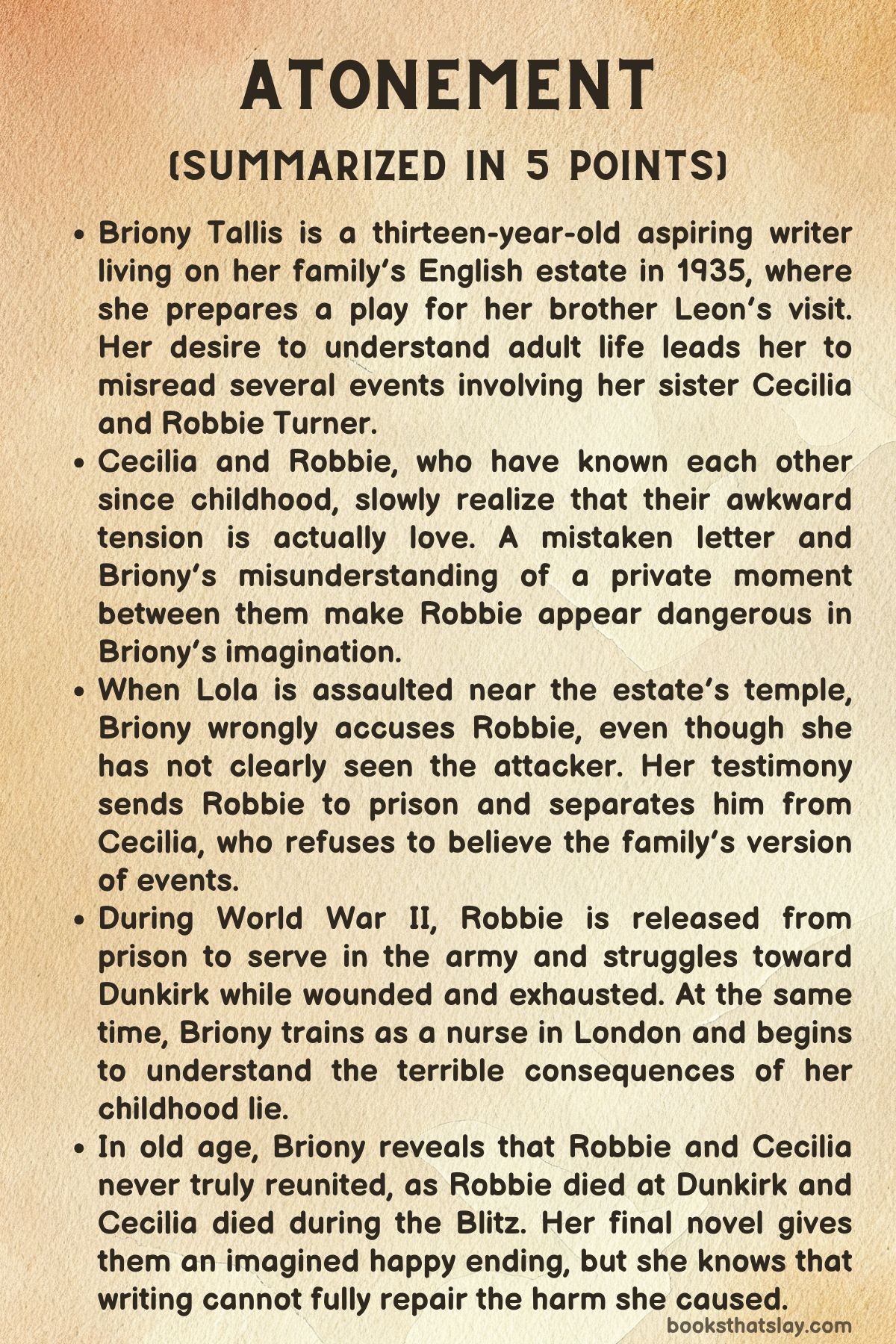
Characters
Briony Tallis
Briony Tallis is the central consciousness of the book and its most troubling figure because her imagination is both her gift and her moral danger. As a thirteen-year-old, she sees herself as a writer and longs for a life filled with secrets, drama, and meaning.
Her need for control appears early in her frustration with the failed play, where she cannot bear that her cousins resist her direction or that Lola might receive the praise she wants for herself. Briony is not cruel in a simple way; she is inexperienced, proud, fearful, and desperate to interpret adult life before she is ready.
The fountain scene, the letter, and the library encounter become evidence in a story she has already begun building in her mind. Her tragedy is that she confuses narrative certainty with truth.
As an adult, Briony becomes more self-aware, and her nursing work shows a genuine desire to be useful and disciplined. Yet her guilt is never easily purified.
She attends Lola and Paul’s wedding but remains silent, proving that remorse does not automatically produce courage. As an elderly writer, she tries to give Robbie and Cecilia the life she denied them, but she also recognizes the limits of art.
Her atonement is sincere, but it comes too late to save anyone.
Cecilia Tallis
Cecilia Tallis is intelligent, restless, proud, and emotionally guarded. At the start of the story, she has returned from Cambridge without a clear future and feels trapped between the privileges of her class and the emptiness of her role within the family estate.
Her feelings toward Robbie are tangled with class discomfort, rivalry, attraction, and resentment. She sees his ambition and education as both admirable and irritating because they unsettle the old social order in which her family holds power.
The fountain scene marks a turning point because her anger and embarrassment reveal feelings she has not yet admitted. Once she reads Robbie’s mistaken letter, however, she understands the desire between them and accepts it with a force that changes her life.
Cecilia’s greatest strength is loyalty. After Robbie is accused, she rejects the family’s version of events and refuses to abandon him.
Her work as a nurse in London also shows independence; she chooses a life outside the Tallis household and pays the emotional cost of that separation. Cecilia becomes one of the book’s clearest moral figures because she sees through the family’s hypocrisy and remains faithful to Robbie even when the law, class prejudice, and family pressure turn against him.
Robbie Turner
Robbie Turner is one of the most wronged figures in Atonement, and his character carries the novel’s deepest sense of wasted promise. He is the son of Grace Turner, the Tallis family’s cleaner, yet he has grown up close to the estate and has been educated through Jack Tallis’s support.
This creates a fragile position for him: he belongs near the Tallises but never fully among them. His intelligence, ambition, and hope of becoming a doctor show his desire to build a life beyond the limits of class.
His feelings for Cecilia are complicated by years of familiarity, embarrassment, and social tension, but once he recognizes his love, it gives him purpose. The mistaken letter is a private error that becomes public evidence against him because of the social assumptions already surrounding him.
After prison and war, Robbie is physically and mentally scarred, yet he continues to hold onto Cecilia’s command to return. His anger toward Briony is not petty; it is the rage of a man whose name, body, career, and future have been stolen.
His imagined reunion with Cecilia underscores the injustice of his actual death, making his life feel unfinished in the most painful way.
Lola Quincey
Lola Quincey is a complex character because she is both a victim and, later, someone who participates in silence. As a fifteen-year-old, she arrives at the Tallis estate during her parents’ bitter separation, carrying a maturity that Briony envies and misunderstands.
Lola knows how to attract attention and present herself with confidence, but this does not protect her from harm. Her encounter with Paul Marshall is troubling from the beginning because he treats her with a kind of attention that seems far too adult and possessive.
After she is assaulted, Lola is dazed, frightened, and unwilling or unable to name her attacker. Briony supplies Robbie’s name, and Lola does not correct her.
Whether this silence comes from fear, shock, pressure, shame, or a need to survive, it has devastating consequences. Her later marriage to Paul is one of the darkest turns in the story.
It suggests not romance but containment: the victim is bound to the attacker, and the legal and social truth becomes almost impossible to speak. As an older woman, Lola remains protected by wealth and reputation, making her part of the system that prevents public justice.
Paul Marshall
Paul Marshall is a figure of privilege, appetite, and social immunity. He enters the Tallis household as Leon’s wealthy friend, full of talk about business, success, and his family’s confectionery empire.
Cecilia immediately sees him as dull and self-satisfied, but his wealth makes him attractive to others as a possible match within their social world. His behavior toward Lola is disturbing because he gives her attention that carries an undercurrent of control.
The scratch on his face and his awkward explanation later become signs that the truth is present but ignored. Paul’s greatest power is not intelligence or charm, but status.
Once Robbie is accused, Paul benefits from the accusation without needing to defend himself. His later marriage to Lola protects him even more, turning a possible witness against him into his wife.
By the end of the book, he and Lola are wealthy public figures who can threaten legal action against anyone who names the truth. Paul represents how class, money, and respectability can hide violence in plain sight.
Emily Tallis
Emily Tallis is Briony, Cecilia, and Leon’s mother, and she represents a form of domestic authority weakened by illness, denial, and social habit. Her migraines keep her physically removed from much of the action, but she remains emotionally involved in the household through listening, judging, and worrying.
She thinks constantly about her children, her sister Hermione, and the visiting cousins, yet her concern does not translate into effective protection. Emily believes she understands people, especially Lola, whom she compares to Hermione, but her judgments are often shaped by prejudice and family assumptions.
When Robbie is accused, Emily accepts the accusation readily, helped by the obscene letter and by class expectations that make Robbie easier to suspect. She also blames Cecilia for not warning the family, which reveals her instinct to preserve family order rather than examine the truth.
Emily is not a villain, but her passivity and certainty help injustice take root. Her failure shows how harm can grow not only from lies, but also from comfortable people accepting the easiest story.
Jack Tallis
Jack Tallis is mostly absent from the estate during the central events, but his absence matters. As the father of Briony, Cecilia, and Leon, he has financial and moral authority, yet he is away in London when the family crisis occurs.
His support for Robbie’s education shows generosity, but it also places Robbie in a dependent and socially exposed position. Jack’s rumored affair suggests that the Tallis household is already built on concealed fractures.
He is part of a world where men can remain distant while women and children manage the emotional consequences. Later, his mention of Paul’s proposal to Lola suggests that he may suspect more than he openly says.
If he does suspect Paul, his failure to act becomes morally serious. Jack is a character defined by power without presence, and that absence allows others to shape events in his place.
Leon Tallis
Leon Tallis is Cecilia and Briony’s older brother, cheerful, socially easy, and largely unburdened by deep responsibility. His return home is the reason Briony writes her play, and his arrival brings Paul Marshall into the Tallis household.
Leon enjoys pleasure, conversation, and lightness; Cecilia sees him as someone who avoids the harder demands of life. His invitation to Robbie for dinner is casual, but it places Robbie directly into the setting where the later accusation will unfold.
Leon does not appear malicious, yet his lack of seriousness matters. When the crisis comes, he takes action by calling Jack home, but he does not challenge the emerging story with any real force.
Leon represents a kind of upper-class ease that can be pleasant in ordinary moments and dangerously shallow in moral emergencies.
Jackson Quincey
Jackson Quincey is one of Lola’s younger twin brothers, staying at the Tallis estate while his parents’ marriage breaks apart. His role may seem small, but he helps reveal the emotional disorder beneath the surface of the household.
He and Pierrot are homesick, confused, and distressed by the word divorce, a word they know even though the adults have tried to keep it from them. Their refusal to cooperate with Briony’s play frustrates her because they do not behave like figures in her imagined world.
Their decision to run away triggers the search that leads Briony to find Lola after the assault. Jackson is not responsible for the tragedy, but his childish fear sets the final chain of events in motion.
He represents the children’s side of adult failure: the divorce, the secrecy, and the lack of emotional safety around them.
Pierrot Quincey
Pierrot Quincey, Jackson’s twin, shares much of Jackson’s function in the story, but he also emphasizes how young children become caught inside adult conflicts they cannot understand. He struggles with Briony’s play, misses home, and becomes overwhelmed by the instability of his family.
His presence helps show Briony’s impatience and lack of empathy at the beginning; she wants him to perform a role, while he is simply a frightened child. When the twins run away, their action is not rebellion for its own sake but a desperate attempt to return to some idea of home.
Pierrot’s vulnerability contrasts with Briony’s desire to seem grown up. While she imagines adulthood as power and knowledge, he shows that childhood is often marked by helplessness in the face of adult decisions.
Grace Turner
Grace Turner is Robbie’s mother and the Tallis family’s cleaning woman. Her social position is crucial because Robbie’s vulnerability is partly inherited from her class status.
She has raised Robbie after being abandoned by his father, and her life of service places her close to the Tallis family without granting her equal power. Her pride in Robbie is implied through his education, ambition, and rootedness on the estate.
When Robbie is arrested, Grace’s cry that the others are liars is one of the clearest statements of truth in the scene. Unlike the Tallises, she has no institutional authority, no social protection, and no ability to stop the police from taking her son.
Her grief exposes the cruelty of a system in which a working-class man can be condemned by the confident testimony of a wealthy child.
Ernest Turner
Ernest Turner, Robbie’s father, is absent but psychologically important. He abandoned Robbie and Grace, leaving behind uncertainty and emotional damage.
Robbie thinks about him during moments of stress, especially in France, where war and suffering make him reflect on fatherhood and responsibility. Ernest’s absence shapes Robbie’s desire to become a better man than the father he never had.
He also represents one more missing authority in a book filled with absent or ineffective adults. Robbie’s wish to find him after the war shows that even after betrayal and abandonment, part of Robbie still wants answers.
Ernest never appears directly, but his absence deepens Robbie’s loneliness and his longing for a stable future with Cecilia.
Hermione
Hermione is Emily’s sister and the mother of Lola, Jackson, and Pierrot. She does not directly appear in the main events, but her divorce creates the situation that brings her children to the Tallis estate.
Emily thinks of her as selfish and dramatic, and these judgments shape how Emily views Lola. Hermione’s absence places emotional pressure on her children, especially the twins, who are frightened by the collapse of their family.
Through Hermione, the book shows how adult conflict reaches children even when adults try to hide it. She is also part of the family pattern of avoidance: the divorce is known but not honestly discussed, leaving the children to carry confusion and shame.
Sister Marjorie Drummond
Sister Marjorie Drummond is Briony’s strict nursing instructor in London. She is severe, disciplined, and intimidating, creating constant anxiety among the trainee nurses.
Her importance lies in the contrast she provides to Briony’s earlier life. At the Tallis estate, Briony shaped stories and sought attention; under Sister Drummond, she must obey, clean, serve, and respond to suffering without dramatizing herself.
Sister Drummond’s authority forces Briony into practical humility. Though she may seem harsh, her discipline is part of the wartime hospital’s moral structure, where fantasy has no use unless joined to action.
She helps place Briony in a world where consequences are physical, immediate, and often irreversible.
Fiona
Fiona is Briony’s fellow trainee nurse and friend. She is described as loud and cheerful, offering a social warmth that contrasts with Briony’s inward guilt.
Fiona encourages Briony to be more sociable and briefly pulls her attention away from Robbie, Cecilia, and the past. Her role is small but important because she shows what ordinary young life might look like even during wartime: friendship, conversation, music in the park, and attempts to remain human under pressure.
Fiona also helps highlight Briony’s isolation. While Fiona can still move with some ease through daily life, Briony remains tied to the moral disaster she created.
Luc Cornet
Luc Cornet is a dying French soldier whom Briony tends in the hospital. He mistakes her for his girlfriend, and Briony chooses to comfort him by accepting the role he gives her.
When he asks whether she loves him, she says yes because any other answer would be cruel. This moment is one of Briony’s most genuine acts of compassion.
Unlike her childhood storytelling, which imposed false meaning on others, this small fiction serves mercy rather than ego. Luc allows Briony to experience care without reward and tenderness without self-display.
His death also connects her private guilt to the wider suffering of war, reminding her that loss is everywhere and cannot always be repaired.
Corporal Mace
Corporal Mace is one of the soldiers who travels with Robbie through France. Though he outranks Robbie, he comes to rely on Robbie’s practical knowledge and leadership.
Mace’s presence helps show the disorder of retreat, where formal rank matters less than endurance, judgment, and the ability to keep moving. He is part of the small group that gives Robbie a temporary structure during the chaos of war.
Mace also contributes to the grim realism of the military sections: men are tired, frightened, hungry, and often unsure what orders still matter. Through him, Robbie’s strength becomes clearer, because even while wounded and wronged, Robbie remains capable of guiding others.
Corporal Nettle
Corporal Nettle travels with Robbie and Mace toward Dunkirk and becomes especially important near the end of Robbie’s journey. Like Mace, he respects Robbie’s competence and calls him by an informal term of respect.
Nettle’s later documents also become part of Briony’s research, meaning he helps preserve the historical truth of Robbie’s final days. In the immediate story, he is a comrade who tries to keep Robbie moving and later tries to calm him when fever and trauma overtake him.
Nettle represents the rough fellowship of soldiers who may not know one another deeply but depend on each other for survival.
The French Brothers
The French brothers who shelter Robbie, Mace, and Nettle offer a brief moment of hospitality during the retreat. They share food and wine and describe the destruction caused by the German advance.
Their presence widens the war beyond the British soldiers, showing the suffering of civilians whose homes and communities have been damaged. Robbie’s promise that he will return is made with little real conviction, but the exchange still matters because it gives both sides a moment of human connection.
The brothers stand for ordinary people caught in historical violence, trying to preserve dignity through generosity.
The Major
The major encountered during Robbie’s march represents military delusion and desperation. He wants the exhausted men to join a counterattack, still imagining that order and resistance can be restored.
His confidence is soon shattered by the German attack from the air. Through this character, the book shows the collapse of official certainty during retreat.
The major’s authority cannot protect the convoy, the soldiers, or himself. His brief appearance deepens the sense that war reduces plans and ranks to confusion, injury, and death.
The Young French Woman and Her Son
The young French woman and her son appear during Robbie’s journey through the wreckage of war. Robbie tries to help them but fails, and their deaths affect him deeply.
They matter because they force Robbie to confront helplessness on a scale beyond his own injustice. He has already suffered prison, false accusation, and separation from Cecilia, but the war shows him innocent suffering everywhere.
The mother and child also awaken his thoughts about fatherhood, protection, and the kind of man he wants to become if he survives. Their deaths strengthen his desire for a future with Cecilia, even as that future becomes less likely.
The Air Force Clerk
The Air Force clerk whom Robbie and the others save from angry soldiers at Dunkirk shows how fear turns men against one another. The clerk is not an enemy, but in the chaos of defeat, frustrated soldiers look for someone to blame.
Robbie’s intervention reveals that even in exhaustion and pain, he still has a moral instinct. He protects a vulnerable man when he could have looked away.
The clerk’s role is brief, but it adds to the picture of Dunkirk as a place where discipline, identity, and unity are breaking down under pressure.
Betty
Betty is the Tallis family cook, and her argument with Emily over the meal gives a glimpse into the working life that supports the family’s comfort. Though she is a minor figure, she helps establish the estate as a social system with servants, routines, and hierarchies.
Cecilia’s ability to resolve the dispute diplomatically shows her competence within the household even as she feels trapped by it. Betty’s presence reminds the reader that the Tallis family’s leisure depends on other people’s labor, a fact that connects indirectly to Robbie and Grace Turner’s lower social position.
Danny Hardman
Danny Hardman is the son of the Tallis family’s driver. Cecilia notices that he is growing into a young man and wonders whether he might be attracted to Lola.
Later, Cecilia tries to direct suspicion toward Danny after Robbie is accused, but the police are already convinced by Briony’s testimony and the letter. Danny’s role is important because he becomes a possible suspect in the minds of some characters, showing how quickly suspicion can be shaped by class, gender, and convenience.
Yet the final truth points elsewhere. Danny also reflects the estate’s broader world of servants and employees, people visible to the family but not treated with equal attention.
Hardman
Hardman, the Tallis family driver, appears mainly through his household role and through his connection to Danny. He belongs to the network of workers who keep the estate functioning.
Though he is not deeply developed, his presence helps define the class structure around the Tallis family. The fact that his son can become a possible suspect also shows how servants and their families are near enough to be implicated in family events but distant enough to be treated through assumption rather than real knowledge.
Thierry
Thierry is Briony’s deceased husband, remembered by her in old age. He does not shape the central 1935 crisis, but his mention helps show that Briony has lived a long public and private life after the events that defined her morally.
His absence in the final stage of her life adds to her solitude as she faces dementia and the unfinished problem of her final novel. Thierry also marks the distance between Briony’s later success and the unresolved past she has never escaped.
The Doctor
The doctor who diagnoses Briony with vascular dementia serves a crucial narrative function because the diagnosis gives urgency to her final reflections. Briony knows she will soon lose memory, the very faculty on which her identity as a writer and witness depends.
The doctor’s role is not emotionally developed, but the diagnosis changes the meaning of Briony’s final work. She is running out of time not only legally, because Paul and Lola are still alive, but mentally, because her own mind is beginning to fail.
The Historian at the Imperial War Museum
The historian at the Imperial War Museum represents factual record, research, and accountability. Briony consults museum materials and receives notes on her writing, showing that her final book is not only memory but also a reconstruction built from documents.
This figure matters because Briony’s childhood crime came from replacing uncertainty with invention. In old age, she tries to discipline invention with evidence.
The historian therefore stands for the historical truth that fiction must face, even when fiction chooses to imagine what history denied.
Briony’s Grandchildren
Briony’s grandchildren appear during her birthday celebration, where they perform the play she wrote as a child. Their performance brings her back to the beginning of the story and forces her to see her younger self from a painful distance.
They are innocent of the old crime, yet they revive the world in which it began: childhood drama, family performance, and the desire to arrange life into scenes. Their presence also shows the continuation of family life after tragedy.
Briony has descendants, recognition, and celebration, while Robbie and Cecilia were denied a shared future.
Pierrot, Leon, and the Extended Family in Old Age
The family members gathered at Briony’s birthday, including Leon and Pierrot, show how time has softened or buried many old tensions without resolving the central injustice. Their praise of Briony’s career contrasts with what the reader knows about the hidden source of her greatest work.
Leon’s presence links the old estate to the present, while Pierrot’s survival into adulthood reminds us of the frightened child who once ran away with his brother. The gathering is warm on the surface, but for Briony it is shadowed by memory, guilt, and the knowledge that celebration cannot erase the past.
In Atonement, family continuity exists beside moral damage, not in place of it.
Themes
Guilt, Responsibility, and the Limits of Atonement
Guilt in Atonement is not treated as a feeling that automatically purifies the person who suffers from it. Briony’s remorse is real, but the book asks whether remorse can matter when the damage is permanent.
Her false testimony sends Robbie to prison, separates him from Cecilia, and allows Paul Marshall to escape exposure. Later, Briony chooses nursing, writes confessional fiction, seeks Cecilia, and plans to correct the record.
These actions show responsibility, but they are delayed and incomplete. Her silence at Lola and Paul’s wedding is especially important because it proves that guilt can exist alongside fear.
She knows or strongly suspects the truth, yet she still does not speak. By the end, her final act of atonement is artistic rather than legal or personal.
She gives Robbie and Cecilia an imagined reunion because reality gave them none. This act is moving but morally unsettled.
It honors them, but it cannot ask their forgiveness. It preserves truth, but also changes it.
The theme’s power lies in that contradiction: Briony can confess, remember, and create, but she cannot restore the lives that her younger self destroyed.
The Danger of Misreading Others
Briony’s childhood mistake comes from misreading scenes and then trusting her interpretation more than reality. She sees Cecilia undress at the fountain and imagines Robbie controlling her.
She reads Robbie’s explicit letter and assumes it reveals criminal nature rather than private desire and accidental delivery. She enters the library and interprets a consensual encounter as violence.
Finally, in the darkness after Lola’s assault, she does not clearly see the attacker, but her mind has already prepared the answer. The danger is not imagination alone; the danger is imagination joined to certainty, pride, and social permission.
Briony’s family and the police accept her account because it fits what they are prepared to believe. Robbie’s class position makes him vulnerable, and the letter seems to confirm the story already forming around him.
The book shows how people often do not respond to facts as facts. They arrange them into patterns based on fear, desire, prejudice, and convenience.
Misreading becomes catastrophic when the person doing it has enough authority to be believed and when others prefer a simple explanation to a difficult truth.
Class, Power, and Social Protection
Class shapes nearly every important event in the story. Robbie grows up near the Tallis family but remains socially below them because his mother works for the household.
Jack Tallis pays for his education, and this support helps Robbie rise, but it also leaves him exposed to resentment and suspicion. Cecilia’s feelings toward Robbie are tangled partly because his education challenges the boundary between servant and family friend.
When Briony accuses him, the accusation succeeds not only because of her confidence but because Robbie is socially easy to sacrifice. The same system protects Paul Marshall.
Paul is wealthy, connected, and respectable; he can enter the Tallis household as an honored guest, prey upon Lola, and later transform himself into a public figure admired for charity and success. Robbie’s letter is treated as proof of moral corruption, while Paul’s suspicious behavior is overlooked.
The contrast is severe: the working-class man is punished for a crime he did not commit, while the wealthy man gains more protection through marriage and reputation. The theme exposes justice as deeply vulnerable to social rank.
Truth exists, but power decides whether it can be heard.
Storytelling, Memory, and Truth
Writing begins as Briony’s way of controlling the world. As a child, she writes plays, imagines scenes, and turns confusion into order.
That same habit contributes to disaster because she forces real people into roles: villain, victim, rescuer, witness. As she grows older, writing becomes less a game of control and more a burden of witness.
Her final novel is built from memory, documents, letters, and invention, and the reader must confront the uneasy relationship between fiction and truth. Briony’s invented reunion between Robbie and Cecilia is emotionally generous, but it is also false.
She gives them happiness because she cannot give them justice. This makes storytelling both powerful and inadequate.
It can preserve what official history ignored, accuse the protected guilty, and keep the dead imaginatively alive. Yet it can also soften reality, delay confession, or replace action with art.
Memory is equally unstable. Briony’s dementia diagnosis makes the final act urgent because the past she has carried for decades is about to vanish from her mind.
The theme asks whether a story can be honest when it changes the ending, and whether truth without repair can ever be enough.