The Adventures of Pinocchio Summary, Characters and Themes
The Adventures of Pinocchio by Carlo Collodi is a classic children’s novel about a wooden puppet who wants to become a real boy but must first learn honesty, discipline, kindness, and responsibility. The story begins with a strange talking piece of wood and follows Pinocchio through a long chain of mistakes, punishments, temptations, and rescues.
Though often playful and comic, the book is also a moral tale about growing up, respecting parental love, valuing education, and understanding that freedom without responsibility can become dangerous.
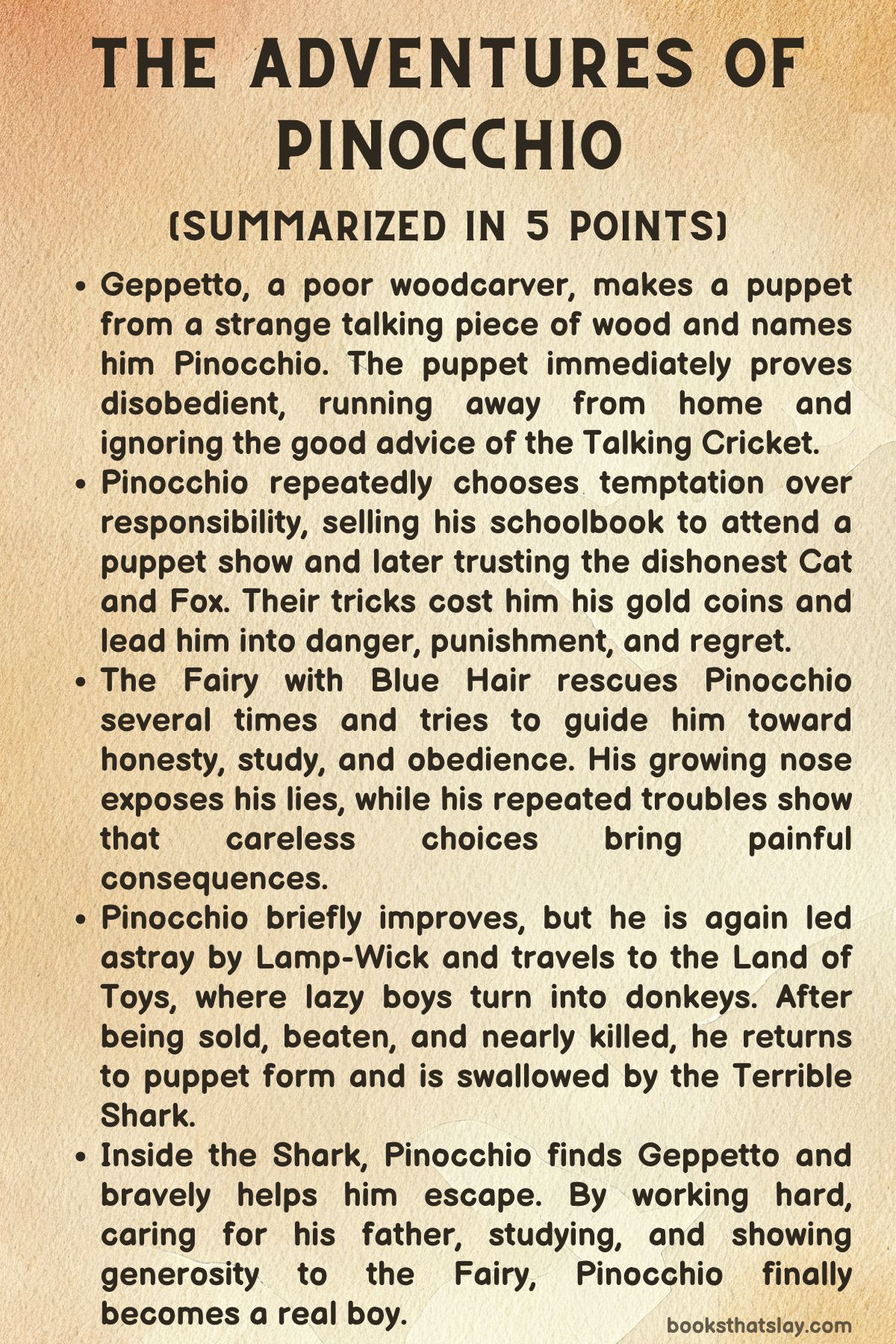
Summary
The Adventures of Pinocchio begins when a carpenter named Mastro Cherry finds an unusual piece of wood that seems perfect for making a table leg. As soon as he tries to work on it, the wood cries out in pain and laughs at him.
Mastro Cherry is terrified because he cannot understand where the voice is coming from. Soon afterward, his friend Geppetto arrives.
Geppetto is a poor old man who wants to make a puppet so that he can travel and earn a living. Mastro Cherry gives him the strange piece of wood, and after a comic quarrel between the two men, Geppetto takes it home.
In his small house, Geppetto carves the wood into a puppet and names him Pinocchio. The puppet comes alive even before he is finished.
He opens his eyes, laughs at Geppetto, steals his wig, kicks him, and runs away as soon as he learns to walk. Geppetto chases him through the street, but a policeman arrests Geppetto instead, because the people fear he may punish the puppet harshly.
Pinocchio returns home alone and meets a Talking Cricket, who advises him to obey his father, study, and become useful. Pinocchio refuses to listen and, in anger, throws a hammer at the cricket, killing him.
Left alone, Pinocchio soon becomes hungry and regrets his behavior. He tries to find food, but his efforts fail.
A man pours water on him when he asks for bread, and when Pinocchio returns home and falls asleep near the fire, his wooden feet burn off. Geppetto comes back from jail and finds him helpless.
Although Pinocchio has behaved badly, Geppetto feeds him with the pears he had bought for himself. Pinocchio first complains about the peels and cores, but hunger teaches him not to be fussy.
Geppetto then makes him new feet, clothes, shoes, and a cap. When Pinocchio says he needs a schoolbook, Geppetto sells his coat in cold weather to buy one.
Pinocchio sets out for school but hears music from a puppet theater and sells his schoolbook to buy a ticket. Inside the theater, the puppets Harlequin and Pulcinella recognize him as one of their own and welcome him warmly.
Their celebration angers the theater director, Fire-Eater, who threatens to burn Pinocchio for firewood. Pinocchio begs for mercy and calls for Geppetto.
Fire-Eater is moved by Pinocchio’s story and later by his willingness to sacrifice himself for Harlequin. Instead of burning anyone, Fire-Eater gives Pinocchio five gold coins to take home to his poor father.
On his way home, Pinocchio meets a fox and a cat, who pretend to be disabled and poor but are actually cheats. They convince him that he can multiply his coins by planting them in the Field of Wonders in the City of Simple Simons.
A blackbird warns Pinocchio not to trust them, but the cat kills the bird. Pinocchio follows the pair and spends the night at an inn, where the fox and cat eat a great deal and leave Pinocchio to pay.
The ghost of the cricket appears and warns him that people promising quick riches are usually swindlers. Pinocchio ignores the warning.
Later, two hooded figures attack Pinocchio and demand his money. He hides the coins in his mouth and refuses to give them up.
After a chase through the forest, they catch him and hang him from a tree. Near death, Pinocchio thinks sorrowfully of Geppetto.
A blue-haired fairy, who first appears as a strange little girl, rescues him. She sends a falcon to cut him down and a poodle in a glass carriage to bring him to her house.
Doctors are called: an owl, a crow, and the cricket. The cricket describes Pinocchio as disobedient and ungrateful, which makes him cry, proving he is still alive.
The fairy cares for Pinocchio and gives him medicine. He refuses it because it tastes bitter, but when black rabbits arrive to carry him away as if he were dead, he drinks it and recovers.
When the fairy asks about his coins, Pinocchio lies, saying he lost them and then swallowed them. Each lie makes his nose grow longer.
The fairy explains that lies are easy to recognize, either because they have short legs or long noses. She later has woodpeckers shorten his nose and tells him that Geppetto is coming to live with them.
Instead of waiting, Pinocchio again meets the fox and the cat. They persuade him to plant his remaining coins in the Field of Wonders.
He buries and waters them, then leaves briefly. When he returns, the money is gone.
A parrot tells him the fox and cat stole it. Pinocchio reports the theft to a gorilla judge, but in that foolish city, he is punished for being robbed and is sent to prison.
He remains there until prisoners are released for a public celebration, and he must falsely claim to be a criminal in order to go free.
Pinocchio tries to return to the fairy. Along the way he meets a huge serpent, is frightened into falling in the mud, and is caught in a farmer’s trap while trying to steal grapes.
The farmer makes him serve as a watchdog. During the night, weasels arrive and offer him the same bargain they had with the old dog Melampo: they will steal chickens and give him one.
Pinocchio refuses and barks to wake the farmer. The farmer is grateful and releases him.
This is one of the first signs that Pinocchio is learning to choose honesty over selfish gain.
When Pinocchio reaches the fairy’s cottage, he finds it empty and believes she has died from grief over his behavior. A pigeon tells him that Geppetto has gone to sea in search of him.
Pinocchio flies with the pigeon to the shore and sees Geppetto in a tiny boat, but a storm overturns it. Pinocchio jumps into the water to save him but cannot find him.
After swimming through the night, he reaches an island and learns from a dolphin that Geppetto may have been swallowed by the Terrible Shark.
On the island, Pinocchio asks for food but refuses work until hunger forces him to help a woman carry a jug. She feeds him, and he realizes she is the fairy, now old enough to be his mother.
She promises that if he studies, works, obeys, and tells the truth, he can become a real boy. Pinocchio agrees and begins school.
At first other boys mock him, but he becomes a good student. Still, he is tempted by bad companions.
They trick him into going to the shore by saying the Terrible Shark is there. A fight breaks out, and a boy named Eugene is injured by a book.
Pinocchio is blamed and runs from the police.
A mastiff named Alidoro chases him into the sea, but when the dog starts drowning, Pinocchio saves him. Soon after, a fisherman catches Pinocchio in a net and plans to fry him like a fish.
Alidoro repays the favor by rescuing him. Pinocchio returns to the fairy’s house, but a slow snail keeps him waiting for hours.
After another lesson in patience and consequences, the fairy forgives him and says he may become a real boy the next day if he behaves.
Pinocchio is sent to invite friends to the celebration. He finds his friend Lamp-Wick, the laziest boy at school, who is leaving for the Land of Toys, a place without school, teachers, or work.
Pinocchio resists at first but is slowly persuaded. A wagon full of boys arrives, driven by a cheerful little man and pulled by donkeys.
Pinocchio joins them and spends five months playing without study or responsibility. Then he grows donkey ears.
A mouse tells him that boys who reject school and work become donkeys. Lamp-Wick changes too.
Soon both boys fully transform.
The wagon driver sells the donkey-boys for profit. Lamp-Wick is sold to a farmer, while Pinocchio is sold to a circus owner.
He is trained through beating to perform tricks. During a show, he sees the fairy in the audience and tries to call to her, but he can only bray.
After injuring himself, he is sold to a man who wants to make a drum from his hide. The man throws him into the sea to drown, but fish eat away the donkey body, leaving Pinocchio a puppet again.
He escapes, only to be swallowed by the Terrible Shark.
Inside the shark, Pinocchio meets a tunny fish and then finds Geppetto, who has survived for two years in the shark’s stomach by eating fish swallowed by the monster. Father and son are overjoyed.
Pinocchio helps Geppetto escape while the shark sleeps with its mouth open. Pinocchio swims with Geppetto on his back until he is exhausted, and the tunny, who has also escaped, carries them to shore.
Pinocchio and Geppetto find shelter in a cottage owned by the cricket, who says it was given to him by a blue-haired goat mourning her son. Pinocchio understands that the fairy has continued to protect him.
He works hard to care for Geppetto, drawing water in exchange for milk, studying, and making baskets to earn money. He sees Lamp-Wick dying as a worn-out donkey and learns the full cost of wasted life.
When the snail tells him the fairy is ill and poor, Pinocchio gives away the money he had saved for new clothes.
The next morning, Pinocchio wakes as a real boy. His home is comfortable, Geppetto is healthy and strong again, and the fairy has returned his money with a note praising his good heart.
The lifeless wooden puppet remains in the corner, showing that Pinocchio has left behind his selfish, careless self and earned human life through love, labor, truth, and sacrifice.
Characters
Pinocchio
Pinocchio is the central figure of The Adventures of Pinocchio, and his character is built around growth through repeated mistakes. At first, he is selfish, impatient, rude, and easily distracted.
He rejects advice, avoids school, sells the book Geppetto sacrifices for, trusts obvious swindlers, lies when questioned, and often chooses pleasure over duty. Yet he is not cruel at heart.
His worst actions usually come from immaturity rather than deep malice. He kills the cricket in anger, but he is shocked afterward; he disobeys Geppetto, but he later longs for him; he falls into temptation, but he is capable of shame, gratitude, and courage.
His growth is slow because he learns only after suffering the consequences of his choices. By the end of the book, Pinocchio becomes responsible because he cares for Geppetto, studies, works, and gives up his own comfort to help the fairy.
His transformation into a real boy is not just magical reward; it marks the moral change from careless puppet to loving son.
Geppetto
Geppetto is Pinocchio’s father, creator, and moral center. He is poor, lonely, and sometimes quick-tempered, but his defining quality is selfless love.
From the moment he makes Pinocchio, he treats him not as an object but as a son. He suffers because of Pinocchio’s disobedience, even being arrested when people mistakenly believe he may harm him.
Still, he never stops caring for him. He gives Pinocchio his own food, makes him new feet, creates clothes for him from humble materials, and sells his coat in cold weather to buy him a schoolbook.
Geppetto’s love is practical, sacrificial, and patient. His long search for Pinocchio, even across the sea, shows a parent’s devotion pushed to its limit.
In the shark’s belly, he becomes physically weak and dependent, allowing Pinocchio to reverse roles and care for him. Geppetto’s renewed health at the end reflects the restoration of the family through Pinocchio’s moral growth.
Mastro Cherry
Mastro Cherry is the carpenter who first discovers the talking piece of wood. His role is brief but important because he introduces the strange, magical quality of the story.
He is practical and ordinary, so his terror at hearing the wood speak creates humor and surprise. Mastro Cherry is also hot-tempered and easily drawn into conflict, especially with Geppetto.
Their quarrels are comic, full of misunderstanding and physical scuffling, yet they also show the lively world from which Pinocchio emerges. By giving the wood to Geppetto, Mastro Cherry unknowingly sets the whole story in motion.
He does not shape Pinocchio himself, but he is the first person to sense that the wood has a will of its own. His confusion and fear prepare the reader for a world where moral lessons, magic, and comedy exist side by side.
The Talking Cricket
The Talking Cricket represents conscience, wisdom, and moral warning. He tells Pinocchio that children who rebel against parents and refuse school usually come to harm.
Pinocchio rejects this advice because he wants freedom without limits. The cricket’s death at Pinocchio’s hands is one of the puppet’s earliest and darkest actions, showing how violently he resists correction.
Yet the cricket does not disappear from the book. He returns as a ghost, then as a doctor, and later as the owner of the cottage where Pinocchio and Geppetto recover.
His repeated presence suggests that conscience cannot truly be destroyed. Even when ignored, it returns.
The cricket is stern, but not hateful; he tells the truth about Pinocchio’s faults because those truths are necessary. By the end, Pinocchio can face him with remorse, proving that he has become capable of moral reflection.
The Fairy with Blue Hair
The Fairy with Blue Hair is one of the most powerful and mysterious figures in The Adventures of Pinocchio. She appears first as a strange little girl, then as a sisterly figure, later as a mother, and even in symbolic forms such as the goat with blue hair.
Her changing roles reflect Pinocchio’s changing needs. At first, he needs rescue; later, he needs discipline, forgiveness, and maternal guidance.
The fairy is kind, but she is not indulgent. She saves Pinocchio from death, cares for him when he is ill, shortens his nose after he lies, forgives him after misbehavior, and promises him human life if he earns it.
She allows consequences to teach him, which makes her love firm rather than weak. Her final reward comes only after Pinocchio proves he can work, study, care for Geppetto, and give generously.
She stands for mercy joined with moral expectation.
Fire-Eater
Fire-Eater, the puppet theater director, appears frightening at first because he threatens to burn Pinocchio and later Harlequin. His huge appetite, authority over the puppets, and sudden rage make him seem dangerous.
Yet his sneezing reveals his softer nature, and he becomes one of the first characters to respond to Pinocchio’s better qualities. When Pinocchio tells him about Geppetto’s poverty and then offers himself in place of Harlequin, Fire-Eater is moved.
He spares the puppets and gives Pinocchio five gold coins for his father. Fire-Eater is not gentle in manner, but he has compassion beneath his rough exterior.
His character shows that goodness can exist in unexpected people, while also giving Pinocchio a chance to show courage and loyalty before he loses his way again.
Harlequin
Harlequin is one of the puppets in the theater who welcomes Pinocchio as a brother. His delight at seeing Pinocchio shows that the puppet world has its own sense of kinship and community.
Harlequin becomes important when Fire-Eater decides to burn him instead of Pinocchio. Pinocchio’s willingness to sacrifice himself for Harlequin reveals that the puppet is capable of bravery and affection even early in the story.
Harlequin himself is not deeply developed, but his presence gives Pinocchio a moral test. Through him, the book shows that Pinocchio’s character is not fixed in selfishness; he can act nobly when moved by friendship and pity.
Pulcinella
Pulcinella, like Harlequin, belongs to the puppet theater and helps create the atmosphere of welcome when Pinocchio arrives. He recognizes Pinocchio as one of their own, and his joy helps interrupt the performance.
Pulcinella’s role is small, but he contributes to the sense that Pinocchio is caught between two worlds: the artificial world of puppets and the human world he wants to enter. The theater puppets accept him immediately, while the human world often judges, tempts, punishes, or teaches him.
Pulcinella’s affection helps show that Pinocchio is not alone, even when he behaves foolishly. He also helps set up the conflict with Fire-Eater, which becomes an early test of Pinocchio’s courage.
The Cat
The Cat is one of the book’s main tricksters. He pretends to be blind in order to gain sympathy, but his actions reveal greed, violence, and cunning.
He helps deceive Pinocchio with the false promise that buried coins will grow into riches. His quick killing of the blackbird shows how ruthless he can be when his schemes are threatened.
As one of the disguised assassins, he attacks Pinocchio for the gold and loses a paw when Pinocchio bites him. Later, he continues the deception, appearing with his paw in a sling and letting the fox explain it away.
By the end, the Cat is truly blind and poor, which turns his earlier false performance into poetic justice. He embodies dishonest gain and its final emptiness.
The Fox
The Fox is the Cat’s partner and often acts as the smoother speaker of the two. He pretends to have difficulty walking, using false weakness as a tool of manipulation.
He is persuasive, patient, and skilled at telling Pinocchio exactly what he wants to hear. His promise of effortless wealth appeals to Pinocchio’s impatience and desire to help Geppetto without doing honest work.
The Fox is dangerous because he makes foolishness sound reasonable. He is also shameless, returning after the attack as if nothing has happened.
At the end of the book, he has lost his tail and is reduced to begging. His fall shows that cleverness without honesty leads to degradation rather than success.
The Blackbird
The Blackbird is a minor but meaningful warning figure. He tells Pinocchio not to trust the Cat and the Fox, identifying them as dishonest before Pinocchio understands the danger.
His warning is practical and direct, but Pinocchio fails to benefit from it because the Cat immediately kills him. The Blackbird’s sudden death shows how quickly truth can be silenced by greed and deceit.
His role also increases the reader’s awareness that Pinocchio is walking into danger. Though brief, the Blackbird stands among the many voices of good advice in the story, voices that Pinocchio repeatedly ignores until suffering teaches him.
The Innkeeper
The innkeeper at the Red Lobster is part of the world that profits from Pinocchio’s foolishness without necessarily being the main villain. He wakes Pinocchio after the Cat and the Fox have left and informs him that they claimed a family emergency.
He also makes Pinocchio pay for the expensive meal they consumed. The innkeeper does not protect Pinocchio or question the obvious unfairness of the situation.
His character shows a society in which the naive can be exploited not only by active cheats but also by ordinary people who accept such exploitation as business. He helps move Pinocchio from temptation into real loss.
The Assassins
The assassins are the Cat and the Fox in disguise, but as hooded attackers they represent the open violence behind their earlier friendliness. Their demand for Pinocchio’s money reveals the truth of their relationship with him: they never cared for him and only wanted his coins.
The scene also shows Pinocchio’s stubborn courage. He refuses to open his mouth even when threatened, and he fights hard to escape.
The assassins turn deception into physical danger, teaching that bad company does not merely mislead; it can destroy. Their hanging of Pinocchio marks one of the darkest consequences of his refusal to listen to honest warnings.
The Falcon
The Falcon serves the fairy and rescues Pinocchio after he is hanged. Though not a developed personality, the Falcon is important as an agent of mercy.
His action comes when Pinocchio is helpless and near death, showing that rescue sometimes arrives after consequences have fully revealed the seriousness of wrongdoing. The Falcon’s obedience to the fairy also contrasts with Pinocchio’s disobedience.
In the moral structure of the story, even animals and servants of goodness act with order and purpose, while Pinocchio must learn to do the same.
The Poodle
The Poodle is another servant of the fairy, sent in a glass carriage pulled by mice to bring Pinocchio to safety. His elegant appearance adds a fairy-tale quality to the rescue.
The Poodle’s role is not psychological but symbolic: he belongs to a world of care, order, and strange grace that surrounds the fairy. Through him, Pinocchio is moved from the violence of the forest into a place of healing.
The Poodle also helps create the contrast between the ugly results of Pinocchio’s choices and the refined, almost ceremonial mercy offered by the fairy.
The Owl
The Owl is one of the doctors called to examine Pinocchio after his rescue. He gives vague medical opinions, which adds satire and humor to the scene.
The Owl’s traditional association with wisdom is undercut by his uncertainty, suggesting that professional speech is not always useful when it avoids plain truth. In contrast, the cricket speaks morally rather than medically and understands Pinocchio more deeply.
The Owl helps make the doctor scene comic while also showing that Pinocchio’s real sickness is not only physical; it is moral.
The Crow
The Crow, another doctor, joins the Owl in giving uncertain opinions about whether Pinocchio is alive or dead. Like the Owl, he contributes to the comic treatment of authority.
His role shows the limits of detached observation. The doctors can discuss Pinocchio’s condition, but they do not reach the central truth of his character.
The Crow’s presence also strengthens the strange animal society of the book, where creatures often speak, judge, advise, and serve as moral signs. His uncertainty prepares the way for the cricket’s sharper judgment.
The Black Rabbits
The Black Rabbits appear when Pinocchio refuses to take medicine. They arrive as a funeral-like group ready to carry him away, and their presence frightens him into finally drinking the medicine.
They represent the consequences of stubbornness taken to an extreme. Pinocchio does not respond to reasonable advice, sweetness, or care, but he responds when death becomes visible.
The rabbits are frightening but also comic, because their purpose is to push him into doing what he should have done earlier. They show how childish refusal can become dangerous when pride matters more than survival.
The Woodpeckers
The Woodpeckers shorten Pinocchio’s nose after it grows because of his lies. Their role is practical, but their presence turns a moral lesson into a memorable physical image.
Pinocchio’s lies make his inner fault visible, and the Woodpeckers remove the outward sign only after he experiences shame. They do not erase the lesson; they simply allow him to continue after correction.
Their work reflects the fairy’s method: punishment teaches, but mercy follows when the lesson has been felt.
The Parrot
The Parrot tells Pinocchio that the Cat and the Fox have stolen his buried coins. He laughs at Pinocchio’s foolish belief that money could grow from the ground.
The Parrot’s laughter is harsh but truthful. He represents common sense after deception has already succeeded.
Unlike the earlier warning figures, he appears too late to prevent the loss, so his role is to expose the trick clearly. Through him, Pinocchio must confront the fact that greed and laziness made him easy to fool.
The Gorilla Judge
The Gorilla Judge presides over the City of Simple Simons and sentences Pinocchio to prison for having been robbed. His judgment is absurd, but it reflects a corrupt society where victims are punished and criminals prosper.
The judge’s character broadens the book’s moral world beyond Pinocchio’s personal flaws. It suggests that foolishness can be social and institutional, not only individual.
His decision is unjust, yet Pinocchio’s imprisonment still becomes part of his education, forcing him to experience the bitter results of trusting dishonest people.
The Serpent
The Serpent blocks Pinocchio’s path after his release from prison. At first, it seems threatening because it refuses to move and then suddenly rises, terrifying him.
Yet it dies from laughing at Pinocchio’s muddy fall. The Serpent is a strange comic obstacle, mixing danger with ridicule.
Its scene shows that Pinocchio’s journey is full of humiliations as well as punishments. The Serpent does not teach through speech but through experience: Pinocchio is still a figure whose fear, pride, and clumsiness make him ridiculous.
The Glow Worm
The Glow Worm appears when Pinocchio is caught in the farmer’s trap after trying to steal grapes. Pinocchio asks for help, but the Glow Worm rebukes him for theft.
This small character serves as another moral voice, reminding Pinocchio that hunger does not automatically excuse wrongdoing. The Glow Worm’s light also has symbolic value, bringing moral clarity in a dark moment.
Although minor, the character reinforces the book’s repeated pattern: Pinocchio asks for rescue, but first he must hear the truth about what he has done.
The Farmer Who Makes Pinocchio a Watchdog
The farmer punishes Pinocchio by making him replace his watchdog. His response is severe but not entirely unjust, since Pinocchio was caught trying to steal grapes.
The farmer becomes important because his punishment gives Pinocchio a chance to act responsibly. When the weasels try to continue their arrangement of stealing chickens, Pinocchio refuses and protects the farm.
The farmer then rewards him with freedom. This character helps turn punishment into moral opportunity.
He is not a central guide like the fairy or Geppetto, but his farm becomes a place where Pinocchio practices honesty instead of merely being told about it.
The Weasels
The Weasels are thieves who had made a corrupt bargain with the old watchdog Melampo. They assume Pinocchio will accept the same arrangement, giving him one stolen chicken in exchange for silence.
Their offer tests whether Pinocchio has learned anything from being cheated and punished. By rejecting them and barking to wake the farmer, Pinocchio shows real progress.
The Weasels are minor villains, but their scene is essential because it allows Pinocchio to choose duty when dishonesty would benefit him.
Melampo
Melampo is the old watchdog who had secretly allowed the Weasels to steal chickens in exchange for a share. Though he does not appear directly, his past behavior shapes the scene at the farm.
He represents corruption hidden under the appearance of duty. As a watchdog, he was supposed to protect the chickens, but he betrayed that trust for personal gain.
Pinocchio’s refusal to repeat Melampo’s bargain shows that he can act better than someone whose role should have made him responsible. Melampo’s unseen presence therefore sharpens Pinocchio’s moral test.
The Pigeon
The Pigeon brings Pinocchio news that Geppetto has been searching for him and is leaving by boat for the New World. The Pigeon also carries Pinocchio toward the sea, helping him try to reunite with his father.
This character represents helpful action after a period of loss and regret. Unlike the Cat and the Fox, who lead Pinocchio away from home, the Pigeon helps him move toward family and responsibility.
The journey with the Pigeon marks a turning point because Pinocchio begins to think less about his own pleasure and more about saving Geppetto.
The Dolphin
The Dolphin gives Pinocchio information after he washes onto the island. He tells him that Geppetto may have been swallowed by the Terrible Shark.
The Dolphin is brief but important because he connects Pinocchio’s search with the next major stage of the plot. He is calm, knowledgeable, and direct.
Like several animals in the book, he helps Pinocchio understand the world more clearly. His news is painful, but it keeps Pinocchio’s love for Geppetto active and gives direction to his grief.
The Woman with the Jug
The Woman with the Jug is the fairy in another form, but Pinocchio does not recognize her immediately. She offers food in exchange for work, and Pinocchio first resists labor before hunger makes him agree.
This scene is important because it teaches that help may come through effort, not begging. When the woman feeds him and reveals herself as the fairy, Pinocchio experiences both relief and shame.
Her disguise allows her to test whether he is willing to work. The moment prepares him for the fairy’s later promise that he can become a real boy through obedience, study, truth, and labor.
The Teacher
The Teacher represents formal education and social discipline. He appreciates Pinocchio’s progress as a student and warns him against bad companions.
His role is less emotional than Geppetto’s or the fairy’s, but he supports the same values: study, seriousness, and self-control. The Teacher’s warning is important because Pinocchio is not led astray out of ignorance alone; he is told what danger looks like and still chooses wrongly.
In this way, the Teacher’s presence makes Pinocchio more responsible for his choices. Education in the book is not just reading and writing; it is training the will.
The Schoolboys
The schoolboys who mock Pinocchio and later trick him represent peer pressure and the cruelty of careless groups. At first, they tease him because he is different.
Later, they resent his effort to become a good student and lure him away by claiming the Terrible Shark is near the shore. Their behavior shows how children can punish goodness when it makes them feel judged.
In the fight that follows, they run away when Eugene is hurt, leaving Pinocchio to face the consequences. They are not as calculated as the Cat and the Fox, but they are dangerous because they make disobedience seem social, exciting, and normal.
Eugene
Eugene is the boy injured during the fight by the shore. His injury turns a childish quarrel into a serious crisis.
Eugene is not deeply characterized, but his role matters because he becomes a living consequence of group foolishness and violence. Pinocchio does not intend to hurt him, and he stays to help while the other boys flee.
This response shows Pinocchio’s conscience developing. Eugene’s suffering forces Pinocchio to see that misbehavior can harm others, not only himself.
The Crab
The Crab appears during the fight among Pinocchio and the schoolboys and tells them to stop. Like the cricket and other warning figures, he speaks reason into a scene ruled by anger.
The boys ignore him, and the injury to Eugene follows. The Crab’s role is small but clear: he represents ignored wisdom.
His warning shows that the disaster was preventable. The characters are not trapped by fate; they choose not to listen.
The Carabineers
The Carabineers are armed policemen who arrive after Eugene is injured. They assume Pinocchio is guilty and try to arrest him.
Their presence reflects the law as quick, forceful, and not always careful. Pinocchio’s fear of them drives him to run, which leads to the chase with Alidoro and then to the fisherman’s net.
The Carabineers are not villains in the same sense as the Cat and the Fox, but they show how public authority can misunderstand events. Their role adds pressure to Pinocchio’s already troubled effort to become better.
Alidoro
Alidoro is the mastiff sent after Pinocchio by the Carabineers. At first, he seems like a threat, but when he nearly drowns, Pinocchio saves him.
Alidoro later returns the favor by rescuing Pinocchio from the fisherman. His character shows the value of mercy.
Pinocchio helps him even though Alidoro had been chasing him, and that generous act saves Pinocchio’s life later. Alidoro’s loyalty is simple and direct: kindness creates a bond.
Through him, the book shows that good actions can return in unexpected ways.
The Fisherman
The Fisherman is a grotesque and frightening figure who catches Pinocchio in his net and refuses to believe he is a puppet rather than a fish. He prepares to fry him, treating Pinocchio as food rather than a living being.
His character brings dark comedy and danger together. The Fisherman’s stubborn literalism makes him threatening because he cannot or will not recognize the truth in front of him.
He also shows how helpless Pinocchio becomes when his choices place him in the wrong world. Only Alidoro’s intervention saves him.
The Snail
The Snail is the fairy’s servant and is defined by extreme slowness. When Pinocchio returns to the fairy’s house, the Snail takes hours to reach the door and later more hours to bring food.
This delay punishes Pinocchio’s impatience and disobedience without direct violence. The food she brings is inedible, which reflects the emptiness of his excuses and misbehavior.
Later, the Snail tells Pinocchio that the fairy is ill and poor, giving him the chance to show generosity. The Snail therefore appears in both punishment and redemption, first testing patience and later prompting sacrifice.
Lamp-Wick
Lamp-Wick is Pinocchio’s closest bad companion and one of the clearest warnings in the story. He is lazy, rebellious, and proud of rejecting school.
He attracts Pinocchio because he offers a vision of life without duty, effort, or adult correction. His invitation to the Land of Toys is disastrous, yet he does not seem evil in a calculated way; he is a boy ruined by his own refusal to grow.
His transformation into a donkey, sale to a farmer, and later appearance as a broken, dying animal show the tragic end of wasted potential. Lamp-Wick’s fate helps Pinocchio understand what he himself might become if he continues choosing pleasure over responsibility.
In The Adventures of Pinocchio, Lamp-Wick is the shadow version of Pinocchio’s possible future.
The Little Man, or Wagon Driver
The cheerful little man who drives boys to the Land of Toys is one of the most sinister characters in the book. His pleasant manner hides a cruel business: he gathers lazy boys, waits until they turn into donkeys, and sells them for profit.
Unlike Lamp-Wick, who is foolish, the little man is fully exploitative. He understands the consequences and uses temptation as a trap.
His wagon promises freedom, but it leads to enslavement. The detail of the donkeys pulling the wagon hints that other boys have already suffered the same fate.
He represents adults who exploit childish weakness rather than correcting it.
The Donkey Who Warns Pinocchio
One of the donkeys pulling the wagon quietly warns Pinocchio that he will regret going to the Land of Toys. This donkey is likely another transformed boy, and his warning carries the sadness of experience.
He cannot save Pinocchio, but he tries to speak the truth from inside his punishment. His bitten ears also show the cruelty of the wagon driver and the suffering hidden beneath the trip’s festive surface.
The donkey’s warning is one more chance for Pinocchio to turn back, and his failure to listen makes the coming transformation feel deserved rather than accidental.
The Mouse
The Mouse explains to Pinocchio that boys who abandon study and work eventually turn into donkeys. This character provides the moral logic of the Land of Toys.
The Mouse does not cause the punishment; he simply names it. His explanation forces Pinocchio to understand that his donkey ears are not random misfortune but the visible result of his choices.
Like many small animals in the book, the Mouse carries truth in a plain and practical way. His role marks the moment when Pinocchio can no longer pretend that play without responsibility has no cost.
The Circus Owner
The Circus Owner buys Pinocchio after he becomes a donkey and trains him to perform. He uses force, hunger, and beating to make Pinocchio useful for entertainment.
His character shows the loss of dignity that follows Pinocchio’s rejection of education and freedom rightly used. Pinocchio wanted endless play, but he ends up performing for others under harsh control.
The Circus Owner is not interested in Pinocchio’s inner life or suffering; he values him only as property. This treatment helps Pinocchio understand the difference between true freedom and the false freedom promised by the Land of Toys.
The Veterinarian
The Veterinarian appears after donkey-Pinocchio is injured during a circus performance. He declares that Pinocchio will not recover, causing the Circus Owner to sell him cheaply.
His role is brief, but he helps move Pinocchio from public performance to near death. The Veterinarian represents practical judgment without emotional concern.
He diagnoses the animal’s usefulness, not his suffering. In the chain of events, his verdict shows how quickly a being valued only for labor or entertainment can be discarded once damaged.
The Man Who Wants a Drum
The man who buys the injured donkey wants to make a drum from his hide. He is coldly practical and sees the donkey only as material.
By tying a stone to Pinocchio and throwing him into the sea, he becomes a direct threat to his life. Yet this act also leads to Pinocchio’s return from donkey form to puppet form when the fish eat away the animal body.
The man’s cruelty therefore becomes part of a strange rescue, though he intends no kindness. He represents the final dehumanization of Pinocchio’s foolish choices: after rejecting the path toward becoming human, Pinocchio is nearly reduced to an object.
The Goat with Blue Hair
The Goat with Blue Hair appears on a rock in the sea and urges Pinocchio to swim quickly when the Terrible Shark approaches. The goat resembles the fairy, and later the cricket reveals that a blue-haired goat had given him the cottage while mourning Pinocchio.
This figure is another form of the fairy’s watchful love. Even when Pinocchio is far from safety, the image of the blue-haired protector remains near him.
The goat cannot prevent the shark from swallowing him, but her presence shows that he has not been abandoned. She links danger, memory, and maternal care.
The Terrible Shark
The Terrible Shark is the great monster that swallows both Geppetto and Pinocchio. It functions as the largest physical danger in the book, but also as the place where father and son are reunited.
The shark’s size and power make human beings seem helpless, yet its sleeping with an open mouth creates the chance for escape. Inside the shark, Pinocchio finds Geppetto and finally acts with courage, planning their escape and carrying his father.
The Shark is therefore both threat and trial. It forces Pinocchio to become brave not for himself alone, but for someone he loves.
The Tunny
The Tunny is a fish swallowed by the Shark who first seems resigned to death. When Pinocchio decides to search for the light inside the Shark, the Tunny does not expect escape.
Later, inspired by Pinocchio and Geppetto, he follows them out and carries them safely to shore. The Tunny’s role shows how courage can awaken courage in others.
He also repays Pinocchio’s friendliness and becomes essential to survival when Pinocchio is too exhausted to swim farther. Like Alidoro, the Tunny proves that kindness and example can create rescue.
The Farmer Next Door
The farmer next door gives Pinocchio work drawing water in exchange for milk for Geppetto. He represents honest labor and fair exchange.
Unlike those who trick, exploit, or punish Pinocchio, this farmer offers a simple arrangement: work brings food. Through this daily task, Pinocchio learns discipline and care.
Drawing one hundred pails of water is difficult, but he does it for his father’s health. The farmer’s role is quiet but crucial because he provides the setting in which Pinocchio’s final transformation becomes possible through repeated, humble responsibility.
Themes
Growing Up Through Responsibility
In The Adventures of Pinocchio, becoming “real” is not simply a magical change from wood to flesh. It is the result of learning responsibility through action.
Pinocchio begins life with movement and speech, but he lacks judgment. He wants the privileges of freedom without the duties that make freedom meaningful.
He runs away from Geppetto, rejects the cricket’s advice, sells his schoolbook, follows cheats, lies to the fairy, skips school, and joins Lamp-Wick in the Land of Toys. Each mistake teaches him that choices have consequences.
The story does not suggest that maturity comes from age alone; it comes from accepting duty even when it is difficult. Pinocchio’s true growth begins when he stops merely promising to improve and starts caring for others through work.
He rescues Geppetto, earns milk for him, studies at night, makes baskets, and gives his saved money to the sick fairy. These actions prove that he has moved beyond selfish desire.
His transformation into a human boy is the outward sign of an inward change. The book presents childhood not as innocence alone, but as a stage in which character must be formed through discipline, love, and moral effort.
The Danger of False Freedom
Pinocchio often mistakes freedom for doing whatever he wants, and this misunderstanding places him in danger again and again. He thinks school is a burden, advice is interference, and obedience is a loss of independence.
Yet every escape from guidance leads him into a harsher form of control. When he runs from Geppetto, he ends up hungry, cold, and damaged.
When he follows the Cat and the Fox, he loses his money, is attacked, and is imprisoned. When he joins Lamp-Wick in the Land of Toys, he believes he has found perfect freedom because there are no lessons, teachers, or rules.
That place, however, is a trap designed to turn boys into donkeys and sell them. The book’s sharpest irony is that the life Pinocchio imagines as freedom becomes slavery.
He is beaten, trained, bought, sold, and nearly killed. Through these events, the story argues that real freedom requires self-control.
A person who cannot resist temptation becomes easy prey for stronger and more cunning forces. Pinocchio becomes free only when he accepts limits: study, work, truthfulness, and care for family.
Honesty and the Visible Shape of Lies
The most famous image in the story is Pinocchio’s growing nose, but its meaning goes beyond comic punishment. His lies become visible because dishonesty changes the self, even when the liar hopes to hide it.
When the fairy asks about the coins, Pinocchio lies first by saying he lost them and then by claiming he swallowed them. Each lie makes his nose grow longer, turning private falsehood into public exposure.
The fairy’s lesson is simple but severe: lies reveal themselves. Some are obvious because they cannot travel far; others become obvious because they grow out of proportion.
Pinocchio’s problem is not only that he tells lies to others, but that he lies to himself. He convinces himself that the Cat and the Fox are friends, that quick wealth is possible, that he can delay obedience without consequence, and that pleasure can replace duty.
The growing nose gives physical form to this habit of self-deception. By the end, Pinocchio’s honesty is shown not merely in speech but in conduct.
He admits wrongdoing, accepts labor, and acts with sincerity toward Geppetto and the fairy.
Parental Love, Sacrifice, and Moral Guidance
Love in the story is generous, but it is never shown as weakness. Geppetto and the fairy both love Pinocchio deeply, yet their love includes correction, sacrifice, patience, and expectation.
Geppetto gives Pinocchio life, food, new feet, clothing, and a schoolbook bought at the cost of his own coat. He searches for him across great distances and suffers because of his son’s choices.
The fairy saves Pinocchio from death more than once, but she also lets him experience consequences. She does not turn him into a real boy simply because he asks; she waits until he becomes truthful, hardworking, and kind.
This combination of mercy and discipline gives the book its moral structure. Parental love does not remove every hardship, because hardship becomes part of Pinocchio’s education.
At the same time, the story never presents the child as abandoned. Even when Pinocchio believes the fairy is gone, signs of her care remain.
The final transformation restores both child and parent: Pinocchio becomes human, and Geppetto becomes healthy again. Love, in this world, is fulfilled when the child learns to return care for care.