The Adventures of Huckleberry Finn Summary, Characters and Themes
The Adventures of Huckleberry Finn is Mark Twain’s famous novel about a boy who runs away from control, cruelty, and false respectability, only to discover a harder moral world on the Mississippi River. Huck Finn escapes his abusive father and travels with Jim, an enslaved man seeking freedom.
Their journey brings them into contact with frauds, feuding families, hypocritical townspeople, and dangerous ideas about race, law, religion, and conscience. The book is both an adventure story and a sharp social criticism, using Huck’s plain, observant voice to expose the failures of the society around him.
Summary
The Adventures of Huckleberry Finn begins with Huck Finn explaining his life after the events connected with Tom Sawyer. Huck and Tom had found a large sum of gold, and Huck’s share is being kept safely by Judge Thatcher.
Huck now lives with Widow Douglas and her sister Miss Watson, who are trying to “civilize” him. They want him to attend school, pray, dress properly, behave politely, and accept respectable society.
Huck dislikes these rules. He finds the house confining, religion confusing, and manners unnatural.
He longs for freedom, even though he slowly becomes used to regular meals, clean clothes, and school.
Tom Sawyer remains Huck’s friend and pulls him into imaginary adventures. Tom forms a boys’ gang based on the adventure books he has read, but the gang’s plans are childish, confused, and unrealistic.
Huck notices the gap between Tom’s grand ideas and the ordinary world around them. This early contrast between fantasy and practical life continues throughout the story.
Huck’s peace is broken when his father, Pap, returns. Pap is violent, greedy, drunken, and resentful of Huck’s education and money.
He demands Huck’s funds and tries to stop him from becoming better than the rest of the family. When legal efforts fail to remove Pap from Huck’s life, Pap kidnaps him and takes him to a lonely cabin across the river.
At first Huck enjoys the freedom from school and manners, but Pap’s beatings grow worse. During one drunken fit, Pap nearly kills him.
Huck decides to escape.
Using his intelligence and knowledge of the river, Huck fakes his own murder. He kills a pig, spreads blood, stages signs of violence, and escapes by canoe to Jackson Island.
There he lives alone for a few days, enjoying independence. Soon he finds Jim, Miss Watson’s enslaved man, who has also run away.
Jim explains that he heard Miss Watson considering selling him downriver to New Orleans, which would separate him from everyone he knows. Huck agrees to keep Jim’s secret, though he has been taught that helping an enslaved man escape is wrong.
Huck and Jim settle on the island, gather food, and protect themselves from discovery. They find a cave, collect useful items from a floating house, and survive through practical teamwork.
In that house, Jim sees the body of a dead man but keeps Huck from looking closely at it. Later, Huck dresses as a girl and goes into town to gather news.
A woman named Judith Loftus sees through parts of his disguise but believes he is an abused runaway apprentice. From her, Huck learns that people suspect both Jim and Pap in Huck’s supposed murder, and that men are planning to search Jackson Island.
Huck rushes back, warns Jim, and the two escape on a raft.
Their raft becomes a floating home. They travel mostly by night, hiding during the day.
Their goal is to reach Cairo, where Jim can take the Ohio River toward free territory. Along the way, they explore a wrecked steamboat and encounter criminals who plan to abandon a man named Jim Turner to drown.
Huck feels guilty about leaving the criminals to die and tries to arrange help, showing that his conscience is active even when it is confused.
As the journey continues, Huck and Jim grow closer. They talk, argue, and learn from each other.
Huck plays a cruel trick on Jim after they are separated in fog, pretending that the whole terrifying experience was only Jim’s dream. When Jim realizes the truth, he is hurt because Huck has made him feel foolish after he had been worried sick about him.
Huck feels ashamed and apologizes. This is a major moment in Huck’s moral growth, because he recognizes Jim as a friend whose feelings matter.
The two miss Cairo in the fog, destroying their best chance at freedom. Soon after, a steamboat crashes into their raft.
Huck and Jim are separated. Huck comes ashore and is taken in by the Grangerford family, a wealthy household caught in a deadly feud with the Shepardsons.
The Grangerfords seem refined, religious, and generous, but they live by senseless inherited violence. Huck befriends Buck Grangerford, a boy near his own age, and witnesses the deadly results of the feud when Sophia Grangerford runs away with Harney Shepardson.
The conflict ends with several deaths, including Buck’s. Huck is horrified.
He reunites with Jim, who has repaired the raft, and they flee.
For a short time, life on the river feels peaceful again. That peace ends when Huck helps two fleeing con men who join them on the raft.
One claims to be a duke; the other claims to be the rightful king of France. Huck quickly realizes they are frauds, but he avoids open conflict to keep the peace.
The duke and king take control of the raft and use Huck and Jim in their schemes.
The con men perform scams in several towns. They exploit a religious revival, print false documents, and stage a ridiculous show called the Nonesuch.
Their fraud succeeds because the first audiences are too ashamed to admit they have been cheated, so they encourage others to attend and be cheated too. Twain uses these episodes to expose cowardice, greed, mob behavior, and foolish pride in ordinary society.
Huck also witnesses the killing of Boggs by Colonel Sherburn in an Arkansas town. Boggs is a harmless drunk who insults Sherburn publicly.
Sherburn warns him, then shoots him dead. A lynch mob forms, but Sherburn faces them down with contempt, calling them cowards who only feel brave in a crowd.
Huck sees how quickly public anger can rise and how quickly it can collapse.
The duke and king’s worst fraud involves the Wilks family. After learning details about the recently deceased Peter Wilks and his expected brothers, the con men pretend to be those brothers.
They fool the grieving family and nearly steal the inheritance. Huck is especially moved by Mary Jane Wilks, whose goodness and trust make the fraud feel unbearable.
Huck steals the gold from the con men and tries to hide it, but he ends up placing it in Peter Wilks’s coffin. Later, when the real brothers arrive, confusion grows.
The truth begins to come out when the coffin is opened and the money is discovered. Huck escapes, hoping to be free of the duke and king, but they catch up with the raft again.
The group continues south, and the con men become more desperate. Eventually, Jim is captured after the king sells him for forty dollars using the false wanted notice created earlier by the duke.
Huck is devastated. He considers writing to Miss Watson to reveal Jim’s location, believing this would be the socially approved thing to do.
Yet he remembers Jim’s kindness, loyalty, and friendship. Huck decides that he would rather face damnation than betray Jim.
This decision marks the strongest expression of Huck’s conscience: he rejects the corrupt morality taught by his society.
Huck learns that Jim is being held at the Phelps farm. By coincidence, the Phelpses are expecting Tom Sawyer, and they mistake Huck for him.
Huck plays along. When the real Tom arrives, Huck stops him and explains the situation.
Tom agrees to help free Jim, but his approach is completely different from Huck’s. Huck wants a simple escape.
Tom insists on a complicated plan based on prison-adventure stories, even though Jim could be freed much more easily.
Tom’s plan becomes absurd and cruel. He makes Jim endure unnecessary tricks, including secret messages, a rope ladder, carved inscriptions, snakes, rats, spiders, and other theatrical details.
Jim patiently cooperates, though he is the one suffering. Huck follows Tom’s lead, partly because he admires Tom and partly because Tom’s confidence overwhelms him.
The escape finally takes place after Tom sends warning letters to the Phelps household, causing armed men to gather. Jim, Huck, and Tom escape, but Tom is shot in the leg.
Jim refuses to abandon Tom, even though staying risks his own freedom. A doctor later praises Jim for helping care for Tom, but Jim is still brought back as a prisoner.
The truth comes out when Tom wakes and reveals that Jim has actually been free all along. Miss Watson died and freed him in her will.
Tom knew this but still turned Jim’s release into a game. Aunt Polly arrives and exposes Huck and Tom’s real identities.
Tom gives Jim money for his trouble. Jim then reveals that the dead man in the floating house was Huck’s father, meaning Huck no longer needs to fear Pap.
At the end, Huck refuses the idea of being civilized again and plans to head west, still seeking freedom from the rules and hypocrisies of settled society.
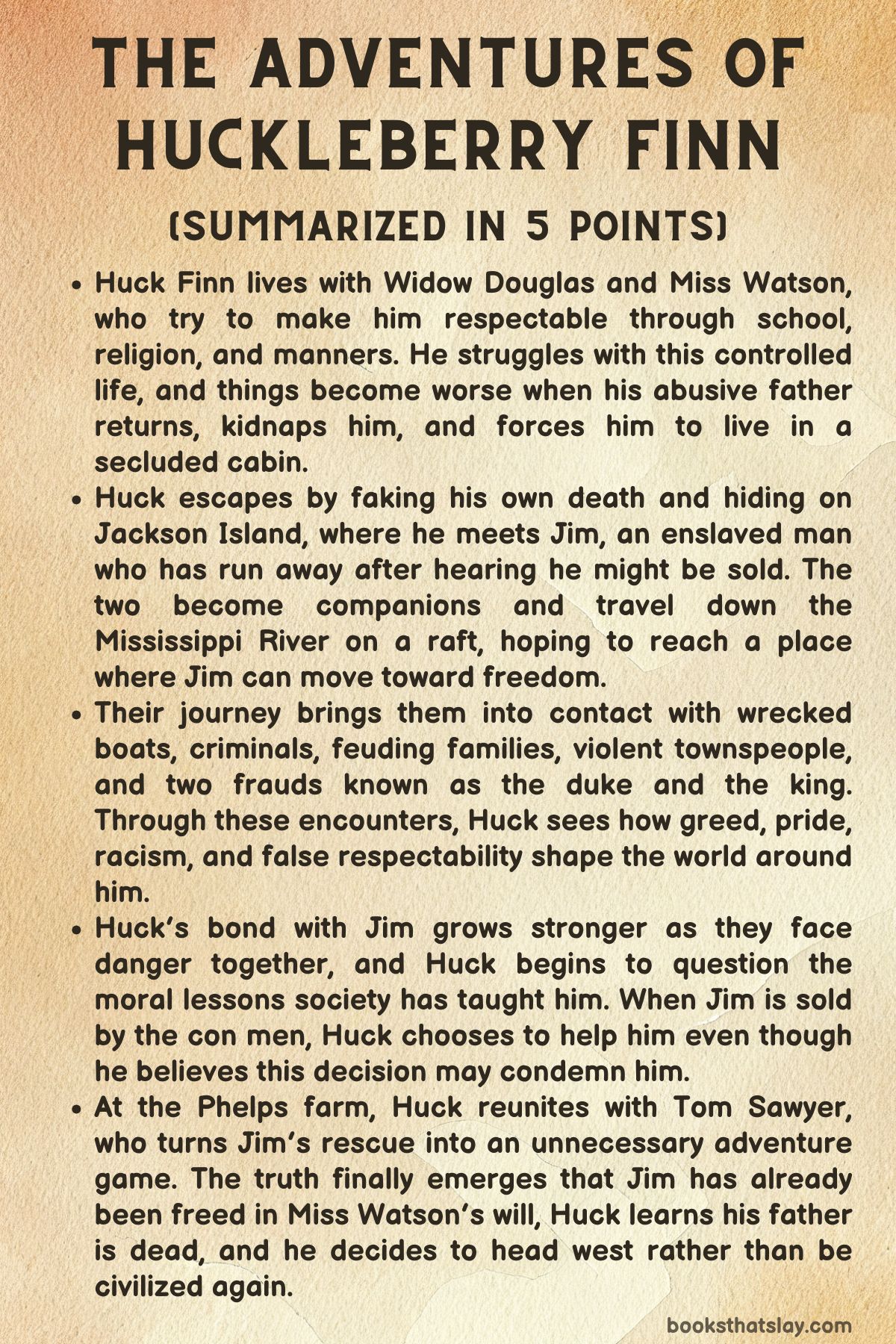
Characters
Huckleberry Finn
Huckleberry Finn is the narrator and moral center of The Adventures of Huckleberry Finn. He begins as a boy who resists rules because they feel false, uncomfortable, and unnatural, but his rebellion is not merely childish misbehavior.
Huck has been shaped by neglect, poverty, violence, and social rejection. Because he has lived outside respectable society, he can often see its contradictions more clearly than those who belong to it.
He is practical, observant, quick-thinking, and skilled at survival, especially on the river. His greatest development comes through his relationship with Jim.
Huck has absorbed racist and religious ideas from his community, and he initially believes helping Jim escape is a sin. Yet his lived experience with Jim teaches him a deeper moral truth than the one society has given him.
Huck’s decision to help Jim, even when he believes it may condemn him, shows that his conscience has grown beyond the false ethics of his world. He is not perfect; he lies often, plays tricks, and sometimes follows Tom’s foolishness.
Still, he learns from shame, pity, loyalty, and affection. His voice gives the book its plain force: he rarely speaks like a philosopher, but his observations expose cruelty, hypocrisy, and moral confusion with unusual clarity.
Jim
Jim is one of the most important and humane figures in the book. He is introduced as Miss Watson’s enslaved man, but the story gradually reveals his intelligence, loyalty, emotional depth, and longing for family.
Jim runs away because he fears being sold downriver, a fate that would cut him off from the people he loves and place him in harsher conditions. His desire for freedom is not abstract; it is tied to his wife, his children, and his right to own himself.
Jim often speaks through superstition, signs, and folk belief, but the book never reduces him to foolishness. In many situations, he is cautious, perceptive, and morally stronger than the people around him.
He protects Huck from seeing his father’s corpse, forgives Huck after being hurt by him, and risks his freedom to help Tom after Tom is shot. His grief over punishing his daughter Elizabeth before realizing she was deaf reveals him as a loving father haunted by remorse.
In The Adventures of Huckleberry Finn, Jim’s humanity challenges the racist assumptions of the society that treats him as property. He becomes Huck’s friend, guardian, companion, and moral teacher.
Tom Sawyer
Tom Sawyer represents imagination without responsibility. He is clever, energetic, and confident, but his ideas about adventure come from books rather than reality.
Tom enjoys rules when they make life more dramatic, not when they make life more ethical. Early in the story, his robber gang shows his love of oaths, secrets, ransom, and theatrical danger, even though he barely understands the concepts he imitates.
Later, when Jim is held at the Phelps farm, Tom turns a simple rescue into an elaborate performance. This is where his flaws become serious.
Because he knows Jim has already been freed, Tom’s schemes are not only silly but cruel. He makes Jim suffer for the sake of style.
Tom is not presented as evil; he is brave, loyal to Huck in his own way, and full of charm. But his imagination is morally immature.
He values adventure as a game and fails to grasp the real cost paid by others. In The Adventures of Huckleberry Finn, Tom serves as a contrast to Huck: Tom follows stories, while Huck slowly learns to follow conscience.
Widow Douglas
Widow Douglas is Huck’s guardian and one of the first representatives of respectable society in the story. She is kind in intention and genuinely wants Huck to live safely, attend school, dress properly, and accept religion.
Her home offers comfort, food, and protection, but Huck experiences it as confinement. She is not cruel like Pap, nor cold in the way Miss Watson can be, yet her efforts to civilize Huck fail because she does not understand his need for independence.
Widow Douglas represents the softer side of social order. She believes she is saving Huck, and in practical terms she does offer him a better life than the one Pap provides.
However, the book also shows that even well-meaning authority can feel oppressive when it leaves no room for a child’s nature, history, and pain. Her role is important because Huck’s rejection of civilization is not a rejection of kindness alone; it is a rejection of a whole structure that mixes care, control, religion, manners, and racial injustice.
Miss Watson
Miss Watson is stricter and more severe than Widow Douglas. She teaches Huck religion, prayer, manners, and obedience, but she often does so in a scolding way that makes virtue seem joyless.
Her role is morally complicated because she is also Jim’s enslaver. She can speak about spiritual goodness while considering the sale of Jim for money.
This contradiction is central to the society Twain criticizes. Miss Watson’s decision to free Jim in her will comes late, and it matters, but it does not erase the damage caused by her ownership of him or the fear that drives him to run away.
To Huck, she represents a version of religion that is difficult to understand and hard to trust. She wants him to pray for spiritual gifts, but he sees little practical value in what she teaches.
Through Miss Watson, the book shows the gap between religious language and moral action.
Judge Thatcher
Judge Thatcher is the respectable legal guardian of Huck’s money. He is cautious, responsible, and protective, especially when Huck tries to give away his fortune because he fears Pap’s return.
The judge understands enough to make a token transaction that keeps the money safe. He also joins Widow Douglas in trying to remove Huck from Pap’s control.
Yet the legal system fails Huck when a new judge refuses to separate father and son. Judge Thatcher’s role shows both the usefulness and limits of social institutions.
Individually, he is decent and wants to protect Huck. Structurally, however, the law cannot always recognize danger quickly enough, especially when it is blinded by conventional respect for parental rights.
Pap Finn
Pap Finn is Huck’s father and one of the clearest images of domestic violence, ignorance, racism, and moral decay in the book. He resents Huck’s education because it threatens his own sense of superiority.
He wants Huck’s money not to care for him but to buy alcohol. His speeches are bitter, self-pitying, and hateful, especially when he complains about government and social change.
Pap’s violence turns Huck’s desire for freedom into a matter of survival. He kidnaps Huck, locks him in a cabin, beats him, and nearly kills him during a drunken hallucination.
Yet Pap is also pathetic in appearance and condition, which makes him both frightening and degraded. His death, revealed only at the end, frees Huck from one of the story’s deepest threats.
Pap is not only a bad father; he is a symbol of a society that grants power to the unworthy while failing to protect the vulnerable.
Jim Turner
Jim Turner is one of the criminals on the wrecked steamboat. He has betrayed or angered his companions, Bill and Jake Packard, and is tied up while they decide his fate.
Though he appears briefly, his situation pushes Huck into a moral test. Huck does not like criminals, but he is disturbed by the thought of leaving Turner and the others to drown.
Turner’s presence helps show that Huck’s conscience responds even to people who may not deserve sympathy. The episode also adds danger to the river journey and shows that violence and greed are not confined to towns or families; they drift through the wider world Huck and Jim are trying to navigate.
Bill
Bill is one of the criminals on the wrecked steamboat. He is practical, dangerous, and willing to let Jim Turner die indirectly rather than risk a direct killing.
His logic is cold: leaving a man tied up on a sinking wreck allows him to avoid the emotional and legal burden of murder while still achieving the same result. Bill represents a kind of cowardly brutality.
He is not wild with rage; he is calculating. Through him, the book shows how people can commit evil while pretending they have kept their hands clean.
Jake Packard
Jake Packard is Bill’s partner in crime and another figure in the steamboat episode. Like Bill, he is prepared to abandon Jim Turner to death.
His role is brief but important because he helps create one of the first serious moral situations Huck faces after joining Jim. Jake belongs to a world of theft, suspicion, and betrayal, where loyalty among criminals collapses quickly.
His presence reinforces the danger of the adult world Huck keeps encountering: men form groups, make plans, and justify cruelty when it serves their interests.
Judith Loftus
Judith Loftus is the woman Huck meets while disguised as a girl. She is intelligent, observant, talkative, and kinder than Huck first expects.
Though new to town, she knows the gossip about Huck’s supposed murder and Jim’s escape. She quickly detects that Huck is not really a girl by noticing how he moves, throws, catches, and threads a needle.
Yet she does not expose him harshly. Instead, she assumes he is an abused runaway apprentice and gives him advice.
Judith matters because she is one of the few adults who sees through Huck without becoming a direct threat. Her information allows Huck to save Jim from capture on Jackson Island.
Buck Grangerford
Buck Grangerford is a boy about Huck’s age and becomes Huck’s friend during the Grangerford episode. He is lively, welcoming, and eager for companionship, but he has been raised inside a culture of inherited violence.
Buck accepts the feud with the Shepardsons even though he does not understand its origin. He can be friendly and playful one moment, then ready to shoot at Harney Shepardson the next.
His death is one of the story’s most painful events because he is still a child, shaped by adult hatred before he has the maturity to question it. Huck’s grief over Buck shows how senseless violence destroys the young as well as the guilty.
Colonel Grangerford
Colonel Grangerford is the head of the Grangerford family. He appears dignified, brave, wealthy, and respected.
Huck admires his bearing and the order of his household. Yet the Colonel is also deeply committed to the feud, praising violence as family honor.
His refinement does not prevent brutality. This contradiction is central to the Grangerford episode: a family can own fine things, attend church, speak politely, and still participate in murder.
Colonel Grangerford represents the dangerous union of gentility and violence. His death in the feud reveals the emptiness of the honor code he upholds.
Bob Grangerford
Bob Grangerford is one of Colonel Grangerford’s sons. Though he receives less individual attention than Buck or the Colonel, he belongs to the armed male structure of the family.
His role shows how the feud consumes generations of Grangerford men. Bob is part of a household where masculinity is tied to readiness for violence.
His death in the conflict following Sophia’s escape with Harney confirms that the feud is not romantic or noble; it is a machine that destroys sons, brothers, and fathers.
Tom Grangerford
Tom Grangerford, one of the Grangerford sons, should not be confused with Tom Sawyer. Like Bob, he is part of the family’s violent code.
He exists mainly within the collective identity of the Grangerford men, who are proud, armed, and loyal to a feud whose origins have become almost irrelevant. His fate helps complete the image of a family ruined by customs it refuses to question.
Through Tom Grangerford, the book shows how inherited hatred can make individuals less important than the role they are expected to play.
Charlotte Grangerford
Charlotte Grangerford is one of the Grangerford daughters. She belongs to a household that prizes elegance, family pride, and social standing while living under the shadow of violence.
Though she is less central than Sophia, Charlotte helps show the domestic side of the family. The women of the Grangerford home preserve manners, memory, and hospitality, yet they are surrounded by the consequences of the men’s feud.
Charlotte’s presence adds to the contrast between household refinement and moral disorder.
Sophia Grangerford
Sophia Grangerford is quiet, secretive, and determined. Her decision to run away with Harney Shepardson breaks the surface peace between the families and triggers renewed bloodshed.
Sophia’s love for Harney suggests that private feeling can challenge inherited hatred, but her escape also leaves others to face the consequences. She uses Huck to retrieve the message hidden in her Bible, drawing him unknowingly into the feud.
Sophia is not portrayed as malicious; she is a young woman trying to choose love over family war. Still, her action exposes how fragile the social order around her is.
The feud is so ready to explode that one marriage attempt leads to death.
Harney Shepardson
Harney Shepardson is the young man Sophia Grangerford loves and runs away with. He is first seen as an enemy target when Buck shoots at him, yet his relationship with Sophia complicates the idea that the two families are naturally opposed.
Harney’s escape with Sophia suggests the possibility of peace through personal bonds, but the families respond with violence instead. He remains less developed than Sophia, but his role is important because he proves that the feud is not inevitable at the level of individual feeling.
The younger generation can cross the boundary, though the older codes punish that crossing.
Jack
Jack is the enslaved man assigned to Huck during his stay with the Grangerfords. He appears helpful, discreet, and resourceful.
He secretly leads Huck to Jim, who has been hiding nearby. Jack’s role shows the hidden networks of knowledge and assistance among enslaved people.
While the white families are absorbed in pride and violence, Jack quietly helps preserve Huck and Jim’s connection. His actions are understated but meaningful.
He understands danger and moves carefully within it, helping without drawing attention to himself.
Betsy
Betsy is a servant in the Grangerford household. Her role is small, but her presence helps establish the wealth and social structure of the family.
The Grangerfords’ gentility depends on enslaved labor, even while the household presents itself as refined and honorable. Betsy reminds the reader that the family’s comfort rests on racial power.
Like other minor enslaved figures in the book, she is not given much space to speak, but her presence matters because it reveals the social foundation beneath the family’s polished surface.
Emmeline Grangerford
Emmeline Grangerford is dead before Huck arrives, but her presence fills the Grangerford home. She wrote poetry, made drawings, and kept a scrapbook focused on death, especially the deaths of young people.
Huck is impressed by the family’s devotion to her memory, though the book treats her art with satire. Emmeline represents sentimental culture that aestheticizes death while the living family continues to produce real death through the feud.
Her preserved room and mournful works show a household obsessed with loss but unable to stop the violence that causes it.
The Shepardson Family
The Shepardsons are the rival family in the feud with the Grangerfords. They are described as equally rich, proud, brave, and socially important.
Their role is to mirror the Grangerfords, showing that both sides share the same values and the same blindness. Neither family can clearly explain the origin of the feud, yet both continue killing.
The Shepardsons are not presented as simple villains; they are part of a shared culture of honor, revenge, and inherited violence. Their conflict with the Grangerfords becomes one of the book’s strongest attacks on romanticized Southern codes.
The Duke
The duke is a con man who joins Huck and Jim on the raft after fleeing pursuit. He is younger than the king, theatrical, opportunistic, and quick to invent schemes.
He claims to be the rightful Duke of Bridgewater and expects others to treat him with noble respect. His frauds include printing fake notices, staging performances, and helping impersonate the Wilks brothers.
The duke is more organized than the king in some ways, especially with printing and planning, but he is equally dishonest. He can be comic, yet his comedy turns ugly because his schemes endanger Jim and exploit grieving families.
He represents educated fraud: someone who uses language, performance, and social expectations to manipulate others.
The King
The king is the older of the two major con men. He claims to be the lost heir of French royalty, outdoing the duke’s false claim.
He is shameless, greedy, and skilled at emotional performance. At the revival meeting, he pretends to be a reformed pirate and extracts money from the crowd.
In the Wilks fraud, he performs grief so aggressively that the community accepts him as Harvey Wilks. The king’s power lies in his ability to exploit people’s trust, pity, and religious feeling.
He is often ridiculous, especially when drunk, but he becomes genuinely harmful when he sells Jim for forty dollars. His betrayal shows the full danger of selfishness without conscience.
Boggs
Boggs is a drunken man in Bricksville who publicly insults Colonel Sherburn. The townspeople treat him as entertainment because his behavior is familiar and seemingly harmless.
Boggs’s death changes the tone of the scene from rough comedy to public horror. He pleads for his life before Sherburn shoots him.
Boggs is not a major figure, but his death exposes a society that enjoys disorder until it becomes violence. The crowd’s earlier amusement turns into outrage, but that outrage is unstable and performative.
Colonel Sherburn
Colonel Sherburn is cold, proud, and commanding. After Boggs insults him, Sherburn waits until his stated limit has passed and then shoots him in public.
When a lynch mob forms, Sherburn faces it alone and shames it into retreat. His speech about mob cowardice is sharp and memorable, but it does not make him morally admirable.
He is brave, but he is also a killer. Sherburn exposes the cowardice of crowds while embodying another kind of violence: individual arrogance backed by social power.
He is one of the book’s most unsettling minor figures because he is both perceptive and cruel.
Boggs’s Daughter
Boggs’s daughter appears in the aftermath of her father’s shooting. She arrives too late to save him and mourns over his body.
Her role gives emotional weight to a scene that the townspeople had treated as spectacle. Through her grief, Boggs stops being merely the town drunk and becomes a father whose death wounds someone deeply.
She reminds the reader that public violence always leaves private suffering behind.
The Ringmaster
The ringmaster appears during the circus scene Huck attends. Huck believes the ringmaster is being tricked by the drunken man who enters the ring and demands to ride a horse.
In reality, the act is staged, and the ringmaster is part of the performance. His role matters because it reveals Huck’s innocence in certain social situations.
Huck is observant, but he can still mistake performance for reality. The ringmaster belongs to the wider pattern of staged identities in the book, though in this case the deception is harmless entertainment rather than fraud.
The Circus Acrobat
The circus acrobat pretends to be a drunk man who recklessly rides a horse before revealing his skill. Huck is amazed and worried for him, not realizing at first that the danger is controlled.
This character briefly reflects one of the book’s central concerns: people are often not what they appear to be. Unlike the duke and king, however, the acrobat’s deception is part of a public show rather than an immoral scheme.
His scene also reveals Huck’s youthful sincerity.
The Clown
The clown at the circus entertains the crowd by mocking and bothering the ringmaster. Huck takes the act at face value, believing the clown is genuinely irritating the man in charge.
The clown’s role is small, but it strengthens the circus as a space of comic illusion. He also provides a lighter version of the book’s larger pattern of performance, disguise, and mistaken interpretation.
Peter Wilks
Peter Wilks is dead before the Wilks episode begins, but his death creates the opportunity for the duke and king’s most serious fraud. His wealth, family ties, and expected brothers become tools for deception.
Peter’s character is known mainly through the trust and grief of his daughters and the inheritance he leaves behind. The treatment of his body, especially when Huck hides the gold in his coffin and the crowd later digs it up, shows how greed and suspicion violate even death.
Peter represents family memory and property, both of which are exploited by con men.
Mary Jane Wilks
Mary Jane Wilks is one of the most admirable figures in the book. She is trusting, generous, emotionally open, and deeply loyal to her family and servants.
Her grief is sincere, and her kindness affects Huck strongly. She gives the supposed uncles control of the money because she believes in family duty, not because she is foolish by nature.
Huck’s decision to help expose the fraud comes largely from his respect for her goodness. Mary Jane also mourns the separation of the enslaved family sold by the duke and king, showing a capacity for compassion that exceeds the moral blindness of many around her.
She helps awaken Huck’s protective conscience in a new way.
Joanna Wilks
Joanna Wilks, the youngest Wilks sister, is sharp, suspicious, and direct. She questions Huck about England and notices the weaknesses in his lies.
Her skepticism contrasts with her sisters’ trusting nature. Yet she is not cruel; when her sisters defend Huck, the emotional pressure of the household makes Huck feel guilty.
Joanna’s role is important because she nearly exposes the fraud through ordinary intelligence. She shows that innocence and suspicion can coexist in a child, and that Huck’s lies are not always as secure as he thinks.
Susan Wilks
Susan Wilks is one of the Wilks sisters and shares in the family’s grief, trust, and vulnerability. She is less individually developed than Mary Jane and Joanna, but she helps create the emotional setting that makes the fraud so ugly.
Susan’s faith in the false uncles shows how easily good people can be manipulated when grief and family feeling are used against them. Her presence also increases Huck’s guilt, because the fraud is not against an abstract estate but against living people who have welcomed him.
Doctor Robinson
Doctor Robinson is the main skeptic during the Wilks fraud. He recognizes that the king’s English accent and behavior are false, and he warns the family and townspeople not to trust the supposed brothers.
His judgment is sound, but the community rejects him because emotional performance is more persuasive than reason. Doctor Robinson represents clear-eyed intelligence in a crowd that prefers sentiment.
His failure to convince others shows how truth can be powerless when people want to believe a comforting lie.
The Wilks Family Lawyer
The Wilks family lawyer helps test the competing claims of the false and real brothers. By comparing handwriting and pressing for evidence, he represents legal reason and procedure.
Yet even this process becomes tangled because neither side can produce simple proof quickly. His role shows that truth in public life often depends not only on facts but on timing, documents, performance, and crowd judgment.
He is a stabilizing figure, but not strong enough by himself to resolve the confusion immediately.
Harvey Wilks
The real Harvey Wilks arrives after the duke and king have already taken control of the family’s trust. He is Peter Wilks’s actual brother and must prove his identity in a town already divided by deception.
His arrival shifts the episode from private fraud to public trial. Harvey’s difficulty in proving the truth shows how much damage a successful lie can do before facts appear.
Though he is not deeply developed as a personality, he represents rightful kinship and truth struggling against theatrical fraud.
William Wilks
William Wilks is Peter Wilks’s other real brother. He is described as deaf and unable to speak, which makes it harder for him and Harvey to prove their identities quickly.
His condition has been used by the duke, who pretends to be him in the fraud. William’s role shows the cruelty of impersonation: the duke does not merely steal a name but turns a person’s disability into a tool for profit.
The real William’s arrival exposes how low the con men are willing to sink.
Sally Phelps
Sally Phelps is Tom Sawyer’s aunt and Silas Phelps’s wife. She mistakes Huck for Tom and welcomes him warmly.
Sally is affectionate, anxious, talkative, and deeply concerned when the boys go missing. She represents domestic kindness, but also the ordinary moral blindness of slaveholding society.
She can care intensely for Tom while accepting Jim’s captivity as normal. During Tom and Huck’s schemes, she becomes confused by missing household items and strange events, often blaming the wrong causes.
Sally is comic in these domestic scenes, but her household is also the place where Jim is imprisoned, which complicates the warmth she offers.
Silas Phelps
Silas Phelps is Sally’s husband, a farmer and preacher-like figure who holds Jim while trying to identify his owner. He is not portrayed as personally cruel, but he participates in the system that treats Jim as property.
Silas is trusting and somewhat slow to understand the boys’ deception. His decency within his own moral framework makes him more unsettling, because he shows how ordinary goodness can coexist with injustice.
He is not a villain in the dramatic sense, but his actions help sustain Jim’s captivity.
Nat
Nat is the servant who brings Jim his meals while Jim is imprisoned at the Phelps farm. He is superstitious and frightened by the strange events Tom and Huck create around Jim’s hut.
Tom manipulates Nat’s fear of witches to carry out the escape plan. Nat’s role is often comic, but it also shows how Tom’s games affect more than Jim alone.
Nat is another vulnerable person drawn into confusion by the boys’ unnecessary theatrics. His fear is used rather than respected.
The Black Woman at the Phelps Farm
The Black woman at the Phelps farm appears when Huck is surrounded by barking dogs. She and her children help restrain the dogs before Sally arrives.
Her role is brief, but she contributes to Huck’s safe entrance into the household. Like several minor Black characters in the book, she performs practical care while remaining socially powerless in the background of white domestic life.
Her presence reminds the reader that the Phelps household depends on Black labor and attention even while holding Jim captive.
The Children at the Phelps Farm
The children who appear with the Black woman at the Phelps farm help manage the dogs and form part of the busy domestic setting into which Huck is mistakenly welcomed. Their role is minor, but they help show the household as a living social space rather than only a prison site.
Their presence also adds to the contrast between ordinary family life and the injustice occurring nearby. The same yard that contains children and daily routines also contains Jim’s confinement.
The Doctor at the Phelps Farm
The doctor is called after Tom is shot. He treats Tom and later speaks in Jim’s defense, explaining that Jim helped care for the injured boy instead of escaping.
The doctor’s testimony prevents the men from treating Jim even more harshly. He is important because he recognizes Jim’s courage and loyalty at a moment when others see Jim mainly as a captured runaway.
Still, his defense has limits. He praises Jim as unusually good without fully challenging the system that made Jim a prisoner in the first place.
Aunt Polly
Aunt Polly arrives near the end and exposes the real identities of Huck and Tom. Her appearance clears up the confusion at the Phelps farm and restores social order.
She also reveals that Tom had been intercepting letters, which explains why Sally and Silas were unprepared for the truth. Aunt Polly represents adult authority from Tom’s home world.
Unlike many adults in the book, she understands Tom well enough to see through his mischief. Her arrival ends the boys’ masquerade and forces explanation.
Elizabeth
Elizabeth is Jim’s daughter. She appears only through Jim’s memory, but that memory is one of the most moving character revelations in the story.
After Elizabeth recovers from scarlet fever, Jim tells her to do something and becomes angry when she does not respond. He strikes or punishes her, only to realize that the illness has left her deaf.
His grief over this moment shows his deep love and guilt as a father. Elizabeth’s role is crucial because she helps Huck, and the reader, see Jim not as an abstract runaway but as a parent with painful memories and strong family bonds.
Jim’s Wife and Children
Jim’s wife and children are mostly absent physically, but they drive much of Jim’s hope. His plan after reaching freedom is to work, save money, and buy his family out of slavery.
If that fails, he imagines taking more desperate measures to reunite with them. Their importance lies in what they reveal about slavery’s cruelty: it threatens not only individual liberty but family unity.
Jim’s longing for them gives moral urgency to the journey. They are the emotional destination behind his search for freedom.
The New Judge
The new judge is the official who refuses to remove Huck from Pap’s custody. He believes in reforming Pap and gives him a chance, even taking him into his home.
His intentions may be charitable, but his judgment is dangerously naive. He values a sentimental idea of family and redemption over Huck’s safety.
When Pap returns to drinking almost immediately, the judge’s failure becomes clear. This character shows how respectable authority can make harmful decisions when it trusts appearances and principles more than evidence.
The Young Man at the Steamboat Landing
The young man at the landing gives the king the information needed to impersonate Harvey Wilks. He is talkative, trusting, and unaware of the harm his gossip will cause.
His role is a reminder that fraud often depends on careless speech as much as deliberate evil. By freely sharing family details with strangers, he unintentionally opens the door to the Wilks deception.
He is not malicious, but his innocence is costly.
The Revival Preacher
The revival preacher leads the religious meeting where the king stages his false repentance as a pirate. The preacher’s emotional control over the crowd creates the opportunity for the king’s performance.
He is sincere within the scene, but he is also easily deceived by public displays of repentance. His role shows how religious feeling can be manipulated when emotion replaces discernment.
The preacher helps create a space where the king can turn fake guilt into money.
The Night Watchman
The night watchman is the man Huck approaches after escaping the wrecked steamboat. At first he is reluctant to help, but Huck changes his attitude by inventing a story involving a prominent family.
The watchman’s response reveals how social status affects moral urgency. He becomes willing to act when he believes wealthy or important people are in danger.
His small role adds to Twain’s criticism of a society that often values rank over human life.
Themes
Freedom and the Meaning of Self-Ownership
Freedom in The Adventures of Huckleberry Finn is not treated as a simple wish to escape rules; it has different meanings depending on who is seeking it. For Huck, freedom begins as relief from school, manners, clean clothes, prayers, and adult control.
His idea of liberty is physical and personal: the ability to smoke, fish, sleep outdoors, move when he wants, and avoid being beaten or “civilized.” For Jim, freedom is far more urgent. It means ownership of his own body, protection from sale, and the possibility of reuniting with his wife and children.
The contrast between Huck’s freedom and Jim’s freedom gives the story much of its moral power. Huck is escaping discomfort and abuse, but Jim is escaping a legal system that denies his humanity.
As the two travel together, Huck slowly learns that Jim’s desire for freedom is not a crime but a deeply human claim. Jim’s statement that he “owns himself” captures the theme clearly.
The book argues that real freedom is not granted by social approval; it begins with the recognition that no person has the moral right to possess another.
Conscience Against Social Morality
Huck’s greatest conflict is not between good and evil as society defines them, but between what he has been taught and what he comes to know through experience. His community has trained him to believe that helping Jim escape is theft because Jim is legally Miss Watson’s property.
Huck accepts this idea for much of the story, which is why his conscience troubles him. Yet his actual relationship with Jim tells him something different.
Jim is kind, loyal, frightened, loving, and fully human. The more Huck knows him, the harder it becomes to treat the law as morally right.
This conflict reaches its strongest point when Huck considers writing to Miss Watson. By social standards, returning Jim would be the “right” thing.
By human standards, it would be betrayal. Huck’s decision to help Jim even at the cost of damnation is powerful because Huck still misunderstands the moral meaning of his action.
He thinks he is choosing sin, but the reader sees that he is choosing loyalty, compassion, and justice. The theme shows that conscience may become truer than the moral rules taught by a corrupt society.
Hypocrisy in Religion, Respectability, and Civilization
The story repeatedly exposes the gap between what society claims to value and how people actually behave. Many characters speak the language of religion, manners, family honor, law, and respectability, yet their actions reveal cruelty, greed, cowardice, or indifference.
Miss Watson teaches Huck religion while owning Jim. The Grangerfords attend church with guns and listen to a sermon about brotherly love while continuing a deadly feud.
The revival crowd gives money to the king because his false repentance sounds moving. The Wilks community trusts the fake brothers because their grief appears convincing, while the doctor’s reasonable warning is dismissed.
Sally and Silas Phelps are warm and caring toward Tom and Huck, yet they accept Jim’s imprisonment as ordinary. Through these contradictions, the book challenges the idea that civilization is automatically moral.
Huck often seems uncivilized by social standards, but he is frequently more honest and humane than the people who claim to be respectable. The theme does not reject kindness, order, or faith themselves.
It rejects the false version of civilization that protects appearances while tolerating injustice.
Performance, Deception, and False Identity
Nearly everyone in the story performs some version of an identity, and these performances range from playful to dangerous. Huck survives by lying and taking on false names.
He dresses as a girl, calls himself George Jackson, and later pretends to be Tom Sawyer. Some of his deceptions protect himself or Jim, while others create confusion.
Tom Sawyer performs the role of romantic adventurer, shaping real events according to books rather than practical need. The duke and king turn performance into exploitation.
They pretend to be royalty, actors, repentant sinners, and grieving brothers, using people’s trust and expectations to steal money. Even the circus scene plays with false appearance, as a skilled acrobat pretends to be drunk and helpless.
These repeated disguises ask the reader to judge not only whether a person is lying, but why the lie is being told and whom it harms. Deception in the book can be a survival tool for the powerless or a weapon for the greedy.
The moral difference lies in purpose. Huck’s lies often protect life; the con men’s lies feed selfishness.