The Somewhat Wicked Witch of Brigandale Summary, Characters and Themes
The Somewhat Wicked Witch of Brigandale by C. M. Waggoner is a comic fantasy about a witch, an abandoned prince, and the trouble that follows when destiny refuses to mind its own business. The story follows Gretsella, a sharp-tongued witch who unexpectedly becomes the mother of Bradley, a royal baby left at her door.
What begins as a fairy-tale setup soon turns into a playful challenge to ideas of monarchy, heroism, family, and duty. With witches, knights, curses, politics, romance, and jokes, the book tells a warm, funny story about choosing the life that truly fits.
Summary
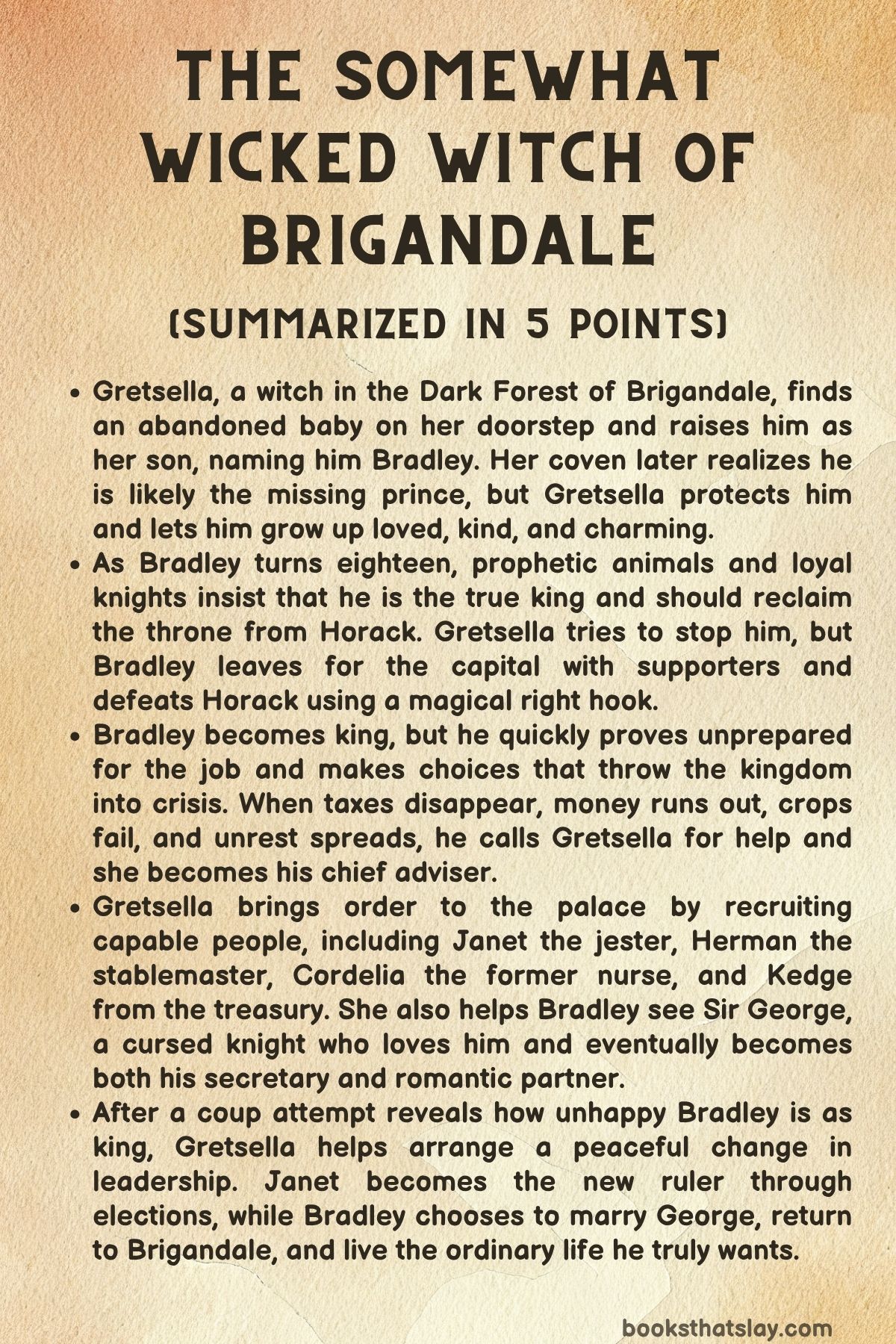
Gretsella is a witch who lives in the Dark Forest of Brigandale, where she enjoys her quiet, independent life and has little patience for foolishness. One Wednesday, she comes home to find a baby abandoned on her doorstep.
The child has been left with a note saying he should be placed in her care. Gretsella is not the sort of person who expected to become a mother, and she certainly does not welcome the interruption at first.
Still, she takes the baby inside, cares for him, and names him Bradley.
Her attachment to Bradley grows quickly, even though she would rather not admit how much she loves him. When soldiers come searching for a strange baby, Gretsella refuses to surrender him.
She insists that Bradley belongs to her and drives the soldiers away. Later, when she gathers her coven for Bradley’s naming, the other witches begin to understand who the child may really be.
They realize he is probably the missing prince. His mother, the queen, died after giving birth to him, his father, King Weltham, was killed, and his great-uncle Horack has taken the throne.
The witches respond to this discovery in their own magical fashion. During Bradley’s naming, they give him blessings.
He receives beauty, politeness, and a powerful right hook. These gifts shape the young man he becomes.
Bradley grows up handsome, kind, and easy to love. He is also not especially thoughtful, and Gretsella often has to manage the consequences of his simple, trusting nature.
Though he is sweet and good-hearted, he is not suited to every task placed before him.
As Bradley grows older, he tries to find useful work. Blacksmithing does not suit him, and office work does not go well either.
Eventually, he becomes a hairdresser, and this turns out to be the perfect occupation for him. He enjoys it, he is good at it, and it lets him live a pleasant life in Brigandale.
Gretsella would be content for things to stay this way. Bradley is happy, and she has no interest in royal politics or heroic destiny.
Everything changes when Bradley turns eighteen. Prophetic animals begin appearing and announcing that he is the true king.
Gretsella tries to stop these messages before Bradley takes them seriously, but the signs keep coming. Singing mice, knights, and finally the handsome Sir Harold all encourage Bradley to reclaim the throne that was stolen from him.
Bradley, being kind, handsome, and easily persuaded by grand ideas, begins to believe he has a duty to go to the capital and take back his kingdom.
Gretsella tries to talk him out of it. She knows Bradley well enough to understand that being king is unlikely to make him happy.
Still, Bradley decides to leave. Before he goes, Gretsella gives him a magical toadaphone so they can speak to each other from a distance.
Bradley travels to the capital with loyal knights and confronts Horack. Thanks to the powerful right hook gifted to him by one of the witches, Bradley knocks Horack out and successfully takes the throne.
He is crowned king.
At first, this seems like the proper fairy-tale ending, but it quickly becomes clear that Bradley is not fit for ruling. He wants everyone to be happy, so he cancels all taxes.
This makes people cheer, but it soon causes serious problems. The treasury runs dry, crops fail, peasants crowd into the capital looking for help, and nobles begin to threaten rebellion.
Bradley is overwhelmed and miserable. He does not understand the practical demands of government, and his good intentions make the kingdom less stable rather than better.
When Bradley finally contacts Gretsella through the toadaphone, she sees the seriousness of the situation. She also sees that Bradley needs her, even if he has to be guided into admitting it.
Through careful wording, she gets him to ask her to come to the capital and serve as his chief adviser. Gretsella arrives ready to take control of the disorder around him.
Her arrival is not smooth. At the palace gate, she is arrested and thrown into a dungeon.
This does not stop her for long. Gretsella turns herself into a mouse and escapes.
During this escape, she meets Janet, the fired court jester. Gretsella quickly recognizes that Janet has sharp instincts and a witchlike talent for understanding people and shaping events.
She gets Janet rehired, seeing that the young woman could be useful to both Bradley and the kingdom.
Gretsella then begins studying the palace from the inside. She investigates the kitchen and questions Prune, the cook, discovering how badly the household is being run.
She understands that Bradley cannot rule alone, so she starts building a council of practical and capable people around him. She recruits Herman, the sensible stablemaster, whose plain advice is far more useful than the flattery of courtiers.
She also brings in Lady Cordelia, the former royal nurse who had originally left Bradley at Gretsella’s cottage, to bring order back to the palace.
Another important figure is Sir George, a cursed knight who has long admired Bradley from a distance. Because of his curse and the way others overlook him, Bradley has not truly noticed him.
Gretsella arranges for George to become visible to Bradley through Janet’s song. Once Bradley sees George properly, their connection grows.
George becomes Bradley’s secretary, supporter, and romantic companion. His kindness and loyalty give Bradley comfort in a court where many people want to use him.
Under Gretsella’s direction, the palace begins to improve. Kedge, a crooked but useful former treasury official, helps repair the kingdom’s finances.
His methods include cutting costs and taxing luxuries, which are practical but unpopular with some of Bradley’s knights. Cordelia reorganizes the royal household, Janet manages public messaging, Herman offers grounded advice, and George helps Bradley manage the daily work of kingship.
Gretsella’s sharp mind and unwillingness to tolerate nonsense make her the strongest force holding the kingdom together.
Even with these improvements, Bradley remains unhappy. He does not like being king.
He dislikes the pressures, the conflicts, and the constant demands. The knights who once supported him become angry about the new taxes, and some of them bully George.
Cordelia, thinking of political stability, tries to arrange a marriage between Bradley and a foreign princess, even though Bradley’s heart is with George. At the same time, Bradley’s toad keeps making dark prophecies that he will destroy the kingdom.
These warnings add to the fear that his reign may end badly if something does not change.
Gretsella eventually oversteps in her efforts to manage affairs and is briefly confined to a comfortable dungeon. Even there, she remains far from helpless.
When a real coup breaks out, she escapes again by turning into a mouse. She helps Bradley and George survive the attack and soon discovers that Sir Harold and his brothers are behind the attempt to seize power.
The rebellion makes it clear that the kingdom cannot remain as it is. Bradley is not merely having a difficult start; he truly does not want the throne.
Bradley finally admits what he wants. He wants to stop being king, marry George, return home to Brigandale, play football, and work at the hair salon again.
These wishes are ordinary compared with royal glory, but they are honest. Gretsella understands that Bradley’s happiness matters more than forcing him into a role he never wanted and cannot perform well.
She begins planning a peaceful way to remove him from power without destroying the kingdom.
Janet proposes democracy as a solution. The idea is strange and risky in a kingdom used to monarchy, but it offers a way out.
Campaigns begin, and public opinion has to be shaped carefully. At first, the process does not go as planned.
Bradley accidentally wins an election, despite not wanting to rule. Janet then secretly engineers her own victory, using her intelligence, showmanship, and political instincts.
Bradley gives an emotional concession speech, and power passes to Janet. The transfer succeeds, allowing the kingdom to move forward under a ruler who actually wants the job.
At the farewell celebration, George proposes to Bradley, and Bradley accepts. Their future together becomes clear.
They plan to return to Brigandale and live in their own village house near Gretsella. Bradley will resume the life he loved: working as a hairdresser, playing football, and being close to the people who truly know him.
George will be with him as his future husband, no longer hidden or ignored.
Gretsella reacts in her usual gruff way. She accepts George as Bradley’s future husband and prepares for Bradley to live nearby again.
She does not openly admit how happy this makes her, but her actions reveal her love. The story ends with Bradley free from the throne, George accepted, Janet in power, and Gretsella able to keep her son close.
The Somewhat Wicked Witch of Brigandale closes not by celebrating royal destiny, but by showing that the best ending is the one where people are allowed to choose the lives that suit them.
Characters
In The Somewhat Wicked Witch of Brigandale by C. M. Waggoner, the characters are built around a playful reversal of fairy-tale expectations. Witches can be nurturing, kings can be helpless, knights can be foolish or tender, and the most practical people are often the ones ignored by official power.
The story uses comedy and magic to explore family, responsibility, identity, chosen love, and the difference between being born for a role and actually wanting it.
Gretsella
Gretsella is the emotional and practical center of the book. At first, she appears to fit the image of a frightening witch who lives in the Dark Forest, but her actions quickly reveal that her harshness is mostly a protective outer shell.
When she finds Bradley abandoned on her doorstep, she does not respond with sentimentality, but she still takes him in, names him, protects him, and raises him as her own. Her love is often expressed through irritation, sarcasm, and bossiness rather than open tenderness, yet the strength of that love is never in doubt.
She lies to soldiers, argues with knights, challenges royal authority, and crosses social boundaries because Bradley is her son in every meaningful sense. Gretsella is also one of the most intelligent characters in the story.
She understands people quickly, recognizes hidden talents in Janet, Herman, Cordelia, Kedge, and George, and builds a functioning government around practical ability rather than rank. Her character shows that love is not always soft or graceful; sometimes it is strategic, stubborn, and fiercely unwilling to let a child be destroyed by a destiny he never asked for.
Bradley
Bradley is the lost prince and later king, but his character is most interesting because he is not naturally suited to either heroic adventure or political rule. He is handsome, charming, polite, and kind, and these qualities make people love him easily.
However, he is also careless, impressionable, and often unable to think through the consequences of his choices. His decision to reclaim the throne is not driven by deep political conviction but by the pressure of prophecy, admiration, and fairy-tale expectation.
Once he becomes king, his kindness becomes a weakness because he tries to please everyone without understanding how a kingdom actually works. By cancelling taxes and making generous decisions without planning, he creates chaos despite having good intentions.
Bradley’s growth comes from slowly realizing that being good-hearted does not mean he must accept a role that makes him miserable. His desire to marry George, return home, play football, and work as a hairdresser shows that his real happiness lies in ordinary love and ordinary work.
Bradley’s character challenges the idea that birthright equals destiny and suggests that a person’s true life may be much smaller, simpler, and happier than the grand role others imagine for him.
Sir George
Sir George is one of the most tender and overlooked figures in the book. He begins as a cursed knight who has long admired Bradley but remains unseen and unrecognized, which makes him a symbol of quiet devotion and hidden worth.
Unlike the louder and more glamorous knights, George does not try to dominate Bradley’s attention through force or heroic performance. His love is patient, respectful, and steady.
Once Gretsella and Janet help make him visible to Bradley, George becomes not only a romantic companion but also a stabilizing presence in Bradley’s life. As Bradley’s secretary, he supports him practically, and as his beloved, he gives Bradley the emotional safety that the throne cannot provide.
George also suffers from the cruelty of others, especially the knights who bully him, but his gentleness is never presented as weakness. His proposal to Bradley at the farewell celebration completes one of the book’s most important emotional movements: Bradley is finally able to choose love freely, and George is finally seen, valued, and chosen in return.
Janet
Janet is one of the sharpest and most transformative characters in the story. She first appears as the fired court jester, but Gretsella quickly recognizes that Janet has instincts and abilities that resemble witchcraft.
Janet’s role as jester is important because she understands performance, language, public mood, and the power of shaping a story. Once she is rehired, she becomes essential to the political repair of the kingdom.
Through songs, messaging, and propaganda, she helps guide public opinion and eventually becomes the figure who makes democracy possible. Janet is playful, clever, and theatrical, but beneath that humor is a serious political intelligence.
She sees that the problem is larger than Bradley’s personal unhappiness; the kingdom needs a better system than hereditary rule. Her secret engineering of her own victory shows both ambition and competence.
Janet’s rise from dismissed entertainer to ruler suggests that wisdom can come from the margins and that those who understand people may govern better than those who merely inherit power.
Horack
Horack is the usurping great-uncle who takes the throne after the deaths of Bradley’s parents. He functions as the story’s early villain and as the figure who creates the political injustice that Bradley is expected to correct.
However, his role is less emotionally complex than Gretsella’s, Bradley’s, or Janet’s because he mainly represents the old fairy-tale problem of illegitimate power. He seizes authority through violence and opportunism, and his rule depends on removing or suppressing the rightful heir.
His defeat is comically simple: Bradley knocks him out with the magically gifted right hook. This makes Horack important not because he is a deeply developed ruler, but because he exposes the limits of the traditional fairy-tale ending.
Removing the bad king does not automatically create a good kingdom. Horack’s overthrow solves the first problem of the story, but it reveals a second and more complicated one: Bradley may be the rightful king, yet he is not the right person to rule.
Sir Harold
Sir Harold is charming, handsome, and persuasive, but he is also one of the story’s more deceptive figures. He initially appears to be part of the heroic machinery that pushes Bradley toward the throne, helping convince him that reclaiming kingship is noble and necessary.
However, Harold’s later involvement in the coup reveals the self-interest beneath his polished surface. He represents a dangerous kind of romance and chivalry: attractive, dramatic, and outwardly loyal, but ultimately invested in power and status.
Harold’s character contrasts strongly with George. Where George’s love is quiet and supportive, Harold’s appeal is public and performative.
Where George wants Bradley to be happy, Harold helps push Bradley into a role that makes him miserable and later participates in treachery when the political situation changes. Through Harold, the book mocks the traditional handsome knight figure and shows that charm is not the same as goodness.
Harold’s Brothers
Harold’s brothers extend the threat that Harold represents. They are part of the coup and therefore belong to the faction that treats the kingdom as something to be seized rather than cared for.
As a group, they embody the aggressive, entitled side of aristocratic and knightly culture. Their importance lies in the pressure they place on Bradley, George, and Gretsella during the crisis.
They help turn the palace’s existing dissatisfaction into open rebellion. Their actions also reveal how fragile Bradley’s rule has become and how quickly people who once supported a heroic restoration can become enemies when their own interests are threatened.
They are not as individually developed as Harold, but as a group they represent the violent backlash against reform and against Bradley’s attempt to move away from the expectations placed on him.
Lady Cordelia
Lady Cordelia is a practical and disciplined figure with a deep connection to Bradley’s past. As the former royal nurse who originally left him at Gretsella’s cottage, she is partly responsible for his survival.
Her decision to place Bradley with Gretsella suggests courage and judgment, because she chooses the person most likely to protect him rather than the most socially acceptable guardian. Later, Cordelia becomes essential in restoring order to the palace household.
She understands structure, discipline, and royal procedure in ways Bradley does not. However, she also represents conventional expectations, especially when she tries to arrange Bradley’s marriage to a foreign princess.
This makes her a layered character: she is loyal and competent, but she is not always emotionally attuned to Bradley’s real desires. Cordelia’s strength is order, but her limitation is that she sometimes mistakes proper royal arrangement for personal happiness.
Herman
Herman, the stablemaster, is one of the book’s clearest examples of practical wisdom. He does not hold a glamorous position, yet Gretsella recognizes that he has exactly the kind of sense the kingdom needs.
His value comes from experience, steadiness, and an understanding of how things actually work. In a palace full of nobles, knights, and officials, Herman stands out because he is grounded.
He is not intoxicated by rank or ceremony, and that makes him useful as an adviser. Through Herman, the story suggests that good governance depends not only on noble ideals but also on ordinary competence.
He represents the intelligence of working people, the kind of knowledge that formal power often ignores until everything begins falling apart.
Kedge
Kedge is morally imperfect but extremely useful. As a former treasury official with crooked tendencies, he is not presented as innocent or noble.
Yet Gretsella understands that his knowledge of money, loopholes, waste, and financial systems can be turned toward repairing the kingdom. Kedge’s character is interesting because he complicates the idea of virtue.
He is not admirable in a pure sense, but he is competent, and the story often values competence very highly. His work cutting costs and taxing luxuries helps solve the financial disaster caused by Bradley’s well-meaning mistakes.
Kedge shows that rebuilding a broken system may require people who understand its corruption from the inside. Gretsella’s use of him also demonstrates her talent for seeing how flawed people can still serve a necessary purpose when properly managed.
Prune
Prune, the cook, gives Gretsella important insight into how badly the palace is being run. Her role may seem small, but she helps reveal the disorder beneath the surface of royal life.
Kitchens often show the real condition of a household, and Prune’s situation makes clear that Bradley’s palace is not merely politically unstable; it is domestically and practically chaotic. Prune is important because she represents the workers who experience the consequences of bad leadership directly.
Through her, Gretsella learns that the kingdom’s problems are not abstract. They affect food, labor, organization, morale, and daily survival.
Prune helps turn Gretsella’s attention from grand political drama to the ordinary systems that keep a household and a kingdom functioning.
Barb
Barb is one of the witches in Gretsella’s circle and is important because she gives Bradley the powerful right hook that later allows him to defeat Horack. Her gift is comic, but it is also meaningful.
Instead of giving Bradley only beauty or politeness, Barb gives him a physical power that becomes decisive at the moment of confrontation. This blessing reflects the playful logic of the book, where magical gifts are both ridiculous and consequential.
Barb also represents the wider witch community that helps shape Bradley’s life. The witches do not fit the simple role of villains or outsiders.
They become protectors, godmother-like figures, and contributors to Bradley’s survival. Barb’s gift shows that even a strange or humorous blessing can become exactly what a person needs.
The Coven
Gretsella’s coven plays a collective role in Bradley’s early life and identity. When the witches gather for his naming, they recognize the likelihood that he is the missing prince and respond not by rejecting him but by blessing him.
Their presence expands the meaning of family in the book. Bradley is not raised by the royal court, but he is surrounded by a magical community that gives him affection, protection, and identity in its own strange way.
The coven also helps invert traditional fairy-tale morality. Witches, who are often expected to curse children, instead become the figures who bless and shelter him.
Their collective role reinforces one of the story’s central ideas: goodness is not tied to social respectability, and the people feared by society may be the ones most capable of love.
King Weltham
King Weltham is Bradley’s father and the murdered king whose death creates the political crisis behind the story. Although he does not appear as an active character in the main events, his absence shapes everything that follows.
His murder allows Horack to take power, and his identity gives Bradley the claim that others later urge him to accept. Weltham functions as part of Bradley’s inherited burden.
Because Bradley is his son, people assume he must reclaim the throne and restore the old royal line. Yet the story ultimately questions whether a father’s crown should determine a child’s future.
King Weltham is therefore important less as a developed personality and more as a symbol of lineage, loss, and the heavy expectations placed on Bradley before he is old enough to choose his own life.
Bradley’s Mother
Bradley’s mother, the queen, dies after childbirth, and like King Weltham, she is more important through absence than direct action. Her death makes Bradley vulnerable from the beginning and contributes to the chain of events that leads him to Gretsella’s doorstep.
She represents the lost royal family Bradley never knows. Yet the story does not make Bradley’s identity depend only on his biological parents.
Instead, it contrasts birth family with chosen and lived family. Bradley’s mother gives him royal origin, but Gretsella gives him upbringing, protection, and home.
The queen’s absence helps emphasize that parenthood in the book is defined not only by blood but by care.
The Prophetic Animals
The prophetic animals are comic forces of destiny. The singing mice and other announcing creatures push Bradley toward the throne by declaring him the true king.
They represent the fairy-tale voice of fate, the kind of magical certainty that usually sends heroes confidently toward their rightful endings. However, the book treats them with humor and suspicion.
Gretsella tries to stop them because she understands that prophecy does not necessarily know what is best for Bradley. The animals are important because they create pressure rather than wisdom.
They are technically correct about Bradley’s identity, but they are wrong to assume that kingship will bring happiness or stability. Through them, the story makes fun of the idea that destiny should automatically be obeyed.
The Toad
The magical toad, used as a toadaphone, is both a communication device and a source of ominous prophecy. Gretsella gives it to Bradley so they can stay connected, which makes it an object of maternal concern as much as magic.
However, its repeated warnings that Bradley will destroy the kingdom add anxiety and dark comedy to his reign. The toad’s prophecies reflect Bradley’s fear that he is failing and Gretsella’s fear that the royal role is harming him.
Like the other prophetic creatures, the toad shows that magical knowledge can be unsettling but not always straightforwardly helpful. Its importance lies in the way it keeps Bradley tied to Gretsella while also reminding the reader that the kingdom cannot continue as it is.
The Knights
The loyal knights who help Bradley reclaim the throne initially seem to belong to the heroic side of the story. They support the rightful heir and help remove Horack.
Yet once Bradley becomes king, the knights become more complicated. They dislike the new taxes, resist reforms, and bully George.
Their behavior reveals the selfishness and cruelty that can exist beneath chivalric language. They want the romance of restoration, but not the responsibility of practical government.
Their treatment of George also exposes their narrow ideas about strength and worth. As a group, the knights help the story criticize traditional heroic masculinity.
They may be brave in battle, but they are often childish, entitled, and unkind when asked to live in a fairer and more orderly system.
The Nobles
The nobles represent inherited privilege and political pressure. When Bradley’s rule becomes unstable, they threaten rebellion, showing that their loyalty depends on whether the system continues to benefit them.
They are not portrayed as people primarily concerned with the common good. Instead, they respond to reforms and financial changes as threats to their own status.
Their presence helps explain why Bradley’s kindness alone cannot govern a kingdom. A ruler must deal not only with hungry peasants but also with powerful elites who resist losing comfort or influence.
The nobles are important because they make the political world of the book feel larger than Bradley’s personal problem. They show that a kingdom is a network of competing interests, not a fairy-tale prize.
The Peasants
The peasants are the ordinary people most affected by Bradley’s failed rule. When crops fail and the treasury runs dry, they crowd the capital in desperation.
Their suffering reveals the consequences of Bradley’s impulsive generosity and the weakness of a government run without planning. The peasants are not individually developed, but they matter because they make the kingdom’s crisis real.
Without them, Bradley’s failure would seem merely comic. With them, the story shows that bad leadership, even when kind in intention, can harm vulnerable people.
Their presence also strengthens the argument for political change. Janet’s move toward democracy becomes more meaningful because the people of the kingdom need a system that is not dependent on whether one accidental king happens to be competent.
Themes
Found Family and Chosen Parenthood
In The Somewhat Wicked Witch of Brigandale, Gretsella’s decision to keep Bradley begins as an act of irritation, suspicion, and reluctant duty, but it slowly becomes a genuine bond of motherhood. She is not presented as a soft or traditionally nurturing figure, yet her actions show deep care long before she is willing to admit it.
She protects Bradley from soldiers, raises him with patience, worries over his future, and later follows him into political chaos because she cannot bear to leave him helpless. The theme shows that family is not only created by birth or bloodline, but by daily responsibility, protection, and love.
Bradley may be a prince by inheritance, but emotionally he belongs to the witch who raised him. Gretsella’s gruffness makes the bond more powerful because her love is shown through action rather than sentiment.
By the end, Bradley’s return home confirms that the family he chooses matters more than the throne he was born to claim.
The Burden of Power
Bradley’s rise to the throne questions the idea that rightful inheritance automatically makes someone fit to rule. He has beauty, charm, kindness, and public affection, but these qualities do not prepare him for difficult decisions.
Once he becomes king, his generous instincts create serious problems: removing taxes pleases people at first, but it weakens the kingdom; avoiding unpleasant choices makes disorder worse; and trying to make everyone happy leaves him miserable. The theme presents power as a responsibility that demands judgment, discipline, and emotional strength, not just popularity or good intentions.
Bradley is not a bad person, but he is the wrong person for the role. His unhappiness shows that power can become a trap when it forces someone to live against their nature.
The story treats his decision to step away not as failure, but as honesty. True wisdom lies in recognizing one’s limits and allowing better-suited people to lead.
Practical Intelligence Over Noble Appearance
The story repeatedly challenges the belief that status, beauty, titles, or heroic reputation are the best signs of worth. Bradley looks like an ideal ruler, Sir Harold appears noble, and the royal court carries the appearance of authority, yet much of the real problem-solving comes from people who are overlooked or underestimated.
Gretsella brings sharp judgment, Janet understands public feeling, Herman offers grounded advice, Cordelia restores order, Kedge fixes financial damage, and George quietly supports Bradley with loyalty and competence. Their value comes from skill, observation, and usefulness rather than grand image.
This theme is especially clear in the contrast between those who perform nobility and those who actually serve the kingdom. Sir Harold’s polished knightly image hides ambition, while George’s invisibility reflects how easily sincere people can be ignored.
The story suggests that a healthy society depends less on glamorous heroes and more on practical minds who understand work, systems, and human behavior.
Personal Freedom and Self-Knowledge
Bradley’s journey is not toward becoming a great king, but toward understanding the life he truly wants. At first, prophecy, royal blood, knights, and public expectation push him toward a destiny that sounds grand from the outside.
Yet the role separates him from the simple pleasures and relationships that make him happy. He wants to cut hair, play football, return home, and marry George, but these desires seem too ordinary for someone declared the rightful king.
The conflict shows how damaging it can be when identity is shaped by what others expect rather than by honest self-knowledge. Bradley’s final choice values emotional truth over public glory.
His happiness depends on rejecting a role that never suited him, even though others see it as his destiny. The theme also applies to George and Janet, who step into fuller versions of themselves once the old order begins to change.
Freedom comes from choosing a life that matches one’s real nature.